

Saved Bookmarks
This section includes 7 InterviewSolutions, each offering curated multiple-choice questions to sharpen your Current Affairs knowledge and support exam preparation. Choose a topic below to get started.
| 1. |
A capillary tube PQ of length 0.6 m and radius 4 xx 10^(-3)m is connected in series with another capillary tube QS of length 0.45 m and radius 10^(-3)m. The tubes are arranged horizontally. End P is connected to a vessel of water having constant pressure head of 0.8 m. The end S is open to the atmosphere. Find the pressure at the junction Q ? |
|
Answer» ` 0.8 - P//P- 0 = ( 10 ^(-3) // 4 xx 10 ^(-3))^(4)xx (0.6 // 0.45 )` Solving P = 0.794 m of WATER |
|
| 2. |
A satellite of mass m is moving in a circular orbit of radius r = (R_(e) + h) around earth of radius R_(e) andmass M_(e), and density of earth rho. Match the following |
|
Answer» A-5, B-2, C-4, D-3, E-1 |
|
| 3. |
Turpentine oil is flowing through a tube of length 1 and radius r. The pressure difference between the two ends of the tube is p. The viscosity of oil is given by eta = (p(r^2 - x^2))/(4vl) where, v is the velocity of oil at distance x from the axis of the tube. The dimesions of etaare |
|
Answer» `[ML^(-1) T^(-1)]` |
|
| 4. |
Which of the following pairs of materials has minimum amount of coefficient of static friction? |
| Answer» Solution : ice and ice | |
| 5. |
When two bodies approach each other with the different speeds, the distance between them decreases by 120 m for every one minute. If they are moving in direction, the distance between them increases by 90 m for every one minute. The speeds of the bodies are |
|
Answer» `2MS^(-1)` and `0.5 MS^(-1)` |
|
| 6. |
If two places are at the same height from the mean sea level, one is on a mountain and the other in air, at which place will .g. will be greater ? State the reason for your answer. |
| Answer» Solution : .g. VALUE on the mountain is greater than g value in AIR even THOUGH both are at same height. At a POINT on the mountain the mass of mountain also contributes to the value of i.e. .g. value depends on local conditionssuch as concentration of huge mass at a particular place, whereas for a point in air no such extra mass EXISTS. | |
| 7. |
"When a person walks on a rough surface the frictional force exerted by the surface on the person is opposite to the direction of his motion". Is it true or false ? |
| Answer» SOLUTION :False. The motion is CAUSED by the REACTION FORCE due to friction. | |
| 8. |
State the nature of the graph drawn between volume and temperature at constant pressure. When the graph is extrapolated, at what temperature it meet the temperature axis ? |
| Answer» Solution :A graph is a straight LINE, when a graph is extra polated it MEETS temperature axis at `-273^(@)C`, this indicates that at constant pressure. The VOLUME of GIVEN mass of gas reduces to ZERO at `-273^(@)C`. | |
| 9. |
Vibrational mode contributes A degrees of freedom. Here, A refers to |
|
Answer» 1 |
|
| 10. |
A block of mass 2 kg is placed on a plane inclined at an angle 30^(@) with the horizontal. Coefficient of friction between the block and the incline is (sqrt(3))/(2). (i) Show that the block will not slide down the plane due to its weight alone. (ii) What force is needed to make the block slide down the incline without any acceleration? (iii) What force will be required to pull the block up along the incline without any acceleration? |
|
Answer» |
|
| 11. |
M.I. of an object does not depend upon |
|
Answer» MASS of object |
|
| 12. |
Two masses of 10kg and 20kg respectively are connected by a massless spring. A force of 200N acts on the 20kg mass. At the instant when the 10kg mass has an acceleration of 10ms^(-2)the acceleration of 20kg mass is_______ ms^(-2) |
|
Answer» 2 |
|
| 13. |
A small bulb is placed at the bottom of a tank containing water to a depth of 80cm. What is the area of the surface of water through which light from the bulb can emerge out? Refractive index of water is 1.33. (Consider the bulb to be a point source.) |
|
Answer» `SQRT(400)ms^(-1)` `P=P_(o)+P` `thereforeP.=P-P_(o)=3-1` `hrhog=2atm=2xx10^(5)Nm^(-2)` `thereforeh=(2xx10^(5))/(rhog)=(2xx10^(5))thereforeh=20m` `thereforev=sqrt(2gh)=sqrt(2xx10xx20)=sqrt(400)ms^(-1)` |
|
| 14. |
An object starting from rest and performing | 41 uniform accelerated motion gains 144 km/h speed in 20 s, then what will be distance covered in 20 s? |
|
Answer» 20 Now `d = ((V + v _(0))/( 2)) t = ((40 + 0)/(2)) 20` `therefore d = 400 m` |
|
| 15. |
Which one of the following is not a conservative force? |
|
Answer» Gravitational force |
|
| 16. |
The location of centre of mass of a rigid body depends on…………… |
|
Answer» only MASS DISTRIBUTION |
|
| 17. |
Is the acceleration of a particle in circular motion not always towards the centre? Explain. |
| Answer» SOLUTION :No ACCELERATION is TOWARDS the centre only in CASE of uniform CIRCULAR motion. | |
| 18. |
Three springs are connected to a mass m= 80 g as shown in figure. What is the effective spring constant and periodic time, if k= 2 Nm^(-1)? |
|
Answer» Solution :Here, `k= 2 Nm^(-1), m= 80g = 80xx 10^(-3) kg = 0.08 kg` Here all the three spring are in parallel so eaquivalent force constant, `k. = 2K+ k+k = 4k` PERIODIC TIME `T = 2pi sqrt((m)/(k.))` `=2pi sqrt((0.08)/(4k)) = 2pi sqrt((0.08)/(4xx2))` `= 2pi xx sqrt(0.01) = 2 xx 3.14 xx 0.1` `THEREFORE T = 0.628s`.  . |
|
| 19. |
A sphere of mass 50 g moving with velocity of 10m/s collide with the rest block at mass 950 g and embeded . The kinetic energy lost by sphere will be ……. |
|
Answer» 1 ` = 1/2 xx 0.05 xx100` K = 2.5 J According the conservation of momentum `MV +mv = (M+m)v` ` 0.05 xx10 + 0 = 1V` ` :. `Final kinetic enegy =`1/2 (M+m) v^(2)` ` = 1/2 xx 1XX 0.25` `:. K = 0.125 J ` ` :. K/K =(0.125)/(2.5)` ` :. (K-K)/K = 100 = (2.5-0.125)/(2.5) xx100` ` = 23.75 xx4` ` = 95.00 ` % |
|
| 20. |
An ideal gas goes from the state i to the state fas shown in figure. The work done by the gas during the process |
|
Answer» is POSITIVE |
|
| 21. |
A simple pendulum bob is given a horizontal velocity sqrt((7)/(2)gl) at the bottom. The string slakens after swinging through an angle theta with the vertical. The theta is |
|
Answer» `30^(@)` |
|
| 22. |
Four particles , each of mass 1kg are placed at the corners of a square of side one meter in the X-Y plane. If the point of intersection of the diagonals of the square is taken as the origin, the coordinates of the centre of mass are |
|
Answer» `(1,1)` |
|
| 23. |
A 1.0 HP motor pumps out from a well of depth 20 m and fills a water tank of volume 2238 litres at a height of 10 m from the ground. The running time of the motor to fill the empty tank is (g=10 ms^(-2)) |
| Answer» Answer :C | |
| 24. |
In the adjacent fig, masses of A, B and C are 1 kg, 3kg and 2kg respectively. Find a) the acceleration of the system b) tension in the string (g=10m//s^(2)) |
|
Answer» Solution :a) In this case NET pulling force `=m_(A)G sin 60^(@)+m_(B)g sin 60^(@)-m_(C )g sin 30^(@)` `=(1)(10)(SQRT3)/(2)+(3)(10)((sqrt3)/(2))-(2)(10)((1)/(2))=24.64N` `"Total MASS "=1+3+2=6kg` `therefore"ACCELERATION of the system"` `a=(24.64)/(6)=4.1m//s^(2)` b) For the tension in the string between A and B. FBD of Body A 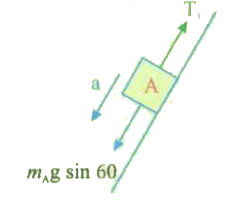 `m_(A)g sin 60-T_(1)=m_(A)a` `T_(1)=m_(A)g sin 60-m_(A)a=m_(A)(g sin 60-a)` `T_(1)=(1)(10xx(sqrt3)/(2)-4.1)=4.56N` For the tension in the string between B and C FBD of body C 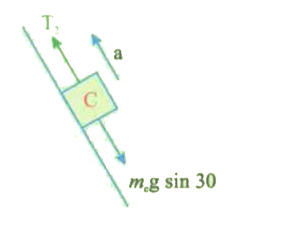 `T_(2)=m_(C)g sin 30^(@)=m_(C)a, T_(2)=m_(C)(g sin theta 30^(@)+a)` `T_(2)=2(10((1)/(2))+4.1)=18.2N` |
|
| 25. |
A person walking at 4 m/s finds rain drops falling slant wise in to his face with a speed of 4m/s at an angle of 30^(0) with the vertical the actual speed of the rain drops is |
| Answer» Answer :A | |
| 26. |
A solid body rotates about a stationary axis so that its angular velocity depends on the rotational angle phi as omega = omega_0 - k phiwhere omega_(0)and k are positive constants. At the moment t = 0, phi = 0, the time dependence of rotation angle is |
|
Answer» `K omega_(0) e^(-kt)` `therefore (d phi)/(DT) = omega_(0) - k phi` or `int_(0)^(phi) = (d phi)/(omega_(0) - k phi) = int_(0)^(t) dt` or `- (1)/(k) [ ln (omega_(0) - k phi)]_(0)^(phi) = t ` or ln `((omega_(0) - k phi)/(omega_(0))) = - kt ` `therefore phi = (omega_(0))/(k) ( I - e^(-kt))` |
|
| 27. |
A particle is at rest at x=a. A force vecF=(b)/(x^(2))veci begins to act on the particle. The particle starts its motion, towards the origin, along X - axis. Find the velocity of the particle, when it reaches a distance x from the origin. |
|
Answer» SOLUTION :`F=-(b)/(X^(2)) RARR (d)/(dt)(p) =-(b)/(x^(2))` `(d)/(dt)(MV)=-(b)/(x^(2)) rArr m(dv)/(dx)(dx)/(dt)=-(b)/(x^(2))` `mvdv=-(b)/(x^(2))dx rArr vdv=-(b)/(mx^(2))dx` `int_(0)^(v)vdv=int_(a)^(x)-(b)/(mx^(2))dx rArr (v^(2))/(2)=(b)/(m)[(1)/(x)]_(a)^(x)` `(v^(2))/(2)=(b)/(m)[(1)/(x)-(1)/(a)]""therefore v=sqrt((2b)/(m)((a-x)/(xa)))` |
|
| 28. |
Two liquidsof thermalcapacitance C_(1) and C_(2)are connected by a metallic rod of length l , unifrom cross sectionalarea A and thermal conductivityK. The entire system is thermally insulated , to check any heat loss to the surrouding . Initially the temperaturedifference betweenthe twobodies as a function of time t. |
|
Answer» Solution :In timerelated processes , one of the variables in usually time t . The other variable here is the temperaturedifference `theta ` betweenthe two BODIES . Letus firstof all establish a relation ( in the form of differentialequation) betweenthesetwo variables. Forthis , let us consider the process takingplaceduringa small time interval DT . IfdQ be the amountof heatlost from one BODYTO the pther (i.e., heat FLOW through the rod) , then `dQ = (KA theta dt)/(L).........(i)` (Here `theta` is takenpositive). Now, if T and `T^(1)`be theinstantaneous temperatures of the hotand cold bodyat time t. then `T - T^(1) = theta........(ii)` Moreover , as a result of theheat flowdQ, we have `dQ, = C_(1) (-dT) and dQ = C_(2) (dT^(1))` wheredT and `dT^(1)` are therespectivetemperaturechanges occurringin the hot and cold body . `therefore "" - dT + dT^(1) = dQ ((1)/(C_(1)) + (1)/(C_(2))) rArr - d(T-T^(1)) = dQ((1)/(C_(1)) + (1)/(C_(2))).........(iii)` Differentaining Eq.(ii) with respect to time t , we get`(d(T - T^(1)))/(dt) = (d theta)/(dt) rArr d(T - T^(1)) = d theta` Therefore , Eq.(iii) canbe rewritten as ` - d theta = dQ ((C_(1) + C_(2))/(C_(1)C_(2))) = (KA theta)/(l) dt ((C_(1) + C_(2))/(C_(1)C_(2)))` i..e,`int_(theta_(0))^(theta) - (d theta)/(theta) int (KA)/(l) ((C_(1) + C_(2))/(C_(1)C_(2))) dt rArr [ - In theta ]_(theta_(0))^(theta) = (KA)/(l) ((C_(1) + C_(2))/(C_(1)C_(2))) [t]_(0)^(t)` (or) `In((theta)/(theta_(0))) = (-KA)/(l) ((C_(1) + C_(2))/(C_(1)C_(2)))t ` Adopting `(KA)/(l)((C_(1) + C_(2))/(C_(1)C_(2))) = mu` we haveIn `((theta)/(theta_(0))) = mu t "" or "" theta = theta_(0e^(-mut))` |
|
| 29. |
A spol is lying on a rough horizontal surface. Forces F_(1),F_(2),F_(3) and F_(4) act in different directions, as represented in column I. Match the information in column I with II. |
|
Answer» |
|
| 30. |
Choose the correct pair : {:((a), "Energy of satetllite",-,"Positive"),((b), "Gravitational field",-,"Positive"),((c), "Escape speed",-,"Positive"),((d), "Gravitational of force",-,"Positive"):} |
|
Answer» |
|
| 31. |
An initially stationary device lying on a frictionless floor explodes into two pieces and slides across the floor. One piece is moving in positive x-direction then other piece is moving in |
|
Answer» <P>positive y- direction `p_(i)=p_(F)` and initial momentum, `p_(i)=mu=m(0)=0` `therefore p_(f)` should also be zero. Hence, other piece will MOVE in negative x-direction. |
|
| 32. |
The …... plays the same role in rotational motion as mass plays in lineat motion. |
|
Answer» |
|
| 33. |
A 20 kg body is pushed with a force of 7N for 1.5 sec then with a force of 5N for 1.7 sec and finally with a force of 10N for 3 sec, the total impulse applied to the body and change in velocity will be |
|
Answer» `49Ns,12.5ms^(-1)` |
|
| 34. |
A girl jumps down from a moving bus, along the direction of motion of the bus, tilting slightly forward. She falls on (b) patch of glue. |
|
Answer» In case (a) she falls backward and in case (b) she falls forward |
|
| 35. |
A girl jumps down from a moving bus, along the direction of motion of the bus, tilting slightly forward. She falls on (a) sheet of ice |
|
Answer» In CASE (a) she falls backward and in case (b) she falls forward |
|
| 36. |
If the internal energy of an ideal gas U and volume V are doubled, then the pressure of the gas : |
| Answer» Solution :remains same | |
| 37. |
The branch of Physics, that was developed to understand and improve the working of heat engines is……… |
|
Answer» |
|
| 38. |
The acceleration due to gravity on moon is only one sixth that on earth. Ratio of moon radius (R_(m)) to earth's radius (R_(e)) should be : (a) (6)/(1) if both are assumed to have same density (b) (1)/(6) if both are assumed to have same density (c) (5)/(18) if (rho_(e))/(rho_(m)) is given as 5/3 (d) 9/6 if (rho_(m))/(rho_(e)) is given as 3/5 |
|
Answer» only a & B are TRUE |
|
| 39. |
An aircraft executes a horizontal loop at a speed of 720 km/h with its wings banked at 15^(@). What is the radius of the loop |
|
Answer» Solution :Speedof aircraft`v= 720 km^(-1)` `=(720 xx 1000)/(3600)` `=200 MS^(-1)` Gravitationalaccelerationg= 9.8 `ms^(-2)` Whenit takesturn. TAN `theta= (v^(2))/(rg )` `r = (v^(2))/(g tantheta )` `= ((200)^(2))/(9.8 xx tan 15^(@)) = (4000)/(9.8 xx 0.2679)` ` r =15.24km` |
|
| 40. |
The saturated water vapour is enclosed in a cylinder under a piston and occupies a volume of 5 litres at 100^(@)C. Find the mass oif th water formed after the volume under the piston is decreased to 1.6 litres at the same temperature. |
|
Answer» |
|
| 41. |
If a liquid wets a solid surface, the angle of contact is …………. . |
|
Answer» `0^@` |
|
| 42. |
What is the heat capacity of copper of 40 g and specific heat "0.3 erg g"^(-1)(""^(@)C)^(-1) ? |
|
Answer» SOLUTION :HEAT CAPACITY `s=Sxxm` `=0.3xx40` `=12G(""^(@)C)^(-1)` |
|
| 43. |
Two moles of a gas is expanded to double itsvolume by two different processes. One is isobaric and the other is isothermal. If w_(1)and w_(2)are the works done respectively, then |
|
Answer» `w_(2)=(w_(1))/(ln_(2))` |
|
| 44. |
The moment of inertia of a body about a given axis is 2.4 kg–m^(2).To produce a rotational kinetic energy of 750 J, an angular acceleration of 5 rad/s2 must be applied about that axis for |
|
Answer» 6 sec |
|
| 45. |
A space-ship entering the earths atmosphere is likely to catch fire, this is due to |
|
Answer» surface TENSION of air |
|
| 46. |
A block of mass M slides aong the sides of bowl as shown in the figure. The walls of the bowl are frictionless and the base has coefficient of friction 0.1, and length 0.5m. The block is released from the point A which is 0.2 m high as shown in figure. Then the block comes to rest |
Answer» Solution : From law of CONSERVATION of energy mgh `= (1)/(2)mv^(2)` `therefore v^(2)=2(0.2)g=0.4g` `therefore (1)/(2)m(0.4)g=0.1 (m)(g) (0.5)+mgh_(1)` `therefore h_(1)=0.15 m` Similarly when it reaches to P again it rises to 0.1 m. And then comes to Q and rises to 0.5 mandthen FINALLY comes to rest at P. |
|
| 47. |
A lead ball of specific heat 125 J Kg^(-1) ""^@C^(-1) at 20^@C is dropped from a height of 2 km. It is heated to air resistance and it is assumed that all of its kinetic energy is used increasing the temperature of ball. Final temperature of the ball in ""^@C is _______ times initial temperature of ball in ""^@C , |
|
Answer» |
|
| 48. |
When do the real gases obey more correctly the gas equation : PV=nRT? |
| Answer» Solution :An ideal gas is one whose molecules have zero volume and no MUTUAL force between them. At low pressure, the volume of a gas is large and so the volume OCCUPIED by the molecules is negligible in comparison to the volume of the gas. At high TEMPERATURE, the molcules have large velocities and so the intermolecular force has no influence on their motion. Hence at low pressure and high temperature, the BEHAVIOUR of REAL gases approach the ideal gas behaviour. | |
| 49. |
A pump motor is used to deliver water at constant rate from a given pipe. To obtain n times water from pipe |
|
Answer» VELOCITY should INCREASE by n times |
|