

Saved Bookmarks
This section includes 7 InterviewSolutions, each offering curated multiple-choice questions to sharpen your Current Affairs knowledge and support exam preparation. Choose a topic below to get started.
| 1. |
Weight of a body is maximum at .......... |
| Answer» Solution :Poles of Earth | |
| 2. |
A steel wire of length 1 m, mass 0.1 kg and uniform cross sectional area10^(-6)m^(2) is rigidly fixed at two ends. The temperature of the wire is lowered by 20^(@) C . If transverse waves are now set up by lucking the string at the middle, calculate the frequency of the fundamental tone.Givne, for steel, co-efficient of linear expansion = 1.21 xx 10^(-5_(@))C^(1)and Young's modulus= 2 xx 10 ^(11) N* m^(-2) . |
|
Answer» |
|
| 3. |
Two blocks of masses m and M are connected by means of a metal wire of corss-sectional area A passing over a frictionless fixed pulley as shown in the figure. The system is then released. If M = 2m, then the stress produced in the wire is : |
|
Answer» `(2MG)/(3A)` |
|
| 4. |
The objective lens of a compound microscope produces magnification of 10. In order to get an over all magnification of 100 when image is formed at 25cm from the eye, the focal length of the eye should be |
|
Answer» 4 |
|
| 5. |
Distance Z travelled by a particle is defined byZ=alpha +betat + gammat^(2). Dimensions of gamma are |
|
Answer» `[LT^(-1)` |
|
| 6. |
(A) : Smaller drops of liquid resist deforming forces better than the larger drops. (R ) : Excess pressure inside a drop is directly proportional to its surface area. |
|
Answer» Both (A) and (R ) are true and (R ) is the CORRECT EXPLANATION of (A) |
|
| 7. |
A simple pendulum of length l is suspended to the ceiling of a lift moving upward with an acceleration of (g//6). Find the time period of its oscillation? |
|
Answer» Solution :As lift is moving UPWARDS, time PERIOD is given by `T= 2pisqrt((L)/(g+a))= 2pisqrt((l)/(g+(g)/(6)))= 2pisqrt((6L)/(7g))` |
|
| 8. |
Find the average acceleration in first 20 s. (Hint: Area under a-t fraph is equal to the change in velocity). . |
|
Answer» Solution :LET us first find the CHARGE in VELOCITY Change in velcity is the area under the ACCELERATION=time graph. For first `20 s`, Area `=Delta v (1)/(2) xx10 xx20+10xx20 =300 ms^(-1)` Average acceleration `=(Delta v)/(Delta t) =(300)/(20) =15 ms^(-2)`. |
|
| 9. |
The ratio of intensities of two waves is 16 :9 . If they produce interference , then the ratio of maximum and minimum intensities will be ………….. . |
|
Answer» `4 : 3` `(I_("max"))/(I_("max")) = ((r + 1)/(r-1))^(2) = ((4 + 3)/(4 -3 ))^(2) = (49)/(1)` |
|
| 10. |
The terminal velocity of a copper ball of radius 2.0 mm falling through a tank of oil at 20^@C is 6.5 cm s^-1. Compute the viscosity of the oil at 20^@C. Density of oil is 1.5 times 10^3kg m^-3.density of copper is 8.9 times 10^3 kg m^-3. |
|
Answer» SOLUTION :We have `v_1=6.5 TIMES 10^2 ms^-1,a=2 times 10^3m ` `g=9.8 ms^-2,p=8.9 times 10^3 KG m^-3` `sigma=1.5 times 10^3 kg m^-3`. From EQ. (10.20) `eta=2/9 times ((2 times 10^-3)^2 m^2 times 9.8 ms^-2)/(6.5 times 10^-2 ms^-1) times 7.4 times 10^3 kg m^-3` `=9.9 times 10^-1 kg m^-1 s^-1` |
|
| 11. |
Assertion: The universal gravitational constant is same as acceleration due to gravity . Reason : Gravitational constant and acceleration due to gravity have different dimensionalformulae . |
|
Answer» Both Assertion and Reason are true and Reason is the CORRECT explanation of Assertion |
|
| 12. |
The moment of inertia of a cylinder about its own axis is equal to its mo0ment of inertia about an axis passing throughj its centre and normal to its length. The ratio of length to radius is |
| Answer» Answer :B | |
| 13. |
If the gravitational force between two objects were proportional to 1"/"R (and as 1"/"R^(2)) where R is separation between them, then a particle in particular orbit under such a force would have its orbital speed v proportional to |
| Answer» Answer :B | |
| 14. |
Two satellites A & B move round the earth in the same orbit. The mass of B is twice that of A, then |
|
Answer» speed of A & B are equal |
|
| 15. |
(A) : Steel is more elastic than rubber. (R) : Under given deforming force, steel is deformed less than rubber. |
|
Answer» Both (A) and (R) are TRUE and (R) is the correct EXPLANATION of (A) |
|
| 16. |
The angular momentum of a body changes by 80 kg m^(2)s^(-1) when its angular velocity changes from 20 rad s^(-1) to 40 rad s^(-1). Find the change in its kinetic energy of rotation. |
|
Answer» Solution :Change in aangular momentum of the BODY `L_(2)-L_(1)=I(omega_(2)-omega_(1))` Change in kinetic energy `=(1)/(2)I(omega_(2)^(2)-omega_(1)^(2))` `("change in K.E.")/("change in ANGULAR momentum")=(omega_(2)+omega_(1))/(2)` `therefore`change in K.E. `= 80 ((20+40)/(2))=2400J` |
|
| 17. |
A body falls freely from a height of 125m (g = 10 m//s^2) after 2 sec gravity ceases to act Find the time taken by it to reach the ground? |
|
Answer» Solution :Distance covered in 2s under gravity `s_(1)=1/2 gt^(2)=1/2 (10) (2^(2))=20m` velocity at the end of 2s, V=gt =(10)2=20m/s. Now at this instant gravity ceases to act a velocity by here after becomes constant The remaining distance which is 125-20=105 m is covered by the body with constant velocity of 20 m/s. Time taken to cover 105 m with constant velocity is given by `t_1=S/V RARR t_(1)=(105)/(20)=5.25s` Henee total time taken to reach the ground =2+5.25 =7.25s |
|
| 18. |
The shape of l-T graph of simple pendulum is |
|
Answer» STRAIGHT line |
|
| 19. |
A hoop of mass 500 g and radius 10 cm is placed on a nail. Find the moment of inertia of the hoop when it is rotated about the nail. |
|
Answer» Solution :When the hoop is rotated about the nail, the AXIS of rotation is the tangent perpendicular to its plane. Its MOMENT of INERTIA `I=2MR^(2)=2xx0.5xx(0.1)^(2)=0.01kgm^(2)` |
|
| 20. |
Solar constant and Stefan.s constant have same dimensions in |
|
Answer» Mass |
|
| 21. |
Free-fall : Discuss the motion of an object under free fall. Neglect air resistance. |
|
Answer» Solution :An object released near the surface of the Earth is accelerated downward under the influence of the FORCE of gravity. The magnitude of acceleration due to gravity is represented by g. If air resistance is neglected, the object is said to be in free fall. If the height through which the object falls is small compared to the earth’s radius, g can be taken to be constant, EQUAL to `9.8 ms^(-2)`. Free fall is thus a case of motion with uniform acceleration. We assume that the motion is in y-direction, more correctly in –y-direction because we choose upward direction as positive. Since the acceleration due to gravity is always downward, it is in the negative direction and we have `a=-g=-9.8 ms^(-2)` The object is released from rest at y = 0. Therefore,`upsilon_(0)=0` and the equations of motion become : `{:(UPSILON=0-g t,=-0.8t,ms^(-1)),(y=0-1//2g t^(2),=-4.9t^(2),m),(upsilon^(2)=0-2 gy,=-19.6 y,m^(2)s^(-2)):}` These equations give the velocity and the distance travelled as a function of time and ALSO the VARIATION of velocity with distance. The variation of acceleration, velocity, and distance, with time have been plotted in Fig. 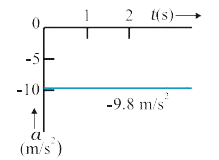 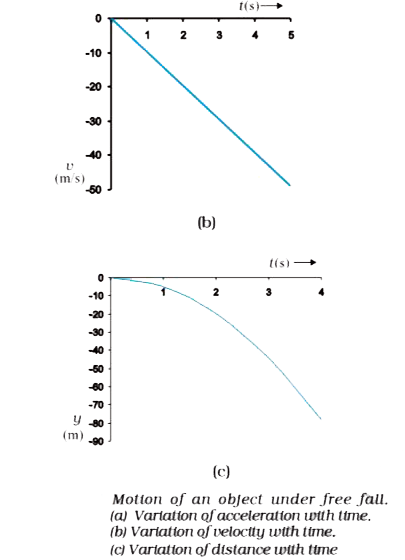
|
|
| 22. |
A steel wire is stretched by 5 kg wt. If the radius of the wire is doubled its Young's modulus |
|
Answer» REMAINS UNCHANGED |
|
| 23. |
The difference in lengths of brass and aluminium rods at all temperatureis 2xx10^(-3)m. If alpha for brass is 18xx10^(-6)" "^(0)C^(-1) and for aluminium is 20xx10^(-6)" "^(0)C^(-1). Calculate their lengths at 0^(0)C? |
|
Answer» |
|
| 24. |
The initial state of a certain gas isP_(i)V_(i), T_(i)) . It undergoes expansion till its volume becomes V_(f)Consider the following two cases. (a) The expansion takes place at constant temperature. (b) The expansion takes place at constant pressure. Plot the P-V diagram for each case. In which of the two cases, is the work done by the gas more ? |
Answer» Solution : The P-V DIAGRAM for each CASE is shown in the figure. In case (i) `P_(i)V_(i)=P_(f)V_(f)` : therefore process is ISOTHERMAL. Work DONE = area under the PV curve so work done is more when the gas expands at constant PRESSURE. |
|
| 25. |
A pan filled with hot food cools from 94^(@) C " to " 86^(@) C in 2 minutes when the room temperature is at 20^(@) C . How long will it take to cool from 71^(@) C " to " 69^(@) C ? |
|
Answer» SOLUTION :The average TEMPERATURE of `94^(@) C` and `86^(@) C " is " 90^(@) C`. Which is `70^(@) C` above the room temperature . Under these conditions the pan cools `8^(@) C` in 2 minutes. Using Eq. (11.21), we have ` "Change in temperature "/"Time" = K Delta T` ` (8 ^(@) C)/(2 min) = K (70^(@) C)` The average of `69^(@) C" and " 71^(@) C " is " 70^(@) C`, which is `50^(@) C` above room temperature . K is the same for this situation as for the original. `(2^(@) C)/ ("Time") = K (50^(@) C)` When we divide above TWO EQUATIONS , we have `(8^(@) C//2 "min")/(2^(@) C//"time") = (K(70^(@) C))/(K(50^(@) C))` Time ` = 0.7` min ` = 42 s` |
|
| 26. |
Assume theplanetary orbits to be circular and T be the time period of revolution of the earth around the sun of mass M. If the Jupiter.s period of revolution around the sun is K times that of the earth, the velocity of jupiter in heliocentric reference frame is [(2piGM)/(TK^(1//2))]^((1)/(4)). The product of x and y is |
|
Answer» |
|
| 27. |
A circular disc A of radius r is made from an iron plate of thickness t and another circular disc B of radius 4r is made from an iron plate of thickness t//4. The relation between the moments of inertia I_(A) and I_(B) is |
|
Answer» `I_(A) gt I_(B)` |
|
| 28. |
A sphere is dropped into a viscous liquid of viscosity eta from some height if the density of material and liquid are rho and sigma respectively (rhogtsigma) then which of the following is/are incorrect. (a). The acceleration of the sphere just after entering the liquid is g((rho-sigma)/(rho)) (b). Time taken to attain terminal speed tproprho^(0) (d). At terminal speed, the net force acting on the sphere is zero. |
|
Answer» |
|
| 29. |
Ratio of densities of materials of two circular discs of same mass and thickness is 5 : 6. The ratio of their M.I about natural axes is |
|
Answer» `5:6` |
|
| 30. |
A projectile is fired horizontally with a velocity u making an angle theta. Derive the expression for time of the flight . |
|
Answer» SOLUTION :Time of flight is the total taken by the projectile from the point of projection till it hits the horizontal plane. This time of flight is given by the time taken by the projectile to GO from point O to B via point A in the FIGURE .Here initial velocity is resolved into components as follows . We know that `s_(y) = u_(y) t = (1)/(2) a_(y) t^(2)` Here, `s_(y) = y = 0`(net displacement in y-direction is zero), `u_(y) = u sin theta, a_(y) = - g, t = T_(F)` Then`0 = u sin theta T_(f) -(1)/(2) g T_(f)^(2)` `T_(f) = 2U (sin theta)/(g)` 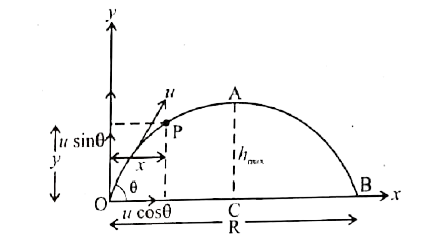
|
|
| 31. |
A swimmer is capable of swimming 1.65 ms^(-1) in still watre. If she swims directly across a 180 m wide river whose current is 0.85 m/s, how far downstream (from a point opposite her starting point) will she reach ? |
|
Answer» 92.7 m |
|
| 32. |
Derive the kinematic equations of motion for constant acceleration. |
|
Answer» Solution :Consider an object moving in a straight line with uniform or constant acceleration `alpha`. Let u be the velocity of the object at time t = 0, and v be velocity of the body at a later time t. Velocity - time relation: (i) he acceleration of the body at any instant is given by the first derivative of the velocity with respect to time, `a=(dv)/(dt)ordv=adt` INTEGRATING both sides with the condition that as time changes from 0 to 1, the velocity changes from u to v. For the constant acceleration, `int_(u)^(v)dv=int_(0)^(t)adtimplies[v]_(u)^(v)=a[t]_(0)^(t)` `v-u=at(or)v=u+at` Displacement - time relation (ii) The velocity of the body is given by the first drivative of the displacement with respect to time. `v=(ds)/(dt)ORDS=vdt` and since v=u+at, We GET ds =(u+at)dt Assume that initially at time 1 = 0, the particle started from the origin. At a later time i, the particle displacement is s. Further assuming that acceleration is time-independent, we have `int_(0)^(t)ds=int_(0)^(t)udt+int_(0)^(t)atdtors=ut+(1)/(2)at^(2)""......(2)` Velocity - displacement relation (iii) The acceleration is given by the first derivative of velocity with respect to time. `a=(dv)/(dt)=(dv)/(ds)(ds)/(dt)=(dv)/(ds)v` [since ds//dt=v] where s is displacement traversed. This is rewritten as `a=(1)/(2)(d)/(ds)(v^(2))ords=(1)/(2a)d(v^(2))` Integrating the above equation, using the fact when the velocity changes from u to v, displacement changes from 0 to s, we get `int_(0)^(t)ds=(v_(1))/(""^(=)2a)d(v^(2))` `:.s=(1)/(2a)(v^(2)-u^(2))` `:.v^(2)=u^(2)+2as""....(3)` We can also derive the displacement s in terms of initial velocity u and final velocity v. From equation we can write, at=v-u SUBSTITUTE this in equation, we get `s=ut+(1)/(2)(v-u)t` `s=((u+v)t)/(2)"".......(4)` The equations are called kinematic equations of motion. |
|
| 33. |
A venturimeter has a threat of diameter 0-06 m. The diameter of the horizontal pipeline where the venturimeter is inserted is 0-1 m. The pressure difference between the mainline and the throat is 0-32 of water. Calculate the rate of now of water in the pipeline. ? |
|
Answer» Solution :Rate of flow of water ` Q = a_1a_2sqrt((2(P_1+P_2))/(RHO ( a_1^(2) - a_2^(2))))` ` P_1- P_2 = HRHO g "" ` where` h= 0.32 m of " water ", rho = 10 ^(3) kg//m^(3)` `a_1 = PI r_1^(2), ""r_1 = 0.05m "" a_1 =0.0025 pi m^(2)` ` a_2 = pi r_2^(2),"" r_2=0.03 m , "" a_2= 0.0009 pi m^(2)` ` "" Q= 0.0025 pi xx 0. 0009 pisqrt((2xx 0.32 xx 10 ^(3) xx 9.8)/(10^(3) xx pi (0.0025^(2) - 0.0009^(2))))` ` = 0.00762 m^(3)//s` |
|
| 34. |
If two bodies of masses 3gm and 5gm are moving with linear momenta in the ratio 2: 3, the ratio of their kinetic energies is |
| Answer» Answer :D | |
| 35. |
A rocket is moving with constant acceleration omega . Assume external forces on it to be zero . Exhaust gases escape with velocity u relative to the rocket . Find how its mass changes with time if its initial mass is m_(0). |
|
Answer» Solution :`F=d/(dt) (-Mu)--U(DM)/(dt)` (since u is constant) `:. Momega =-u(dM)/(dt)` ( where `omega` is its acceleration ) `(dM)/M =(-domega)/u` Integrating `log M =-omega/ut+C` when `t=0, M=M_(0)` so `C=log M_(0), log M=-omega/ut+log M_(0) :. log M/M_(0)= - omega/ut` `M/M_(0)=E^(-omega/ut) "or" M= M_(0)e^(-omega/ut)` THUS , the MASS of the rocket changes exponentially |
|
| 36. |
A bob attached to the string oscillates back and forth resolve the forces acting on the bob in to compentswhat is theacceleration experience by the bob at an angle theta |
Answer» SOLUTION : (i)Heretangentialforce(REF. Diagram ) F =mg sin `theta` ma = mg` sin theta` `:., a =G sin theta` (II)CENTRIPETALFORCE `F= T-mg sin theta` `ma = T - mgsin theta` `:. , a = (T -mgsin theta )/(m )` |
|
| 37. |
An open pipe makes a good musical instrument, in comparison to a closed pipe. Why? |
| Answer» Solution :Because, in OPEN organ pipe, all HARMONICS are PRESENT. | |
| 38. |
The acceleration due to gravity on the surface of the moon is 1.7ms^(-2). What is the time period of a simple pedulum on the surface of moon it its time period on the surface earth is 3.5s? (g on the surface earth 9.8ms^(-2)) |
|
Answer» SOLUTION :Here `g_(m)=1.7ms^(-2),g_(e)=9.8ms^(_2),T_(e)=3.5s^(-1)` As `T_(e)=2pisqrt(L/(g_(e)))"and" T_(m)=2pisqrt(l/(g_(m)))` `:.(T_(m))/(T_(e))=SQRT((g_(e))/(g_(m)))"or" T_(m)=T_(e)sqrt((g_(e))/(g_(m)))=3.5sqrt(9.8/1.7)=8.4s` |
|
| 39. |
The number of significant figures in an area 2.64 xx 10^(24)m^(2) is |
|
Answer» 1 |
|
| 40. |
A gas undergoes a process in which is pressure P and volume V are related as VP^n= constant, the bulk modulus of the gas in this process is : |
|
Answer» NP |
|
| 41. |
When 1g of the water at 100^(@)C is converted into stream at 100^(@)C,. it occupiesa volume of 1671 cc at normal atomospheric pressure. Find the increase in internal energy of the molecules of steam. |
|
Answer» SOLUTION :1 atomosphere `=1.013 xx 10^(5)Nm^(-2)`, volume of 1 GM of water, `V_(1) = 1 cc = 10^(-6) m^(3)`, Volume of steam `=1671 cc = 1671 xx 10^(-6)m^(3)` Externalwork DONE `dW = P(V_(2)-V_(1))` `=1.013 xx 10^(5) (1671 xx10^(-6) - 1xx10^(-6))` `=1.013 xx 167 =169.2 J`. Specific latent hat of vaporisation of steam = 540 cal/g. So, heat supplied to convert 1g of water into steam, `DeltaQ=540 xx 4.2J=2268J` By firstlaw of thermodynamics `DeltaU= DeltaQ -DeltaW = 2268 - 169.2 = 2098.8J` |
|
| 42. |
If tension in a wire is made four times, then what will be the change in speed of wave propagationg in it ? |
|
Answer» Solution :Wave speed in the wire is `v= sqrt ((T)/(mu))` `THEREFORE v prop sqrtT implies (v _(1))/(v _(2)) = sqrt ((T _(1))/(T _(2)))` `therefore (v _(1))/(v _(2)) = sqrt ((T _(1))/( 4 T _(1)) implies v _(2) = 2v _(1)` `therefore ` Wave speed will become DOUBLED. |
|
| 43. |
In the above problem if body is thrown down with velocity 'u' the equation for the descent time is |
|
Answer» `h=(1)/(2)G t^(2)` |
|
| 44. |
State any threephysical quantities having same dimensions and their dimension. |
|
Answer» Solution :WORK, energy and torque have the same DIMENSIONS. Dimensions are `[ML^(2)T^(-2)]` |
|
| 45. |
A circular disc is to be made by using iron and aluminium so that it acquires maximum moment of inertia about geometrical axis. It is possible with |
|
Answer» ALUMINIUM at interior and iron surround to it |
|
| 46. |
A simple pendulum of length L swings in a vertical plane. The tension of the string when it makes an angle theta with the vertical and the bob of mass m moves with a speed v is (g is the gravitational acceleration) |
|
Answer» `mv^(2)//L`  At point P, the resultant of the tension in the string (T) and the COMPONENT of weight `(mgcostheta)` provide the necessary CENTRIPETAL force for the CIRCULAR motion of the bob. i.e., `T-mgcostheta=(mv^(2))/Lor,T=mgcostheta+(mv^(2))/L` |
|
| 47. |
Is it possible that physical quantity has dimension but do not have mole? |
| Answer» SOLUTION :This is not POSSIBLE. | |
| 48. |
Establish the relation angle of friction and angle of repose. |
|
Answer» Solution :In Fig. `oversettoF`= limiting friction, `oversettoN`= normal reaction, `oversettoR`= RESULTANT of `oversettoF` and `oversettoN`. The ANGLE `lambda`, between `oversettoR` and `oversettoN` is called the angle of friction. `:.tanlambda=(F)/(N)=mu`= coefficient of friction In Fig when a BODY just starts to move downward due to its own weight along an inclined plane, the angle of INCLINATION of the plane at that moment is called the angle of repose. Now, coefficient of friction, `mu= (F)/(N)=(Wsintheta)/(Wcostheta)=TANTHETA` `:. mu= tanlambda= tantheta" ""or",theta=lambda` i.e, angle of friction and angle of repose are equal. 
|
|
| 49. |
Calculate C_(P) for air, given that C_(v) = 0.162calg^(-1)K^(-1) and density of air at S.T.P is 0.001293 g cm^(-3). |
|
Answer» |
|
| 50. |
A rigid body is said to be in translational equilibrium, if it remains at rest or moving with a constant velocity in a particular direction. For this, the net external force or vector sum of all the external forces acting on the body must be zero, i.e., oversetrarr(F) = 0 or overset rarr(F) = sum overset rarr(F_(i)) = 0 If U is potential energy of the body, then F = - (dU)/(dr) = 0 or U = constant (max. or min.) When U = minimum, equilibrium of body is stable, When U tends to increase, equilibrium is unstable, When U remains constant, equilibrium is neutral. Read the above passage and answer the following questions : (i) When can a bosy moving uniformly along a straight line be in equilibrium ? What is this equlilbrium called ? (ii) What is the significance of U = minimum in day to day life ? |
|
Answer» Solution :(i) A body moving UNIFORMLY along a straight line is in equilibrium when VECTOR sum of all the external forces acting on the body is zero. This equilibrium is called dynamic equilibrium. (ii) When `U =` minimum, i.e. potential energy of the body is minimum, the body is in stable equilibrium. In day to day life, stable equilibrium CORRESPONDS to peace of mind and potential energy `(U)` corresponds to your involvement. THUS when your involvement is minimum, you have peace of mind and stability. |
|