

Saved Bookmarks
This section includes 7 InterviewSolutions, each offering curated multiple-choice questions to sharpen your Current Affairs knowledge and support exam preparation. Choose a topic below to get started.
| 1. |
When no extemal torque acts on the body, the net angular momentum of a rotating body |
| Answer» Answer :D | |
| 2. |
A body initially at rest sliding along a frictionaless track from a height h (as shown in the figure) just completes a vertical circle of diameter AB = D.The height h is equal to |
|
Answer» `3/2 D`  As body is at rest INITIALLY, i.e., SPEED = 0 At point A, speed = v, As track is frictionless , so TOTAL mechanical energy will remain constant `:. (T.M.E)_(i) = (T.M.E)_f` `0 mgh = 1/2 mv^2 + 0 " or " h= (v^2)/(2g)` For completing the vertical circle, `v ge sqrt(5 gR)` `:. h = (5 gR)/(2g) = 5/2 R = 5/4 D` |
|
| 3. |
Two men, of masses 60 kg and 80 kg are sitting at the ends of a boat of mass 60 and length 4 m. the boat is stationary. If the men now exchange their position, then: |
|
Answer» |
|
| 4. |
If a person moves from Chennai to Trichy, his weight: |
|
Answer» increases |
|
| 5. |
Give an example of an oscillatory motion which is not simple harmonic. |
| Answer» SOLUTION :Oscillation of a SIMPLE PENDULUM when angular AMPLITUDE `(theta)` is large. | |
| 6. |
The foundations of dimensional analysis were laid down by |
|
Answer» Gallileo |
|
| 7. |
The pressure in a liquid at a given depth below the surface ………….. . |
|
Answer» Solution :In order to understand the increase in pressure with depth below the water surface, consider a water sample of cross sectional area in the form of a cylinder. Let `h_1 and h_2` be the depths from the air-water interface to level 1 and level 2 of the cylinder, respectively. Let `F_1` be the force acting downwards on level 1 and `F_2` be the force acting upwards on level 2, such that `F_1 = P_1 A and F_2 = P_2A`. Let us assume the mass of the sample to be m and under equilibrium condition, the total upwards force `(F_2)` is balanced by the total downward force `(F_1 + MG)`, in other words, the gravitational force will act downward which is being exactly balanced by the difference between the force `F_2 - F_1`. `F_2 - F_1 = mg = F_G"" .....(1)` where m is the mass of the water available in the sample element. Let `rho` be the density of the water then , the mass of water available in the sample element is `m = rho V = rho A (h_2 - h_1)` `V = A(h_2 - h_1)`  Hence, gravitational force, `F_G = rho A(h_2 - h_1)g` On substituting the W value in equation (1) `F_2 = F_1 + mgimplies P_2A = P_1A + rhoA(h_2 - h_1) g` Cencelling out A on both sides, `P_2 = P_1 + rho(h_2 + h_1)g ""....(2)` If we choose the level 1 at the surface of the liquid (i.e., air water interface) and the level 2 at a depth .h. below the surface, then the value of atmospheric pressure (say `P_a`). In addition, the pressure `(P_2)` at a depth becomes P. Substituting these values in equation, we get `P = P_a + rho gh"" .....(3)`  which means, the pressure at a depth h is greater than the pressure on the surface of the liquid, where `P_a` is the atmospheric pressure which is equal to `1.013 xx 10^5 Pa`. If the atmospheric pressure is neglected or ignored then `P = rho gh "".....(4)` for a given liquid, `rho` is fixed and g is also CONSTANT, then pressure due to the fluid column is directly PROPORTIONAL to vertical distance or height of the fluid column. This implies, the height of the fluid column is more important to decides the pressure and not the cross sectional or BASE area or even the shape of the container. Let us consider three vessels of different shapes A, B and C as shown in figure. These vessels are connected at the bottom by a horizontal PIPE. When they are filled with a liquid (say water), it occupies the same level even though the vessels hold different amounts of water. It is true because the liquid at the bottom of each section of the vessel experiences the same pressure. 
|
|
| 8. |
Explain why some oils spread on water, when others float as drops. |
| Answer» Solution :If the surface tension of oil is LESS than that ofwater, then it spreads on WATER. If the surface tension of oil is more than that of water, then it floats as DROPS on water. | |
| 9. |
A: An object moving with a velocity of magnitude 10 m/s is subjected to a uniform acceleration 2 m//s^(2) at right angle to the initial motion. Its velocity after 5 s has a magnitude nearly 14 m/s rarr rarr rarr R: The equation vec(v) = vec(u) + vec(a)t can be applied to obtain vec(v) if vec(a) is constant |
|
Answer» If both A and B are true and R is the correct explanation of A |
|
| 10. |
A source of sound of frequency 512 Hz is moving towards a huge reflector-wll, with a velocity of 10 m/s. Velocity of sound in air = 330 m/s. How many beats per second will be heard by an observer standing between the source and the wall? |
|
Answer» Solution :No BEAT is heard. It is because the FREQUENCY received by the listener directly from the SOURCE and that received on reflection from WALL is same. Frequency does not change by reflection. Each frequency received = `(512xx330)/(330-10)Hz=528Hz` |
|
| 11. |
A solid cube with coefficient of linear expansion alpha floats on a liquid whose coefficient of volume expansion is gamma . when both the solid and the liquid are heated {:("A) the solid sinks more ",(d) gamma lt 3 alpha), ("B) the solid does not sink (or) lift", (e) gamma gt 3 alpha), ("C) the solid lifts up ",(f) gamma = 3 alpha):} |
|
Answer» A-e, B-f C-d |
|
| 12. |
For astreamline flow, if the elevation head is h, then velocity head and pressure head will be |
|
Answer» <P>`1/2v^2and p/RHO` |
|
| 13. |
An aluminium wire of cross-sectional area (10^-6)m^2 is joined to a steel wire of the same cross-sectional area. This compound wire is stretched on a sonometer pulled by a weight of 10kg. The total length of the compound wire between the bridges is 1.5m of which the aluminium wire is 0.6 m and the rest is steel wire. Transverse vibrations are setup in the wire by using an external source of variable frequency. Find the lowest frequency of excitation for which the standing waves are formed such that the joint in the wire is a node. What is the total number of nodes at this frequency? The density of aluminium is 2.6 xx (10^3) kg//m^3 and that of steel is 1.04 xx 10^(4) kg//m^2 (g = 10m//s^2) |
|
Answer» ` f_a = f_s` or`n_a((v_a)/(2l_a)) = n_s ((v_s)/(2l_s))` or `(n_a)/n_s = ((v_s)/(v_a)) ((l_a)/(l_s))` But, `v = (sqrt(T/mu)) = (sqrt(T/(rhos))) prop (1/(sqrtrho))` Therefore,`v_s/v_a = sqrt(rho_a/rho_s)` ` n_a/n_s = sqrt(rho_a)/(rho_s))* (l_a)/(l_s)` Substituting the values, we have ` (n_a)/(n_s) = sqrt(2.6 xx (10^3)/1.04 xx (10^4)) * (0.6)/(0.9) = 1/3 ` i.e. at lowest frequency, one LOOP is formed in aluminium wire and three loops are formed in steel wire as shown in figure. 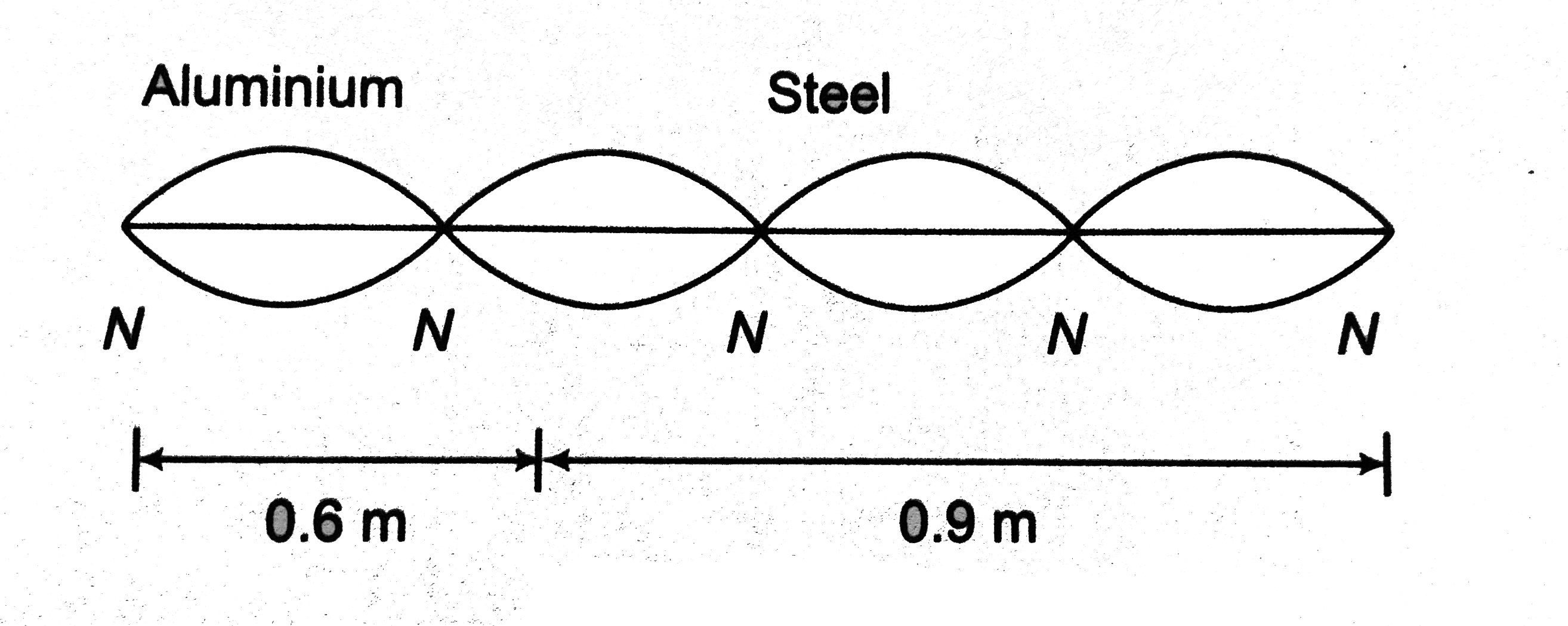 `:. f_(min) = n_a ((v_a)/(2l_a)) = 1/(2l_a) sqrt(T/(rho_aS))` ` = 1/(2 xx 0.6) sqrt ((10 xx 10)/(2.6 xx (10^3) xx (10^-6)))` or `f_(min) = 163.4` Hz. Total number of nodes are FIVE as shown in figure. |
|
| 14. |
The gravitational field due to a mass distribution is given by E = K//x^3 in x-direction. Taking the gravitational potential to be zero at infinity, its value at a distance x. |
|
Answer» `K/(2X^(2))` |
|
| 15. |
The volume and surface area of a cube is numerically equal . The volume of such a cube is |
|
Answer» 1000 unit |
|
| 16. |
The maximum acceleration of the train in which a box lying on its floor will remain stationary, given that the co-efficient of static friction between the box and the train's floor is 0.15 is |
|
Answer» `2.5 MS^(-2)` |
|
| 17. |
A standing wave is maintained in a homogerneous string of cross - sectional areaa and density p . It is formed bt yhe superpostions given of two waves travelling in opposite direations given by the equations |
|
Answer» `(3pi spomega^(2)a^(2))/(2K)` |
|
| 18. |
If a liquid does not wet glass, its angle of contact is |
|
Answer» zero |
|
| 19. |
A particle is placed in a field characterized by avalue of gravitational potential given by V = -kxy, where .k. is a constatn. If vecE_(g) is the gravitational field then |
|
Answer» `vecE_(g)=k(xhati + yhatj)`and is CONSERVATIVE in NATURE |
|
| 20. |
Write the rules for determining significant figures. |
Answer» SOLUTION :RULES for COUNTING SIGNIFICANT FIGURES: 
|
|
| 21. |
A 2m long wire of resistance 4 ohm and diameter 00.64 mm is coated with plastic insulation of thickness 0.06 mm. When a current of 5 ampere flows through the wire, find the temperature difference (in degrees) across the insulation in steady state if K=0.16xx10^(-2)" cal"//"cm"-""^(0)C-"sec". |
|
Answer» |
|
| 22. |
A very flexible chain of mass M and length l is suspended vertically in a lift so that its lower end is just touching the surface of the floor. When the upper end of the chain is released, it falls with each link coming to rest intantaneously find the force exerted by the floor of the lift on the chain at the moment when one fourth of the chain has already landed on the floor Assume the lift is moving with acceleration g//2 |
Answer»  FORCE by the floor `=(MG)/8+Mg` `F=(9Mg)/8` |
|
| 23. |
What will be the velocity of object thrown upwards with 40 ms^(-1) after 2 s? |
|
Answer» 15 |
|
| 24. |
CalculaJe the stress developed inside a tooth cavity filled with copper when hot tea at temperature of 57^(@) C is drunk. You can take body (tooth) temperature to be 37^(@) C and a = 1.7 xx 10^(-5)//^(0)C, bulk modulus for copper = 140 xx 10^(9) N//m^(2). |
|
Answer» SOLUTION :Stress K `xx ` strain = K `(Delta V)/(V ) = K (3 alpha ) Delta t ` ` = 140 xx 10^(9) xx 3 xx 1.7 xx 10^(-5) xx 20` `= 1.428 xx 10^(8) N//m^(2)` This is about `10^(3)` times atmospheric pressure. |
|
| 25. |
A drop of liquid of diameter 2.8 mm split into 125 identical drops .The change in energy is …..(Surface tension T=75dyne/cm) |
|
Answer» zero No. of drops N=125 Change in energy `DeltaU`=(?) Surface energy of larger drop of radius R `U=TA` `thereforeU=T(4piR^(2))` …(1) Surface energy of smaller drop of radius r, `thereforeU.=T(4pir^(2))`...(2) Volume of n small drops = volume of large drop `n((4)/(3)PIR^(3))=(4)/(3)piR^(3)` `thereforenr^(3)=R^(3)` `thereforen^((1)/(3))r=R` `thereforer=(R)/(n^((1)/(3)))` `thereforer^(2)=(R^(2))/(n^((2)/(3)))`... (3) Equation (2) obtain as below, `U.=T((4piR^(2))/(n^((2)/(3))))` `n=125` `thereforen^((2)/(3))=(5^(3))^((2)/(3))=5^(2)=25` `U.=T((4piR)/(25))^(2)`....(4) Change in energy , `DeltaU=U-U`. `DeltaU=4piR^(2)T-(4piR^(2)T)/(25)` `=4piR^(2)T*[1-(1)/(25)]` `=4piR^(2)T((24)/(25))` `DeltaU=4xx3.14xx(2.8xx10^(-1))^(2)(75)((24)/(25))` `=7.89` `DeltaU=71erg` |
|
| 26. |
A tuning fork of frequency 300 Hz resonates with an air-column closed at one end at 27^@C.How many beats will be heard in the vibrations of the fork and the air-column at 0^@C.End-correction is negligible. |
|
Answer» |
|
| 27. |
Is it possible to change the temperature of a body without heating it or taking heat from it? |
| Answer» Solution :YES, For EXAMPLE, during adiabatic compression temperature INCREASES and in adiabatic expension temperature decreases although no heat is GIVEN to or TAKEN from the system. | |
| 28. |
As observed from the earth, the sun appears to move in an approxite circular orbit. For the motion of another planet like mercury as observed from the earth, this would |
|
Answer» be similarly true |
|
| 29. |
The radius of a circle is 21.2 m. Its area according to the rule of significant figures is |
|
Answer» 14.1124 `"m"^(2)` |
|
| 30. |
A thin metal disc of radius ‘r floating on water surface, bends the surface downwards along the perimeter making an angle theta with vertical edge of the disc. If the disc displaces a weight of water W and surface tension of water is T, then the weight of metal disc is |
|
Answer» ` 2 pir T+ W ` |
|
| 31. |
When a big drop of water is formed from n small drops of water, the energy loss is 3E, where, E is the energy of the bigger drop. If the radius of the bigger drop is R and r is the radius of the smaller drop, then number of smaller drops (n) is |
|
Answer» `( 4R)/( R)` |
|
| 32. |
In Lee's disc experiment two discs are separated by gap of thickness 5 mm. The space between the discs contains a gas of thermal conductivity 3.88 xx 10^(-5) "Wm"^(-1) "K"^(-1).At the steady state the temperature, of the two sides of discs are 368K and 333K. If the area of cross-section the slab is 25 "cm"^(2), calculate the quantity of heat crossing the gas per second. |
|
Answer» Solution :`x=5 xx 10^(-3) m, K= 3.88 xx 10^(-5) "Wm"^(-1) "K"^(-1), theta_1 - theta_2 = 368 - 33 = 35 "K"` `A = 25 "cm"^(2) = 25 xx 10^(4) "m"^(2) , t = 1 "Sec". Q= ?` `Q= "KA" ((theta_1 - theta_2) )/( x ) t = ( 3.88 xx 10^(-5) xx 25 xx 10^(-4) xx 35 xx 1)/( 5 xx 10^(-3) )` `= 6.79 xx 10^(-4)` J |
|
| 33. |
A helicopter is ascending vertically with a speed of 8.0 ms^(-1). At a height of 120m above the earth , a package is dropped from a window . How much time does it take for the package to reach the ground ? |
|
Answer» Solution :`u=8 m//s, "HEIGHT" H = 120m RARR s=-120m` `s=ut+1/2at^(2) -120=8t-1/2xx9.8xxt^(2)-8t-120=0` `t=(8+-sqrt(64+4xx4.9xx120))/(2xx4.9)=(8+-sqrt(64+2352))/(9.8)=(8+-sqrt(2416))/(9.8)=(8+-49.15)/(9.8)` `t=(8+-49.15)/(9.8)` , (only positive VALUE )`=5.83 sec` |
|
| 34. |
In an inelastic collision |
|
Answer» the initia kinetic energy is equal to the FINL kineitc energy |
|
| 35. |
Explain angle of contact in the context of intermolecular forces. |
|
Answer» Solution :The surface of liquid near the plane of contactwith another mediumis curved. Angle of contact : The angle between tangent to the surface at the point of contact and solid surface inside the liquid is know as angle of contact .it is DENOTED by `theta`. It is different in interfaces of differernt pairs of liquids and solids. In figure (a) and (b) water forms and droplets on lotous LEAF is shownin (a) which spreads over a clean plastic plate a shown in (b)  In figures the surface tension of liquid air intefaces `=S_(la)` The surface tension of solid air interfaces `=S_(sa)` The surface tension of solid -liquid interfaces `-S_(sl)` At the line of contact , the surface forces between the three media must be in equilibrium. In figure (a) `S_(sa)+S_(la)cos(180^(@)-theta)=S_(sl)` `thereforeS_(sa)-S_(la)costheta=S_(sl)` `thereforeS_(sl)ltS_(sa)`, means `theta` obtained negative In this situation angle of contact `theta` is an obtuse, because cohesive forces between the molecules of liquid , while weak adhesive force between molecules of liquid and solid. If angle of contact is obtuse liquid does not wet the surface of solid body and the liquid will be depressed in a capillary of small bar and meniscus becomes convex. Illustration : (1) Mercury and any solid surface . (2) Water and wing of duck. (3) Lotus leaf and water. Glass and mercury. (5) Solid surface with wax and oil and water. (6) Raincoat and water. In figure (b) `S_(sl)+S_(la)costheta=S_(sa)` `thereforecostheta=(S_(sa)-S_(sl))/(S_(la))` `thereforeS_(sl)ltS_(sa)`means `theta` is positive. In this situation angle of contact BECOME acute because adhesive force is more predominant than cohesive force is more predominant than cohesive force. If angle of contact is acute ,then liquid wets the solid surface and the liquid rise in vertical capillary and the meniscus is concave. Illustrations : (1) WATERIS SPREAD with glass , plastic or other body . (2) Kerosene is spread over any surface. the angle of contact between the silver capillary and water is `90^(@)` Hence in this capillary is placed vertical in water , water neither rise nor depressed. |
|
| 36. |
Escape speed for object of mass m on surface of Earth is 11.3 km/s, then for object of mass 2m it is 22.4 km/s. |
|
Answer» |
|
| 37. |
The bodies of masses 100 kg and 8100 kg are held at distance of 1 m. The gravitational field at a point on the line joining them is zero. The gravitational potential at that point in J/kg is (G = 6.67 xx 10^(-11) N.m^(2)//kg) |
|
Answer» `-6.67xx10^(-7)` |
|
| 38. |
Should there be any change in the positionof the centre of gravity of a hollow sphere when it is (i) half filled, (ii) completely filled with water? |
|
Answer» Solution :The centre of GRAVITY of an EMPTY hollow sphere is at its centre. (i) When it is HALF filled with water the centre of gravity is LOWERED. (ii) When it is COMPLETELY filled with water the centre of gravity again shifts to the centre. |
|
| 39. |
Energy required to move a body of mass 'm' from orbit of radii 2R to 3R is |
|
Answer» `(GMM)/(2R^2)` |
|
| 40. |
A body projected up reaches a point A in its path at the end of 4th second and reaches the ground after 5 seconds from the start. The height of A above the ground is (g=10m//s^(2)) |
|
Answer» 19.6m |
|
| 41. |
A piece of wood is taken deep inside a long column of water & released it will move up. |
|
Answer» with a CONSTANT UPWARD acceleration |
|
| 42. |
A planet revolves round the sun in an elliptical orbit of minor and major axes x and y respectively . Then the time period of revolution is proportional to |
|
Answer» `(X+y)^(3//2)` |
|
| 43. |
A body takes 1(1)/(3) times as much time to slide down a rough inclined plane as it takes to slide down an identical bust smooth inclined plane. If the angle of inclination is 45^(@), the coefficient of friction is |
|
Answer» `(1)/(16)` |
|
| 44. |
A body of mass 0.5 kg travels in a straight line with velocity v= ax^(3/2)" where "a= 5m^(1/2)s^(-1). What is the work done by the net force during its displacement from x=0 to x= 2m? |
| Answer» SOLUTION :`= 20 J` | |
| 45. |
Three masses in contact is as shown above. If force F is applied to mass m_1 , then the contact force acting on mass m_2is |
|
Answer» `(F)/(m_1 + m_2+m_3)` |
|
| 46. |
Suppose, the acceleration due to gravity at the Earth's surface is 10 m//s^(2) and at the surface of Mars it is 4.0 m//s^(2). A 60 kg passenger goes from the earth to the mars in a spaceship moving with a constant velocity. Neglect all other objects in the sky. Which part of figure best represents the weight (net gravitational force) of the passenger as a function of time. |
|
Answer» A |
|
| 47. |
An inclined track ends in a circular loop of diameter .D.. From what height on the track a particle should be released so that it completes that loop in the vertical plane ? |
| Answer» Answer :C | |
| 48. |
In a previous question pressure will be minimum at point - |
|
Answer» `A` |
|
| 49. |
Consider a common mirage formed by super-heated air just above a roadway.A truck driver is in mediumofmu=1.0003looks forwards .He ooreceives the illustion of a patcj of water ahead on the road where his line of sight makes an angle of 1.20^(@)below the horizontal .Find the index of refraction of the air just above the road surface.(Hint Treat this as a problem in total internal reflection). |
|
Answer» `1.00006` |
|
| 50. |
Match the following columns. |{:(,"Column I",,"Column II"),((A),"Constant positive acceleration",(p),"Speed may increase"),((B),"Constant negative acceleration",(q),"Speed may decrease"),((C ),"Constant displacement",(r ),"Speed is zero"),((D),"Constant slope of a-t graph",(s),"Speed must increase"),(,,(t),"Speed must decrease"):}| |
|
Answer» |
|