

Saved Bookmarks
This section includes 7 InterviewSolutions, each offering curated multiple-choice questions to sharpen your Current Affairs knowledge and support exam preparation. Choose a topic below to get started.
| 1. |
The gravitational field in a region is given by E =10(hati + hatj) N//kg.The work done by an external agent to slowly shift a particle of mass 2kg from the point (0,0) to a point (5m, 4m). |
| Answer» ANSWER :D | |
| 2. |
The ratio of the distance of two planets from the sun is 1:2. The ratio of their periods of revolution is |
|
Answer» `1:4` |
|
| 3. |
Acceleration-displacement graph of a particle executing SHM Is as shown in given figure. The time period of its oscillation is: (in sec) |
| Answer» Answer :B | |
| 4. |
A Small ball of mass m suspended from the ceiling at a point O by a thread of length l moves along a horizontal circle with a constant angular velocity omega. Which of the following statements(s) is/are correct ? |
|
Answer» Angular momentum is constant about O |
|
| 5. |
List of condition on which angular momentum is zero. |
| Answer» SOLUTION :The angular momentum is zeri `(L=0)`, if the LINEAR momentum is ZERO `(p=0)` or if the particle is at the origin `(vecr=0)` or if `vecr` and `VECP` are PARALLEL or antiparalel to each other `(theta=0^(@)` or `180^(@))` | |
| 6. |
A uniform square sheet has a side length of 2R. A circular sheet of maximum possible area is removed from one of the quadrants of the square sheet. The distance of centre of mass of the remaining portion from the centre of the original sheet is |
|
Answer» `(PI R)/(SQRT(2)[16-pi])` |
|
| 7. |
A boat of mass M sails with velocity v_(0)hati. At t = 0, its engine stops, and at the same time a ball of mass m(m lt lt M) is thrown form the boat with initial velcoity uhatj. Here x-direction is horizontal any y is vertically up. The water exters a friction drag forve proportional to the boat's velocity (v), so that vecF = kvecvhati, where K is positive constant. The acceleration of the boat can be written as: veca =- (kv)/(M)hati or (dvecv)/(dt) =- (kv)/(M)hati intergrating we get: vecv = (Ce^(-Kt//M))hati where C is a constant emerging due to intergraitng. Now assume that ball is observed form the reference frame of boat (X'Y'). The origin of this reference frame coincided with the static frame (XY) at t = 0. The acceleration of the ball in the reference frame of boat can be written as veca = a_(x)hati +a_(y) hatj and in the static frame it can be written as veca = a_(x) hati +a_(y) hatj. The value of constant C is : |
|
Answer» `v_(0)//2` |
|
| 8. |
What internal pressure can be sustained by a glass tube of trideness and radius r?o is breaking stress of material of glass and there is no external pressure |
|
Answer» |
|
| 9. |
A boat of mass M sails with velocity v_(0)hati. At t = 0, its engine stops, and at the same time a ball of mass m(m lt lt M) is thrown form the boat with initial velcoity uhatj. Here x-direction is horizontal any y is vertically up. The water exters a friction drag forve proportional to the boat's velocity (v), so that vecF = kvecvhati, where K is positive constant. The acceleration of the boat can be written as: veca =- (kv)/(M)hati or (dvecv)/(dt) =- (kv)/(M)hati intergrating we get: vecv = (Ce^(-Kt//M))hati where C is a constant emerging due to intergraitng. Now assume that ball is observed form the reference frame of boat (X'Y'). The origin of this reference frame coincided with the static frame (XY) at t = 0. The acceleration of the ball in the reference frame of boat can be written as veca = a_(x)hati +a_(y) hatj and in the static frame it can be written as veca = a_(x) hati +a_(y) hatj. The acceleration of boat as a function of time is: |
|
Answer» `(Kv_(0))/(M)E^(-(Kt//M))HATI` |
|
| 10. |
A spring block (force constant k=1000 N//m and mass m=4kg) system is suspended from the ceiling of an elevator such that block is initially at rest. The elevator begains to move upwards at t=0. Acceleration tome graphof the elevator is shown in the figure. Draw the displacement X (from its initial position taking upwards as positive) vs time graph of the block with respect to the elevator starting from t=0 to t=1 sec. Take pi^(2)=10. |
|
Answer» |
|
| 11. |
A boat of mass M sails with velocity v_(0)hati. At t = 0, its engine stops, and at the same time a ball of mass m(m lt lt M) is thrown form the boat with initial velcoity uhatj. Here x-direction is horizontal any y is vertically up. The water exters a friction drag forve proportional to the boat's velocity (v), so that vecF = kvecvhati, where K is positive constant. The acceleration of the boat can be written as: veca =- (kv)/(M)hati or (dvecv)/(dt) =- (kv)/(M)hati intergrating we get: vecv = (Ce^(-Kt//M))hati where C is a constant emerging due to intergraitng. Now assume that ball is observed form the reference frame of boat (X'Y'). The origin of this reference frame coincided with the static frame (XY) at t = 0. The acceleration of the ball in the reference frame of boat can be written as veca = a_(x)hati +a_(y) hatj and in the static frame it can be written as veca = a_(x) hati +a_(y) hatj. Values of a_(x) and a_(x), respectively are: |
|
Answer» `a_(X) = 0, a_(x) = (Kv_(0))/(M) E^(-(Kt//M))` |
|
| 12. |
A particle is fastened at the end of a string adis whirled in a verticle circle with the other end of het string being fixed. The motion of the particle is |
|
Answer» periodic |
|
| 13. |
The high domes of ancient buildings have structural value. It arises from pressure difference on the two faces dur to curvature (as in soap bubbles). There is a dome of radius 5m and uniform thickness. The surface tension of its masonry structure is about 500 Nm^(-1). Treated as hemispherical, calculate the maximum load the done can support. |
|
Answer» Solution :Given `R=5m, T=500Nm^(-1) "Excess pressure P"=(2T)/(R)` but `P=F/A =(2T)/(R)""i.e, F=2 T/R A=(2 XX T xx 2piR^(2))/(R)` `F=4piRT=4 xx 3.142 xx 5 xx 500N` F=31420 N i.e, `F=(31420)/(g)=(31420)/(10)""F=3142kgwt."` |
|
| 14. |
If the diameter of the earth becomes twice but its mass remains unchanged, then how would be the weight of an object on the surface of the earth affected? |
|
Answer» Solution :W = mg = `GMm/(2R)^2` = 1/4 W i.e., weight will become one-fourth of the PRESENT VALUE. |
|
| 15. |
Give velocity and acceleration at any point for an moving object whose x to t graph is straight line. |
| Answer» SOLUTION :VELOCITY is CONSTANT and ACCELERATION is ZERO. | |
| 16. |
vec(F)=ahat(i)+3hat(j)+6hat(k) and vec(R)=2hat(i)-6hat(j)-12hat(k). The value of 'a' for which angular momentum is conserved is |
|
Answer» `-1` |
|
| 17. |
A cup of hot tea on a metal table in a room loses heat by |
|
Answer» Conduction |
|
| 18. |
The displacement of it particle varies according to the relation x = 3 sin 100 t + 8 cos^2 50t .Which of the following is/are correct about this motion. |
|
Answer» The motion of the particle is not SHM |
|
| 19. |
A boy and a man carry a uniform pole of length 8m and of mass 60kg by supporting it on their shoulders. They are located at the ends of the pole. Where should a load of 90kg be suspended from boy's end so that boy carries only one-third of the total load ? |
Answer» Solution :The mass of pole ACTS from its CENTRE .C.. LET the load be placed at a distance .x. from the boy.s end.  If `N_(1)`, `N_(2)` are the normal reactions on man and boy respectively then `N_(1)=(2)/(3)(60+90)g=100gN` `N_(2)=(1)/(3)(60+90)g=50gN` Taking TURNING effects about boy.s end .B., we have. `N_(1)xx8-60gxx4-90gxx x=0` or `100gxx8-60gxx4-90g XX x=0` on solving `x=6.22m` |
|
| 20. |
A swimmer moves across the Cauvery river of 750 m wide. The velocity of the swimmer relative to water (vecv_(SW)) is 1.5ms^(-1) and directed perpendicular to the water current. The velocity of water relative to the bank (vecv_(wb)) is 1ms^(-1). Calculate the velocity of the swimmer with respect to the bank of the river (vecv_(sb)). (b) time taken by the swimmer to cross the Cauvery river. |
Answer» Solution :We can draw the following picture from the given data in the problem.  The velocity of the SWIMMER relative to the BANK `vecv_(sb)=vecv_(sw)+vecv_(wb)` Since the swimmer travels in the perpendicular direction against the water CURRENT The magnitude is given by `vecv_(sb)=SQRT(v_(sw)^(2)+v_(wb)^(2))` `sqrt(1.5^(2)+1^(2))=sqrt(3.25)ms^(-1)~=1.802ms^(-1)` The direction of the swimmer relative to the bank is given by `tantheta=(v_(sw))/(v_(wd))=(1.5)/(1)=1.5` `theta=tan^(-1)(1.5)~~56^(@)`. (b) The time taken by the swimmer to cross the river is equal to the total distance by the swimmer with velocity `1.802ms^(-1)` The total distance covered by him, `d=("width of the river")/(sin56^(@))=(750)/(0.829)=904.7m` The time taken by the swimmer, `T=(d)/(v_(ab))=(904.7)/(1.802)=502s` |
|
| 21. |
One end of a metal rod is dipped in boiling water and the other is dipped in melting ice. |
|
Answer» All PARTS of the rod are in thermal equilibrium with each other |
|
| 22. |
Density of a liquid at 0^(@)C is 13.6 gm/c.c., and its coefficient of real expansion is 18xx10^(-5)//""^(@)C. If the temperature is increased to 200^(@)C, percentage change in its density is |
|
Answer» `0.36%` |
|
| 23. |
Give the magnitude and direction of the net force acting on (a) a drop of rain falling down with a constant speed (b)a cork of mass 10 g floating on water(c) a kite skillfully held stationary in the sky (d) a car moving with a constant velocity of 30 km//hon a rough road (e) a high-speed electron in space far from all material objects and free of electric and magnetic fields. |
|
Answer» Solution :(a) As the rain drop is FALLING with a CONSTANT speed, its accelerationa=0. Hence net force F=ma =0. (b)As the CORK is floating on water , its weight is being balanced by the UPTHRUST (equal to weight of water displaced ). Hence net force on the cork is zero . (c)As the kite is held stationary , net force on the kiteis zero , in accordance with Newton.s first law. (d) Force is being applied to overcome the force of friction . But as velocty of the car is constant , its acceleration . a=0. Hence net force on the car F=ma=0. (e) As no field (graveitational //electric//magnetic ) is acting on the ELECTRON , net force on it is zero. |
|
| 24. |
A uniform sphere of mass m and radius R is placed on a rough horizontal surface. The sphere is struck horizontally at a heighth from the floor. Match the following: |
|
Answer» Solution : The SPHERE will roll without slipping if `omega=(v)/(R)` Moment of inertia about DIAMETER is `I=(2)/(5)MR^(2)` ANGULAR momentum of the sphere about C.M. is given by `Mv(h-R)=I omega` `=(2)/(5) MR^(2)*(v)/(R)` or `mv(h-R)=(2)/(4) MvR` 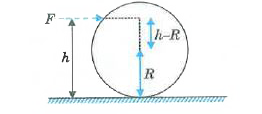 or `h=(7)/(7)R` So, if force is applied at `h = (7)/(5)R` sphere will roll without slipping Torque DUE to sphere about `CM tau=F(h-R)`. sphere will have only translational motion if `t= 0 or h = R`. Sphere will spin clockwise if torque is positive and will spin anticlockwise if torque is negative. So `(a) to (III), (b) to (iv), (c) to (ii), (d) to (i)`. |
|
| 25. |
Two bodies A,B of masses 5 kg and 10 kg in contact with each other rest on a table against a rigid wall. The coefficient of friction between the bodies and the table is 0.15. A force of 200 N is applied horizontally to A. (i) What is the reaction of the partition? (ii) The actionreaction forces between A,B? (iii) What happens when the wall is removed ? Does the answer to (ii) change when bodies are in motion ? [ Ignore the difference between mu_(s) and mu_(k)] |
|
Answer» SOLUTION :We take the round off value g = 10 `"m.s"^(-2)`. Normal reaction on A, `N_(A) `=its weight (mg) `= 5xx10` = 50 N Normal reaction on B, `N_(B)=10xx10`=100 N So the limiting friction on A, `f_(A)= mu N_(A)= 0.5xx50=7.5 N` and limiting friction on B, `f_(B) = muN_(B)=0.15xx100=15` N [ As the applied force , 200 N, is higher the force of friction attains its limiting value ] (i) We take the combination of A and B as a single body. It is at REST due to the PRESENCE of the wall. If R be the reaction of the wall, the force equation in the horizontal direction is, `200-f_(A)-f_(B)-R=0` or, R = 200 -7.5 -15 = 177.5 N (ii) Let `F_(AB)` = action force of A on B, `F_(BA)` = reaction force of B on A, `F_(AB)` and `F_(BA)` are equal and opposite. From the equilibrium of A, we get 200-`f_(A) -F_(BA)`=0 or, `F_(BA)` = 200 -7.5=192.5 N So, `F_(AB)=- 192.5 N` (iii) Now if the wall is removed, the reaction force R is absent due to the applied force the combination of A and B would MOVE forward with an acceleration a (say). Then the force equation in the horizontal direction would be, `200-f_(A)-f_(B)= (m_(A)+m_(B))a` or, `a = (200-7.5-15)/(5+10)= (177.5)/(15)=11.83 "m.s"^(-2)` Now, the force equation for the body A is, `200-f_(A)-F_(BA)=m_(A)a` `[ F_(BA)= ` new value of force by B on A] or, `F_(BA)=200-7.5-5xx11.83=133.3` N Similarly, `F_(AB)` =-133.3 N So due to the accelerated motion the action-reaction pair changes to a much reduced value. 
|
|
| 26. |
A particle moves in a straight line obeying the v-t graph as shown in the figure. The average velocity of the particle over the time T is : |
|
Answer» zero |
|
| 27. |
A particle is projected with velocity2sqrt(gh)so that it just clears two walls of equal height h which are a distance 2 h from each other. The time interval for which the particle travels between this two walls is(theta=60^(@)) |
| Answer» Answer :A | |
| 28. |
A block of wood of mass0.5 kg is placed on plane making angle 30^(@) with the horizontal. If the coefficient of friction between the surface of the body and the plane is 0.2, the force required to keep the body sliding down with uniform velocity is |
|
Answer» 6.4 N |
|
| 29. |
A light vertical spring is streched by 2 cm when a weight of 10 kg is attached to its free end. The weight is further pulled down by 1.0 cm and released. Find its time period and amplitude? |
|
Answer» Solution :(i) Force constant of the SPRING `K=("Restoring Force")/("INCREASE in length")=(mg)/("Increase in length")( :. F=mg)` `=(10xx10^(-3)xx9.8)/(2.0xx10^(-2))=4.9Nm^(-1)` TIME period of a spring `T=2pisqrt(m/k)=2pisqrt((10xx10^(-3))/4.9)` the frequency `v=1/T=1/(2pi)sqrt((4.9)/(10^(-2)))=3.523Hz` (II) The amplitude of motion= The distance through which the weight is further pulled down =1.0 cm i.e. A=1.0cm |
|
| 30. |
A reference frame attached to the earth with respective to an observer in space |
|
Answer» is an INERTIAL frame because Newton’s laws of motion are applicable in it |
|
| 31. |
Show that for a particle executing simple harmonic motion average value of kinetic energy is equal to the average value of potential energy. |
|
Answer» Solution :Suppose a particle of mass m exectues SHM of time PERIOD T. The DISPLACEMENT of the particle at any instant t is given by `y=A sin OMEGA t""....(1)` Velocity `v=(dy)/(dt)=(d)/(dt)(A sin omega t)` `=A omega cos omega t= omega A cos omega t` `:. {:("Kinetic"),("energy"):}}E_(k)=(1)/(2)mv^(2)` `=(1)/(2) m omega^(2)A^(2) cos^(2)omega t""....(2)` `:. {:("Potential"),("energy"):}}E_(P)=(1)/(2)m^(2) v^(2)` `=(1)/(2) m omega^(2)A^(2) sin^(2) omega t""....(3)` `:.` Average K.E for one period of oscillation, `E_(k_(av))=(1)/(T_(0)) E_(k)dt` `=(1)/(T) overset(T) UNDERSET(0)int (1)/(2) m omega^(2)A^(2)cos ^(2) omega t dt` `=(1)/(2T)m omega^(2)A^(2) overset(T) underset(0)int ((1-cos2 omega t))/(2)dt` `K_(k_(av))=(1)/(4T)m omega^(2)A^(2)[t+(sinj 2 omega t)/(2 Omega)]_(0)^(T)` `K_(k_(av))=(1)/(4T)m omega^(2)A^(2)[T+0]` `k_(k_(av))=(1)/(4T)m omega^(2)A^(2)(T)` `E_(K_(av))=(1)/(4)m omega^(2)A^(2) ""...(4)` Average potential energy over a period of oscillation is `E_(p_(av))=(1)/(T)overset(T) underset(0)int E_(rho)dt` `=(1)/(T)overset(T) underset(0)int m omega^(2)A^(2)sin^(2) omega t dt` `=(1)/(2)m omega^(2)A^(2)A^(2)overset(T) underset(0)int ((1- cos 2 omega t))/(2)dt` `E_(p_(av))=(1)/(4) m omega^(2)A^(2)[-t-(sin 2 omegat)/(2 omega)]_(0)^(T)` `=(1)/(4T) m omega^(2)A^(2)[T-0]` `=(1)/(4T)m omega^(2)A^(2)(T)` `E_(p_(av))=(1)/(4T) m omega^(2)A^(2) ""....(5)` Clearly from equation (4) and (5) `E_(K_(av))=E_(p_(av))` `:. {:("Average"),("value of K.E"):}}= {{:("Average"),("value of P.E"):}` |
|
| 32. |
When the surface of a liquid in increased |
|
Answer» SURFACE TENSION increases |
|
| 33. |
Two bodies are in equilibrium when suspended in water from the arms of a balance. The mass of one body is 28 g and its density is 5.6 g/c.c. If the mass of the other body is 36 g, find its density d. |
|
Answer» Solution :Weight of water displaced by first BODY `=28/5.6g` Weight of water displaced by second `=36/dg`, Apparent weight of first body `(28-28/5.6)G` Apparent weight of second body `=(36-36/d)g` SINCE bodies are in EQUILIBRIUM `(28-28/5.6)g=(36-36/d)g""d=36/13~~2.8` g/cc |
|
| 34. |
A pendulum is hung from the roof of a sufficiently high building and is moving freely to and fro like a simple harmonic oscillator. The acceleration of the bob of the pendulum is 20ms^(-2) at a distance of 5 m from the mean position. To find the time period of oscillation. |
|
Answer» Solution :`a=20ms^(-2),y=5m""a=OMEGA^(2)y` `20=omega^(2)(5),omega^(2)=4` `omega=2` rad/sec Time PERIOD of oscillation, `T=(2PI)/(omega)=(2pi)/(2)` `T=pisec` 
|
|
| 35. |
Match the Columns |
|
Answer» A-3,B-5,C-2,D-1 |
|
| 36. |
For a low altitude orbit if r ~= r_(p), where r_(p) is planet radius, show that for a given average planetary density, the orbital period of satellite is independent of the size of the planet. Calculate its value average density is rho. |
|
Answer» |
|
| 37. |
A solid sphere of density rho= rho_(0) (1 - (r^(2))/(R^(2))), 0 lt r le R just floats in a liquid, then the density of the liquid is (r is the distance from the centre of the sphere) |
|
Answer» `rho_(0)` `m= pv [ :. rho = (m)/(V)]` `:.m= rho xx "Area " xx "Distance"` `:. m= rho xx 4pi r^(2) dr` Buoyant force, `F_(B)= rho_(L) xx` volume of liquid equlas to volume of sphere `xx G` `= rho_(L) xx (4)/(3) pi R^(3) g` where radius of sphere is R As sphere floats in liquid hence Buoyant force= weight `rho_(L) xx (4)/(3) pi R^(3)g = rho xx 4pi r^(2) dr` `= rho_(0) (1- (r^(2))/(R^(2))) 4pi r^(2) dr` `= underset(0)overset(R )int rho_(0) (1 - (r^(2))/(R^(2))) 4pi r^(2) dr` `=4pi rho_(0) underset(0)overset(R )int (r^(2)- (r^(4))/(R^(2))) dr` `:. rho_(L) xx (4)/(3) pi R^(3) g = 4pi rho_(0)g [(r^(3))/(3)- (r^(5))/(5R^(2))]_(0)^(R )` `:. rho_(L) = (4pi rho_(0) [(2R^(3))/(15)]g)/((4)/(3) pi R^(3)g)` `:. rho_(L)= (2)/(5) rho_(0)` |
|
| 38. |
A uniform rod of mass M and length L is placed freely on a horizontal table. A horizontal force F is applied perpendicular to the rod at one of its ends. The force F is increased gradually from zero and it is observed that when its value becomes F_(0), the rod just begins to rotate about point O (i) Find length AO (ii) Find F_(0) |
|
Answer» (ii) `F_(0) = MU MG(sqrt(2)-1)` |
|
| 39. |
Water is taken in a metal container and is heated at its bottom. The arrangement is placed in a freely falling elevator. Now the liquid is heated up by ________ a) Conduction b) Convection c) radiation |
|
Answer» a,B,C |
|
| 40. |
A ball impings directly upon another ball at rest and is itself brought to rest by the impact. If half of initial kinetic energy is destroyed in the collision, the coefficient of restitution is |
|
Answer» 0.3 |
|
| 41. |
In the expression P=El^(2)m^(-5)G^(-2),Em,l and Gdenote energy, mass, angular momentum and gravitational constant respectively. Show that P is a dimensionless quantity. |
|
Answer» SOLUTION :Givet, expression is `P=EL^(2)m^(-5)G^(-2)` where E is ENERGY `[E]=[M^(1)L^(2)T^(-2)]` m is mass `[m]=[M^(1)]` L is angular moment`[L][M^(1)L^(2)T^(-1)]` G is gratvittional constant `[G]=[M^(1)L^(3)T^(-2)]` Substituting DIMENSIONS of each term in the given expression `[P]=[M^(1)L^(2)T^(-2)]xx[M^(1)L^(2)T^(-1)]xx[M^(1)]^(-5)xx[M^(-1)L^(3)T^(-2)]^(-2)` `=[M^(1+2-5+2)L^(2+4-6)T^(-2-2+4)]=[M^(0)L^(0)T^(0)]` Hence P is a dimensionless QUANTITY. |
|
| 42. |
The refractive index of denser medium with respect to rarer medium is 1.125. The difference between the velocities of light in the two media is 0.25 times 10^8 m//s Find the velocities of light in the two media and their refractive indices. |
|
Answer» `2.0 TIMES 10^8 m//s, 2.25 times 10^8 m//s, 1500, 1.333` |
|
| 43. |
A vessel contains 1 mole of O_2 gas at temperature T and pressure P.An identical vessel containing 1 mole of He at temperature 2T has pressure |
|
Answer» `P/8` |
|
| 44. |
A force F is f=given by F= at + bt^(2) where t is the time , the dimensions of a and b are |
|
Answer» `MLT^(-3)` and `MLT^(-4)` |
|
| 45. |
A train takes t sec to perform a journey, if travel for t/ n sec with uniform acceleration then for ((n-3)/(n))t sec with uniform speed v and finally it comes to rest with uniform retardation. Then average speed of train |
|
Answer» `(3n - 2) (V)/(2N)` |
|
| 46. |
A body constrained to move along the z-axis of a coordinate system is subject to a constant force F given by F= -hati+2hatj+3hatk N where hati, hatj, hatk are unit vectors along the x-, y- and z-axis of the system respectively. What is the work done by this force in moving the body a distance of 4m along the z-axis? |
| Answer» SOLUTION :`= 12 J` | |
| 47. |
When two waves of amplitudes 3 unit and 5 unit superpose at some point, find ratio of maximum to minimum intensity. |
|
Answer» `2:1` `THEREFORE I _(MAX) prop a _(max) ^(2)` `therefore I _(max) prop (a _(1) + a _(2)) ^(2) ""...(1)` Similarly `I_(min)prop a _(min) ^(2) ` `therefore I _(min ) prop (a _(1) -a _(2)) ^(2) ""...(2)` From (1) and (2), `(I _(max ))/( I _(min )) = ((a _(1) + a _(2) ) ^(2))/( (a _(1) -a _(2)) ^(2))` `therefore (I _(max))/( I _(min )) = ((3 + 5 ) ^(2))/( (3 -5) ^(2)) = (64)/(4) = (16)/(1) = 16:1` |
|
| 48. |
When a massof 0.5 kg is suspended from the free end of a sprng, it stretches the spring by 0.2 m. This mass is removed and 0.25 kg mass is attached to the same free end of the spring. If the mass is pulled down and released, what is its time period? (g=10ms^(-2)) |
|
Answer» SOLUTION :When 0.3 kgmass is SUSPENDED, extension of th spring is 0.2 m. Since in EQUILIBRIUM `mg=Kx` (or) `0.5xx10=kxx0.2impliesK=25`N/m The time PERIOD of spring block system is `T=2pisqrt(m/k)=2pisqrt(0.25/25)=0.63s` |
|
| 49. |
A new unit of length is chosen so that the speed of light in vaccum is 1ms^-2. If light takes 8 min and 20 s to cover this distance, what is the distance between the Sun and Earth in terms of the new unit? |
|
Answer» |
|
| 50. |
A boat at anchor is rocked by waves of velocity 25m/s, having crests 100 m apart. The boat bounches up once in every …………. . |
|
Answer» `4.0` s `lambda` = DISTANCE between crests = 100 m frequency `v = (25)/(100) = (1)/(4) s^(-1)` Therefore , the crests REACT the BOAT once every 4 SECONDS . |
|