

Saved Bookmarks
This section includes 7 InterviewSolutions, each offering curated multiple-choice questions to sharpen your Current Affairs knowledge and support exam preparation. Choose a topic below to get started.
| 1. |
An ideal gas heat engine operators in a carnot's cycle between 227^(@)C and 127^(@)C. It absorbs 6xx10^(4)J at high temperature. The amount of heat converted into work is …………… . |
|
Answer» `1.2xx10^(4)" cal"` `W=(1)/(5)xx6xx10^(4)=1.2xx10^(4)" Cal"` |
|
| 2. |
A particle of mass M is placed at the centre of a uniform spherical shell of equal m as and radius a. Find the gravitational potential at a point P at a distance a/2 from the centre. |
|
Answer» Solution :The GRAVITATIONAL potential at the POINT P DUE to the particle at the CENTRE is `V_1=-(GM)/(a//2)=-(2GM)/a` The potential at P due to the shell is `V_2=-(Gm)/a` The net potential at P is `V_1+V_2=-(3Gm)/a` |
|
| 3. |
A hollow sphere and a hollow cube, both made of the same metal, have same surface area and negligible thickness. They are filled with warm water of same temperature and placed in an enclosure of constant temperature, a few degrees below that of water. Then in the beginning the rate of |
|
Answer» energy LOST by the sphere is LESS than that by the cube |
|
| 4. |
In the figure S_(1) and S_(2) are two light springs of stiffness k and 4k respectively. When springs are in relaxed state, seperation between their free ends is 2x_(0) . A uniform solid cylinder of mass m and radius R( lt x_(0)) is placed exactly midway between the free ends of the springs with its axis horizontal and perpendicular to the springs . Now consider the two cases separately. Case I : The cylinder is imparted speed v_(0) towards left. When the cylinder comes to rest momentarily the co-ordinates of its centre are either (-x_(1), R) or (x_(2),R) . Case II: The Cylinder is imparted speed v_(0) toward left and angular speed omega^(0) in clockwise sense simultaneously . At the time of maximum compression in the springs the co-ordinates of centre of the cylinder are either (-x_(3),R) " or "(x_(4),R) Now answer the following questions assuming that friction is absent every where. Choose the correct option |
|
Answer» `x_(1)=x_(2)` |
|
| 5. |
Acceleration of a particle at any time t is veca=(2thati+3t^(2)hatj)m//s^(2).If initially particle is at rest, find the velocity of the particle at time t=2s |
|
Answer» Solution :Here acceleration is a function of time , i.e., acceleration is not constant . So , we cannot APPLY `vecv=vecu+vecat` We will have to ho for integration for finding velocity at time t. thus `dvecv=vecadt "or" int_(0)^(v) d vecv=int_(0)^(2)veca dt "or" vecv=int_(0)^(2)(2thati+3t^(2)HATJ) dt=[t^(2)hati+t^(3)hatj]_(0)^(2)=(4hati+8hatj)m//s` Therefore , velocity of PARTICLE at time `t=2 s is =(4hati+8hatj)m//s` |
|
| 6. |
The potential energy function for a particle executing linear simple harmonic motion is given U(x)=1/2kx^(2), where k is the force constant of the oscillator. For k=0.5Nm^(-1), the graph of U(x) on Y-axis x is shown figure. The particle has total energy 1J. Moving this potential it turns back when it reaches x=+-_________m |
|
Answer» |
|
| 7. |
For the equation F prop A^(a)V^(b)D^(c ), where F is the force, A is the area, V is the velocity D is the density, the dimensional formula gives the following values |
|
Answer» a = 1, B = 2, c = 1 |
|
| 8. |
A uniform rod of mass m and lengh I makes a constant angle theta with an axis of rotation which passes through one end of therod. Find the moment of inertia about this axis. |
|
Answer» SOLUTION :MOMENT of inertia of the rod about the axis which is passing through itscentre of gravity is `I_(a)=(Ml^(2))/(12)=Ml^(2) sin^(2) THETA//12` Moment of inertia of a uniform rod of mass mand length / about one axis which PASSES through one end of the rod `I_(0)=(Ml^(2) sin^(2) theta)/(4)=(Ml^(2)sin^(2) theta)/(12)+(Ml^(2) sin^(2) theta)/(4)=(1)/(3)Ml^(2) sin^(2) theta` 
|
|
| 9. |
Two persons are facing each other on two boats floating on still water. They are holding the two ends of a rope. When either of them or both pull the rope, then the boats meet at the same point whatever the pull on the rope may be. Give reasons for this. Is there any difference in the times taken by the boats to meet, for different forces applied on the rope? |
|
Answer» Solution :LET the MASSES of the first and the second MEN together with their respective boats be `m_(1) and m_(2)`. Let the force applied by ONE of them on the rope be F. Acceleration of the 1 st boat = `(F)/(m_(1)) = a_(1) ` , and that of the 2nd boat = `(F)/(m_(2)) = a_(2)`. Let the displacements of the two boats before meeting be `s_(1) and s_(2)` respectively. They MEET after a time t. `therefore""s_(1) = (1)/(2)a_(1)t^(2) = (1)/(2) (F)/(m_(1))t^(2)`, ` s_(2) = (1)/(2) a_(2) t^(2)= (1)/(2) (F)/(m_(2)) t^(2)` Hence, `(s_(1))/(s_(2)) = (m_(2))/(m_(1))`. Thus for any value of the force F, the meeting point of the two boats divide the initial distance in the ratio of `m_(2) : m_(1)` . Hence, the contact point is a fixed point. Now,`t^(2) = (2s_(1) m_(1))/(F) = (2 s_(2) m_(2))/(F)`. As ` s_(1) m_(1) = s_(2) m_(2)` , time remains unchanged for a fixed F. But the time taken would be different for different values of F. |
|
| 10. |
The perameters that determine the physical state of a gas are a) Pressureb)volume c) No.of molesd) Temperature |
|
Answer» a & B |
|
| 11. |
Planetary motion in the solar system is based on |
|
Answer» CONSERVATION of KINETIC energy |
|
| 12. |
While travlling on high ways, many of us have a tendency to overspeed cross the prescribed speed linmit, especially when there are no visible obstacles on the path and the traffic police. We simply forget that speed thrills but kills. ltbRgt (i) What are the dangers and risks of overspeeding ? (ii) From this study, what values do you learn in day to day life ? |
| Answer» Solution :As the speed of vehicle increases, its stoppoing DISTANCE incrases. Ingact, stopping distance ` S PROP` (velocity)^2. We MUST OBEY at the traffic rules, not for fear of challan or fine, but for won safety, and safery of others on road. We must imbibe this disciline in our blood. It should vecome a part of our otinal character. | |
| 13. |
Distance travelled by a travelling wave having wavelength lamda and periodic time T, in one secons is …. |
| Answer» SOLUTION :DISTANCE = CONSTANT velocity `xx` time `= VT = lamda vt (because v = v lamda)` | |
| 14. |
Is it possible for any moving object that velocity is constant but speed is changing ? |
| Answer» SOLUTION :No, not POSSIBLE. | |
| 15. |
Pressure is a scalar quantity because ……. |
|
Answer» it is the RATIO of force to area and both force and area are vectors force . (Option C) `[P=(vecF)/(vecA)]` The magnitude of component of the force is taken into consideration .HENCE it has no direction .(OptionB) Hence ,pressure is a scalar quantity. |
|
| 16. |
Three particles of masses 1 kg, 2 kg and 3 kg are placed at the vertices A, B and C of an equilateral triangle ABC. If A and B lie at (0,0) and (1,0) m, the co-ordinates of their centre of mass are |
|
Answer» `((sqrt(3))/(2) m and (7)/(6)m)` |
|
| 17. |
Find out the increases in moment of inertia I of a uniform rod (coefficient of linear expansion alpha) about its perpendicular bisector when its temperature is slightly increased by DeltaT. |
|
Answer» SOLUTION :Suppose mass of rod is M and moment of INERTIA is I. Moment of inertia of rod about perpendicular bisector, `I=(Ml^(2))/(l^(2))`  Increase in LENGTH due to increase in temperature `DeltaT`, `Deltal=l alphaDeltaT` . . . (1) `:.` Now, new moment of inertia of rod, `I.=(M)/(12)(l+Deltal)^(2)` `=(M)/(12)(l^(2)+2l+Deltal^(2))` But, `Deltal` is very SMALL, `Deltal^(2)` is neglected. `I.=(M)/(12)(l^(2)+2lDeltal)` `=(Ml^(2))/(12)+(MlDeltal)/(6)` `=I+(MlDeltal)/(6)` Increase in moment of inertia, `I.-I=(MlDeltal)/(6)` `:.DeltaI=2xx(Ml^(2))/(12)*(Deltal)/(l)""[because" MULTIPLYING and dividing by 2"]` `:.DeltaI=2Ialpha DeltaT""[because(Deltal)/(l)=alphaDeltaT]` |
|
| 18. |
(A) : Moment of inertia of circular ring about a given axis is more than moment of inertia of the circular disc of same mass and same size, about the same axis.(R ) : All the mass of a ring is near its nm and the mass is distributed uniformly in case of disc. |
|
Answer» Both (A) and (R ) are TRUE and (R ) is the CORRECT EXPLANATION of (A) |
|
| 19. |
When the object is at distances a_1 and a_2 the images formed by the same lens are real and virtual respectively and of the same size. Then focal length of the lens is: |
|
Answer» SOLUTION :Magnification `m=F/(f+u)` [use SIG convention in this formula] According to the question `m_1=-m_2 implies (f/(f-mu_1))=-(f/(f-mu_2))implies f=(mu_1+mu_2)/2` |
|
| 20. |
A constant torque is acting on a wheel. If starting from rest, the wheel makes n rotations in t seconds, Show that the angular acceleration is given byalpha = \frac { 4 \pi n } { t ^ { 2 } } rad s^-2. |
|
Answer» SOLUTION :Initial angularvelocity ` omega_0 = 0` Number of rotations in t seconds = N angular DISPLACEMENT` theta = 2pi n ` but , ` theta = omega_0 t + 1/2 at^2` ` 2pi n = 1/2 at^2` `alpha= (4PI n)/(t^2)` |
|
| 21. |
In an experiment on the specific heat of a metal, a 0.20 kg block of the metal at 150^(@)C is dropped in a copper calorimeter (of water equivalent 0.025 kg) containing 150" cm"^(3) of water at 27^(@)C. The final temperature is 40^(@)C. Compute the specific heat of the metal. If heat losses to the surroundings are not negligible, is your answer greater or smaller than the actual value for specific heat of the metal ? |
| Answer» SOLUTION :For answer SEE Section - B Textual Exercise Q. no. 11.14 | |
| 22. |
In the above problem, what angles will be formed between the films at the points of contact |
|
Answer» `120^(@)` |
|
| 23. |
A solid uniform sphere resting fona rough horizontal plane is given a horizontal impulse directed through its centre so that it starts sliding with an initial velocity v_(0). When it finally starts rolling without slipping the speed of its centre is |
|
Answer» `(2)/(7)v_(0)` So, `mv_(0)R = "mvR" + (2)/(5) mR^(2)((v)/(R )) "" or, v = (5)/(7)v_(0)` |
|
| 24. |
''Perfect black body is black in colour''. Is this statement true or false ? |
| Answer» SOLUTION :It is FALSE. | |
| 25. |
vecAxxvecB is equal to |
|
Answer» `VECBXXVECA` |
|
| 26. |
A block B of mass 5 kg is placed on a slab A of mass 20 kg which lies on a frictionless surface as shown in the figure. The coefficient of satic friction between the block and the slab is 0.4 and that of kinetic friction is 0.2. If a force F = 25N acts on B, the acceleration of the slab will be |
|
Answer» `0.4 MS^(-2)` |
|
| 27. |
The stress versus strain graphs for wires of two materials A and B are as shown in the figure. If Y_A and Y_Bare the Young's modulii of the materials, then |
|
Answer» `Y_B = 2Y_A` |
|
| 28. |
Deduce the dimensional formulae for the following physical quantities : (i) Specific heat (ii) Entrophy (iii) Thermal conductivity (iv) Stepan's constant (v) Boltzmann's constant (vi) Universal gas constant. |
|
Answer» Solution :(i) Specific HEAT `=("Heat")/("Mass" xx "Temperature")` `=("Work")/("Mass" xx "Temperature")` `=("Force" xx "distance")/("Mass" xx "Temperature")=([MLT^(-2)][L])/([M][K])` `=[M^(0)L^(2)T^(-2)K^(-1)]` (II) ENTROPY `=("Heat")/("Temperature")=([ML^(2)T^(-2)])/([K])` `=[ML^(2)T^(-2)K^(-1)]` (iii) Thermal conductivity `=("Heat"xx "Distance")/("Area"xx"Temperature"xx"Time")` `=([ML^(2)T^(-2)]*[L])/([L^(2)]*[K]*[T])` `=MKT^(-3)K^(-1)` (IV) Stefan.s constant `=("Energy")/("Area"xx"Time"xx("temperature")^(4))` `=([ML^(2)T^(-2)])/([L^(2)]*[T]*[K]^(4))` `=[ML^(0)T^(-3)K^(-4)]` (v) Boltzmann.s constant `=("Energy")/("Temperature")` `=([ML^(2)T^(-2)])/([K])` `=[ML^(2)T^(-2)K^(-1)]` (vi) Universal gas constant `=("Pressure"xx"Volume")/("No. of moles" xx "Temperature")` `=(PV)/(nT)` `=([ML^(-1)T^(-2)][L^(3)])/(["mol.]*[K])` `=[ML^(2)T^(-2)K^(-1) "mol"^(-1)]` |
|
| 29. |
A cyclindrical rod of length 1.2 m is made of three materials. The first part 0.5 m is made of iron, the second part 0.3 m is of copper and the last 0.4 m is of aluminimum. If the densities of iron, copper and aluminimum are 7.9xx10^(3)kg//m^(3), 8.9xx10^(3), 2.7xx10^(3)kg//m^(3) respectively the centre of mass of the rod from right end of the aluminium rod is |
|
Answer» `0.5` |
|
| 30. |
Which is greater the angular velocity of hour hand of a watch or angular velocity of earth around its own axis ? Calculate their ratio ? |
|
Answer» Solution :The HOUR hand COMPLETES one rotation in 12 hours. Itsangular speed is `:. omega_(1) = (theta)/(t) = ( 2 pi rad)/(12 h)` `= (2 pi rad)/( 12 xx 60 xx 60s)` `= (pi)/( 21600) rad s^(-1)` The earth completes one rotation about its axis in 24 hours. Its angular speed is ` :. omega_(2) = (theta)/(t) = ( 2 pi rad)/( 24 h)` `= ( 2 pi rad)/( 24 xx 60 xx 60)` `= (2pi)/( 86400)` ` = (pi)/(43200) rad s^(-1)` Clearly , `omega_(1) gt omega_(2) and omega _(1) : omega_(2) = 2 : 1 ` |
|
| 31. |
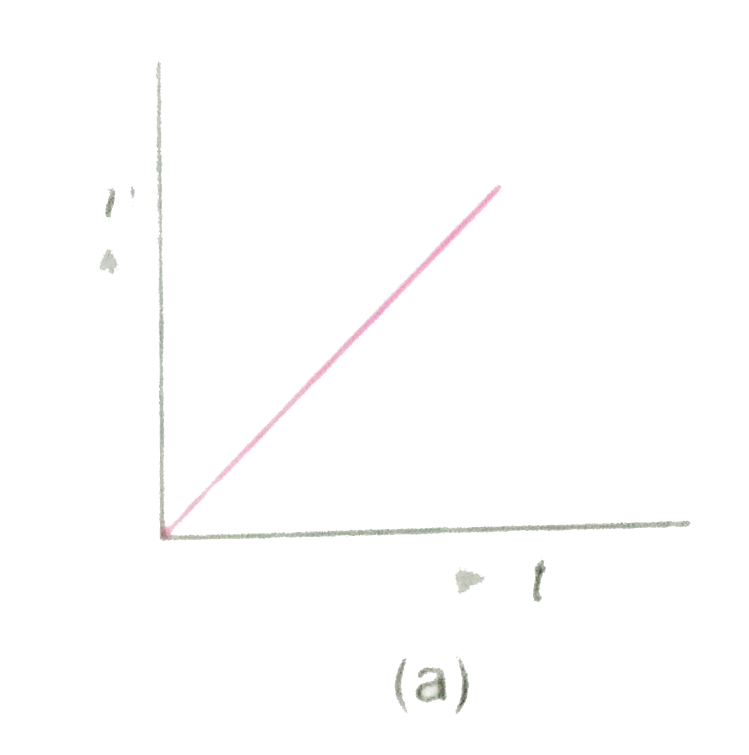
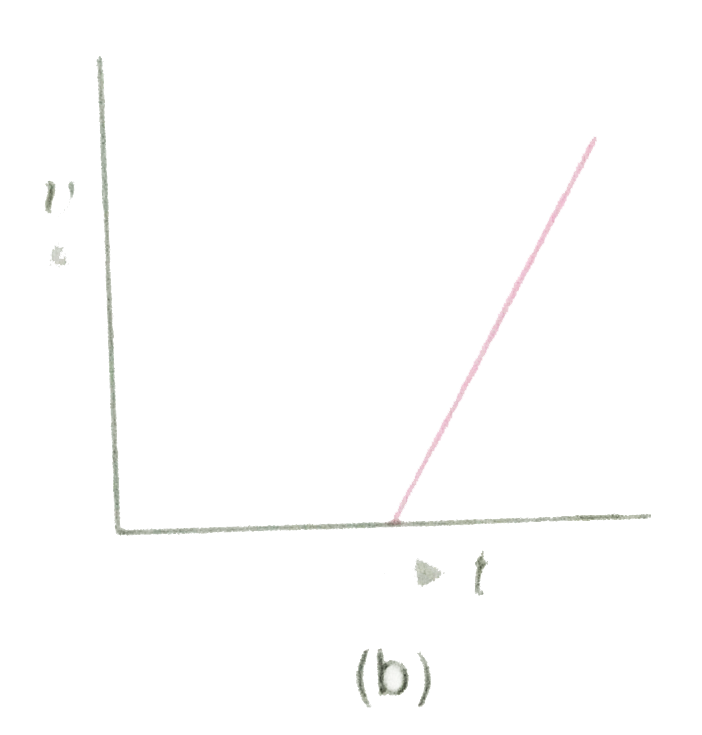
A tall cylinder is filled with viscous oil. A round pebble is dropped from the top with zero initial velocity. From the plot shown in Fig. 7(EP).15, indicate the one that represent the velocity (v) of the people as a function of time (t). |
|
Answer»
|
|
| 32. |
Explosion is due to |
|
Answer» INTERNAL forces |
|
| 33. |
A telescope, consisting of an objective of focal length 60cm and a single eye lens of focal length 15cm is focused on a distant object in such a way that parallel rays comes out from the eye lens. IF the objects subtends at angle 2^@ at the objective, the angular width of the image is |
| Answer» ANSWER :B | |
| 34. |
Three particle each of 1kg mass are placed at corners of a right angled triangle AOB, O. being the origin of coordinate system (OA and OB along the x-direction and + Ve y-direction). If OA = OB =1m, the position vector of centre of mass (in metres) is |
|
Answer» `(hati+hatj)/(3)` |
|
| 35. |
A block is placed on a horizontal platform. The system is making horizontal oscillations about a fixed point with a frequency o 0.5 hz. The maximum amplitude of osicllation if the block isnot to slide on the horizontal platform, is (coefficient of friction between the blcok and the platform =0.4) |
|
Answer» 0.3971 m |
|
| 36. |
The escape velocity v of a body depends upon (i) the acceleration due to gravity of the planet and (ii) the radius of the planet R. Establish dimensionally the relationship between v, g and R. |
|
Answer» Solution :`v prop g^a R^h rArr v = k g^a R^h , K to` DIMENSIONLESS proportinally constant `[v] = [g]^a[R]^b` `[M^0 L^1 T^(-1) ]= [M^0 L^1 T^(-2) ]^a [ M^0 L^1 T^0]^b` EQUATING powers `1 = a+ b` ` - 1 = -2a rArr a = 1/2` ` b = 1 - a = 1 - 1/2 = 1/2` ` THEREFORE v = k sqrt(gr)` |
|
| 37. |
Define the term sphere of influence. |
| Answer» Solution :It is a sphere drawn AROUND a particular molecule as centre and MOLECULAR RANGE as radius. | |
| 39. |
A gun of mass M fires a bullet of mass m with a velocity v relative to the gun. The averge force required to bring the gu to rest in 0.5 sec. is |
|
Answer» `(2Mmv)/(M+m)` |
|
| 40. |
A person is standing on a platform rotating with an angular speed omega, with stetched hands carrying equal masses each of m. Now he releases the masses such that they fall on the platform. The new angular velocity of plateform would be |
|
Answer» `OMEGA` |
|
| 41. |
Assertion: In adiabatic compression the internal energy and temperature of the system get decreased. Reason: The adiabatic compression is a slow process. |
|
Answer» Both assertion and REASON are TRUE and the reason is the CORRECT explanation of the assertion. |
|
| 42. |
In the arrangement shown in fig. a wedge of mass m_(3) =3.45 kg is placed on a smooth horizontal surface. Small and light pulley is connected on its top edge, as shown. A light, flexible thread passes over the pulley. Two block having mass m_(1)=1.3kg and m_(2) =1.5 kg are connected at the ends of the thread. m_(1) is on smooth horizontal surface and m_(2) rests on inclined smooth surface of the wedge. the base length of wedge is 2m and inclination is 37^(@). m_(2) is initially near the top edge of the wedge. If the whole system is released from rest, calculate: (a) velocity of wedge when m_(2) reaches its bottom. (b) velocity of m_(2) at that instant. (g=10ms^(-2)). |
|
Answer» (a) `(a+b)` down the plane and (b) b leftwards. Hence, components of this resultant acceleration are (a) `[(a+b) cos 37^(@)-b]=((4a-b))/(5)` horizontal rightward, and (b) `(a+b) sin 37^(@)=3/5 (a+b)` vertically downward. Considering free body diagrams 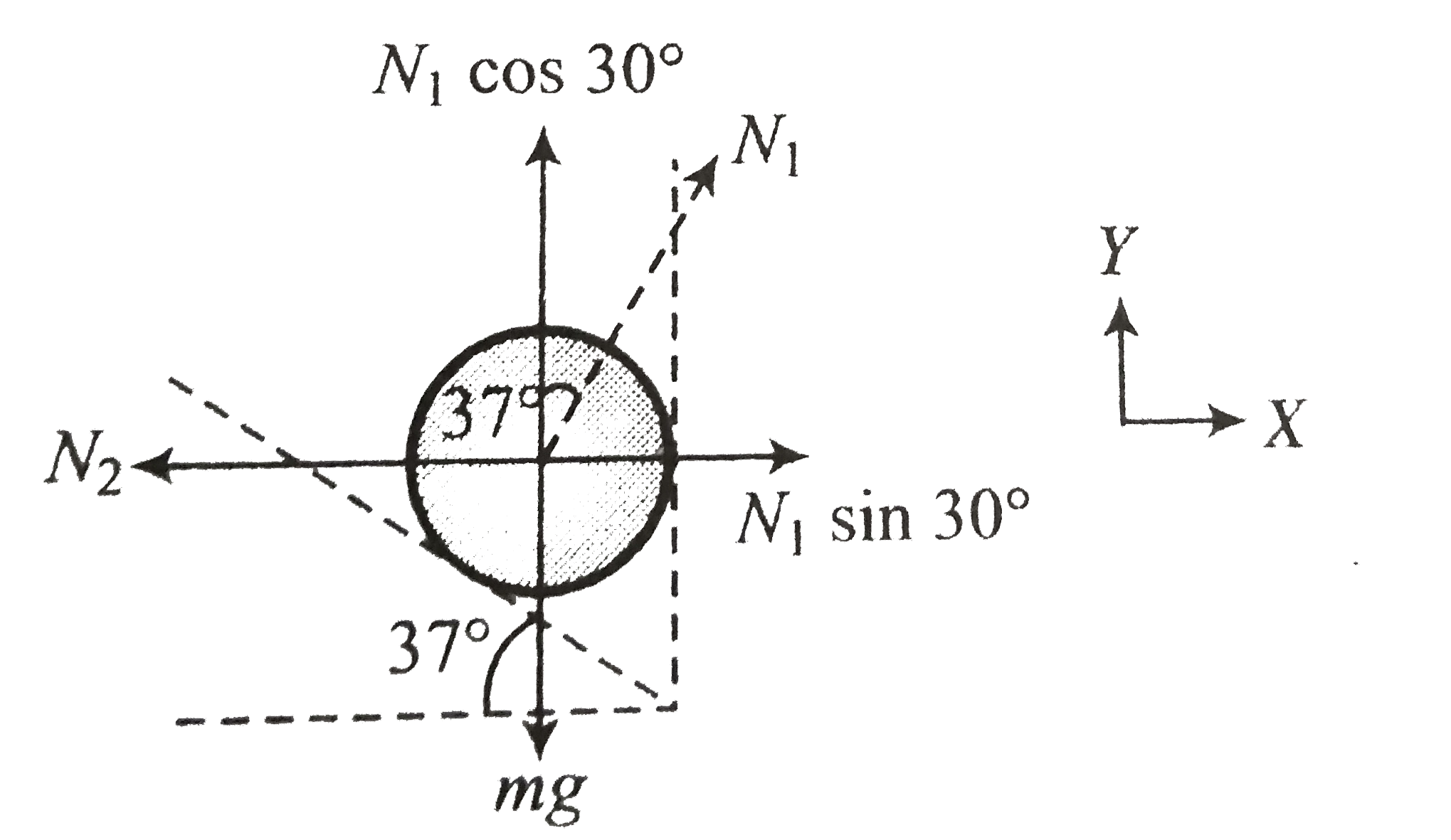 For horizontal FORCE on `m_(1), T=m_(1)a` ...(i) For horizontal force on wedge, `T-T cos 37^(@)+N_(2) sin 37^(@)=m_(3)b`...(ii) For horizontal force on `m_(2)` `N_(2). sin 37^(@)-T cos 37^(@)=m_(2)(0.8a-0.2)`...(III) For vertical force on `m_(2)` `m_(2)g-N_(2) cos 37^(@)-T sin 37^(@)=m_(2)(0.6 a + 0.6b)`...(iv) From above equations , `a=3ms^(-2), b=2ms^(-2)` SINCE base ANGLE and base length of wedge are `37^(@)` and 2m respectively, therefore, height of its vertical faces is `2tan 37^(@)=1.5m`. Now considering vertical motion of `m_(2)` from top of bottom of the wedge, `u=0`, acceleration =`(0.6a=0.6b)=3ms^(-2)` and displacement = `1.50m`. `t=1s` At this instant, horizontal component of velocity of `m_(2)` is `v_(2x)=(0.8a-0.2b)t=2ms^(-1)` and vertical component, `v_(2y)=(0.6a+0.6b)t=3ms^(1)` Vertical of `m_(2)` is `v_(2)=sqrt(v_(2x)^(2)+v_(2y)^(2))=sqrt(13)ms^(-1)` Velocity of wedge at this instant = `bt=2ms^(-1)`. |
|
| 43. |
Explain why a small iron needle sinks in water while a large iron ship floats? |
|
Answer» Solution :For floatation, `Vrho_(b)=V_("in")P_(L)` where, V is volume of material of the body and volume of displaced liquid, Hollow bodies can displace liquid whose volume is MUCH larger than the volume of the matter of the body, for example, a hollow BOX, a ship etc. Due to this reason, though the DENSITY of iron is much lager than that of water, `V_("in")` will compensate for that and makes sure that the ship FLOATS, whereas in the case of a solid body such as needle this is not possible and so, the needle sinks in water. |
|
| 44. |
A body of mass 'm' slides down a smooth inclined plane having an inclination of 45^(@) with the horizontal. It takes 2S to reach the bottom. It the body is placed on a similar plane having coefficient friction 0.5 What is the time taken for it to reach the bottom ? |
|
Answer» Solution :Mass = m, `= 45^(@)` Time taken to reach the BOTTOM `T_(1)=2 sec mu = 0.5` Time taken by the body to TOUCH the bottom without friction is `T_(1)=sqrt((2L)/(g sin theta))` Time taken with friction is `T_(2)=sqrt((2l)/(g(sin theta - mu COS theta)))` `(T_(1))/(T_(2))=sqrt((sin theta - mu cos theta)/(sin theta))` `T_(2)=T_(1)sqrt((sin theta)/(sin theta - mu cos theta))=2.828 sec`. |
|
| 45. |
What is head -on collision ? |
| Answer» SOLUTION :When the COLLIDING objectsmove along a staright line JOINING their centres , the COLLISION is said to be head - on collision . | |
| 46. |
Statements :(a) The motion of the centre of mass can be studied using kepler.s laws of motion.(b) The internal forces will not effect the motion of the centre of mass |
|
Answer» Both a and B are TRUE |
|
| 47. |
What is rigid body ? |
| Answer» SOLUTION :A RIGID BODY is the ONE which maintains its definite and fixed shape even when an external force acts on it | |
| 48. |
An ideal monoatomic gas of one mole undergoes a cyclic process ADBCA as shown in figure. X and Y are two isothermal curves at temperature 211^(@)C and 127^(@)C respectively. If the work done by the gas in cyclic process is lambdaR, then find the value of lambda. (R is the gas constant) |
|
Answer» |
|
| 49. |
In which process the rate of transfer of heat from one place to another place is large ? |
|
Answer» CONDUCTION |
|
| 50. |
A lift is tied with thick wires and the mass of the lift is one metric ton. If the maximum acceleration of the lift is 1 "ms"^(-2) and the maximum stress of the wire is 1.4 xx 10^(8) "Nm"^(-2). If g=10ms^(-2) the minimum diameter of that wire is ...... |
|
Answer» 10 m |
|
`<br><img src=)