

Saved Bookmarks
This section includes 7 InterviewSolutions, each offering curated multiple-choice questions to sharpen your Current Affairs knowledge and support exam preparation. Choose a topic below to get started.
| 1. |
What is the microscopic origin of pressure? |
|
Answer» Solution :According to the KINETIC theory of a gases, the pressure exerted by the molecules depands on (i) number density`n=N/V ` MASS of the molecule (iii) MEAN SQUARE speed The perssure is given by `p=1/3 nm barv^(2) (or) P=1/3 N/V m barv^(2)` 
|
|
| 2. |
A block of mass m hangs on a vertical spring. Initially the spring is unstretched, it is now allowed to fall from rest. Find (a) the distance the block falls if the block is released slowely, (b) the maximum distance the block falls before it beings to move up |
Answer» Solution :(a) When the block falls slowely, it COMES to rest at a distance `y_(0)`, which is referred to as the equilibrium position. From, condition of equilibrium,  (B) When the block is released suddenly, it oscillates about the equilibrium position. Initially the speed of the block increase then reaches maximum value and then decreases to zero at the LOWEST position. In this situation the block oscillates about the equilibrium position. The block is released from rest, there fore its total mechanical ENERGY initially. `E_(i) = U_(g) + U_(s) + KE = 0 + 0 + 0` Final total mechanical energy, `E_(f)= - mgy_(m) + (1)/(2) ky^(2) + 0` From conservation of energy, `E_(i)= E_(f)` `0 = - mgy_(m) + (1)/(2) ky^(2) or y_(m)= (2MG)/(k) = 2y_(0)` |
|
| 3. |
Given in figure are examples of some potential energy functionsin one dimension. The total energy of the aprticle is indicated by a cross on the ordinate axis . In each case , specify the regions ,if any , in whichthe particlecannotbe foundfor the given energy .Also , indicatethe minimum totalenergythe particle must havein each case . Thinkof simple physical contexts for which these potential energyshapes are relvant . |
|
Answer» Solution :We knowthat total energy , `E = K+V `where V = potential energy , K = kinetic energy ` :. K = E - V ` and kinetic energy (K) can never be negativeIf K is negative, the object cannot exist in the region . (a) In the region between x = 0 and x = a potential energy is ZERO . So , kineticenergy is positive .In the region `x gt a ` the potentialenergy has a valuegreaterthan E . So, kinetic energy has a value greater than E . So kinetic energy will be negative in this region . THUS , the particle cannot be present in the region`x gt a ` .the minimum total energythat the particlecan havein this case is zero . (b) In graph (b) potentail energy `gt` the total energy and HENCE kinetic energy` [ K = E-V]`WOULD be negative . Thus , object cannot be present in any region of the graph . (c ) Here x = 0 to x = 0 and `x gt b ` the potentialenergy is more than total energy, so kineticenergyis negative. the particle cannot existin theseportions . (d) The object cannot exist in the region between `x = - b/2 to x = - a/2 and x = - a/2" to " x = -b/2 ` .Because in this region potential energy `gt ` total energy . |
|
| 4. |
Two balls are dropped from the same height at two different places A and B where the acceleration due to gravities are g_A and g_B . The body at 'B' takes 't' seconds less to reach the ground and strikes the ground with a velocity greater than at 'A” by v m/s. Then the value of 'v/t' is |
|
Answer» `(1)/(SQRT(g_A g_B))` |
|
| 5. |
The oxygen molecule has a mass of 5.4xx10^(-26)kg and moment of inertia is 1.8xx10^(-46)kg.m^(2) about an axis passing through its centre and perpendicular to the line joining the two atoms. Suppose the mean speed of the molecule in sample of oxygen has is 500"ms"^(-1) and its kinetic energy of rotation is two third of its kinetic energy of translation. Its angular velocity is found to be approximately nxx10^(12) rad/sec where n = __________. |
|
Answer» |
|
| 6. |
Two disc have the same mass and thickness. Their materials are of densities d_(1) and d_(2). The ratio of their M.I about their central axis is |
|
Answer» `d_(2):d_(1)` |
|
| 7. |
A toy cyclist completes one round of a square track of side 2 min 40 seconds. What will be the displacement at theend of 3 minutes? |
|
Answer» 52 m `= 3 min = 3 xx 60 = 180 s` Time period of revolution= 40 s `:.` Displacement in160 s `(=4xx 40) = 0 `, as toy CYCLIST will be reaching at the straight point . Thus displacement in 18 s displacement in 20 s `=sqrt((20)^2+(2)^2)=2sqrt2` m |
|
| 8. |
A rigid uniform rod of mass M and length 'L' is resting on a smooth horizontal table. Two marbles each of mass 'm' and travelling with uniform speed 'V' collide with two ends of rod simultaneously and inelastically as shown. The marbles get struck to the rod after the collosion and continue to move with the rod If m=M/6 and V = L mts/sec, then the taken by rod rotate through pi//2 is |
| Answer» ANSWER :D | |
| 9. |
A tension of 22N is applied to copper wire of crosssectional area 0.02cm^2,Young's modulus of copper is 1.1xx10^11N/m^2 and poisson's ratio 0.32.The decrease in cross-sectional area will be |
|
Answer» `1.28 XX 10^(-6) cm^2` |
|
| 10. |
A man weighs 60kg on the surface of the earth. The altitude where his weight will be 30kg is (R is the radius of the earth) |
|
Answer» `H = 2 sqrtR` |
|
| 11. |
Which of the following remains unchanged,when the wave propagates from air to water? |
|
Answer» velocity |
|
| 12. |
A capillary tube of radius 0.2mm is dipped vertically in a beaker containing water if surface tension of water is 7xx10^(-2)N//m the rise of water in the tube will be |
| Answer» ANSWER :B | |
| 13. |
A bomb at rest at the summit of a cliff breaks into two equal fragments. One of the fragments attains a horizontal velocity of 20 sqrt3 ms^(-1). The horizontal distance between the two fragments, when their displacement vectors is inclined at 60^@relative to each other is |
|
Answer» `40sqrt3 m` |
|
| 14. |
A bus moves over a straight level road with a constant acceleration a. A boy in the bus drops a ball out side. The acceleration of the ball w.r.t the bus and the earth are respectively |
|
Answer» `SQRT(a^(2)+G^(2))`,g |
|
| 15. |
The expression (me^(4))/(8epsilon_(0)^(2)h_(c )^(3)) has the dimensions (m = mass, e = electric charge, in_(0)= permittivity, h = planck's constant and c = velocity of light) |
| Answer» ANSWER :A | |
| 16. |
The order of magnitude of height of man is |
|
Answer» ZERO |
|
| 17. |
Thermodynamic process are indicated in the following diagram. Then match the following process in a correct manner. |
|
Answer» P-c,Q-a,R-d,S-b |
|
| 18. |
The mass of a uniform ladder of length 5 mis 20 kg. A person of mass 60 kg stands on the ladder at a height of 2 m from the bottom. The position of centre of mass of the ladder and man from the bottom nearly is |
|
Answer» 1M |
|
| 19. |
The average thermal energy of a oxygen atom at room temperature (27^(@)C) |
|
Answer» `4.5xx10^(-21)J` |
|
| 20. |
Two bodies with moment of inertia I_(1) and I_(2) (I_(2)gt I_(1)) are rotating with same angular momentum. If K_(1) and K_(2) are their kinetic energies, then |
| Answer» Answer :B | |
| 21. |
In Latin, the word vector means |
|
Answer» Magnitude |
|
| 22. |
It is known that density rho of air decreases with height y as rho=rho_0e^(-y//y_0) where rho_0=1.25 kg m^-3 is the density at sea level. And y_0 is a constant . This density variation is called the law of atmosphere. Obtain this law assuming that the temperature of atmosphere remains a constant (isothermal conditions). Also assume that the value of g remains constant. A large He balloon of volume 1425 m^3 is used to lift a payload of 400kg.Assume that the balloon maintains constant radius as it rises. How high does it rise? |
| Answer» Solution :8KM, If we CONSIDER the variation of g with ALTITUDE the height is somewhat more. About 8.2km. | |
| 23. |
Two satellite A and B go around a planet in circular orbits having radii 4R and R respectively. If the speed of satellite A is 3v, the speed of satellite B would be .......... |
|
Answer» 12v `v_0 = sqrt((GM_e)/(4R))` For satellite A orbiting in CIRCULAR path of RADIUS 4R `(v_0)_A= sqrt((GM_e)/(4R)) = 3 lamda ""....(1)` For satellite B orbiting in circular path of radius R `(v_0)_B= sqrt((GM_e)/(4R)) = 3 lamda ""....(2)` `:.((v_0)_B)/((v_0)_A)=sqrt((GM_e)/(4R)xx(4R)/(GM_e))` `(v_0)_B = 2(v_0)_A` = 2(3v) = 6v |
|
| 24. |
The dimensional formula of velocity gradient is |
| Answer» Answer :A | |
| 25. |
Statement -A : The acceleration vector of a particle in uniform circular motion averaged over one cycle is a null vector Statement -B : The average speed of a particle is either greater or equal to the magnitude of average velocity of the particle over the same interval of the time. |
|
Answer» A only TRUE |
|
| 26. |
You are riding in an automobile of mass 3000 kg . Assuming that you are examining the oscillation characterisitics of its suspension system. The suspension sags 15 cm when the entire automobile is placed on it. Also, the amplitude of oscillation decreases by 50% during one complete oscillation. Estimate the value of the damping constant b for the spring and shock absorbed system of one wheel, assuming that each wheel supports 750 kg. g= 10 m//s^2 |
|
Answer» Solution :If m is the mass SUPPORTED by each spring , then `m =(3000)/4 = 750 KG` `X= x_0 e^(-bt//2m) ` or `2 = e^(bt//2m)` or `log_e 2 =(bt)/(2m) log_e e = (bt)/(2m)` where `t= 2pi sqrt(M/K) = 2 xx (22)/(7) xx sqrt((3000)/(4 xx 5 xx 10^4)) = (44)/(70) sqrt(3/2)` `therefore b= (2m log_e 2)/(t) = (2xx 750 xx 0.6931)/((44)/(70) sqrt(3/2)) = 1350.4 ` kg/s |
|
| 27. |
A constant force acts on a body which is intially at rest. If a graph is drawn by plotting its kinetic energy along Y-axis and displacement along X-axis, shape of the graph is |
|
Answer» STRAIGHT LINE PASSING through origin |
|
| 28. |
A beam of metal supported at the two ends is loaded at the centre. The depression at the centre is proportional to |
|
Answer» `Y^(2)` |
|
| 29. |
Can you associate a vector with (a) the length of a wire bent into a loop (b) a plane area (c) a sphere. |
| Answer» SOLUTION :(a) We cannot associate a vector with the length of a wire BENT into a loop. this is cause the length of the loop does not have a definite direction. (b) We can associate a vector with a plane AREA. Such a vector is called area vector and its direction is REPRESENTED by a NORMAL drawn outward to the area. (c) The area of a sphere does not point in any difinite direction. However, we can associate a null vector with the area of the sphere. We cannot associate a vector with the volume of a sphere. | |
| 30. |
You are riding in an automobile of mass 3000 kg . Assuming that you are examining the oscillation characterisitics of its suspension system. The suspension sags 15 cm when the entire automobile is placed on it. Also, the amplitude of oscillation decreases by 50% during one complete oscillation. Estimate the value of the damping constant b for the spring and shock absorbed system of one wheel, assuming that each wheel supports 750 kg. |
|
Answer» Solution :Mass supported by each spring in `=(3000)/(4) = 750 kg ` damped OSCILLATIONS Amplitude `A_t= AE^(-bt//2m)` Time period `T= 2PI sqrt(m/t) = 2 xx 3.14 sqrt((750)/(5xx10^4)) = 77 xx10^(-2) ` seconds. Amplitude decreases by 50% then At = A/2 and t=T `THEREFORE A/2 = Ae^(-bt//2m) ` (or) `b= (0.693 xx 2m)/(T) = 1350 kg//s` |
|
| 31. |
You are riding in an automobile of mass 3000 kg . Assuming that you are examining the oscillation characterisitics of its suspension system. The suspension sags 15 cm when the entire automobile is placed on it. Also, the amplitude of oscillation decreases by 50% during one complete oscillation. Estimate thevalue of spring constant k . |
|
Answer» Solution :F= mg = `3000 XX 10 = 3xx10^4 N` `x=-15 xx 10^(-2) m` 4 springs in parallel `K= 4K, F=-(4K) x` `K =-F/(4x) =(-3xx 10^4)/(4(-15xx10^(-2))) = 5 xx 10^4 N//m` |
|
| 32. |
Under isothermal condition, energy E is supplied to a soap bubble of surface Tension sigma and radius r, to double the radius of bubble, then E is |
|
Answer» `16 pi r^(2) sigma` |
|
| 33. |
A motor pump of power 1 H.P is discharging water with a velocity of 10ms^(-1).In order to discharge water with a velocity of 20 ms^(-1),the power of the motor should be |
|
Answer» 2 H.P |
|
| 34. |
Assertion: In damped oscillation, the energy of the system is dissipated continuously. Reason: For small damping, the oscillations remain approximately periodic. |
|
Answer» If both assertion and RESON are true and REASON is the correct explanation of assertion |
|
| 35. |
Explain the concept of relative velocity in one and two dimensional motion. |
|
Answer» Solution :When two OBJECTS A and B are moving with different velocities, then the velocity of one object A with respect to ANOTHER object B is called relative velocity of object A with respect to B. Case I. Consider two objects A and B moving with uniform velocities `V_(A)andV_(B)`. as shown, along straight tracks in the same direction `vecV_(A),vecA_(B)`, with respect to ground. The relative velocity of object A with respect to object B is `vecV_(AB)=vecV_(A)-vecV_(B)`. The relative velocity of object B with respect to object A is `vecV_(BA)=vecV_(B)-vecV_(A)`underset(vecv_B)larr` Thus, if two objects are moving in the same direction, the MAGNITUDE of relative velocity of one object with respect to another is equal to the difference in magnitude of two velocities. Case II. Consider two objects A and B moving with uniform velocities `V_(A)andV_(B)`along the same straight tracks but opposite in direction `underset(vecv_B)to The relative velocity of an object A with respect to object B is `vecV_(AB)=vecV_(A)-(-vecV_(B))=vecV_(A)+vecV_(B)` The relative velocity of an object B with respect to object A is `vecV_(AB)=-vecV_(A)-vecV_(A)=-(vecV_(A)+vecV_(B))` Thus, if two objects are moving in opposite DIRECTIONS, the magnitude of relative velocity of one object with respect to other is equal to the sum of magnitude of their velocities. ase III. Consider the velocities and at an angle between their directions. The relative velocity of A with respect to B, `vecv_(AB)=vecv_(A)-vecv_(B)` hen, the magnitude and direction of `vec_(AB)` is given by `v_(AB)=sqrt(vecv_(A)^(2)+vecv_(B)^(2)-2v_(A)v_(B)costheta)` and tan `beta=(v_(B)sintheta)/(v_(A)-v_(B)=costheta)` (Here `beta` is angle between `vec_(B)andvecv_(A)`) (i) When `theta=0`, the the bodies move along parallel sraight lines in the same direction, We, have `v_(AB)=(v_(A)-v_(B))` in the direction of `vecv_(A)`. Obviously `v_(BA)=(v_(B)+v_(A))` in the direction of `vecv_(B)`. (ii) When `theta=180^(@)`, the bodies move along parallel straight lines in opposite directions, We have `v_(AB)=(v_(A)+v_(B))` in the direction of `vecv_(A)`. Similarly, `v_(BA)=(v_(B)+v_(A))` in the direction of `vecv_(B)`. (iii)If the two bodies are moving at right angles to each other, then `theta=90^(@)`. The magnitude of the relative velocity of A with respect to `B=v_(AB)=sqrt(v_(A)^(2)+v_(B)^(2))`. (iv) Consider a person moving horizontally with velocity `vecV_(M)`.Let rain fall vertically withvelocity `vecV_(R)` . An umbrella is HELD to avoid the rain. Then the relative velocity of the rain with respect to the person is,  And direction `theta=tan^(-1)((V_(M))/(V_(R)))` with the vertical as shown in figure. |
|
| 36. |
A glass container of volume V contains some mercury. The coefficients of cubical expansion for glass and mercury are gamma_g and gamma_m , respectively. If the volume of air inside the flask remains constant at different temperature, then the volume of mercury in the flask is |
|
Answer» `(gamma_m V)/(gamma_g)` ` therefore V gamma_g DeltaT = V. gamma_m DELTA T` ` RARR V. = (V gamma_g)/(gamma_m)` |
|
| 37. |
A block of mass m is kept over another block of mass M nd the system rests on a horizontal force F acting on the lower block produces an accelertion F/(2(m+M)) in the system the two blocks always move together. A. Find the coefficient of kinetic frictioin between the bigger block and th horizontal surface. b. find the frictional force acting on the smaller block. c. Find the work done by the force of friction on the smaller block by the bigger block during a displacement d of the system. |
Answer» 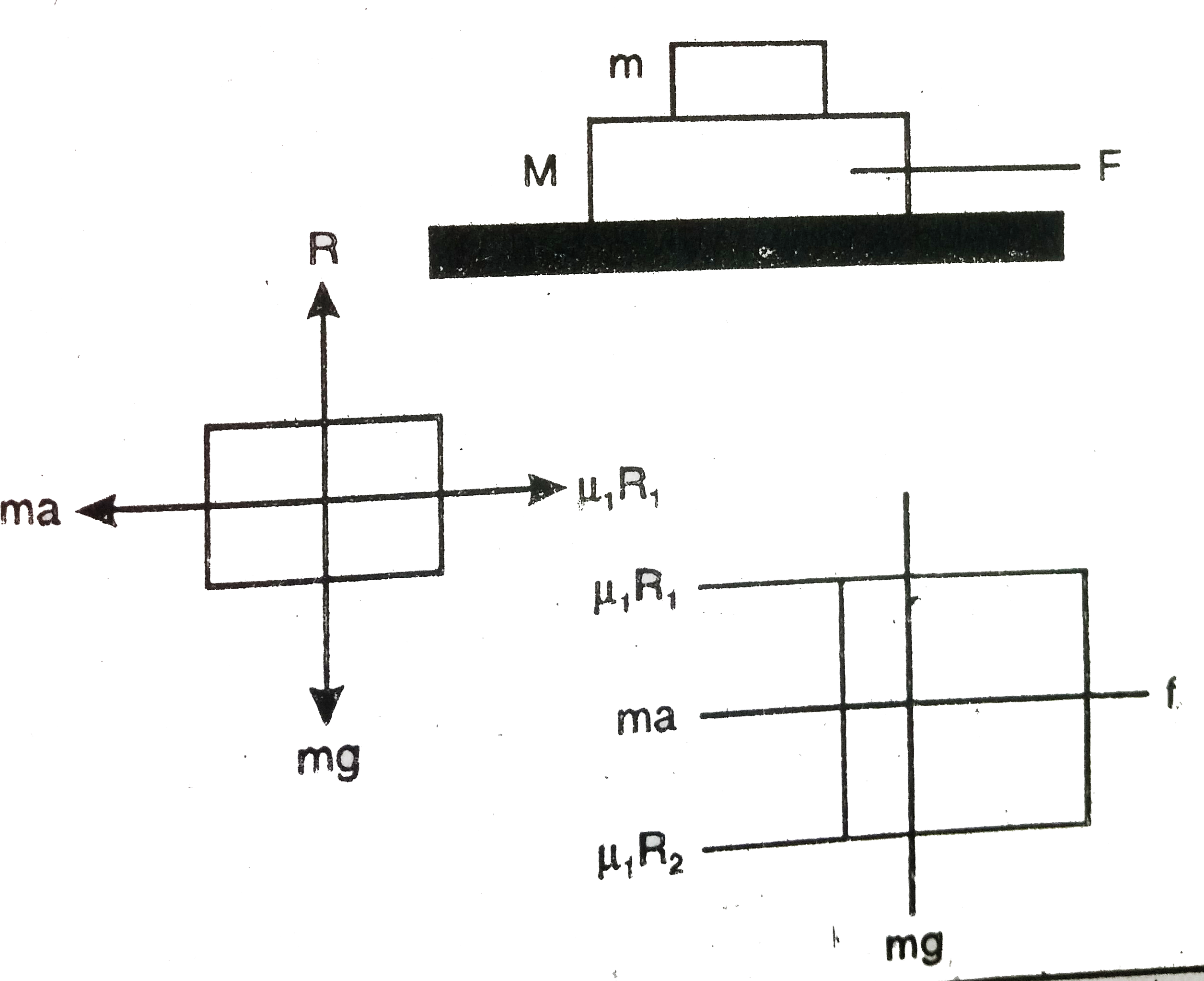 From`ma=muR_1` and `R_1=mg` `rarr =MU=(ma)/R_1` `=F/(2(M+m)G)` b. FrictioN/Al froce acting on the smaller block `f=muR= F/(2(M+m)g)xxmg` `=(mF)/(2(M+m))` c. work done `w=fs ` `s=d` `=(mF)/(2(M+m))xxd` `=(MFD)/(2(M+m))` |
|
| 38. |
The dimensional formula ML^(2)T^(-2) represents |
|
Answer» MOMENT of a force |
|
| 39. |
In determing viscosity (eta) by poiseuille's method the formula used eta = (pi p r^(4))/(8 vl). Which of the quantities in the formula must be measured more accurately |
|
Answer» p |
|
| 40. |
One mole of an ideal monatomic gas at temperature T_(0) expands slowly according to the law (P)/(V) = constant. If the final temperature is 2T_(0), heat supplied to the gas is |
|
Answer» `2RT_(0)` As the process is `(P)/(V)` = constant, i.e., `PV^(-1)` = constant, therefore, `x = -1` For a MONATOMIC GAS, `gamma = 5//3` `:. C = (R )/((5)/(3)-1) + (R )/(1-(-1)) = (3)/(2)R + (R )/(2) = 2R` Heat supplied to the gas is `Delta Q = nC(Delta T) = 1(2R)(2T_(0) - T_(0)) = 2RT_(0)` |
|
| 41. |
An aircraft is flying at a height of 3400 m above the ground. If the angle subtended at a ground observation point by the aircraft position 10 second apart is 30^(@), what is the speed of the aircraft? |
| Answer» SOLUTION :SPEED `=182.2ms^(-1)` | |
| 42. |
In this above problem the horizontal distance between the two fragments when their velocity vectors are perpendicular to each other is |
|
Answer» 10 m |
|
| 43. |
What is the difference between Stefan's law and Newton's law of cooling ? |
| Answer» Solution :Stefan.s LAW cab be applied to a black body RADIATING heat at anytemperature. Newton.s law can be applied only when the temperature DIFFERENCE between the body and the surrounding is small, and the cooling OCCURS due to reaction. Also there should be no loss of heat due to conduction. | |
| 44. |
The period of simple pendulum whose bob is a hollow mentallic sphere is 'T'. The period is T_(1) when the bob is filled with sand , T_(2) when the bob is filled with mercury and T_(3) when it is half filled with sand then |
|
Answer» `T=T_(1)+T_(2)gtT_(3)` |
|
| 45. |
In the given figure, the inclined surface is smooth. The body releases from the top. Then- |
|
Answer» the body has MAXIMUM velocity just before striking the SPRING |
|
| 46. |
A lead bullet (Specific heat=0.032" cal/gm"^(@)C) is completely stopped when it strikes a target with a velocity of 300 m/s . The heat generated is equally shared by the bullet and the target. The rise in temperature of bullet will be |
|
Answer» `16.7^(@)C` |
|
| 47. |
The equation of a certain gas can be written as T^(7//5)/P^(2//5)=" const". Its specific heat at constant volume will be |
|
Answer» `3/2R` |
|
| 48. |
If more air is pushed in a soap bubble, the pressure in it |
|
Answer» decreases |
|
| 49. |
A cyclist is riding with a speed of 27 kmh^(-1) . As he approaches a circular turn on the road of radius 80m, he applies brakes and reduces his speed at the constant rate of 0.50 ms^(-1) every second. The net acceleration of the cyclist on the circular turn is |
|
Answer» `0.5 m//s^2` |
|
| 50. |
The work done in lifting a body of mass 20 kg and specific gravity 3.2 to a height of 8m in water is (g=10ms^(-2)) |
|
Answer» 110 j |
|