

Saved Bookmarks
This section includes 7 InterviewSolutions, each offering curated multiple-choice questions to sharpen your Current Affairs knowledge and support exam preparation. Choose a topic below to get started.
| 1. |
What determines the nature of the path followed by the particle |
|
Answer» speed |
|
| 2. |
If the dot product of two vectors is equal to the magnitude of the cross product of the same vectors, then the angle between the vectors is |
| Answer» Answer :B | |
| 3. |
What is point mass ? |
|
Answer» Solution :A " positn mass" has no internal structure like SHAPE and size . Mathematically it has FINITE mass with zero dimension . In the motion of Earth with respect to Sun, Earth is treated as a POINT mass. This is because the distance between the Sum and Earth is very large compared to the size of the Earth . |
|
| 4. |
From which conditioon, the normal modes for the case of small hand drums are decided ? |
| Answer» Solution :By stretching the CIRCUMFERENCE of small drums, their normal modes can be obtained from the condition that NONE of points is VIBRATING. The normal modes of such system are more COMPLEX to be obtained. | |
| 5. |
An observer moves towards a stationary source of sound with a velocity on fifth of the velocity of sound, what is the percentage increase in the apparent frequency? |
| Answer» ANSWER :D | |
| 6. |
A block of mass 4kg is placed in contact with the front vertical surface of a lorry. The coefficient of friction between the vertical surface and block is 0.8. The lorry is moving with an acceleration of 15 m//s^(2)(g=10 ms^(-2)). The force of friction between lorry and block is |
| Answer» Answer :C | |
| 7. |
Statements : (a) In translatory motion each point of the body experiences the same displacement as any other point as time goes on, so that the motion of any particle represents the motion of the whole body. (b) In rotatory motion, all the particles in the rigid body moves in concentric circles about the axis of rotation |
|
Answer» a is TRUE, B is FALSE |
|
| 8. |
A drop of water of surface area A and radius R at a temperature T breaks into two drops of area A_(1)andA_(2), radii r_(1)andr_(2) and having temperature T_(1)andT_(2). Then the correct statement is |
|
Answer» `A=A_(1)+A_(2)` |
|
| 9. |
A car moving on a straight road accelerates from a speed of 4.1 m/s to a speed of 6.9 m/s in 5.0 s. What was its average acceleration ? |
|
Answer» `0.56 m//s^(2)` |
|
| 10. |
Compare conservative forces and non conservative forces. |
Answer» SOLUTION :
|
|
| 11. |
the work done by friction in 10 s is |
|
Answer» 200J Thus, work done by the friction is `W_f=fd COS 180^@ =(2 N) (100 m) cos 180^@=-200 J` |
|
| 12. |
Derive differenital equation for damping oscillations and writes its solution. |
|
Answer» Solution :The resistive force acting on the OSCILLATOR in a fluid medium DEPENDS upon the velocity of the oscillator. In practice, for not very large velocities, the resistive force is directly proportional to the velocity of the oscillator. Resistive force `F_(d) propto -v` `therefore F_(d) = -bv """.........."(1)` Where b is positive constant and it is called DAMPING coefficient. It depeds on characteristics of medium (like viscosity) and the size and shape of the block. The unit of damping coefficient `(b =(F_d)/(v))" is "(NS)/(m)` and dimensional formula is`[M^(1)L^(0) T^(-1)]`. When the oscillator has displacement x from mean position, the restoring force `(F_S)` produced in it is `F_(S) = -kx """......."(2)` Thus, the total force acting on the mass at any time t is, `F= F_(S)+ F_(d)` `therefore F= -kx - bv """........."(3)` If a(t) is the acceleration of mass at time t, then by Newton.s law of motion, `F= ma(t)` From equation (3) `ma(t) = -kx(t)- bv(t)""".........."(4)` but `a(t) = (d^(2)xk(t))/(dt^(2))" and "v(t) = (dx(t))/(dt)` `therefore m(d^(2)x(t))/(dt^(2))+ b(dx(t))/(dt)+kx = 0"""........"(5)` is the differential equation for damping oscillations. The solution of equation (5) is below (without proof) `x(t) =Ae^(-(bt)/(2m)) cos [omega.t +phi]"""........"(6)` where `Ae^(-(bt)/(2m))` is the amplitude of oscillator and `omega.` is the angular frequency of oscillator and it is obtained from the formula `omega. = sqrt((k)/(m)-(b^2)/(4m^2))` In this function, the cosine function has a PERIOD `(2pi)/(omega.)` but function x(t) is not pure periodic because of the FACTORE `e^(-(bt)/(2m))` which decreases continuously with time. If the decrease is small in one time period T, the equation (6) is approximately periodic. The solution of equation (5) can be graphically represented as shown in figure.  Equation (6) is considered as consine function whose amplitude `(Ae^(-(bt)/(2m)))`, which is gradually decrease with time. In the graph a damped oscillator is periodic with decreasing amplitude of oscillation with greater damping oscillation die out faster. |
|
| 13. |
Particles of masses 1g, 2g, 3g, …….. 100 g, are kept at the marks 1 cm, 2cm, 3 cm, ……. 100 cm respectively on a meter scale. Find the moment of inertia of the system of particles about a perpendicular bisector of the meter scale. |
|
Answer» Solution :`[1xx49^(2)+2xx48^(2)+3xx47^(2)+……49xx1^(2)+52xx2^(2)+…….98xx48^(2)+99xx49^(2)+100xx50^(2)]10^(-7)` `= 100[50^(2)+49^(2)+48^(2)+…..+1^(2)]xx10^(-7)` `= 10^(-5)XX(1)/(6)xx50xx51xx101=0.43 KGM^(2)` |
|
| 14. |
The masses and radii of the earth and moon are M_(1), R_1 and M_(2)R_2 , respectively . Their centres are at distance d apart. What is the minimum speed with which a particle of mass m should be projected from a point midway between two centres so as to escape to infinity ? |
|
Answer» Solution :Potential energy of m when it is midway between `M_1 and M_2` `U=m(V_(1)+V_2)=m(-(GM_1)/(d//2)+(-GM_2)/(d//2))=(-2Gm)/d[M_1+M_2]` And as potential energy at INFINITY is zero, so work required to SHIFT m from the given position ot infinity , `W=0-U=2Gm(M_(1)+M_(2))//d` As this , work is provided by initial KINETIC energy. `1/2"m"upsilon^(2)=(2Gm(M_(1)+M_(2)))/(d)" or " upsilon=2sqrt((G(M_1+M_2))/d)` |
|
| 15. |
The ratio of the distance travelled in the fourth and the third second by a starting particle, moving over a straight path from rest with constant acceleration is...... |
|
Answer» `7/5` `d_(n) = v_(0) + a/2 (2n-1)` `therefore` Distance covered by a PARTICLE in `4^(th)` second, `d _(4) = 0 + a/2 (7) [because v _(0) = 0]` `d _(4) = (7a)/(2)` and distance covered by a particle in `3^(rd)` second, `d _(3) = 0 + (a)/(2) (5)` `thereforfe d _(3) = (5a)/(2)` `therefore` Ratio `(d_(4))/(d _(3)) = (7a)/(2) xx (2)/(5a) =7/5` |
|
| 16. |
The density of a material in CGS system of units is 4 g cm^(-3). In a system of units in which unit of length is 10 cm and unit of mass is 100 g, the value of density of material will be |
|
Answer» 0.04 |
|
| 17. |
Whichof the followingis not theunit of energy ? |
|
Answer» watt - HOUR |
|
| 18. |
Two particles of masses 10kg and 30kg are lying on a straight line. The 10kg mass is shifted towards the 30kg mass by a distance of 2cm. By what distance should the 30kg mass be shifted so that the position of their centre of mass does not change |
|
Answer» 2/3 cm TOWARDS 10KG |
|
| 19. |
A body of mass ‘M’moving with velocity 'V'explodes into two equal parts. If one comes to rest and the other body moves with the velocity 'v' what is the value of 'v'? |
|
Answer» `V` After explosion , the total momentum of the system` = M/2 xx 0+ M/2 xx v = (Mv)/(2)` PRINCIPLE of momentum conservation, before= after ` MV = (Mv)/(2) RARR v = 2V |
|
| 20. |
Mention the position of centre of mass of two particles of equal mass. |
| Answer» Solution :CENTRE of MASS of TWO isolated of equal mass lie on the MIDDLE of line joining between these two PARTICLES. | |
| 21. |
A body is moving in a vertical circle of radius r by a string. If the ratio of maximum to minimum speed is sqrt(3):1, the ratio of maximum to minimum tensions in the string is |
|
Answer» `3:1` |
|
| 22. |
The focal length of a mirror is give by (1)/(f)=(1)/(u)+(1)/(v), where 'u' represents object distance, 'v' image distance and 'f' local length. The maximum relative error is |
|
Answer» `(DELTA f)/(f)=(Delta u)/(u)+(Delta v)/(v)` |
|
| 23. |
Consider a body body shown in figure consisting of two identical balls, each of mass M connected by a light rigid rod. If an impulse J = MV is imparted to the body at one of its ends, its angular velocity would be ("KV")/(l). The value of K is |
|
Answer» |
|
| 24. |
30 g of water at 300^(@)C is in a beaker . Which of the following when added to water , will have greater cooling effect ?( specific heat of copper =0.1 cal//g^(@)C) |
|
Answer» 100 gm of water at `10^(@) C` |
|
| 25. |
Three liquid baths are thermally connected with the help of two identical rods AB and CD, each having thermal resistance 1^(0)C//W. There is a heater of 100W in the middle bath, the temperature of the left hand liquid bath is maintaind at 100^(0)C and that of right hand side is maintained at 40^(0)C. Assume there is no heat loss to surroundings. |
|
Answer» The steady temperature of the middle bath WOULD be `120^(0)C` |
|
| 26. |
Assertion : Vapourization is done from liquid surface. Reason : The atoms on the surface apply less attraction as compared to atoms inside the surface. |
|
Answer» Both are true and the reason is the CORRECT EXPLANATION of the assertion. |
|
| 27. |
The power of a motor is 15 HP and its maximum angular speed is 150 rad s^(-1). What is the corresponding torque ? |
| Answer» SOLUTION :`TAU = P//omega = 746 XX 15//10 = 75.6 NM` | |
| 28. |
A car moving along a straight highway with a speed of 126 kilometre per hour is brought to a stop within a distance of 200m. What is the retardation of the car (assumed uniform) and how long does it taken for the car to stop? |
|
Answer» Solution :INITIAL VELOCITY of car, `U=126kmh^(-1)=126xx(5)/(6)ms^(-1)=35ms^(-1)""………(1)` Since, the car finaly comes to rest, v=0 Distance covered, s 200 m, a=?, t=? `v^(2)=u^(2)-2asora=(v^(2)-u^(2))/(2s)""......(2)` Substituting the values from EQ. (1) in eq. (2), we get `a=(0-(35)^(2))/(2xx200)=-(35xx35)/(400)=-(46)/(16)ms^(-2)=-3.06ms^(-2)` Negative sign shows that acceleration in negative which is CALLED retardation, uniformly retarded at `-a=3.06ms^(-2)`. To find t, let us use the relation v=u+at `t=(v-u)/(a)` Use `a=-3.06ms^(-2),v=0,u=35ms^(-1)` `:.t=(v-u)/(a)=(0-35)/(-3.06)=11.44s` `:.t=11.44` sec. |
|
| 29. |
In visible region the dispersive powers and the mean angular deviation for crown and flint glass prism are omega,omega. and d, d. respectively. The condition for getting deviation without dispersion when the two prism are combined is |
|
Answer» `SQRT(omegad)+sqrt(omega^1d^1)=0` |
|
| 30. |
A force is applied for a duration of 10sec on a body of mass 5kg that is at rest. As a result the body acquires a velocity of 2ms^(-1) Find the magnitude of the force applied. |
|
Answer» |
|
| 31. |
The radius of the earth is R. The height of a point vertically above the earth.s surface at which the acceleration due to gravity becomes 1% of its value at the surface is |
| Answer» Answer :B | |
| 32. |
Some physical constants are given in List - I and their dimensional formulae are given in List - II. Match the following : {:(,"List - I",,"List - II"),((A),"Planck's constant",(E ),[ML^(-1)T^(-2)]),((B),"Gravitational constant",(F),[ML^(-1)T^(-1)]),((C ),"Bulk modulus",(G),[ML^(2)T^(-1)]),((D),"Coefficient of Viscosity",(H),[M^(-1)L^(3)T^(-2)]):} |
|
Answer» |
|
| 33. |
A uniform circulr disc has radius R and mass m. A particle also of mass m is fixed point A on the edge of the disc as shown in the fig. The disc can rotate freely about a fixed horizontal chord PQ that is at a distance R/4 from the centre C of the disc. The line AC is perpendicular to PQ. Initially the disc is held vertical with the point A at its highest position. It is then aloowed to fall so that it starts rotaing about PQ. Then linear speed of the particle as it reaches its lowest posirion sqrt(xgR) where 'x' is |
|
Answer» |
|
| 34. |
When heat is added to a system, which of thefollowing is not possible ? |
|
Answer» INTERNAL energy of the SYSTEM INCREASES |
|
| 35. |
(a) Explain perfect inelastic collision and derive an expression for loss of kinetic energy in perfect inelastic collision. |
|
Answer» Solution :In a perfectly INELASTIC or completely inelastic collision, the objects stick together permanently aft er collision such that they move with common velocity. Let the two bodies with masses `m_(1) "and" m_(2)` move with initial velocities `u_(1) "and" u_(2)` respectively before collision. Aft er perfect inelastic collision both the objects move together with a common velocity v as shown in figure. SINCE, the linear momentum is conserved during collisions,  The common velocity can be computed by `v = (m_(1)u_(1) + m_(2)u_(2))/(m_(1) + m_(2))`...(1) Loss of kinetic ENERGY in perfect inelastic collision: In perfectly inelastic collision, the loss in kinetic energy during collision is transformed to another form of energy like sound, thermal, heat, light etc. Let `KE_(i)` be the total kinetic energy before collision and `KE_(f)` be the total kinetic energy after collision. Total kinetic energy before collision, `KE_(e) = 1/2 m_(1)u_(1)^(2) + 1/2 m_(2)u_(2)^(2)`...(2) Total kinetic energy after collision, `KE_(f) = 1/2 (m_(1) + m_(2))v^(2)`...(3) Then the loss of kinetic energy is Loss of `KE, DeltaQ = EK_(f) - KE_(i)` = `1/2 (m_(1) + m_(2)) v^(2) - 1/2 m_(1)u_(1)^(2) - 1/2 m_(2)u_(2)^(2)`...(4) Substituting equation (1) in equation (4), and on simplifying (expand v by USING the algebra `((a + b)^(2) = a^(2) + b^(2) + 2AB)`, we get Loss of KE, `DeltaQ = 1/2 ((m_(1)m_(2))/(m_(1)+ m_(2))) (u_(1) – u_(2))^(2)`...(5) |
|
| 36. |
Acopper wire 2m long is stretched by Imm. If the energy stored in the stretched wire is converted into heat, calculate the rise in temperature of the wire. (Y=12.5xx10^(10)N//m^(2), density =9xx10^(3)kg//m^(3) specific heat of copper =385J/kg/K) |
|
Answer» |
|
| 37. |
A steel rod of dimesions 4 xx 4 cm^(2)is tightly fixed between two supports and is not allowed to expand. It is heated through 2^(@) C. Thermal stress developed is .... 10^(6) N//m^(2) |
|
Answer» 7.2 |
|
| 38. |
g_(e) and g_(p) denote the acceleration due to gravity on the surface of earth and another planet whose mass and radius are twice that of the earth, then |
|
Answer» <P>`g_(p) = g_(e)` |
|
| 39. |
While performing the resonance column apparatus experiment in a laboratory at a certain height you can hear maximum sound.Explain with digrams the normal nodes of vibration in the case of air in open pipe. |
Answer» SOLUTION :
|
|
| 40. |
While performing the resonance column apparatus experiment in a laboratory at a certain height you can hear maximum sound.open pipes are preferred to closed ones in musical instruments. WHY? |
| Answer» SOLUTION :All HARMONICS/ FREQUENCIES are PRESENT in open pipes. | |
| 41. |
When a monoatomic gas expands.at constant pressure, the percentage of heat supplied that increasestemperature of the gas and in doing external work in expansion at constant pressure is |
|
Answer» 100%, 0 |
|
| 42. |
While performing the resonance column apparatus experiment in a laboratory at a certain height you can hear maximum sound.Name the physical concept behind it. |
| Answer» SOLUTION :REASONANCE | |
| 43. |
A thin uniform rod of length l and mass m is swinging freely about a horizontal axis passing through its end. Its maximum angular speed is omega. Its centre of mass rises to a maximum height of |
|
Answer» `(1)/(6)(lomega)/(g)` |
|
| 44. |
A piece of uniform string hangs vertically so that its free end just touches horizontal surface of a table. The upper end of the string is now released. Show that at any instant during the falling of string, the total force on the surface is three times the weight of that part of string lying on the surface. |
|
Answer» SOLUTION :LET m be the mass per unit length of string and x the length of string at any instant on the table. If differential length dx of string further falls in time dt, then velocity v of this element will be given by `v^(2) = U^(2) + 2gx` ` or v^(2) = 0 +2 gx` ........ (1) ` or v^(2) = gx` ......... (2) Net force on the surface of the table `F=(dp)/(dt) +` weight of string LYING on the surface `=(m dx.v)/(dt) + mxg = mv(dx)/(dt) + mxg = mv^(2) + mgx`  Using (1) , `F=m(2gx) + mgx = 3 (MX) g ` But` mx = M^(1) =` weight of string lying on the table `:. F = 3M^(1)g` |
|
| 45. |
Gas is taken through a cyclic processcompletely once. Change in the internal energy of the gas is |
| Answer» ANSWER :B | |
| 46. |
A fly wheel has a moment of inertia ok 5 kgm^2. If 10^5 joule of work is done on it, what is its angular speed? Find torqure required to stop it in 10 seonds |
| Answer» SOLUTION :`OMEGA = 200 rads^-1` | |
| 47. |
A person row a boat across a river making an angle 60^@with down stream. Find the percentage of time he would have saved had he crossed the river in shortest possible time |
|
Answer» 0.47 |
|
| 48. |
A ball is attached to a string of length L. The ball is released when the string is horizontal. The ball collides with wall and e = 2//sqrt(5). After how many minimum number of collisions , the amplitude of oscillation becomes less than 60^(@). |
|
Answer» Solution :When the ball strikes the first time , its speed `v = sqrt( 2gL)` Speed of ball after the `N^(th)` collision `= e^(n) v` `0 = (e^(n)v)^(2) - 2gL( 1 - cos theta)` `= e^(2n) v^(2) - 2 gL(1 - cos theta)` `cos theta = 1 - e^(2n)` ` = 1 - ((2)/(sqrt(5)))^(2n) = 1 - ((4)/(5))^(n)` If `theta lt 60^(@) , cos theta gt (1)/(2)` `1 - ((4)/(5))^(n) gt (1)/(2) rArr ((4)/(5))^(n) lt (1)/(2)` If `n = 1 , ((4)/(5))^(1) = 0.8` `n = 2, ((4)/(5))^(2) = 0.64` `n = 3 , ((4)/(5))^(3) = 0.512` `n = 4 , ((4)/(5))^(4) = 0.41` Minimum number of collisions `= 4` 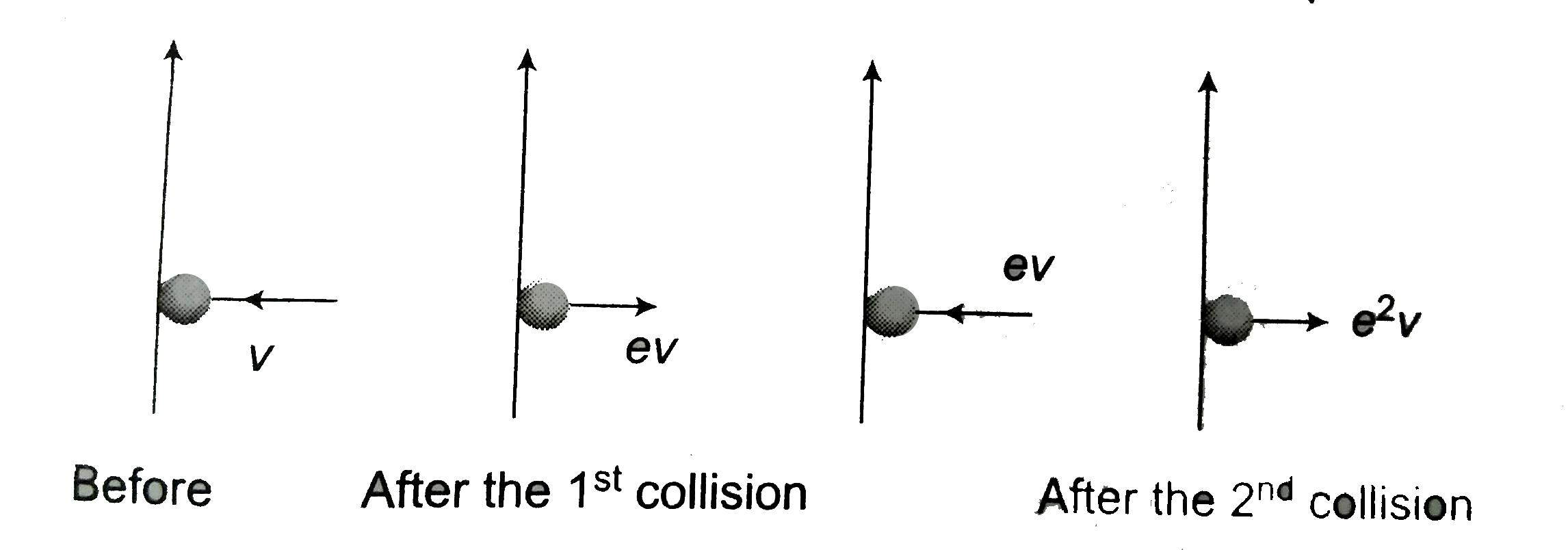 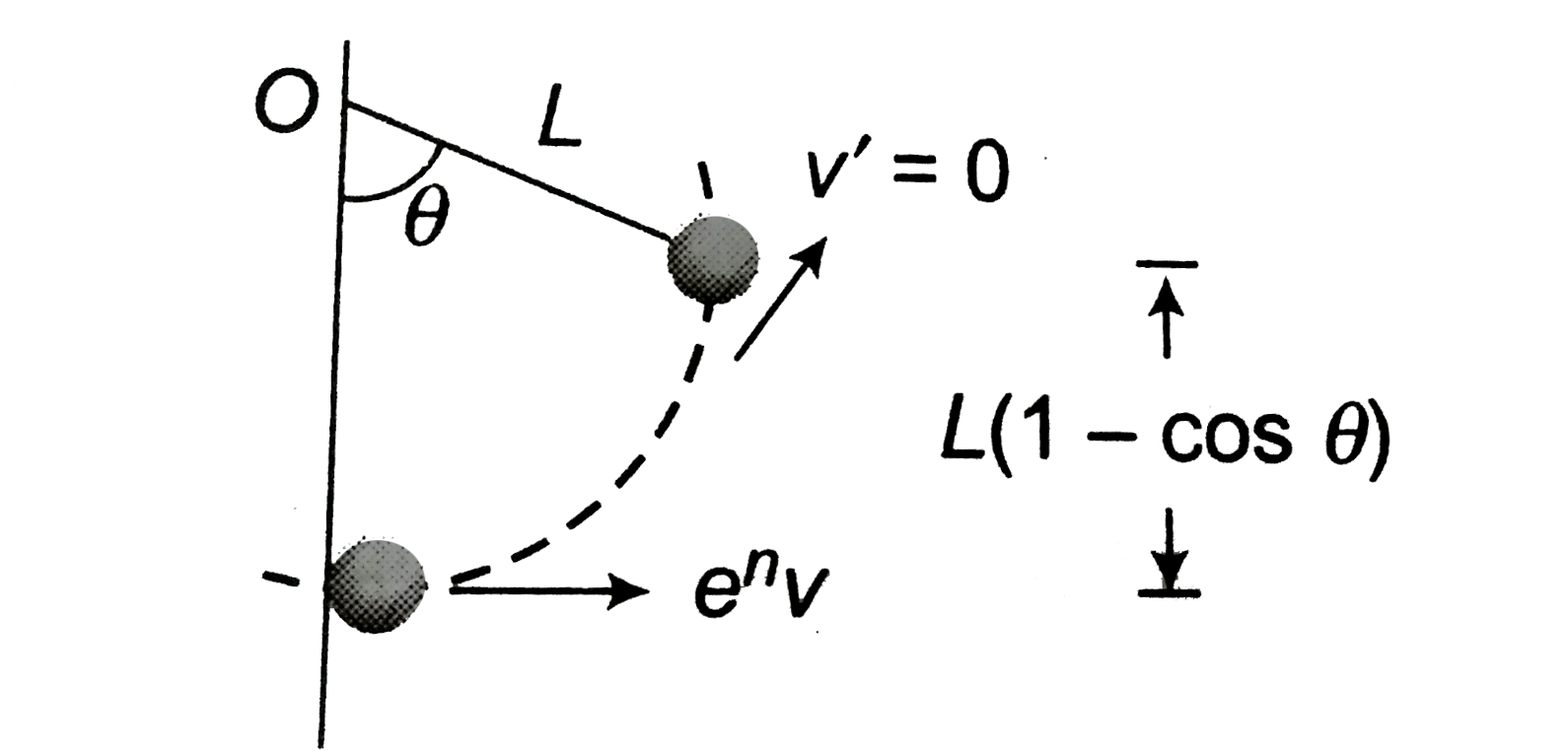
|
|
| 49. |
What do you mean by Mean free path? Give an quation for Mean free path. |
|
Answer» Solution :The mean FREE PATH of a gas molecule is DEFINED as the average distance TRAVELLED by the molecule between two successive collisions. Mean free path `lemda = 1/(sqrt2npid^2)` |
|
| 50. |
If the unit of mass is alpha kg,the unit of length is beta metre and the unit of time is .gamma. second, The magnitude of calorie in the new system is (1 Cal = 4.2J) |
|
Answer» `4.2 alpha^(2) BETA^(2) GAMMA^(2)` new units |
|