

Saved Bookmarks
This section includes 7 InterviewSolutions, each offering curated multiple-choice questions to sharpen your Current Affairs knowledge and support exam preparation. Choose a topic below to get started.
| 1. |
When drops of mercury are placed on a clean surfaces of glass , they mergeand becomes single drop explain . |
| Answer» SOLUTION :The adhesive force between MERCURY MOLECULES and glass molecules are weak , while cohesive force between molecule -molecule of mercury are strong .HENCE ,mercury drop does not stick to the surface of glass and gathered to form a LARGE drop . | |
| 2. |
Effect of friction between pulley and thread : In ideal cases i.e., when pulley and strings are massless and no friction exists at any contact surface, then tension in the string is constant throughout its length. But consider a, massless pulley and massless string but friction exists between pulley and string With coefficient mu. Then tension at the two ends of the pulley will be different. As shown in figure, consider an element of string : dN=(T+dT) "sin" (d theta)/2+T "sin"(d theta)/2 (T+dT)"cos"(d theta)/2 -T"cos"(d theta)/2-mu dN=dr a=0 (massless strings) dT"cos"(d theta)/2=mu dN dT"cos"(d theta)/2=mu [(T+dt) "sin" (d theta)/2+T "sin" (d theta)/2] dt."cos" (d theta)/2=mu[T "sin" (d theta)/2+dT. "sin" (d theta)/2+T "sin" (d theta)/2] dT=mu[T. (d theta)/2+0+T(d theta)/2]=mu T cos theta int_(T_(1))^(T_(2)) (d T)/T=int _(0)^(pi)mu d theta rArr ln(T_(2)/T_(1))=mu pi rArrT_(2)/T_(1)=e^(mu pi) Suppose cofficient of friction between the string and pulley is mu =1/pi The tension on side of lighter mass will be: |
|
Answer» `m_(1)G` |
|
| 3. |
How is the resultant of two like parallel forces obtained, using the theorem of moments ? |
|
Answer» <P> Solution :Taking moments of forces P and Q about 'c' , we get `Pbar(AC)=Qbar(BC)`MOMENT of P about O=`Pbar(AO)` Moment of Q about O=`Qbar(BO)` Algebraic SUM of moments of forces about O=`Pvar(AO)+Qbar(BC)` `=P(AC+OC)+Q(OC-BC)` `=Pbar(AC)+Pbar(OC)+Qbar(OC)+Qbar(BC)` `=(P+Q)bar(OC)` `:.Pbar(AO)+Qbar(BO)=Rbar(OC)` 
|
|
| 4. |
The bob of a simple pendulum is hollow. Now its time period is T, If it is partially filled with water the time period will be |
|
Answer» More than T |
|
| 5. |
Effect of friction between pulley and thread : In ideal cases i.e., when pulley and strings are massless and no friction exists at any contact surface, then tension in the string is constant throughout its length. But consider a, massless pulley and massless string but friction exists between pulley and string With coefficient mu. Then tension at the two ends of the pulley will be different. As shown in figure, consider an element of string : dN=(T+dT) "sin" (d theta)/2+T "sin"(d theta)/2 (T+dT)"cos"(d theta)/2 -T"cos"(d theta)/2-mu dN=dr a=0 (massless strings) dT"cos"(d theta)/2=mu dN dT"cos"(d theta)/2=mu [(T+dt) "sin" (d theta)/2+T "sin" (d theta)/2] dt."cos" (d theta)/2=mu[T "sin" (d theta)/2+dT. "sin" (d theta)/2+T "sin" (d theta)/2] dT=mu[T. (d theta)/2+0+T(d theta)/2]=mu T cos theta int_(T_(1))^(T_(2)) (d T)/T=int _(0)^(pi)mu d theta rArr ln(T_(2)/T_(1))=mu pi rArrT_(2)/T_(1)=e^(mu pi) Suppose cofficient of friction between the string and pulley is mu =1/pi The tension on side ofheavier\nass will be: |
|
Answer» `m_(1)g` |
|
| 6. |
Effect of friction between pulley and thread : In ideal cases i.e., when pulley and strings are massless and no friction exists at any contact surface, then tension in the string is constant throughout its length. But consider a, massless pulley and massless string but friction exists between pulley and string With coefficient mu. Then tension at the two ends of the pulley will be different. As shown in figure, consider an element of string : dN=(T+dT) "sin" (d theta)/2+T "sin"(d theta)/2 (T+dT)"cos"(d theta)/2 -T"cos"(d theta)/2-mu dN=dr a=0 (massless strings) dT"cos"(d theta)/2=mu dN dT"cos"(d theta)/2=mu [(T+dt) "sin" (d theta)/2+T "sin" (d theta)/2] dt."cos" (d theta)/2=mu[T "sin" (d theta)/2+dT. "sin" (d theta)/2+T "sin" (d theta)/2] dT=mu[T. (d theta)/2+0+T(d theta)/2]=mu T cos theta int_(T_(1))^(T_(2)) (d T)/T=int _(0)^(pi)mu d theta rArr ln(T_(2)/T_(1))=mu pi rArrT_(2)/T_(1)=e^(mu pi) Suppose cofficient of friction between the string and pulley is mu =1/pi What should be the ratio of heavier mass to lighter mass for no motion ? |
| Answer» ANSWER :a | |
| 7. |
Effect of friction between pulley and thread : In ideal cases i.e., when pulley and strings are massless and no friction exists at any contact surface, then tension in the string is constant throughout its length. But consider a, massless pulley and massless string but friction exists between pulley and string With coefficient mu. Then tension at the two ends of the pulley will be different. As shown in figure, consider an element of string : dN=(T+dT) "sin" (d theta)/2+T "sin"(d theta)/2 (T+dT)"cos"(d theta)/2 -T"cos"(d theta)/2-mu dN=dr a=0 (massless strings) dT"cos"(d theta)/2=mu dN dT"cos"(d theta)/2=mu [(T+dt) "sin" (d theta)/2+T "sin" (d theta)/2] dt."cos" (d theta)/2=mu[T "sin" (d theta)/2+dT. "sin" (d theta)/2+T "sin" (d theta)/2] dT=mu[T. (d theta)/2+0+T(d theta)/2]=mu T cos theta int_(T_(1))^(T_(2)) (d T)/T=int _(0)^(pi)mu d theta rArr ln(T_(2)/T_(1))=mu pi rArrT_(2)/T_(1)=e^(mu pi) Suppose cofficient of friction between the string and pulley is mu =1/pi If m_(2)=2emthen acceleration of each mass is : |
|
Answer» `G` |
|
| 8. |
(A) : Two solid cylinders of different masses and radii take same time to roll down an inclined plane without slipping.(R ) : Moment of inertia of two solid cylinders of different masses and radii about their natural axes are different. |
|
Answer» Both (A) and (R ) are TRUE and (R ) is the CORRECT explanation of (A) |
|
| 9. |
A force of 5 N acts on a body for 2 milliseconds. Calculate the impulse. If the mass of the body is 5g, calculate the change of velocity. |
| Answer» ANSWER :A | |
| 10. |
A lift of mass m is supported by a cable that can with stand a force of 3gm . Find the shortest distance in which the lift can be stopped when it is descending with a speed of g//4. |
|
Answer» |
|
| 11. |
One litre of air at 76 cm of mercury is compressed to a pressure of 152 cm of mercury under isothermal conditions. What is the new volume ? |
|
Answer» <P> Solution :`V _(2) = P _(1) V _(1) //P_(2) = 76 xx 1//152 = 0.5` LITRE `= 500 xx 10 ^(-6) m ^(3)` |
|
| 12. |
During a cyclone, bits of paper, leaves from a tree, etc., enter the twister and move upwards revolving continuously. Explain. |
| Answer» Solution :During a cyclone, the velocity of AIR inside the twister is greater that of air outside it and hence the air pressure within the twister becomes LOW. So, bits of paper, leaves, etc. ENTER the centre of the twister from the outer high pressure zone. Inside the twister, the speed of air in the upward direction is higher, so the pieces of paper, leaves, etc., KEEP MOVING upwards revolving continuously. | |
| 13. |
A pendulum that beats seconds on the surface of the earth were taken to a depth of (1/4)th the radius of the earth. What will be its time period of oscillation? |
|
Answer» 5.107 sec |
|
| 14. |
(A): For observing traffic at our back, we prefer to use a convex mirror. (R ) A convex mirror has a much larger field of view than a plane mirror or a concave mirror. |
|
Answer» Both A and R are TRUE and R is the correct EXPLANATION of A |
|
| 15. |
10 kg of water gets frozen at 0^(@)C in a refrigerator kept in a room at 20^@C . The time taken for this is 30 minutes . Considering it to be a cannot refrigerator |
|
Answer» Heat extracted from ICE is 800 k cal |
|
| 16. |
How are large time intervals method? |
| Answer» Solution :Large time INTERVALS are MEASURED USING carbon dating method. The time si measured by determining the ratio of decayed RADIOACTIVE atoms to remaining undecayed atoms. | |
| 17. |
A particle is performing SHM. If its displacement from mean position is x, corresponding acceleration a, kinetic energy K and excess potential energy U, which of the following graphs is/are correct? |
|
Answer»
|
|
| 18. |
If the ice on the polar cap of the earth melts how will it effectthe duration of the day? |
| Answer» SOLUTION :As no external torque works, L = I`omega` = I`((2pi)/T)` = constant. Whenice melts the mass CONCENTRATED near the axis of rotation (polar axis) sperads, thereby INCREASING MI of the earth. Hence, T also increases, i.e., the DURATION of the day increases. | |
| 19. |
A force of (4x^(2)+3x) N acts on a particle which displaces it fromx = 2m to x = 3 m. The work done by the force is |
| Answer» ANSWER :A | |
| 20. |
Consider a one -dimensional motion of a particle with total energy E. There are four regions A,B,C and D in which the relation between potential energy E. There are four regions A,B,C and D in which the relation between potential energy V, kinetic energy (K) and total energy E is as given below Region A : V gtERegion B: V lt E Region C :K gt E Region D : V gt E . State with reasons in each |
|
Answer» SOLUTION :We know that Total energy `E = PE +KE` `E = V+K ""…..(i)` For region A : Given `V gt E` From Eq. (i) `K = E -V` as ` V gt E RARR E -V lt 0 ` HENCE , `K lt 0 ` , this is not possible . For region B : `V lt E rArr E - V gt 0 ` This is possible because total energy can be GREATER than PE(V) . or region C : Given , `K gt E rArr K - E K - ZE lt 0 ` Which is possible , because PE can be negative . For region D :Given `V gt K ` This is possible because for a system pE (V) MAY be greater than kE (K) . |
|
| 21. |
A particle performs linear SHM of period (2pi)/(omega) about a centre 'O' and is observed to have a velocity bomegasqrt(3) when at a distance b from O'. If the particle is moving towards the positive extremity at that instant, show that it will travel a further distance b in a time (pi)/(3omega) before coming momentarily to rest. |
|
Answer» Solution :Given `T= (2PI)/(omega), v= bomegasqrt(3)` and x=b substituting in `v= omegasqrt(A^(2)-x^(2))` we get `bomegasqrt(3)= omegasqrt(A^(2)-b^(2))` Squaring , `3b^(2)omega^(2)= omega^(2)(A^(2)-b^(2))` `3b^(2) = A^(2)-b^(2) implies 4b^(2)= A^(2) implies A= +-2b` The time TAKEN (t) to travel from the mean position to a distance b can be found from `x= Asin omegat` we have, `x = b, A = 2b:. b=2b sin omegat` `sinomegat= (1)/(2), omegat= (pi)/(6) implies t= (pi)/(6omega)` `:.` Further time taken to reach the extreme position `= (T)/(4)- (pi)/(6omega)= (2pi)/(4omega)-(pi)/(6omega)= (pi)/(3omega)` It will momentarily come to REST when it reaches the positive extreme position. Further distance travelled = A-b=2b-b=b |
|
| 22. |
The cylindrical tube of a spray pump has radius R, one end of which has 'n' fine holes, each of radius r. If the speed of the liquid in the tube is V, what is the speed of the ejection of the liquid through the holes. |
|
Answer» Solution :LET the required SPEED by `v.` ACCORDING to equation of CONTINUITY `a.v. = av` `v. = (av)/(a.) = (piR^2 V)/(n pi r^2) implies v. = (R^2v)/(nr^2)`. |
|
| 23. |
Two blocks A and B are joined by means of a slacked string passing over a massless pulley as shown in Figure. The system is released from rest and it becomes taut when B falls a distance 0.5 m. a. Find the common velocity of the two blocks just after the string becomes taut. b. Find the magnitude of impulse on the pulley by the clamp during the small interval while string becomes taut. |
|
Answer» `v_(B)=sqrt(2g/_\h)=sqrt10m//s` a. common velocity =v `:. (m_(A)+m_(B))v=m_(B)v_(B)impliesv=v_(B)/3=(sqrt(10))/3m//s` b. magnitude of impulse on `A =` MAGITUDE of impulse on `B=1(sqrt(10)-(sqrt(10))/3)=2/3sqrt(10)m//s` THEREFORE, impulse on pulley `=sqrt(2)` impulse on `A=4/3sqrt(5)Ns` |
|
| 24. |
When a rigid body is rotating, every point in it describes a ciruclar path |
|
Answer» Only if the AXIS of rotation PASSES symmertrically through the CENTRE of GRAVITY of the body |
|
| 25. |
Two identical rods 1 and 2 each of mass M and length L are performing general plane motion on the horizontal planeas shown in the figure. If v is velocity of centre of mass of both the rods and omega is the angular speed about the vertical axis then angular momentum of rod 1 in the frame of reference of centre of mass of rod 2 at the instant will be |
|
Answer» |
|
| 26. |
If R is the radius of earth, the height at which the weight of a body becomes 1/4thits weight on the surface of the earth is |
|
Answer» 2R |
|
| 27. |
Compare the impulses exerted on a wall by the two objects, a golf ball and a lump of mud, both having the same mass and the velocity. |
|
Answer» the golfball imparts GREATER impulse |
|
| 28. |
Two ball buildings are 40 m apart. With what speed must a ball be thrown horizontally from a window 145m above the ground in one building, so that it will enter a window 22.5 m above the ground in other ? |
|
Answer» 4m/s |
|
| 29. |
Velocity - time graph for the motion of a certain body is shown in Fig. Explain the noture of this motion . Find the initial velocity and acceleration and write the equation for the variation of displacement with time. What happens to the moving body at point B? How will the body move after this moment? |
|
Answer» Solution :The velocity- time GRAPH is a straight line with-ve SLOPE , the motion is uniformly retarding one upto POINT B and uniformly accelerated after with - ve side of velocity axis. At point B the body stops and then its direction of velocity reversed. The INITIAL velocity at point A is `v_(0)=7ms^(-1)` The acceleration `a=(Deltav)/(Deltat)=(v_(f)-v_(0))/(Deltat)=(0-7ms^(-1))/(11S)=-7/(11)ms^(-2)` `=-0.6364ms^(-2)=-0.64ms^(-2)` The equation of motion for this body for veriation of displacement with time is `s=7t-1/20.64t^(2)=7t-0.32t^(2)` If B the body of instantaneous test and then reverse direction 
|
|
| 30. |
Consider a particle of mass m having linear momentum vecp at position vecr relative to the origin O . Let vecL be the angular momentum of the particle with respect to the origin . Which of the following equations correctly relate (s) vecr , vecp and vecL ? |
|
Answer» `(dvecL)/(dt) + vecr XX (d VECP)/(dt) = 0` |
|
| 31. |
according to kinetic theory of gases, at absolute zero of temperature |
|
Answer» WATER freezes |
|
| 32. |
Area of the triangle whose base is given by bar(A) =i + j + k and one of the two sides by bar(B) =4j + 3k is |
|
Answer» `sqrt26` |
|
| 33. |
A disc of radius R is rotating with an angular omega_(0) about a horizontal axis. It is placed on a horizontal table. The coefficient of kinetic friction is mu_(k). (a) What was the velocity of its centre of mass before being brought in contact with the table? (b) What happens to the linear velocity of a point on its rim when placed in contact with the table? (c) What happens to the linear speed of the centre of mass when disc is placed in contact with the table? (d) Which force is responsible for the effects in (b) and (c )? (e) What condition should be satisfied for rolling to being? (f) Calculate the time taken for the rolling to begin. |
|
Answer» Solution :(a) The disc was in pure rotational motion before being brought in contact with the table, hence `u_(CM)=0` (b) Velocity of a point on the rim decreases when the disc is placed in contact with the table due to friction. (c ) Centre of mass ACQUIRES some LINEAR velocity when the rotating disc is placed in contact with the table due to friction. (d) Friction is responsible. (E) When rolling starts `v_(CM)=omegaR`. (f) Acceleration produced in centre of mass due to friction. `a_(CM)=(f)/(m)=(mu_(K)N)/(m)=(mu_(K)mg)/(m)=mu_(K)g` Angular retardation produced by the torque due to friction. `alpha=(tau)/(I)=(mu_(K)mgR)/(I)" "[because tau=fR=mu_(K)mgR]` `therefore v_(CM)=u_(CM)+a_(CM)t (because u_(CM)=0)` `therefore v_(CM)=mu_(K)g t` Now `omega=omega_(0)+ALPHAT` `therefore omega=omega_(0)-(mu_(K)mgR)/(I)t` For rolling without slipping, `(v_(CM))/(R)=omega` `therefore (v_(CM))/(R)=omega_(0)-(mu_(K)mgR)/(l)t` `(mu_(K)g t)/(R)=omega_(0)-(mu_(K)mgR)/(l)t` `t=(Romega_(0))/(mu_(K)g(1+(mR^(2))/(l)))` |
|
| 34. |
A particle of mass 0.5 kg travels in a straight line with velocity v = ax^(3//2), where a = 5 m^(-1//2) s^(-1). What is the work done by the net force during its displacement from x = 0 to x = 2 ? |
|
Answer» |
|
| 35. |
The potential energy for a conservative system is given by U = ax^2 - bx where a and b are positive constants. The law of the force governing the system is |
|
Answer» F = CONSTANT `:. F = - d/(dx) (ax^2 - bx) = - (2ax - b) = b - 2ax`. |
|
| 36. |
Calculate the minimum force required to drag a body of mass m, resting on a horizontal surface. The coefficient of friction between the body and the surface is mu. |
|
Answer» Solution :Let the applied force be F, acting at an angle `theta` with the HORIZONTAL FIG. `f_(2)` = force of limiting friction, mg = weight of the body and R = NORMAL force. For equilibrium, `R+F sintheta = mg """or"`, R = mg - F sin`theta` and F cos `theta = f_(s) = mu R= mu (mg- F sin theta`) or, F cos `theta +muF sin theta = mu`mg `:. F = (mu mg)/(cos theta+musin theta)` Value of F will be minimum when ( cos`theta +mu sin theta`) is maximum. `:. (d)/(d theta) (cos theta +mu sin theta) = 0 ` or , - sin `theta +mucos theta = 0 """or", tan theta = mu ` `:.sin theta = (mu)/(SQRT(1+mu^(2))),"and cos"theta = (1)/(sqrt(1+mu^(2)))` `:. F_("min")= (MUMG)/((1)/(sqrt(1+mu^(2)))+(mu^(2))/(sqrt(1+mu^(2))))=(mumg)/(sqrt(1+mu^(2)))" ""and"theta= tan^(-1)mu` 
|
|
| 37. |
A load (M) suspended from a wire produces an elongation (e ) in the wire then find the rise in temperature required to produce same elongation in the same wire. |
|
Answer» Solution :`Y=(((F)/(A)))/(((Deltal)/(l)))""alpha=(Deltal)/(l(Deltal))` `Deltal=(Mgl)/(AY)…….(1)""Deltal=lalpha Delta t……….(2)` But from data `(Mgl)/(AY)=l alphaDeltat rArr DELTAT=(Mg)/(AY alpha)` |
|
| 38. |
The ring M_(1) and block M_(2) are held in the position shown in fig. Now the system is released. If M_(1) gt M_(2), find V_(1)//V_(2) wheb the ring m_(1) slides down along the smooth fixed vertical rod by the distance h. |
|
Answer» Solution :Method 1: Let ring has moved down a distance y. From fig., we have `y^(2)+l^(2)=s^(2)`…(i) Here l is the length of string which is constant. Differentiating (i) w.r.t. time, we get 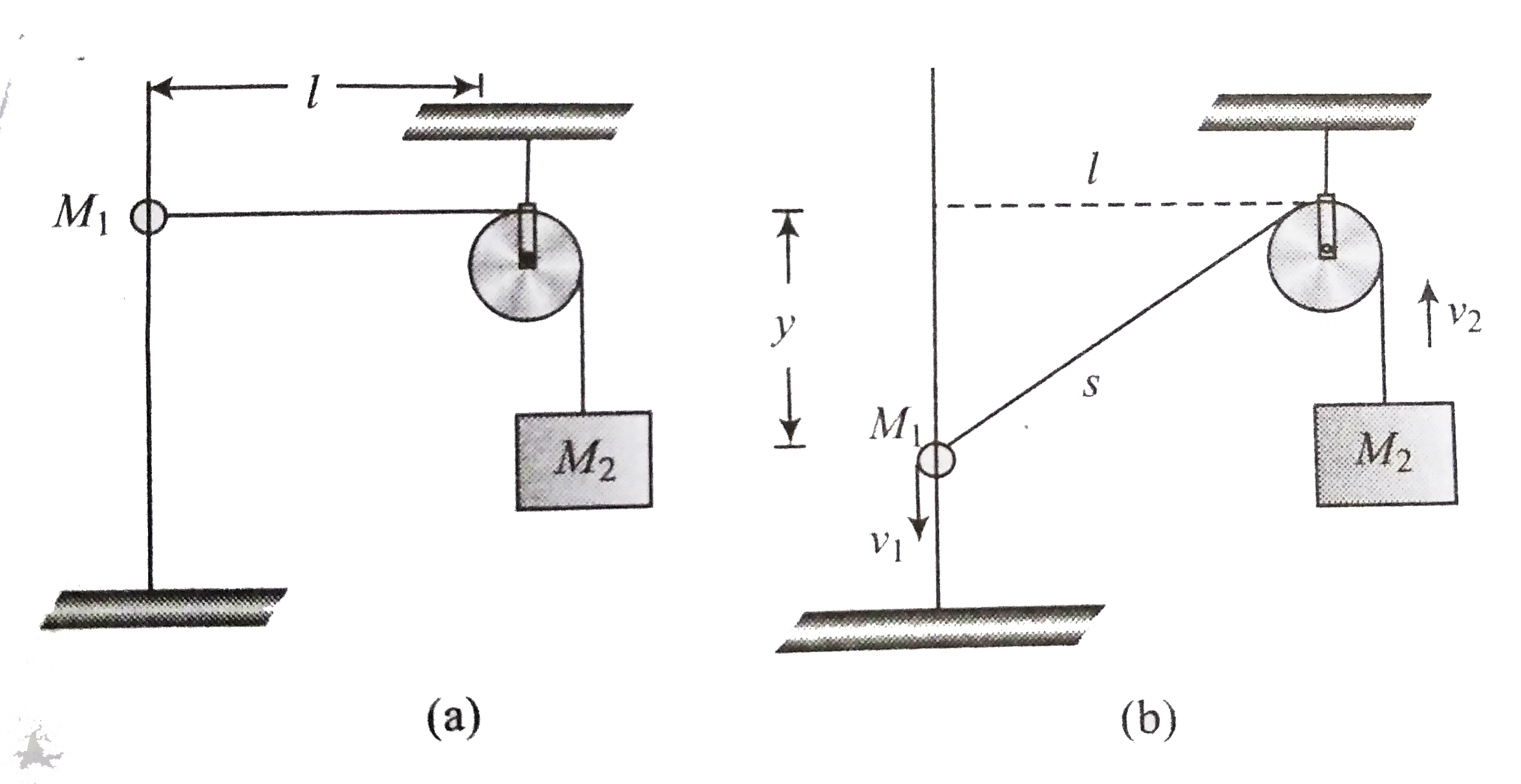 `2y(dy)/(DT)+0=2S(ds)/(dt) or (dy)/(dt)=(s)/(y)*(ds)/(dt)` ...(ii) Here `(dy)/(dt)=v_(1)` and `(ds)/(dt)=v_(2)`. For `y=h, s=sqrt(h^(2)+l^(2))` Therefore, Eq(ii) takes the from `v_(1)=(sqrt(h^(2)_l^(2)))/(h).v_(2) or (v_1)/(v_2)=(sqrt(h^(2)+l^(2)))/(h)` Method 2: Let in time t the ring falls to point A which is a distance h below the ring's initial position. 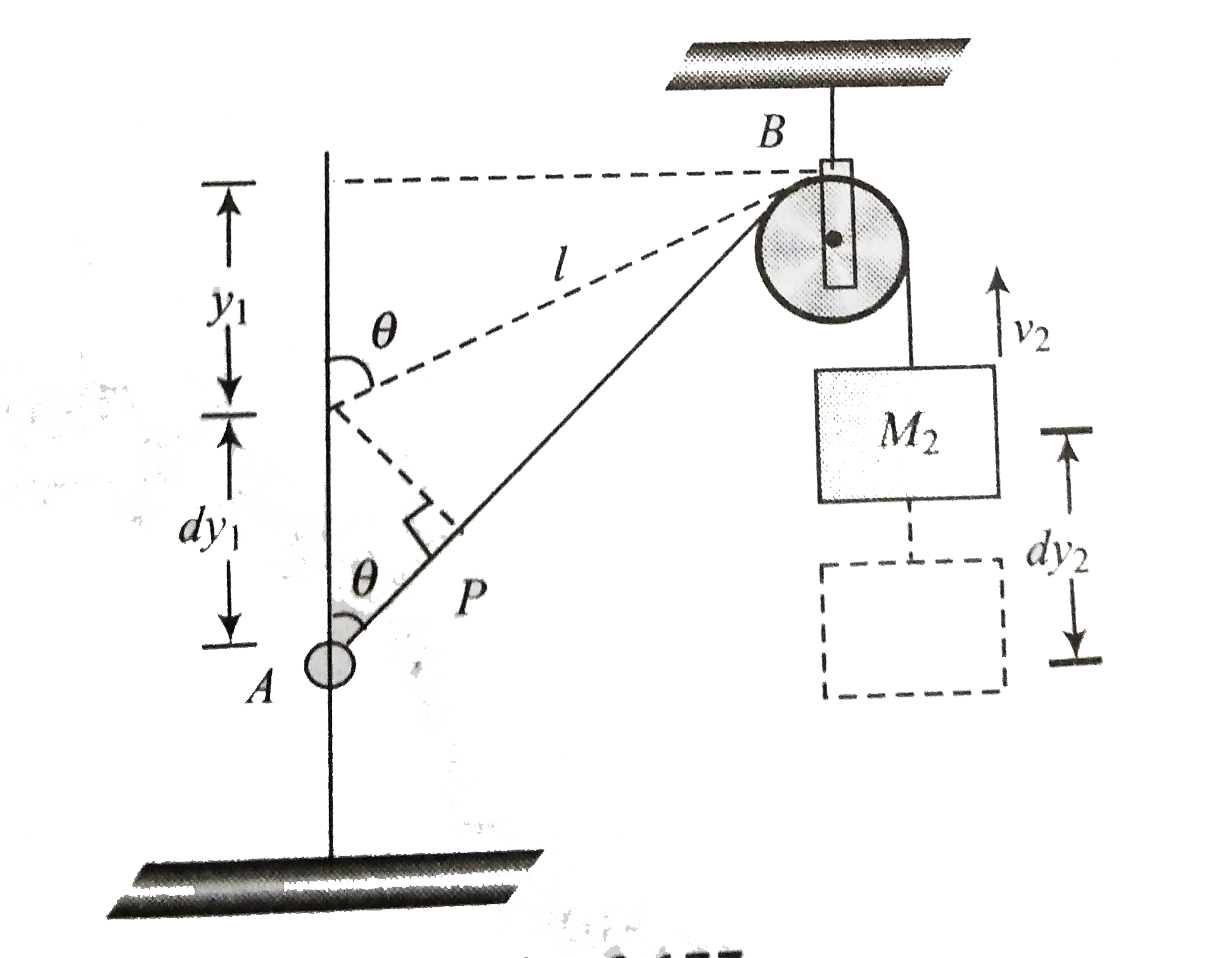 At this position, the string makes an angle `theta` with rod in small time interval dt, the ring moves down to A' and the block rises by `dy_(2)`. Let us DRAW a perpendicular AP from A to AB. As the length of the string is constant `:. A'P=dy_(2)` But `A'P=dy_(1) COS theta` `:. dy_(1) cos theta=dy_(2)` Dividing both sides by dt, we get `((dy_(1))/(dt)) cos theta =((dy_(2))/(dt))`. Here `(dy_(1))/(dt)=V_(1)`, the rate of change of position of ring with time and `(dy_(2))/(dt) =V_(2)`, the rate of change position of block with time. Thus, we have `V_(1) cos theta = V_(2)` or `(V_1)/(V_2)=(1)/(cos theta)=(1)/((h)/(sqrt(h^(2)+l^(2))))=(sqrt(h^(2)+l^(2)))/(h)`. |
|
| 39. |
A coin is slidingdown on a smooth hemi-spherical surface of radius R. The height from the bottom, where it looses contact with the surface is |
|
Answer» `R"/"3` |
|
| 40. |
A pointchargeq is at a distancer from the centre O ofanuncharged sphereicalconductinglaryer, whoseinnerand outerradii are equal to a andb respectively . Find thepotential at the pointOif r lt a |
Answer» SOLUTION :Equal amountof charge will be INDUCED on the innerand OUTER SURFACEOF the conductor. Theneach negativechargeatO is `V = (1)/(4 pi in_(0)) ((-q))/(a)`  Similarly due to positivecharge ,potentialat O` V_(+)= (1)/(4 pi in_(0)) (q)/(b)` Potentialat O dueto charge q `V_(0) = (1)/(4 pi in_(0))(q)/(r)` The TOTAL potential `V = V_(0) + V_(-) + V_(+)` ` = (q)/(4pi in_(0)) [(1)/(r) - (1)/(a) + (1)/(b)]` |
|
| 41. |
A cubical block of side .L. rests on a rough horizontal surface with coefficient of friction \i. A horizontal force F is applied on the block as shown in figure. The minimum force required to topple the block is: |
|
Answer» INFINITESIMAL |
|
| 42. |
The maximum load a wire can withstand without breaking, when its length is reduced to half of its original length, will |
| Answer» Answer :D | |
| 43. |
In an adiabatic process temperature remains constant. |
| Answer» SOLUTION :FALSE. Amount of HEAT REMAINS constant. | |
| 44. |
What is sublimation ? Write an example for a sublime material ? |
| Answer» Solution :The change of the state from SOLID to VAPOUR without passing through the LIQUID state is CALLED SUBLIMATION. E.g. Naphthelene. | |
| 45. |
A car is moving with a constant acceleration and initial velocity 2 ms^(-1)on a straight path. After 10 s it attains the velocity 12 ms^(-1). Then find the distance covered by it in this 10 s. |
|
Answer» Solution :`v _(0) = 2ms ^(-1) , v = 12 ms ^(-1) , t = 10s` `therefore a = (v -v _(0))/( t ) = (12 -2)/(10) = 1 ms ^(-2)` Now, `x = v _(0)t + 1/2 at ^(2)= (2) (10) + 1/2 (1) (10) ^(2) = 70 m` |
|
| 46. |
A horizontal surface moves up and down in SHM with an amplitude of 1 cm. If a mass of 10 kg which is placed on the surface is remain continuously in contact with it the maximum frequency of SHM will be………… |
|
Answer» Solution :The mass will remain in contact with surface if `mg= m omega^(2)a` `thereforew= 2pi F= sqrt((G)/(a))""` (where, a= amplitude) `therefore f= (1)/(2pi) sqrt((g)/(a))` `therefore f= (1)/(2xx 3.14)sqrt((980)/(1))` `therefore f= 4.98 Hz approx 5 Hz`. |
|
| 47. |
A bock of mass M is on a horizontal table and is connected to an inextensible string. The string passes over a frictionless pulley fitted at one edge of the table. At the other end, another block of mass m hangs vertically. Coefficient fo friction between the table and the block of mass is mu. Find the acceleration of the system. |
| Answer» SOLUTION :`(mg-muMg)/(M+m),(MMG)/(M+m)(1+mu)` | |
| 48. |
A capillary tube is attached horizontally to a constant head arrangement. If the radius of the capillary tube is increased by 10% ther the rate of flow of liquid will change nearly by |
| Answer» ANSWER :B | |
| 49. |
A liquid flows through two capillary tubes A and B connected in series. The length and length of B are twice that of A. The ratio of pressure difference across A and across B |
|
Answer» 1 |
|
| 50. |
Consider a geosynchronous communications satellite of mass m placed in an equitorial circular orbit of radius r_(0). These satellite have an "apogee engine" which provides the thrusts needed to reach the final orbit. Once an error by the ground controllers causes the apogee engine to be fired. the thrust happens to be directed the Earth and, despite the quick reaction of the ground crew to shut the engine off, an unwanted velocity variation Deltav is imparted on the satellite. we characterize this boost by the parameter beta=Deltav//v_(0). the duration of the engine burn is always negligible with respect to any other orbital times, so that it can be considered as instantaneous.[Hing : under the action of central forces obeying the inverse square law, bodies follow trajectories descirbed by ellipses, parabolas or hyperbolas. in the approzimation mlt ltM the gravitating mass M is at one of the focuses. where l is a positive constant named the semilatus rectum and epsilon is the eccentricity of the curve. in terms of constants of motion: l=(L^(2))/(GMm^(2)) and epsilon=(1+(2EL^(2))/(G^(2)M^(2)m^(3)))^(1//2) where G is the Newton constant, L is the modulus of the angular momentum of the orbiting mass, with respect to the origin, and E is its mechanical energy, with zero potential energy at infinity. suppose betalt1 Determine what kind of trajectorythe satellite will take |
|
Answer» PARABOLIC |
|


