

Saved Bookmarks
This section includes 7 InterviewSolutions, each offering curated multiple-choice questions to sharpen your Current Affairs knowledge and support exam preparation. Choose a topic below to get started.
| 1. |
Assume that a tunnel is dug along a chord of the earth, at a perpendicular distance R//2 from the earth's centre where R is the radius of the earth. The wall of the tunnel is frictionless. (a) Find the gravitational force exerted by the earth on a particle of mass m placed in the tunnel at a distance x from the centre of the tunnel. (b) Find the component of this force along the tunnel and perpendicular to the tunnel. (c) Find the normal force exerted by the wall on the particle. (d) Find the resultant force on the particles. (e) Show that the motion of the particle in the tunnel is simple harmonic and find the time period. |
Answer» Solution :(a)  The mass of sphere of radius R `M^'=(M)/(4/3piR^3)*4/3pir^3=(Mr^3)/(R^3)` M: mass of earth `F=(GM^'m)/(r^2)=(GMm)/(R^3)r=(GMm)/(R^3)SQRT(x^2+R^2/4)` (b) 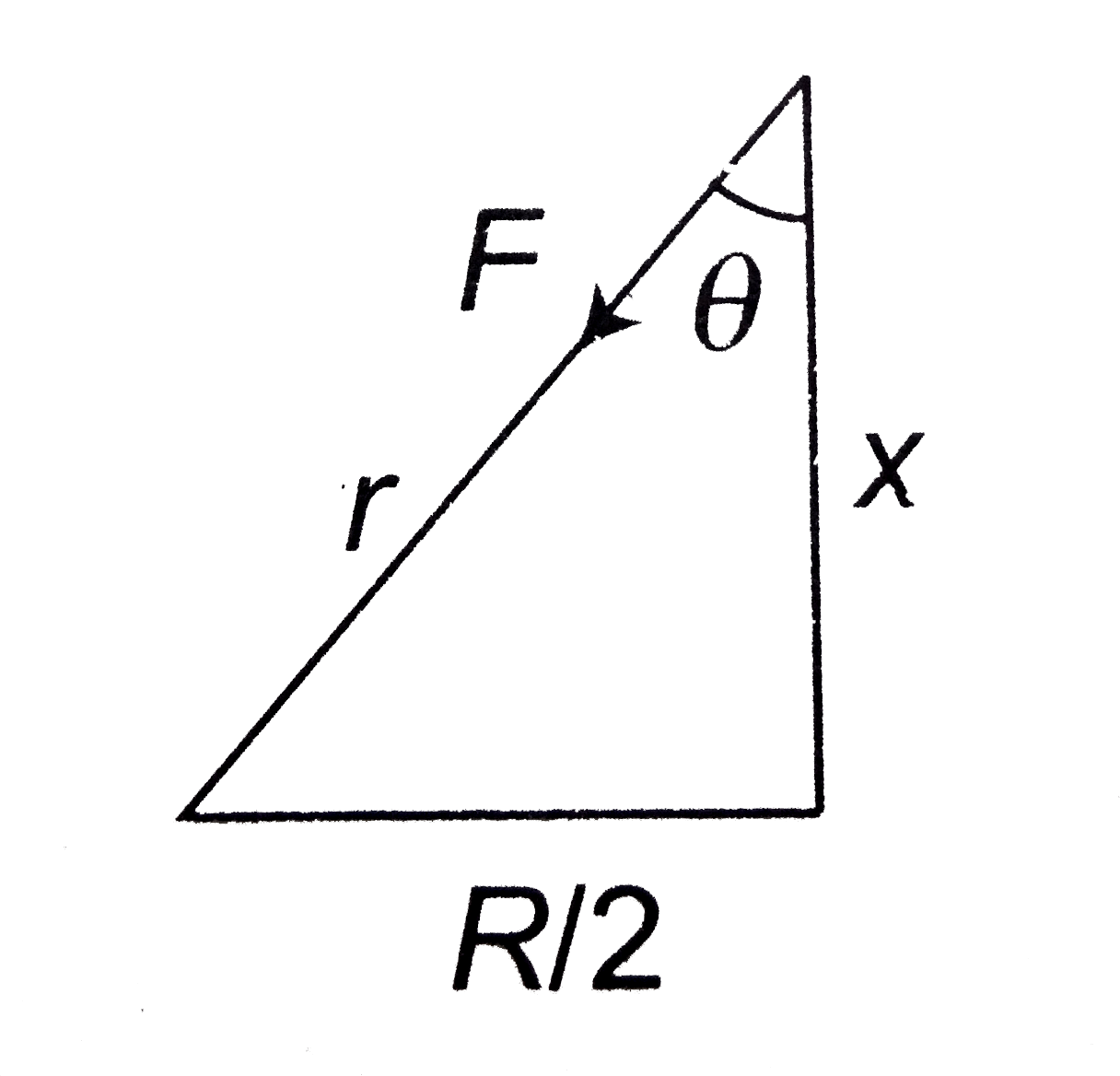 COMPONENT of force (i) ALONG the tunnel `Fcostheta=Fx/r=(GMm)/(R^3)x` (ii) `_|_^(ar)` to the tunnel `Fsintheta=F(R//2)/(r)=(GMm)/(2R^2)` (c) 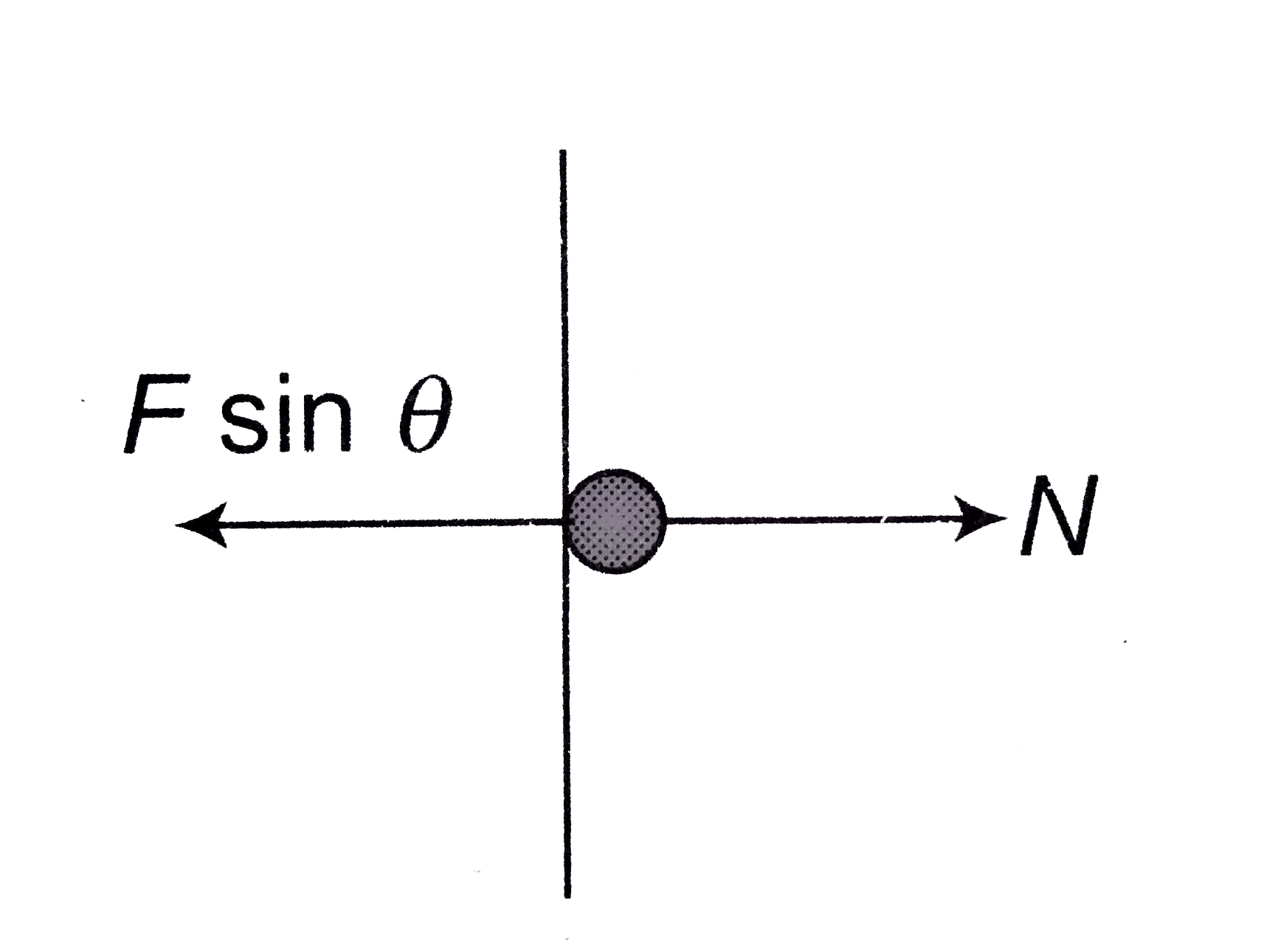 `N=Fsintheta=(GMm)/(2R^2)` (d) Resultant force on particle `=Fcostheta=(GMm)/(R^3)x` (e) Restoring force `F^'=-Fcostheta=-(GMm)/(R^3)x` `a=(F^')/(m)=-(GM)/(R^3)x=-omega^2x` `T=2pisqrt((R^3)/(GM))` |
|
| 2. |
Aglass tube scaled at both end is 1 m long. It lies horizontally with middle 10cm containing Hg. The two ends of the tube, eqaul in length, contain air at 27^(@)C Neglect the chang in length of Hg column. Then the change in length on two sides is |
|
Answer» 12.3 cm `P_(1)=P_(2)=P(say)`  Applying gas law at end A, `(45Ap)/(300)=(45-x)AP_(1)/(273)`.....(II) At end `B(45AP)/(300)=(45+X)AP_(2)/(400)`......(iii) From(i),(ii)and(iii) `(45-X)/(273)=(45+X)/(400) rArr = X=8.49` |
|
| 3. |
If three particles each of mass m are placed at the three corners of an equilateral triangle of side l, the work done if the side of that triangle is increased to 2l is |
|
Answer» `(3GM^(2))/(l)` |
|
| 4. |
Show that moment of a couple does not depend on the point about which you take the moments. |
Answer» SOLUTION :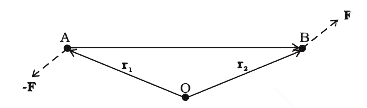 Consider a couple as shown in Fig. 7.22 ACTING on a rigid body. The forces `F and -F` act respectively at points B and A. These points have position vectors `r_(1) and r_(2)` with respect to origin O. Let us TAKE the moments of the forces about the origin. The moment of the couple = sum of the moments of the two forces making the couple `=r_(1)xx(-F)+r_(2)xxF` `=r_(2)xxF-r_(1)xxF` `=(r_(2)-r_(1))xxF` But `r_(1)+AB=r_(2)`, and hence `AB=r_(2)-r_(1)`. The moment of the couple, therefore, is `AB × F`. Clearly this is INDEPENDENT of the origin, the point about which we TOOK the moments of the forces. |
|
| 5. |
Obtain the resultant wave of more than two wave functions by representing the superposition principle mathematically. |
|
Answer» Solution :Let `y _(1) (x,t) and y _(2) (x,t)` be the displacement that any element of the string would EXPERIENCE if each wave travelled alone. The displacement y(x,t) of an element of the string when the waves overlap is then given by, `y (x,t) =y _(1) (x,t) +y_(2) (x,t)""...(1)` If we have two or more waves moving in the medium the RESULTANT waveform is the sum of wave functions of individula waves. `y _(1) =f _(1) (x-vt)` `y _(2) =f_(2) (x-vt)` ---- ---- If `y _(n) = f _(n) (x-vt),` then resultant wave FUNCTION, `y =f _(1) (x-vt) + f _(2) (x-vt)+,....f _(n) (x-vt)` `therefore y = sum _(i =1) ^(n)f _(i) (x - vt) ` where ` i=1,2,3,...,n` The PHENOMENON of superpostition of two waves of a same medium is called interfeference. |
|
| 6. |
Find the value of lamda so that the vector vecA=2hati+lamdahatj+hatkandvecB=4hati-2hatj+2hatk perpendicular to each other. |
| Answer» SOLUTION :`:.vecAbotvecBimpliesvecA.vecB=0implieslamda=3` | |
| 7. |
A boy and a man carry a uniform rod of length 'L' horizontally in such way that the boy get 1//4 of the loqd. If the boy is at one end rod distance of the man from the other rend is |
|
Answer» `L//6` |
|
| 8. |
Glycerine flows steadly through a horizontal tube of length 1.5 m and radius 1.0 cm. IF the amount of glycerine collected per second at one end is 4.0 times 10^-3 kg s^-1. What is the pressure difference between the two ends of the tube?(density of glycerine =1.3 times 10^3 kg m^-3 and viscosity of glycerine =0.83 Pa s).[You may also like to check If the assumption of laminar flow in the tube is correct] |
| Answer» Solution :`9.8 TIMES 10^2 PA` (The REYNOLDS number is about 0.3 so the flow is LAMINAR) | |
| 9. |
Two balls are dropped from the same height from places A and B. The body at B takes two seconds less to reach the ground at B and strikes the ground with a velocity greater than at A by 10 m/s. The product of the acceleration due to gravity at the two places A and B is |
|
Answer» 5 |
|
| 10. |
What is longitudinal stress? |
| Answer» SOLUTION :when the deforming FORCE acts ALONG the length of the body stress produced is called longitudinal stress | |
| 11. |
The area of cross-section of a wire is 10^(-5) m^2when its length is increased by 0.1% a tension of 1000N is produced. The Young's modulus of the wire will be |
|
Answer» `10^12 NM^(-2)` |
|
| 12. |
What is the ratio between the distance travelled by the oscillator in one time period and amlitude? |
|
Answer» Solution :Distance TRAVELLED by OSCILLATOR in one TIME period, `d= A+ A+ A+ A` `therefore d= 4A`, where A = AMPLITUDE The ratio of distance travelled and amplitude, `(d)/(A)= (4A)/(A)= 4`  . .
|
|
| 13. |
The figure shows a smooth track, a part of which is a circle of radiur R. A block ofmas m is pushed against a spring of spring constant K fixed at the left end and is then released. Find the initial compression of the spring so that the block presses the track with a force mg when it reaches the point P, where the radius of the track is horizontal? |
|
Answer» `SQRT((mgR)/K)` |
|
| 14. |
If amplitude of particle executing SHM is doubled which of the following quantities are doubled (a) Time period(b) Maximum velocity (c) Maximum acceleration (d) Total energy |
|
Answer» B and c |
|
| 15. |
In our solar system, the inter-planetary region has chunks of matter (much smaller in size compared to planets) called asteroids. They |
|
Answer» will not move around the sun, since they have very small masses compared to the sun |
|
| 16. |
Explain the kinds of multiplication operations for vectors . |
|
Answer» Solution :There are TWO kind of multiplication of VECTORS : (i) If the product of two vector quantities results into a scalar then the product called a scalar product . This product is also known as DOT product . The scalar products of two vectors `vec(A) and vec(B)`is DENOTED by `vec(A ) . vec(B ) = | vec(A) | |vec(B)|` where A and B are the magnitudes of `|vec (A)|and |vec (B)|` respectively and `theta`is the angle between `vec(A) and vec(B)` (ii) Vector product [Corss product ] : If the product of two vector quantities results into a vector then the product is called a vector product . A vector product is represente d by keeping cross sign `(xx)` between two vectorshence it is also called cross product of vectors . Suppose `theta ` is the angle between `vec(A) and vec(B)`then its vector product is , `vec(A).vec(B ) = |vec(A) ||vec(B)|sin theta hat (n)` `= AB sin theta hat(n)` where `hat(n)`is the unit vector in the direction perpendicular to the plane formed by `hat(A) and hat(B)` and B are the MAGNITUDE of `hat(A) and hat(B)` respectively . |
|
| 17. |
If L = 2.05 cm pm 0.02 cm B = 1.11 cm pm 0.03 cm What are (L + B) and (L - B) equal to ? |
|
Answer» Solution :`L+B = 3.17 cm pm 0.05 cm` `L-B = 0.95 cm pm -0.05 cm` PLEASE NOTE that actual VALUES i.e. 2.06 cm and 1.11 cm are added in case of `(L+B)` and subtracted in case of `(L-B)`, but ABSOLUTE errors are added in both cases. |
|
| 18. |
The velocity of a particle moving in the positive direction of the X-axis varies as V=Ksqrt(S) where K is a positive constant. Draw V-t graph. |
|
Answer» Solution :`V=Ksqrt(s)` `(DS)/(dt)=Ksqrt(S) therefore underset(0)overset(S)int(dS)/(SQRT(S))=underset(0)overset(t)intKdt` `therefore 2sqrt(S)=Kt and S=(1)/(4)K^(2)t^(2)` `impliesV=(dS)/(dt)=(1)/(4)K^(2)2t=(1)/(2)K^(2)t` `therefore Vpropt` `therefore` The `V-t` GRAPH is a straight line passing through the origin 
|
|
| 19. |
The dimensional formula of angular momemtum is |
|
Answer» `ML^(2)T^(-2)` |
|
| 20. |
Linear momentum of a particle given by relation p = a + b t^(2), where a, b are constant and t is time, then force acting on particle is ……….. |
|
Answer» propotional to t `:. , (dp )/( d t) = 0+2bt ` `F = 2 bt, 2b= `constant `F PROP t` |
|
| 21. |
The arrangement shown in figure is in equilibrium with all strings vertical. The end A of the string is tied to a ring which can be slid slowly on the horizontal rod. Pulley P_(1) is rigidly fixed but P_(2) can move freely. A mass m is attached to the centre of pulley P_(2) through a thread. Pulleys and strings are mass less. (a) Which block will move up as A is moved slowly to the right? (b) Will the block of mass m have horizontal displacement?(c) Is it possible, for a particular position of A, that M has no acceleration but m does have an acceleration? If this happens when string from P_(2) to A makes an angle theta with vertical, find the acceleration of m at the instant. |
|
Answer» ` (b) yes (C) `g (1 - "cos"theta)` |
|
| 22. |
In a thermodynamic process the pressure of a fixed mass of gas is changed. In this process gas releases 20J heat and 8J of work is done on the gas. If initial internal energy of the gas was 30J, then final internal energy is |
|
Answer» 2J |
|
| 23. |
A non-uniform bar of weight W is suspended at rest by two strings of negligible weight as shown in figure. The angles made by the strings with the vertical are 36.9^(@) and 53.1^(@) respectively. The bar is 2 m long. Calculate the distance d of the centre of gravity of the bar from its left end. |
|
Answer» Solution :Suppose bar AB is suspended at rest by two strings OA and O.B of negligible weight. The angles made by the strings with the VERTICAL are `36.9^(@)and53.1^(@)` respectively. `angleOA A.=53.1^(@)andangleO.BB=36.9^(@)` `AB=2m` and suppose distance of centre of mass from end A is d.  `T_(1)andT_(2)` are the tensions produced in the left and right strings respectively and their mutual components are shown as in figure. At TRANSLATIONAL equilibrium, `-T_(1)cos53.1^(@)=-T_(2)cos36.9^(@)` `:.T_(1)cos53.1^(@)=T_(2)cos36.9^(@)and....(1)` `T_(1)sin53.1^(@)+T_(2)cos36.9^(@)=W....(2)` Sum of torque at point A `:.-T_(2)sin36.9^(@)xxAB+W.d=0` `:.-T_(2)sin36.9^(@)xx2+W.d=0` `:.T_(2)=(Wd)/(2sin36.9^(@))....(3)` From eqn. (2) and (3) `T_(1)sin53.1^(@)=W-T_(2)sin36.9^(@)` `=W-(Wdsin36.9^(@))/(2sin36.9^(@))` `=W-(Wd)/(2)` `:.T_(1)=(W(1-(d)/(2)))/(sin53.1^(@))....(4)` From eqn. (1) `T_(1)cos53.1^(@)=T_(2)cos36.9^(@)` PUTTING the VALUE of eqn. (2) and (3) `(W(1-(d)/(2))cos53.1^(@))/(sin53.1^(@))=(Wdcos36.9^(@))/(2sin36.9^(@))` `:.(1-(d)/(2))/(tan53.1^(@))=(d)/(2tan36.9^(@))` `:.(1-(d)/(2))/(1.3319)=(d)/(2xx0.7508)` `:.1-(d)/(2)=(d xx1.3319)/(1.5016)` `:.1=0.5d+0.887d` `:.1=1.387d` `:.d=(1)/(1.387)=0.72098` `:.d~~0.721m` `:.d~~72.1cm` |
|
| 24. |
A liquid having coefficient of volume expansion gamma_(0) is filled in a cylindrical glass vessel. Glass has a coefficient of linear expansion of alpha_(g). The liquid along with the container is heated to raise their temperature by DeltaT. Mass of the container is negligible. (a) find relationship between alpha_(g) and gamma_(0) if it was found that the centre of mass of the system did not move due to heating. (b) Find relationship between alpha_(g) and gamma_(0) if the fraction of volume of the container occupeid by the liquid does not change due to heating. |
|
Answer» |
|
| 25. |
The equation for the displacement of a particle executing SHM is y = {5 sin 2pi t} cm. Find (i) the velocity at 3cm from the mean position, (ii) acceleration after 0.5s after leaving the mean position |
|
Answer» `8picms^(-1),"ZERO"` |
|
| 26. |
A cricket fielder can throw the cricket ball with a speed v_0 . If the throws the ball while running with speed u at an angle thetato the horizontal, |
|
Answer» the effective angle to the horizontal at which the ball is projected in air as seen by a SPECTATOR is`tan^(-1) ((v_0 SIN theta)/(v_0 cos theta +u))` |
|
| 27. |
The kinetic energy of a man is half that of a boy whose mass is half that of the man. When the man speeds up by 5m^(-1), his kinetic energy is 100% more than that of the boy. The initial velocity of the man is |
|
Answer» `SQRT(2)+1`m/s |
|
| 28. |
If the amplitude of sound is doubled and the frequency reduced to one-fourth, the intensity will ………… |
|
Answer» INCREASES by a factor of 2 `implies (I.)/(I) = ((omega.)/(omega))^(2) ((A.)/(A))^(2) = ((1)/(4))^(2) (2)^(2) = (1)/(4)` |
|
| 29. |
Two identical objects A and B (emissivity e_(A) and e_(B),e_(A)ne e_(B)) are planced in an enclosure, Temperature of body A, B and enclosure are same and constant. |
|
Answer» HEAT emitted by body A is not equal to heat emitted by body B |
|
| 30. |
What is the S.I. Unit of thermal conductivity? |
|
Answer» |
|
| 31. |
A stone is tied to a rope is rotated in a vertical circle with uniform speed. If the difference between maximum and minimum tensions in the rope is 20 N, mass of the stone in Kg is (g=10 m//s^(2)) |
|
Answer» `0.75` |
|
| 32. |
An ideal gas is that which |
|
Answer» cannot be liquified |
|
| 33. |
The x-t graph of an object in straight line motion is shown in the fig . Predict the type of motion it undergoes. (##CHY_DMB_PHY_XI_P1_U02_C01_E08_009_S01.png" width="80%"> |
| Answer» SOLUTION :It is a MOTION with uniformvelocity , as the graph is a straight LINE and its slope `(dx)/(DT)`= velocity (v) is a constant. | |
| 34. |
Figure shows three transparent media of refractive indices mu_1,mu_2 and mu_3 A point object O is placed in the medium. IF the entire medium on the right of the spherical surface has refractive index. mu_1 the image forms at O. If this entire medium has refractive index mu_3 the image forms at O. In the situation shown, |
|
Answer» the image forms between O. and O.. |
|
| 35. |
A piece of ice slides down a 45^(@) incline in twice the time it takes to slide down a frictionless 45^(@) incline. What is the coefficient of friction between ice and the incline? |
|
Answer» |
|
| 36. |
A disc of radius 0.1m rolls without sliding on a horizontal surface with a velocity of 6m//s. It then ascends a smooth continuous track as shwon in figure. The height upto which it will ascend is (g=10m//s^(2)) |
|
Answer» `2.4m` |
|
| 37. |
A drop of liquid of surface tension sigma and diameter D breaks up into 8 tiny drops. Calculate the resulting change in energy. |
|
Answer» Solution :Radius of bigger drop =D/2 Let radius of each small drop =r Volume of bigger drop= Volume of 8 smaller drops `rArr 4/3 PI (D/2)^(3)=8 xx 4/3 pi r^(3)` `rArr D/2=2r` Surface AREA of bigger drop `=4PI (D/2)^(2)` `=pi D^(2)` Surface area of 8 smaller drops `=8 xx 4pir^(2)` `=32 pi (D/4)^(2)` `=2pi D^(2)` Increase in surface area `=2pi D^(2)-pi D^(2)=pi D^(2)` Change in energy =Increase in surface area `xx" Surface tension"` `=pi D^(2) SIGMA` |
|
| 38. |
At a certain height a body at rest explodes into two equal fragments with one fragment receiving a horizontal velocity of 10 ms^(-1). The horizontal distance between the two fragments when their velocity vectors are perpendicular to each other is |
|
Answer» 10m |
|
| 39. |
Two waves of wave length 100 and 101 cm produce 20 beats in 6 seconds in air.Find the velocity of sound in air. |
| Answer» SOLUTION :336.6 m/s | |
| 40. |
In a horizontal pipe line pressure falls byy 10 Pa between two points separated by a distance of 1 km. The change in kinetic energy per kg of oil when the oil flows from one point to the other is (Density of oil = 800Kg//m^(3)) |
|
Answer» `(1)/(40)J` |
|
| 41. |
Two plane mirrors are at 45^@ to each other. IF an object is placed between them, then the number of images will be |
|
Answer» 5 |
|
| 43. |
Show thatthe law of conservation of mechanicalenergyis obeyedby pulling or compressingthe block tied at the end of a spring (a) |
|
Answer» Solution :Infigure (a) block is in equilibrium ` :. X = 0 ` When a blockof mass m is pulled from its postionx = 0 UPTO `x_(m)` and itreleased then itmoves from `-x_(m)`to `x_(m)`. The total mechanicalenergyat any pointx = x it remainsconstant . `1/2 kx_(m)^(2) = 1/2 kx^(2) +1/2 mv^(2)` where v is velocity of BLOCKAT x . At originalpositionof block at x = 0 , the speed is maximu and hencekinetic energy is maximum . ` :. 1/2mv_(m)^(2) =1/2 kx_(m)^(2)` where `v_(m)` is maximum speed . ` :. v_(m)^(2) = k/m . x_(m)^(2)` `:. v_(m) = sqrt(k/m) .x_(m)` DIMENSIONAL formula of `sqrt(k/m) ` is `[T^(-2)]` hencedimensional formula of `v_(m)` is same as thedimensional formula of `sqrt(k/m).x_(m)` Hence, kineticenergy is converted into POTENTIAL energy and potential energyis convertedintokinetic energybut total mechanicalenergyremains constant . |
|
| 44. |
Select the correct statement for the given situation |
|
Answer» rider is taken bqack |
|
| 45. |
A horizontal pipe line carries water in a streamline flow. At a point along the pipe where the cross-sectional area is 10 cm^(2) the velocity of water is 1 m/s and the pressure is 2000 Pa. What is the pressure at another section where the cross-sectional area is 5 cm^(2) ? |
|
Answer» 1000 |
|
| 46. |
Find the angular frequency of small oscillation of block m in the arrangement shown. Rod is massless. (Assume gravity to be absent) |
|
Answer» Solution :Suppose the mass `m` is displaced a distance `x` downward and let `theta` be the angular displacement of the rod. It is clear that the SPRING of force constant `k_(2)` will have a compression `=(x-(l theta)/(2))` for small `x` and `theta`. `:.` Balancing the TORQUES on (massless) rod `rArr k_(2)(x-(l theta)/(2))(l)/(2)costheta=k_(3)//theta//costheta` `rArrk_(2)(x-(l theta)/(2))=2k_(3)l thetarArrl theta=(2k_(2)x)/(4k_(3)+k_(2))` Now for mass `m` `F_(real)=-k_(1)x-k_(2)(x-(l theta)/(2))=-k_(1)x-k_(2)x+(k_(3)^(2)x)/(4k_(3)+k_(2))` (putting the value of `l theta`) `rArrm(d^(2)x)/(dt^(2))= -(4k_(1)k_(3)+k_(1)k_(2)+4k_(2)k_(1))/(4k_(3)+k_(2))x` `:. m(d^(2)x)/(dt^(2))+(4k_(1)k_(3)+k_(1)k_(2)+4k_(2)k_(1))/(4k_(3)+k_(2))x=0` `:. ` Motion is simple harmonic and `omega=sqrt((4k_(1)k_(3)+k_(1)k_(2)+4k_(2)k_(3))/((4k_(3)+k_(1))m))` |
|
| 47. |
Theacceleration dula to gravity on the surface of moon is1.7ms^(-2) . What is the time period of a simple pendulum on the surface of moon if its time period on the surface of earth is 3.5s ? |
|
Answer» Solution :For the moon: `g_(m)=1.7ms^(-2),T_(m)=?` For the EARTH: `g_(E)=9.8ms^(-2),T_(e)=3.5s` But, `T_(e)=2pisqrt((l)/(g_(e)))andT_(m)=2pisqrt((l)/(g_(m)))` `(T_(m))/(T_(e))=SQRT((g_(e))/(g_(m)))` `T_(m)=sqrt((g_(e))/(g_(m)))xxT_(e)=sqrt((9.8)/(1.7))xx3.5` `T_(m)=8.4sec` |
|
| 48. |
Describlean analyticalmethod foradterminingth workdoneduringthe expansion of gas. |
|
Answer» Solution :Consider agascontainingina cylinderof area Aandprovidedwithfrictionlessmovablepiston. P-pressureof the gas , Forceexertedby thegason the piston. `F= PxxA` The gasexpandsandpushesthe piston THROUGHA smalldistancedx. Workdone by thegasdW= Fdx= PAdx= P.dV `:.,dV= A dxto` changein volumeof the gas. The totalworkdone byy the gaswhenits volumeincreasesfrom`V_(1)` to `V_(2)`WILLBE `W= intdW=underset(V_(1))OVERSET(V_(2))(int)PdV` |
|
| 49. |
A particle moving in a circular path of certain radius, with uniform angular velocityomegahas an angular acceleration equal to : |
|
Answer» 0 |
|