

Saved Bookmarks
This section includes 7 InterviewSolutions, each offering curated multiple-choice questions to sharpen your Current Affairs knowledge and support exam preparation. Choose a topic below to get started.
| 1. |
If the size of a nucleus (in the range of 10^(-15)to 10^(-14)) is scaled up to the tip of a sharp pin, what roughly is the size of an atom ? Assume tip of the pin to be in the range 10^(-5) m to 10^(-4)m. |
| Answer» Solution :The size of a NUCLEUS is in the range of `10^(-15) m and 10^(-14)` m. The tip of a sharp pin is taken to be in the range of 10 m and `10^(-4)m`. THUS we are scaling up by a factor of `10^(10)` . An atom roughly of size `10^(-10)` m will be scaled up to a size of 1 m. Thus a nucleus in an atom is as small in size as the tip of a sharp pin placed at the centre of a SPHERE of radius about a metre long. | |
| 2. |
Find the centre of mass of the shaded portion of a disc |
|
Answer» |
|
| 3. |
The steam point and the ice point of mercury thermometer arewrongly marked as 92^(@) C and 2^(@) C respectively. The correct temperature read by this thermometer is |
|
Answer» |
|
| 4. |
When equal volumes of two metals are mixed together the specific gravity of alloy is 4. When equal masses of the same two metals are mixed together, the specific gravity of the alloy now becomes 3. Find specific gravity of each metal. |
|
Answer» SOLUTION :In case of MIXTURE `rho_("mix")=(m_(1)+m_(2))/(v_(1)+v_(2))` When equal volumes are mixed `r=(4rho_(1)+vrho_(2))/(v+v)=(rho_(1)+rho_(2))/2`…..i When equal MASES are mixed. `3=(m+m)/(m/(rho_(1))+m/(rho_(2)))=(2rho_(1)rho_(2))/(rho_(1)+rho_(2))`.....ii Therefore from (i) and (ii) SPECIFIC gravity of the metals are 2 and 6. |
|
| 5. |
Explain in detail about systematic errors and its classification. |
|
Answer» Solution :Systemaic errors : They are reproducible inaccuracies that are consistently in the same direction. It is classified as FOLLOWS : (i) Instrumental errors : It arrises when an INSTRUMENT is not calibrated properly at the time of manufacturing. It can be corrected by choosing ACCURATE instruments. (ii) IMPERFECTIONS in experimental technique or procedure: It is due to the limitation in the experimental arrangement. To overcome this, necessary and PROPER correction is to be applied. (iii) Personal errors : These errors are due to individuals performing the experiment, may be due to incorrect initial setting up to the experiment or carelessness of the individual making the observation due to improper precautions. (iv) Errors due to external causes : The change in the external conditions during an experiment can cause error in measurement. For example, changes in temperature, humidity, or pressure during measurements may affect the result of the measurement. (v) Least count error : Least count is the smallest value that can be measured by the measuring instrument, and the error due to this meausrement is least count error. |
|
| 6. |
One end of 85 cm long pipe is made closed. Now, normal modes of vibration are set up in the air column, inside this pipe. Find no. of harmonics having frequency less than 1250 Hz. (Velocity of sound in air is 340 m/s.) |
|
Answer» 6 Now, possible vibratons are `f _(1), 3f_(1) , 5f _(1), 7f_(1) , 9f_(1) and 11 f _(1)` with frequencies `100,300, 500,700,900,1100Hz.(because` Here we require `f lt 1250 Hz)` No. of possible harmonics = 6 |
|
| 7. |
A satellite is at a height of 25, 600km from the surface of the earth. If its orbital speed is 3.536km/s find its time period. (Radius of the earth = 6400km) |
|
Answer» SOLUTION :R=6400 KM = `6.4xx10^6` m , h=25 600= km =`25.6xx10^6`m , `v_0=3.536xx10^3` m/s The TIME period `T=(2pi(R+h))/V_0=(2pi(25.6xx6.4)10^6)/(3.536xx10^3)` `=(2pixx32)/3.536xx10^3`=56,870s |
|
| 8. |
what is law of conservation of linear momentum? |
| Answer» Solution :It STATES that ,"in absence of any external forces the inear momemtum of a SYSTEM REMAINS conversed ." | |
| 9. |
A ball is dropped onto a fixed horizontal surface from aheight h. The coefficient of restitution is e. The average speed of the ball during its motion is |
|
Answer» `[(1+e)/(1-e)]^(2)` |
|
| 10. |
Define gravitational potential. |
| Answer» Solution :The gravitational POTENTIAL is defined as the amount of WORK REQUIRED to bring unit MASS from infinity to that point. | |
| 11. |
The work done by pressure in forcing 2m^(3) of water through a 1cm of pipe, if the pressure difference across the pipe is 10^(5)Pa is n xx10^(5)J where n = ____ |
|
Answer» |
|
| 12. |
Find the magnitude and direction of the resultant of two vectors A and B in terms of theirmagnitudes and angle theta between them . |
|
Answer» Solution :LET OP and OQ REPRESENT two vectors A and B making an angle `theta` (Fig . 4.10) . Then , using the parallelogram method of vector ADDITION , OS represents the resultant vector R: R = A+B SN is normal to OP and PM is normal to OS . From the geometry of the figure, `OS^(2)=ON^(2)+SN^(2)` but`ON=OP+PN=A+Bcostheta` `SN=Bsintheta` `OS^(2)=(A+Bcostheta)^(2)+(Bsintheta)^(2)` or , `R^(2)=A^(2)+B^(2)+2ABcostheta` `R=sqrt(A^(2)+B^(2)+2ABcostheta)` In `DeltaOSN SN =OS `sinalpha=Rsinalpha,and` in `DeltaPSN,SN=PSsintheta=Bsintheta` Therefore , `R sinalpha=Bsintheta` or`(R)/(sintheta)=(B)/(sinalpha)` similarly `PM=Asinalpha=Bsinbeta` or `(A)/(sinbeta)=(B)/(sinalpha)` or Combining Eqs . (4.24b) and (4.24c),we get `(R)/(sintheta)=(A)/(sinbeta)=(B)/(sinalpha)` Using Eq . (424a). or , `tanalpha=(SN)/(OP+PN)=(Bsintheta)/(A+Bcostheta)` Equation (4.24a) gives the magnitude of the resultant and Eqs . (4.24e) and (4.24f) its direction.Equantion (4.24a) is known as the Law of cosines and Eq . (4.24d) as the Law of sines. 
|
|
| 13. |
A plot of angle of deviation (D) versus angle of incidence (i) for a triangular prism isshown below. The angle of incidence for which the light ray travels parallel to the base is |
|
Answer» `30^@` |
|
| 14. |
The unit vector parallel to the resultant of the vectors vec(A) = 4hat(i) + 3hat(j) + 6hat(i) and vec(B) = -hat(i) + 3hat(j) - 8hat(k) is |
|
Answer» `(1)/(7)(3HAT(i) + HAT(J) - 2hat(k))` |
|
| 15. |
A 6 kg mass collides with a body at rest. After the collision, they travel together with a velocity one third the velocity of 6 kg mass. The mass of the second body is |
| Answer» Answer :C | |
| 16. |
On a horizontal smooth surface a disc is placed at rest. Another disc of same mass is coming with impact parameter equal to its own radius. First disc is of radius r. What should be the radius of comping disc so that after collision first disc moves at an angle 45^(@) to the direction of motion of incoming disc ? |
|
Answer» 2R |
|
| 17. |
Find the ratio of the moments of inertia of two solid spheres of same mass but densities in the ratio 1 : 8. |
| Answer» SOLUTION :According to the data, the radii of the SPHERES WOULD be in the ration `2:1.(I_(1))/(I_(2))=((R_(1))/(R_(2)))^(2)=4` | |
| 18. |
There is no atmosphere on the moon because |
| Answer» SOLUTION :the escape VELOCITY of gas molecules is LESS than their ROOT mean square velocity here | |
| 19. |
The potential (in volts) of a charge distribution is given by V(z)=30-5z^(2) for |z| le 1m V(z)=35-10 |z| for |z| ge 1m V(z) does not depend on x and y. If this potential is potential is generated by a constant charge per unit volume rho_(0) (in units of in_(0)) which is spread over a certain region, then choose the correct statement. |
|
Answer» `rho_(0)=20 in_(0)` in the entire redion |
|
| 20. |
Two wires of same length and material but with radii 0.1 mm and 0.2mm are loaded with the same weight. Then |
|
Answer» THICK WIRE EXTENDS more |
|
| 21. |
Energy is being emitted from the surface of a block body at 127^(0)C temperature at the rate of 1.0xx10^(6)" J/sec - m"^(2). Temperature of the black body at which the rate of energy emission is 16.0xx10^(6)" J/sec - m"^(2) will be |
| Answer» SOLUTION :`527^(@)C` | |
| 22. |
The heat capacity of a body depends on |
|
Answer» the HEAT GIVEN |
|
| 23. |
A steel wire of area of cross-section A and length 2L is clamped firmly between two points seperated by a distance .2L.. A body is hung from the middle point of the wire such that the middle point sags by a distance X. Calculate the mass of the body and the angle made by the string with the horizontal. (Young.s modulus of Steel = y) |
|
Answer» |
|
| 24. |
Assertion : If the projuct of surface area and density is same for both Reason : Product of surface area and density is proportional to the mass of the planet per unit radius f the planet. |
|
Answer» If both Assertin and REASON are correct and Reason is the correct EXPLANATION of ASSERTION `:. v_(e) PROP sqrt((M)/(R))rArr(4pi R^(2)).rho(4pi R^(2))(M)/((4//3)piR^(3))prop(M)/(R)` |
|
| 25. |
A porter carrying load on his head moves up a staircase. Is he doing any work? |
| Answer» SOLUTION :YES, the porter is doing WORK agains the gravitational pull of EARTH. | |
| 26. |
Explain accuracy and precision in measurement. |
|
Answer» Solution :The accuracy of a measurement is a MEASURE of how close the measured value is to the true value of the QUANTITY. Precision tells us to what resolution or limit the quantity is measured. For example any digital WATCH that shows the time as 10:11:12 AM is very precise because it has least count of 1 SECOND. Any other digital clock has no second hand and it gives the time as 10:13 AM.The least count of watch is 1 minute which means that is less precise. If the digital watch runs several minutes slow then time measured with this watch has no accuracy but it is precise |
|
| 27. |
Statement-1: The kinetic energy of a system of particles is minimum from centre of mass frame of reference. Statement-2 : The total momentum of a system as seen from centre of mass frame is minimum. |
|
Answer» Statement-1 is true, statement-2 is true and statement-2 is CORRECT EXPLANATION for statement-1. |
|
| 28. |
Describe Galileo’s experiment of inclined plane regarding motion. |
|
Answer» Solution :Tostudymotionof objectinclined planeGalileoperformedtwoexperiment. FirstExperiment.  Asshowninfigurehearangedtwo l planeatsameinclination andallowedsphericalobjectto movealonginclinefollowingwerehisobservation (i)A spheremovingdownainclinehasincrease. (II)Forspheremovingupwardon inclinehasintermediateconditionfrom thisgalileoaccelerationor retardation. Heconcludedthatbodywillcontinuemotionwithconstantvelocity. SecondExperiment Asshownin figuretwoplanewithsomeslopeare CONSIDERED  WHENA body isallowedfromrestto moveonthe slopwitsvelocityincreaseand onoppositeslopeits velocitydecreases. Inidealconditionwhenthere is thenofrictionheight . Whenslopeof secondplaneis keptfirstslopetoattainsimilarheightballtocovermoredistance. Inpractisecontinousmotion of BALLIS notpossiblebutaftercoveringsomedistanceballforcewhichcannotbetotallyeliminated . |
|
| 29. |
A uniform narrow rod of mass M and length 2 L is kept vertically, along the y-axis (as shown in Fig. ) on a smooth horizontal plane. The lower end of the rod coincides with the origin (0,0). Due to a slight disturbance at time t = 0 , the rod slides along the positive x-axis and begins to fall. Determine (i) the shift in the centre of gravity during the fall, (ii) the equation of the locus of a point ata distance r from the lower end of the rod and also mention the shape of the locus. |
|
Answer» Solution :Initially (0,L) was the coordinates of the centre of gravity of the rod. Let B be the point at a distance r, from point O (0,0) , on the rod. So, (0,r) denotes the point B. At t=0, the rod is disturbed and it falls. During this fall there is no other force acting on it except the downward gravitational force. (i) We know that the centre of gravity is influenced only by an external force which is gravity in this case. So the centre of gravity will be SHIFTED vertically downwards from (0,L) ot (0,0). (ii) Let (x,y) be the POSITION of B. at any moment during the fall of the rod, where B. is the point at a distance r, from the lower end O. of the rod. From the Fig. `(OG.)/(O.G.)=(CB.)/(O.B.)or, (a)/(L)=(y)/(r)` Again, `(O.O)/(OC)=(O.G)/(G.B.)or, (OC)/(G.B.)=(O.O)/(O.G.)or, (x)/(r-L) =(b)/(L)` `:. (x^(2))/((r-L)^(2))=(b^(2))/(L^(2))=(L^(2)-a^(2))/(L^(2))=1-(a^(2))/(L^(2))=1-(y^(2))/(r^(2))` or, `(x^(2))/(r-L)^(2)+(y^(2))/(r^(2))=1` This is the EQUATION of the locus of a point (x,y) and it is elliptical with its centre at the origin. 
|
|
| 30. |
Two particles X and Y of mass m each, are joined by a rigid massless rod of length l. A particles O of mass m moving with a speed of u normal to X and Y strikes X and stick to it. The centre of mass of the 'X+Y+O' system is K |
|
Answer» |
|
| 31. |
A simple pendulum of length 'I' and having a bob of mass M is suspended in a car. The car is moving on a circular track of radius R with a uniform speed v. If the pendulum makes small oscillation in a radial direction about its equilibrium position, then what will be its time period? |
|
Answer» Solution :Let `THETA` be the angle of banking period of oscillation `T=T=2pisqrt((Lcos theta)/(g))` `"but"TAN theta=(V^(2))/(Rg)`, so that `AC=sqrt(v^(4)+R^(2)g^(2))` `"and"cos theta=(BC)/(AC)=(Rg)/(sqrt(v^(4)+R^(2)g^(2)))` 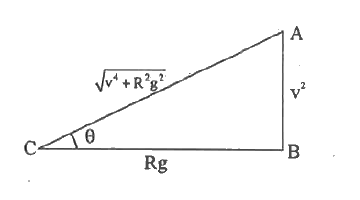 `"or"cos theta=(g)/(sqrt((v^(4))/(R^(2))+g^(2)))` Hence the period of oscillation of pendulum will be, `T=2pi sqrt((LG)/(g sqrt((v^(4))/(R^(2))+g^(2))))"or"T=2pisqrt((L)/(sqrt((v^(4))/(R^(2))+g^(2))))` |
|
| 32. |
(I) vecL=vecr.vecp where P is the Linear momentum (II) vecv=r.vecomega where omega is the angular velocity Which statement is is correct? |
| Answer» Answer :A | |
| 33. |
A body of mass 8kg at rest exploded into 3 pieces of masses 1kg, 2kg and 5kg. The first two pieces fly off perpendicular with velocities in the ratio 3:2 and 5 kg piece fly off at 10 m/s. Then |
|
Answer» Velocity of 1kg part is 30 m/s |
|
| 34. |
A 100 kg gun fires a ball of 1 kg horizontally from a cliff of height 500 m. It falls on the ground at a distance of 400 m from the bottom of the cliff. Find the recoil velocity of the gun. (Take g = 10 ms^(-2)) |
|
Answer» `0.2 MS^(-1)` |
|
| 35. |
A ball of mass 'm' is rotated in a vertical circle with constant speed. The difference in tensions at the bottom and horizontal positions would be |
|
Answer» 6mg |
|
| 36. |
The total internal energy of one molecule of rigid diatomic gas is |
|
Answer» 3/2 RT |
|
| 37. |
A force of 20 dyne applied to the end of spring increase its length of 1mm, then force constant will be what ? |
| Answer» SOLUTION :`k= (F)/(TRIANGLE L) = (20)/(0.1) = 200 " dyne"/"cm`. | |
| 38. |
When 0.0003125 is reduced to 3 significant figures its value is |
|
Answer» 0.00312 |
|
| 39. |
A block at - 10^@C is slowly heated and converted to steam at 100^(@)CWhich of the following curves represents the phenomena qualitatively ? |
|
Answer»
|
|
| 40. |
How much mercury must be placed inside a glass flask, having an internal volume of 300 c.c., so that the volume of the remaining space inside the flask may be constant at all temperatures ? (Coefficient of real expansion of mercury 0.00001//^(0) C , coefficient of linear expansion of glass is 0.00001//^(0) C .) |
|
Answer» Solution :`V_(1) gamma_(1) = V_(2) gamma_(2) "" V_(1) gamma_(1)= V_(2) XX 3 alpha_(2)` here , `V_(2) = 300 "c.c., " alpha_(2) = 0.00001 //^(@)C,` `gamma_(1) = 0.00018//^(@) C ` `V_(1) = (V_(2) xx 3 alpha_(2))/(gamma_(1)) = (300xx 3 xx 0.00001 )/(0.000 18 ) = 50 c.c` |
|
| 41. |
Give names of supplementary physical quantities and their units. |
|
Answer» Solution :The two supplementary PHYSICAL quantities are (i)plane angle SOLID angle. (ii)The units of the two supplemantary physical quantities are RESPECTIVELY (i) radian (rad) (ii)steradian(SR). |
|
| 42. |
A particle of mass m is rotated in the horizontal xy plane along a circular curves of radius r with angular speed omega radian per second. The rotation is opposite to that of hands of aclock |
|
Answer» The ANGULAR momentum of the particle about an axis passing through CENTRE of path is `mr^(2)omegahat(k)` |
|
| 43. |
Calculate (a) the refracting angle of a flint glass prism which should be combined with a crown glass prism of refracting angle 6^@ so that the combination may have no deviation of D line and (b) the angular separation between the C and F lines, given that the refractive indices of the materials are as follows: |
|
Answer» Solution :Let `A_1 and A_2` be the refracting ANGLES of the flint and crown glass prisms respectively. `mu_1and mu_2` be the refractive indices for the D line of flint and crown glasses respectively. (a) If `delta_1 and delta_2` be the angles of DEVIATIONS DUE to the flint are crown glass prisms respectively, then for no deviation of D line `delta_1+delta_2=0,A_1(mu_1-1)+A_2(mu_2-1)=0` `A_1/A_2=((mu_2-1)/(mu_1-1))` The negative sign indicates that `A_1 and A_2` are oppositely directed. `A_1/6^@=((1.530-1)/(1.795-1)),A_1=6^@ times 0.530/0.795=-4^@` b) Angular DISPERSION due to the flint glass prism `=A_1(mu_F-mu_C)=-4^@(1.805-1.790)=-0.060` Angular dispersion due to the crown glass prism `=A_2(mu_F-mu_C)_2=6^@(1.535-1.527)=0.048` Net angular dispersion =0.048-0.060=-0.012 the negative sign indicates that the resultant dispersion is in the direction of the deviation produced by the flint prism. |
|
| 44. |
The triple point of water is at ...... pressure and ...... temperature. |
| Answer» SOLUTION :4.58 MM HG, 273.16 K | |
| 45. |
Table -2 gives certain situatios involving two blocks of mass 2 kg and 4 kg the 4 kg block lies on a amooth horizontaltable there is sufficiet friction between both the block and there is no relatve motion between both the block in all situations. Horizontal forces on one or both blocks in all situations . Horizontal forces act on one o rboth blocks as shown . table -1 given certain statement realate to figures given in table -2 Match the statement s in Table -1 with the figure in table -2. |
|
Answer» |
|
| 46. |
The rms speed of oxygen moleucle at a certain absolute temperature is ‘v.. If the absolute temperature is double and the oxygen molecules dissociate into atomic oxygen. Then the rms speed would be |
| Answer» ANSWER :C | |
| 47. |
Some vessels of cooking have copper coating at bottom why ? |
| Answer» Solution :Being a GOOD conductor of heat, copper promotes the DISTRIBUTION of heat over the bottom of a POT for UNIFORM cooking. That is why some cooking pots have copper COATING on the bottom. | |
| 48. |
What is meant by the term elastic limit? |
| Answer» Solution :The maximum stress WITHIN which the body ragains its original size and SHAPE after the removal or deforming force is CALLED the elastic limit. | |


