

Saved Bookmarks
This section includes 7 InterviewSolutions, each offering curated multiple-choice questions to sharpen your Current Affairs knowledge and support exam preparation. Choose a topic below to get started.
| 1. |
A closes organ pipe of length 20 cm is sounded with a tuning fork in resonance. What is the frequency of the tuning fork? (v = 332 m/s) |
| Answer» Solution :In resonance , the FREQUENCY of the FORK is equal to the frequency of the organ pipe `f = (V)/(4L) = (332)/(4 xx 0.2) = 415` Hz | |
| 2. |
A ball moving with a velocity v strikes a wall moving towards the ball with a velocity u. An elastic impact occurs. Determine the velocity of ball after the impact. What is the cause of change in kinetic energy of the ball? Consider the mass of the wall to be infinitely large. |
|
Answer» |
|
| 3. |
The linear momentum of a particle varies with times as p=a_(0)+at+bt^(2). Which ofthe following represents force and time relation ? |
|
Answer» SOLUTION :`p=a_(0)+at+bt^(2)` `therefore F=(dp)/(dt)=a+2bt` At t = 0, F = a and F VARIES linearly with TIME. 
|
|
| 4. |
Consider the quantities, pressure, power, energy, impulse, gravitational potentia, electrical charge, temperature, area. Out of these, the only vector quantities are |
|
Answer» Impulse, pressure and area |
|
| 5. |
A student measured the diameter of a wire using a screw gauge with least count 0.001 cm and listed the measurements. The correct measurement is |
|
Answer» 5.3 cm |
|
| 6. |
A very flexibleunifrom chain of mass M and length L is suspended vertically so that its lower end just touches the surface of a table When the upper end of the chain is released it falls with each link coming to rest the instant it strikes the table Find the force exerted by the chain on the table at the moment when x part of chain has already rested on the table . |
|
Answer» Solution :In this PROBLEM , force exerted by the chain on the table ` F = F_(1) + F_(2) ` where ` F_1` = WEIGHT of chain already on the table ` = (M)/(L) x.G` and ` F_(2)=` rate of change of momentum of chain at the instant it strikes the table To calcutate `F_(2)` let us CONSIDER a small element dy of the chain at a heigth `y` above the table mass of the element ` (M)/(L) dy` velocity of the element on striking the table ` upsilon = sqrt(2 g y) ` `:. dp = ((M)/(L)dy) sqrt(2 gy) ` ` F_(2) = (dp)/(dt) = (M)/(L) (dy)/(dt) sqrt(2 gy)` As ` (by)/(dt) = upsilon= sqrt(2gy) :. F_(2) = (M)/(L) (2 gy)` PUTTING in (i) we get ` F = (M)/(L) xg + (M)/(L) 2 gy = (M)/(L) g (x + 2 y)` 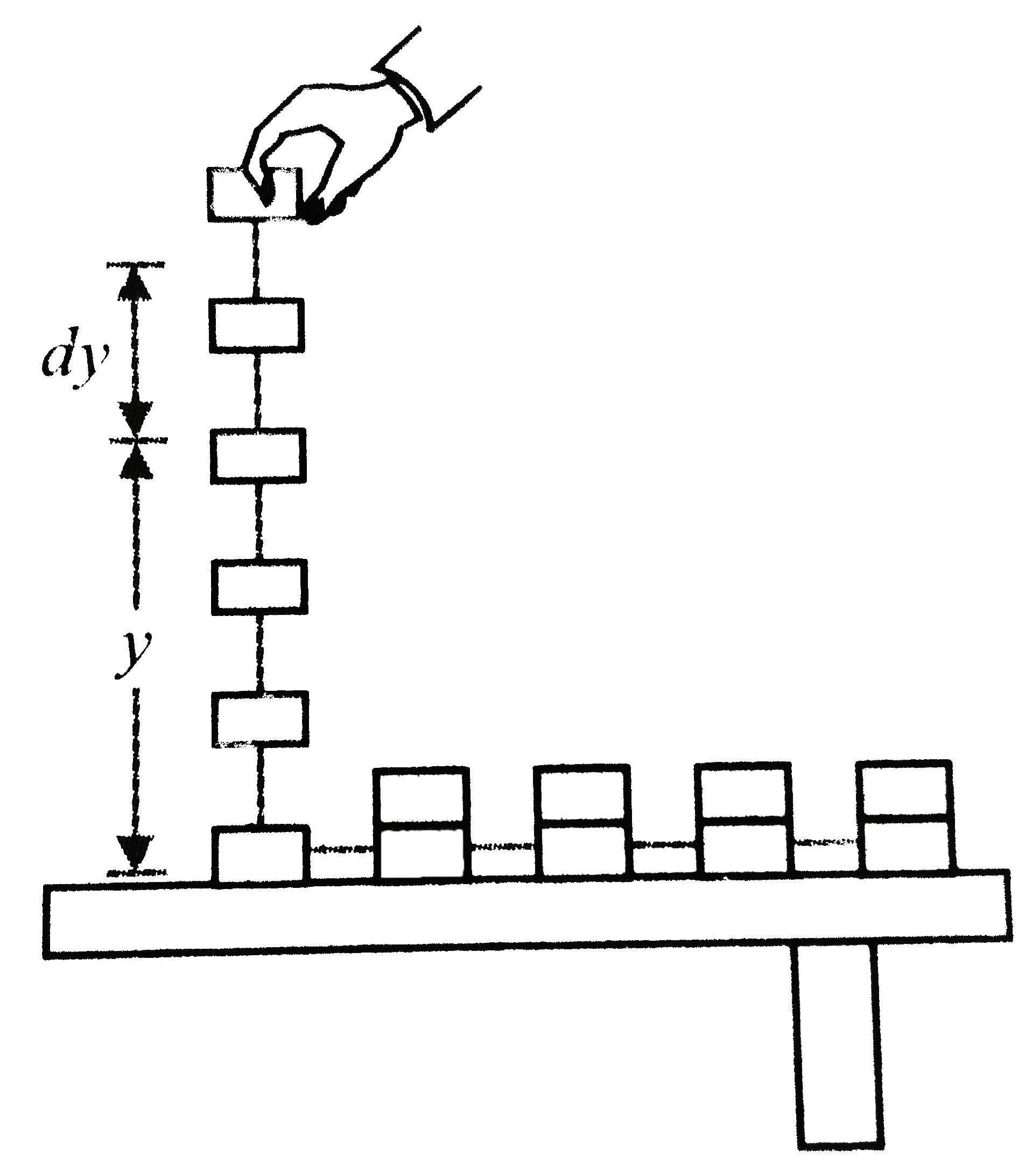 . .
|
|
| 7. |
The relation 3t=sqrt(3x)+6 describes the position of a particle in one direction where x is in metre and t in sec.The displacment,when velocity is zero,is |
|
Answer» 24 METRES |
|
| 8. |
Water drops are falling from a pipe at 5 m height at regular interval of time. When the third drop is released at the same time the first drop touches the ground. Then the height of second drop from ground is ....... m. (g = 10 ms^(-2)) |
|
Answer» `1.25` TIME taken by `1^(st)` DROP to reach at ground is .t. then, `d = v _(0) t + 1/2 at ^(2)` `5=0 + 1/2 xx (10) xx t ^(2)` `therefore t ^(2) =1 implies t =1 s` Thus at 1 sec time `1^(st)` drop reaches ground and `3 ^(rd)` drop is released. Thus, time taken by `2^(nd)` drop, `d =0 xx t +1/2 xx 10 xx (0.5) ^(2)` `d = 1.25 m` Thus, height of drop from ground `=5-1.25 m = 3.75 m` |
|
| 9. |
An orifice of diameter 8 mm is made on one side of a tank in which water level is 10 mm above the orifice. What is the rate of discharge of water through the orifice? |
|
Answer» |
|
| 10. |
The frequency v of the stretched string may depend on (i) the length of the vibrating segment 1 (ii) the tension in the stringand (iii) the mass per unit length m. Show that v prop 1/l sqrt(F/m). |
|
Answer» Solution :Tension is a force and its dimensions are `MLT^(-2)` Dimensions of mass PER unit length are `ML^(-1)` According to the given DATA `v prop l^(x)F^(y)m^(z)` `v=kl^(x)F^(y)m^(z)`. K is a constnat WITHOUT any dimension. Taking dimensions of terms on both sides `T^(-1)=L^(x)(MLT^(-2))^(y)(ML^(-1))^(z)=L^(x)M^(y)T^(-2y)M^(z)L^((-z)` `M^(0)L^(0)T^(-1)=L^(x+y-z)M^(y+z)T^(-2y)` Equating the dimensions of T on both sides `-1=-2y,y=1/2` Equating the dimensions of M `z+y=0, z=-y=(-1)/2` Equating the dimensions of L `0=xy-z+x+1/2+1/2, x=-1` `v=kl^(-1)F^(1//2)m^(-1//2),v=1/lsqrt(F/m)` |
|
| 11. |
Rate of emitted radiation energy from perfect black body at 500 K is proportional to. . . ... |
|
Answer» `(500)^(4)` `W=sigmaAT^(4)t` `:.WpropT^(4)` (Other are constant) `:.W PROP(500)^(4)` |
|
| 12. |
When ‘n’ identical droplets are combined to form a big drop, then the energy will be releasedWork done to form a big drop from ‘n’ identical droplets each of radius r is |
|
Answer» `W= 4 PI r^2 T (n-n^(2//3))` |
|
| 13. |
Uniform circular motion is a special case of two-dimensional motion having centripetal acceleration. Can a body have acceleration with constant speed? Explain |
| Answer» SOLUTION :YES. In UNIFORM CIRCULAR MOTION | |
| 14. |
Uniform circular motion is a special case of two-dimensional motion having centripetal acceleration.Express angular velocity in terms of angular displacement |
| Answer» SOLUTION :`OMEGA=(DELTATHETA)/(DELTAT)` | |
| 15. |
Uniform circular motion is a special case of two-dimensional motion having centripetal acceleration . Define centripetal acceleration |
| Answer» Solution :When a particle executes UNIFORM circular motion, the acceleration is ALWAYS normal to the direction of velocity and is DIRECTED TOWARDS the CENTRE. This acceleration is known as centripetal acceleration | |
| 16. |
Figure 10.24(a) shows a thin liquid film supporting a small weight =4.5 times 10^-2 N What is the weight supported by a film of the same liquid at the same temperature in Fig.(b) and ( c) ? Explain your answer physically. |
| Answer» SOLUTION :`4.5 TIMES 10^-2 N` for (B) and (C ) the same as in (a). | |
| 17. |
In theregular hexagon shown in fig.3.51, vecAO+vecBO + vecCO+vecDO + vecEO + vecFO can be expressed as : |
|
Answer» ZERO |
|
| 18. |
A harmonic wave is travelling on string 1. At a junction with string 2 it is partly reflected and partly transmitted . The linear mass densityof the second string is four times that of the first string , and that the boundary between the two strings is atx = 0 . If the expression for the incident wave isy_(i) = A_(i) cos (k_(1) x - omega _(1) t). What are the expressions for the transmitted and the reflected waves in terms of A_(i),K_(1) and omega_(1)? (b) Show that the average power by the incident wave is equal to the sum of the average power carried by the transmitted and reflected waves . |
|
Answer» Solution :Since ` v= sqrt (T//mu), T_(2) = T_(1) and mu_(2) = 4 mu_(1)` We have , `v_(2) = (v_(1))/(2)`(i) Since the FREQUENCY does not change , that is , `omega_(1) = omega_(2)`(ii) Also , because `k = ( omega //v)` , the numbers of the harmonic wavesin the strings are related by `k_(2) = (omega_(2))/( v_(2)) = (omega_(1))/( v_(1)//2) = 2 (omega_(1))/( v_(1)) = 2 k_(1)`(iii) The AMPLITUDES are `A _(t) = (( 2v_(2))/( v_(1) + v_(2))) A_(i)` `= [ (2 (v_(1)//2))/( v_(1) + ( v_(1)//2))] A_(i) = (2)/(3) A_(i)`(iv) and `A_(r) = (( v_(2) - v_(1))/( v_(1) + v_(2))) A_(i)` ` = [ ((v_(1)//2) - v_(1))/(v_(1) + (v_(1)//2))] A_(i) = (-A_(i))/(3)`(iv) Now with Eqs. (ii) and (iii) and (iv) , the transmitted wave can be written as `y_(t) = (2//3) A _(i) cos ( 2k_(1) x - omega t)` SIMILARLY the reflecteed wave can be expressed as ` y _(x) = - (A_(i))/(3) cos ( k_(1) x + omega _(1) t)` ` = (A_(i))/(3) cos ( k_(1) x + omega _(1) t + pi)` (B) The average power of a harmonic wave on a string is GIVEN by `P = (1)/(2) rho A^(2) omega^(2) mu v``(as rho s = mu)` Now `P_(i) = (1)/(2) omega_(1)^(2) A_(i)^(2) mu_(1) v_(1)`(vi) `P_(t) = (1)/(2) omega_(1)^(2) ((2)/(3) A_(i))^(2) ( 4 mu _(1)) (( v_(1))/(2)) = (4)/(9) omega_(1)^(2) A_(i)^(2) mu_(1) v_(1)`(vii) `P_(r) = (1)/(2) omega_(2)^(2) ( - (A_(i))/(3))^(2) ( mu_(1))(v_(1))= (1)/(18) omega_(1)^(2) A_(i)^(2) mu_(1) v_(1)`(viii) From Eqs. (vi),(vii) and (viii) , we can show that `P_(i) = P_(t) + P_(r)`. |
|
| 19. |
A function f(theta) is defined as f(theta)=1-theta+(theta^(2))/(2!)-(theta^(3))/(3!)+(theta^(4))/(4!) +.... Why is it necessary for f(theta) to be a dimesnionless quantity ? |
| Answer» SOLUTION :Since, `f (theta)` is a sum of different power of `theta` and as RHS is dimensionless, HENCE LHS should also be dimensionless. | |
| 20. |
State the rules for finding the significant figures in the multiplication and division of two numbers, with example. |
|
Answer» Solution :Multiplication and Division : The final result should retain as many SIGNIFICANT figures as there are in the original number with smallest number of significant figures. In multiplication or division. Eg: (i) `1.21xx36.72=44.4312=44.4` Here the least number of significant digits in the MEASURED values is three. HENCE the result when rounded off of three significant digits is 44.4 (ii) `36.72 div 1.2 =30.6 =31` Here the least number of significant digits in the measured values is two. Hence the result when rounded off to significant digit BECOMES 31. |
|
| 21. |
1 mol of an ideal gas obeys the following equations p=p_0/(1+(V_0//V)^2) where p_0 and V_0 are constants. Find the change in temperature the volume of the gas is doubled. |
|
Answer» |
|
| 22. |
The angular speed of a body changes from omega_(1)to omega_2without applying a torque, but due to changes in moment of inertia. The ratio of radii of gyration in the two cases is |
|
Answer» `omega_(2) : omega_1` `THEREFORE I_(1) omega_(1) = I_(2) omega_(2) or (M k_(1)^(2)) omega_(1) = (Mk_(2)^(2)) omega_(2)` `therefore (k_(1))/(k_(2)) = sqrt((omega_(2))/(omega_(1)))` |
|
| 23. |
Which of the following graph shows the variation in the value of 'g' with increasing distance from the centre of the earth. [R_e = Radius of earth] |
|
Answer»
|
|
| 24. |
A child stands at the centre of turn table with his two arms out stretched. The turn table is set rotating with an angular speed of 40 rpm. How much is the angular speed of the child if he folds his hands back and thereby reduces his moment of inertia to 2/5 times the initial value? Assume that the turn table rotates without friction (ii) Show that the child's new kinetic energy of rotation is more than the initial kinetic energy of rotation. How do you account for this increase in kinetic energy? |
|
Answer» SOLUTION :Here `omega_(1)=40 rpm, I_(2)=(2)/(5)I_(1)` By the principle of conservation of ANGULAR momentum `I_(1) omega_(1)=I_(2) omega_(2) or I_(1)xx40=(2)/(5)I_(1) omega_(1) or omega_(2)=100` rpm. (ii) Initial kinetic ENERGY of rotation `(2)/(5)I_(1) omega_(1)^(2)=(2)/(5)I_(1)(40)^(2)=800I_(1)` New kinetic energy of rotation `(2)/(5)I_(2) omega_(2)^(2)=(1)/(5)xx(2)/(3)I_(1)(100)^(2)=2000I_(1)` `("New K.E.")/("Initial K.E.")=(2000I_(1))/(800I_(1))=2.5` hus the child.s new kinetic energy of rotation is 2.5 times its initial kinetic energy of rotation. This increase in kinetic energy is due to the INTERNAL energy of the child which he uses in folding his hands back from the outstretched position. |
|
| 25. |
A water drop of diameter 2mm is split upto into 10^(9) identical water drops. Calculate the work done in this process. (The surface tension of water is 7.3xx10^(-2)Nm^(-1)). |
|
Answer» Solution :Let a water drop of radius R be split up into `10^(9)` identical water drops each of radius r. `R=(D)/(2)=(2MM)/(2)=1mm=1xx10^(-3)m` Number of droplets `n=10^(9)` Surface tension `(S)=7.3xx10^(-2)Nm^(-1)` `W=4piR^(2)S[n^(1//3)-1]` `=4pi(10^(-3))^(2)xx7.3xx10^(-2)[(10^(9))^(1//3)-1]=9.17xx10^(-5)J` |
|
| 26. |
A person of mass 80 kg is standing on the top of a 18 kg ladder of length 6 m. Upper end of the ladder rests on a smooth vertical wall and thelower end is on the ground 3 m away from the vertical wall. What should be the minimum coefficient of friction between the floor and the ladder so that the system remains in equilibrium ? |
|
Answer» Solution :Given that, for the LADDER weight W acts through the centre of gravity, C (mid -point of AB) of theladder Fig. Weight W. of the MAN acts at B downwards. Normal reaction R. by the WALL acts at B. Normal reaction R. by the ground acts at A. Limiting friction that acts along the floor at A, f = `mu` R where, `mu` is the COEFFICIENT of friction required for equilibrium. At equilibrium, the sum of all horizontal forces and the sum of all vertical forces will be zero separately. `mu R -R. =0 " ""or", muR=R.""cdots (1)` R-W-W.0 `" ""or", R=W+W.""cdots(2)` Again the sum of the moments of all forces taken about A will be zero. `:. R.xxBD-WxxAE-W.xxAD=0` or, `mu(W+W.)xxBD=WxxAE+W.xxAD` `:."" mu = (WxxAE+W.xxAD)/((W+W.))xxBD` Here, AB = 6m, AD = 3 m. `:."" AE=(AD)/(2)=(3)/(2) m, BD = sqrt(AB^(2)-AD^(2))=5.2 m,` W =18 kg `xxg, W. = 80 kgxxg` `:. " " mu =(18xx(3)/(2)+80xx3)/((18+80)xx5.2)=0.52.` 
|
|
| 27. |
Two cars X and Y start off to a race on a straight path with initial velocities of 8 m/s and 5 m/s respectively. Car X moves with uniform acceleration of 1m//s^(2) and car Y moves with uniform acceleration of 1.1m//s^(2). If both the cars reach the winning post together find the length of the track. |
|
Answer» 1000 m |
|
| 28. |
Estimate the temperature on the surface of the Sun from the following data. Average distance of the orbit=1.5xx10^8 km Average radius of the sun=7.0xx10^5 km solar constant=400Wm^(-2) |
|
Answer» SOLUTION :`T=(((d^2)/(R^2))(d/sigma))^(1/4)=((1.5xx10^8)/(7xx10^5))^(2/4)((1400)/(5.67xx10^(-8))^(1/4))=(2.1428xx10^2)^(1/2)(3.964xx10^2)` `=5802.6K` |
|
| 29. |
Average temperature of the Earth was 300 K when the Earth came into existence. At present its average temperature is 3000 K (This is due to the heat evolving from the disintegration of radioactive substances at the core of the Earth) What would be the radius of the Earth at the toime of its birth ? For the material of the Earth gamma=3xx10^(-5)K^(-1). At present, radius of the Earth = 6400 km. |
|
Answer» SOLUTION :`V=V_(0)(1+gammaDeltaT)` `(4)/(3)piR^(3)=4/3piR_(0)^(3)(1+gammaDeltaT)` `:.R=R_(0)" "(1+gammaDeltaT)^(1/3)` `:.R_(0)=(R)/((1+gammaDeltaT)^(1/3))=(6400)/([1+3xx10^(-5)xx2700]^(1/3))` `:.R_(0)=6236km` |
|
| 30. |
A calorimeter of mass m contains an equal mass of water in it. The temperature of the water and calorimeter is t_2 . A block of ice of mass m and temperature t_(3) lt0^@Cis gently dropped into the calorimeter. Let C_(1), C_(2) and C_3be the specific heals of calorimeter, water and ice respectively and L be the latent heat of ice. The whole mixture in the calorimeter becomes water is |
|
Answer» `(C_(1)+C_(2))t_(2)-C_(3)t_(3)+ L gt 0` |
|
| 31. |
A calorimeter of mass m contains an equal mass of water in it. The temperature of the water and calorimeter is t_2 . A block of ice of mass m and temperature t_(3) lt0^@Cis gently dropped into the calorimeter. Let C_(1) ,C_(2) and C_3be the specific heals of calorimeter, water and ice respectively and L be the latent heat of ice. Water equivalent of calorimeter is |
|
Answer» `mC_1` |
|
| 32. |
A calorimeter of mass m contains an equal mass of water in it. The temperature of the water and calorimeter is t_2 . A block of ice of mass m and temperature t_(3) lt0^@Cis gently dropped into the calorimeter. Let C_(1) C_(2) and C_3be the specific heals of calorimeter, water and ice respectively and L be the latent heat of ice. Thw hole mixture in the calorimeter becomes ice if |
|
Answer» `C_1t_2+C_2t_2+L+C_3t_3gt0` |
|
| 33. |
Image of an object at infinity is formed by a convex lens of focal length 30cm such that the size of the image is 2cm. If a concave lens of focal length 20cm is placed in between the convex lens and the image, at a distance 26cm from the convex lens, size of the new image is |
|
Answer» 2.5cm |
|
| 34. |
A uniform ladder which is 5m long has a mass of 25kg , leans with its upper end against a smooth vertical wall and its lower end on rough ground. The bottom of the ladder is 3m from the wall.Calculate the frictional force between the ladder and the ground . (g=10ms^(-2)) |
|
Answer» |
|
| 35. |
A block of mass m is connected to a massless pulley and mass-less spring of stiffness k. The pulley is frictionless. The string is mass-less. Initially the spring is unstretched when the block is released. When the spring is maximum stretched, find the ratio of tenstion in the rope and weight of the block. |
|
Answer» |
|
| 36. |
If the object is at rest and no external force is applied on the object, the static friction acting on the object is |
| Answer» SOLUTION :infinity | |
| 37. |
A block is placed on a horizontal platform.. The system is making horizontal oscillations about a fixed point with a frequency of 0.5Hz. Find the maximum amplitude of oscillation if the block is not to slide on the horizontal platform? (Coefficient of friction between the block and the platform=0.2) (g=10ms^(-2)) |
|
Answer» `2/(PI^(2))` |
|
| 38. |
Suppose the average mass of raindrops is 3.0 xx 10^(-5) kg and their average terminal velocity 9 ms^(-1) . Calculate the energy transferred by rain to each square metre of the surface at a place which receives 100 cm of rain in a year. |
|
Answer» Solution :`M = 3.0 xx10^(-5)` KG V = 9m/s h = 100 cm = 1m `rho =10^(3) kg//m^(3)` `A = 1m^(2)` , V = Area `XX` height = `A xxh` ` = 1xx1= 1m^(3)` Mass of the water due to rain , `M = V xxrho` ` = 1xx10^(3)` `=10^(3)` kg ` :. ` Energy transferredto the SURFACE , `E = 1/2 mv^(2)` `=1/2 xx10^(3) xx(9)^(2)` `= 40.5 xx10^(3) J ` ` = 4.05 xx10^(4)` J |
|
| 39. |
Select the correct pair stating has applications of reflection of sound waves. |
|
Answer» SONAR and RADAR |
|
| 40. |
If the mass of a moving body is decreased by one-third of its initial mass and velocity is tripled, the percentage change in its kinetic energy is |
|
Answer» 5 |
|
| 41. |
If a body moves through a distance greater than 2πR in one full rotation then |
|
Answer» `V_(CM)gtR_(omega)` |
|
| 42. |
Figure show plot of (PV)/(T) and P for 2gm of oxygen gas at two different temeratures. (i)The significance of dotted line (ii)The relation between T_(1) and T_(2) (iii)The value of (PV)/(T) where the curves meet on the Y-axis. |
|
Answer» Solution :(i)For the DOTTED line ,`(PV)/(T)`=constat. It presents the behavior of an IDEAL gas. (ii)The gas equation PV =RT is true only at high temperature In figure ,curve for `T_(1)` is closer to the dotted line than curve for `T_(2)` Hence the relatioon between `T_(1)` and `T_(2)` is `T_(1)gtT_(2)` (iii)`(PV)/(T)=muR`.So the VALUE of `(PV)/(T)` where the curves meet on the Y-axis gives the value of `muR`. In this CASE`mu=(m)/(M)=(2)/(32)=(1)/(16)` `therefore(PV)/(T)=muR=(1)/(16)xx8.31=0.518`J/K |
|
| 43. |
J Kg^(-1) K^(-1) is the unit of |
|
Answer» BOLTZMANN constant |
|
| 44. |
Determine the angleof banking so as to minimizethe wearand tear of the tyres ofcar negotiating a banked curve |
|
Answer» Solution :Letthe surfaceof the roadmakeangle `theta`withhorizontal surface. THENTHE normalforcemakesthe sameangle`theta` with the verticalwhenthe cartakesa turnthereare twoforcesactingon thecar. IGravitationalforce mg(downwards ) (ii)Normalforce N(perpendicular tosurface) Thenormalforcecan be resolvedintotwocomponents . N cos `theta`and Nsin`theta ` . The gravitionalforce mgandcompoenetNsin`theta ` willprovidethenecessarycentripetalacceleration. ByusingNewton'ssecondlaw . N cos `theta= mg` N sin `theta = (MV^(2))/(r )` By dividingthe equationwe get tan `theta= (V^(2))/(r g) ` `v= sqrt( rg tan theta)` Thebankingangle `theta ` and RADIUSOF curvatureof theroador trackdeterminesthe safe speedof the carat theturnin |
|
| 45. |
The average speedof lulecules in a gas is given by |
|
Answer» `sqrt((3p)/(p))` `v_(av)=(v_(1)+v_(2)+v_(3)+...)/N` From kinetic theory of gases, `sqrt((8p)/(pip))=sqrt((8RT)/(PIM))=sqrt(8/(pi))=(KT)/M` |
|
| 46. |
One mole of diatomic ideal gas undergoes a cyclic process ABC as shown in figure. The process BC is adiabatic. The temperature at A,B and C are 400K, 800K and 600K respectively. Choose the correct statement: |
|
Answer» The CHANGE in internal ENERGY in the PROCESS BC is -500R |
|
| 47. |
Which is not a unit of electric field |
|
Answer» `NC^(-1)` |
|
| 48. |
Mercury does not wet the glass. Why? |
| Answer» Solution :If the FORCES of adhesion between molecules ofa solid and the LIQUID is less than the force of cohesion between molecules of liquid, then the liquid does not ahere or stick to the solid. This is the reason for MERCURY not wetting the glass ROD. | |
| 49. |
A thin spherical shell of mass .M. and radius .R. has a small hole. A particle of mass .m. is released at the mouth of hole. Then |
|
Answer» the particle will execute S.H.M inside the shell |
|
| 50. |
The minimum wavelength lambda_min in the continuous spectrum of X-rays is |
|
Answer» Proportional to the potential DIFFERENCE V between the cathode and anode. |
|


