

Saved Bookmarks
This section includes 7 InterviewSolutions, each offering curated multiple-choice questions to sharpen your Current Affairs knowledge and support exam preparation. Choose a topic below to get started.
| 1. |
What did Aurangzeb ban in his palace? |
|
Answer» PLAYING of Pungi |
|
| 2. |
Dimensions of epsilon_(0)(d phi_(E))/(dt) are of : |
|
Answer» potential |
|
| 3. |
A ray of light is incident on one face of a transparent slab of thickness 15 cm. The angle of incidence is 60^@. If the lateral displacement of the ray on emerging from the parallel plane is5sqrt3 cm, the refractive index of the material of the slab is |
|
Answer» 1.414 |
|
| 4. |
A difference of 2.3 eV separates two energy levels in an atom. What is the frequency of radiation emitted when the atom make a transition from the upper level to the lower level? |
| Answer» SOLUTION :`5.6 XX 10^(14) HZ` | |
| 5. |
The change in potential energy of the body when it is taken from the earth's surface to a height above its surface is : |
|
Answer» (n-1) mgR `U_(1)=(-GMm)/(R)` At HEIGHT nR from the surface of earth, `U_(2)=(-GMN)/((n+1)R)` `:.` Change in G.P.E is `Delta U=U_(2)-U_(1)` `DeltaU=(-GMn)/((n+1)R)+(GMn)/(R)` `DeltaU=(GMn)/(R)[1-(1)/(n+1)]=(GMn)/(R)((n)/(n+1))` Since`g=(GM)/(R^(2))implies GM=gR^(2)` `DeltaU=(gR^(2)m)/(R)((n)/(n+1))=(n)/(n+1)mgR` |
|
| 6. |
Radiations of two different frequencies whose photon energies are 3.4 eV and 8.2 eV successively illuminate a metal surface whose work function is 1.8eV. The ratio of the maximum speeds of the emitted electrons will be |
|
Answer» `1:1` |
|
| 7. |
Which of the following device is full duplex? |
|
Answer» Mobile phone |
|
| 8. |
What is meant by zener effect? |
| Answer» Solution :The ELECTRIC field is STRONG enough to BREAK or rupture the covalent bonds in the lattice and THEREBY generating electron-hole pairs. This effect is CALLED Zener effect. | |
| 9. |
A neutron at rest decays. Assuming the resulting proton to remain at rest, too, find the kinetic energy of the electron and the energy of the antineutrino. |
|
Answer» `Deltaepsi=(m_(n)-m_(p))xx931.6-938.2=1.4MeV` This energy is shared by the electron and the antineutrino: `Deltaepsi=epsi_(e)+epsi_(v)`, where the total energy of the electron is the sum of its rest energy `epsi_(0)` and its KINETIC energy `K_(e)`, i.e. `epsi_(e)=epsi_(0)+K_(e)`. In accordance with the law of conservation of momentum for a proton at rest `p_(e)-p_(v),orepsi_(v)/e=1/esqrt(epsi_(e)^(2)-epsi_(v)^(2))` SUBSTITUTING the value of the neutrino energy, we obtain after simple transformations `epsi_(e)=((Deltaepsi)^(2)+epsi_(0)^(2))/(2Deltaepsi),K_(e)=((Deltaepsi-epsi_(0))^(2))/(2Deltaepsi),epsi_(v)=((Deltaepsi)^(2)-epsi_(0)^(2))/(2Deltaepsi)` |
|
| 10. |
An LC circuit contains a 20 mH inductor and a 50 uF capacitor with an initial charge of 10 mC. The resistance of the circuit is negligible. Let the instant, the circuit is closed be t = 0. (a) What is the total energy stored initially ? Is it conserved during LC oscillations ? (b) What is the natural frequency of the circuit ? (c) At what time is the energy stored (i) completely electrical (i.e., stored in the capacitor)? (ii) completely magnetic (i.e., stored in the inductor)? (d) At what times is the total energy shared equally between the inductor and the capacitor ? (e) If a resistor is inserted in the circuit, how much energy is eventually dissipated as heat ? |
|
Answer» Solution :Here, L = 20 mH `=20 xx 10^(-3) H, C = 50 muC = 50 xx 10^(-6)` F and `q_(m) = 10 mC = 10 xx 10^(-3) C = 0.01 C`, when t=0. (a) `therefore` Total energy stored initially `U = 1/2 q_(0)^(2)/C = (0.01)^(2)/(2 xx 50 xx 10^(-6)) = 1J` Yes, the energy remains conserved during LC oscillations provided that resistance R of the circuit is zero. (b) Natural frequency of the circuit. `v_(0) =1/(2pi sqrt(LC)) = 1/(2 xx 3.14 xx sqrt(20 xx 10^(-3) xx 50 xx 10^(-6))) = 159 Hz` and natural frequency `omega_(0) = 2pi v_(0) = 2pi xx 159 = 1000 rad s^(-1)` ( c)Let time period of oscillations be T, where T=`1/v_(0) =1/159 = 6.3 xx 10^(-3)s = 6.3 rms` then, (i) at times t=0, `T/2, T , (3t)/2, 2T` .......... the energy stored is completely electrical and (ii) at times t =`T/4 , (3T)/4, (5T)/4, (7T)/4`, ......... the energy stored is completely MAGNETIC. (d) Let at time t the electrical and magnetic energies are equal i.e., `q^(2)/(2C) =1/2 LI^(2) = 1/2 [(q_(0)^(2)/(2C))]` i.e. at time t, q =`+- q_(0)/sqrt(2)` `therefore q = q_(0) cos omega` `RARR +- q_(0)/sqrt(2) = q_(0) cos omega t` or `cos omega t = +- 1/sqrt(2)` or `omega t = pi/4, (3pi)/4, (5pi)/4`..... substituting `omega = (2pi)/T`, we have `t=T/8, (3T)/8, (5T)/8, (7T)/8`,......... e) If a resistor is inserted in the circuit, continuously some of the INITIAL energy (U=1) will bedissipated as heat energy. As a result, amplitude of LC oscillations gradually decreases with time and finally the oscillations stop altogether. |
|
| 11. |
Consider a sphere of mass M and radius R centered at origin. The density of material of the sphere is rho = Ar ^(alpha), where r is the radial distance, alpha andA are constants. If the moment of inertia of the sphere about the axis passing through centre is 6/7MR ^(2), then the value of alpha is |
|
Answer» Solution :`(**)` Given, density of sphere, `rho = Ar ^(alpha )` (where, r= radial distance and A and `alpha` are constants) Consider an elemental spherical shell of radius r and thickness dr 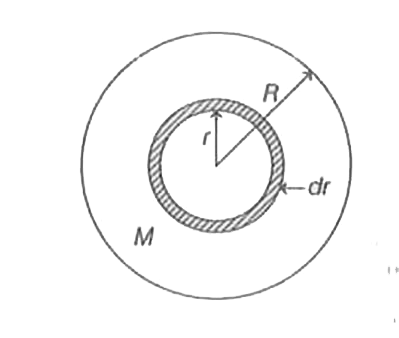 Mass of elemental spherical shell, dm= Volume `XX` Density `dm = (4pi r ^(2)) dr. Ar ^(alpha ) = 4pi a r ^(2+ alpha ) dr""...(i)` Mass of entire solid sphere, `M = 4pi A int _(0)^(R) r ^(2+ alpha ) dr` `M = 4piA [(R ^(3+alpha ))/(3 + alpha )]_(0 ^(R)) = (4piA)/(3 + alpha ) . R ^(3 + alpha)""...(ii)` Now, moment of inertia of elemental spherical shell is `dI = 2/3 (dm). r ^(2) = 2/3 (4pi A r ^(2+alpha ) dr) r ^(2)` Moment of inertia of entire solid sphere, `I = int _(0) ^(R) dI = 2/3 4 pi A int _(0) ^(R) r^(A + alpha). dr` `I = 2/3 4piA [(r ^(5+ alpha ))/(5 + alpha )]_(0)^(R)implies I = 2/3 4pi A [(R ^(5 + alpha ))/(5 + alpha ) ]` `I = 2/3 ((4piA)/(3 + alpha ) . R ^(3 + alpha )) . (R ^(2) (3 + alpha ))/(5 + alpha )` From Eq. (ii), we get `I = 2/3 MR ^(2) . ((3+ alpha )/( 5 + alpha )) ""...(iii)` It is given in the question. `I = 6/7 MR^(2) ""(iv)` On comparing EQS (iii) and (ov), we get `2/3 MR^(2). ((3 + alpha )/(5 + alpha ))= 6/7MR^(2) implies (3 +alpha)/(5 + alpha ) = 9/7` `21+ 7 alpha = 45 + 9 alpha` `implies alpha =-12` |
|
| 12. |
A beam of monichromatic light falls normally on the surfcae of a plane-parallel plate of thickness l. The absorption coefficient of the substance the plate is made of varies linearly along the normal to its surfcae from x_(1) to x_(2). The coefficient of reflection at each surface of the plate is equal to rho. Neglecting the secondary reflections, find the transmission coefficient of such a plate. |
|
Answer» Solution :Apart from the factor `( 1- rho)` on each end face of the plate, we shell get a factor due to absorptions. This factor can be calculated by assuming the plate to consist of a LARGE number of very thin slab within each of which the ABSORPTION coefficient can be assumed to be CONSTANT. Thus we sheel get a produced like `............E^(-CHI(x)dx) e^(-chi(x+dx)dx) e^(-chi(x+2dx)dx)..........` This produced in nothing but `e^(-int_(0)^(l)chi(x)dx` Now `chi (0) = chi_(1), chi (l) = chi_(2)` and variation with `x` is linear so `chi(x) = chi_(1) + (x)/(l) (chi_(2) - chi_(1))` Thus the factor becomes `e^(-int_(0)^(l) [chi_(1) + (x)/(l) (chi_(2) - chi_(1))] dx) =e^(-(1)/(2) (chi_(1) + chi_(2))l` |
|
| 13. |
(a) If one of two identical slits producing interference in Young's experiment is covered with glass so thatthe lightintensity passing through it is reduced to 50%, find the ratio of the maximu and minimum intensity of the fringe in the interference pattern. (b)Whatkindof fringes do you expect to observeif white lightis used instead of monochromatic light ? |
|
Answer» SOLUTION :The central fringe remains white Hence ` (I_(max) )/( I_(min) ) =((a_1+a_2)/( a_1-a_2))^(2) ` `( ((1+( 1))/( sqrt(2)))/( 1-(1)/(sqrt(2))) )^(2) ` `= (( sqrt2+1)/( sqrt2-1) )^(2) ` The central frings remains white. No CLEAR frings pattern is seeen after a few (coloured ) frings on either side of the central fringe [Note: For part(a) of this question the student may ] (i) just draw the diagram for the young.s double SLIT experiment (ii) just side that the INTRODUCTION of teh glass sheet would INTRODUCE an additional phase difference and the position of the central fringe would shift . For all such answer the student may be awarded the full (2)marks for this part of this question] |
|
| 14. |
A message signal of frequency 10KHz and peak voltage 10V is used to modulate a carrier frequency 1MHz and peak voltage 20V. Find modulation index |
| Answer» SOLUTION :`mu=A_m/A_c=10/20=0.5` | |
| 15. |
An ideal monoatomic gas is heated at constant pressure. What is the fraction of the energy supplied to the gas- that is used to increase the internal energy of the gas ? |
|
Answer» `3/7` |
|
| 16. |
A certain amount of a diatomic gas undergoes a certain polytropic process in which it absorbs 100 "Jouk" heat and performs 25 "Joule" work. The process can be described by the formula : |
|
Answer» `PV^(5)=C` `DeltaW=n((R )/(1-x))DeltaT` `(DeltaQ)/(DeltaW)=((1-x)/(gamma-1)+1)=(100)/(25)=4` `rArr x=1-3(gamma-1)` `=1-3((2)/(5))=-(1)/(5)` |
|
| 17. |
A current flowing in the winding of a long straight solenoid is increased at a sufficiently slow rate. Demonstrate that the rate at which the enrgy of the magnetic field in the solenoid increases is equal to the flux of the Poynting vector across the lateral surface of the solenoid. |
|
Answer» Solution :Within the solenoid `B = mu_(0)n I` and the rate of CHANGE of magnetic energy `=W_(m) = (d)/(dt) ((1)/(2)mu_(0)n^(2)I^(2)piR^(2)l) = mu_(0)n^(2)piR^(2)l I dotI` where `R =` radius of CROSS section of the solenoid `l =` length Also `H = B//mu_(0) = nI` along the axis within teh solenoid. By Faraday's law, the induced electirc field id `E_(theta) 2pir = pir^(2)dotB = pir^(2)mu_(0)n dotI` or `E_(theta) = (1)/(2)mu_(0) n dotI r` so at the edeg `E_(theta)(R) = (1)/(2)mu_(0)n dotIR` (circuital) Then `S_(r ) = E_(theta)H_(z)` (radially inward) and `dotW_(m) = (1)/(2)mu_(0)n^(2)I dotIR XX 2piRl = mu_(0)n^(2)piR^(2) lII` as before. |
|
| 18. |
For a Step-Down Transformer which of the following Is correct. |
|
Answer» Output VOLTAGE `gt` Input voltage |
|
| 19. |
When a 6000Å light falls on the cathode of a photo cell and produced photoemission. If a stopping potential of 0.8 V is required to stop emission of electron, then determine the net energy of the electron after it leaves the surface |
|
Answer» Solution :Given data `:` WAVELENGTH of incident light `lambda =6000Å = 6 xx 10^(-7) m ` Stopping POTENTIAL `V_(0) =0.8 V` To find `:` (i) FREQUENCY of light v = ? (ii) Energy of incident photon E =? (iii) Work function of the cathode material W= ? (iv) Threshold frequency `v_(0) = ?` (v)Net energy of the electron after it LEAVES the surface E = ? Net energy of the photo electrons `E =hv - hv_(0) = ( 2.07 -1.26) eV` `E = 0.81 eV` |
|
| 20. |
Which one of the relation is correct between time period and number of orbits while an electron is revolving in a orbit? |
|
Answer» `T INFTY 1/(n^(2))` |
|
| 21. |
A pure inductor of 25mH is connnected to a source of 220V and 50 Hz. Find the inductive reactance, rms value of current and peak current in the circuit. |
|
Answer» Solution :Here : `L=25x10^(-3)H,V_("RMS")=220V,V=50Hz,X_(L)=?I_("rms")=?I_(0)=?` INDUCTIVE reactance is `""X_(L)=omegaL=2pi vL` `=2xx3.14xx50xx25xx10^(-3)` `=7850xx10^(-3)` `X_(L)=7.850Omega` rms value of current in the CIRCUIT is given by `I_("rms")=(V_("rms"))/(X_(L))` `=(220)/(7.850)` `=28.025" A"` Peak current in the circuit is `I_(0)=sqrt(2)I_("rms")=1.414xx28.025` `=39.627" A"`. |
|
| 22. |
In the previous problem, if two falling conductors attain velocities v_(1) and v_(2) respectively after falling through same height h, ratio of energy dissipated as heat to the energy dissipated in resistor per unit time for two conductors is same. Find which of the following condition will be satisfied |
|
Answer» `gh+1/2 v_(1)v_(2)=0` `ghv_(2)-1/2 v_(1)^(2)v_(2)^(2)=ghv_(1)-(1)/(2)v_(2)^(2)v_(1)` `gh(v_(1)-v_(2))=1/2 v_(1)v_(2)(v_(1)-v_(2))` `gh+1/2 v_(1)v_(2)=0`. |
|
| 23. |
An antenna |
|
Answer» Converts AF wave to RF wave |
|
| 24. |
An electric dipole has the magnitude of its charge as q and its dipole moment is p. It is placed in a uniform electric field E. If its dipole moment is along the direction of the field, the force on it and its potential energy are respectively |
|
Answer» 2QE and MINIMUM. |
|
| 25. |
How are the capacitive reactance and inductive reactance , respectively , for three sinusoidally driven series RLC circuits : (1) 50 Omega , 100 Omega , (2) 100 Omega, 50 Omega , (3)50 Omega , 50 Omega . (a) For each does the current lead or lag the applied emf , or are the two in phase ? (b) Which circuit is in resonance ? |
|
Answer» |
|
| 26. |
The energy of a photon of wavelength lambda is |
|
Answer» `hclambda` |
|
| 27. |
A capacitor of capacitance C is charged to a constant potential difference V and then connected in series with an open key and a pure resistor r. At tiem t=0 , the key is closed. If I is current at time t=0, aplot of log I against t is shown as in the graph (I) . Latter on of the parameters, i.e. V,R and C is changed, keeping the other two constant and graph (2) is recoded. Then - |
|
Answer» C is reduced `I=(E)/(R)e^(-t//RC)` log `I="log"(E)/(R)-(t)/(RC)` INTERCEPT is constant `RARR` E & R constant |slope| dercrease `rArrCuarr` |
|
| 28. |
An electrolytic bath containing a vitriol solution is connected to a d.c. power supply with an e.m.f. of 4 V and an internal resistance of 0.1 ohm. The resistance of the solution is 0.5 ohm, the polarization e.m.f. is 1.5 V. How much copper will be deposited in one hour? |
|
Answer» |
|
| 29. |
The magnetic field induction at the centre of a current - carrying circular coil (coil 1) and a closed coil (coil 2), shaped as a quarter of a disc is found to be equal in magnitude. If both the coils have equal area, then find the ratio of the currents flowing in coil 2 and coil 1. |
|
Answer» |
|
| 30. |
A faulty thermometer has ice point at-5^circCand steam point at 105^circCWhat would be the tempareture shown by this thermometer of a person?(Assume correct tempareture of person is 37^circC) |
|
Answer» `42^circC` |
|
| 31. |
A Sigma^(+) hyperon with kinetic energy T_(Sigma)= 320MeV distingrated during its flight into a neutrral particle and a positive pion outgoing with kinetic energy T_(pi)= 42MeV at right angles to the hyperon's motion direction. Find the rest mass of the neutral particle (in MeV units). |
Answer» Solution : By ENERGY CONSERVATION `sqrt(m_(SIGMA)^(2)c^(4)+c^(2)+P_(Sigma)^(2))=sqrt(m_(pi)^(2)c^(4)+c^(2)P_(pi)^(2))+sqrt(m_(N)^(2)c^(4)+c^(2)p_(pi)^(2)+c^(2)P_(Sigma)^(2))` or `(sqrt(m_(Sigma)c^(4)+c^(2)P_(Sigma)^(2))-sqrt(m_(pi)^(2)c^(4)+c^(2)p_(pi)^(2)))^(2)=m_(n)^(2)c^(4)+c^(2)p_(pi)^(2)+c^(2)P_(Sigma)^(2)` or `m_(Sigma)^(2)c^(4)+c^(2)P_(Sigma)^(2)+m_(pi)^(2)c^(4)+c^(2)p_(pi)^(2)-2sqrt(m_(pi)^(2)c^(4)+c^(2)P_(Sigma)^(2))sqrt(m_(pi)^(2)c^(2)+c^(2)p_(pi)^(2))` `=m_(n)^(2)c^(2)+c^(2)p_(pi)^(2)+c^(2)P_(Sigma)^(2)` or using the K.E o f `Sigma & pi` `m_(n)^(2)=m_(Sigma)^(2)+m_(p)^(2)-2(m_(Sigma)+(T_(Sigma))/(c^(2)))(m_(pi)+(T_(pi))/(c^(2)))` and `m_(n)sqrt(m_(Sigma)^(2)+m_(pi)^(2)-2(m_(pi)+(T_(Sigma))/(c^(2)))(m_(pi)+(T_(pi))/(c^(2))))= 0.949(GeV)/(c^(2))` |
|
| 32. |
What is direction of dipole moment? Is it a vector? |
| Answer» Solution :From negativecharges towards POSITIVE CHARGES. Yes, it is a VECTOR. | |
| 33. |
Howdoes the huge ball ( 5.4 xx 10^(5) kg ) hanging on the 22^(nd) floor of one of the world's tallest builgind ( chapter opening question mentioned in the introduction) counter the sway of the building? |
| Answer» Solution :Thehuge ball hangs from FOUR cables and swings like a PENDULUM when the building sways. When the building sways-say, westward-the ball does also but delayed enough so that ASIF finally swings westward, the buildingis swaying eastward. So, the MOTION of the ball is out of step with the BUILIDING motion, and thus counters it. | |
| 34. |
Find the magnitude and direction of the force acting on the particle of mass m during its motion in the plane xy according to the law x=a sin omega t, y=b cos omega t, where a, b, and omega are constants. |
|
Answer» Solution :OBVIOUSLY the RADIUS vector DESCRIBING the position of the PARTICLE relative to the origin of coordinate is `vecr=xveci+yvecj=a sin omega tveci+b cos omega t vecj` DIFFERENTIATING twice with respect the time: `vecw=(d^2vecr)/(dt^2)=-omega^2(a sin omega t veci+b cos omega t vecj)=-omega^2vecr` (1) Thus `vecF=mvecw=-momega^2vecr` |
|
| 35. |
This section contains 2 questions. Each questions contains statements given in two columns, which have to be matched. The statements in Column I are labelled A, B, C and D, while the statements in Column II are labelled p, q, r, s and t. Any given statement in Column I can have correct matching with one or more statement(s) in Column II. The appropriate bubbles corresponding to the answers to these questions have to be darkened as illustrated in the following example : If the correct matches are A – p, s and t, B – q and r , C – p and q, and D – s and t, then the correct darkening of bubbles will look like the following Column II gives certain systems undergoing a process. Column I suggests changes in some of the parameters related to the system. Match the statements in Column I to the appropriate process(es) from Column II. |
|
Answer» `{:(,"Column I", (P),"Column II"),((A),"The energy of the system is Increased",(P),"System : A capacitor initially unchargedIncreased Process: It is connected to a battery"):}` |
|
| 36. |
The distance v of the real image formed by a convex lens is measured for various object distance u. A graph is poltted between v and u, which one of the following graphs is correct |
|
Answer» |
|
| 37. |
In the above question, the reading of ammeter is 200//x mA. What is the value of x? |
|
Answer» CURRENT in ammeter (II)`= (V_(1) - 1)/(R ) = ((5//3) - 1)/(200) = (2)/(300) A = (20)/(3) mA` |
|
| 38. |
Assertion : Even though net external force on a body is zero, momentum need not be conserved.Reason : The internal interaction between particles of a body cancels out momentum of each other |
|
Answer» If both ASSERTION and REASON are true and reason is the correct EXPLANATION of assertion. |
|
| 39. |
When a p-type semiconductor is sandwitched between two n-type semiconductors we call it as ? |
|
Answer» |
|
| 40. |
When the audio signal is suprimposed on carrier wave in a suitable manner, what we call the resultant waves? |
| Answer» SOLUTION :MODULATED WAVES | |
| 41. |
In the given circuit which of the following statement(s) is/are true ? |
|
Answer» with `S_1`closed ,` V_1 =15V,V_2 = 20 V` |
|
| 42. |
A ray of light is directed towards a corner reflector as shown. The incident ray makes an angle of 22^(@) with one of the mirrors. At what angle theta does the ray emerge? |
|
Answer» `22^(@)` ANGLE,`theta=90^(@)-22^(@)=68^(@)` 
|
|
| 43. |
The A.T.P in mitochondria are produced in |
|
Answer» INNER membrane |
|
| 44. |
A proton and electron are lying in a box having unpenetrable walls,the ratio of uncertainty in their velociteis are ………..[m_(e)=mass of electron and m_(p)=mass of proton.] |
|
Answer» `(m_(2))/(m_(p))` `Deltax.Deltap=(h)/(2pi)=h` `therefore Deltax.Delta(MV)=h` `thereforex.mDeltav=h` `therefore v=(h)/(mDeltax)` `therefore Deltav prop (1)/(m)therefore (Deltav_(p))/(Deltav_(e))=(m_(e))/(m_(p))` |
|
| 45. |
The K.E. per m^3 of hydrogen at N.T.P. is |
|
Answer» `1.519xx10^5 J/m^3` |
|
| 46. |
A car battery of emf 12 V and internal resistance 0.1 Omegais being charged at a constant current of5 A. The potential difference between the two terminals of the battery is ______. |
| Answer» SOLUTION :`12.5V` | |
| 47. |
If one of the two electrons of a H_(2) molecule is removed, we get a hydrogen molecular ion (H_(2)^(+)). In the ground state of an (H_(2)^(+)), two protons are separated by roughly 1.5 Å and the electron is roughly1 Åfrom each proton. Determinethe potential energyof the system. Specify your choice of the zero of potential energy. |
Answer» Solution :Consider zero potential energy at infinity. 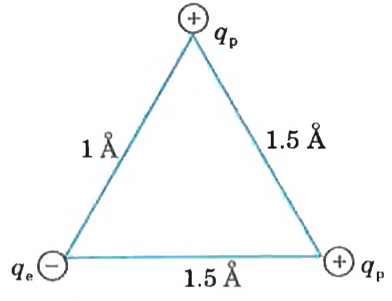 Here, CHARGE on electron, `q_(e)=-1.6xx10^(-19)C` Charge on proton, `q_(p)=1.6xx10^(-19)C` Distance betweenelectron and proton, `r_(ep)=1Å=1xx10^(-10)m` Distance between two protons, `r_(p p)=1.5Å =1.5xx 10^(-10)m` Then, electric POTENTIALENERGY of the system can be CALCULATED as: `U=(1)/(4pi epsilon_(0)) ((q_(e)q_(p))/(r_(ep))+(q_(e)q_(p))/(r_(ep))+(q_(p)q_(p))/(r_(p p)))` `rArr U=9xx10^(9) (((-1.6xx10^(-19))(1.6xx10^(-19)))/(1xx10^(-10))+((-1.6xx10^(-19))(1.6xx10^(-19)))/(1xx10^(-10))+((1.6xx10^(-19))(1.6xx10^(-19)))/(1.5xx10^(-10)))` `rArr U=-30.72xx10^(-19)J` `rArr U=19.2eV` |
|
| 48. |
A network of resistors is connected to a 12V battery as shown in fig. a) Calculate the equivalent resistance of the network. b) Obtain current in 12Omega and 6Omega resistors. |
|
Answer» SOLUTION :`R_(1)=12OMEGA` `R_(2)=6Omega` `V=12V` `R_(P)=?` `I_(1)=?` `I_(2)=?` The EQUIVALENT resistance of the parallel combination is `(1)/(R_(p))=(1)/(R_(1))+(1)/(R_(2))` `R_(p)=(R_(1)R_(2))/(R_(1)+R_(2))=(12xx6)/(12+6)` `R_(p)=4Omega` The current through resistor `R_(1)=12Omega` is `V=I_(1)R_(1)` `I_(1)=(V)/(R_(1))=(12)/(12)=1A` The current through resistor `R_(2)=6Omega` is `V=I_(2)R_(2)` `I_(2)=(V)/(R_(2))=(12)/(6)=2A` |
|
| 49. |
The equation Y = a cos^2(2pi nt - (2pix)/(lamda)) represents a wave with |
|
Answer» AMPLITUDE a, frequency N and wavelength `lamda` |
|


