

Saved Bookmarks
This section includes 7 InterviewSolutions, each offering curated multiple-choice questions to sharpen your Current Affairs knowledge and support exam preparation. Choose a topic below to get started.
| 1. |
Assertion (A) : For a perfectly diamagnetic material the relative permeability has a value of -1. Reason (R) : The ability of a material to permit the passage of magnetic field lines through it is called magnetic permeability. |
|
Answer» If both assertion and reason are TRUE and the reason is the CORRECT explanation of the assertion |
|
| 2. |
Three large plates are arranged as shown. How much charge will flow through the key k if it is closed? |
|
Answer» `(5Q)/6` |
|
| 3. |
Two capacitors are in parallel and when connected to a source of 3000 V, store 250 J of energy. When they are connected in scries to the same source, the energy stored decreases by 190 J for the same potential. Their capacities are in the ratio |
| Answer» ANSWER :A | |
| 4. |
Show that voltage gain in a transistor amplifier in CE mode is negative and hence obtain the expression for the voltage gain. |
|
Answer» Solution :Circuit diagram. w.k.t DC biasing condition to be SATISFIED is `V_(BB) = V_(BE) + I_(B) R_(B)` when a signal voltage `V_(1)` is supplied, `V_(i) = Delta I_(B) R_(B) + Delta I_(B) r_(i)` i.e., `"" V_(i) = Delta I_(B) (R_(B) + r)` `V_(i) = r Delta I_(B) R_(B) "" `where, r = `R_(B) + r_(i)` In the AMPLIFIER, circuit , for a change in base CURRENT, there will be a large variation in the collector current. i.e., ac current gain `A_(i) = beta_("ac") = (Delta I_(C))/(Delta I_(B)) ~~ beta_(dc) = (i_(C))/(i_(B))` By applying Kirchhoffs law to the output loop, `V_("CC") = V_(CE) + I_(C) R_(L)` Since change in base current causes change in collector current, `Delta V_("CC") = Delta V_(CE) + R_(L) Delta I_(C).` But `V_("CC")` is fixed. Hence `Delta V_("CC")` = 0. i.e., `'"" Delta_(CE) = -R_(L) Delta I_(C) = V_(0)` the voltage gain of the amplifier`A_(v) =(V_(0))/(V_(i)) ` i.e.,`""A_(v) =(V_(0))/(V_(i)) = (-beta_(ac) R_(L) Delta I_(B))/(r Delta I_(B))` or `"" A_(v) = (-beta_(ac) R_(L))/(r)` where, `R_(L) = R_(c) + r_(0)` 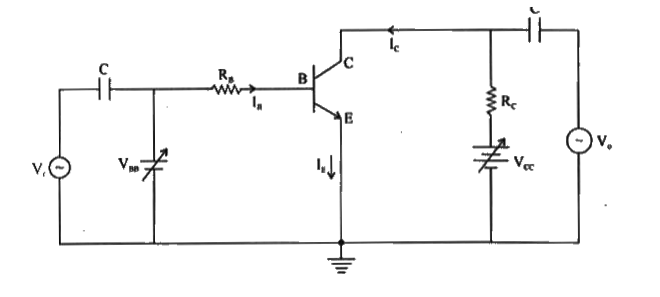
|
|
| 5. |
A circular disc is placed in front of a narrow source. When the point of observation is at a distance of 1 meter from the disc, then the disc covers first HPZ. The intensity at this point is I_(0) . The intensity at a point distance 25 cm from the disc will be |
|
Answer» `I_(1)=0.531I_(0)` |
|
| 6. |
If the focal length of a lens for red and violet light rays respectively are f_R and f_V then which of the following is true relationship ? |
|
Answer» `f_R GE f_V` `therefore(1)/(f_R)=(n_R-1)((1)/(R_1)-(1)/(R_2))` and `(1)/(f_V)=(n_V-1)((1)/(R_1)-(1)/(R_2))` `therefore" RATIO "(f_V)/(f_R)=(n_R-1)/(n_V-1)` `n_R lt n_V` `therefore n_R-1 lt n_V-1` `therefore (n_R-1)/(n_V-1) lt 1` `therefore (f_V)/(f_R) lt 1` `therefore f_V lt f_R` `therefore f_R gt f_V` |
|
| 7. |
Ifabodycontainsn _ 1electronsandn_2protonsthenwhatisthetotalchargeonthe body ? |
|
Answer» SOLUTION : `Q =q _ 1 + q _ 2+ … +q_n `(Additivepropertyofcharge) ` Q =(N _ 2 -n _ 1 )E ` |
|
| 8. |
The displacemet of the medium in a sound wave is given by the equation y_1 = A Cos(ax + bt) where A, a and b are positive constants. The wave is reflected by an obstacle situated at x = 0. The intensity of the reflected wave is 0.64 times that of incident waveWrite the equation of the reflected wave |
|
Answer» y=0.8A Cos(BT – ax) |
|
| 9. |
A point object is placed at a distance of 30 cm from a convex mirror of focal length 30 cm. The image will form at |
|
Answer» Infinity `(1)/(f)=(1)/(v)+(1)/(u)rArr(1)/(+30)=(1)/(v)+(1)/((-30))` v = 15 cm, behind the mirror 
|
|
| 10. |
The displacemet of the medium in a sound wave is given by the equation y_1 = A Cos(ax + bt) where A, a and b are positive constants. The wave is reflected by an obstacle situated at x = 0. The intensity of the reflected wave is 0.64 times that of incident waveIn the resultant wave formed after reflecting find the maximum and minimum values of particles speed in the medium |
|
Answer» `V_(MAX) = 1.8 AB, V_("min") = 0 Ab` |
|
| 11. |
A thin equiconvex lens is made of = glass of refractive index 1.5 and its focal length in air is 0.2 m. If it acts as a concave lens of 0.5m focal length when dipped in a liquid, the velocity of light in the liquid is |
|
Answer» `1.2xx10^(8)MS^(-1)` |
|
| 12. |
Write SI unit of electric flux |
|
Answer» `Vm^(-1)` `THEREFORE` Unit `N/Cm^(2)` |
|
| 13. |
What did they offer the bird to eat? |
|
Answer» Bread-omelette |
|
| 14. |
Solid uniform conductiong sphere of mass 'm' and charge Q, rotates about its axis of symmetry with constant angular velocity 'omega' then the ratio of magnetic moment to the moment of inertia of the sphere is (xQomega)/(6m) then x is :(Neglect induced charges due to centrifugal force) |
|
Answer» Solution :`M=(Q)/(2M)xx(2)/(3)MR^(2).omega` `I=(2mR^(2))/(5)` `(M)/(I)=(5Q.omega)/(6M)`. |
|
| 15. |
A train is moving slowly on a straight track with a constant speed of 2" m s"^(-1) . A passengers in the train starts walking at a stready speed of 2" m s"^(-1) to the back of the train in the opposite direction of the motion of the train. So to an observer standing on the platform directly in front of that passenger, the velocity of the passenger appears to be |
|
Answer» 2 `ms^(-1)` in the opposite DIRECTION of the train |
|
| 16. |
In an oscillating LC circuit with L=79mH and C=4.0 muF, the current is initially a maximum . How long will it take before the capacitor is fully charged for (a) the first time and (b) the second time ? |
|
Answer» |
|
| 17. |
The focal lengths of the lenses of an astronomical telescope are 50 cm and 5 cm. The length of the telescope when the image is formed at the least distance of distinct vision is (in cm) |
| Answer» ANSWER :4 | |
| 18. |
The refractive indices of glycerine and diamond with respect to air are 1.4 and 2.4 respectively. Calculate the speed of light in glycerine and diamond. From these results, calculate the refractive index of diamond with respect to glycerine |
|
Answer» `2.143 XX 10^8 m//s , 1.250 xx 10^8 m//s , 1.714` |
|
| 19. |
According to Bohr's quantum condition an electron in hydrogen and hydrogen like atoms can revolve in those stable orbits in which its momentum is an integer multiple of Planck's constant. |
| Answer» Solution :As per Bohr.s QUANTUM condition for stable orbits ANGULAR momentum of electron must be an integer MULTIPLE of`(h)/(2PI)` | |
| 20. |
A galvanometer having 30 divisions has current sensitivity of 20 μA/ division. It has a resistance of 25 ohm. How will you convert it into an ammeter measuring upto 1 A? How will you now convert this ammeter into a voltmeter reading upto 1 V? |
|
Answer» Solution :The full scale deflection current `i_(g)=30xx(20xx10^(-6))=6xx10^(-4)A`. If S is the required VALUE of the shunt connected in parallel with the galvanometer, then `i_(g)=S/(S+G)irArr6xx10^(-4)=S/(S+25)xxl` After SOLVING, we GET `S=150/9994Omega-0.01150Omega` The resistance of the ammeter `R_(A)=(SG)/(S+G)=(0.0150xx25)/(0.0150+25)=0.0150Omega` To convert this ammeter into the voltmeter, we can use `V=i_(g)(R_(A)+R_(0))` Here `V=1V,i_(g)=1A` `therefore1=1(0.0150+R_(0))` or `R_(0)=0.985Omega` |
|
| 21. |
The plano-convex lens of focal length 20cm and 30cm are placed together to form a double convex lens.The final length will be |
|
Answer» `12cm` `1/F=1/(f_(1))+1/(f_(2))=1/20+1/30` `F=(20xx30)/(20+30)=600/50=12cm` |
|
| 22. |
A rocket is receding away from earth with velocity 0.2C. The rocket emits signal of frequency 4 xx 10^7 Hz. The apparent frequency of the signal produced by the rocket observed by the observer on earth will be |
|
Answer» `3 xx 10^(6)` Hz |
|
| 23. |
What is a canyon? |
|
Answer» A DEEP GORGE typically a stream running through it |
|
| 24. |
A wave pulse on a string has the dimension shown in figure. The waves speed is v = 1 cm/s. If point O is a free end. The shape of wave at time t = 3 s is : |
|
Answer»
|
|
| 25. |
What is the difference between hole current and electron current ? |
|
Answer» Solution :A p-type semiconductor has HOLES as majority carriers and during conduction, the ELECTRON jumps from nearby covalent bond to occupy the hole and thus the hole SHIFTS towards covalent bond from which the electron has jumped. This MOVEMENT of hole is called hole current. An n-type semiconductor has electrons as majority carriers and during conduction, the free electrons constitute the electron current. |
|
| 26. |
A wooden core (figure ) supports two coils : coil 1 with inductance L_(1) and shor - circuited coil2 with active resistance R and inductance L_(2). The mutual inductance of the coils depends on the distance x between them according to the law L_(12)(x). Find the mean ( averaged over time ) value of the interaction force between the coils when coil 1 carries an alternating current I_(1)=I_(0)cos omegat |
|
Answer» Solution :We consider the force `vec(F_(12))` that a circuit 1 exerts on another closed circuuit 2`:-` `vec(F_(12))=ointI_(tau)d vec(l_(2)) xx vec(B_(12))` Here `vec(B_(12))=` magnetic field at the site of the current element `dvec(l_(2))`due to the current `I_(1)` flowing in 1 . `=(mu_(0))/( 4 pi ) int(I_(1)dvec(l_(1))xxvec(r_(12)))/(r_(12)^(3))` where `vec(r_(12))=vec(r_(2))-vec(r_(1))=` vector, current element `dvec(l_(1))` to the current element `dvec(l_(2))` Now `vec(F_(12))=(mu_(0))/( 4pi)int intI_(1)I_(2)(dvec(l_(2))xx(dvec(l_(1))xxvec(r_(12))))/(r_(12)^(3))=(mu_(0))/(4pi) int intI_(1)I_(2)(dvec(l_(2))(dvec(l_(2)).vec(r_(12)))-(dvec(l_(1)).dvec(l_(2)))vec(r_(12)))/(r_(12)^(3))` In the first term, we carry out the integration over `dvec(l_tau)` first. Then `int int (dvec(l_(1))(dvec(l_(2)).vec(r_(12))))/(r_(12)^(3))=int d vec(l_(2))oint(dvec(l_(2)).vec(r_(12)))/(r_(12)^(3))=-intd vec(l_(1))oint d vec(l_(2)). grad_(2)(1)/( r_(12))=0` because `oint dl_(2). grad_(2)(1)/(r_(12))=intd vec(S_(2)) curl (grad(1)/(r_(12)))=0` Thus `F_(12)=-(mu_(0))/(4pi) int int I_(1)I_(2)dvec(l_(1)).dvec(l_(2))(vec(r_(12)))/( r_(12)^(3))` The integral involved will depend on the vector `vec(a)` that defines the separation of the `(` suitably CHOSEN `)` CENTRE of the coils . Let `C_(1)` and `C_(2)` be the centres of the two coil suitably defined. Write `vec(r_(12))=vec(r_(2))-vec(r_(1))=vec(rho_(2))-vec(rho_(1))+vec(a)` where `vec(rho_(1))(vec(p_(2)))` is the distance of `dvec(l_(1))(dvec(l_(2)))` from `C_(1)(C_(2))`and `vec(a)` stands for the vector `C_(1)vec(C_(2))`. Then `(vec(r_(12)))/(r_(12)^(3))=-vec(grad_(vec(a)))(1)/(r_(12))` and `vec(F_(12))=vec("grad")_(a)[I_(1)I_(2)(mu_(0))/( 4pi)int int(dvec(l_(1)).dvec(l_(2)))/(r_(12))]` The bracket defines the mutual inductance `L_(12)`. Thus noting the definition of `x` `lt F_(x) gt =(deltaL_(12))/( deltax) lt I_(1)I_(2) gt` where `lt gt` denotes time average. Now `I_(1)=I_(2)cos omegat=` Real part of `I_(0)e^(iomegat)` ltbr. The current in coil 2 satisfies `RI_(2)+L_(2)(dI_(2))/(dt)=-L_(12)(dI_(1))/(dt)` or ` I_(2)=(-iomegaL_(12))/( R+iomegaL_(2))I_(0)e^(iomegat )` ( in the complex case) taking the real part `I_(2)=-(omegaL_(12)I_(0))/(R^(2)+omega^(2)L_(2)^(2))( omegaL_(2)cosomegat-R sin omegat)=- (omegaL_(12))/(sqrt(R^(2)+omega^(2)L_(2)^(2)))I_(0)cos ( cosomegat+varphi)` Where `tan varphi=(R)/( omegaL_(2))`. Taking time average, we get `lt F_(x) gt =(deltaL_(12))/(delta x)I_(0)(omegaL_(12)I_(0))/(sqrt(R^(2)+omega^(2)L_(2)^(2))).(1)/(2) cos varphi=(omega^(2)L_(2)L_(12)I_(0)^(2))/( 2(R^(2)+omega^(2)L_(2)^(2)))(deltaL_(12))/( deltax)` The repulsive nature of the force is also consistent with Lenz's law, assuming, of comse, that `L_(12)` decreases with `x`. |
|
| 27. |
Define instantaneous current. |
|
Answer» Solution :The INSTANTANEOUS CURRENT I is defined as the LIMIT of the AVERAGE current, as `DELTA to 0`. `I=lim_(Delta t to 0) (DeltaQ)/(Delta t)=(dQ)/(dt)` |
|
| 28. |
A particle is projected horizontally with a speed ''u'' rom the top of plane incline at an angle theta with the horizontal. How far from the point of projection will the particle strike the plane ? |
Answer» Solution :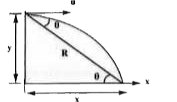 `R=sqrt(X^(2) + y^(2)) (y/x = TAN theta)` `=sqrt(x^(2) + (x tan theta)^(2)) =xsqrt(1 + tan^(2) theta) =x sec theta` `x=ut, y=1/2 "gt"^(2), y/x = 1/2("gt"^(2))/(ut)` `tan theta =("gt")/(2u), t=(2u)/gtan theta` `x=ut =(2u^(2))/g tan theta, therefore R=(2u^(2))/g. tan theta.sec theta` |
|
| 29. |
The wavelength lamda_epsilon of an electron and lamda_p of a photon of same energy E are related by : |
|
Answer» `lamda_p PROP lamda^2_e` |
|
| 30. |
A long solenoid carrying a current produces a magnetic field B along its axis. If the current is doubled and the number of turns per cm is halved, the new value of the magnetic field is |
|
Answer» B |
|
| 31. |
Three test tubes contain aqueous solutions as under I. KCN IIgt Fe(CN)_(2) III. Mixture of KCN,Fe(CN)_(2) in molar ratio 4 : 1 pick up the correct statement |
|
Answer» both I and III will give test for `CN^(-)` |
|
| 32. |
Height of the body from the ground can be calculated by using the formula h=-ut+(1//2)^(g t^2) in (a) A body projected vertically with velocity 'u' from the top of tower, reaches the ground in 't' sec. ( b) A body dropped from a balloon moving up with uniform velocity, reaches the ground in 't' sec (c) A body dropped from a helicopter moving up with uniform velocity, reaches the ground in 't' sec (d) A body projected vertically from the ground reaches the ground in 't' sec. |
|
Answer» a, B and C are correct |
|
| 33. |
A particle starting from rest falls from a certain height. Assuming that the value of acceleration due to gravity remains the same throughout the motion is displacement in three successive half second intervals are S_1.S_2.S_3 thenS_1.S_2.S_3 is given by : |
|
Answer» `1:5:9` |
|
| 34. |
Statement - (A) : Series combination of cells is preferred when external resistance is large compared to internal resistance of cell. Statement - (B) : Parallel combination of cells is preferred when external resistance is small compared to the internal resistance of each cell. |
|
Answer» A and B are TRUE |
|
| 35. |
What is NOR gate? Write its symbol, truth table and Boolean equation. |
|
Answer» SOLUTION :The NOR gate is constructed by combining the OR gate and the NOT gate. `therefore OR +NOT=NOR` Here, the output of the OR gate is given as input to the NOT gate.  The symbol of NCR gate is shown in figure (a). It has two or more inputs and one output.  FUNCTION of NOR gate: "The output is .0. whenever the input is .1. and whenever all the input are .0. the output is EQUAL to .1.. Boolean eqution of NOR gate is `Y=bar(A+B)`. It is READ as "Y is equal to NOT A or B". The truth table of the NOR gte is shown in table (b).  NOR gates are also called universal gates since by USING the gates one can realise other basic gates like OR, AND and NOT. |
|
| 36. |
What is the maximum value of angle of dip ? |
|
Answer» 90° `therefore tan phi = oo` `therefore phi = tan^(-1) (oo)` `therefore phi=90^@` which is maximum value of `phi` |
|
| 37. |
A radar sends the waves towards a distant object and receives the signal reflected by object. These waves are |
|
Answer» sound waves |
|
| 38. |
Twelve cells each having the same emf are connected in series and are kept in a closed box. Some of the cells are wrongly connected. This battery is connected in series with an ammeter and two cells identical with each other .The current is 3A when the cells and battery aid each other and 2A when the cells and battery oppose each other . How many cells ae wrongly connected ? |
|
Answer» Solution :Let m cells wrongly connected in the battery and `xi_("net") = (12-2m)xi` When two cells aid the battery , then current. `3=((12- 2m) xi+ 2xi)/(R) ""…..(i)` where R is the total resistance of the CIRCUIT. When two cells OPPOSE the battery , then `2=((12-2m)xi - 2xi)/(R) "".....(ii)` Solving above equations , we get m = 1 HENCE ONE cell is wrongly connected in the battery. |
|
| 39. |
The input resistance of a transistor is 1000Omega on charging it base current by 10 mu A', the collector increases by 2mA.If a load resistance of 5KOmegais used in, the circuit, the voltage gain of the amplifier is |
|
Answer» 100 |
|
| 40. |
निम्न मूल बलों को आपेक्षिक शक्ति के बढ़ते हुए क्रम में व्यवस्थित करें।1.गुरुत्वाकर्षण बल 2.विद्युतचुम्बकीय बल 3.दुर्बल नाभिकीय बल 4.प्रबल नाभिकीय बल |
|
Answer» 1,2,3,4 |
|
| 41. |
Consider a thick walled metallic spherical shell with inner radius a and outer radius b. No charge is given to the spherical shell. A point charge +Q is kept at the centre. Find the electric potential at a point distance x from thecentre where 0lt x lt oo. |
Answer» Solution :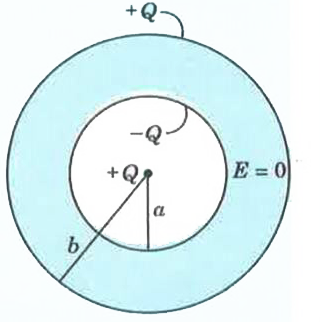 See the figure for charges induced on the inner and outer surfaces of a thick walled spherical shell. Charge induced on the inner surface is -Q and charge appearing on outer surface is +Q . These two spherical surfaces will act like two thin spherical shells of radius a and b respectively. In between these two faces,electric field intensity will remain zero. Hence, electric potential will remain constant for `a lt x lt b`. Moreover to PROCEED further we should be AWARE of the fact that elecrtric potential, due to a thin spherical shell for points outside it or on the surface, is same as that of a POINT charge as it it were kept at its centre and electric potential inside the thin spherical shell is same as that on its surface. We know that electric potential due to a point charge at a point that is at a distance x from it is given by the formula `V=(q)/(4pi epsilon_(0)x)` and now we can use the above stated information to write electric potential for different points due to the given system. (i) `0 lt x lt a` `V=(Q)/(4pi epsilon_(0)x)+(-Q)/(4pi epsilon_(0)a)+(Q)/(4pi epsilon_(0)b)` `rArr V=(Q)/(4pi epsilon_(0)x)-(Q)/(4pi epsilon_(0)a)+(Q)/(4pi epsilon_(0)b)"" ...(i)` (ii) `a lt x lt b` `V=(Q)/(4pi epsilon_(0)x)+(-Q)/(4pi epsilon_(0)x)+(Q)/(4pi epsilon_(0)b)` `rArr V=(Q)/(4pi epsilon_(0)b)"" ...(ii)` Note that value of potential for x = a, is same from both the equations (i) and (ii). Hence, there is no DISCONTINUITY. (iii) `b lt x lt oo` `V=(Q)/(4pi epsilon_(0)x)+(-Q)/(4pi epsilon_(0)x)+(Q)/(4pi epsilon_(0)x)` `rArr V=(Q)/(4pi epsilon_(0)x)"" ...(iii)` Note that value of potential at x = b is same from both the equaiton (ii) and (iii). Hence, there is no discontinuity at this point also. 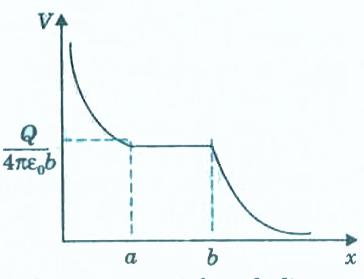 Electric potential due to the sbove system is defined for all the points EXCEPT x = 0. At x = 0, potential approaches infinity. Graph between electric potential and distance from the centre is shown in the figure. |
|
| 42. |
A sample of oxygen at N.T.P. has volume V and a sample of hydrogen at N.T.P. has volume 4V. Both the gases are mixed and the mixture is maintained at N.T.P.If the speed of sound in hydrogen at N.T.P. is 1270 m/s, that in the mixture will be : |
|
Answer» 317 m/s |
|
| 43. |
The relative permeability of a medium is 0.075. What is its magnetic susceptibility ? |
|
Answer» 0.926 |
|
| 44. |
A transformer has an efficiency of 80%. It works at 100 V and 4kW. If secondary voltage is 240 V, the current in primary coil is …….. |
|
Answer» SOLUTION :`P_1=V_1 I_1` `THEREFORE I_1=P_1/V_1` `=(4xx10^3)/100=40` A |
|
| 45. |
In Bohr's atomic model , the potential energyis negative and hasa magnitude greater than the kinetic energy, what does this imply ? |
| Answer» SOLUTION :The REVOLVING ELECTRON is BOUND to the NUCLEUS. | |
| 46. |
In the above example, the average acceleration of the particle in the interval t = 1 to t = 3 sec will be- |
|
Answer» 12 a – 2b ` (dx)/(dt) = 2at - 3bt^(2)` Now velocity at t = 1 SEC, ` v_(1)= ((dx)/(dt))_(t=1) = 2a- 3B` and that at ` t = 3 sec , v_(2) = ((dx)/(dt))_(t= 3) = 6a - 27 b ` THUS average acceleration` a_(av) = (v_(2) - v_(1))/(t_(2) - t_(1))` ` = (6a - 27b - 2a + 3b)/(3-1) = (4a - 24b)/(2) = 2a - 12b ` Hence correct answer is (C) |
|
| 47. |
A linder charge having linear charge density lambda pentrates a cube diagonally and then it pentrates a spere diametrically as shown. What will br the ratio of flux coming out of cube and sphere ? |
|
Answer» `1/2` |
|
| 48. |
A solid cube and a solid sphere both made of same material are completely submerged in water but to differentdepths. The sphere and the cube have same surface area. The buoyant force is– |
|
Answer» Greater for the cube than the SPHERE |
|
| 49. |
How many molecules of RMgX are consumed in the above given reaction ? |
| Answer» Solution :ACTION of `R^(ɵ)` (NUCLEOPHILE) | |
| 50. |
In a biprism experiment, the fringe width is 1.5mm when the eyepiece is 1.2 m from the salt. What will be the fringe width if the eyepiece is moved towards the slit by 0.2m, with no other change in the experimental setup? |
|
Answer» Solution :`X_(2)/X_(1)= D_(2)/D_(1)` `therefore` The NEW fringe WIDTH, `X_(2) = D_(2)/D_(1)X_(1)` `=(1.2 -0.2)/(1.2) XX 1.5 = 1.5/1.2 = 1.25` MM |
|


