

Saved Bookmarks
This section includes 7 InterviewSolutions, each offering curated multiple-choice questions to sharpen your Current Affairs knowledge and support exam preparation. Choose a topic below to get started.
| 1. |
A mathematical pendulum 1 m long is deflected from the vertical by an angle of 40^(@)and let go. Find the period of oscillations using numerical methods. What will be the error, if in this case we use the formula for small oscillations? |
|
Answer» `v-sqrt(2gh)=sqrt(2gl(cosalpha-cosalpha_(0)))=sqrt(2gl)` where `x=sqrt(cosalpha-cosalpha_(0))`. The body travels along the element of arc `Deltas=lDeltaalpha` in time `Deltal=(Deltas)/(v_(nv))=(lDeltaalpha)/(x_(AV)sqrt(2gl))=(Deltaalpha)/(x_(n)sqrt(2))sqrt((l)/(g))` PUT `Deltaalpha=3^(@)=pi//60` radian. Then `Deltat=2pisqrt((1)/(g)).(sqrt2)/(240x_(av))` Theperiod of oscillations is `T=4(Deltat_(1)+Deltat_(2)+......)=2pisqrt((l)/(g))(sqrt2)/(60)((1)/(x_(1av))+(1)/(x_(2av))+)`  Since the formula `T_(0)=2pisqrt(l//g)` is used to compute the period of small oscillations, it follows that `T=kT_(0)`, where `k=(sqrt2)/(60)((1)/(x_(1av))+(1)/(x_(2av))+.........)` is the correction factor. Let us compile a table from the COMPUTED data. We have `k=(sqrt2xx44.23)/(60)=1.042` Hence, the period `T=2piksqrt(l//g)=2.08` s, the VALUE of `T_(0)` being `T_(0)2pisqrt(l//g)=2.00` s. In this case the relative error DUE to the use of the formula for small oscillations will be 4%. |
|
| 2. |
When hydrogen atom is in its first excited level its radius is______in its ground state. |
|
Answer» 4 times |
|
| 3. |
Explain the importance of Fresnel distance. |
|
Answer» Solution :An APERTURE of size .a. illuminated by a parallel beam sends diffracted light into an angle `theta` , then angular width `theta~~(LAMDA)/(a)` In travelling a distance z, the diffracted beam acquires a width `=ztheta` `=(zlamda)/(a)` due to diffraction The VALUE of z the spreading due to diffraction is EQUAL to the size of a of the aperture. `:.a=(zlamda)/(a)` `:.z=(a^(2))/(lamda)` This quantity is called the Fresnel distance `z_(F)`. `:z_(F)=(a^(2))/(lamda)` This equation shows that for distances much smaller than `z_(F)` the spreading due to diffraction is smaller compared to the size of the beam (That means moving in a straight LINE). Hence, spreading due to diffraction dominates over that due to ray optics and it shows that ray optics is valid in the limit of wavelength tending to zero. |
|
| 4. |
A concave - convex lens has faces of radii 4 cm and 3 cm respectively and is made of glass of refractive index 1.6. Determineposition of image when object is placed at 28 cm in front of the lens |
| Answer» SOLUTION :70CM BEHIND the LENS | |
| 5. |
Explain Malu's law for polaroids |
| Answer» SOLUTION :Malus law is GIVEN by `I=I_(@)cos^(2) theta` Where `I_0` is the intensity of POLARIZED LIGHT coming out of I Polaroid and incidenting on Il Polaroid. `.theta.`is the ANGLE between the pass-axis of the Il Polaroid makes with that of I Polaroid. | |
| 6. |
A point chargeq is placed inside a conducting spherical shell of inner radius 2R and outer radius 3R at a distance R from the centre. The electric potential at the centre of shell will be (1)/(4 pi epsilon_(0)) times |
|
Answer» `(Q)/(2R)` |
|
| 7. |
Two charge q and –3q are placed fixed on x–axis separated by distance d. Where should a third charge 2q be placed such that it will not experience any force ? |
Answer» Solution :Here, LET us keep the charge 2q at a distance r from A.  Thus, charge 2q will not EXPERIENCE any force. when, force of repulsion on it DUE to q is balanced by force of attraction on it due to -3 q, at B, where AB=d. thus, force of attraction by -3q=force of repulsion by q `implies(2qxxq)/(4piepsi_(0)x^(2))=(2qxx3q)/(4piepsi_(0)(x+d)^(2))` `implies(x+d)^(2)=3X^(2)` ltBrgt `impliesx^(2)+d^(2)+3xd=3x^(2)` `implies=2x^(2)-d^(2)` ltBrgt `therefore2x^(2)-2dx-d^(2)=0` ltBrgt `x=(d)/(2)+-(sqrt(3)d)/(2)` (Negative sigh be between q and -3q and hence is unadaptable.) `x=-(d)/(2)+(sqrt(3)d)/(2)` `=(d)/(2)(1+sqrt(3))` to the left of q. |
|
| 8. |
There are three red coloured hands on a carbon resistor. What is its resistance ? |
|
Answer» `2.2 K Omega` Resistance from three bands of red colour = 22 `xx 10^(2) = 2200 Omega` As fourth band is not there, tolerance is 20% `therefore " Tolerance = 2200 " of " 20 % ` `= 2200 xx (20)/(100 ) = 440 Omega` `therefore `Magnitude of RESISTANCES `= (2200 pm 440 ) Omega` = ` 2200 + 440 " or " 2200 - 440 ` = ` 2640 Omega " or " 1760 Omega` `= 2.64 k Omega " or " 1.76 k Omega` |
|
| 9. |
When sound travels from air to water the quantity that remains unchanged is : |
|
Answer» speed or `I_(A) = I_(0) 10^(LA)` SIMILARLY `I_(B) = I_(0) 10^(LB)` `therefore (I_(A))/(I_(B)) = (10^(LA))/(10^(LB)) = (10)^(LA - LB)` Hence CORRECT choice is (c) . |
|
| 10. |
A closed vessel contains a mixture of two diatomic gases A and B.Molar massof A is 16 timesthat of Band mass of gas A. contained in the vessel is 2 times that of B . Then |
|
Answer» AVERAGE kinetic energy per molecule of gas A is equal to that of gas B. Itdependsonlyon temperature. ` v_(rmsA) = sqrt((3RT)/(M_(A)))` ` v_(rms B) = sqrt((3RT)/(M_(B)) = sqrt((3RT)/(M_(A)//16)) = 4 v_(rms)A ` ` n_(A) = m_(A)/(M_(A) ,n_(B) = m_(B)/(M_(B) = (M_(A)//2)/((M_(A)//16)) = 8 NA ` ` P_(B) = ( n_(B)/(n_(A) + n_(B))) P_(0) , P_(A)= ( n_(A)/(n_(A)+ n_(B))) P_(0)` ` RightarrowP_(B) = 8 P_(A)` |
|
| 11. |
When different capacitors are connected in series, they will have the same: |
|
Answer» Capacity |
|
| 12. |
Every metal has a definite work function. Why do all photoelectrons not come out with the same energy if incident radiatio is monochromatic ? Why is there an energy distribution of photoelectrons ? |
| Answer» Solution :Work FUNCTION of a metal merely indicates the minimum energy REQUIRED for the electron in the highest level of the CONDUCTION band to get out of the metal surface. HOWEVER, all electrons in the metal do not along to this level. They occupy a continuous band of energy levels. as a CONSEQUENCE, for the same incident radiation, electrons knocked off from different energy levels come out with different energies. | |
| 13. |
What is the direction of magnetic dipole moment'? |
|
Answer» North to South `therefore` DIRECTION is South to North. |
|
| 14. |
Derive scalar relation between electric field and electrostatic field . Electric field of a charge Q at a distance E= (KQ)/(r^(@)) and electrostatic potential, V= (kQ)/(r) :. Taking ratio , (E)/(V) = (1)/(r) :. V= Er |
|
Answer» SOLUTION :ELECTRIC field of a CHARGE Q at a DISTANCE `E= (KQ)/(r^(2))` and electrostatic potential , `V= (KQ)/(r) ` `:.` Taking ratio `(E)/(V)=(1)/(r)` `:. V=Er` |
|
| 15. |
A spring of spring constant 8 N/cm has an extension of 5 cm. The minimum work done in Joule in increasing the extension from 5 cm to 15 cm is |
|
Answer» 16 J |
|
| 16. |
Calculate the frequency of the photon,which can excite the electron to -3.4 eV from-13.6 eV. |
|
Answer» SOLUTION :Energy of PHOTON, `hupsilon = E_(2) - E_(1)` Frequency, `UPSILON = (E_(2) - E_(1))/(h)` `= ([-3.4 - (-13.6)] xx 1.6 xx 10^(-19))/(6.6 xx 10^(-34))` ` = (10.2 xx 1.6 xx 10^(15))/(6.6)` `upsilon = 2.47 xx 10^(15) Hz` |
|
| 17. |
Initially the space between the plates of the capacitor is filled with air, and the field strengthin the gapis equalto E_(0). Thenhalf the gap is filled with uniformisotropicdielectric with permittivity epsilonas shown in Fig. Find the moduli of the introduction of the dielectric (a) deos not change the voltageacross the plates, (b) leaves the charges at the plates constant. |
|
Answer» SOLUTION :(a) We have `D_(1) = D_(2)`, or EPSILON `E_(2) = E_(1)` Also,`E_(1) (d)/(2) + E_(2) (d)/(2) = E_(0) d` or, `E_(1) + E_(2) = 2 E_(0)` Hence, `E_(2) = (2 E_(0))/(epsilon + 1)` and `E_(1) = (2epsilon E_(0))/(epsilon + 1)` and `D_(1) =D_(2) = (2 epsilon epsilon_(0) E_(0))/(epsilon + 1)` (b) `D_(1) = D_(2)`, or `epsilon E_(2) = E_(1) = (sigma)/(epsilon_(0)) = E_(0)` THUS, `E_(1) = E_(0), E_(2) = (E_(0))/(epsilon)` and `D_(1) = D_(2) = epsilon_(0) E_(0)` |
|
| 18. |
A friend from abroad presents you a coffee maker when she visited you. Unfortunately it was designed to operate at 110V line to obtain 960W power that it needs.: Which type of transformer you use to operate the coffee maker at 220V? |
| Answer» SOLUTION :STEP down TRANSFORMER | |
| 19. |
Consider the following statements A and B given below and identify the correct answer. (a) Vectorshati+3hatj+5hatk and 2 hati+6hatj+10 hatk are parallel (b) hati+hatj+hatk represents a unit vector. |
|
Answer» Both A and B FALSE |
|
| 20. |
A point charge is kept at the centre of a metallic insulated spherical shell. Then |
|
Answer» Electric field out side the sphere is zero |
|
| 21. |
A condenser of 21 muF is charged to 100V and then discharged through a wire of mass 0.25 gm and specific heat 0.1 cal "gm"^(-1) ""^@C^(-1). The rise in temperature of the wire is |
| Answer» ANSWER :B | |
| 22. |
A stationary,circular wall clock has a face with a radius of 15cm Six turns ofwire are wound arout its permeter the wire carries a current 2.0A in the clockwise direaction The clcok is located where there is a contant, uniform external magnetic filed of 70m T (but the clock still keeps perfect time) at exactly 1 :00p m the hour hand of the clock points in the direction of the external magnetic field (a) After how many minutes will the minute hand point in the direction of the torque on the winding due to the magngetic field (b) What is the magnitude of this torque . |
|
Answer» (a) After 20 minutes (b) `tau_(3) = NIAB sin 90^(@) = 6 xx 2 pi xx (0.15)^(2) xx 70 xx 10^(-)` `tau = 12 xx (22)/(7) xx 225 xx 70 xx 10^(-7) N -m = 5.94 xx 10^(-2) N -m` 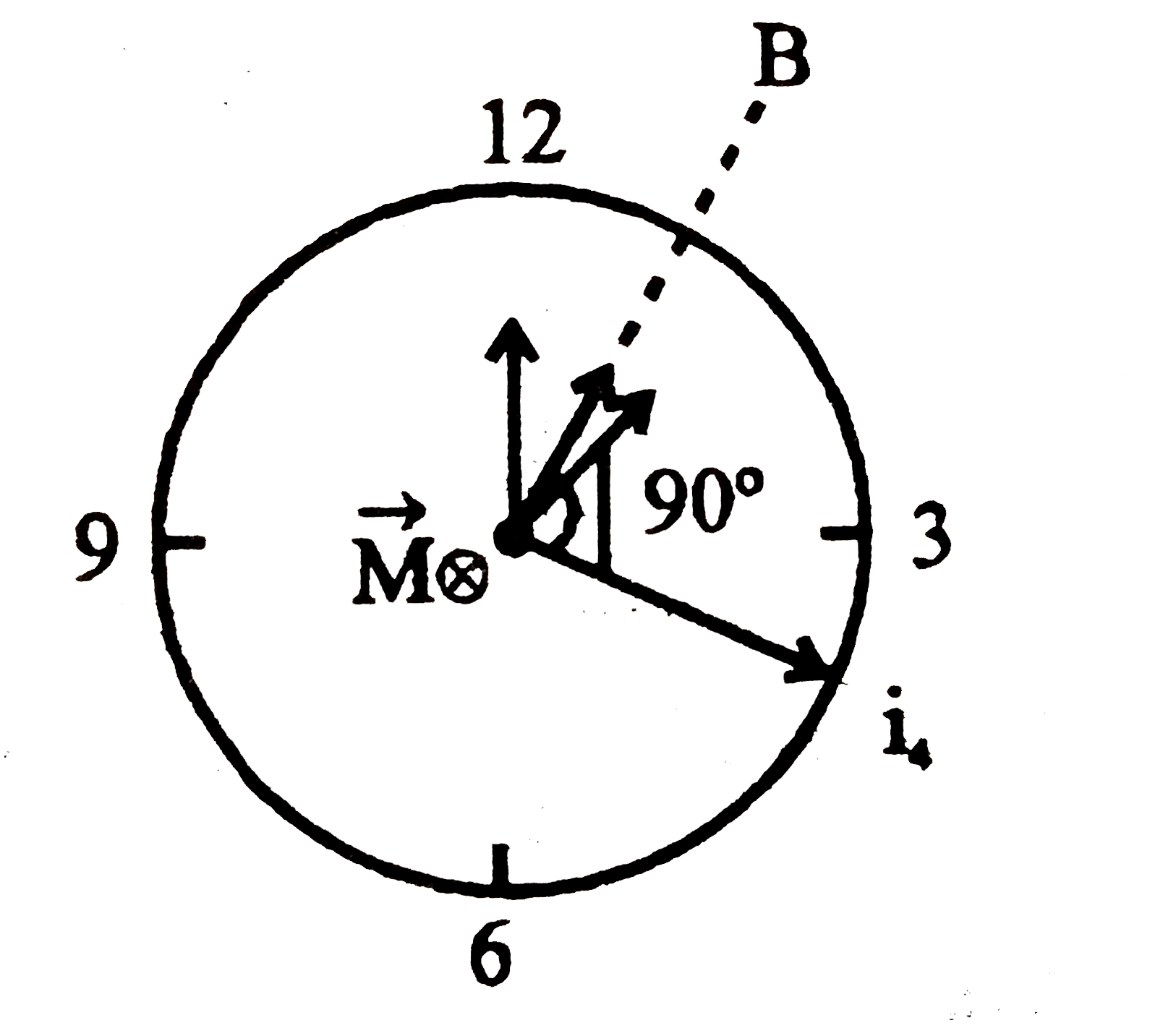 . .
|
|
| 23. |
Who propounded that a moving particle always has a wave associated with it and the particle is controlled ny a wave ? |
| Answer» SOLUTION :DE BROGLIE | |
| 24. |
Two balls are projected simultaneously with the same speed from the top of a tower, one vertically upwards and the other vertically downwards. They reach the ground in 9 second and 4 second respectively. The height of the tower is: |
|
Answer» 100 m `= -9v+405` ALSO `h=4v+(1)/(2)xx10xx64` `=4v+320` Subtracting 13v =325 or v=25 m `s^(-1)` Thus putting in (i) h=180 m. |
|
| 25. |
Choose the correct statement(s) about the frictional force between two solid surfaces in contact |
|
Answer» Static FRICTION is a variable FORCE |
|
| 26. |
Light incident normally on a plane mirror attached to a galvanometer coil retraces backwards as shown in Fig. 9.11. A current in the coil produces a deflection of 3.5° of the mirror. What is the displacement of the reflected spot of light on a screen placed 1.5 m away ? |
|
Answer» Solution :We know that in a plane mirror if for a GIVEN INCIDENT ray the pjg 911 mirror is rotated by an angle 0 then the reflected rays rotates in the same direction by an angle 20. It is given that on PASSING current mirror produces a deflection of 3.5°, hence the reflected ray rotates by 2 x 3.5° = 7°. `THEREFORE tan 7^(@) = d/(1.5 m) rArr d = 1.5 tan 7^(@) = 1.5 xx 0.1228 = 0.184 m = 18.4` cm |
|
| 27. |
A metallic spherical shell has an inner radius R j and outer radius R_2. A charge Q is placed at the centre of the spherical cavity. What will be surface charge density on (i) the inner surface, and (ii) the outer surface ? |
| Answer» Solution :As CHARGE in spherical cavity + Q, the charge INDUCED on inner surface of spherical SHELL will be - Q and accordingly the charge induced on outer surface will be + Q. Surface charge DENSITY on inner surface of spherical shell `sigma_(1) = -Q/(4piR_(1)^(2))` and surface charge density on outer surface of spherical shell `sigma_(2) = (+Q)/(4piR_(2)^(2))` | |
| 28. |
The wavelength of light from the spectral emission line of sodium is 589 nm. Find the kinetic energy at which (a) an electron, and (b) a neutron, would have the same de Broglie wavelength. |
|
Answer» SOLUTION :(a) `6.95xx10^(-25)J=4.34mueV` (B) `3.78xx10^(-28)J=0.236neV` |
|
| 29. |
A body of mass 8kg is in limiting equilibrium over an inclined plane of inclination 30^@. If the inclination is made 60^@, the minimum force required to prevent the body from sliding down is (g = 10ms^(-2)) |
|
Answer» 80 N |
|
| 30. |
When a light wave travels from air to glass, |
|
Answer» its wavelength decreases |
|
| 31. |
A ball having charge 4.9xx10^(-5)C and mass 100 g is allowed to fall from rest. Horizontal field intensity of the place from where the ball starts to fall is 2xx10^(4)N//C. (i) Calculate the resultant force applied on the ball. (ii) What is the nature of the path followed by the ball ? (iii) What would be the position of the ball after 2 s? |
|
Answer» (ii) Rectilinear along the DIRECTION of RESULTANT force (iii) 28 m from the INITIAL POINT |
|
| 32. |
In a Young's double slit experiment minimum intensity is found to be non-zero. If one of the slits is covered by a transparent film which absorbs 10% of light energy passing through it, then |
|
Answer» INTENSITY at MAXIMA must decrease |
|
| 33. |
Which two of the below given points are known as the twin characteristics growth ? (i) Increase in mass(ii) Increase in number of individuals (iii) Cellular organization (iv) Cellular differentiation |
|
Answer» (i) and (II) |
|
| 34. |
Find the equivalent resistance between point a and b in the network shown in figure. |
|
Answer» |
|
| 35. |
A 2 m string is fixed at one end and is vibrating in its third harmonic with amplitude 3 cm and frequency 100Hz Find the maximum kinedic energy of the string by intergrating your expression for part (a) over the total length of the string. |
| Answer» | |
| 36. |
A 2 m string is fixed at one end and is vibrating in its third harmonic with amplitude 3 cm and frequency 100Hz (a) Write an expression for the kinetic energy of a segment of a segment of the string of length dx at a point x at some time l. At what time is its kinetic energy maximum? What is the shape of the string at this time? |
|
Answer» |
|
| 37. |
Match the statements in Column I labeled as (a), (b), (c ), and (d) with those in Column II labeled as (p), (q), (r ), and (s). Any given statement in Column I can have correct matching with one or more statements in Column II. An electron in hydrogen atom moves from n=1 to n=2. {:("Column I",,"Column II"),("(a) Angular momentum",,"(p) One-forth times"),("(b) Kinetic energy",,"(q) Two times"),("(c) Potential energy",,"(r) Four times"),("(d) Mechanical energy",,"(s) Half times"):} |
|
Answer» <P> |
|
| 38. |
Match the statements in Column I labeled as (a), (b), (c ), and (d) with those in Column II labeled as (p), (q), (r ), and (s). Any given statement in Column I can have correct matching with one or more statements in Column II. {:("Column I",,"Column II"),("(a) Lithium atom",,"(p) 54.4 eV"),("(b) Helium atom",,"(q) 13.6 eV"),("(c) Beryllium atom",,"(r) 122 eV"),("(d) Hydrogen atom",,"(s) 217.6 eV"):} |
|
Answer» <P> |
|
| 39. |
A uniform wire of resistance 2R is bent in the form of a circle. The effective resistance between the ends of any diameter of the circle is |
|
Answer» 2R 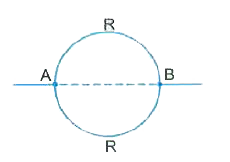
|
|
| 40. |
Figures 9.31(a) and (b) show refraction of a ray in air incident at 60° with the normal to a glass-air and water-air interface, respectively. Predict the angle of refraction in glass when the angle of incidence in water is 45° with the normal to a water-glass interface [Fig. 9.31(c)]. |
|
Answer» Solution :For (a), refractive index of glass with respect to air, `""^(a)mu_g = (SIN i)/(sin r) = (sin 60^@)/(sin 35^@) = (0.8660)/(0.5736) = 1.51 ` (B) Refactive index of glass with respect to air, `""^(a) mu_(W) = (sin i)/(sin r) = (sin 60^@)/(sin 47^@) = (0.8660)/(0.6561) = 1.32 ` (c) Refractive index of glass w.r.t water. `""^(w)mu_(G) = (a_(mug))/(a_(mug))= 1.51/1.32= 1.144` `""^(w)mug = (sin i)/(sinr) = (sin 45^@)/(sinr)` `(""^(a)mu_g)/(""^(a)mu_g) = (sin 45^@)/(sinr )` `THEREFORE (1.51)/(1.32) = (0.7071)/(sinr)` `therefore sin r = (0.7071)/(sinr)` `therefore sin r = (0.7071 xx 1.32)/(1.51) = 0.6181` From log table` r = 38.2^@` |
|
| 41. |
A diode can be used as |
|
Answer» a demodulator |
|
| 42. |
a. Two insulated charged copper spheres A and B have their centres separated by a distance o 0.5 m. What is the mutual force of electrostatic repulsion if the charge on each is 6.5xx10^(-7)C? Assume that the radii of A and B are negligible compared to the distance fof separation. b. What is the fore of repulsion if each sphere is charged double the above amount and the distance between them is halved? |
|
Answer» Solution :(a)CHARGE on sphere , r=50cm=0.5m Force of repulsion between the two spheres, `F=(q_(A)q_(B))/(4piepsilon_(0)r^(2))` where , `epsilon_(0)=`Free space permittivity `(1)/(4piepsilon_(0))=9xx10^(9)NM^(2)C^(-2)` `F=(9xx10^(9)xx(6.5xx10^(-7))^(2))/((0.5)^(2))` `=1.52xx10^(-2)N` THEREFORE , the force between the two sphere is `1.52xx10^(-2)N`. (b)After doubling the charge , charge on sphere A,`q_(A)=` Charge on sphere `B,q_(B)=2xx6.5xx10^(-7)C=1.3xx10^(-6)C` The distance between the sphere is halved. `thereforer=(0.5)/(2)=0.25m` Force of repulsion between the two spheres, `F=(q_(A)q_(B))/(4piepsilon_(0)r^(2))` `=(9xx10^(9)xx1.3xx10^(-6)xx1.3xx10^(-6))/((0.25)^(2))` `=16xx1.52xx10^(-2)` `=0.243N` Therefore , the force between the two spheres is `0.243N`. |
|
| 43. |
Define current gain alpha and beta for a transistor. How are they mutually related ? |
|
Answer» Solution :CURRENT gain `alpha` is defined as the ratio of collector current to the emitter current at constant collector voltage. Current gain `beta` is defined as the ratio of the collector current to the base current at constant collector voltage. i.e. `beta=((I_(C))/(I_(b)))_(E_(ie))` RELATION between `alpha` and `beta`. For n-p-n and p-n-p transistor, we have `I_(e)=I_(b)+I_(c)` or `(I_(e))/(I_(c))=(I_(e))/(I_(c))+1`......`(i)` Since current gain of common emitter amlifier, `alpha=(I_(c))/(I_(e))` And current gain of common base amplifier, `beta=(I_(c))/(I_(b))` So Eq. `(i)` BECOMES `(1)/(alpha)=(1)/(beta)+1` or `(1)/(beta)=(1)/(alpha)-1` or `beta=(alpha)/(1-alpha)` |
|
| 44. |
Calculate the force per unit length on a long straight wire carrying current of 4 A due to a parallel wire carrying 6 A current . Distance between the wires is 3 cm. |
|
Answer» SOLUTION :Here, `I_1 = 4 A, I_2 = 6A, and d= 3 CM, 0.03 m`. `:.` Force per unit length on ONE wire DUE to the other = `(mu_0)/(4pi) cdot (2 I_1 I_2)/(d) = (10^(-7) XX 2 xx 4 xx 6)/(0.03) = 1.6 xx 10^(-4) T`. |
|
| 45. |
When n, identical capacitors are connected in series then equivalent capacitance becomes x, and when the same are connected in parallel then equivalent capacitance becomes y. Calculate y/x. |
|
Answer» Solution :`(1)/(C_(eq))=(1)/(C )+(1)/(C )+…`N times `RARR C_(eq)=(C )/(n)=x "" …(i)` Equivalent capacitanceof n identical CAPACITORS connected in PARALLEL is `C_(eq)=C+C+C….` n times `rArr C_(eq)=NC=y "" …(ii)` Dividing (ii) by (i), `(nC)/(C//n)=(y)/(x)` `rArr n^(2)=y//x` `or (y)/(x)=n^(2)` |
|
| 46. |
The magnifying power is also known as_____. |
| Answer» SOLUTION :ANGULAR MAGNIFICATION | |
| 47. |
A cell of emf E and internal resistance r is connected across an external resistance R. Plot a graph showing the variation of P.D. across R, verses R. |
|
Answer»
|
|
| 48. |
चित्र में कौन सा ग्राफ एक समान त्वरण के अन्तर्गत गति को व्यक्त करता है? |
| Answer» ANSWER :D | |
| 49. |
A plane wavefront is divided into a number of half period zones as per Fresnel theory. The resultant amplitude at a point due to secondary waves spreading from a zone is |
|
Answer» DIRECTLY porportional to the squareroot of the area of the zone |
|
| 50. |
A beam of light converges of at a point P. Now a lens is placed in the path of the convergent beam 12 cm from P. At what point does the beam converge, if the lens is (a) a convex lens of focal length 20 cm, and (b) a concave lens of focal length 16 cm? |
|
Answer» Solution :Here the lens has been placed in the path of the convergent BEAM before its actual converging. It means that the object is situated on the right side of lens, i.e., u = + 12 cm (a)If the lens is convex, then f= + 20 cm `therefore 1/V -1/12 =1/20` or `1/v = 1/12 + 1/20 = (5+3)/60 = 8/60 rArr v = 60/8 = 7.5` cm (b) If the lens is concave, then f= - 16 cm, `1/v -1/12 =1/(-16)` or `1/v = 1/12 - 1/16 = (4-3)/48 rArr v= 48 cm` Thus, the image is REAL and situated at 48 cm from the lens. |
|


