

Saved Bookmarks
This section includes 7 InterviewSolutions, each offering curated multiple-choice questions to sharpen your Current Affairs knowledge and support exam preparation. Choose a topic below to get started.
| 1. |
An aluminium cylindrical container has an internal capacity of 2.00 litre at 20.0^(@)C. It is completely filled with turpentine oil and then slowly warmed to 100.0^(@)C. Coefficient of volume expansion of turpentine oil is 9.00xx10^(-4)C^(-1) and the thermal linear co-efficient of aluminium is 0.720 xx10^(-4)C^(-1). The amount of overflow of turpentine oil in litres is ............ |
|
Answer» `=Delta V _("TURPENTINE") - Delta V _(Al) = gamma _("turpentine") V _(0) Delta THETA - gamma _(A L) V _(0) Delta theta` `= (gamma _("Turpentine")- 3alpha _(Al)) V _(0) Delta theta = (9.00xx10^(-4)-2.16xx10^(-4)) V_(0) Delta theta` `= 6.84xx10^(-4) xx 2xx 80L =0.11L` |
|
| 2. |
If the energy of a photon corresponding to a wavelength 600 nm is 3.32xx10^(-19)J, then energy of a photon of wavelength 400 nm will be |
|
Answer» 1.4 eV |
|
| 3. |
A container made of glass (mu= 1.5) contains a liquid. A ray of light passing through the liquid falls on the bottom of the container at an angle of incidence theta= tan^(-1)""(0.9) and completely polarized. The ray should strike the bottom of the container at an angle of incidences so that it undergoes total internal reflection |
|
Answer» `TAN^(-1) (1.5)` |
|
| 5. |
Which of the following is a paramagnetic material ? |
|
Answer» Water |
|
| 6. |
An electrolytic cell containing a solution of CuSO_(4) has an internal resistance of 1Omega. It is connected in series with 3 V battery of negligible resistance and a 4Omega resistance. The mass of copper which will be deposited on the copper electrode in 30 min is calculated. If 4 Omega resistance is connected in parallel across the electrolytic cell and the same battery is used, the amount of copper deposited in 30 min is calculated ECE of Cu= 0.00033 g/C. Using Faraday's first law of electrolysis, the mass deposited on the copper electrode can be calculated. For the resistance of 4 Omega connected in parallel to cell, the current in the circuit is |
|
Answer» 3.75A |
|
| 7. |
How the quality factor effects the selectivity of the circuits ? |
| Answer» Solution :Higher the QUALITY FACTOR, more SELECTIVE is the CIRCUIT. | |
| 8. |
An electrolytic cell containing a solution of CuSO_(4) has an internal resistance of 1Omega. It is connected in series with 3 V battery of negligible resistance and a 4Omega resistance. The mass of copper which will be deposited on the copper electrode in 30 min is calculated. If 4 Omega resistance is connected in parallel across the electrolytic cell and the same battery is used, the amount of copper deposited in 30 min is calculated ECE of Cu= 0.00033 g/C. Using Faraday's first law of electrolysis, the mass deposited on the copper electrode can be calculated. Mass of copper deposited in 30 min when resistance of 4 Omega is in series is |
|
Answer» 0.214g |
|
| 9. |
For an angle of incidence theta on an equilateral prism of refractive index sqrt(3) , the ray refracted is parallel to the base inside the prism. The value of theta is |
|
Answer» `30^(@)` |
|
| 10. |
A bomb initially at rest at a height of 40 m above the ground suddenly explodes into two identical fragments. One of them starts moving vertically downwards with an initial speed of 10 m/s. If acceleration due to gravity is 10 m//s^2, the separation between the fragments, 2 seconds after the explosion is |
|
Answer» Solution :Initial relative velocity `u_(rel) =10-(-10) = 20 m//s` Relative acceleration `a_("rel") =g -g=0` After t=2 sec, relative separation After t=2 sec, relative separation `S_("rel") =u_(rel) t + 1/2 a_(rel)t^(2) =(20 xx 2) + 0= 40 m` |
|
| 11. |
Use the mirror equation to show that (a) an object placed btween f and 2f a concave mirror produces a real image beyond 2f (b) a convex mirror always produces a virtual image independent of the location of the objcet. (c) an object placed between the pole and focus of a concave mirror produces a virtual and enlarged image. |
|
Answer» Solution :(a) As `DeltasABC` and `A'B'C` are similar `therefore (AB)/(A'B')=(CB)/(CB')……..(I)` Again as `DeltasABP` and `A'B'P` are similar `(AB)/(A'B')=(PB)/(CB')……..(II)` From `(i)` and `(ii)` `(AB)/(A'B)=(PB)/(PB')…….(iii)` Measuring all distance from `P` , we have `CB=PB-PC` `CB'=PC-PB'` `therefore` from `(iii)` `(PB-PC)/(PC-PB')=(PB)/(PB')........(iv)` Using New Cartisian SIGN conventions, `PB=-u` `PC=-R` `PB'=-v` We GET from `(iv)` `(-u+R)/(-R+v)=(-u)/(-v)` or `+uR-uv=uv-vR` `uR+vR=2uv` Dividing both sides by `uvR`, we get `(1)/(v)+(1)/(u)=(2)/(R)` As `(1)/(v)+(1)/(u)=(2)/(R)=(2)/(2f)=(1)/(f)` `rArr (1)/(v)+(1)/(u)=(1)/(f)` 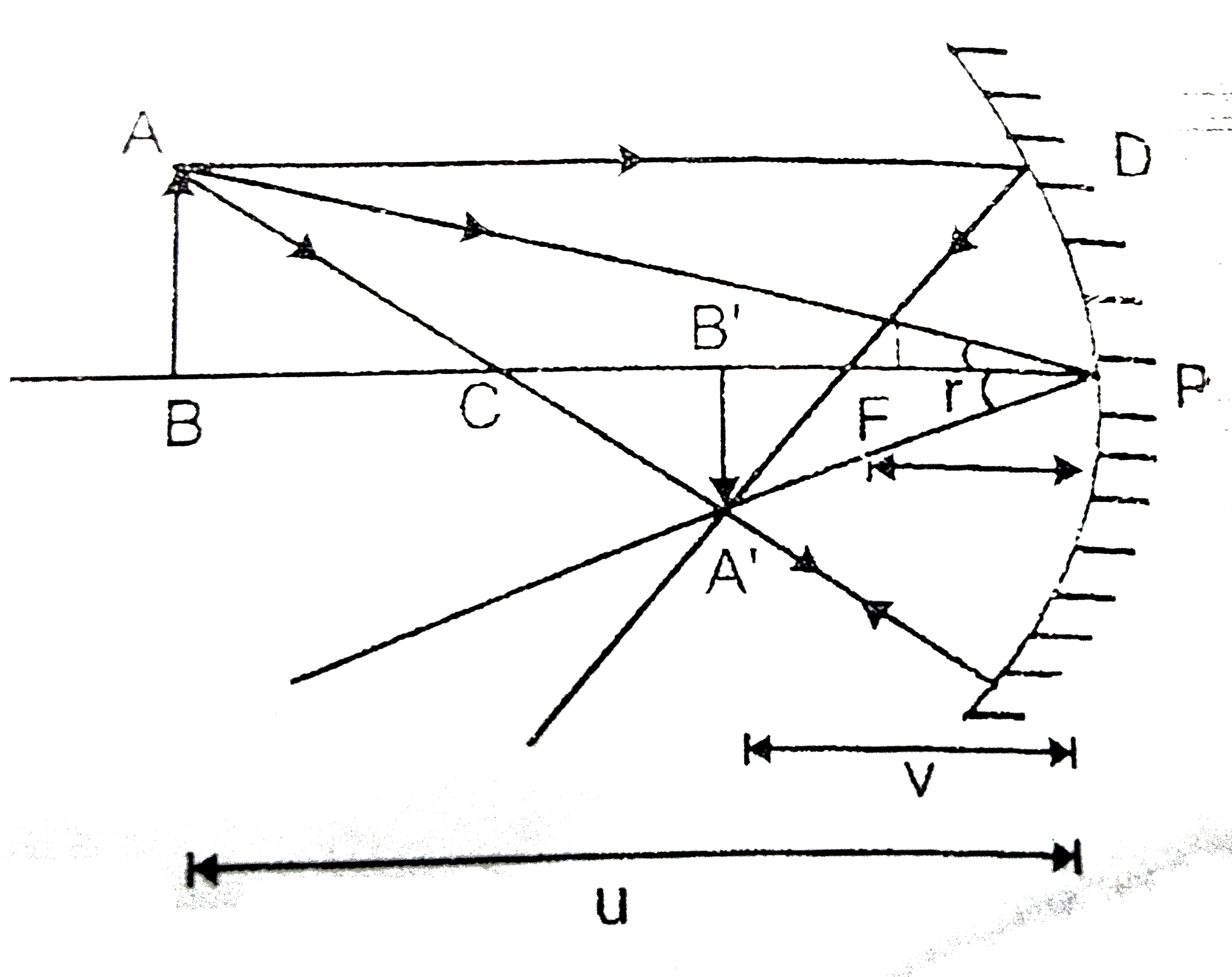 (b) According to sign conventions, `PB'=-u,PB'=+v` `PB=f,PC=2f` `DeltasABC` and `A'B'C` are similar `therefore (AB)/(A'B')=(CB)/(B'C)` But all DISTANCES along the principal axis should be measured from the pole of the mirror. `(AB)/(A'B')=(PC+PB)/(PC-PB')` Since the aperture of the mirror is small therefore `MP` can be regarded as a straight line. `DeltasMPF` and `A'B'F` are similar `(MP)/(A'B')=(PF)/(B'F)=(PF)/(PF-PB')`or ` (AB)/(A'B')=(f)/(f-v)........(ii)` from `(i)` and `(ii)` `(2f-u)/(2f-v)=(f)/(f-v)` `2f^(2)-2fv-uf+uv=2f^(2)-VF` `-fv-uf+uv=0` `uv=fv+fu` Dividing by `uvf`, we get `(1)/(f)=(1)/(u)+(1)/(v)` 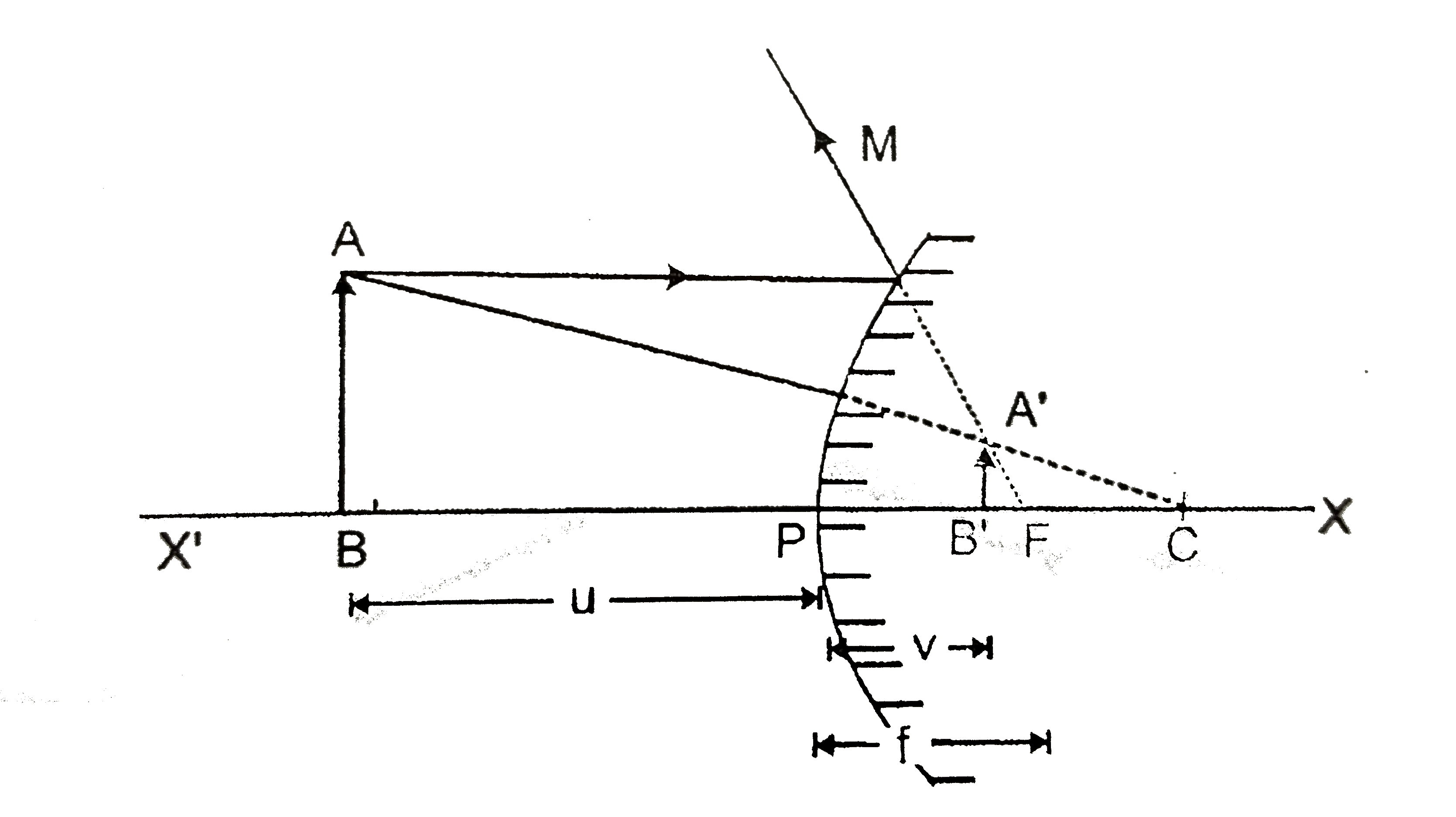 (c) `(PB-PC)/(PC-PB')=(PB)/(PB') ........(i)` Proceeding as above, we get `(CB)/(CB')=(PB)/(PB')...........(ii)` Measuring all distance from `O`, we get `CB=PC-PB` `CB'=PC+PB` From `(i)` `(PC-PB)/(PC+PB') =(PB)/(PB')` Using New cartisian sign conventins, PB=-u,PB=+v` `PC=-R=(-R+u)/(-R+V)=(-u)/(v)` or `uR-uv=vR+uv` `uR+vR=2 uv` Dividing both sides by `uvR`, we get `(1)/(v)+(1)/(u)=(2)/(R)=(2)/(2f)=(1)/(f),(1)/(v)+(1)/(u)=(1)/(f)` 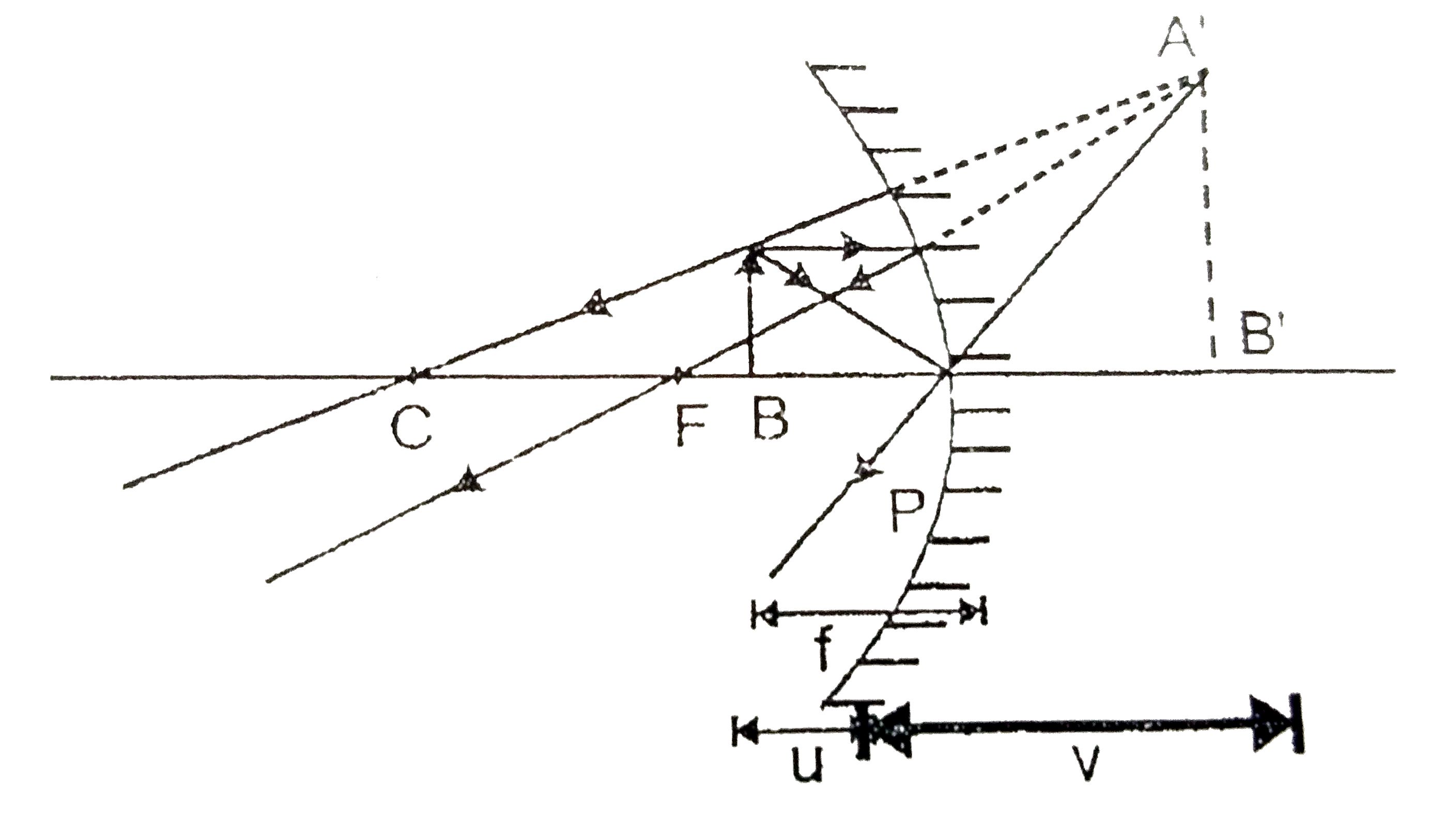
|
|
| 12. |
The equation of a wave is y= 4 sin[pi/2 (2t + 1/8x)] where y and x are in cm and t is in second. |
|
Answer» The AMPLITUDE, wavelength, velocity and frequency of WAVE are 4cm, `16cm,32cm^(-1)`and 1Hz respectively with wave propagating along + X direction, |
|
| 13. |
An electrolytic cell containing a solution of CuSO_(4) has an internal resistance of 1Omega. It is connected in series with 3 V battery of negligible resistance and a 4Omega resistance. The mass of copper which will be deposited on the copper electrode in 30 min is calculated. If 4 Omega resistance is connected in parallel across the electrolytic cell and the same battery is used, the amount of copper deposited in 30 min is calculated ECE of Cu= 0.00033 g/C. Using Faraday's first law of electrolysis, the mass deposited on the copper electrode can be calculated. For series connection of 4 Omega resistor, the current flowing through electrolyte is |
|
Answer» 6A |
|
| 14. |
What is the maximum value of the force F such that the block shown in the arrangement, does not move? |
|
Answer» `20N` ` F cos 60^@= mu(W + Fsin 60^@60 ^@ )` SUBSTITUTING`mu = (1)/(2 sqrt(3))andW= 10sqrt(3), ` weget ` F=20 N` 
|
|
| 15. |
The material which do not conduct electric current are called . |
| Answer» SOLUTION :INSULATORS | |
| 16. |
Using Kichhoff's law in the given circuit determine the voltange drop a cross the unknown resistor 'R' |
|
Answer» Solution :Applying kirchhoff's second rule (law) in the closed loop ABFEA. `-0.5xx2=V_(A)-V_(B)-3` `-1+3=V_(A)-V_(B)` `V_(A)-V_(B)=2Va` POTENTIAL drop ACROSS R si 2V as R, EF & AB are parallel. |
|
| 17. |
In a certain experiments to measure the ratio of charge to mass of elementry particles, a surprising result was obtained in which two particle, a surprising result was obtained in which two particles moved in such a way that the distance between them always remained constant. It was also noticed that this two-particle system was isolated from all other particles and no force was acting on this system except the force between these two mases. After careful observation followed bu intensive calculation, it was deduced that velocity of these two particles was always opposite in direction and magnitude of velocitywas 10^(3) ms^(-1) and 2 xx 10^(3) ms^(-1) for first and second particle, respectively,and mass of these particles were 2 xx 10^(-30) kg and 10^(-30)kg, respectively. Distance between them were 12Å(1Å = 10^(-10)m). Paths of the two particles was |
|
Answer» intersecting straight lines 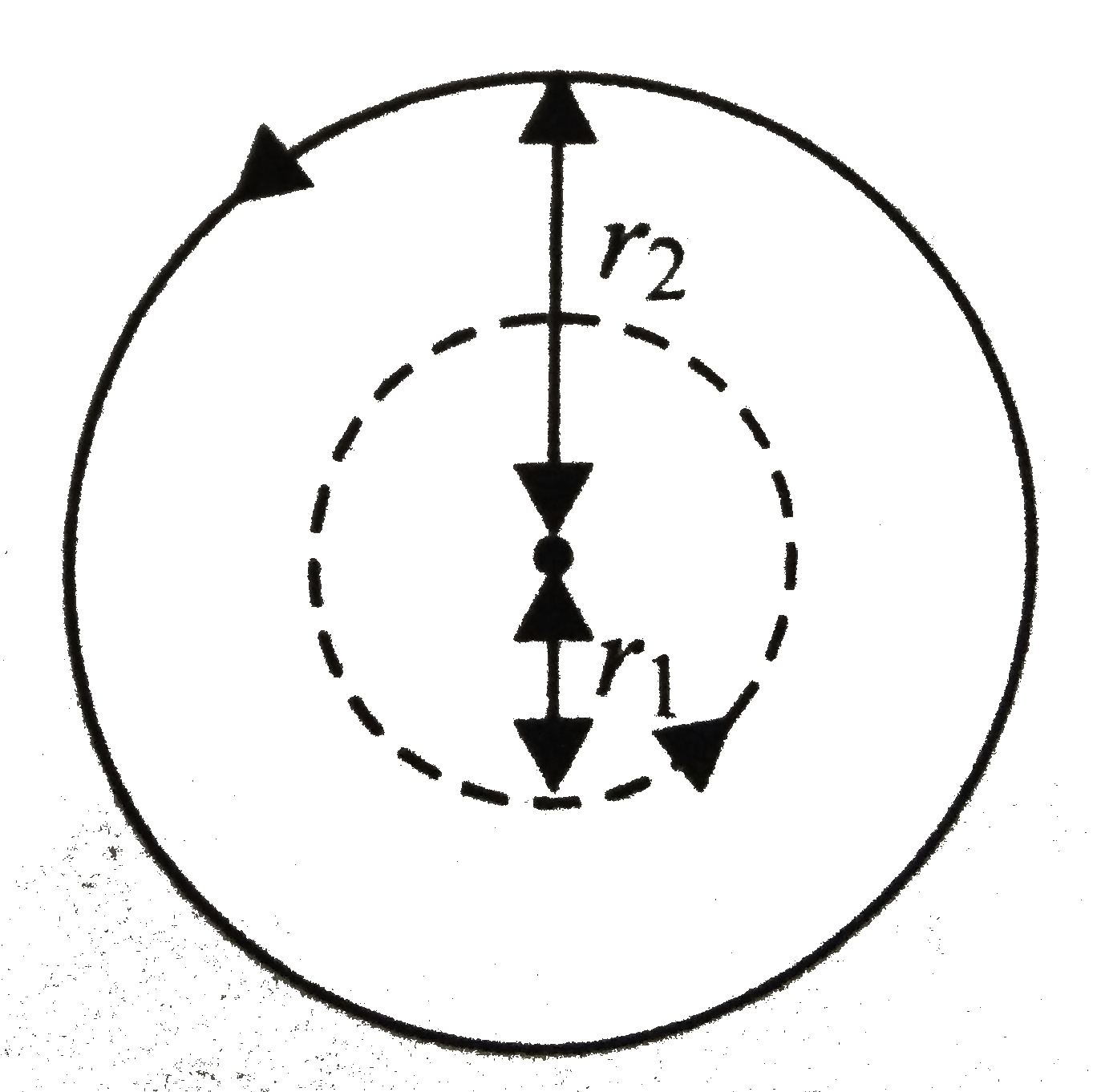 Since the DISTANCE between them always REMAINS constant, but they MOVE with different velocities they must move in different circles with common center as shown in FIG. |
|
| 18. |
The velocity of an electron at point A_(1) is V_(0) where cross sectional areas is A. The velocity of electron just the end of contraction at point B, where cross sectional area is 2A is V_(1). Find the correct option: |
|
Answer» `V_(1) lt V_(0)` |
|
| 19. |
A circular motion of a particle with constant speed is |
|
Answer» Periodic but not SHM So correct choice is (a). |
|
| 20. |
In a certain experiments to measure the ratio of charge to mass of elementry particles, a surprising result was obtained in which two particle, a surprising result was obtained in which two particles moved in such a way that the distance between them always remained constant. It was also noticed that this two-particle system was isolated from all other particles and no force was acting on this system except the force between these two mases. After careful observation followed bu intensive calculation, it was deduced that velocity of these two particles was always opposite in direction and magnitude of velocitywas 10^(3) ms^(-1) and 2 xx 10^(3) ms^(-1) for first and second particle, respectively,and mass of these particles were 2 xx 10^(-30) kg and 10^(-30)kg, respectively. Distance between them were 12Å(1Å = 10^(-10)m). Acceleration of the second particle was |
|
Answer» `5 XX 10^(15) MS^(-2)` `(v_(2)^(2))/(r_(2))=((2xx10^(3))^(2))/((8xx10^(-12)))=5xx10^(15)ms^(-2)` |
|
| 21. |
A set of atoms in an excited state decays. |
|
Answer» in general to any of the states with lower ENERGY. |
|
| 22. |
In a certain experiments to measure the ratio of charge to mass of elementry particles, a surprising result was obtained in which two particle, a surprising result was obtained in which two particles moved in such a way that the distance between them always remained constant. It was also noticed that this two-particle system was isolated from all other particles and no force was acting on this system except the force between these two mases. After careful observation followed bu intensive calculation, it was deduced that velocity of these two particles was always opposite in direction and magnitude of velocitywas 10^(3) ms^(-1) and 2 xx 10^(3) ms^(-1) for first and second particle, respectively,and mass of these particles were 2 xx 10^(-30) kg and 10^(-30)kg, respectively. Distance between them were 12Å(1Å = 10^(-10)m). Acceleration of the first particle was |
|
Answer» zero `F_(12)=(m_(1)v_(1)^(2))/(r_(1))` and `F_(21)=(m_(2)v_(2)^(2))/(r_(2))` `|vecF_(1)|=|vecF_(2)|` or `(m_(1)v_(1)^(2))/(r_(1))=(m_(2)v_(2)^(2))/(r_(2))` putting values we get `r_(2)=2r_(1)` Also, `r_(1)+r_(2)=12xx10^(-12)m` (GIVEN) `r_(1)=4xx10^(-12)m,r_(2)=8xx10^(-12)m` Acceleration of first particle `=(v_(1)^(2))/(r_(1))=((10^(3))^(2))/((4xx10^(-12)))` `=2.5xx10^(15)ms^(-2)` |
|
| 23. |
Explain 'Mixed Connection' of cells and derive an expression for its equivalent emf and current. |
Answer» Solution :n. cells of emf `epsilon_(1) , epsilon_(2) ....epsilon_(n) and r_(1) , r_(2) ....r_(n)`INTERNAL resistance are connected in a series. .m. rows of above series are joined in parallel toform a mixed connection as shown in figure. `rArr` Now total emf of each series is, `epsilon = sum_(i=l)^(n) epsilon_(i)` `rArr` If total (EQUIVALENT) internal resistance of mixed connection is r then `(1)/(r) = (1)/(r.) + (1)/(r.) + (1)/(r.) ` + ..... m times = `(m)/(r.) = (m)/(SUM r_(i)) ` `therefore r = (sum r_(i))/(m)` `rArr` All rows are parallel to each other, So total emf `epsilon = sum epsilon_(1)` `therefore` CurrentI =` (" Total emf" )/("Total resistance " )` `I = (sum epsilon_(i))/(R + (sum r_(i))/(m) ) ` where R is the series resistance given in the CIRCUIT. |
|
| 24. |
In a certain experiments to measure the ratio of charge to mass of elementry particles, a surprising result was obtained in which two particle, a surprising result was obtained in which two particles moved in such a way that the distance between them always remained constant. It was also noticed that this two-particle system was isolated from all other particles and no force was acting on this system except the force between these two mases. After careful observation followed bu intensive calculation, it was deduced that velocity of these two particles was always opposite in direction and magnitude of velocitywas 10^(3) ms^(-1) and 2 xx 10^(3) ms^(-1) for first and second particle, respectively,and mass of these particles were 2 xx 10^(-30) kg and 10^(-30)kg, respectively. Distance between them were 12Å(1Å = 10^(-10)m). if the first particle is stopped for a moment and then released, the velocity of center of mass of the system just after the release will be |
|
Answer» `1/3 XX 10^(-30)ms^(-1)` `V_(CM)=(m_(1)v_(1)+m_(2)v_(2))/(m_(1)+m_(2))` `=((2xx10^(-30))(0)+(10^(-30))(2xx10^(3)))/(3xx10^(-30))=(2)/(3)xx10^(3)ms^(-1)` |
|
| 25. |
What suggest that light waves are transverse in nature ? |
| Answer» SOLUTION :POLARISATION | |
| 26. |
A vessel consists of two plane mirrors at right angles (as shown in figure). The vessel is filled withwater. The total deviation in incident ray is |
|
Answer» `0^(@)` The deviation produced by combination of TWO plane mirrors is `delta=PI-2theta` or `delta=2pi-2(pi)/2` ( `:'theta=90^(@)`) `:. Delta=pi=180^(@)` |
|
| 27. |
sqrt(v) versus Z graph for dcharacteristic X-rays is as shown in figure. Mathc the following |
|
Answer» |
|
| 28. |
Some cases are given below. Identify the case in which emf is induced between O and P in uniform magnetic field |
|
Answer» In I, III and IV only |
|
| 29. |
In a solid sphere two small symmetrical cavities are created whose centres lie on a diameter AB of sphere on opposite sides of the centre. |
|
Answer» The gravitational field at the centre of the sphere is zero |
|
| 30. |
A point Q lies on the perpendicular bisector of an electric dipole of dipole moment P. If the distance of Q from the dipole is r, then electric field at Q is proportional to |
|
Answer» `p^(-1) and R^(-2)` |
|
| 31. |
The most stable particle in the Baryon group is |
|
Answer» neutron |
|
| 32. |
Kirchhoff''s junction rule is a reflection of |
|
Answer» CONSERVATION of current density vector. At any junction whatever quantity of charge enter in given time similar charge leaves similar time. Means, charge is not COLLECTED at junction. |
|
| 33. |
Consider Experiment II in Section 6.2. a. What would you do to obtain a large deflection of the galvanometer? b. How would you demonstrate the presence of an induced current in the absence of a galvanometer? |
|
Answer» Solution :a. To obtain a large deflection, ONE or more of the following steps can be taken: (i) Use a rod made of soft iron INSIDE the COIL `C_(2)` (ii) Connect the coil to a powerful BATTERY, and (III) Move the arrangement rapidly towards the test coil `C_(1)`. b. Replace the galvanometer by a small bulb. The relative motion between the two coils will cause the bulb to glow and thus demonstrate the presence of an induced current. |
|
| 34. |
(a) A ball, suspended by a thread, swings in a vertical plane so that the magnitudes of its acceleration in the extreme and the lowest positions are equal. Find the maximum deflection of the thread with respect to the vertical. ( b) The kinetic energy of a particle moving in a circle of radius R depens on the distance covered as T = as^(2) , where 'a' is a constant. Find the magnitude of the force acting on the particle as a function of s. |
|
Answer» |
|
| 35. |
All the edges of a block with parallel faces are unequal . Its longest edge is twice its shortest edge. The ratio of the maximum resistance between parallel faces is : |
|
Answer» 2 |
|
| 36. |
Find the emf induced in the coil if it were positioned such that its plane contains the axis of the solenoid. |
| Answer» Solution :No EMF is INDUCED in the loop even though the MAGNETIC FIELD in space is CHANGING. This is because no flux is linked with the coil. | |
| 37. |
When switch is closed , charges on C_(1) and C_(2) are |
|
Answer» `20muC,0` |
|
| 38. |
When it is most sensitive ? |
|
Answer» <P> Solution :When all the four RESISTORS P,Q,R and S are nearly of same magnitude. |
|
| 39. |
In Figure, two light rays go through different paths by reflecting from the various flat surfaces shown. The light waves have a wavelength of 411.0 nm and are initially in phase. What are the (a) smallest and (b) second smallest value of distance L that will put the waves exactly out of phase as they emerge from the region? |
| Answer» SOLUTION :(a) 51.38 NM, (B) 154.1 nm | |
| 40. |
Usually it is the negative charge that is transferred when two bodies are rubbed together. Can you explain. Why? |
| Answer» Solution :The ELECTRONS are very light and LOOSELY bound to the ATOMS than the POSITIVE charges. | |
| 41. |
A 100 muF capacitor is to have an energy content of 50 J in order to opreator a flash lamp . The voltage required to charge the capacitor is |
| Answer» Solution :U =`(1)/(2) rArr Vsqrt((2U)/(C)) = (sqrt(2xx50))/(100 xx 10^(2)) 1000 `V | |
| 42. |
The electron affinity of the following element can be arranged - |
|
Answer» `CL GT O gt N gt C` |
|
| 43. |
The wire star of the previous problem is connected to the circuit at points P and C. Find the equivalent resistance. |
Answer» 
|
|
| 44. |
Jambaji's message included how many tenets? |
|
Answer» 20 tenets |
|
| 45. |
Which of the following correctly represents the 1-V characteristic of a solar cell ? |
|
Answer»
|
|
| 46. |
An electric dipole id placed at the centre of a sphere. Mark the correct answer |
|
Answer» the flux of the ELECTRIC FIELD through the sphere is zero |
|
| 47. |
The range of wavelength of the visible light is |
|
Answer» `10 Å "to" 100 Å` |
|
| 48. |
The minmum magnetic dipole moment of electron in hydrogen atom is |
|
Answer» `(2h)/(2 pi m)` |
|
| 49. |
Unit of permittivity is ……. |
|
Answer» `C^(2)N^(-2)m^(-2)` `therefore " Unitof " in_(0)=("UNIT of " Q^(2))/(("Unit of F")("Unit of " r^(2)))` `thereofre` Unit of `in_(0)=(C^(2))/(NM^(2))=C^(2)N^(-1)m^(-2)` |
|
| 50. |
There are two infinite slabs of charge, both of thickness d with the junction lying on the plane x = 0. The slab lying in the range 0 lt x lt d has a uniform charge density +rho and the slab lying in the region – d lt x lt 0 has uniform charge density -rho. Find the Electric field everywhere and plot its variation along the x axis. Note: This can be used to model the variation of electric field in the depletion layer of a p – n junction. |
|
Answer» `=-(rho)/(epsilon_(0))(d-x)""0lexltd` `=0""|x|gt d` `(##IJA_PHY_V02_C06_E01_058_A01##)` |
|


