

Saved Bookmarks
This section includes 7 InterviewSolutions, each offering curated multiple-choice questions to sharpen your Current Affairs knowledge and support exam preparation. Choose a topic below to get started.
| 1. |
Consider an electron in front of metallic surface at a distance d(treated as an infinite plane surface).Assume the force of attraction by the plate is given as (1)/(4)(q^(2))/(4piepsi_(0)d^(2)) . Calculate work in taking the charge to an infinite distance from the plate.Taking d=0.1 nm,find the work done in electron volts.[Such a force law is not valid for dlt 0.1 nm]. |
Answer» Solution : For the sake of simplicity,writing x in place d in the formula ,given in the statement, `F=(1)/(4)((1)/(4piepsi_(0)))(q^(2))/(x^(2))` Now ,as shown in the FIGURE ,amount of work to be done by EXTERNAL force in order to displace electron by amount dx ,away from the surface is dW=F.dx `cos0^(@)` dW=F.dx `therefore intdW=intF.dx` `therefore W=underset(d)overset(oo)int(1)/(4)((1)/(4piepsi_(0)))(q^(2))/(x^(2))dx` `=(1)/(4)((q^(2))/(4piepsi_(0))){-(1)/(x)}_(d)^(2)` `=(1)/(4)((q^(2))/(4piepsi_(0))){-(1)/(oo)-(-(1)/(d))}` `(1)/(4)((1)/(4piepsi_(0)))q^(2)XX(1)/(d)` `=(1)/(4)xx9xx10^(9)xx(1.6xx10^(-19))^(2)xx(1)/(0.1xx10^(-9))` `=5.76xx10^(-19)J` `=(5.76xx10^(-19))/(1.6xx10^(-19))EV` `therefore` W=3.6 eV |
|
| 2. |
A photon of wavelength lambda = 6.0 pm is scattered at right angles by a stationary free electron. Find: (a) the frequency of the scattered photon, (b) the kinetic energy of the compton electron. |
|
Answer» Solution :(a) From the Compton FROMULA `lambda' = 2PI CANCEL lambda_(C) (1- cos 90) + lambda` Thus `omega' = (2pic)/(lambda') = (2pic)/(lambda+2pi cancel lambda_(c))` where `2pi cancel lambda_(c) = (h)/(mc)`. Substituting the values. We get `omega' = 2.24 xx 10^(20)rad//sec` (b) The kinetc energy of the scattered electron (in the frame in which the initial electron was STATIONARY) is simply `T = cancelh omega - cancelh omega'` ` =(2pi cancel h c)/(lambda)-(2pi cancelh c)/(lambda+2pi cancel lambda_(c))` `= (4pi^(2)cancel h cancel lambda_(c))/(lambda(lambda+2pilambda_(c))) = (2picancel h c//lambda)/(1+lambda//2pi cancel lambda_(c)) = 59.5kV` |
|
| 3. |
The rhinestones in costume jewelry are glass with index of refraction 1.50. To make uliem more reflective, they are often coated with a layer of silicon monoxide of index of refraction 2.00. What is the minimum coating thickness nccded to ensure that light of wavelength 500 nm and of perpendicular incidence will be reflected from the two surfaces of the coating with fully constructive interference? |
| Answer» SOLUTION :`6.25 XX 10^(-8)` m | |
| 4. |
One end of spring of spring constant k is attached to the centre of a disc of mass m and radius R and the other end of the spring connected to a rigid wall. A string is wrapped on the disc and the end A of the string (as shown in the figure) is pulled through a distance a and then released. The disc is placed on a horizontal rough surface and there is no slipping at any contact point. What is the amplitude of the oscillation of the centre of the disc? |
|
Answer» a Disc undergoes rolling WITHOUT SLIPPING. Hence the displacement of the CENTRE of the disc = a/2 Thus amplitude of the OSCILLATION of the centre of the disc = a/2 Hence (C ) is correct |
|
| 5. |
Suppose that an electron may be considered to be a ball of radius a carrying an electric charge e uniformly tributed over its surface. It may be shown that outside this ball and on its surface the field will be the same as that of an equal point charge, inside the ball the field is zero. From these considerations find the energy of the electron's field. Assuming it to be equal to the electron's rest energy estimate the radius of this ball (double this quantity is called the classical radius of the electron). Compare with Problem 14.23 |
|
Answer» Solution :A ball of radius a carrying a surface charge may be regarded as a spherical capacitor whose external sphere is infinitely FAR away (i.e. `R=a,R_(1) to oo)` . Making use of the result of the previous problem, we obtain `C=lim_(R_(1) to oo) (4pi epsi_(0)aR_(1))/(R_(1)-a)= lim_(R_(1) to oo) (4pi epsi_(0)a)/(1-(a//R_(1)))= 4pi epsi_(0)a` The energy of the field is `W=(e^(B))/(2C)=(e^(2))/(8 pi epsi_(0)a)` Equating it to the rest energy of an electron `delta_(0)=m_(e)c^(2)`, we obtaine `a=(e^(2))/(8 pi epsi_(0) m_(e)c^(2))=1.4xx10^(-15)m` As is shown in $72.5, the term "classical electron radius" usually applies to a quantity twice as large `r_(el)=2a=2.8xx10^(-16)m`. Comparing this result with the result obtained in Problem 14.23 we see that the latter was TWO orders of magnitude greater. This implies the incorrectness of the solutions of the two problems. In MODERN science the problem of the dimensions of elementary particles, including the electron, is far from being SOLVED. |
|
| 6. |
An electrolytic cell containing a solution of CuSO_(4) has an internal resistance of 1Omega. It is connected in series with 3 V battery of negligible resistance and a 4Omega resistance. The mass of copper which will be deposited on the copper electrode in 30 min is calculated. If 4 Omega resistance is connected in parallel across the electrolytic cell and the same battery is used, the amount of copper deposited in 30 min is calculated ECE of Cu= 0.00033 g/C. Using Faraday's first law of electrolysis, the mass deposited on the copper electrode can be calculated. Mass of copper deposited in 30 min when resistance of 4 Omega is in parallel is |
|
Answer» 4.214g |
|
| 7. |
Explain the Young's experiment, arrangement and experiment to produce interference pattern. |
|
Answer» Solution :The British physicist Thomas Young made a ingenious technique to obtain coherent sources by the division of a wavefront and demonstrated a stationary interference. An experimental arrangement of Young.s EXPERIMENT is shown in the figure (a).  S = small hole on screen A. `S_(1), S_(2)` = two pinholes parallel to screen `A,S_(1)` and `S_(2)` are two pinholes on screen B and distances `SS_(1)=SS_(2)`, he DISTANCE between screen A and screen B is small in the order of mm). C = screen parallel to B and a screen is at D distance in the order of meters. Hole S is lit by a bright source, light SPREAD out from S and fall on both `S_(1)` and `S_(2)`. Distance `SS_(1)` and `SS_(2)` are equal so they behave like two coherent sources. Because light waves coming out from `S_(1)` and `S_(2)` are derived from the same original source and any abrupt PHASE change in S will manifest in similar phase change (equal) in the light coming out from `S_(1)` and `S_(2)` Thus, the two source `S_(1)` and `S_(2)` will be locked in phase. Thus they will become coherent sources. |
|
| 8. |
What a low flying aircraft passes over head, we sometimes notice a slight shaking of the picture on our TV screen. This is due to |
| Answer» Solution :Interference of the DIRECT SIGNAL received by the ANTENNA with the (WEAK) signal REFLECTED by the passing aircraft. | |
| 9. |
Who is the author of this chapter ? |
|
Answer» LEO Tolstoy |
|
| 10. |
An air cored solenoid with length 20 cm area of cross section 20cm2. The current 2 A is suddenly switched off within 10^(-3) s. The average back emf induced across the ends of the open switch in the circuit is (ignore the variation in magnetic field near the ends of the solenoid) |
|
Answer» 2 V `A=20cm^(2)=20xx10^(-4)m^(2)` `N=400,I_(1)=2A,l_(2)=0,dt=10^(-3)s` As `epsi=(dphi)/(dt)=(d(BAN))/(dt)` `=(mu_(0)NdlAN)/(LDT)""(":. "B=(mu_(0)NI)/(l))` `=(mu_(0)N(I_(1)-I_(2))AN)/(ldt)` `=(4pixx10^(-7)xx(400)^(2)xx2xx20xx10^(-4))/(20xx10^(-2)xx10^-3)` |
|
| 11. |
Prove that electrostatic forces are conservative in nature and define electrostatic potential energy. |
|
Answer» Solution :When an external force does WORK in taking a CHARGE from a point to another against a electrostatic force the work gets stored as potential energy of the charge and when the external force is removed the charge MOVES gaining kinetic energy The sum of kinetic and potential energies is thus CONSERVED and hence electrostatic forces are conservative in nature. Definition of electrostatic potential energy: The work done in a direction, opposing the electric field in BRINGING a unit positivee charge with constant speed from an infinite position to any point in the electric field is called the static electnic potental energy at that particular point. |
|
| 12. |
To ensure almost 100 per cent transmittivity, photographic lenses are often coated with a thin layer of dielectric material. The refractive index of this material is intermediated between that of air and glass (which makes the optical element of the lens). A typically used dielectric film is MgF_(2)(n=1.38). What should the thickness of the film be so that at the center of the visible speetrum (5500Å) there is maximum transmission. |
Answer» Solution : As shown in the figure, suppose a ray of light `vecPA` is incident on the surface `M_(1)N_(1)` of dielectric layer at angle of incidence i at TIME t = 0. As a result, we obtain `vecAQ=vecr_(1)` as reflected ray and `vecAD` as REFRACTED ray. Further ray `vecAD` gets reflected from surface `M_(2)N_(2)`, to give reflected ray as `vecDC` which gets transmitted from point C to give ray `vecCR=vecr_(2)`. Here incident ray `vecPA` undergoes successive reflections and transmissions and so its amplitude goes on decreasing. Hence, intensity of light at point A is majority due to light rays `r_(1)` and `r_(2)` is, Now, optical path difference between light rays `r_(1)` and `r_(2)` is, `r_(2)-r_(1)=n(AD)+n(DC)-AB""......(1)` In right angled `DeltaAED,` `cosr=(d)/(AD)impliesAD=(d)/(cosr)` In right angled `DeltaDEC`, `cosr=(d)/(DC)impliesDC=(d)/(cosr)` Now in right angled `DeltaABC`, `sini=(AB)/(AC)=AB=(AC)sini` In right angled `DeltaAED,tanr=(((AC)/(2)))/(d)=(AC)/(2d)` `:.AC=2dtanr` `:.AB=(2dtanr)sini` Placing above values in equation (1), optical path difference is, `r_(2)-r_(1)=n((d)/(cosr))+n((d)/(cosr))-(2dtanr)sini` `=(2nd)/(cosr)-2d((sinr)/(cosr))(nsinr)("":.n=(sini)/(sinr))` `:.r_(2)-r_(1)=(2nd)/(cosr)(1-sin^(2)r)` `=(2nd)/(cosr)(cos^(2)r)` `r_(2)-r_(1)=2ndcosr"".......(2)` Here both the rays `(r_(1) and r_(2))` get reflected from , the surfaces of denser transparent medium and so there is no additional path difference between them. Now, in order to have MAXIMUM transmissio through the layer of `MgF_(2)`, there must not be ar reflection from its upper surface `M_(1)N_(1)`. In othe words, destructive interference must take plac between `r_(1)` and `r_(2)`. For this, above path difference should be equal to `(LAMDA)/(2)` (for MINIMUM thickness of layer). Hence, `2ndcosr=(lamda)/(2)` Here light rays are made incident normall (perpendicularly) on the lens and so `i=r=0^(@)impliescosr=1` and so, `:.2nd=(lamda)/(2)` `:.d=(lamda)/(4n)` `:.d=(5500)/(4xx1.38)` `=996.4Å` `:.d~~1000Å` |
|
| 14. |
Four resistors A, and D form a Wheatstone bridge. The bridge is balanced , whenC = 100Omega If A and B are interchanged the bridge balances for C=121Omega. The value of D is |
|
Answer» `100OMEGA` |
|
| 15. |
Complete the following nuclear reaction equations_7N^14+_2He^4to_1H^2+ ------ |
| Answer» SOLUTION :`_8O^16` | |
| 16. |
Two persons Pand crosses the river starting from point A on one side to exactly opposite point B on the other bank of the river. The person P crosses the river in the shortest path. The persone crosses the river in shortest time and walks back to point B. Velocity of river is 3 kmph and speed of each boat is 5 kmph w.r.t river. If the two persons reach the point B in the same time, then the speed of walk of Q is |
Answer» Solution :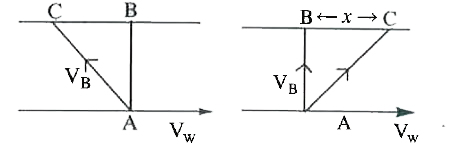 `t_(p)=(d)/(sqrt(V_(B)^(2)-V_(w)^(2)))=(d)/( sqrt(5^(2)-3^(2)))=(d)/(4)` `t_(Q)=(d)/(V_(B))=(d)/(5), t_(Q)+Deltat` `(d)/(4)=(d)/(5)+(X)/(V_("MAN")) "" "But" x=V_(w)(d)/(V_(B))` `(d)/(4)=(d)/(5)+(V_(w)d)/(V_(B)V_("man")) "" (d)/(4)=(d)/(5)+(34)/((5)V_("man"))` `(1)/(4)-(1)/(5)=(3)/(5_("man")) ""...(1)/(20)=(3)/(5V_("man"))` `V_("man")=((3)(20))/(5)=12` kmph |
|
| 17. |
An electron of mass m and charge e is accelerated from rest through a potential difference V in vacuum. Its final velocity will be |
|
Answer» `sqrt((2eV)/(m))` |
|
| 18. |
In the Geiger-Marsden scattering experiment, in case of head on collision the impuct parameter should be |
| Answer» Answer :B | |
| 19. |
The velocities of three molecules are 2m/s, 3m/s and 4m/s respectively. The mean square velocity is |
|
Answer» `9m/s` |
|
| 20. |
A coil having an inductance of 50mH and a resistance of 10 omega is connected in series with a 25muF capacitor across a 200V supply. What is the Q factor of the circuit at resonance ? |
|
Answer» 3.5 |
|
| 21. |
A wire has linear resistance rho ("in" Omega m^(-1)). Find the resistanceR between points A and B if the side of the big square is d. |
|
Answer» `(rhod)/(sqrt2)` Let each half SIDE has resistance `rhord//2` 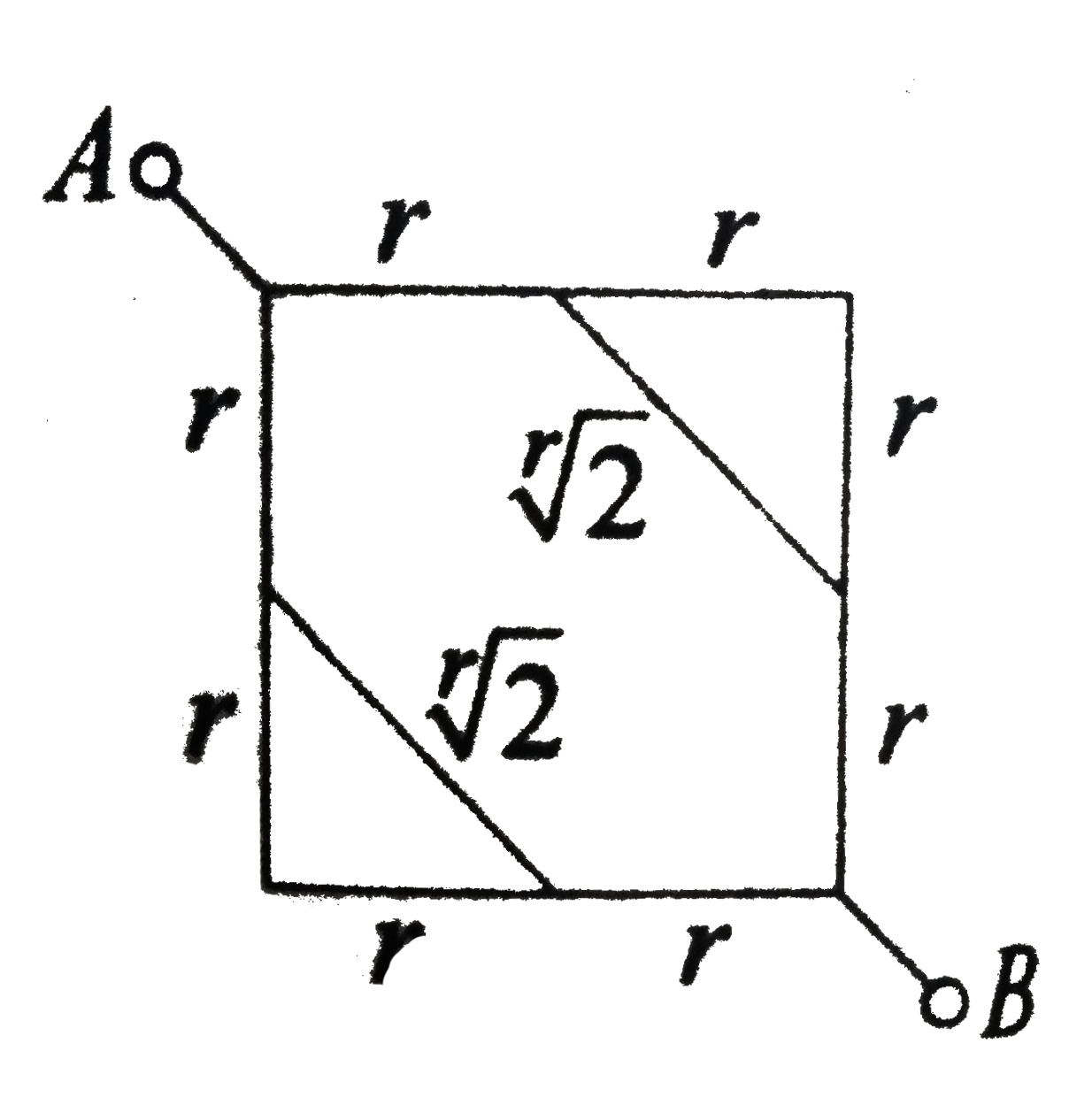 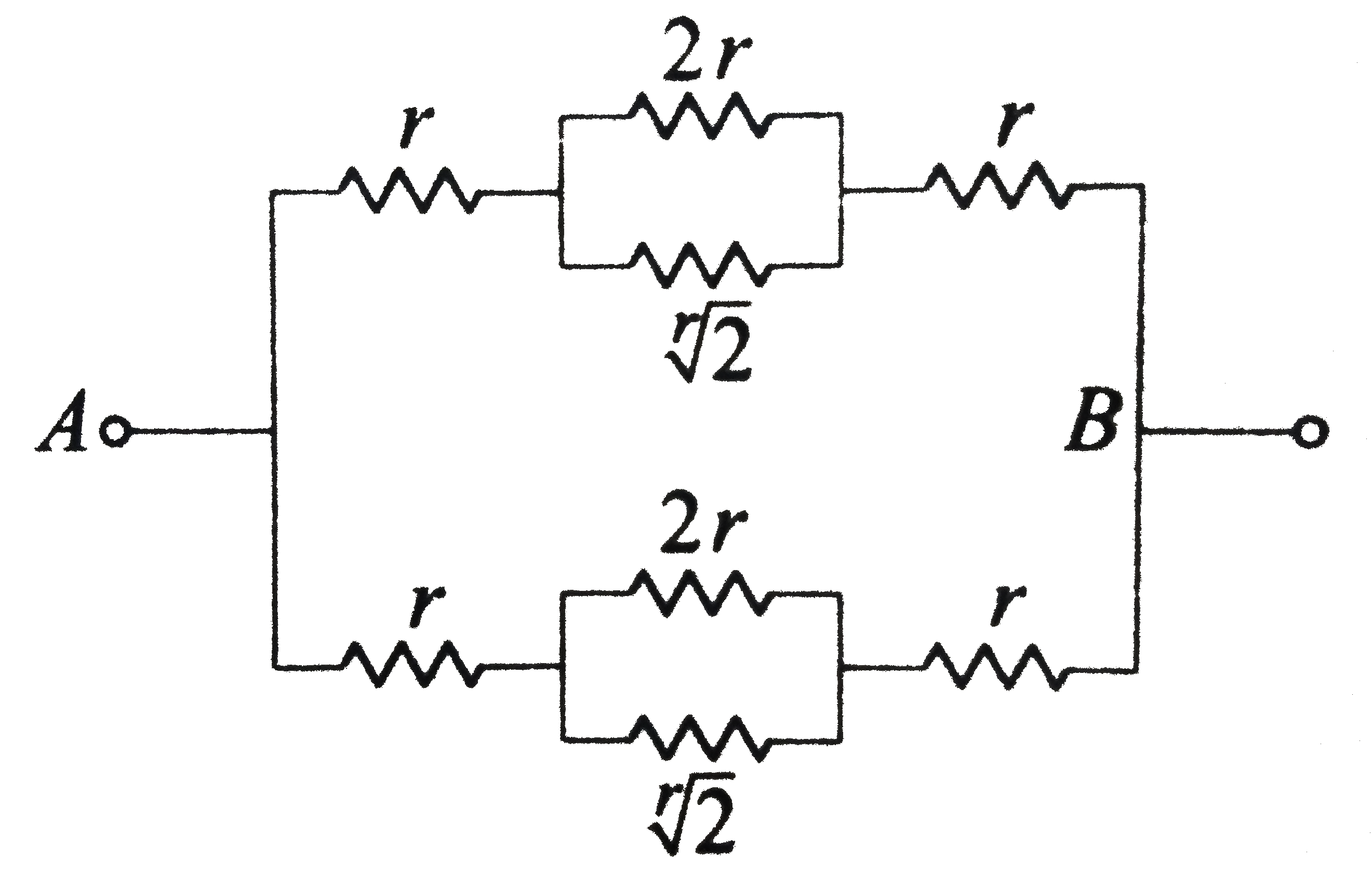 On solving, we get `R = 1/2 [ 2r + ((2r)(rsqrt(2)))/((2+sqrt(2))r)] = 1sqrt(2)` `=rhod//(sqrt2)` . |
|
| 22. |
How does the conductivity change with rise of temperature in semi-conductors? |
| Answer» Solution :All semiconductors behave like insulators at `0K` because at `0K` all the valence bands are COMPLETELY filled and no FREE electron is available. As the temperature of the semiconductor is increased, the electrons JUMP to conduction band due to thermal agitation and the conductivity of the semiconductor is increased, With further increase in temperature more and more electrons SHIFT to conduction band, hence the conductivity of the semiconductor increases with RISE in temperature. | |
| 23. |
Assertion:A pair of closely spaced electron and proton behaves like an electrically neutral particle system and do not apply electric force on isolated proton or electron. Reason: Two types of charges exist in nature, which are opposite to'each other in polarity. These two types of charges have a tendency to cancel the electrical effect of each other. Benjamin Franklin suggested the use of positive and negative signs to represent these two types of charges. We can calculate the net charge of any system by evaluating the algebraic sum of individual charges. |
|
Answer» If both ASSERTION and REASON are CORRECT and reason is a correct EXPLANATION of the assertion . |
|
| 24. |
The maximum possible magnification for a simple microscope is 10. How do you increase the magnification further. |
| Answer» SOLUTION :Use two CONVEX LENS INSTEAD of single lens. | |
| 25. |
Two concentric circular coils, one of small radius r and the other of large radius R, such that R >> T, are placed coaxially with centres coinciding. Obtain the mutual inductance of the arrangement. |
|
Answer» SOLUTION :Let a current `I_(2)` flows through the outer circular COIL of radius R. The magnetic field at the centre of the coil is `B_(2) = (mu_(0)I_(2))/(2R)` As r << R, hence field `B_(2)` may be considered to be constant over the entire cross-sectional area of INNER coil of radius r. Hence, magnetic flux linked with the smaller coil will be `phi_(1) = B_(2)A_(1) = (mu_(0) I_(2))/(2R).pur^(2)` As by definition `phi_(1) (2) = M_(12)I_(2)` `therefore` Mutual INDUCTANCE `M_(12) = (phi_(1))/I_(2)=(mu_(0)pir^(2))/R.` But `M_(12) = M_(21) = M` `therefore` Mutual inductance of pair of concentric coils`M = (mu_(0) pir^(2))/R`. 
|
|
| 26. |
Answer the question regarding earth's magnetism: A vector needs three quantities for its specification. Name the three independent quantities conventionally used to specify the earth's magnetic field. |
|
Answer» Solution :(a) To know magnetic field of Earth at a given place on its surface we REQUIRE following three quantities known as "magnetic elements" of Earth. (1) Declination (D) (2) Inclination (or Dip angle) (`delta` or I) (3) Horizontal component `B_H` By KNOWING angle D, we can determine magnetic meridian of a given place. By knowing angle I, we can determine direction of magnetic field of Earth at a given place in above magnetic meridian. By knowing `B_H`, we can determine MAGNITUDE of magnetic field of Earth at a given place along above direction. |
|
| 27. |
State Huygen's principle. Show , with the help of a suitable diagram, how the principle is used to obtain the diffraction pattern by a single slit. Draw a plot of intensity distribution and explain clearly why the secondary maxima become weaker with increasing order (n) of the secondary maxima. |
|
Answer» Solution :Huygen.s principle : Each point of wavefront is the source of a secondary disturbance and the WAVELETS emanating from these points spread out in all directions with the speed of the wave. The common tangent/forward envelope, to all these secondary wavelets gives the new wavefront at later time. Application to diffraction pattern : All the points of incoming wavefront (PARALLEL to the plane of slit) are in phase with plane of slit. However the contribution of the secondary wavelets from DIFFERENT points, at any point, on the observation screen have phase differences dependent on the corresponding path differences. Total contribution, at any point, may add up to give a maxima or minima dependent on the phase differences.  The central point is a maxima as the contribution of all secondary wavelet pairs are in phase here. Consider next a point on the screen where an ANGLE, `THETA=3lambda//2a`, divide the slit into three equal parts. Here the first two thirds of the slit can be divided into two halves which have a `lambda//2` path difference. The contributions of these two halves cancel. Only the remaining one third of the slit contributes to the intensity at a point between the two minima. Hence, this will be much weaker than the central maxima (where the entire slit contributes in phase). We can similarly show that there are maxima at `theta=(n+1//2)lambda//a` with `n=2,3` etc. These become weaker with increasing n, since only one-fifth, one-seventh, etc. of the slit contributes in these cases. |
|
| 28. |
A wheel having metal spokes of 1m long between its axle and rim is rotating in a magnetic field of flux density 5 xx 10^(-5)T normal to the plane of the wheel. An e.m.f of 22/7 mV is produced between the rim and the axle of the wheel. The rate of rotation of the wheel in revolutions per seconds is |
|
Answer» 10 |
|
| 29. |
State Gauss's theorem. Obtain an expression for elactric field at any point outside a charged spherical hollow conductor (shell). |
|
Answer» Solution :STATEMENT: The total electric flux`(phi)` through anyt closed surface is `1// in _(0)` times the net charge enclosed by the closed surface. Expression for electric intensity at a point outside the uniformly chrged shell  CONSIDER a unifomly chrged thin spherical shell of radius R. Let Q be the charge distributed on the spherical shell. It produces a spherically symmetric electric firld. Let P be a point DISTANT r from the centre of the shell. To determine the FIELD at P, we imagine a Gaussian sphere of radius r with O as its center as shown in the figure. The total electric flux through the Gaussian surface3 is given by, `phi=` Electric field intensity `xx` Area `""because vecE||vecA` According to Gauss theore, we have `phi = (q )/(epsi_(0))` From equation (1) and (2), we have `E xx 4pi r ^(2) =(q)/(epsi _(0))` `E= (q)/(4pi r ^(2) in _(0))` `E = (1)/( 4pi in _(0)) (q)/(r ^(2))` |
|
| 30. |
The inward and outward electric flux for a closed surface in units of N-m2/C are respectively 8 xx 10^(3) and 4 xx 10^(3). Then the total charge inside the surface in S.I. units is (where in_(0)= permittivity in free space) |
|
Answer» `4 XX 10^(3)` |
|
| 31. |
In an A.C. circuit the value of inductive reactance connected with it, then the phase difference between current in coil and voltage = …… rad. |
|
Answer» `pi/2` `THEREFORE delta=45^@ =pi/4` rad |
|
| 32. |
(a) what are coherent sources of light ? Two slits in Young'sdouble slit experimentsare illuminated by two different sodium lamps emitting light of the same wavelength. Why is no interference pattern observed? (b) Obtain the condition for getting dark and bright fringes in Young's experiment. Hence write the expression for the fringe width. (c) If s is the size of thesource and its distance from the plane of thetwo slits, what should be the criterion for the interference fringes to be seen ? |
|
Answer» Solution :(a) Coherent sources of light : The sources of light, which emit continuous light waves of the same wavelength, same frequency and in same PHASE are called coherent sources of light. Interference pattern is not obtained. This is because phase difference between the light waves emitted from two different sodium lamps will change continuously. (B) For bright fringes (maxima), Path difference, `(xd)/(D) = n lambda` `x=n lambda(D)/(d) `, where n=0, 1, 2, 3, ...... For dark fringes (minima), Path difference, `(xd)/(D)=(2n-1) (lambda)/(2) :. x=(2n-1) (lambda)/(2) (D)/(d)`, where n=0, 1, 2, 3, ... The separation between the centre of two consecutive bright fringes is the width of a dark fringe. `:.` Fringe width `P=x_(n)-x_(n-1)` `beta=n(lambdaD)/(d) - (n-1) (lambdaD )/(d) :. beta = (lambda D)/(d)` (c) The condition for interference fringes to be is `(d phi)/(dt)=-(d)/(dt)`. For interference fringes tobe seen, the condition `(S)/(a) lt (lambda)/(d)` should be SATISFIED. 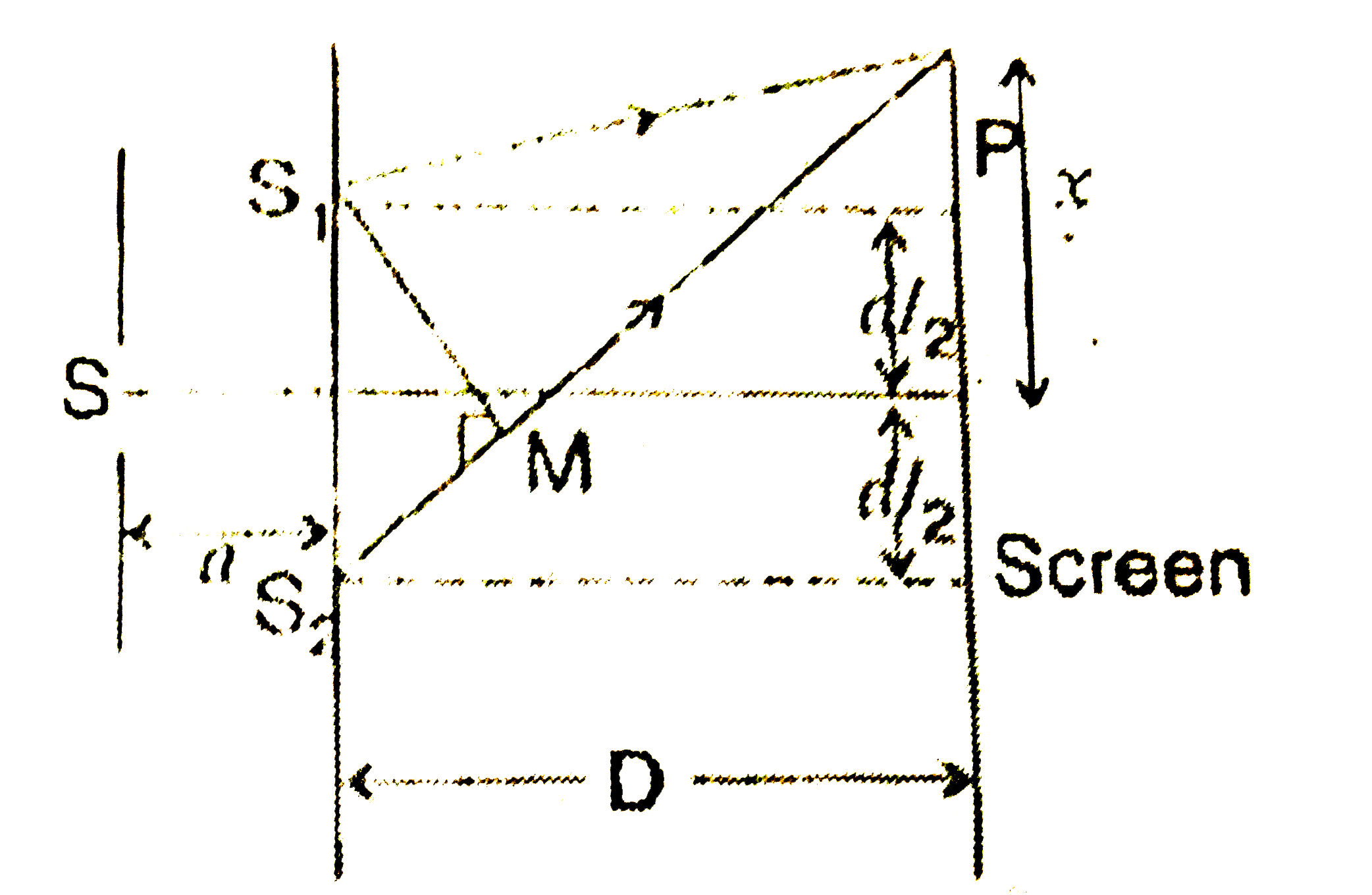
|
|
| 33. |
The speed of a trasnsverse wave along a unifrom metal wire, when it is under at tension of 1 kg wt, is 68 m/s . If the density of the metal is7900 Kg//m^(3) . Find the area of cross section of the wire. |
|
Answer» |
|
| 34. |
The intensity (I) of X-rays after traversing a distance x through a matter is related to the coefficient of absorption (mu) of the material as |
|
Answer» `I= I_0 E^(MU X)` |
|
| 35. |
A fire work gave brick red colour . It probably contained a salt of - |
|
Answer» CA |
|
| 36. |
नाइट्रोजन अणु के 1/2 मोल का द्रव्यमान कितना होगा |
|
Answer» 14 gm |
|
| 37. |
If the number of turns per unit length of a coil of a solenoid is tripled, then the self - inductance of the solenoid will |
|
Answer» Be NINE times |
|
| 38. |
A wire carrying a current I is shaped as shown . Section AB is a quarter circle of radius r . The magnetic field at C is directed |
|
Answer» along the bisector of the ANGLE ACD, away from AB. |
|
| 39. |
A bus moving on a level road with a velocity v can be stopped at a distance of x, by the application of a retarding force E The load on the bus is increased by 25% by boarding the passengers. Now, if the bus is moving with the same speed and if the same retarding force is applied, the distance travelled by the bus before it stops is |
|
Answer» 1.25x `-u^(2)= 2as= 2[F/m]s, (V=0)` [From NEWTON’s `2^(ND)` LAW of motion] `u^(2)=(2FS)/m` `m=(2Fs)/u` `m propto s` `m_(1)=m` `m_(2)=1/4m+ m,s_(1)=x` `m_(1)/m_(2)=s_(1)/s_(2)` `therefore s_(2)=(x xx m[(100+25)/100])/m` `125/100 x` `therefore s_(2)=1.25x` |
|
| 40. |
Nuclei of a radioactive element A are being produced at constant rate alpha .The element has a decay constant lamda . At time t = 0, there are N_0nuclei of the element. (a) Calculate the number N of nuclei of A at time t. (b) If alpha = 2N_(0)lamda, calculate the number of nuclei of A after one half-life of A, and also the limiting value of N as t rarr oo . |
|
Answer» |
|
| 41. |
A beaker is half filled with water. It is allowed to slip down an inclined plane with angle of inclination theta to the horizontal. The level of water in the beaker will be :- |
|
Answer»
|
|
| 42. |
When current passing through a series connection of 100Omega resistance and 2H inductance has frequency 25/pi Hz, the phasedifference between voltage and current is ..... |
|
Answer» Solution :If `delta` is the phase difference betweenvoltage and CURRENT , `TAN delta = (omegaL)/R=(2pivL)/R` (where v=frequency) `=(2pixx25/pixx2)/100` `=100/100` `tan delta=1` `therefore delta=45^@` |
|
| 43. |
Which of the following proves particle nature of light ? |
|
Answer» Refraction |
|
| 44. |
Two point charges 4muF and -4muF are seperated by 8cm. Find the electric potential between them at a distance of 2cm from the positive charge. |
|
Answer» |
|
| 45. |
A beam of light considering of two wavelengths 6500Å and 5200Å is used to obtain interference fringes in a Young's double slit experiment. :) Find the distance of the third bright fringe on the screen from the central maximum for wavelength 6500Å (ii) What is the least distance from the central maximum where the bright fringes due to both the wavelengths coincide ? Distance a between the slits is 2 mm, distance between the slits and the screen D= 120 cm. |
|
Answer» Solution : (i) The distance of the `m^(th)` BRIGHT fringe from the central MAXIMUM. `y_m = (m lamda L)/(d), y_3 = (3 lamda L)/(d) = (3 xx (6500 xx 10^(-10)) xx 1.20)/(2 xx 10^(-3))` = 1.17mm ii) Let the nth bright fringe of wavelength `lamda_n`and `m^th`bright fringe of wavelength a coincide at a distance `y_m`from the central maximum then `y = (m lamda_m L)/(d) THEREFORE m/n = (lamda_n)/(lamda_m) = 6500/5200 = 5/4` i.e., 5th bright fringe of wavelength 5200Å COINCIDES with the 4TH bright fringe of wavelength 6500Å ` therefore y_m = (m lamda_m L)/(d) = (5(5200 xx 10^(-10)) xx 1.20)/(2 xx 10^(-3)) = 1.56mm` |
|
| 46. |
Two coherent sources are 0.18 mm apart and the fringes are observed on a screen 80 cm away. It is found that with a certain monochromatic source of light, the fourth bright fringe is situated at a distance of 10.8 mm from the central fringe. Calculate the wavelength of light. |
|
Answer» Solution :The distance of the NTH fringe from the central fringe is `y= (n lambda D)/(d)`. It is GIVEN that `D= 80 cm, d= 0.18 mm0.018 cm, y= 10.8 mm = 1.08 cm " and "n =4`. `THEREFORE lambda = (yd)/(nD)= (1.08xx 0.018)/(4xx 80)= 6075xx 10^(-8) cm= 6075 dotA`. |
|
| 47. |
Assertion: Under steady flow the velocity of the particle of fluid is not constant at a point. Reason: Ideal fluids are compresssible. |
|
Answer» If both ASSERTION & REASON are true & the Reason is a correct EXPLANATION of the Assertion. |
|
| 48. |
In half-wave rectification, what is the output frequency if the input frequency is 50 Hz. What is the output frequency of a full-wave rectifier for the same input frequency ? |
|
Answer» Solution :`because` Frequency of INPUT supply V = 50 HZ `therefore` OUTPUT frequency of half-wave rectifier= v = 50 Hz and output frequency of a full-wave rectifier= 2v = 2 `xx` 50 = 100 Hz. |
|
| 49. |
Draw a plot showing variation of electric field with distance from the centre of a solid conducting sphere of radius R having a charge Qon its surface. |
|
Answer» Solution :The E(r) -r plot has been shown in ` (##U_LIK_SP_PHY_XII_C01_E08_037_S01.png" width="80%"> |
|
| 50. |
State Gauss's law on electrostatics and derive an expression for the electric field due to a long straight thin uniformly charged wire (linear charge density ) at a point lying at a distance r from the wire. |
|
Answer» Solution :Gauss. law in ELECTROSTATICS states that the total electric flux overa closed surface in free space is `(1)/(in_(0))` times the net charge enclosed within that surface. Mathematically, for a closed surface `phi_(E)=ointvecE. hatn ds = (1)/(in_(0))(Q)` where Q = total charge enclosed. Consider an infinitely LONG straight CHARGED wire of linear charge density `lambda`. To find electric field at a point P situated at a distance r from the wire by using Gauss. law consider a cylinder of length l and radius ras the Gaussian surface. From symmetry consideration electric field at each point of its curved surface is `VECE` and is pointed outwards normally. Therefore, electric flux over the curved surface 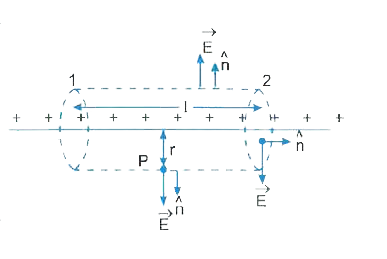 `= intvecE . hatn ds = E 2pir l` On the side faces 1 and 2 of the cylinder normal drawn on the surface is perpendicular to electric field E and hence these surfaces do not contribute towards the total electric flux. `:.` Net electric flux over the entire Gaussian surface `phi_(E)= (1)/(in_(0)) ` ( charge enclosed ) = `(lambdaI)/(in_(0))` Comparing (i) and (ii) we have `E.2 PI r l = (lambdal)/(in_(0)) implies E = (lambda)/(2 pi in_(0)r)` We know that E = `-(dV)/(dr) ` and so dV = -E dr As per question E = (10 r +5) `:. dV =- (10r +5) ` `implies int_(v_(i))^(v_(2))dV= int_(r_(1)=1)^(r_(2)=10)-(10r+5)dr` `implies V_(2)-V_(1)=[-(5r^(2)+5r)]_(1)^(10)=[-5(r^(2)+r)]_(1)^(10)=[-5(100+10)]-[-5(1+1)]` `=-550 +10 =-540 V` The - ve signifies that `V_(2) lt V_(1)` . |
|


