

Saved Bookmarks
This section includes 7 InterviewSolutions, each offering curated multiple-choice questions to sharpen your Current Affairs knowledge and support exam preparation. Choose a topic below to get started.
| 1. |
Define zener effect. |
| Answer» Solution :Electric field is STRONG ENOUGH to break ( or) REP tune thecovalent BONDS inthe lattice and there by generating electron- hole pairs .this EFFECT is called zener effect. | |
| 2. |
Number of male gametes formed by 16 microspore mother cells is |
|
Answer» 128 |
|
| 3. |
If two sound waves, y_1 = 0.3 sin 596 pi [t - x//330] and y_2 =0.5 sin 604 pi[t - x//330] are superposed, what will be the (a) frequency of resultant wave (b) frequency at which the amplitude of resultant waves varies (c ) frequency at which beats aer produced. Find also the ratio of maximum and minimum intensities of beats. |
|
Answer» Solution :Comparing the given wave equation with `y =A sin(ometat - kx) = A sin omega [t - (X //v)]` `[as k//omega =I//v]` we FIND that here `A_1 = 0.3 and omega_1 = 2PI f_1 =596 pi` `i.e.,f_1 =298 Hz and A_2=0.5 and omega_2 =2 pi f_2 = 604 pi` `i.e., f_2 = 302 Hz` So (a) The frequency of the resultant wave `f_(av) =(f_1 + f_2)/(2)= ((298+302))/2 = 300 Hz` (b) The frequency at which AMPLITUDE of resultant wave varies: `f_A =(f_1 + f_2)/(2)=((298 - 302))/2 =2Hz` (c ) The frequency at which beats are produced `f_b = 2f_A = f_1 = f_2 = 4Hz` (d) The ratio of maximum to minimum intensities of BEAT `I_(max)/(I_(min)) =((A_1 + A_2)^2)/((A_1 - A_2)^2) =((0.3 + 0.5)^2)/((0.3 - 0.5)^2) =64/4 =16` |
|
| 4. |
a resistor is marked with colours red , red, orange and gold . Write the value of its resistance . |
| Answer» SOLUTION : `22x10^(3)PM5% OMEGA` | |
| 5. |
Assertion Photoelectric effect demonstrates the wave nature of the light. Reason: The number of photoelectrons is directly proportional to the intensity of incident light. |
|
Answer» If both assertion and reason are ture and the reason is the CORRECT explanation of the assertion. |
|
| 6. |
Tritium is an isotope of hydrogen whose nucleus triton contains 2 neutrons and 1 proton. Free neutrons decay into p+e^(-)+barV. If one of the neutrons in triton decays, then it would transform into He^(3) nucleus. This does not happen. This is because |
|
Answer» Triton energy is less than that of a `He^3` nucleus |
|
| 7. |
An electric bulb and an inductor are connected in series to an ac source. An iron rod is inserted in the coil, the brightness of bulb |
|
Answer» DECREASES |
|
| 8. |
A metallic wire of resistance 12Omegais bent to form a square. The resistance between two diagonalpoints would be |
|
Answer» `12 Omega ` 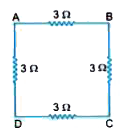 When a metallic WIRE of resistance 12 `Omega`is bent to form a square ABCD as shown in Fig., the resistance of each side of square is `R = 12/4 = 3Omega` Between diagonal points A and C we have parallel combination of TWO ARMS each having 2 resistances of 3 `Omega`each joined in series. Hence EQUIVALENT resistance = 3`Omega` |
|
| 9. |
A given coin has a mass of 3.0 g. Calculate the nuclear energy that would be required to separate all the neutrons and protons from each other. For simplicity assume that the coin is entirely made of " "_(63)^(29)Bi atoms (of mass 62.92960 u). |
|
Answer» Solution :It is GIVEN that `m_(H)` = 1.007825 u, `m_(n)` = 1.008665 u and `m_(Cu)` = 62.92960 u Every atom of `" "_(29)^(63)Cu` contains 29 protons, 29 electrons (i.e., EFFECTIVELY 29 H atom) and (63 - 29) = 34 neutrons. We know that 1 mole of copper WEIGHS 63 g and contains `N_(A) = 6 xx 10^(23)` atoms of copper (or `29 xx 6XX 10^(23) m_(H)` and `34 xx 6 xx 10^(23)`neutrons). Hence, corresponding number in 3 g of copper will be : `n_(p) = 3/63xx29xx6xx10^(23), n_(n)= 34xx 6xx 10^(23)` and `n_(Cu) = 3/63xx6xx 10^(23)` `THEREFORE` Total mass defect `DeltaM = n_(p). m_(H) + n_(n). m_(n) + n_(Cu).m_(Cu)= (3xx29xx6xx10^(23))/63xx1.007825+(3xx34xx6xx10^(23))/63xx1.008665-(3xx6xx10^(23))/63xx 62.92960 u=(6xx10^(23))/21[29xx1.007825+34xx1.008665-62.92960]u=(6xx10^(23))/21xx0.591935u` `therefore` Total energy required to split 3.0g of Cu into protons and neutrons `E=DeltaMxx931.5MeV=(6xx10^(23)xx0.591935)/21xx931.5MeV=1.584xx10^(25)MeV=2.535xx10^(12)`J. |
|
| 10. |
The reflected rays at a plane mirror can form a real image |
|
Answer» if the INCIDENT RAYS at the mirror are convergent |
|
| 11. |
A wooden wheel of radius R is made of two semicircular parts (see figure). The two parts are held together by a ring made of a metal strip of cross sectional area S and length L. L is slightly less than 2pi R. To fit the ring on the wheel, it is heated so that its temperature rises by Delta T and it just steps over the wheel. As it cools down to surrounding temperature, it presses the semicircular parts together. If the coefficient of linear expansion of the metal is alpha, and its Youngs modulus is Y, the force that one part of the wheel applies on the other part is: |
|
Answer» `2SY alpha DELTA T` `Y=((F)/(A))/((Delta L)/(L)) rArr (FL)/(A Delta L)` `rArr F=(Y A Delta L)/(L) =(Y A alpha L Delta T)/(L)` `rArr F= YA alpha Delta T rArr T =2 Y S alpha Delta T (because A=2S)` Correct choice : (a). |
|
| 12. |
A conducting sphere of radius r carries a charge q. Total energy stored in surface is : |
|
Answer» `0.25 XX q^2/(4 pi epsilon_0)` |
|
| 13. |
A circular coil ofone turn of radiius 5.0 cm is rotated about a diameter with a constatn angular speed of 80revolutions per minute. A uniform magnetic field B =0.010 T exists in a directon perpendicular to the axis of rotation. Find (a) the maximum emf induced, (b) the average emfinduced in the coil over a long period and (c )the average of the squares of emf induced over a long period. |
|
Answer» Solution :Since emf=(d PHI)/(DT)=(dB.A cos theta)/(dt)` `=-BA OMEGA. Sin theta` `(dq//dt= the rate of change its direction every time, So for the AVERAGE emf=0.` `=BA omega` `=0.010xx25xx10^(-4)xx80xx(2 pixxpi)/(6))` `=0.66xx10^(-3)=6.66xx10^(-4) volt.` `(b) Since the induced emf changes its direction every time.so for the average emf.=0`. |
|
| 14. |
If the vector vecx satisfying vecx xx veca +(vecx .vecb) vecc=vecd be given by vecx=lambda veca+veca xx (veca xx (vecd xx vecc))/((veca.vecc)veca^2) , then theta is equal to |
|
Answer» `(veca.vecc)/a^2` |
|
| 15. |
A given object takes n times more time to slide down a 45^(@)rough inclined plane as it takes to slide down a perfectly smooth 45^(@) incline. The coefficient of kinetic friction between the object and the incline is : |
|
Answer» `(1)/(2- n^2)` |
|
| 16. |
In a heating arrangement an alternating current having a peak value of 28 A is used. To produce the same heat energy, if the constant current is used, its magnitude must by : |
|
Answer» about 14 A |
|
| 17. |
The half-life of 215 At is 100 mu s. The time taken for for the radioactive of a sample of 215 At to decay to 1/16th of its initial value is : |
|
Answer» `400 MU s` |
|
| 18. |
The output form of full-wave rectifier is |
|
Answer» An AC voltage |
|
| 19. |
Calculating the work done in eV in carrying a charge +e Coulomb through a potential rise of 100 volts. (1.0eV =1.6 xx 10^(-19)"joules") |
|
Answer» |
|
| 20. |
The effective capacitance of two capacitors of capacitances C_(1) and C_(2)("with"C_(2)gtC_(1)) connected in parallel is (25)/(6) times the effective capacitance when they are connected in series. The ratio C_(2)//C_(1) is |
|
Answer» <P>`(3)/(2)` In the given reaction `XeF_(6)` acts as fluoride donor |
|
| 21. |
A jet plane flies at an altitude of 1 km at a speed twice that of sound. How far away will the plane be from an observer when he first hears it coming? |
Answer» 
|
|
| 22. |
A wire of certain length carries a current l.It is bent to form a circle of one turn and the magnetic field at the centre is B1. If it is bent to form a coil of four turns, then magnetic field at centre is B_2.The ratio of B_1 and B_2 is |
| Answer» Answer :C | |
| 23. |
When one magnet is kept in 0.8 T magnetic field, magnetic force on each its two poles is 0.08 N. Then pole strength of each pole would be ...... |
|
Answer» `10` Am |
|
| 24. |
How many photons per second emanate from a 50 mW laser of 640 nm ? |
|
Answer» Solution :Number of photons emanate per second `n_(p)=P/E=(plambda)/(hc)` P=50mW, `lambda=640nm` `h=6.6xx10^(-34)JS` `c=3xx10^(8)MS^(-1)` `=(50xx10^(3)xx640xx10^(-9))/(6.6xx10^(-34)xx3xx10^(8))=1616.16xx10^(20)` `n_(p)=1.61xx10^(17)s^(-1)` |
|
| 25. |
Spectrum of sunlight is an example for |
|
Answer» continuous ABSORPTION spectrum |
|
| 26. |
The convex side of a thin concavo-convex lens of glass of refractive index 1.5 has a radius of curvature of 20 cm. The concave surface has a radius of curvature of 60 cm. What is the focal length of the lens? The convex side is silvered and placed on a horizontal surface. What is the effective focal length of the silvered lens? The concave part is filled with water with refractive index 1.33. What is the effective focal length of the combined glass and water lens? If the convex side is silvered, what is the new effective focal length of the silvered compound lens? |
|
Answer» |
|
| 27. |
In space wave porpagaion, the relation between light of antenna (h) and range of transmission is : (radius of earth) |
|
Answer» `d=sqrt(2Rh)` |
|
| 28. |
Two metals A and B have work functions 2eV and 5eV, respectively. Which metla has a lower threshold wavelength ? |
| Answer» SOLUTION :Metal B having higher work FUNCTION of 5 eV will have a lower THRESHOLD wavelength. | |
| 29. |
What did he start to do when he went outside of his home? |
|
Answer» He decided to sit |
|
| 30. |
An electron is trapped in a one-dimensional infinite potential well. For what (a) higher quantum number and (b) lower quantum number is the corresponding energy difference equal to the energy diflerence DeltaF_(43) between levels n = 4 and n = 3? (c) Show that no pair of adjacent levels has an energy difference equal to 2DeltaE_(43). |
| Answer» SOLUTION :(a) 11, (B) 10 | |
| 31. |
Assertion Due to two charges electric field cannot be zero at some simultaneously. Reason Field is a vector quantity |
|
Answer» If both ASSERTION and REASON are correct and Reason is the correct explanation of Assertion |
|
| 32. |
T.V. tower has a height of 70 m. How much population is covered by the TV broadcast average population density around the tower is 1000 km^(-2) Radius of the earth is 6. 4 xx10 ^(6)m. |
|
Answer» |
|
| 33. |
In a Young' sdouble slit experiment the slit separation is 0.5 m and distance of screen is 5m. For a monochromatic light of wavelength 500nm, the distance of 3^(rd) maxima from 2^(nd) minima on the other side is : |
|
Answer» `2.5 mm` `y_(N2)(min) = (n_(2) - 1)/(2)(lambda D)/(d), n_(2) = 2` `therefore y_(n1) + y_(n2) = (n_(1) + n_(2) - 1/2)(lambdaD)/(d)` ` = ( 3 + 2 - 1/2)(lambda D)/(d)` ` = (9)/(2) xx (lambdaD)/(d)` `(9)/(2) xx (500 xx 10^(-6) xx 5)/(0.5)` ` = 22.5 xx 10^(-3)m`. |
|
| 34. |
A vertical iron , pillar , partially dipped inside the ground , is found to be magnetised after several years . What will be the polarity at the top of the pillar when it is at the northern hemisphere of earth ? |
| Answer» SOLUTION :The vertical iron pillar gets magnetic induction in presence of earth's field . We know that ,the southpole of earth's magnet lies in the NORTHERN hemisphere . As a RESULT , following the rule of magnetic induction , a north pole will be induced at the UNDERGROUND end , and a south pole at the top of the pillar . | |
| 35. |
An object of mass 2 kg is moved from infinity to a point P. Initially that object was at rest but on reaching P its speed is 2 m/s. The work done in moving that object is -16J. Then potential at P is |
|
Answer» 8 KJ/kg `"E = -16J` `PE=G.P.xx"mass"` `16=G.P.xx2` `G.P.=(16)/(2)="8J/kg."` |
|
| 36. |
A particle of mass m is executing oscillations about the origin on the x-axis, it's potential energy is U(x)=k|x|^(2), where k is apositive constant, if the amplitude of oscillation is a, then it's time period T is |
|
Answer» PROPORTIONAL `o(1)/(sqrt(a))` |
|
| 37. |
Assertion (A): There is no current in the metals in the absence of an electric field.Reason (R) : Motion of free electrons are randomly directed in the absence of an electric field. |
|
Answer» If both assertion and reason are TRUE and the reason is the correct EXPLANATION of the assertion. |
|
| 38. |
a. For circuits used for transporting electric power, a low power factor implies large powerloss in transmission. Explain.b. Power factor can often be improved by the use of a capacitor of appropriate capacitance in the circuit. Explain. |
|
Answer» SOLUTION :a: We know that `P= IV cos phi`where `cos phi`is the power factor. To supply a given power at agiven voltage, if cos `phi`is small, we have to increase current accordingly. But this will lead to large power loss (`I^2R` ) in transmission. b. Let the current I lags the voltage by an angle. Then power factor` cos phi = R/Z` ` cos phi` can be improved (say tending to I) by making Z tend to R. Let us understand, with the help of a phasor DIAGRAM (Figure) how this can be achieved. Let us resolve I into two components. I along the applied voltage V and `I_q`perpendicular to the applied voltage. `I_q`I is called the wattless component since corresponding to this component of current, there is no power loss. `I_p`is KNOWN as the power component because it is in phase with the voltage and corresponds to power loss in the circuit. It.s clear from this analysis that if we want to improve power factor we must completely neutralize the lagging wattless current `I_q`by an EQUAL leading wattless current `I_q` . This can be DONE by connecting a capacitor of appropriate value in parallel so that `I_q`and `I._q`cancel each other and P iseffectively `I_p V` 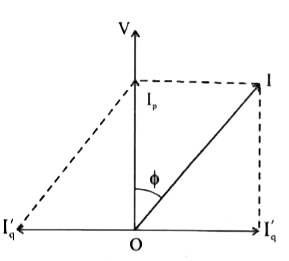
|
|
| 39. |
What we call the gaseous envlop around the earth ? |
| Answer» SOLUTION :ATMOSPHERE | |
| 40. |
प्रोटिस्टा जगत के प्राणी होते है : |
|
Answer» पूर्वकेन्द्रीय एककोशीय |
|
| 41. |
At t=0, the displacement x(0) of the block in a linear oscillator like that of Fig. 15.5 is -8.50cm. (Read x(0) as ''x at time zero''). The block's velocity v(0) then is -0.920m//s, and its acceleration a(0) is +47.0 m//s^(2). What is the phase constant phi and amplitude x_(m) ? |
|
Answer» SOLUTION :Calculations: We know `omega` and want `phi and x_(m)`. If we divide Eq. 15.26 by Eq. 15.25, we find `(v(0))/(x(0)) = (-omega x_(m) sin phi)/(x_(m) cos phi)` Solving for `tan phi`, we find `tan phi = - (v(0))/(omega x(0)) = - (-0.920m//s)/((23.5 "rad/s") (-0.0850m))` This EQUATION has two solutions: `phi = -25^(@) and phi = 180^(@) + (-25^(@)) = 155^(@)` (Normally, only the FIRST solution here is displayed by a calculator), To choose the proper solution, we test them both by using them to compute values for the amplitude `x_(m)`, From Eq. 15.25, we find that if `phi = -25^(@)`, then `x_(m) = (x(0))/(cos phi) = (-0.0850m)/(cos (-25^(@))) = - 0.094m` We find similarly that if `phi = 155^(@), " then " x_(m) = 0.094m`. Because the amplitude of SHM must be a positive constant, the correct phase constant and amplitude here are `phi = 155^(@) and x_(m) = 0.094m = 9.4cm` |
|
| 42. |
A slit 5.0 cm wide is irradiated normally with microwaves of wavelength 1.0 cm. Then the angular spread of the central maximum on either side of the incident light is nearly |
| Answer» Answer :A | |
| 43. |
Draw a plot of potential energy of a pair of nucleons as a function of their separations. Mark the regions where the nuclear force is (i) attractive and (ii) repulsive. Write any two characteristic features of nuclear forces. |
Answer» Solution :Part AB represents REPULSIVE force and Part BCD represents attractive force. 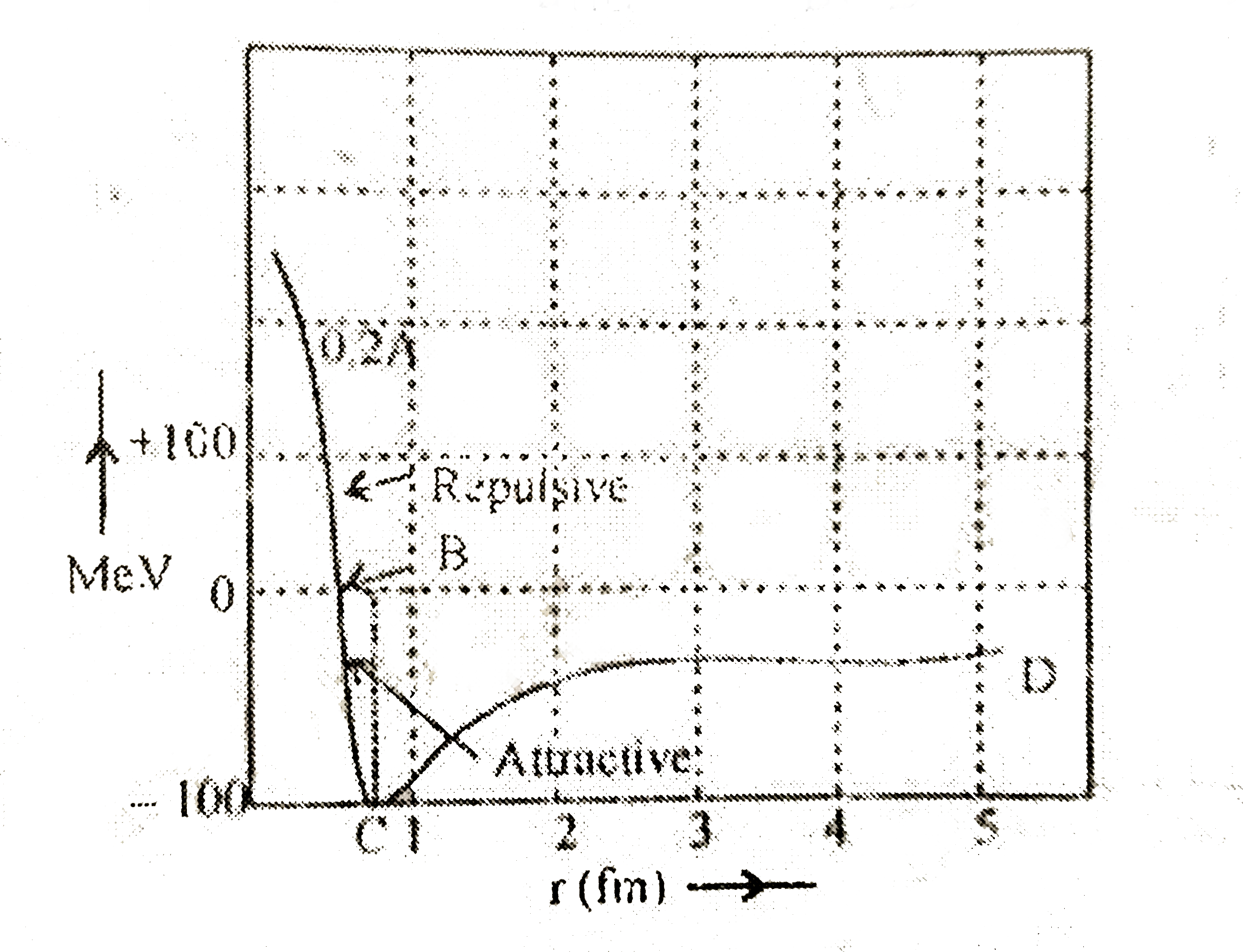 FEATURES : (i) Nuclear forces are attractive and stronger, than ELECTROSTATIC force. (ii) Nuclear forces are charge-independent. |
|
| 44. |
Mention any three application of eddy currents. |
| Answer» SOLUTION :SPEEDOMETER. | |
| 45. |
A plate of thickness t made of a material of refractive index mu is placed in front of one of the slits in a double slit experiment. (a) Find the change in the optical path due to introduction of the plate. (b) What should be the maximum thickness t which will make the intensity at the centre of the fringe pattern zero ? Wavelength of the light used is lambda. Neglect any absorption of light in the plate. |
|
Answer» `(MU - 1)t, (LAMBDA)/(2(mu-1))` |
|
| 46. |
The golden colour found in sea oyster is due to.... |
|
Answer» DIFFRACTION |
|
| 47. |
Give the explanation of Gauss's law for magnetic field. |
|
Answer» Solution :According to the figure let closed surface S. This surface kept in a magnetic field `overset(to) (B)`. The flux associated with this surface we have to DETERMINE. Imagine surface S is divided into small area element. One such element is `overset(to) (Delta S)` and magnetic field associated with it is `overset(to) (B)`. The magnetic flux for this element is defined as, `Delta phi_(B) = overset(to) (B) . overset(to) (DeltaS)` Total flux `phi_(B) = sum_("all") Delta phi_(B) = sum_("all") overset(to) (B) . Delta overset(to) (S) = 0 .... (1)`  The number of LINES leaving the surface is equal to the number of lines entering it. HENCE, the net magnetic flux is ZERO. In equation (1) "all" STANDS for .all area elements `Delta S`. Gauss.s law for magnetism is as below : "The magnetic flux through any closed surface is zero" . Note : In equation ... (1) if `Delta S to 0`, then `phi = oint overset(to) (B) .overset(to) (dS) =0` This equation is also a Gauss.s law. |
|
| 48. |
If in a thermodynamical process, initial thermodynamical pressure and volume are equal to the final pressure and ,volume respectively, then |
|
Answer» net work done on the system must be zero |
|
| 49. |
At t=0, the displacement x(0) of the block in a linear oscillator like that of Fig . 15.5 is -8.50cm. (Read x(0) as ''x at time zero'') The block's velocity v(0) then is -0.920m//s, and its acceleration a(0) is +47.0 m//s^(2). What are the phase constant phi and amplitude x_(m)? |
|
Answer» Solution :Calculations: We know `omega` and want `phi and x_(m)`. If we divide Eq.15.18 by Eq.15.17, we eliminate one of those unknowns and reduce the other to a single trignometric function: `(v(0))/(x(0)) = (-omega x_(m) sin phi)/(x_(m) cos phi) = - omega TAN phi` Solving for `tan phi`, we find `tan phi = -(v(0))/(omega x(0))= - (-0.920m//s)/((23.5"rad/s")(-0.0850m))` `= -0.461` This equation has TWO solutions: `phi = -25^(@) and phi = -180^(@) + (-25^(@)) = 155^(@)`. Normally only the first solution here is displayed by a calculator, but it may not be the physically possible solution. To choose the proper solution, we TEST them both by using them to compute values for the AMPLITUDE `x_(m)`. From Eq. 15.17, we find if `phi= -25^(@)`, then `x_(m) = (x(0))/(cos phi) = (-0.0850m)/(cos (-25^(@)))= - 0.094m` We find similarly that if `phi = - 155^(@), "then " x_(m) = 0.094m`. Because the amplitude of SHM must be positive constant, the correct phase constant and amplitude here are `phi = -155^(@) and x_(m) = 0.094m = 9.4cm` |
|
| 50. |
Cooking food in a pressure cooker saves time and fuel because: |
|
Answer» under increased pressure, water can be made to boil at as TEMPERATURE higher than `100^(@)C` |
|