

Saved Bookmarks
This section includes 7 InterviewSolutions, each offering curated multiple-choice questions to sharpen your Current Affairs knowledge and support exam preparation. Choose a topic below to get started.
| 1. |
Which of the following equations correctly represents the temperature variation of energy gap between the conduction and valence bands for Si? |
|
Answer» `E_g(T)=0.70-2.23xx10^(-4)` T eV For SILICON ,`E_g(T)=1.10-3.60xx10^(-4)` T eV For germanium , `E_g(T)=0.70-2.23xx10^(-4)` TeV |
|
| 2. |
If R.I. of water and glass are 4/3 and 3/2 respectively and incident light beam has wavelength of 6000overset@A in air. The wavelength in water and glass respectively will be: |
|
Answer» 4500 and `5328 OVERSET@A` |
|
| 3. |
Why are dish antennas curved? |
| Answer» Solution :Dish antenna is curved so as it can RECEIVE PRALLEL signal rays coming from same direction. These PARALLEL signal rays REFLECT from parabolic dish, and gathered main antenna part. This increases directivity of antenna, and gives sufficient AMPLITUDE signal. | |
| 4. |
A metal rod of length 10 cm and a rectangular cross-section of 1 cm xx (1)/(2) cm is connected to a battery across oppostie faces. The resistance will be |
|
Answer» maximum when the battery is connected across 1 cm `xx (1)/(2)` cm faces.  resistance of rod, R = `(rho l )/(A)` `therefore R prop (l)/(A)` Hence, to obtain large value of resistance its length (l) should be more and cross section area (A) should be less. This is POSSIBLE when batteryis connected both 1 cm `xx (1)/(2)` cm side. |
|
| 5. |
(A) : A tangent galvanometer is used for measuring current. (R) : Tangent galvanometer reads current directly. |
|
Answer» Both 'A' and 'R' are true and 'R' is the correct EXPLANATION of 'A'. |
|
| 6. |
A ray of light strikes a horizontal plane mirror at an angle of 45^(@). At what angle should a second plane mirror be placed in order that the reflected ray finally be refracted horizontally from the second mirror: |
|
Answer» `22.5^(@)` with horizontal  From fig. `theta + theta + 45^(@) = 180^(@)` So `"" theta = 67.5^(@)` Also `"" angle PCM_(2) = 90^(@)` `angle DCM_(2) = 90^(@) - 90^(@) - 67.5^(@)` `=22.5^(@)` with horizontal. |
|
| 7. |
Pure silicon should be doped with which of the following impurity atoms to make a p-type semiconductor? |
|
Answer» Arsenic |
|
| 8. |
The atomic mass of an alpha particles 4.002603 amu and that of oxygen is 15.99415 amu. Find the energy required to split up the oxygen - 16 nucleus into 4 alpha particles . |
|
Answer» SOLUTION :`Deltam = m (4He_(2)""^(4))-m(O_(8)""^(16))` `= 4xx4.00 2603 - 15.994915` = `0.015497` AMU Hence BE = `Deltam XX 93.1 MeV = 14.435` MeV |
|
| 9. |
An electron of mass m and charge e is accelerated by a potential difference V. It then enters a uniform magnetic field B applied perpendicular to its path. The radius of the circular path of the electron is |
|
Answer» `r=((2mV)/(EB^(2)))^(1//2)` |
|
| 10. |
Draw the string of a simple archery bow back at its mid point until the string tension is twice the magnitude of your force on the string. What is the angle between the two halves of the string? |
| Answer» SOLUTION :`120^(@)` | |
| 11. |
An inductor and two capacitors are connected in the circuit as show in Fig Initially capacitor A has no charge and capacitor B has CV charge. Assume that the circuit has no resistance at all. At t = 0, switch S is closed, then [given LC = (2)/(pi^(2) xx 10^(4)) S^(2) and Cv = 100 mC] |
|
Answer» when current in the circuit is maximum, charge on each capacitor is same 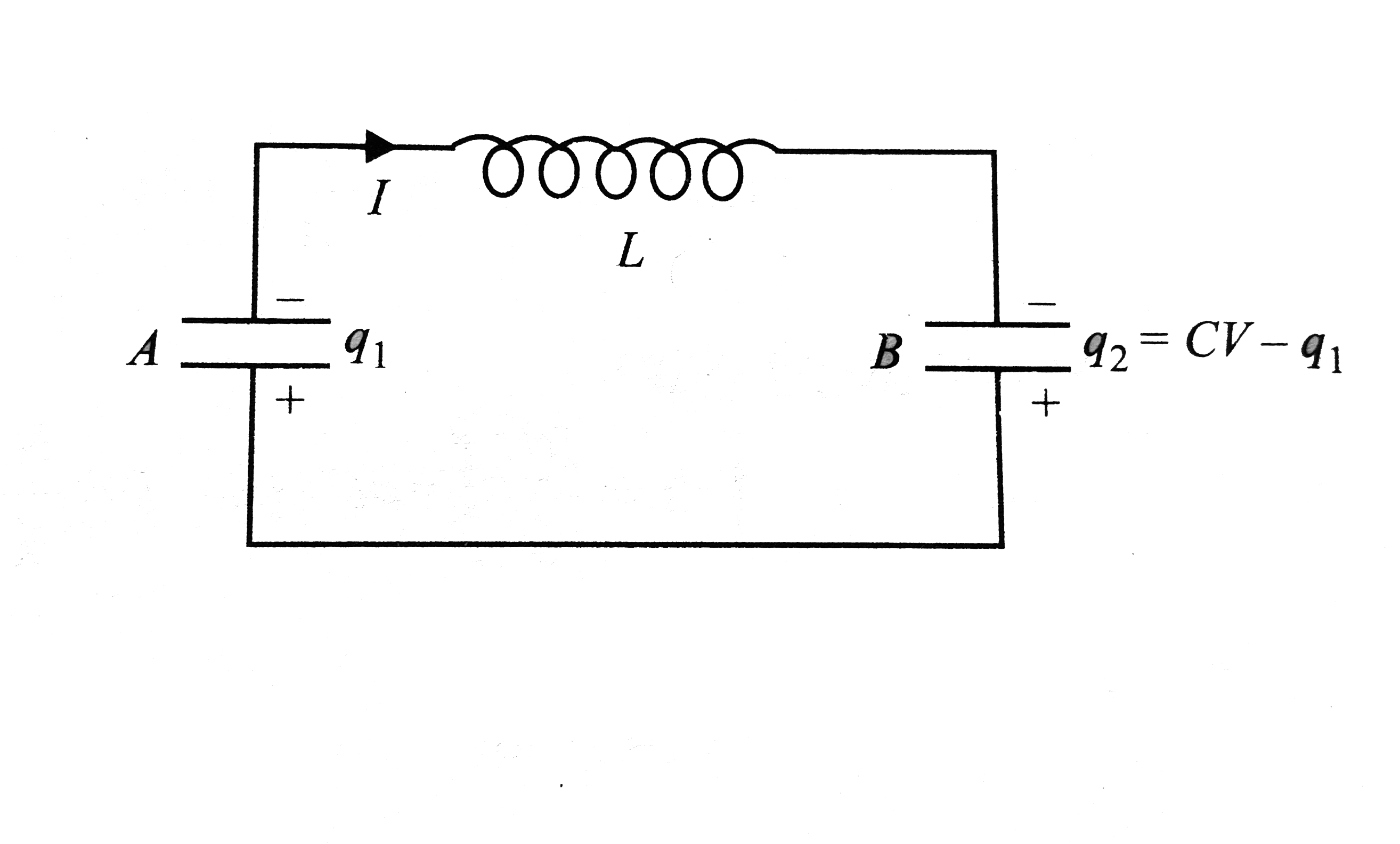 `I = (dq_(1))/(dt)` Applying kirchoff's law, `(CV - q_(1))/(C ) - (q_(1))/(C ) - L(dI)/(dt) = 0 rArr (CV - 2q_(1))/(LC) = L (d^(2)q_(1))/(dt^(2))` `rArr (d^(2)q_(1))/(dt^(2)) = - (2)/(LC) (q_(1) - (CV)/(2))` `rArr q_(1) - (CV)/(2) = A SIN (omega t + delta)` (i) where `omega = SQRT((2)/(LC)) = 100 pi rad//s` At `t = 0`, `q_(1) = 0 rArr 0 - (CV)/(2) = A sin delta` (ii) Differentiating (i), `(dq_(1))/(dt) - 0 = A omega cos (omega t + delta)` `rArr I = A omega cos (omega t + delta)` At `t = 0, I = 0 rArr 0 = A omega cos delta rArr delta = (pi)/(2)` From (ii), `A = - (CV)/(2)` From (i), `q_(1) = (CV)/(2) - (CV)/(2) sin (omega t + (pi)/(2))` (iv) `rArr q_(1) = (CV)/(2) (1 cos 100 pi t) mC` Now `q_(2) = CV - q_(1) = (CV)/(2) (1 + cos omega t)` (v) `= 50 (1 + cos omega pi t)` From (ii), `I = - A omega sin omega t` Current in the circuit is maximum for `omega t = (pi)/(2)*` And for `omegat = (pi)/(2)`, we SEE from (iv) and (v) that `q_(1) = q_(2) = (CV)/(2)` |
|
| 12. |
A vessel at -5^@C contains100 gm ice at -5^@C. The vessel has water equivalent of 40gm. List-I gives quantity and temperature of substance added. List-2 gives final temperature and composition of mixture. Match the column. {:("List I",,"List II"),("P. 10gm water at " 30^@C,,"1. Temperature "gt 0^@C),("Q. 4gm water at " 10^@C,,"2. Temperature " =0^@C, "Ice partly melts"),("R. 1gm steam at "100^@C",,"3. Temperature " lt 0^@C),("S. 20gm steam at " 100^@C,,"4. Added water freezes partly. Temperature " =0^@C):} |
|
Answer» P-4,Q-3,R-2,S-1 `Q_(reqd)=40xx1xx(0-(-5)+100xx1/2xx(0-(-5))+80xx100=8450` `RARR T gt 0^(@)C` |
|
| 13. |
One end of a 10 cm long skill thread is fixed to a large vertical surface of a charged nonconducting plate and the other end ise fastened to a small ball having a mass of 10 g and a charge of 4.0 xx 10^(-6)C. In equilibrium, the thread makes an angle of 60^(@) with the vertical. Find the tension in the string in equilibrium. |
|
Answer» 0.5 N |
|
| 14. |
One end of a 10 cm long skill thread is fixed to a large vertical surface of a charged nonconducting plate and the other end ise fastened to a small ball having a mass of 10 g and a charge of 4.0 xx 10^(-6)C. In equilibrium, the thread makes an angle of 60^(@) with the vertical. Find the surface charge density on the plate. |
|
Answer» `6.5 xx 10^(-8) C//m^(2)` |
|
| 15. |
The magnetic induction due to a short dipole along the axis at a distance r varies as _____ |
| Answer» SOLUTION :`[I/r^3]` | |
| 16. |
The wing span of an aeroplane is 20 metre. It is flying in a field, where the vertical component of magnetic field of earth is 5xx10^(-5) tesla, with velocity 360 km//h. The potential difference produced between the blades will be |
|
Answer» 0.10 V |
|
| 17. |
One end of a 10 cm long skill thread is fixed to a large vertical surface of a charged nonconducting plate and the other end ise fastened to a small ball having a mass of 10 g and a charge of 4.0 xx 10^(-6)C. In equilibrium, the thread makes an angle of 60^(@) with the vertical. In thte above problem suppose the ball is slightly pushed a side and released. Find the time period of the small oscillations. |
|
Answer» 0.45 sec |
|
| 18. |
The amino acid containing indole part is |
|
Answer» TRYPTOPHAN 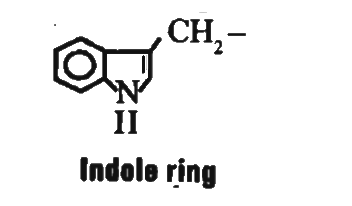
|
|
| 19. |
An electrical cable of copper has just one wire of radius 9 mm. Its resistance is 10 ohm. If this single copper wire of the cable is replaced by 6 identical well insulated copper wires each of radius 3 mm, what will be the new resistance of the cable? |
|
Answer» `10OMEGA` |
|
| 20. |
Which of the following phenomenon is not common to sound and light waves |
|
Answer» interference |
|
| 21. |
The moving coil galvanometer has of 500 turns. The loop is 5xx10^3 and angle of twist 5 Nm. What will be the reduction factor it the magnetic field is 5xx10^(-4)(Wb)//m^2? |
|
Answer» `1.33xx10^(-4) Am^2` |
|
| 22. |
The de-Broglie wavelength ofphoton is twice the de-Broglie wavelength of an electron .The speed of the electron is v_(e)=(c )/(100).Then |
|
Answer» `(E_(e))/(E_(p))=10^(-4)` (`because lambda_(p)=2lambda_(e)` is given) For ELECTRON `E_(e)=(p_(e)^(2))/(2m_(e))=(1)/(2m_(e))((h^(2))/(lambda_(e)^(2)))` `THEREFORE (E_(e))/(E_(p))=(h^(2))/(2m_(2)lambda_(e)^(2))xx(2lambda_(e))/(hc)=(h)/(m_(e)c lambda_(e))` `therefore (E_(e))/(E_(p))=(h)/(m_(e)c)xx(m_(e)v_(e))/(h)(because lambda_(e)=(h)/(m(e)v_(e)))` `therefore (E_(e))/(E_(p))=(v_(e))/(c)=(1)/(100)(because v_(e)=(c)/(100)` is given) `therefore`(E_(e))/(E_(p))=10^(-2)` `implies` OPTION (B) is correct . Now ,`(p_(e))/(m_(e)c)=(m_(e)v_(e))/(m_(e)c)=(v_(e))/(c)=10^(-2)` `implies Option (C )is also correct. |
|
| 23. |
In the figure, the vertical sections of the string are long A is released from rest from the position show. |
|
Answer» |
|
| 24. |
A uniform rod of length l is placed with one end in contact with the horizontal and is then inclined at an angle a to the horizontal and allowed to fall, without slipping at contact point. When it becomes horizontal, its angular velocity will be |
|
Answer» `omega=sqrt((3gsinalpha)/l)` P.E. of rod= MG`.l/2sinalpha` Rotational K.E. =`1/2Iomega^(2)=1/2(ML^(2))/3omega^(2)` `mgl/2sinalpha=1/2.(ml^(2))/3.omega^(2)rArromega=sqrt((3gsinalpha)/l)` |
|
| 25. |
In davisson -Germer experiment ,de-Broglie wavelength of electron is….of accelerating voltage. |
|
Answer» proporational |
|
| 26. |
If the polarising angle for air glass interface is 56.3^(@), what is the angle of refraction in glass ? |
| Answer» SOLUTION :`33.7^@` | |
| 27. |
A uniform surface charge of density sigma is given to a quarter of a disc extending upto infinity in the first quadrant of x-y plane. The centre of the disc is at the origin O. Find the z-component of the electric field at the point (0, 0, z) and the potential difference between the points (0, 0, d) & (0, 0, 2d). |
|
Answer» |
|
| 28. |
A stone hanging from a masslessstring of length 15m is projected horizontally with speed sqrt(147) ms^(-1)Then the Speed of the particle, at the point where tension in string equals the weight of particle, is |
|
Answer» `10 ms ^(-1)` |
|
| 29. |
(a) Draw a graph showing the variation of de-Broglie wavelength of a particle of charge 'q' and mass 'm' with accelerating potential 'V'. (b) Proton and deuteron have the same de-Broglie wavelength. Explain which has more kinetic enegy. |
|
Answer» Solution :(B) We know that de-Broglie WAVELENGTH `LAMDA=(h)/(sqrt(2mK))` As per QUESTION `lamda_("proton")=lamda_("deuteron")`, hence we have `m_(p)K_(p)=m_(d)K_(d)implies K_(d)=(m_(p))/(m_(d))*K_(p)` Since mass `(m_(d))` of deuteron particle is more than that of proton `(m_(p)),`, hence `K_(d) lt K_(p)`. so the proton has more kinetic energy. |
|
| 30. |
If in the above problem the mirror is convex. then : |
| Answer» Answer :A | |
| 31. |
For simple Harmonic Oscillator, the potential energy is equal to kinetic energy |
|
Answer» TWICE during each CYCLE |
|
| 32. |
Consider a sphere of radius R and cylinder of length L. If both have same charge density sigma and E_(s) and E_(e) are electric intensity at a point at a distance r from axis of sphere and cylinder respectively, then E_(s)= |
|
Answer» `(E_(C)R)/r` |
|
| 33. |
A galvanometer gives full scale deflection when the current passed through it is 1 mA. Itsresistance is 100Omega .Without shunting it, as such, it can be used as an ammeter of range : |
|
Answer» 1.000A |
|
| 34. |
A syringe of diameter 1 cm having a nozzle ofdiameter 1 mm, is placed horizontally at a height 5 m from the ground as shown below. An incompressible non-viscous liquid is filled in the syringe and the liquid is compressed by moving the piston at a speed of 0.5 m s^(-1), the horizontal distance travelled by the liquid jet is(g=10 m s^(-2)) |
|
Answer» 12.5 m  Here, Diameter of syringe, `d_1`=1 cm=`10^(-2)` m diameter of nozzle , `d_2`=1 mm = `10^(-3)` m According to equation of continuity , `A_1v_1=A_2v_2` `pi(d_1/2)^2 v_1=pi(d_2/2)^2 v_2` `pi((10^(-2)m)/2)^2 (0.5 m s^(-1))=pi((10^(-3)m)/2)^2 v_2` `v_2=((10^(-4) m^2)/(10^(-6) m^2))(0.5 m s^(-1))=50 m s^(-1)` `THEREFORE` Horizontal distance travelled by the liquid jet is `R=v_2sqrt((2H)/g) = (50 m s^(-1))sqrt((2(5m))/(10 m s^(-2))`=50 m |
|
| 35. |
What is an equipotential surface? Draw the equipotential surfaces for i) a uniform electric field and ii) a point charge. |
Answer» Solution :EQUIPOTENTIAL surface : A surface having same potential at all POINTS is called equipotential surface. i) For a uniform ELECTRIC FIELD
|
|
| 36. |
A zener diode is operating in its normal region i.e., the breakdown region for which the circuit diagram is as shown in figure. Here, take V_(Z) = 7 V and R= 10 k Omega. For potential difference equal to 8V across AB, what is the current through micrommeter? |
|
Answer» `1000 muA` |
|
| 37. |
The value of current i_(1) in the given circuit is |
| Answer» Answer :C | |
| 38. |
An ideal gas is enclosed in a vertical cylindrical container and supports a freely moving piston of mass M. The piston and the cylinder have an equal cross-sectional area A. Atmospheric pressure is p_(0) and when the piston is in equilibrium, the volume of the gas is V_(0). The piston is now displaced slightly from its equilibrium position. Assuming that the system, is completely isolated from, its surroundings, what is the frequency of oscillation. |
|
Answer» `f=(1)/(2pi)sqrt((GAMMA(p_(0)A^(2)+MGA))/(V_(0)M))` |
|
| 39. |
Explain polarization of nonpolar molecule in uniform electric field and define the linear isotropic dielectrics. |
Answer» SOLUTION :As shown in figure, in an external ELECTRIC field the POSITIVE and negative charges of a non-polar molecule are displaced in opposite directions.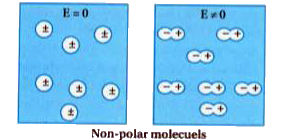 The displacement stops when the external force on the constituent charges of the molecule is balanced by the restoring force (due to internal fields in the molecule). The non-polar molecule thus develops a induced dipole moment is in the direction the field. Linear Isotropic dielectrics : ,.In an extemi electric field when the induced dipole moment i in the direction of the field and is PROPORTIONAL TC the field strength" substances for which thi assumption is true are called linear isotropi, dielectrics. The induced dipole moments of differen molecules add up giving a net dipole moment o the dielectric in the presence of the extema field. |
|
| 40. |
A body is projected vertically upwards from the surface of the earth with a velocity sufficient to carry it to infinity . The time taken by it to reach a height of three times the radius of the earth is ( acceleration due to gravity = 9.8 ms^(-2) andradius of the earth = 6400 km) |
|
Answer» 44.44 min `(TE)_("at weight")=(TE)_("at surface")` `(1)/(2)mv^(2)+(-(GMm)/(r))=(1)/(2)mv_(e)^(2)+(-(GMm)/(R ))` where `v_(e)` = escape velocity. `v^(2)=v_(e)^(2)+{(2GM)/(R)v[(R)/(r)-sqrt(2gR)g]=(GM)/R^(2)}` `V^(2)=2gR+2gR((R)/(r)-1)` `v=sqrt((2gR^(2))/(r)), So, v = (dr)/(dt)= Rsqrt((2g)/(r)) ""cdots(i)` `= R sqrt((2g)/(r))` Intergrating Eq. (i) we GET `int_(0)^(t)dt=(1)/(Rsqrt(2g))int_(R)^(R+h)r^(1//2).dr` `implies t=(2)/(3)(1)/(Rsqrt2g)[(R+h)^(3//2)-R^(3//2)]` `t=(1)/(3)sqrt((2R)/(g)[(1+(h)/(R))^(3//2)-1])` According to equestion h = 3R `t=(1)/(3)sqrt((2R)/(g)[(1+(3R)/(R))^(3//2)-1])` `t=(1)/(3)sqrt((2R)/(g))xx7` PUTTING all values we get `t=(1)/(3)((2xx6400xx10^(3))/(9.8))xx7` `[because R = 6400xx10^(3)]` `t=(80)/(3)XX 14.2xx7s` t=2666.65s t= 44.44min |
|
| 41. |
How can a metallic sphere be charged negatively without touching it ? |
| Answer» SOLUTION :By BRINGING POSITIVELY CHARGED rod NEAR metallic sphere) | |
| 42. |
In an unbiased p-n junction, holes diffuse from the p-region to n-region because |
|
Answer» free electrons in the n-region ATTRACT them In the unbiased p-n junction, holes diffuse from the p-region to n-region because holes concentration in the p-region is high as compared to n-region. |
|
| 43. |
(A): Magnetic field lines can be entirely confined within the core of a toroid. But not within a straight solenoid. (R) : The magnetic field inside the solenoid is uniform. |
|
Answer» Both 'A' and 'R' are true and 'R' is the CORRECT EXPLANATION of 'A'. |
|
| 44. |
A bomb initially at rest at a height of 40 m above the ground suddenly explodes into two identical fragments. One of them starts moving vertically downwards with an initial speed of 10 m/s. If acceleration due to gravity is 10 m//s^(2), the separation between the fragments, 2 seconds after the explosion is |
|
Answer» Solution :Initial relative VELOCITY `u_(rel)=10-(-10)=20m/s` Relative acceleration `a_(rel)=g-g=0` After t = 2 SEC, relative separation `S_(rel)=u_(rel)t+(1)/(2)a_(rel)t^(2)=(20xx2)+0=40 m` |
|
| 46. |
Obtain the amount of ""_(27)^(60)Co necessary to provide a radioactive source of 8.0 mCi strength. The half-life of ""_(27)^(60)Co is 5.3 years. |
| Answer» SOLUTION :`7.126 XX 10^(–6)` G | |
| 47. |
What is principle of homogeneity? |
| Answer» Solution :It states that the DIMENSIONAL formula of every term on the TWO SIDE of correct relation MUST be same. | |
| 48. |
Why are alloys, manganin and constantan used to make standard resistance coils ? |
| Answer» Solution :Because their RESISTIVITY is high and TEMPERATURE COEFFICIENT of resistance is EXTREMELY small. | |
| 49. |
_____ charges attract each other and _____ charges repel each other. |
| Answer» SOLUTION :LIKE, UNLIKE | |
| 50. |
How will the distance of closest approach be affected when the kinetic energy of the incident alpha particle on gold foil is doubled? |
| Answer» Solution :Distance of closest APPROACH,`d=1//4pi epsilon^0(2e)(ZE)//E As d prop1//E`, the distance of closest approach is HALVED when the K.E of the ALPHA particle is doubled. | |