

Saved Bookmarks
This section includes 7 InterviewSolutions, each offering curated multiple-choice questions to sharpen your Current Affairs knowledge and support exam preparation. Choose a topic below to get started.
| 1. |
Two identical vessels are connected by a tube with a valve letting the gas pass from one vessel into the other if the pressure difference is DeltaP. Initially there was a vacuum in one vessel while the other contained ideal gas at a temperature T_(1) and pressure P_(1) Then both vessels were heated to a temperature T_(2). Up to what value will the pressure in the first vessel (which had vaccum initially) increase? |
|
Answer» <P> SOLUTION :`P=(1)/(2)(P_(1)T_(2)//T_(1)-DELTAP` |
|
| 2. |
144 के अभाज्य गुननखंडों मे 2 की घात है :- |
|
Answer» 4 |
|
| 3. |
A copper wire of diameter 1 mm carries a current of 1.1A. The drift speed of electrons in (given, density of Cu=9g//cm^(3), atomic weight of Cu = 63 g and one electron is contributed by each Cu atom) |
|
Answer» 0.1 mm/s |
|
| 4. |
(a) State Ampere's cicuital law. Use this law to obtain the expression for the magnetic field inside an air cored toriod of average radius 'R',having 'n' truns per unit length and carrying a steady current I. (b) An observer to the left of a solenoid of N turns each of cross section area 'A' observes that a steady current I in it flows in the clockwise direction. Depict the magnetic field lines due to the solenoid specifying its polarity and show that it acts as a bar magnet of magnetic moment m = NIA. |
Answer» Solution :(b) The magnetic FIELD lines due to the solenoid are depicted in the fig. The solenoid coilbehaves as a magnetic dipole in which the left END of solenoid , from which side the observer observes the steady current I to FLOW in the clockwise direction, exhibits south (S) polarity and right end the north (N) polarity. 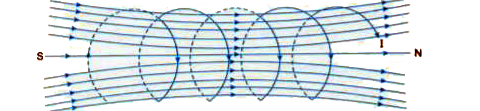 We know that a current carrying closed loop PRODUCES a magnetic field similar to that of a magnetic dipole and the magnetic moment `vecm` of the current loop is given by `vecm = I VECA `, where `vecA` is the area vector of the loop. In a solenoid magnetic field and hence magnetic moment of all the N turns, carrying same current in same direction, is added up. As a result, the current carrying solenoid acts as a bar magnet whose magnetic moment m = N (magnetic moment due to a single current loop) `implies vecm = N I vecA`. |
|
| 5. |
In an electro magnetic wave electric and magnetic field vectors are given by E= 120 sin(omega t+kz)i, B = 40xx10^-6 sin(omega t +kz)j : What is the direction of propagation of electromagnetic wave? |
| Answer» SOLUTION :A DIRECTION or perpendicular to the direcction of VARIATION of ELECTRIC field and magnetic field ie. Z direction | |
| 6. |
A certain helium -neon laser emits red light in a narrow band of wavelengths centered at 632.8 nm and with a wavelength width (such as on the scale of Fig .32-1) of 5.00 pm. What is the correspondingfrequency widthfor the emission ? |
| Answer» SOLUTION :`3.75 xx10^(9) HZ~~ 3.75 GHZ ` | |
| 7. |
A girl with two normal eyes want to see full width of her face by a plane mirror. The eye- to - eye and ear- to -ear distances of her fave are 10 cm and 14 cm, respectively. Find the minimum width of required mirror. |
|
Answer» |
|
| 8. |
A telescope has an objective of focal length 50cm and an eyepiece of focal length 5cm. The least distance of distinct vision is 25cm. The telescope is focused for distinct vision on a scale 2m away from the objective. Calculate (a) magnification produced and (b) separation between objective and eye piece. |
|
Answer» Solution :Given, `f_(o)=50cmandf_(e)=5CM` For objective: `1/v_(0)-1/(-200)=1/50." "thereforev_(0)=200/3cm` `m_(0)=v_(0)/u_(0)=((200//3))/(-200)=-1/3` For eyepiece : `1/(-25)-1/u_(e)=1/5," "thereforeu_(e)=-25/6cm` and `m_(e)=v_(e)/u_(e)=(-25)/(-(25//6))=6` (a) Magnification, `m=m_(o)xxm_(e)=-2` (B) Separation between objective and eyepiece, `L=v_(o)+|u_(e)|=200/3+25/6=425/6=70.83cm` |
|
| 9. |
A car is driven round a curved path of radius 18m in without the danger of skidding, the coefficient of friction between the tyres of the car and the surface of the curved path is 0.2. What is the maximum speed in kmph of the car for safe driving ? (g = 10 ms^(-2)) |
|
Answer» 21.6 kmph |
|
| 10. |
Assertion:An ac generator is based on the phenomenon of self-induction. Reason: In single coil, we consider self-induction only. |
|
Answer» If both assertion and REASON are t rue and the reason is the CORRECT explanation of the assertion. |
|
| 11. |
A ray of light enters a spherical drop of water of refractive index mu as shown in figure. Q. Considert eh figure of question 60, the angle phi for which minimum deviation is producedwill be given by |
|
Answer» `cos^(2)PHI=(mu^(2)+1)/(3)` `(ddelta)/(dphi)=0rArr (dalpha)/(dphi)=(1)/(2)` `a=sin^(-1)((1)/(mu)sinphi)` `cos^(2)phi=(mu^(2)-1)/(3)` |
|
| 12. |
If the tumbler is suitably tilted and viewed at a suitable angle. a. how the coin apprear ? b. What is due to ? c. Draw the course of the light ray. |
|
Answer» SOLUTION :a. COIN floats in AIR b. DUE to total INTERNAL reflrection. 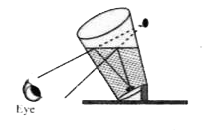
|
|
| 13. |
Can a silicon nucleus transform into a phosphorus nucleus? What particles would be emitted in the process? What is their total energy? |
|
Answer» `""_(14)SI^(31)to""_(15)P^(31)+""_(-1)e^(0)+""_(0)v^(0)` The total energy of the beta-particle and the antineutrino is 1.48 MeV. |
|
| 14. |
The equation of two progressive waves are y_1=8sin(2wpit-x/8) and y_2=6sin(200pi-x/8+pi)cm. If two waves superpose at a point, what is the resultant amplitude ? |
|
Answer» SOLUTION :RESULTANT AMPLITUDE `R=sqrt(a_1^2+a_2^2+2a_1a_2cos(a_1-a_2)=8^2+6^2+2cdot8cdot6cdotcospi=64+36+91(-1)=sqrt4=2cm` |
|
| 15. |
A relativistic particle collides inelastically with an identical stationary particle. What are the internal and the kinetic energies of the resulting object? The kinetic energy of the particle before the collision is K= evarphiwhere varphiis the potential of the accelerating electric field. Do the calculations for protons with kinetic energies of 10 GeV and 76 GeV. |
|
Answer» <P> `p.=p,epsilon.=epsilon+epsilon_0` where ` epsilon=epsilon_0+K=epsilon_0+ e varphi` is the total energy of the PARTICLE before the IMPACT, p is its momentum, and `epsilon.`and p. are the total energy and momentum of the object formed after the inelastic collision. Eliminating the momentum p. using the relation `epsilon^(.2) =epsilon_0^(2.)+p^(.2)c^2` ,we obtain for the internal energy of the object formed `epsilon._0=SQRT(2epsilon_0(epsilon+epsilon_c))=sqrt(2epsilon_0(2epsilon_0+evarphi))` The kinetic energy of the object formed `K.=epsilon.-epsilon._0=2epsilon_0+evarphi-sqrt(2epsilon_0(2epsilon_0+evarphi))` For a proton `(epsilon_0=0.938 "GeV")`with a kinetic energy of 10 GeV we obtain `epsilon._0=4.7 "GeV,"K.=7.2 ` GeV For a proton with a kinetic energy of 76 GeV we obtain the VALUES = 12.1 GeV, K.=65.8 GeV |
|
| 16. |
A short bar magnet placed with its axis at 30^@ with an external field of 800 G experiences a torque of 0.016 Nm . a. What is the magnetic moment of the magnet ? b. What is the work done in moving it from its most stable to most unstable position ? c. The bar magnet is replaced by a solenoid of cross - sectional area 2xx10^(-4) m^2and 1000 turns, but of the same magnetic moment . Determine the current flowing through the solenoid. |
|
Answer» Solution :(a) From Eq. (5.3). `tau =m B sin theta, theta= 30^@,` hence `sin theta=1//2.` Thus, `0.016 = m xx (800 xx 10^(-4)T) xx (1//2)` `m =160 xx 2//800 = 0.40Am^(2)` (b) From Eq. (5.6). the most stable position is `0 = 0^@` and the most UNSTABLE position is `theta= 180^@.` Work done is given by `W=U_(m) (theta-180^(@))-U_(m) (theta=0^(@))` `=2mB =2 xx 0.40 xx 800 xx 10^(-4)=0.064J` (c) From Eq. (4.30) `m_(s)=N//A`. From part (a), `m_(s)=0.40 Am^(2)` `0.40=1000 xx l xx 2 xx 10^(-4)` `I=0.40 xx 10^(4)//(1000 xx 2)=2A` |
|
| 17. |
The direction of induced current during electro magnetic induction is given by… |
|
Answer» FARADAY's law |
|
| 18. |
Explain, with the help of a circuit diagram, the working of a photo diaode. Write briefly how it is used to detect the optical signals. |
Answer» Solution :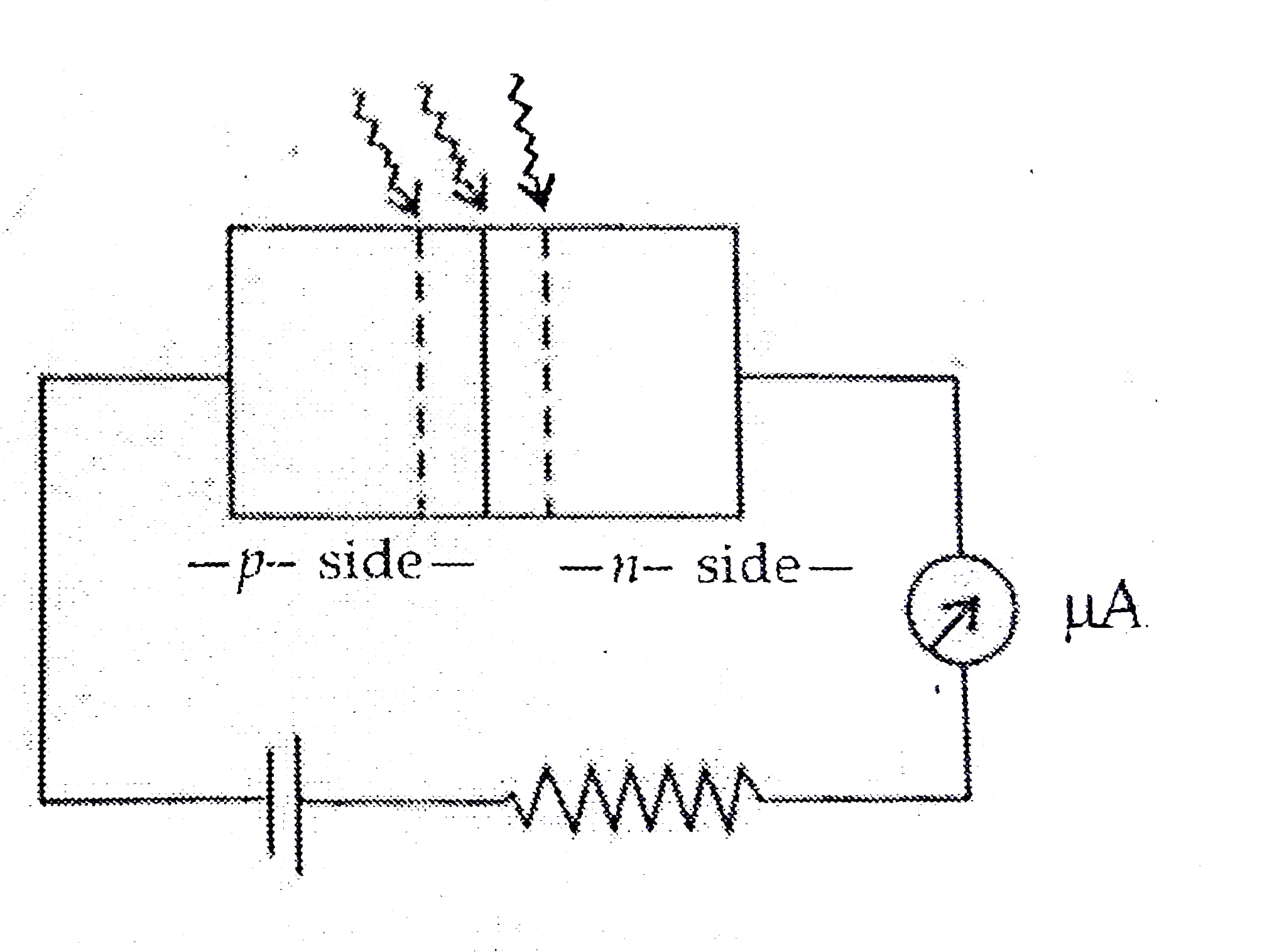 Working of photo -diode - A junction diode made from light sensitive semiconductor is called a photo diode. A PHOTODIODE is an electrical device USED to detect and convert light into on energy signal through the use of a photo detector. It is a PN - junction whose function is controlled by the light allowed to fall on it. Suppose, the wavelength is such that the energy of a photon`hc//lambda`, is SUFFICIENT to break a valence bond. When such light falls on the junction, new hole -electron pairs are created. The numberof charge carriers increases and hence the conductivityof the junction increase . If the junction is connectedto some circuit, the CURRENT in the circuit is controlled by the intensity of the incident light. |
|
| 19. |
Assertion : Basecurrent (I_(B)) decreases and in turn increases the collector current. Reason : Input signal (V_(S)) decreases the forward voltage across the emitter- base. |
|
Answer» ASSERTION and REASON are correct and Reason is the correct explanationof Assertion. |
|
| 20. |
Define term, "refreactive index " of a medium. Verify Snell's law refraction when a plane wavefront is propagating from a denser to a rarer medium. |
Answer» Solution :Refrative Index : REFRACTIVE Index is the ratio of the sine of angle of incidence to the sine of the angle of refraction.  `1mu_(2)`is the refractive index of 2nd MEDIUM w.r.t. Ist medum. Laws of refraction of the basis of Huygen's wave theory : Let PP' represents the medium (1) and medium (II). Let `v_(1)" and "v_(2)` represent the speed of light in medium (I) and medium (II) respectively. Let AB be the incident wave front and EC be the refracted wave front. 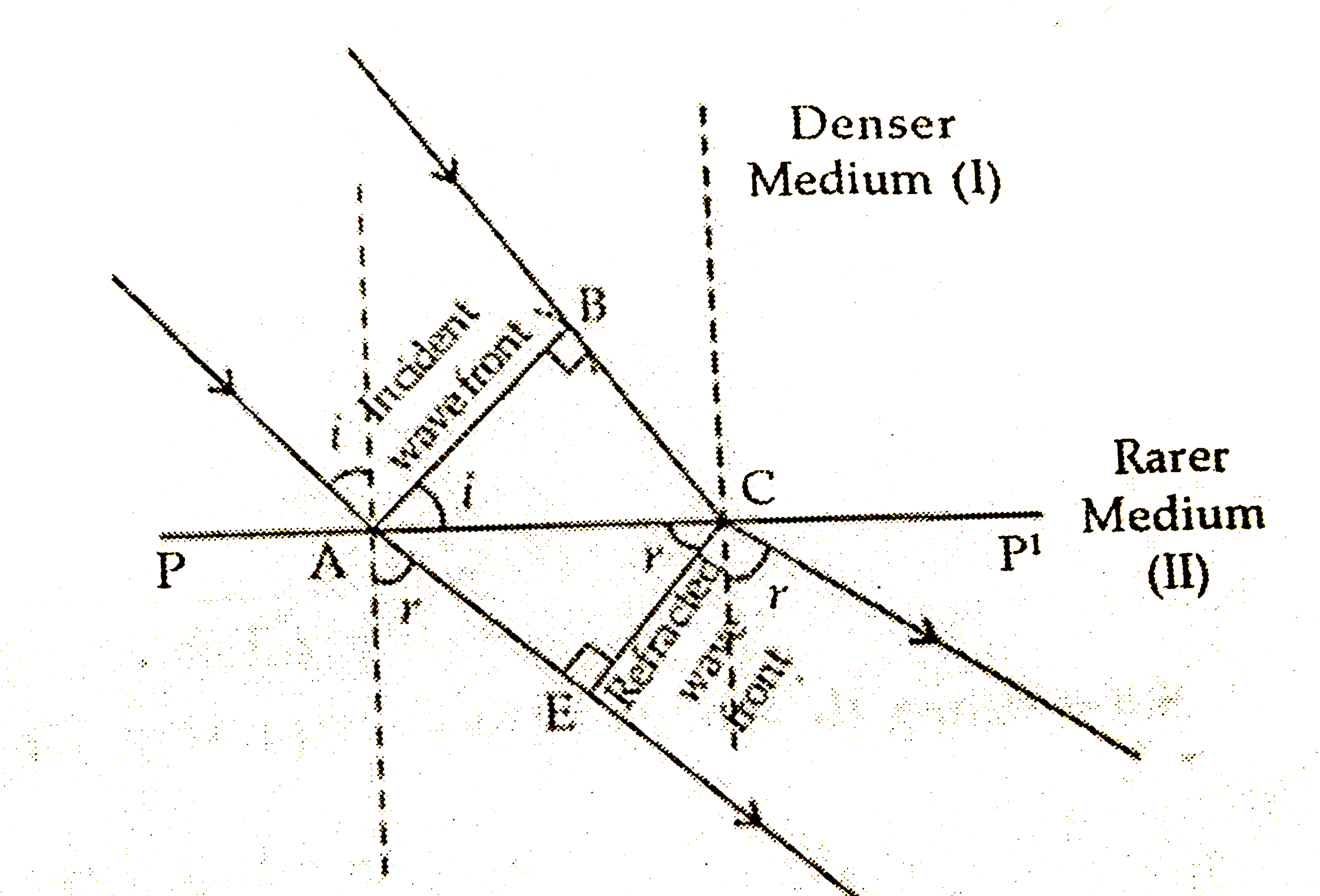 `BC==v_(1)t,""AE=v_(2)t` `"In "DeltaABC, sini=(BC)/(AC)=(v_(1)t)/(AC)"....(1)"` `"In "DeltaCAE, sin r=(AE)/(AC)=(v_(2)t)/(AC)"....(2)"` Dividing equation no. (1) and (2) `(sini)/(sinr)=(v_(1)t)/(AC)xx(AC)/(v_(2)t)=v_(1)/v_(2)="CONSTANT"` Let C be the speed of light `mu_(1)=c/v_(1)"rArr"v_(1)=c/mu_(1)"...(3)"` `mu_(2)=c/v_(2)"rArr"v_(2)=c/mu_(2)"...(4)"` Dividing equation (3) and (4) `v_(1)/v_(2)=mu_(2)/mu_(1)=(sini)/(sinr)` `mu_(2)sinr=mu_(1)sini.` This proves the Snell's law of refraction. |
|
| 21. |
What isdielectricstrength ? Writethevalueofdielectricstrengthofair. |
|
Answer» SOLUTION :Maximumelectricfieldwhichcanbesafelyappliedacrossa dielectricbeforeitsbreakdownis calleddielectricstrength. Dielectricstrength ofair ` =3 XX 10 ^(6) V//m`. |
|
| 22. |
The radii of curvature of both the sides of a convex lens are 15 cm and if the refractive index of the material of the lens is 1.5, then focal length of lens in air is ......... cm. |
|
Answer» 10 `1/f=(mu-1)(1/R_1-1/R_2)` Here,taking `R_1=15,R_2=-15,mu=1.5,` `THEREFORE 1/f=(1.5-1)((2)/(15))=(0.5xx2)/(15)` `implies f=(15xx10)/(5xx2)`=15 CM |
|
| 23. |
A vehicle moves safe on a rough , curvedand unbankedroad . Then Thedirection of static friction is rapidallyout wards The direction of staticfriction is radially inwards . The direction of kinetic friction is tangential to curvedpath Staticfriction doesnot exist |
|
Answer» a and B are CORRECT |
|
| 24. |
Correct the following CE amplifier circuit . |
Answer» SOLUTION :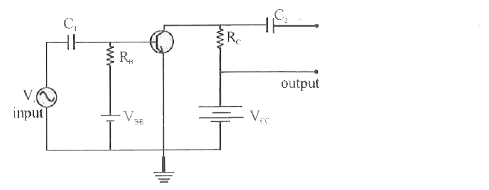
|
|
| 25. |
Two mirrors, one concave and the other convex, are placed 60 cm apart with their reflecting surfaces facing each other . An object is placed 30 cm from the pole of either of them on their axis. If the focal lengths of both the mirrors are 15 cm , the position of the image formed by reflection, first at the convex and then at the concave mirrors , is |
|
Answer» 19.09 cm from the POLE of the CONVEX MIRROR |
|
| 26. |
Obtain the de Broglie wavelength associated with thermal neutrons at room temperature (27^(@)C). Hence explain why a fast neutron beam needs to be thermalised with the environmentbefore it can be used for neutron diffraction experiments . |
|
Answer» Solution :`lambda=(h)/(p)=(h)/(sqrt(2mK))`.Thus, for some K, `lambda` decreases with m as `(1//sqrtm)`. Now `(m_(n)//m_(e))=1838.6`, therefore for the same energy, (150 ev) as in Ex. 11.31 wavelength of neutron `=(1//sqrt(1838.6))xx10^(-10)m=2.33xx10^(-12)m`. The INTERATOMIC spacing is about a hundred TIMES greater. A neutron beam of 150 ev energy is therefore not suitable for diffraction EXPERIMENTS. (b) `lambda=1.45xx10^(-10)m[" Use "lambda=(h//sqrt(3mkT))]`which is comparable to interatomic spacing in a crystal. Clearly, from (a) and (b) above, THERMAL neutrons are a suitable probe for diffraction experiments, so a high energy neutron beam should be first thermalised before using it for diffraction. |
|
| 27. |
An electrical technician requires a capacitance,of 2 muFin a circuit across a potential difference of 1 kV. A large number of1 muFcapacitors are available to him each of which can withstand a potential difference of more than 400 V. Suggest a possible arrangementthat requires the minimum number of capacitors . |
|
Answer» Solution :For obtain 2 `mu`F capacitance and p.d. of 1 kVnumber of capacitor connected in series of `1mu`capacitor and such m series connected i parallel For number of capacitor in each row is GIVEN a `p.d. = (V)/(n) = (1000)/(n)` `400 = (1000)/(n)` `:. n = (1000)/(400) ` `:. n = 2.5` but no. of capacitor should be in integer `:. ` n =3 The equivalent of capacitance of composition connection , `(m)/(n) = 2 IMPLIES m=2n` = `2xx3` =6 Required number of capacitor = MN `= 6xx3` = 18 This composite connection is shown as figure 
|
|
| 28. |
V-i graph for a metal wire at temperature is as shown in figure |
|
Answer» `T_(1)=T_(2)` |
|
| 29. |
Figure 16-37 shows resonane oscillation of a string of mass m=2.500 g and lengt L= 0.800 m and that is under tension tau= 325.0 N. What is the wavelength lambda of the transverse waves producing the standing wave patient and what is the charmant number. What is the frequency of the transverst waves and of the osciallation of the moving string elements? What is the maximum magnitude of the transverse velocity u_(m) of the element oscillating a coordinate x =0.180 m? At what point during the element's oscillation is the transverse velocity maximum? |
Answer» Solution :(a) The transverse waves that produce STANDING wave pattern must have a wavelength such that inter number n of half-wavelengths fit into the length L of the string. 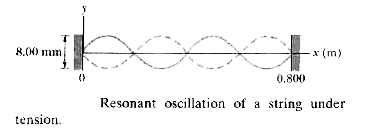 (2) The frequency of those waves and of the oscillations of the string elements is given by Eg. 16-75 `(F=nv//2L).` (3) The displacement of a string element as a function of position X and TIMER is given by Eq, 16-66: `y. (x,t) =[2y_(m) sin kx] cos omega t` Wavelength and harmonic number: In Fig. 16-37, the solid line, which is effectively a snapshot (or freeze-frame) of the oscillations, reveals that 2 full wavelengths fit into the length L=0.800 m of the string. Thus, we have `2lambda=L`, or `lambda=L/2` `=(0.800 m)/(2)=0.400 m` By counting the number of loops (or half-wavelengths) in Fig. 16-37, we see that the harmonic number is n=4 We also find n=4 by comparing Eqs. 16-78 and 16-74 `(lambda = 2L//n).` Thus, the string is oscillating in its FOURTH harmonic. Frequency. We can get the frequency of the transverse waves from Eq. 16.15 `(v= lambda f)` if we first find the speed v of the waves. That speed is given by Eq 16:29, but we must substitute m/L, for the unknown lincar kiensity `MU`. We obtain `v=sqrt(tau/mu)=sqrt(tau/(m//L))=sqrt((tau L)/(m))` `=sqrt((325 N) (0.080 m))/(2.50 xx 10^(-3) kg) =322 .49m//s` After rearranging Eq. 16-15, we write `f=v/lambda=(322.49 m//s)/(0.400m)` =806.2Hz= 806 Hz |
|
| 30. |
One inductor (of inductance L henry) is connected to an A.C. source, then the current flowing through the inductor I = ........ A. |
|
Answer» `V_0/(omegaL) SIN (omegaL + pi/2)` `THEREFORE tan DELTA` = infinite `therefore delta = pi/2` `therefore` From `I=V/"|Z|" sin (omegat-delta)` `therefore I=V_0/(omegaL) sin (omegat-pi/2)` Amp. |
|
| 31. |
A charged particle, having a charge q, is moving with a speed v along the x-axis. It enters a region of space where an electric field vecE ( = E hatj) and a magnetic field vecB are both present. The particle, on emerging from this region, is observed to be moving along the x-axis only. Obtain an expression for the magnitude of vecB in terms of v and E. Give the direction of vecB. |
|
Answer» Solution :As the charged particle finally moves undeviated along the x-axis only, it MEANS that force due to electric field and force due to magnetic field are just equal and opposite and are nullifying each other i.e., `Q vecE + q vecv xx vecB = vec0 "or" QE = qvB implies B = E/v` It is POSSIBLE only when `vecB` is along the z-axis. thus, particles, possessing a particular speed .v. only will move undeviated under the INFLUENCE of a pair of crossed electric and magnetic fields. |
|
| 32. |
The Domain of Function sqrt (x^2 -5x+6) +sqrt (2x+8-x^2),is |
|
Answer» [2,3} |
|
| 33. |
According to Newton’s law of cooling ms (d theta)/(dt)=-K(theta-theta_0). If sigma is Stefan’s constant, A is surface area of the body and T_@ is temperature of surroundings in K, then the value of K on the basis of Stefan-Boltzmann law is – |
|
Answer» `SIGMA AT_(0)^4` |
|
| 34. |
The magnetic filedon theaxis of a shortbarmagnetat a distance of 10 cm is 0.2 oersted. Whatwill bethe field at a point, distant5 cm on the line perpendicular to the axisandpassingthrough themagnet ? |
|
Answer» 0.025 oersted |
|
| 35. |
In the circuit shown in figure, when the input voltage of the base resistance is 10V, V_(BE) is zero and V_(CE) is also zero. Find the values of I_(B), I_(C ) and beta. |
|
Answer» Solution :In the INPUT section, `v_(i)=I_(B)R_(B)+V_(BE)` `therefore 10=(I_(B))(400xx10^(3))+0` `therefore I_(B)=(10)/(400xx10^(3))=0.25xx10^(-4)A` `therefore I_(B)=25xx10^(-6)A=25muA` In the output section, `V_(C C)=I_(C )R_(C )+V_(CE)` `therefore10=I_(C )(3xx10^(3))+0` `therefore I_(C )=(10)/(3xx10^(3))=0.3333xx10^(-2)A` `therefore I_(C )=3333xx10^(-6)A=3333muA` `rArr BETA=(I_(C ))/(I_(B))=(3333)/(25)=133.3` |
|
| 36. |
The plate of a capacitor are separated by .5 mm and they are connected to a battery of 100 V What will be the force on an electron located between the plates ? |
|
Answer» `1.6xx10^-19N` |
|
| 37. |
20 % NaOH by mass means |
|
Answer» 20 g NaOH in 100 g solution |
|
| 38. |
Two different magnets are tied together and allowed to vibrate in a horizontal plane. When their like poles are joined, time period of oscillation is 5 s and with unlike poles joined. Time period of oscillation is 15 s. The ratio of their magnetic moments is |
|
Answer» `5:4` |
|
| 39. |
A pin is placed 10 cm in front of a convex lens of focal length 20cm made of material having refractive index 1.5. The surface of the lens farther away from the pin is silvered and has a radius of curvature 22cm. Determine the position of the final image. Is the image real or virtual? |
|
Answer» Solution :As radius of curvature of silvered surface is 22 cm, `f_M=(R )/(2)= (-22)/(2) =- 1 1 cm ` andhence ` P_M=- (1)/(f_M) =- (1)/( -0.11 ) = (1)/( 0.11)D ` Further as the focal length of lens is 20 cm, i.e., 0.20 m, its power will be given by: `P_L=- (1)/(f_L) = (1)/(0.20)D `  Now as in image formation, light after PASSING through the lens will be reflected back by the curved mirror through the lens again ` P=P_L +P_M +P_L= 2P_L+P_M` `i.e.,P=(2)/(0.20)+(1)/( 0.20 )+(1)/(0.11) = (210 )/(11) D ` so thefocallengthof equivalentmirror ` F=- (1)/(P)=- (11)/(210 )m =- (110)/(21) m` i.e., the silvered lens behaves as a concave mirror of focal length (110/21) cm. So for object at a distance 10cmin frontof it ` (1)/(V)+(1)/(10)=- (21)/(110)` i.e., image will be 11 cm in front of the silvered lens and will be real as SHOWN in FIG. |
|
| 40. |
A hollow metallic sphere of radius 5 cm is charged so that the potential on its surface is 10 V. Thepotential at the centre of the sphere is |
|
Answer» 0 V |
|
| 41. |
Assertion: Combiantion of lenseshelps to obtaindiverging or converging lenses of desired magnification. Reason:It enhances sharpness of the image. |
|
Answer» If both assertion and reason are true and reason is the correct explanation of assertion. |
|
| 42. |
Consider Experiment 6.2. (a) What would you do to obtain a large deflection of the galvanometer? (b) How would you demonstrate the presence of an induced current in the absence of a galvanometer? |
|
Answer» Solution :(a) To obtain a large deflection, one or more of the following steps can be taken: (i) Use a rod made of soft iron inside the coil `C_2` , (ii) Connect the coil to a powerful battery, and (III) Move the arrangement rapidly towards the test coil `C_1`. (B) Replace the galvanometer by a small bulb, the kind one FINDS in a small torch light. The relative motion between the two coils will cause the bulb to glow and thus demonstrate the presence of an induced current. In experimental physics one MUST learn to innovate. Michael FARADAY who is ranked as one of the best experimentalists ever, was legendary for his innovative skills. |
|
| 43. |
Calculate the value of Rydberg constant if the wavelength of the first memberof Balmer series in the hydrogen spectrum is 6563 Å. Also find the wavelengthof the first member of Lyman series in the same spectrum. |
|
Answer» Solution :GIVEN `lamda = 6563 Å = 6563 xx 10^(-10) m` USING the relation , v`= 1/lamda =R [ (1)/(n_1^2) - (1)/(n_2^2) ]` For first member in Balmer series , `n_1 = 2` and `n_2= 3` `1/lamda = R [1/4 - 1/9]` `(1)/(6563 xx 10^(-10)) = (5R)/(36)` ` R = 1.097 xx 10^7 m^(-1)` For first member of lyman series : `n_1 = 1`, and `n_2 = 2` Using the relation `(1)/(lamda.) = R [(1)/(n_1^2) - (1)/(n_2^2)]` `(1)/(lamda.) = 1.097 xx 10^7 [1/1 - 1/4]` `(1)/(lamda.) = 1.097 xx 10^7 [3/4]` `lamda. =(4)/(3 xx 1.097 xx 10^7)` `lamda. = 1.215 xx 10^(-7)` `lamda. = 1215Å` |
|
| 44. |
When air is replaced by a dielectric medium of constant K, the maximum force of attraction between two charges separated by a distance |
|
Answer» increases K times |
|
| 45. |
There is a circularr hole in a square copper plate. If the plate is heated then the radius of the circular hole will |
|
Answer» increase |
|
| 46. |
A sinusoidal carrier voltage of 80 volts amplitude and I MHz frequency is amplitude modulated by a sinusoidal voltage of frequency 5kHz producing 50% modulation. Calculate the amplitude and frequency of lower and upper side bands. |
|
Answer» Solution :AMPLITUDE of both LSB and USB are equal and given by `= (mE_(c))/(2)= (0.5 XX 80)/(2)= 20 volts` Now frequency of LSB = `f_(c)-f_(s)= (1000-5)KHZ= 995kHz` Frequency of USB= `f_(c)+f_(s)= (1000+5)kHz= 1005 kHz` |
|
| 47. |
Explain experimentally observed facts of photoelectric effect with the help of Einstein's explanation. |
|
Answer» Solution :Explanation for the photoelectric effect : The experimentally observed facts of photoelectric effect can be explained with the help of Einstein.s photoelectric equation. As each incident photon liberates one electron, then the increase of intensity of the light (the number of photons per unit area per unit time) increases the number of electrons emitted thereby increasing the photocurrent. The same has been experimentally observed. From `K_(max) = h upsilon - phi_(0)`, it is evident that `K_(max)` is PROPORTIONAL to the frequency of the light and is independent of intensity of the light. As given in Einstein.s photoelectric equation, there MUST be minimum energy (equal to the work function of the metal) for incident photons to liberate electrons from the metal surface. Below which, emission of electrons is not possible. Correspondingly, there EXISTS minimum frequency called threshold frequency below which there is no photoelectric emission. According to quantum CONCEPT, the transfer of photon energy to the electrons is instantaneous so that there is no time lag between incidence of photons and ejection of electrons. |
|
| 48. |
A coil Q is connected to low voltage bulb B and placed near another coil P as shown in the Fig. 6.46. Give reasons to explain the following observations: (a) The bulb 'B' lights. (b) Bulb gets dimmer if the coil Q is moved towards left. |
|
Answer» Solution :(a) The bulb B lights due to the mutual inductance phenomenon. On passing alternating current through COIL P, magnetic flux of coil P continuously CHANGES with TIME. As coil Q is placed near the coil P, hence due to change in magnetic flux of coil P the magnetic flux of coil Q also correspondingly changes. As a result an alternating voltage is induced across the coil Q, due to which the bulb B starts glowing. (b) If the coil Q is moved towards left (i.e., away from the coil P), the coupling between the COILS Pand Q becomes loose. It means that flux lines passing through coil Q will be lesser and so the induced voltage across it will be less. Hence, the bulb B gets dimmer. |
|
| 49. |
J.J.Thomson's cathode ray tube experiment demonstrated that ...... |
|
Answer» the `(e)/(m)` ratio of the cathode RAY particles changes when a different gas is placed in the discharge tube. cathode rays are streams of negatively charged ions. |
|