Saved Bookmarks
This section includes 7 InterviewSolutions, each offering curated multiple-choice questions to sharpen your Current Affairs knowledge and support exam preparation. Choose a topic below to get started.
| 1. |
Two capillaries of radii r_(1) and r_(2) and lengths l_(1) and l_(2) are set in series. A liquid of viscosity eta is flowing through the combination under a pressure difference p. The rate of flow of the liquid is : |
|
Answer» <P>`(pip)/(8eta)[(l_(1))/(r_(1)^(4))+(l_(2))/(r_(2)^(4))]` `p_(1)-p_(2)=(8Vetal_(1))/(pir_(2)^(4))` `p_(2)-p_(3)=(V8etl_(2))/(pir_(2)^(4))` Adding `p_(1)-p_(3)=(8Veta)/(pi)[(l_(1))/(r_(1)^(4))+(l_(2))/(r_(2)^(4))]` `p=(8Veta)/(pi)((l_(1))/(r_(1)^(4))+(l_(2))/(r_(2)^(4)))` `V=(pip)/(8eta)((l_(1))/(r_(1)^(4)+(l_(2))/(r_(2)^(4)))` `THEREFORE` Correct choice is (B). |
|
| 2. |
If the gravitational force between two objects were proportional to 1//R (and not as 1//R^(2)), where R is the distance between them, then a particle in a circular path (under such a force) would have its orbital speed v, proportional to |
|
Answer» REMAINS unchanged Since `(mv^(2))/(R )=(GMm)/(R )`, therefore `V=sqrt(GM)`. Thus velocity v is independent of R. |
|
| 3. |
There are basic modes of communication point and broadcasting in short wave broadcast service which mode of propagation of radio waves is used |
| Answer» SOLUTION :SKY WAVE | |
| 4. |
In a step-down transformer ....... increases. |
| Answer» Solution :In step-down TRANSFORMER voltage DECREASES, so current INCREASES. | |
| 5. |
Two wires of resistance R_(1) and R_(2) at 0^(@)C have temperature coefficient of resistance alpha_(1) and alpha_(2) respectively. These are joined in series. The effective temperature coefficient of resistance is : |
|
Answer» `(alpha_(1)+alpha_(2))/(2)` |
|
| 6. |
In the adjoining circuit diagram each resistance is of 10 Omega. The current in the arm AD will be |
|
Answer» `(2I)/(5)` |
|
| 7. |
A person’s far point is 2 m and his near point is 50 cm. Find the nature, focal length and power of the lenses, he must use to read a book clearly, The least distance of distinct vision is 25 cm. |
|
Answer» |
|
| 8. |
Noble metals, like gold and platinum are soluble in which of the following mixtures? |
|
Answer» 1:1 MIXTURE of CONC. `HNO_3` and conc. `H_2SO_4` i.e, `3HCI+1 HNO_3`= aqua- regia Hence option( c) is correct. |
|
| 9. |
Draw the diagram representing the schematic arrangement of Geiger-Marsden experimental alpha particle scattering. |
Answer» SOLUTION :
|
|
| 10. |
a 0.02 m wide slit is illumijnated at normal incidence by light of wavelength 6000 Å (i) Find the width of the central maximum band on the screen placed 1 m awayb from the slit. (ii) What should br the fringe width if the appratus Is impressed in water whose refractive index is 4/3? |
|
Answer» |
|
| 11. |
An electric dipole of moment P is placed in the position of stable equilibrium in uniform electric field of intensity E. It is rotated through an angle theta from the initial position. The potential energy of electric dipole in the position is |
|
Answer» `PE cos THETA` |
|
| 12. |
Derive the expression for effective focal length of two thin lenses kept in contact. |
|
Answer» SOLUTION :Correct ray diagram with Indication of arrows} Refraction through first lens in the absence of second, equation `(1)/(v_(1))-(1)/(u)=(1)/(f_(1))`} Refraction through second lens In the absence of first, equation `(1)/(v)-(1)/(v_(1))=(1)/(f_(2))` } ADDING equation `(1)/(v)-(1)/(u)=(1)/(f_(1))+(1)/(f_(2).)(1)/(v)-(1)/(u)=(1)/(F)` } Arriving `(1)/(f)=(1)/(f_(1))+(1)/(f_(2))`.  Consider two thin lenses of focal lengths `f_(1) and f_(2)` respectively placed in contact with each other. Let .O. be the POINT object placed on the principle axis of the lense. If second lens is not present than the first lens forms an image `I_(1)` of the object .O. at a distance `v_(1)` from it. `therefore -(1)/(u)+(1)/(v_(1))=(1)/(f_(1))` . . (1) Since second lens is in contact with the first, So `I_(1)` acts as an object to the second lens which forms the Image I at a distance v from it `therefore -(1)/(v_(2))+(1)/(v)=(1)/(f_(2))`. . (2) adding (1) and (2) we get `-(1)/(u)+(1)/(v)=(1)/(f_(1))+(1)/(f_(2))` Or `-(1)/(u)+(1)/(v)=(1)/(f)` where `(1)/(f)=(1)/(f_(1))+(1)/(f_(2))` Thus, the two thin lenses in contact behave as a single lens of focal length f. this single lens is known as equivalent lens and its focal length f is called equivalent focal length. |
|
| 13. |
The skip zone in radio wave trasmission is that range where |
|
Answer» there is no RECEPTION of EITHER ground WAVE or SKY wave |
|
| 14. |
Explain the determination of the internal resistance of the cell using voltmeter. |
|
Answer» ZERO |
|
| 15. |
The difference in the frequency of series limit of Lyman series and frequency of Balmer series is equal to the frequency of the first line of the ...... series. |
|
Answer» PASCHEN `:.(CR)/(lamda_(L))=cR[1-0]"":.f_(L)=cR` For Balmer series `(1)/(lamda_(B))=R[(1)/(2^(2))-(1)/(oo^(2))]` `:.(c)/(lamda_(B))=cR[(1)/(4)]` `:.f_(B)=(cR)/(4)` `:.f_(L)-f_(B)=cR[(1)/(1^(2))-(1)/((2)^(2))]` =Frewquency of first line of Lyman series |
|
| 16. |
A spherical ball contracts in volume by 0.01 % when subjected to a uniform pressure of 100 atmospheres. The bulk modulus of material is : ( one atmosphere = 10^(5) Nm^(-2)) |
|
Answer» `10^(10)NM^(-2)` `=(100xx10^(5))/((0.01)/100)=(100xx105xx100)/(0.01)=10^(11)Nm^(-2)` |
|
| 17. |
Which photon is more energetic ? A red one or violet one ? |
| Answer» SOLUTION :Violet photon has more energy because energy of a photon E = hv and `v_"violet" GT v_(red)` | |
| 18. |
An air bubble of radius 10^-2m is rising up at a steady rate of 2 xx 10^-3 m/sthrough a liquid of density 1.5 xx 10^3( kg) /m^3. The coefficient of viscosity neglecting the density of air will be (g = 10m/s^2) |
| Answer» Answer :D | |
| 19. |
Calculate the intensity of illumination at a distance of 0.5m from a source of light of power 200 candela assuming normal incidence. |
|
Answer» |
|
| 20. |
If the wavelength of light is 4000 A, then the number of waves in 1 mm length will be ...... |
|
Answer» 25 `=(10^(3))/(4xx10^(-7))=(10^(4))/(4)` `=0.25xx10^(4)=2500` |
|
| 21. |
Young's double slit experiment is carried out by using green , redm and blue light, one color at time. The fringe widths recorded are beta_(G) , beta_(R) and beta_(B) respectively. Then |
|
Answer» `beta_(G) GT beta_(B) gt beta_(R)` `BAR("VIBGYOR")` 1 increase `lambda_(R) gt lambda_(G) gt lambda_(B)` So `beta_(R) gt beta_(G) gt beta_(B)` |
|
| 22. |
A particle A moves in one direction along a given trajectory with a tangential acceleration w_tau=atau, where a is a constant vector coinciding in direction with the x axis(figure), and tau is a unit vector coinciding in direction with the velocity vector at a given point. Find how the velocity of the particle depends on x provided that its velocity is negligible at the point x=0. |
|
Answer» `w_t=veca*vectau` But `w_t=(vdv)/(DS)` or `vdv=w_tds` So, `vdv=(veca*vectau)ds=veca*dvecr` or, `vdv=aveci*dvecr=adx` (because `veca` is DIRECTED towards the X-axis) So, `underset0oversetvintdv=aunderset(0)overset(x)intdx` Hence `v^2=2ax` or, `v=sqrt(2ax)` |
|
| 23. |
A mixture of 2 moles of helium gas (atomic mass = 4 u), and 1 mole of argon gas (atomic mass =40 u) is kept at 300 K in a container. The ratio of their rms speeds [(V_(rms)"(helium)")/(V_(rms)"(argon)")], is close to : |
|
Answer» 2.24 |
|
| 24. |
A plane mirror 50 cm long, is hung on a vetical wall of a room, with its lower edge 50 cm above the ground. A man stands of the mirror at a distance 2 m away from the mirror. If his eyes are at a height 1.8 m above the ground, then the length (distance between the extreme pointsof the visible region perpendicular to the mirror ) of the floor visible to him dueto refliection from the mirror is (x)/(26)m . Find the value of x |
|
Answer» So , `(EM)/(PO)=(MP)/(OS) rArr OS=1xx(2)/(0.8) m=2.5 m. Sumilarly, DeltaENQ and DeltaQOR` are similar. So, `(EN)/(QO)=(QN)/(RO) rArrRO=(0.5xx2)/((1.8-0.5)) m. =(10)/(13)m`. Hence, LENGTH of wall visible in mirror `=OS-OR=((5)/(2)-(10)/(13))m =(45)/(26),x=45` 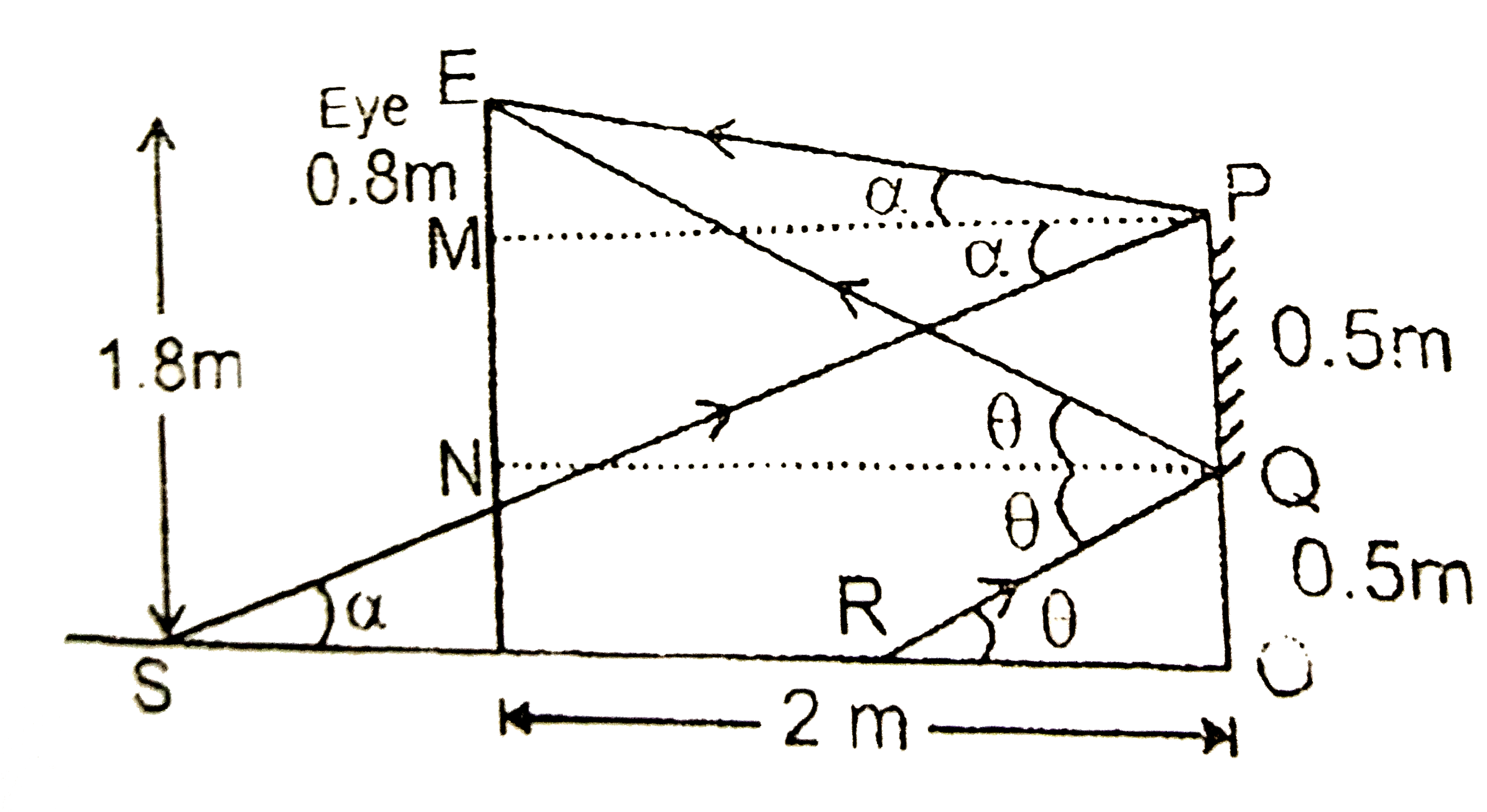
|
|
| 25. |
It is known to you that ''whenever the flux of a magnetic field through the area bound by a closed conducting loop changes , an emf is produced in the loop . Then emf is given by epsi = -(dphi)/(dt) , where psi = int vecB dot "vecds is the flux of the magnetic flux through a closed loop changes, an electric current results. Let us now investigate " what is the external mechanism that maintains the electric field in the loop to drive the current". In the words what is the mechanism to produce an emf? (a) keeping ther magnetic field constant as time pases and moving whole as part of the loop. (b) Keeping the loop at rest and changing the magnetic field. (c) Combination of (a) and (b)that is by moving the loop ( partly or wholly) as well as by changing the field. The mechanism (a) for production of emf is studie under theheating motional emf and mechanism (b) under the heating induced electric field. In mechanism (a) , magnitude of the potential difference across the conductor is given by epsi=Blv where,B,l, v have their usual meanings and the electrostatic field developed within the conductor E=vB Whereas if the magnetic field through a stationary conduting loop is changing with time, then also there will be an induced emf whose value will be epsi=ointvecE.vecdl, where E is the induced electric field. The electric field produced by the changing magneticfield is non-electrostatic and non-conservation A uniform but time varying magnetic field B=(2t^(3)+24t) T is present in a cylinder region of radius R=2.5 c.m.as shown in the figure. The force on an electron at P at t=2.0 s is |
|
Answer» `96xx10^(-21)`N |
|
| 26. |
A series LCR circuit is connected to 230 V a.c. source of variable frequency. The inductance of the coil is 5 H capacitance of the capacitor is 5 mu F and resistance is 40 Omega. At resonance calculate , (a)The resonant frequency , (b) current is the circuit and (c )the inductive reactance. |
|
Answer» Solution :`f_(0) = (1)/(2pisqrt(LC)) = (1000)/(31.4) = 31.8 Hz` `I = (V)/(R ) = (230)/(40) = 5.75 A` `X_(L) = 2pi fL = 998.5 Omega` |
|
| 27. |
It is known to you that ''whenever the flux of a magnetic field through the area bound by a closed conducting loop changes , an emf is produced in the loop . Then emf is given by epsi = -(dphi)/(dt) , where psi = int vecB dot "vecds is the flux of the magnetic flux through a closed loop changes, an electric current results. Let us now investigate " what is the external mechanism that maintains the electric field in the loop to drive the current". In the words what is the mechanism to produce an emf? (a) keeping ther magnetic field constant as time pases and moving whole as part of the loop. (b) Keeping the loop at rest and changing the magnetic field. (c) Combination of (a) and (b)that is by moving the loop ( partly or wholly) as well as by changing the field. The mechanism (a) for production of emf is studie under theheating motional emf and mechanism (b) under the heating induced electric field. In mechanism (a) , magnitude of the potential difference across the conductor is given by epsi=Blv where,B,l, v have their usual meanings and the electrostatic field developed within the conductor E=vB Whereas if the magnetic field through a stationary conduting loop is changing with time, then also there will be an induced emf whose value will be epsi=ointvecE.vecdl, where E is the induced electric field. The electric field produced by the changing magneticfield is non-electrostatic and non-conservation If the above magnetic field is present perpendicular to a ring of radius of 1 cm, mass=10 gram and charge =1 C, then the angular velocity of the ring as a function of time is ( the ring and the cylinderical region are coaxial) |
|
Answer» `(6t^(2)+12)xx10^(2)` rad/s |
|
| 28. |
Twopoints charges are placed on x-axis as shown, a = 1 cm, q = 1muC , mass of each particle m=6g. The charges are tied at the end of an inextensible string of length 2a. The whole system is free to move on a horizontal frictionless surface. Now suppose a third charge of equal value +q is fixed at the point (a//2,0) and the system of charges A and B is released. There is no friction between third chargeand string. Find the maximum velocity of the system of charges A and B. |
|
Answer» `2 ms^(-1)`  `T=F=(kq^(2))/((2a)^(2))=(9xx10^(9)xx10^(-12))/(4xx10^(-4))=22.5` When velocity is maximum THIRD CAHRGE will be centre of A and B  `(KE+PE)_(i)=(KE+PE)_(f)` `0+(kq^(2))/(a//2)+(kq^(2))/(3a//2)=(1)/(2)(2m)v^(2)+2(kq^(2))/(a)` or `v=sqrt((2)/(3)(kq^(2))/(ma))=sqrt((2)/(3)xx(9xx10^(9)xx10^(-12))/(6xx10^(-3)xx10^(-2)))=10MS^(-1)` When third charge is at center of A and B, net force due to third charge on A and B is zero. So acceleration of system of A and B is zero. it means individual acceleration of A and B is ALSO zero. `T=F_(1)+F_(2)=(kq^(2))/(a^(2))+(kq^(2))/((2a)^(2))=112.5N` 
|
|
| 29. |
It is known to you that ''whenever the flux of a magnetic field through the area bound by a closed conducting loop changes , an emf is produced in the loop . Then emf is given by epsi = -(dphi)/(dt) , where psi = int vecB dot "vecds is the flux of the magnetic flux through a closed loop changes, an electric current results. Let us now investigate " what is the external mechanism that maintains the electric field in the loop to drive the current". In the words what is the mechanism to produce an emf? (a) keeping ther magnetic field constant as time pases and moving whole as part of the loop. (b) Keeping the loop at rest and changing the magnetic field. (c) Combination of (a) and (b)that is by moving the loop ( partly or wholly) as well as by changing the field. The mechanism (a) for production of emf is studie under theheating motional emf and mechanism (b) under the heating induced electric field. In mechanism (a) , magnitude of the potential difference across the conductor is given by epsi=Blv where,B,l, v have their usual meanings and the electrostatic field developed within the conductor E=vB Whereas if the magnetic field through a stationary conduting loop is changing with time, then also there will be an induced emf whose value will be epsi=ointvecE.vecdl, where E is the induced electric field. The electric field produced by the changing magneticfield is non-electrostatic and non-conservation A magnetic field B=2t^(3)-24t is present perpendicular to plane of a disc of radius R as shown in the figure. The direction of induced electric field at t=2s is |
|
Answer» clockwise |
|
| 30. |
Twopoints charges are placed on x-axis as shown, a = 1 cm, q = 1muC , mass of each particle m=6g. The charges are tied at the end of an inextensible string of length 2a. The whole system is free to move on a horizontal frictionless surface. What is the tension in the string? |
|
Answer» `11.25 N`  `T=F=(kq^(2))/((2a)^(2))=(9xx10^(9)xx10^(-12))/(4xx10^(-4))=22.5` When velocity is maximum third cahrge will be centre of A and B  `(KE+PE)_(i)=(KE+PE)_(f)` `0+(kq^(2))/(a//2)+(kq^(2))/(3a//2)=(1)/(2)(2M)v^(2)+2(kq^(2))/(a)` or `v=sqrt((2)/(3)(kq^(2))/(ma))=sqrt((2)/(3)xx(9xx10^(9)xx10^(-12))/(6xx10^(-3)xx10^(-2)))=10ms^(-1)` When third charge is at center of A and B, net FORCE due to third charge on A and B is ZERO. So acceleration of system of A and B is zero. it means individual acceleration of A and B is also zero. `T=F_(1)+F_(2)=(kq^(2))/(a^(2))+(kq^(2))/((2a)^(2))=112.5N` 
|
|
| 31. |
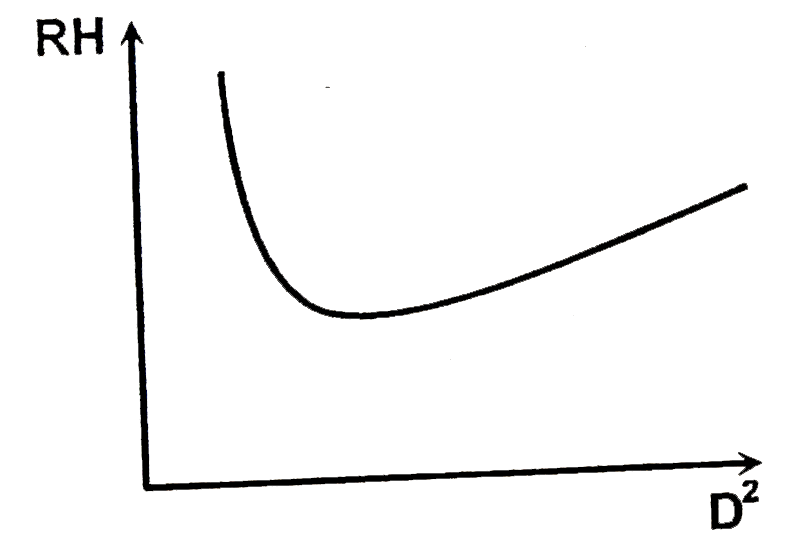
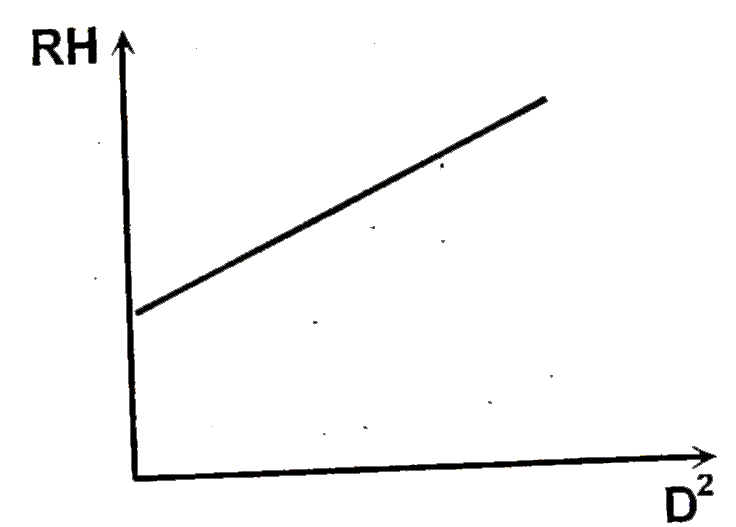
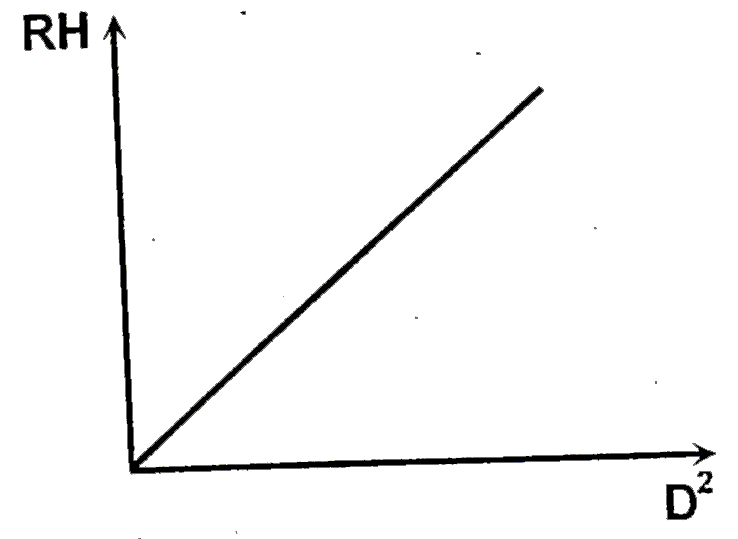
A semicircular wire of radius R is oriented vertically. A small bead is released from rest from the top of the wire. It slides withoutfriction under the influence of gravity to the bottom, where it then leaves the wire horizontally and falls distance H to the ground. The bead lands a horizontal distance D away from where it was launched. Which of the following is correct graph of RH vetsus D^(2)? |
|
Answer»
|
|
| 32. |
If an artificial satellite with metal surface is moving in the equatorial plane of earth , then the e.m.f. induced in it due to earth's magnetism will be __ |
|
Answer» NEGATIVE and base towards earth |
|
| 33. |
Calculate the magnitude of force between two like charges each of magnitude 4C seperated by distance 3 m. |
|
Answer» |
|
| 34. |
A block of wood of mass 0.5kg is placed on plane making angle 30^(@) with the horizontal.If the coefficient of friction between the surface of contact of the body and the plane is 0.2, the force required to keep the body sliding down with uniform velocity is |
|
Answer» 6.4 N |
|
| 35. |
The fringes are ___ in young's double slit experiment. |
| Answer» SOLUTION :Equispaced | |
| 36. |
To obtain the point of destructive interference due to two identical light waves, two light waves should differ in phase by…radium. |
| Answer» ANSWER :A | |
| 37. |
A piece of Ice floats in a vessel with water above which a layer of lighter oil is poured. When ice melts 1. The level of oil water interface falls , 2. The level of oil water interface rises 3. The thickness of oil layer decreases ,4. The thickness of oil layer remain same 5. The thickness of oil layer increases , 6. The level of oil-air interface falls 7. The level of oil-air interface remains same , 8. The level of oil-air interface rises Select the correct alternatives : |
|
Answer» Only 4 & 7 are CORRECT `rArr (h_(2)-H'_(2))` A =Some volume of ice gt0 `rArr h_(2) gt h'_(1)` `:.` Statement3 correct PRESSURE at bottom in fig. (a) is given by `rArr P_(0)+rho_(oil) h_(2)g +rho_("water")h_(1)g` `:. (P_(0)+rho_(oil)h_(2)g+rho_("water")h_(1)g)A=P_(0)A+W_(oil) +W_("water")+W_("Ice")(i)` similarly from fig. (b) `(P_(0)+rho_(oil)h'_(2)g+rho_("water")h'_(2)g+rho_("water") h'_(1)g)A=P_(0)A+W_(oil) +W_("water")+W_(Ice) (ii)` `rho_(oil)(h_(2)-h'_(2))+rho_("water") h'_(1)=rho_("oil")h_(2)+rho_("water")h_(1)` `rArr rho_("oil") (h_(2)-h'_(2))=rho_("water")(h'_(1)-h_(1))` `rArr h'_(1)-h_(1)=(rho_(oil))/(rho_("water"))(h_(2)-h'_(2)) gt 0` `:.` Statement 2 is correct. Now fall in level `=|h_(2)-h'_(2)|` and rise in level `=|h'_(1)-h_(1)|` `=(rho_(oil))/(rho_("water"))(h_(2)-h'_(2)) LT h_(2)-h'_(2)` `rArr ` Fall is more Statement b is correct |
|
| 38. |
A reactor is developing nuclear energy at a rate of 32,000 kilowatt. How many kg of U^235 undergo fission per second? How many kg of U^235 would be used up in 1000 hour of operation? Assume an average energy of 200 MeV released per fission? Take Avogadro.s number as 6 xx 10^23and 1 MeV =1.6xx10^(-13) joule |
|
Answer» Solution :Power developed by reactor = 32,000 kilowatt `=3.2xx10^7` watt `THEREFORE` Energy released by reactor per sec = `3.2xx10^7` joule `=(3.2xx10^7)/(1.6xx10^(-13))` MeV= `2xx10^20` MeV Number of FISSIONS occurring in the reactor per second `=(2xx10^20)/200=10^18` (`because` Energy released per fission = 200 MeV) The number of ATOMS of `U^235` CONSUMED in 1000 hour `=10^18xx(1000xx3600)=36xx10^23` Now mass of `U^235` consumed in 1000 hour `=(36xx10^23)/(6xx10^23)xx235`=1410 gm = 1.41 kg. |
|
| 39. |
Three capacitors each of capacitance C and of breakdown voltage V are joined in series. The capacitance and breakdown voltage of the combination will be : |
|
Answer» 3C,3V |
|
| 40. |
A : The directionof a light is always perpendicular to wavefront R : A ray of light is a line perpendicular to a wavefront in the direction of propagation. |
|
Answer» Both A and R are TRUE and R is the CORRECT explanation of A |
|
| 41. |
Which of the following substances are diamagnetic ? Bi , Al , Na , Cu , Ca and Ni |
| Answer» SOLUTION :Out of the given substances only Bi and CA are DIAMAGNETIC. | |
| 42. |
(a) An AC source of voltage V = V_(0) sin omegat is connected across a series combination of an inductor a capacitor and a resistor . Use the phasor diagram to obtain the expression for the impedance of the circuit and phase angle between the voltage and the current. (b) A capacitor of unknown capacitance a resistor of 100 Omega and an inductor of self - inductance L = (4 //pi^(2)) henry are in series connected to an AC source of 200 V and 50 Hz . Calculate the value of the capacitance and the current that flows in the circuit when the current is in phase with the voltage . |
|
Answer» Solution :(b)R =100 `Omega` L = `(4)/(pi^(2)) , f = 50 `Hz, `epsilon = 200` V the circuit is in PHASE with voltage. Therefore, `X_(L) = X_(C)`,Z = R ` 2 pi f L = (1)/(2 pi f C)` C = `(1)/(4 pi^(2) f^(2) L) = (1 xx (3.14)^(2))/(4 (3.14)^(2)(50)^(2) xx 4) = 25 mu` F `I_(rms) = (epsilon_(rms))/(R) = (200)/(100) = 2 A ` |
|
| 43. |
The radius of the hydrogen atom in its ground state is a_(0). The radius of a muonic hydrogen atom in which the electron is replaced by an identically charged muon with mass 207 times that of an electron, is a_(mu) equal to |
|
Answer» 207 `a_(0)` |
|
| 44. |
The resistance of a wire is 10^(-6)Omega per metre. It is bend in the form of a circle of diameter m 2 . A wire of the same material is connected across its diameter. The total resistance across its diameter AB will be |
|
Answer» `(4)/(3)PI xx 10^(-6)OMEGA` |
|
| 45. |
A charged particle P has a mass of 10^(-16)kg and carries a charge of 4.9 xx 10^(-19)C. Calculate the intensity of the electric field to be applied on it in vertically upward direction, so as to keep it at rest. |
|
Answer» |
|
| 46. |
-10 mu C, 40mu C and q are the charges on three identical spherical conductors P, Q and R respectively. Now P and Q attract each other with a force F when they are separated by a distance d. Now P and Q are made in contact with each other and then separated. Again and R are touched and they are separated by a distance 'd'. The repulsive force between Q and R is 4F. Then the charge q is |
| Answer» Answer :D | |
| 47. |
The maximum wavelength of Lyman series is .... |
|
Answer» `(4xx1.097xx10^(7))/(3)m` `(1)/(lambda)=R[(1)/(1^(2))-(1)/(n^(2))]` but for MAXIMUM wavelength n=2 `:. lambda_(1)/(lambda_(max))=1.097xx10^(7)[(1)/(1)-(1)/(2^(2))]` `:. lambda_(1)/(lambda_(max))=1.097xx10^(7)[1-(1)/(2^(2))]` `:. lambda_(1)/(lambda_(max))=(3)/(4)xx1.097xx10^(7)m^(-1)` `:. lambda_(max)=(4)/(3xx1.097xx10^(7))` |
|
| 48. |
A galvanometer of resistance G Omega can be converted into a voltmeter of range 0 - V volts by connecting a resistance R Omega in series with it. How much resistance will be required to change its range to 0 - V/2 volts ? |
|
Answer» |
|
| 49. |
In the circuit shown in fig. E_(1)=3V, E_(2)= 2V, E_(3)= 1V, R=r_(1)=r_(2)=r_(3)= 1 ohm. Find the potential difference between the points A and B and the currents through each branch. |
|
Answer» `2V, I_(1)=I_(2)=I_(3)=0` |
|
| 50. |
The electric dipole moment of an electron and proton 4.3 nm apart is |
|
Answer» `6.88xx10 ^(-28) Cm` ` therefore ` Dipole MOMENT ` p=1.6 xx10 ^(-19) xx 4.3 xx10 ^(-9)C m =6.88 xx10 ^(-28) C m. ` |
|