

Saved Bookmarks
This section includes 7 InterviewSolutions, each offering curated multiple-choice questions to sharpen your Current Affairs knowledge and support exam preparation. Choose a topic below to get started.
| 1. |
Assuming an electron is confined to a 1nm wide region,find the uncertainty in momentum using Heisenberg Uncertainty principle .You can assume the uncertainty in position Deltax as 1 nm.Assuming p~~Deltap, find th energy of the electron in electron volts. |
|
Answer» SOLUTION :According to Heisenberg.s uncertainty principle, `(Deltax)(Deltap)~~H` `therefore (Deltax)(Deltap)~~(h)/(2PI)` `therefore Deltap~~(h)/(2piDeltax)` `therefore Deltap=(6.625xx10^(-34))/(2xx3.14xx1xx10^(-9))` `therefore Deltap=1.055xx10^(-25)NS` From the statement ,we have `Deltap`=p and so p=`1.055xx10^(-25)Ns` Energy of GIVEN electron, `E=(p^(2))/(2m)` `therefore =((1.055xx10^(-25))^(2))/(2xx9.1xx10^(-31))` `therefore E=(1.113xx10^(-50))/(18.2xx10^(-31))` `therefore E=6.115xx10^(-21)J` `therefore E=(6.115xx10^(-21))/(1.6xx10^(-19))eV` `therefore E=3.822xx10^(-2)eV` |
|
| 2. |
Consider a metal exposed to light of wavelength 600 nm. The maximum energy of the electron doubles when light of wavelength 400 nm is used . The work function in eV is: |
|
Answer» 1.50 E V |
|
| 3. |
A radioactive substance has 6.0 xx 10^18 active nuclei initially. What time is required for the active nuclei o the same substance to become 1.0 xx 10^18 if its half-life is 40 s. |
|
Answer» SOLUTION :The NUMBER of active NUCLEI at any instant of time t, `N_0/N=e^(lambdat)` `log_e (N_0/N)=lambdat` `therefore t=(log_e (N_0/N))/lambda=(2.303 log_10 (N_0/N))/lambda` In this PROBLEM , the initial number of active nuclei, `N_0=6.0xx10^18` `N=1.0xx10^18`, T=40 s `lambda=0.693/T=0.693/40=1.733xx10^(-2) s^(-1)` `t=(2.303 log_10 ((6.0xx10^18)/(1.0xx10^18)))/(1.733xx10^(-2)` `=(2.303 log_10 (6))/(1.733xx10^(-2))=(2.303xx0.7782)/(1.733xx10^(-2))`=103.4s |
|
| 4. |
When the minimum wavelength of X-rays is 2Å then the applied potential difference between cathode and anticathode will be |
|
Answer» 6.2 kV |
|
| 5. |
A particle executing sim ple harn1oni c motion has amplitude of I metre and time period 4 second. At t = 0. x = 5 going towards positive x direction. Then the equation for tl1e displacement x at rime t |
|
Answer» `x=10sin((PIT)/2+pi/6)CM` |
|
| 6. |
Which of the following shows a reverse biased p-n junction diode ? |
|
Answer»
|
|
| 7. |
Resistance of a material at 10^(@)C and 40^(@)C are 45Omega and 85Omega respectively. Find its temperature co-efficient of resistance |
|
Answer» Solution :`T_(0)=10^(@)C , T=40^(@)C, R_(0)=45Omega, R=85Omega` `ALPHA=(1)/(R_(0))(DELTAR)/(DeltaT)` `alpha=(1)/(45)((85-45)/(40-10))=(1)/(45)((40)/(30))` `alpha=0.0296 "PER"^(@)C` |
|
| 8. |
What do you mean by doping ? |
| Answer» Solution :The process of adding IMPURITIES to the INTRINSIC semiconductor is CALLED DOPING. | |
| 9. |
Fig. 6.50 shows a rectangular conducting loop PQRS in which the arm PQ is free to move. A uniform magnetic field acts in the direction perpendicular to the plane of the loop. Arm PQ is moved with a velocity v towards the arm RS. Assuming that the arms QR, RS and SP have negligible resistances and the moving arm PQ has the resistance r, obtain the expression for the current in the loop (ii) the force and (iii) the power required move the arm PQ. |
|
Answer» SOLUTION :LET in a rectangular loop PQRS placed in a uniform magnetic field B, the arm PQ be moving, as shown in Fig. 6.51 with a constant velocity .v.. Then in time `Deltat`, the arm PQ will move through a small distance `Deltar = v.Deltat` and consequently the area enclosed by the loop decreases by `DeltAA = area PQRS - area P.Q. RS` `= Deltax.l = (vDeltat)`, where l is the length of arm PQ. `therefore` decrease in magnetic flux of loop `Deltaphi_(B) = BDeltaA = B(vDeltat)l` `therefore` Induced emf in the rectangular loop `|varepsilon|= (Deltaphi_(B))/(Deltat) = (B(v Deltat)t)/(Deltat) = Blv`  As arms OR, RS and SP have no resistance and moving arm PQ has the resistance .R., hence (i) induced CURRENT in the loop `I = varepsilon/r = (Blv)/r` (II) Force required to move the arm `PQ, F = BIl = B ((Blv)/r)l = (B^(2)l^(2)v)/r` (iii) Power required to move the arm `PQ, P = Fv = (B^(2)l^(2)v^(2))/r` |
|
| 10. |
A full wave rectifier circuit along with the input and output voltages is shown in the figure The contribution to output voltage from diode– 2 is |
|
Answer» A,C |
|
| 11. |
Fig. 6.24 shows a bar magnet M falling under gravity through an air cored coil C. Plot a graph Induced showing variation of induced emf (E) with time (t). What does the area enclosed by the E-t curve depict ? |
|
Answer» Solution :The graph showing variation of induced EMF (E) with TIME (f) is in adjacent Fig. 6.25. The area enclosed by the E-curve depicts the total change in MAGNETIC FLUX linked with the coil during that time. 
|
|
| 12. |
A series combination of an inductor (L), capacitor (C) and a resistor (R) is connected across an ac source of emf of peak value E_(0) and angular frequency (omega). Plot a graph to show variation of impedance of the circuit with angular frequency (omega). |
Answer» SOLUTION :Variation of impedance (Z) with angular frequency `(OMEGA)` is PLOTTED here. 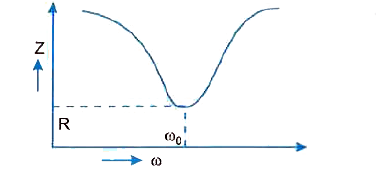
|
|
| 13. |
A solid cylinder of mass M and radius R rolls without slipping down an inclined plane of length L and height h. What is the speed of its centre of mass when the cylinder reaches its bottom ? |
|
Answer» `SQRT(2gh)` K.E. of centre of mass when reached at bottom `=1/2Mv^(2)+1/2Iomega^(2)=1/2Mv^(2)+1/2Mk^(2)v^(2)//R^(2)` `=1/2Mv^(2)(1+(k^(2))/(R^(2)))` For a solid cylinder, `(k^(2))/(R^(2))=1/2therefore` K.E.`=3/4Mv^(2)` `thereforeMgh=3/4Mv^(2)rArrv=sqrt(4/3gh)` |
|
| 14. |
A cockroach of mass m lies on the rim of a uniform disk of mass 4.00 m that can rotate freely about its center like a merry-goround. Initially the cockroach and disk rotate together with an angular velocity of 0.320 rad/s. Then the cockroach walks halfway to the center of the disk. (a) What then is the angular velocity of the cockroach-disk system? (b) What is the ratio K//K_(0) of the new kinetic energy of the system to its initial kinetic energy? ( c) What accounts for the change in the kinetic energy? |
| Answer» Solution :(a) 0.427 rad/s, (B) 1.33, ( c) The COCKROACH does positive work while walking toward the center of the disk, increasing the total kinetic ENERGY of the system. | |
| 15. |
The inverse sequare law in electrostaticis |F| = (e^(2))/((4piepsi_(0))r^(2))for the force between an electron and a proton. The (1/r) dependenceof |F| can be understood in quantum theo ry as being due to the factthat the particle of light (photon) is massless. Ifphotonshad a mass m_(p), force would bemodifiedto |F| = (e^(2))/((4piepsi_(0))pi^(2)) [ (1)/(r^(2)) + (lambda)/(r)] .exp(-lambdar) where lambda = (m_(p)c)/(h) and h = (h)/(2pi). Estimate the change in the gound state energy of a H-atom if m_(p)were 10^(-6) times the mass of the electron. |
|
Answer» `18.6lambdar_(B)` `=(10^(-6)[0.51](1.6xx10^(-13)J))/((1.5xx10^(-34) Js)(3xx10^8 ms^(-1))` `=0.26xx10^7 m^(-1) " " [because m_e c^2=0.51 MeV]` `r_B` (Bohr's radius ) =0.51Å=`0.51xx10^(-10)m` or `lambdar_B=(0.26xx10^7 m^(-1))(0.51xx10^(-10))=0.14xx10^(-3) " lt lt " 1` Further , as |F|=`(e^2/(4piepsilon_0))[1/R^2+lambda/r]e^(-lambdar)`...(i) and `|F|=(dU)/(dr), U_r=int|F|dr=(e^2/(4piepsilon_0))int ((lambdae^(-lambdar))/r+e^(-lambdar)/r^2) dr` If `z=e^(-lambdar)/r=1/r(e^(-lambdar)),(dz)/(dr)=[1/r(e^(-lambdar))(-lambda)+(e^(-lambdar))(-1/r^2)]` or `dz=-[(lambdae^(-lambdar))/r+e^(-lambdar)/r^2]dr` Thus `int((lambdae^(-lambdar))/r+e^(-lambdar)/r^2)drimplies - intdz=- z=-e^(-lambdar)/r` `=-(e^2/(4piepsilon_0))(e^(-lambdar)/r)`...(ii) We know that, `mvr=ħimplies v=ħ/(MR)`, and `(mv^2)/r=F=(e^2/(4piepsilon_0))(1/r^2+lambda/r)` [PUTTING `e^(-lambdar~~` 1 in eqn.(i)] Thus , `(m/r)(ħ^2/(m^2r^2))=(e^2/(4piepsilon_0))(1/r^2+lambda/r)` or `ħ^2/m=(e^2/(4piepsilon_0))(r^2+lambda/r)` When `lambda=0` , `r=r_B` and `ħ^2/m=(e^2/(4piepsilon_0))r_B` ...(iv)From EQNS. (iii) and (iv) , `r_B=r+lambdar^2` Let `r=r_B=delta` so that form (iii) `r_B=(r_B+delta)+lambda(r_B^2+delta^2+2deltar_B)` or `0=lambdar_B^2+delta(1+2lambdar_B)` (neglecting `delta^2`) or `delta=-(lambdar_B^2)/((1+2lambdar_B))=(-lambdar_B^2)(1+2lambdar_B)^(-1)` `=(-lambdar_B^2)(1-2lambdar_B)=-lambdar_B^2 " " (because lambdar_B lt lt 1)` From eqn. (ii) `U_r=-(e^2/(4piepsilon_0))(e^(-lambda(r_B+delta)))/((r_B+delta))` `=-(e^2/(4piepsilon_0)1/r_B)(1-delta/r_B)(1-lambdar_B)~~ - e^2/(4piepsilon_0r_B)=-27.2 eV` `[because e^(-lambda(r_B+delta))~~1-lambda(r_B+delta)=1-lambdar_B-lambdadelta~~1-deltar_B]` and `1/((r_B+delta))=1/(r_B(1+delta//r_B))=1/r_B(1+delta/r_B)^(-1) =1/r_B(1-delta/r_B)` Further, KE of the electron, `K=1/2mv^2=1/2m(ħ^2/(m^2r^2))` `=ħ^2/(2mr^2)=ħ^2/(2m(r_B+delta)^2)=ħ^2/(2mr_B^2+(1+delta//r_B)^2)` `=(ħ^2/(2mr_B^2))(1+delta/r_B)^(-2)=(ħ^2/(2mr_B^2))(1-(2delta)/r_B)` `=(13.6)(1+2lambdar_B)eV` (as `ħ^2/(2mr_B^2)=13.6 eV and delta=-lambdar_B^2`) Total ENERGY of H-atom in the ground state =final energy - initial energy `=(-.^13.6+27.2lambdar_B)eV-(-13.6 eV)=(27.2 lambdar_B)eV` |
|
| 16. |
Statement-1 : The ionising power of beta- particles is less compared alpha- particles but their penetraing power is more because Statement -2 , The mass of beta- particles is les than the mass of alpha-particle. |
|
Answer» Statement -1 is True, statement -2 is True, Statement -2 is a correct EXPLANATION for Statement -1. |
|
| 17. |
A fly F is sitting an aglass S 45 cm thick & of refractive index 3//2. The slab covers the top of a container C containing water (R.I.4//3) upto a height of 20 cm. Bottom of container is closed by a concave mirror M fo radius of curvature 40 cm. Lacate the final image formed by all refractions & reflection assuming paraxial rays. |
|
Answer» `(mu_(2))/(V)-(mu_(1))/(u)=(mu_(2)-mu_(1))/(R)` `(4)/(3v)-((3)/(2))/((-45))=0 (therefore R =infty) , therefore v=-40 cm` For reflection from mirror, `u=-(20 + 40) cm =- 60 cm. , f=-20 cm` `therefore (1)/(v)=(1)/(f)-(1)/(u)` gives `v=-30 cm` Again, for refraction from surface `-2` `u=30 - 20 =10 cm`. `(mu_(2))/(v)-(mu_(1))/(u)=(mu_(2)-mu_(1))/(R)` gives `(mu_(s))/(v)-(mu_(W))/(u)=(mu_(s)-mu_(w))/(R)` `(3)/(2v)-(4)/(3xx(+10))=0 , v=(45)/(4) cm` For refraction from surface `-1` `u=(45-(45)/(4))cm=(3xx45)/(4)` `(mu_(a))/(v)-(mu_(s))/(u)=0`. (thereforeR=infty) `therefore v=(-45)/(2)=-22.5 cm` Hence, iamge is FORMED `22.5 cm` below surface `1` 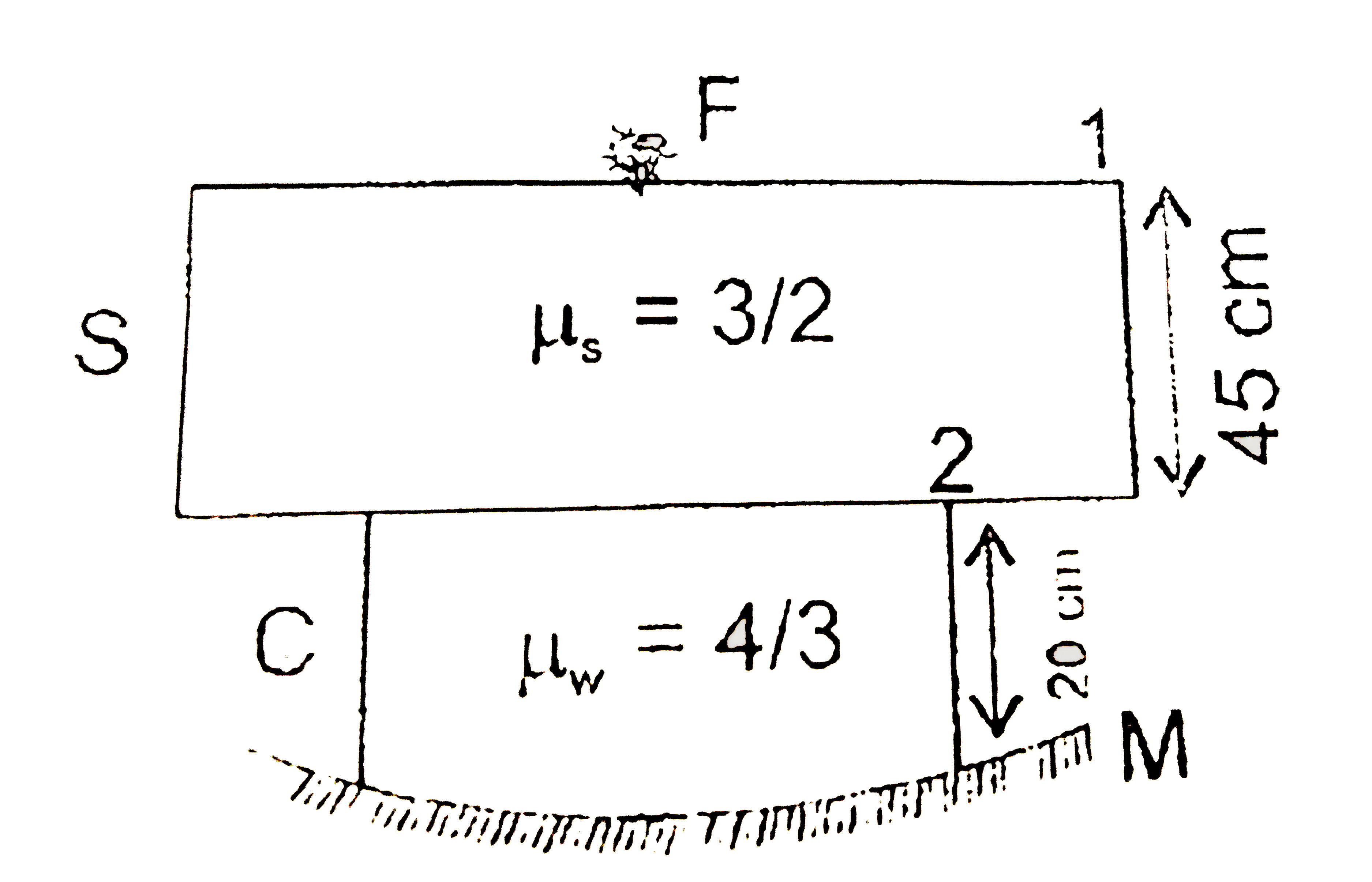
|
|
| 18. |
Two electric charges of 9 muC and -3 muC are placed 0.16 m apart in air. There will be a point P at which electric potential is zero on the line joining two charges and in between them. The distance of P from 9 muC is |
|
Answer» 0.14 m |
|
| 19. |
The self inductance of a choke coil is 10mH. When it is connected witrh a10V dc sourceloss of power is 10watt. The frequency of a csource will be: |
|
Answer» 50Hz |
|
| 20. |
Assertion:Binding energy per nucleon is nearlyconstant for element in the range A=30 to A=170 . Reason : The nuclear force between twonucleons falls rapidly to zero as their distance is more than a few femtometres. |
|
Answer» If both assertion and REASON are true and reason is the correct explanation of assertion . |
|
| 21. |
(a) Draw a labelled diagramof a step-up transformer.Obtain theratio of secondaryto primaryvoltage in terms of number of turns and currents in the two coils. (b) A power transmission line feeds inputpowerat 2200 V toa step-down transformerwith its primary windings having 3000 turns. Find the number of turns in the secondary to get thepower output at 220 V. |
Answer» Solution :Labelled diagram of a STEP up TRANSFORMER Deriveation of ratio of seconary and primary VOLTAGE.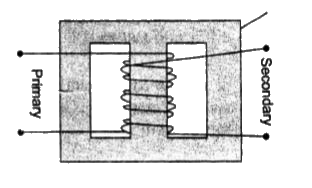
|
|
| 22. |
Water is flowing in a non viscous tube as shown in the diagram. The diametre at a point A and B are 0.5m and 0.1m respectively. The pressure difference between points A & B are triangleP=0.8 then find out the rate of flow: |
|
Answer» `P_(1)-P_(2)=+(1)/(2)rho(V_(1)^(2)-V_(1)^(2))` `P_(1)-P_(2)=rho[(Q^(2))/(A_(2)^(2))-(Q^(2))/(A_(1)^(2))]` `2(P_(1)-P_(2))=rho[(A_(1)^(2)-A_(2)^(2))/(A_(1)^(2)A_(2)^(2))]Q^2` `Q=A_(1)A_(2) SQRT((2(P_(1)-P_(2)))/(rho(A_1^2-A_2^2)))` |
|
| 23. |
A drum of mass m_(1) and radius r_(1) rotates freely with initially angular velocity omega_(0). A second drum with mass m_(2) and radius r_(2)(r_(2)gtr_(1)) is mounted on same axle and is at rest although it is free to rotate. A thin layer of sand with mass m is distributed on iner surface of smaller drum. At t=0 small perforations in the inner drum are opened. The sand starts to fly out at a consant rate lamdakg//sec and sticks to the outer drum. Ignore the transit time of the sand. Choose the corect alternatives. |
|
Answer» Angular speed of outer DRUM at time is `(lamda t omega_(0))/(m_(2)+lamdat)((r_(1))/(r_(2)))^(2)`  As the sand leaves the inner drum through the OPEN holes, it does not exert any force of the drum, angular MOMENTUM remains conserved. At time `t`, `m_(1)r_(1)^(2)omega_(0)=(m_(1)-lamdat)r_(1)^(2)omega_(0)+(m_(2)+lamdat)r_(2)^(2) omega_(2)` `omega_(2)-(lamdat r_(1)^(2)omega_(0))` `((m_(2)+lamdat)r_(2)^(2))` The speed of inner drum does not change. |
|
| 24. |
Answer the following questions : (a) Optical and radio telescopes are built on the ground while X-ray astronomy is possible only from satellites orbiting the Earth. Why ? (b) The small ozone layer on top of the stratosphere is crucial for human survival. Why ? |
|
Answer» Solution :(a) SINCE, the transmission of signals using ground waves restricted upto a frequency of 1500 Hz to save the loss of energy. (b) The ultraviolet RADIATIONS from the sun is harmful to the living cells and plants. The ozone LAYER absorbs ultraviolet radiation and prevents it from reaching the earth. It ALSO keeps the earth warm by trapping infra-red radiations. |
|
| 25. |
विधयुत फ्लक्स का मात्रक hai |
|
Answer» न्यूटन/कूलम |
|
| 26. |
Out of the two characteristics, the mass number (A) and the atomic number (Z) of a nucleus, which one does not change during nuclear beta-decay? |
| Answer» Solution :The mass NUMBER A does not change during NUCLEAR `BETA`-DECAY. | |
| 27. |
In pair annhilation, an electron and a positron destroy each other to produce gamma radiation. How is the momentum conserved? |
| Answer» Solution :When an electron annhilates a position, two `gamma`-rays photon are produced, which move in OPPOSITE DIRECTIONS. This leads to conservation of linear momentum. `._(0)e^(-1)+._(0)e^(1) to 2gamma` RAY photons | |
| 28. |
A basic communication system consists of A) transinitter B) information source C) user of information D) channel E) receiver Choose the correct sequence in which these are arranged in a basic communication system |
|
Answer» ABCDE |
|
| 29. |
Which of the following has minimum wavelength ? |
|
Answer» X-RAYS |
|
| 30. |
An athlete peddles a stationary tricycle whose pedals are attached to a coil having 100 turns age of area 0.1 m^(2). The coil, line in the X-Y plane is rotated in this plane at the rate of 50 rpm about the Y-axis in a region where a uniform magnetic field vec(B) = (0.01) k, tesla is present. Find the (i) maximumemf (ii)average emf generated in the call over one complete revolution. |
|
Answer» Solution :(i) The maximum EMF `.epsilon.` generated in the coil is, `epsilon = NBC omega` `= NBA 2pi f` `(because 50 rpm = (50)/(60) = (5)/(6)` revolution per sec) `= [100 XX 0.01 xx 0.1 xx 2pi ((5))/(6)]` `= (pi)/(6) = 0.52 V` The average rmf generated in the coil over one COMPLETE revolution = 0 |
|
| 31. |
Energy or workdone is stored in an inductor as |
|
Answer» ELECTRICAL energy |
|
| 32. |
A bullet is fired from gun. The force on bullet is, F = 600 -2 xx 10^(5) t newton. The force reduces to zero just when bullet leaves barrel. Find the impulse imparted to bullet |
|
Answer» Solution :`F = 600 -2 xx 10^(5)`t F BECOMES zero as soon as the bullet leaves the BARREL, `0=600 - 2 xx 10^(5), t, 600 = 2 xx 10^(5)`t `t = 3 xx 10^(-3) s` Impulse `=int_(0)^(t)Fdt` `=int_(0)^(t)(600-2 xx 10^(5)t)dt = [600t -2 xx 10^(5) t^(2)/2]^(3 xx 10^(-3))` `=0.9 Ns` |
|
| 33. |
A cylindrical rod is having temperature T_(1) and T_(2) at its ends. The rate of flow of heat is Q_(1) cal/s. If all the linear dimensions are doubled keeping temperatures constant, the rate of flow of heat Q_(2) will be : |
|
Answer» `4Q_(1)` When all dimensions are DOUBLED then `(dQ)/(dt)` BECOMES two TIMES i.e. `2Q_(1)` Correct choice is (c ). |
|
| 34. |
Figures shows a parallel LCR circuit connected to a 200V, AC source. L=5H, C=80muF and R=40Omega. At resonance let I_(1) and i_(2) be the rs currents through L,C and R. Then |
|
Answer» `i_(1)=i_(2) and i_(1)gti_(2)` |
|
| 35. |
Embryo sac is monosporic when it develops from |
|
Answer» One of the FOUR megaspores of a MEGASPORE mother CELL |
|
| 36. |
When photon of v frequency os incident on photo sensitive surface withV_(0) threshold frequency,maximum kinetic energy of photo-electron emitted will be…. |
|
Answer» `h(v-v_(0))` Maximum KINETIC energy =`h(v-v_(0))` |
|
| 37. |
Use this graph to explain the release of energy in both the processes of nuclear fusion and fission |
|
Answer» Solution :Mass of NUCLEUS (M)=mass of its nucleons -bindingenergy (B) So, M decreases with increase in B. Now , we consider nuclear FISSION : `1 to 2+ 3`. From mass-energyequivalence , `M_1=M_2+M_3` + energy release (Q) or , `Q=M_1-M_2-M_3` Clearly , Q is positive , i.e., energy is actually released if `M_1 gt M_2+ M_3 `, i.e., `B_1 lt B_2 + B_3` or `A_1e_1 lt A_2e_2 + A_3e_3` where `A_1,A_2,A_3` are mass numbers `(A_1=A_2+A_3)`and `e_1, e_2 , e_3` are bindingenergy per nucleon. From the plot, we see that this condition is satisfied for high `A_1`, where both `e_2` and `e_3` are higher than `e_1` of the large nucleus1. `therefore` Fission of a large nucleus releases energy . On the other hand , for low A nuclei , `e_2`and `e_3` will be less than `e_1` of the larger nucleus 1. So, energy will be released rather in the opposite process : 2 + 3 `to` 1 . Therefore , FUSION of small nuclei releases energy . |
|
| 38. |
In a hydrogen like atom electron makes transition from an energy level with quantum number n to another with quantum number (n - 1). If n gt gt 1, the frequency of radiation emitted is proportional to : |
|
Answer» `1/N^(2)` `v=(triangleE)/(h) k[(1)/((n-1)^(2))-(1)/(n^(2))] =(k2n)/(n^(2)(n-1)^(2))` `=(2K)/(n^(3)) ALPHA 1/n^(3)` |
|
| 39. |
Two block of masses m and 2m are kept on a smooth inclined plane and the system is pushed using force 3mg as shown. Find the contact force between those two blocks |
|
Answer» |
|
| 40. |
Highly energetic electrons are bombarded on target of an element containing 30 neutrons. The ratio of radii of nucleus to that of helium nucleus is (14)^(1/3). The atomic number of nucleus will be : |
|
Answer» 25 |
|
| 41. |
What is capacitance of a capacitor ? |
|
Answer» |
|
| 42. |
One mole of an ideal diatomic gas at initial pressure P_(0) temperature T_(1) and Volume V_(1) expands according to PV^(x)= constant. Column I: gives value of n. Column II: given information about the given process Column III, gives value of slope of PV curve. Pick correct combination |
|
Answer» (I)(ii)(S) |
|
| 43. |
Surface tension in a liquid is due to |
|
Answer» ADHESIVE FORCE between the molecules |
|
| 44. |
Find the (a) maximum frequency, and (b) minimum wavelength of X-rays produced by 30 kv electrons. |
|
Answer» SOLUTION :(a) `7.24xx10^(18)HZ` (B) `0.041nm` |
|
| 45. |
When is the parallel combination of cells advantageous and why? |
|
Answer» Solution :Parallel combination is ADVANTAGEOUS when more current is to be drawn at low potential from a circuit. In parallel combination of CELLS , `I = (epsi)/(R+(r//N))` If `R lt lt r`, then `i= (n epsi//R)` that means, if external RESISTANCE is very small, current drawn is .n. times that of a single cell. |
|
| 46. |
In an astronomical telescope in normal adjustment a straight black line of length L is drawn on inside part of objective lens. The eye-piece forms a real image of this line. The length of this image is I. The magnification of the telescope is : |
|
Answer» `L/I`  MAGNIFICATION of TELESCOPE, m = `(f_o)/(f_e)` But, magnification m = `-("HEIGHT of image")/("height of OBJECT")` `v/u=-1/L` `therefore (f_e)/(f_e-(f_o+f_e))=-I/L` `therefore (f_e)/(-f_o)=-I/L` `(f_o)/(f_e)=L/T` `therefore` magnification `m=L/I` |
|
| 47. |
A beam of light consisting of two wavelengths 6500A^(0)" and "5200A^(0) is used to obtain interference fringes in a Young.s double slit experiment. What is the least distance from the central maximum where the bright fringes due to both the wavelengths coincide? Distance between the slits is 2mm, distance between the slits and the screen L= 120 cm. |
|
Answer» Solution :LET the nth bright fringe of wavelength `lambda_(m)` coincide at a distance y from the central maximum then `y= (m lambda_(m)L)/(d)= (n lambda_(n)L)/(d)""therefore (m)/(n)= (lambda_n)/(lambda_m)= (6500)/(5200)= (5)/(4)` i.e., 5th bright fringe of wavelength `5200A^(0)` COINCIDES with the 4th bright fringe of wavelength `6500A^(0)` `therefore y_(m)= (m lambda_(m) L)/(d)= (5(5200xx 10^(-10))xx 1.20)/(2xx 10^(-3))= 1.56 mm`. |
|
| 48. |
An object 'O' is placed in front of a small plane mirror M_1 and a large convex mirror M_2 of focallength 'f'. The distanace between 'O' and M_1 is x and the distance between M_1 and M_2 is y. The images of 'O' formed by M_1 and M_2 coincide. The magnitude of 'f is |
|
Answer» `X - y` |
|
| 49. |
Suppose while sitting in a parked car, you notice a jogger approaching towards you in the side view mirror of R = 2 m. If the jogger is running at a speed of 5 ms^(-1) , how fast the image of the jogger appear to move when the jogger is (a) 39 m, (b) 29 m, (c) 19 m, and (d) 9 m away. |
|
Answer» Solution :`rArr` Side mirror of car is convex and as per mirror equaton, `1/F = 1/U + 1/v` `therefore 1/v = 1/f - 1/u = (u-f)/(fu)` `therefore v = (fu)/(u-f)` and radius of curvature R = 2 cm hence focal lenght f =1 m Constant SPEED of person `v = 5 ms^(-1)` (toward car) Distance covered by person toward mirror `=vt` `= 5 xx 1` `= 5m` (a) Image distance for `u _1 = -39m, ` `v_1 = (fu_1)/(u_1 - f) = ((1)(-39))/((-39)-1) = 39/40 m ` distance of person from mmirror after 1 s, `u_2 =- 39 + 5 =- 34 m` `therefore` Image distance after 1s, `u_2 = - 39+ 5 = - 34m ` `therefore` Image distance after 1 s, `therefore v_2 = (fu_2)/(u_2-f) = ((1)(-34))/(-34 - 1) = (34)/(35) m` `thereforev_2 = (fu_2)/(u_2 - f) = ((1)(-34))/(-34-1) = (34)/(35) m` `therefore` Speed of image after 1 s, ` = (v_1 -v_2)/(t)` `= (39/40 - 34/35)/(1) = (1365 - 1360)/(1400)` `= (5)/(1400) = (1)/(280) ms^(-1)` (b) For `mu_1 = -29 m` `v_1 = (fu_1)/(u_1 -f) = ((1)(-29))/(-29-1) = (29)/(30) m ` distance of person from car after 1 s, `u_2 = -29 + 5 = -24 m` `therefore` Image distance after 1 s, `v_2 = (fu_2)/(u_2 - f) = ((1)(-24))/(-24-1) = (24)/(25) m ` `rArr` Speed of imageaftr1 s `= (v_1 - v_2)/(t)` ` = (29/30 - 24/25)/(1)` `= (725 - 720)/(750)` `= (5)/(750) = (1)/(150) ms^(-1)` (C)For `u_1 = -19 m` `v_1 = (fu_1)/(u_1 - f) = ((1)(-19))/(-19-1) = (19)/(20) m ` distance of person from car after 1 s, `u_2 = -19 + u=-14m` Image distance after 1 s, `v_2 = (fu_2)/(u_2 - f) = ((1)(-14))/(-14-1) = 14/15 m ` Speed of image after 1 s, ` = In (v_1 - v_2)/(t) , t = 1s ` ` = v_1 - v_2` `= (19)/(20) - (14)/(15) = (285-280)/(300) = (5)/(300)` `= (1)/(60)ms^(-1)` For `u_1 = -9M` `v_1 = (fu_1)/(u_1-f) = ((1)(-9))/(-9-1) = (9)/(10) m ` distance of person from car after 1 s, `u_2 = -9 +_ 5 = -4m` Speed of image after1 s, `v_2 = (fu_2)/(u_2 - f) = ((1)(-4))/(-4-1) = 4/5 m ` speed of image after 1 s, `= In (v_1-v_2)/(t) , t= 1 s ` `v_1 -v_2` `= 9/10 - 4/5 = (9-8)/(10) = 1/10 ms^(-1)` Here, person is moving with constant speed but it seems that its speed increasing while he comes nearer This can be experienced by person in car at rest or in moving bus This can be experienced in any moving vehicle . |
|
| 50. |
Suppose while sitting in a parked car, you notice a jogger approaching towards you in the side view mirror of R = 2 m. If the jogger is running at a speed of 5 ms^(-1), how fast the image of the jogger appear to move when the jogger is (a) 49 m, (b) 59 m away. |
| Answer» SOLUTION :`(a) 1/(450) ms^(-1), (B) (1)/(660) ms^(-1)` | |


