Saved Bookmarks
This section includes 7 InterviewSolutions, each offering curated multiple-choice questions to sharpen your Current Affairs knowledge and support exam preparation. Choose a topic below to get started.
| 1. |
If the velocities of 3 molecules are 2m/s, 3m/s and 7m/s respectively then their root mean square velocity is |
|
Answer» 4.54 m/s |
|
| 2. |
A person with normal vision using a compound microscope with f_o=8mm and f_e=2.5 cm , is able to bring an object 9 mm from objective in sharp focus. |
|
Answer» The MINIMUM tube LENGTH during adjustment is 9.7 cm with image at D |
|
| 3. |
Which quantity can be expressed in the same units as impulse? |
|
Answer» Displacement |
|
| 5. |
The deflection in a moving coil galvanometer falls from 50 division to 10 divisions, when a shunt of 10omega is applied. The resistance of galvanometer is : |
|
Answer» `10OMEGA` |
|
| 6. |
दी गई चकती का आयतन ज्ञात कीजिए - |
|
Answer» `0.00314 m^3` |
|
| 7. |
A free sationary Ir^(191) nucleus with excitation energy E=129 keV passes to the ground state, emitting a gamma quantum. Calculate the fractional change of gamma quanta energy due to recoil of the nucleus. |
|
Answer» Solution :With recoil NEGLECTED, the `gamma` quantum will have `129keV` enrgy. To a first APPROXIMATION, its momenturm will be `129keV//c` and the energy of recoil will be `((0.129)^(2))/(2xx191xx931)MeV= 4.18xx10^(-8)MeV` In the next approximation we therefore WRITE `E_(gamma)overset~-.129-8.2xx10^(-8)MeV` Therefore `(deltaE)/(E_(gamma))=3.63xx10^(-7)` |
|
| 8. |
In a hydrogen atom, electron moves in an orbit of radius 5 xx 10^(-11) m with a speed of 2.2xx10^6 m/s . Calculate the equivalent current. |
|
Answer» Solution :`"Current I "=f.e=(V)/(2PI r).e=(2.2xx10^(6))/(2pixx5xx10^(-11))xx1.6xx10^(-19)` `=1.12xx10^(-3)" amp "=1.12 mA`. |
|
| 9. |
A capacitor having initial change q_(0) and capacitance C is connected to a variable resistance R. The resistance R can have values ranging from O to R_(0). How should we vary R with time (t) such that the discharging current remains constant with time? |
|
Answer» |
|
| 10. |
A block of mass 'm' initially at rest is dropped from a height 'h' into a spring whose constant is k. The maximum distance through which the spring is compressed is : |
|
Answer» `(2mgh)/(k)` `2mgh+2 mgx= kx^2` or`kx^2-2 mgx-2 mgh=0` `x=(2mg PM sqrt(4m^2g^2+4kxx2 mgh))/(2k)` =`(mg pm sqrt(m^2g^2+2mghk))/(k)` (Take +ve SIGN) |
|
| 11. |
Assertion: In a cavity within a conductor, the electric field is zero. Reason: Charges in a conductor reside only on its surface. |
|
Answer» Both Assertion and Reason are true and Reason is the CORRECT EXPLANATION of Assertion |
|
| 12. |
GaAs (with a band gap = 1.5 eV) as a L.E.D can emit |
|
Answer» blue light |
|
| 13. |
In what are the charger on all the four capacitors? . |
Answer» Solution :Let us assign the potentials at nodes `N_(1)` and `N_(2)` as `x` and `y`, respectively. We have identified two isolated systems in the circuits asmarked in The potentials at defferent junctions are marked ACCORDING to the emf of the BATTERIES as shown in the figure. The charge APPEARING in each CAPACITORS is marded as per the formula `q=CDeltaV`  In the isolated systems `(1)` and `(2)` the net should to CONSERVED. For the isolated system `(1)`, `2(x-10)+4(x-y)+2x=0` or `8x-4y-20=0` or `2x-y=5`  . . For the isolated system `(2)` `-4(x-y)+4(y-15)+4(y-5)=0` or `-4x+12y-80` or `-2x+6y=40` Adding Eqs. `(i)` and `(ii)`, we get `5y=45` or `y=9 V` and `x=7 V` Hence, the charges on different capacitors are shown in. |
|
| 14. |
If an p-n diode is reverse biased, then the resistance measured by an ohm meter, will be |
|
Answer» zero |
|
| 15. |
A ball is kept at a height h above the surface of a heavy transparent sphere made of a material of refractive index mu. The radius of the sphere is R. At t=0 the ball is dropped to fall normally on the sphere. For t lt sqrt((2h)/g) and by a single refraction, what is the speed of image as a function of time? |
|
Answer» `(MUR^(2)"GT")/([(mu-1)(h-1/2"gt"^(2))-R]^(2))` |
|
| 17. |
If a convergent beam of light passes through a diverging lens, the result |
|
Answer» may be a CONVERGENT beam |
|
| 18. |
The charging current of capacitor is 0.25A. Then the displacement current around its plates is……A |
|
Answer» 1.25 (Because CONDUCTION CURRENT= DISPLACEMENT current) |
|
| 19. |
The vertical component of earth's magnetic field at a place is sqrt3 times the horizontal component. What is the value of angle of dip at this place? |
| Answer» SOLUTION :it is GIVEN that `B_V = sqrt3 B_H`, hence `TAN delta = (B_V)/(B_H) = sqrt3 impliesdelta = 60^@` | |
| 20. |
C,Si and Ge have same of valence electrons.C is an insulator because energy required to take electron out from. |
|
Answer» SI is more |
|
| 21. |
A simple pendulum length l made of conducting material swings with small amplitude theta_(0) in a uniform magnetic field of magnetic induction B. Plot the voltage induced in the pendulum if the magnetic field is perpendicular to the plane of oscillation. At t = 0, the string is vertical. |
|
Answer»
|
|
| 22. |
(a) Obtain an expression for the mutual inductance between a long straight wire and a square loop of side a as shown in figure. (b) Now assume that the straight wire carries a current of 50 A and the loop is moved to the right with a constant velocity, v = 10 m/s. Calculate the induced emf in the loop at the instant when x = 0.2 m. Take a = 0.1 m and assume that the loop has a large resistance. |
Answer» Solution :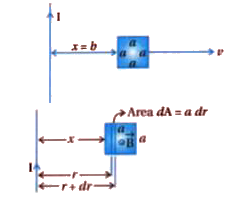 Consider area element in the form of rectangular strip with area dA = a dr at distance r from current carrying extremely long straight wire. Magnetic field through this element is perpendicularly INSIDE the plane of figure. Since the width of above strip is extremely small, magnetic field `B=(mu_0I)/(2pir)` can be taken almost constant. 2nr Hence, magnetic flux linked with this strip is, `d phi=B dA` `therefore dphi=((mu_0I)/(2pir))(a dr)` `int_0^Phi dphi=(mu_0Ia)/(2PI) int_x^(x+a) 1/r dr` `therefore {phi}_0^Phi=(mu_0Ia)/(2pi){ln r}_x^(x+a)` `therefore {Phi-0}=(mu_0Ia)/(2pi){ln (x+a)-ln(x)}` `therefore Phi=(mu_0Ia)/(2pi)ln((x+a)/x)` `therefore Phi=(mu_0Ia)/(2pi)ln(1+a/x)`...(1) Mutual inductance of given system will be , `M=Phi/I=(mu_0a)/(2pi) ln (1+a/x)` (b) Now, when above loop moves with constant velocity V towards right, magnetic flux linked with it goes on decreasing with time. When loop is at distance x from the wire at time t, emf induced in it will be , `epsilon=-(dPhi)/(dt)` `therefore epsilon=-((dPhi)/(dx))((dx)/(dt))` `therefore epsilon=-v (dPhi)/(dx)` ( `because (dx)/(dt)=v=` velocity of loop ) `=-vd/(dx){(mu_0Ia)/(2pi) ln (1+a/x)}` `=-v(mu_0Ia)/(2pi) 1/(1+a/x)d/(dx)(1+a/x)` `=-v (mu_0Ia)/(2pi) (x/(x+a)){0+a d/(dx)(1/x)}` `=-v(mu_0Ia)/(2pi) (x/(x+a)){a(-1/x^2)}` `therefore epsilon=(mu_0Ia^2v)/(2PIX(x+a))` `therefore epsilon=((4pixx10^(-7))(50)(0.1)^2(10))/((2pi)(0.2)(0.2+0.1))` `therefore epsilon=1.667xx10^(-5)` V |
|
| 23. |
A pipe of circular cross-section of inner radius r and outer radius 2r is bent into a semi circle as shown in the diagram. A fluid of density rho=10^(3)kg//m^(3) is flowing through it. The breaking stress of the material of the pipe is 3xx10^(7)n//m^(2). The maximum velocity with which the fluid can flow in the pipe is kxx100 m//s. find value of k. |
|
Answer» SOLUTION :`2rhoAv^(2)=2F` `sigma=(F)/(3pir^(2))=(rhoA)/(3pi)` `sigma=(rhov^(2))/(3)` `v=30m//s` 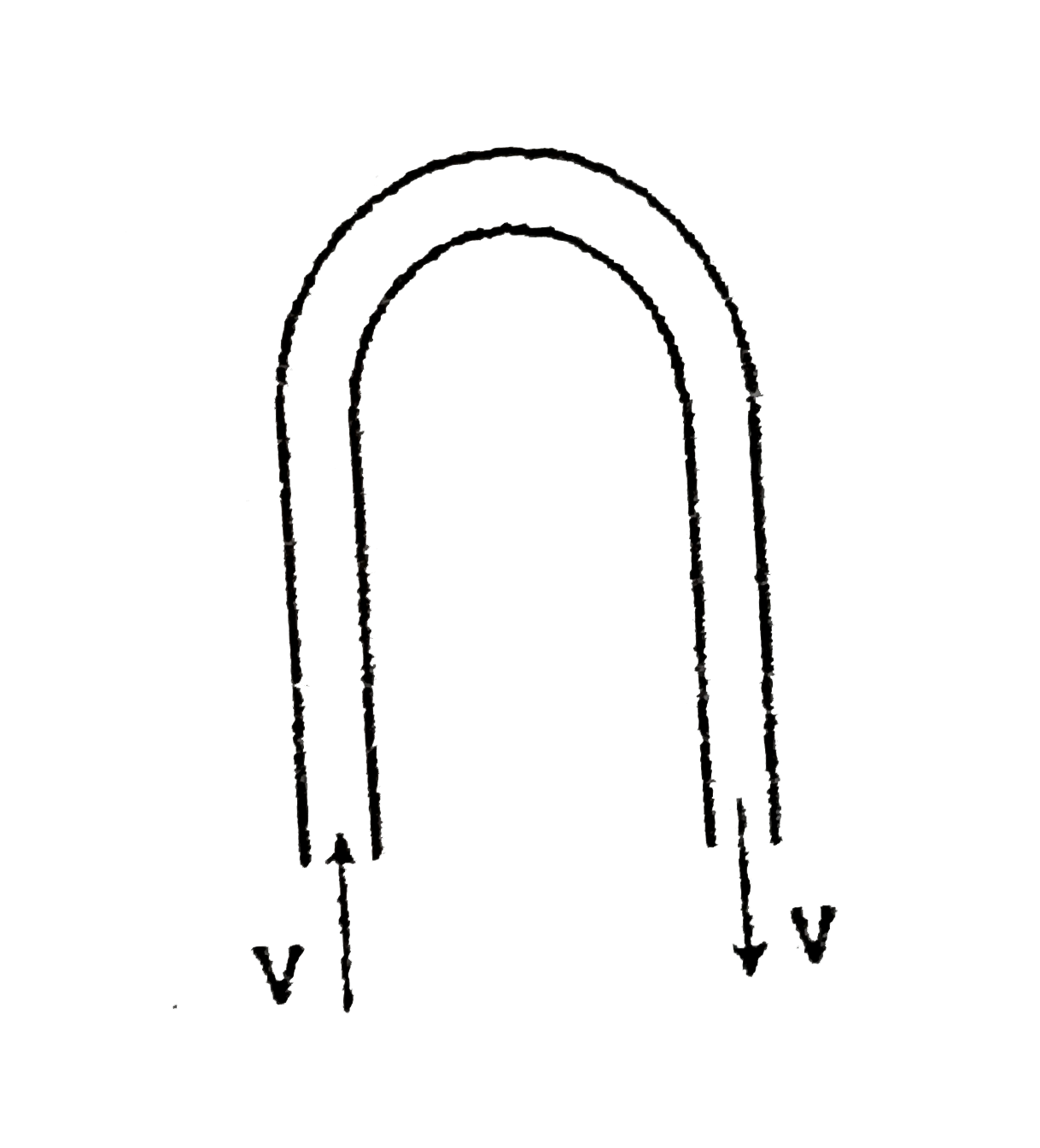
|
|
| 24. |
The minimum (threshold ) KE of the proton to initiate the nulear reaction "" p+^(7)Lirarr ""^(7)Be+n Givenm_(p)=1.0073 amu,m_(1) =7.0144 amu, m_(Be)=7.0147 amu, m_(0)=1.0087 amu. |
|
Answer» `2xx10^(-15) J` `[m_(Be)+m_(a)-m_(p)-m_(Li)]=2.5xx10^(-13)` JOULE |
|
| 25. |
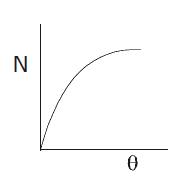
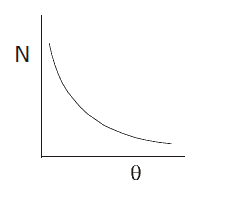
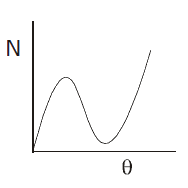
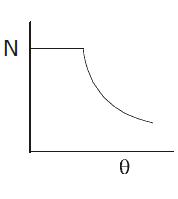
Which of the following may be representing graph between number of scattered particles detected (N) and sacttering angle (theta) in Rutherford's experiment? |
|
Answer»
|
|
| 26. |
What conclusion do you draw when a radiation of frequency 10^(16)Hz fails to produce photoelectrons from a metal surface? |
| Answer» SOLUTION :It means that the frequency of incident radiation `(10^(16)Hz)` is less than the threshold frequency of the METAL SURFACE. | |
| 27. |
These two waves travel along the same string: y (x,t)= (4.00 mm) sin(2pi x - 650pit) y_2(x,t) =(6.20 mm) sin(2npi- 650pit +0.60x rad). What are (a) the amplitude and (b) the phase angle (relative to wave 1) of the resultant wave? (c) If a third wave of amplitude 5.00 mm is also to be sent along the string in the same direction as the first two waves, what should be its phase angle in order to maximize the amplitude of the new resultant wave? |
|
Answer» |
|
| 28. |
Impedance Z is the net _____ opposition offered by all the circuit elements in an a.c. circuit. |
| Answer» SOLUTION :EFFECTIVE | |
| 29. |
The capacitor for capacitance C can be charged ( with the help of a resistance R) by a voltage source V, by closing switch S_(1) while keeping switch S_(2) open. The capacitor can be connected in series with an inductor 'L' by closing switch S_(2) and opening S_(1). After the capacitor gets fully charged S_(1) is opened and S_(2) is closed so that the inductor is connected in series with the capacitor. Then, |
|
Answer» at t=0, ENERGY stored in the CIRCUIT is purely in the FORM of magnetic energy |
|
| 30. |
A long narrow solenoid is half filled with material of relative permeability mu_(1) and half filled with another material of relative permeability mu_(2). The number of turns per meter length of the solenoid is n. Calculate the magnetic field (B) on the axis of the solenoid at boundary of the two material (i.e. at point P). The current in solenoid coil is I. |
|
Answer» |
|
| 31. |
A pure semiconductorwhen doped with a donor impurity is called ? |
|
Answer» |
|
| 32. |
A:Photon do not have mass then also it possess momentum. R:Momentum of photon is due to energy and energy is equivalent to mass. |
|
Answer» Both assertion and reason are true and the reason is CORRECT explanation of the assertion. According toEinstein THEORY mass and energy are proportional to each other. `Eprop m` `THEREFORE E=mc^(2)` Where c=speed of lighy in VACCUM but E=hf `therefore hf=mc^(2)` `therefore m=(hf)/(c^(2))` `therefore mc=(hf)/(c )` `therefore p=(hf)/(c )[because mc =p]` |
|
| 33. |
What is the significance of the negative total energy possesed by an electron in a hydrogen atom? |
| Answer» Solution :The negative VALUE of the TOTAL ENERGY implies that the ELECTRON is bound to the NUCLEUS. | |
| 34. |
How does the angle of minimum deviation of a glass prism of refractive index 1.5 change, if4t is immersed in a liquid of refractive index 1.3 ? |
| Answer» Solution :As `n_(GL) = n_(g)/n_(l) = 1.5/1,3 = 1.15`, hence angle of MINIMUM DEVIATION of glass prism decreases on IMMERSING the prism in the liquid. | |
| 35. |
In the above problem, the maximum length of the hanging part to prevent the from sliding down the incline is |
|
Answer» Solution :`m_(1)G SIN 30=m_(2)g+mu m_(1)g COS 30` `(L-x)g.(1)/(2)=x g mu(L-x)g sqrt(3)//2` `(L-x)(1)/(2)=x+mu(L-x)(sqrt(3))/(2)` `therefore x=((1-sqrt(3)mu)L)/((3-sqrt(3)mu))` |
|
| 36. |
In a ring ABCD of radius r, the lower half ABC has mass m and the upper half ADC has mass 2m. In both parts, the masses are distributed evenly. The ring is initially at rest on a horizontal surface, as shown. O is the centre of the ring. The ring is now folded along the diameter AC, such that the plane of the section ABC is normal to the plane of the section ADC. (The angle BOD = 90^(@)). It is then placed on a thin, fixed horizontal wire, ie.e, the diameter AC lies along the wire. The angle made by DO with the vertical will now be |
|
Answer» `TAN^(-1)(2//3)` |
|
| 37. |
Two plano concave lenses of glass of refractive index 1.5 have radii of curvature of 20 cm and 30 cm. If they are placed in contact with curved surfaces towards each other and the space betweenthem is filled with water (mu_(w)=4/3), find the focal length of the system. |
| Answer» Answer :C | |
| 38. |
In a ring ABCD of radius r, the lower half ABC has mass m and the upper half ADC has mass 2m. In both parts, the masses are distributed evenly. The ring is initially at rest on a horizontal surface, as shown. O is the centre of the ring. Let C_(1) denote the centre of mass of the section ABC and C_(2) denote the centre of mass of the section ADC. The distance C_(1)C_(2) is equal to |
|
Answer» `R` |
|
| 39. |
Difine the term 'amplitude modulation'. Explain any two factors which justify the need for modulating a low frequency baseband signal. |
|
Answer» Solution :The two factors that justify the need for modulating a LOW frequency baseband SIGNAL are: (a) Power radiated by antenna is given by `P prop (l^(2))/(lambda^(2))`. Hence there is a need of higher frequency conversation for effective power transmission by the antenna. (B) To transmit signal EFFECTIVELY the size of the antenna should be at least of the size `(lambda)/(4)`, where `lambda` is the wavelength of the signal to be transmitted. So if `lambda` is small (or frequency is HIGH) signal can be transmittedwith reasonable antenna length. |
|
| 40. |
Derive lens maker's formula for a thin convex lens. |
|
Answer» `(1)/(f)=((1)/(R_(1))-(1)/(R_(2)))((n_(1))/(n_(1)-n_(2)))` |
|
| 41. |
If L has the dimensions of length, V that of potential and epsilon_(0) is the permittivity of free space then quantity epsilon_(0) LV have the dimensions of : |
|
Answer» Current |
|
| 42. |
Ampere's circuits law can be derived from |
|
Answer» a. Ohm's LAW |
|
| 43. |
In a ring ABCD of radius r, the lower half ABC has mass m and the upper half ADC has mass 2m. In both parts, the masses are distributed evenly. The ring is initially at rest on a horizontal surface, as shown. O is the centre of the ring. The ring is now pushed very slightly and begins to roll on the horizontal surface without slipping. When it has made half a rotation, i.e., B is vertically above D, its angualar velocity omega will be given by (where beta = g//pir) |
|
Answer» `OMEGA^(2) = 3beta//2` |
|
| 44. |
Which has larger wavelength, violet or red colour ? |
| Answer» Solution :RED COLOUR has LARGER wavelenght than the VIOLETCOLOUR. | |
| 45. |
A hydrogen atom in the ground state absorbs 12.09 eV of energy . The change in the orbital angular momentum of the electron is : |
|
Answer» `+1.05xx10^(-34)JS` |
|
| 46. |
एक पुष्प में विकसित होने वाले फल की प्रकृति में निम्नलिखित में से किसकी महत्त्वपूर्ण भूमिका होती है ? |
|
Answer» पुमंग |
|
| 47. |
A generating station is supplying electric powerP at voltage V to a factory through a cable of resistance R . Show that the loss of power in the connecting cable is inversely proportional to V^(2). |
|
Answer» SOLUTION :Supplied POWER , `P=VI` `THEREFORE I=(P)/(V)` Loss in power , `DeltaP=I^(2)R=(P^(2)R)/(V^(2))` `therefore DeltaPprop (1)/(V^(2))` |
|
| 48. |
In Fig 15.19a, a meter stick swings about a pivot point at one end, at distance h from the stick's center of mass. What is the period of oscillation T? |
|
Answer» Solution :The stick is not a simple pendulum because its mass is not concentrated in a bob at the END opposie the pivot point- so the stick is a physical pendulum. Calculations: The period for a physical pendulum is given by Eq 15.45, for which we need the rotational inertia I of the stick about the pivot point. We can treat the stick as a uniform rod of length L and mass m. Then `I= 1//3mL^(2)`, and the distance H in Eq. 15.45 is 1/2L. Substituting these QUANTITIES into Eq. 15.45, we find `T= 2PI sqrt((I)/(mgh)) = 2pi sqrt(((1)/(3)mL^(2))/(mg((1)/(2)L)))` `=2pi sqrt((2L)/(3g))` `=2pi sqrt(((2)(1.00m))/((3)(9.8m//s^(2))))= 1.64s` Note: the result is independent of the pendulum.s mass m. |
|
| 49. |
In Fig 15.19a, a meter stick swings about a pivot point at one end, at distance h from the stick's center of mass. What is the distance L_(0) between the pivot point O of the stick and the center of oscillation of the stick? |
|
Answer» <P> Solution :Calculations: We want the LENGTH `L_(0)` of the simple pendulum (drawn in Fig 15.19b) that has the same period as the physical pendulum (the stick) of Fig 15.19a. Setting EQS. 15.44 and 15.47 equal yields.`T= 2pi sqrt((L_(0))/(g)) = 2pi sqrt((2L)/(3g))` You can see by inspection that `L_(v) = (2)/(3)L` `=((2)/(3)) (100cm) = 66.7cm` In Fig 15.19a point P marks this DISTANCE from suspension point O. Thus, point P is the stick.s center of oscillation for the given suspension point. Point P would be different for a different suspension choice. 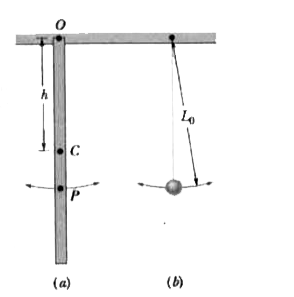 (a) A meter stick suspended from one end as a physical pendulum. (b) A simple pendulum whose length `L_(0)` is chosen so that the periods of the two pendulums are equal. Point P on the pendulum of (a) marks the center of oscillation. |
|
| 50. |
A very long cylindrical wire is carrying a current I_(0) distriuted uniformly over its cross-section area. O is the centre of the cross-section of the wire and the direction of current in into the plane of the figure. The value int_(A)^(B) vec(B).vec(dl) along the path AB (from A to B ) is |
| Answer» Answer :B | |