

Saved Bookmarks
This section includes 7 InterviewSolutions, each offering curated multiple-choice questions to sharpen your Current Affairs knowledge and support exam preparation. Choose a topic below to get started.
| 1. |
Consider a closed loop C in a magnetic field as shown in figure. The flux passing through the loop is defined by choosing a surface whose edge coincides with the loop and using the formula phi=vecB_1 . dvecA_1 + vecB_2 . dvecA_2+…. Now if we choose two different surfaces S_1 and S_2 having C as their edge, would we get the same answer for flux. Justify your answer. |
Answer» SOLUTION :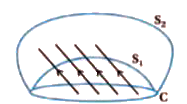 Magnetic flux linked with any surface can also be determine by no. of FIELD LINES PASSING from it. 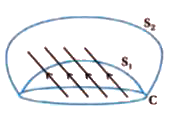 Here, from surface `S_1` and `S_2` no. of FIELDLINE passing through them are same so flux linked with them is also same. |
|
| 2. |
A galvanometer coil has a resistance of 12 Omegaand the metre shows full scale deflection for a current of 3 mA. How will you convert the metre into a voltmeter of range 0 to 18 V? |
| Answer» SOLUTION :RESISTANCE in SERIES = 5988 OMEGA ` | |
| 3. |
The ratioof kinetic energy of mean position to thhe potential energy when the displacementis half of the amplitudeis : |
|
Answer» `(4)/(1)` At MEAN position `y=0,:. E_(K)=(1)/(2)m omega^(2)r^(2)` Potential energy `E_(P)=(1)/(2)m omega^(2)y^(2)` At ` y=( r )/(2),E_(P)=(1)/(2)m omega^(2)(r^(2))/(4)`. `:.""(E_(K))/(E_(P))=(4)/(1)` Correct choice is (a). |
|
| 4. |
(A) Between any two given energy levels, the number of absorption transitions is always less than or equal to the number of emission transitions. (R): Absorption transitions start from the lowest energy level only and may end at any higher energy level. But emission transitions may start from any higher energy level and end at any energy level below it. |
|
Answer» Both 'A' and 'R' are true and 'R' is the correct EXPLANATION of 'A'. |
|
| 5. |
A photoelectric plate is initially exposed to a spectrum of hydrogen gas excited to second energy level. Late when the same photoelectric plate is exposed to a spectrum of some unknown hydrogen like gas, excited to second energy level. It is found that the de-Broglie wavelength of the photoelectrons now ejected has increased sqrt(6.1) times. For this new gas difference of energies of first Lyman line and Balmer series limit is found to be two times the ionization energy of the hydrogen atom is ground state. Detect the atom and determine the work function of the photoelectric plate. |
|
Answer» Solution :For minimum de-Broglie wavelength of electron, the momentum and hence `KE` of electron must be maximum. Case-I. When hydrogen spectra is used, for maximum energy of PHOTOELECTRON `13.6[(1)/(1^(2))-(1)/(2^(2))]-phi=(1)/(2)mv_(1)^(2) rArr (1)/(2)mv_(1)^(2)=(3)/(4)xx13.6eV-phi` For unknown GAS of atomic no.`z` `13.6z^(2)[(1)/(1^(2))-(1)/(2^(2))]-phi=(1)/(2)mv_(2)^(2) rArr (1)/(2)mv_(2)^(2)=z^(2)(3)/(4)xx13.6ev-phi` Comparing the de-Broglie wavelengths `(lambda_(1))/(lambda_(2))=(h//mv_(1))/(h//mv_(2))=((v_(2))/(v_(1)))` `rArr ((lambda_(1))/(lambda_(2)))^(2)=((3)/(4)xx13.6-phi)/((3)/(4)xx13.6z^(2)-phi)=(1)/(6.1)`....(`1`) For the unknown gas Energy of first lvman line-Energy of Balmer SERIES limit `=2XX(13.6)eV` `(13.6)z^(2)((3)/(4))-13.6z^(2)((1)/(4))=2(13.6)` `z^(2)//2=2`, `z=2` `:. ` Unknown gas is helium Now from equation (`1`) `(10.2-phi)/(40.8-phi)=(1)/(6.1)` `rArr phi=4.2eV` |
|
| 6. |
Two wires A and B of same mass and material are taken. Diameter of wire A is half of wire B. If resistance of wire A is 24Omega find the resistance of wire B. |
|
Answer» Solution :`R=(rhom)/(A^(2)d),(R_(A))/(R_(B))=((r_(B))/(r_(A)))^(4)` `rArr r_(A)=(r_(B))/(2)rArr (R_(A))/(R_(B))=(2)^(4)=16` `therefore R_(B)=(R_(A))/(16)=(24)/(16)="1.5 OHM."` |
|
| 7. |
(A) : When two long parallel wires, hanging freely are connected in parallel to a battery, they come close to each other. (R) : Wires carrying current m opposite direction repel each other. |
|
Answer» Both 'A' and 'R' are true and 'R' is the CORRECT explanation of 'A'. |
|
| 8. |
Two points A and B are maintained at a potential of7 V and -4 V respectively . The work down in moving 50 electrons from A to B is ….. . |
|
Answer» `8.80xx10^(-17)J` |
|
| 9. |
A metal block weighing 2 kg is resting on a frictionless horizontal plane. It is struck by a jet releasing water at the rate of 1 kg//s and at a speed of 5 ms^(-1) The Initial acceleration of block is : |
|
Answer» `25 MS^(-1)` (a) is the choice. |
|
| 10. |
The kinetic energy of alpha-particle emitted in the alpha-decay of ""_(88)Ra^(266) is [given, mass number of Ra = 222 u] |
|
Answer» `5.201` Me V Energycorrespondingmass defect `Q =[{:("(MASS NUMBEROF Ra )"),("-(Massnumberof Ru )"),("-m (4He )"):}]Uxx931.5Me V= 4.871MeV ` |
|
| 11. |
The input characteristics of a transistor in CE mode is the graph obtained by plotting |
|
Answer» `I_B` against `V_(CE)` at CONSTANT `V_("BE")` |
|
| 12. |
The V-I characteristic of a silicon diode is shown in the Fig. 14.17. Calculate the resistance of the diode at (a)I_(D) = 15 mA and (b) V_(B)=-10 V |
|
Answer» Solution :Considering the diode characteristics as a straight line between I = 10 mA to I = 20 mA passing through the origin, we can CALCULATE the resistance using OHM’s LAW. (a) From the CURVE, at I = 20mA, V= 0.8 V, I= 10mA, V= 0.7 V `r_(fb) = DeltaV//DeltaI = 0.1V //10 mA = 10 Omega` (b) From the curve at `V = -10 V, I=-1 MUA`, |
|
| 13. |
The amplitude of S.H.M. at antinodes of theproblem No. 51 is |
|
Answer» 0.01 m |
|
| 14. |
Three identical metal plates of area S are at equal distances b as shown. Initially metal plate A is uncharged, while metal plates B and C have respective charges +Q_(0) and -Q_(0) initially as shown. Metal plates A and C are connected by switch K through a resistor of resistance R. the key K is closed at time t = 0 The total heat produced dissipiated by resistor of resistance R is : |
|
Answer» `(Q_(0)^(2)b)/(4S epsilon_(0))` `=Q_0^2/(2C)-(Q_0//2)^2/(2C)-(Q_0//2)^2/(2C)=(Q_0^2b)/(4Sepsilon_0)` |
|
| 15. |
When a strong electric field of approximately ……is applied on the metal the electron is pulled ut from the metal. |
|
Answer» `10^(1)(V)/(m)` |
|
| 16. |
Three identical metal plates of area S are at equal distances b as shown. Initially metal plate A is uncharged, while metal plates B and C have respective charges +Q_(0) and -Q_(0) initially as shown. Metal plates A and C are connected by switch K through a resistor of resistance R. the key K is closed at time t = 0 Then the magnitude of current in amperes through the resistor at any later time is : |
|
Answer» `(Q_(0)b)/(RS epsilon_(0))e^((-bt)/(RS epsilon_(0)))` integrating and evaluating the constant we get Hence `q=Q_0/2(1-e^(-(2t)/(RC)))` or `i=(dq)/(dt)=Q_0/(RC)e^(-(2t)/(RC))` 
|
|
| 17. |
An alternating e.m.f of 0.1 V is applied acrossan LCR series circuit having R=2 omega,C=40muF and L=100mH. At resonance, the voltage drop across the inductor is: |
|
Answer» 10V |
|
| 18. |
Three identical metal plates of area S are at equal distances b as shown. Initially metal plate A is uncharged, while metal plates B and C have respective charges +Q_(0) and -Q_(0) initially as shown. Metal plates A and C are connected by switch K through a resistor of resistance R. the key K is closed at time t = 0 After the steady state is achieved, the charge on plate A is : |
|
Answer» `(Q_(0))/(2)` |
|
| 19. |
Magnetic field at a distance a from long current carrying wire is proportional to |
|
Answer» `1/a` |
|
| 20. |
The time of exposure of a photographic print is |
|
Answer» DIRECTLY PROPORTIONAL to the INTENSITY of illumination |
|
| 21. |
Match Column - I with Column - II : |
|
Answer» `sqrt(2mE) = mv` de Broglie wavelength , `lamda=h/(mv)=h/(sqrt(2mE))` Momentum of a particle and its kinetic energy (E) are related as :de Broglie wavelength , When kinetic energy of alpha particle is found TIMES GREATER than that of alpha particle and momentum of alpha particle is greater than that of proton. When kinetic energy of alpha particle is one fourth pf proton , `lamda_alpha/lamda_p=sqrt((m_pE_p)/(m_alphaE_alpha))=1` Thus wavelength for both the particles is same. However in case of momentum , `lamda_alpha/lamda_p=sqrt((m_p)/(m_alpha))=sqrt(1/4)=1/2` Thus, momentum of proton is less than that of alpha particle . When velocity of alpha particles is equal to that of proton , their energy ratio will be `E_(alpha)/(E_p)=((m_alphav_alpha^2)/2)/(m_pv_p^2)=m_alpha/m_p=4/1` `:.E_alpha=4E_p` Thus wavelength of photon isgreater than that of alph particle and momentum of alpha particle is greater than that of photon. Similarly, when kinetic energy of alpha particle is FOUR times greater than that of protons , than wavelength of proton is greater than of alpha particle and momentum of alpha particle is greater than that of proton. |
|
| 22. |
A parallel monochromatic beam of light is incident formed on a narrow slit diffraction patternis formed on screen palced perpendicular to the direction of the incident beam . At the first minimum of the diffraction pattern , the phase difference between the rays coming from the two edges of the slit of |
| Answer» ANSWER :D | |
| 24. |
A tank filled with water upto 1.25 m has two outlets (i) a rounded orifice A or area of cross section10^(4) m^(2) and (ii) a pipeBwith well rounded entryandof length 55cm , Pickthe correctcombination . |
| Answer» Answer :C | |
| 25. |
Match Column - I with Column - II : |
|
Answer» <P> |
|
| 26. |
A tank filled with water upto 1.25 m has two outlets (i) a rounded orifice A or area of cross section10^(4) m^(2) and (ii) a pipeBwith well rounded entryandof length 55cm , Pickthe correct combination for list velocity . |
|
Answer» <P>(II) (i) (P) |
|
| 27. |
Energy levels A, B and C of a certain atom correspond to increasing values of energy i.e., E_(A)lt E_(B) lt E_(C) .If lambda_(1), lambda_(2) and lambda_(3) are the wavelengths of radiations corresponding to the transitions Cto B, B to A and C to A respectively as shown in Fig. 12.04, then which of the following statement is correct? |
|
Answer» `lambda_(3)= lambda_(1) + lambda_(2)` On simplyfingtheseequestions weget THERELATION ` (1)/(lambda_(3)) =(1)/(lambda_(1))+(1)/(lambda_(2))` |
|
| 28. |
The coefficient of transmission is the ratio of |
|
Answer» RADIANT energy incident to the radiant energy TRANSMITTED through the body |
|
| 29. |
On a carbon resistor there are bands of colours of our national flag from upto down, what is resistance of the carbon resistor ? |
|
Answer» `39 XX 10^(5) pm 20% Omega` There are bands of colours of our national flag from up to down is saffron, white and green. `therefore " resistance "39 xx 10^(5) ` There is no FOURTH band in it, so TOLERENCE is 20 % `therefore" Resistance = (39 xx 10^(5) pm 20% ) Omega` |
|
| 30. |
Give the espression for the magnetic induction due tobar magnet on aixal line ? |
|
Answer» Solution :Magnetic induction on the AXIAL line of a BAR magnet , is ` B = (mu_0)/( 4PI) (2Md)/((d^(2) -l^(2))^(2))` In case of shortbar magnet the magnetic INDCUTION on the axial line is `B=(mu_0)/(4pi) (2M)/(d^(3))` . |
|
| 31. |
Consider a point P as the contact point of a wheel on ground which rolls on ground without slipping. Value of displacement of point P when wheel completes half of rotation (Ifradius of wheel is 1 m) |
|
Answer» 2m  In half ROTATION point P has moved horizontally. `(pid)/2=pir=pixx1m=pim` `[because` radius=1m`]` In the same time, it has moved vertically a distance which is EQUAL to its diameter = 2 m. `THEREFORE` Displacement of P = `sqrt(pi^(2)+2^(2))=sqrt(pi^(2)+4)`m |
|
| 32. |
Figure shows equipotential surfaces concentric at O the magnitude of electric field at a distance r measured from O is |
|
Answer» `(9)/(R^(2))(Vm^(-1))` |
|
| 33. |
Electric charge of 1 muc, - 1muc and 2muc are placed in air at the corners A,B and C respectively of an equilateral triangle ABC having length of each side 10 cm . The resultant force on the charge at C is |
|
Answer» `0.9N ` |
|
| 34. |
The magnetic field in a plane electromagnetic wave is given byB_(y)=2xx10^(-7)sin(0.5xx10^(3)x +1.5xx10^(11)t)T.a.What is the wavelength and frequency of the wave ?b.Write an expression for the electric field. |
|
Answer» Solution :a.Comparing the given EQUATION with `B_(y)=B_(0)sin [2x((x)/(lambda)+(t)/(T))]`, we get,`lambda = (2pi)/(0.5xx10^(3))m=1.26cm`and`(1)/(T)=upsilon =((1.5xx10^(11)))/(2pi)=23.9` GHz. b.`E_(0)=B_(0)c=2xx10^(-7)xx3xx10^(8)=6xx10^(1)V//m` The electric field COMPONENT is perpendicular to the direction of propagation and the direction of magnetic field. Therefore, the electric field component along the z-axis is obtained as,`E_(z)=60 sin (0.5xx10^(3)x +1.5xx10^(11)t)V//m`. |
|
| 35. |
The dielectric constant of a metal is |
|
Answer» `INFTY` |
|
| 36. |
Three equal resistance each of 3Omega are in series and connected to cell of internal resistance one ohm. If three resistances are parallel and connected to the same cell. Then the ratio of the respective currents through the electric circuits in the two cases is |
|
Answer» `1//8` |
|
| 37. |
A long straight wire of radius 'a' carries a steady current i. The current is uniformly distributed across its cross section. The ratio of the magnetic fields at a/2 and 2a is |
|
Answer» 1 |
|
| 38. |
An ammeter of resistance 0.80 Omega can measure current upto 1.0 A. What must be the value of shunt resistance to enable the ammeter to measure current upto 5.0 A ? What is the combined resistance of the ammeter and the shunt? |
|
Answer» SOLUTION :Here `I_g = 1.0 A, I = 5.0 A and R_G = 0.80 Omega` `:.` RESISTANCE of shunt `r_(s) = (I_(g) cdot R_G)/(I - I_g) = (1.0 xx 0.80)/(5.0 - 1.0) = 0.20 Omega` Net resistance of the AMMETER and the shunt `R = (R_G xx r_s)/(R_G xx r_s) = (0.80 xx 0.20)/(0.80 + 0.20) = 0.16 Omega`. |
|
| 39. |
A copper wire of cross sectional area 0.5 mm^2 carries a currentsof 1A . Assume that each copper atom contributes one free electron . The density of copper is 9,000 kg//m^3 and atomic mass is 63.5 u. if v_d is drift speed of electrons. Now assume that one copper atom is kept at temperature 300 K and it develops thermal motion. Let v_("rms") be the root mean square speed of copper atom at given temperature . find the ratio v_(rms)//v_d ( HInt: Treat copper atom like a mono-atomic gas particle for the calculation of v_(rms)) |
|
Answer» Solution :Cross SECTIONAL area of wire `A=0.5 mm^2 =0.5 xx10^(-6)m^2` Current I=1A Density of copper `d=9,000 kg //m^3` Atomic mass of copper=63.5 u Drift velocity `v_d=?` Root mean square velocity `v_(rms)=?` Mass of `1 m ^3` of copper=9,000 kg Number of atoms in 63.5 g of Cu`=6.023 xx 10^(23)` Number of atoms in 1g of `Cu =(6.023xx10^(23))/(63.5)` Number of atoms in `9,000 xx10^3 g of Cu`, `n=(6.023xx10^(23))/(63.5)xx9,000xx10^3` `rArr n=85.3 xx10^(27)` atoms As `I="neA"v_d` `I/("neA")=v_d` `rArr 1/(85.3xx10^(27)xx1.6xx10^(-19)xx0.5xx10^(-6))=v_d` `therefore v_d =0.015xx10^(-2)m//s` `v_(rms)=sqrt((3kT)/m)` Mass of copper atom ,m `=(63.5)/(6.023xx10^(23))g` `=(63.5xx10^(-3))/(6.023xx10^(23))kg` k= BOLTZMANN constant `=1.38xx10^(-23) m^2 kg s^(-2)K^(-1)` `v_(rms)=sqrt((3xx1.38xx10^(-23)xx300xx6.023xx10^(23))/(63.5xx10^(-3)))` `=3.43xx10^2m s^1 rArr 343 ms^(-1)` `therefore v_(rms)//v_d=0.015xx10^(-2)//343=4.37xx10^(-5)` |
|
| 40. |
How did they get rid of the bird's exhaustion ? |
|
Answer» They MADE him run |
|
| 41. |
Calculate the number of electrons, protons and neutrons present in 24 grams of ""_(12)Mg^(24)and ""_(12)Mg^(26). |
|
Answer» Solution :24 g of magnesium CONTAINS `6.023 xx 10^(23)` protons For `""_(12)Mg^(24)` `therefore` 24 g of Mg has `12 xx 6.023 xx 10^(23)` protons `=72.2 xx 10^(23)` `therefore 24`g of Mg has `12 xx 6.023 xx 10^(23)` electrons `=72.2 xx 10^(23)` `therefore 24G` of Mg has `12 xx 6.023 xx 10^(23)` neutrons `=72.2 xx 10^(23)` For `""_(12)Mg^(26)` 26 g of Mg has `6.023 xx 10^(23)` atoms 1g of Mg has `(6.023 xx 10^(23))/26 xx 24` atoms `=5.56 xx 10^(23)` atoms `therefore` Totalnumber of electrons in 24 g of `""_(12)Mg^(26) = 12 xx 5.56 xx 10^(23) = 66,72 xx 10^(23` `therefore` Total NUMBER of proton in 24 g of `""_(12)Mg^(26)` `=66.72 xx 10^(23)` `therefore` total number of proton in 24 g of `""_(12)Mg^(26) = 66.72 xx 10^(23)` Total number of neutrons in 24 g of `""_(12)Mg^(26)` `=14 xx 5.56 xx 10^(23) = 77.84 xx 10^(23)` |
|
| 42. |
What is electrostatic potential energy ? When it is maximum and minimum ? |
|
Answer» |
|
| 43. |
"Louis De Broglie suggested existence of matter waves based on a hypothesis" What do you mean by matter wave? |
| Answer» Solution :The WAVE ASSOCIATED with MATERIAL PARTICLE is . called MATTER wave. | |
| 44. |
Mention two applications of infrared radiation. |
|
Answer» Solution :Two APPLICATIONS: (i) Used in long distance photography. (II) They are used to treat sprains and muscular PAINS. ETC. |
|
| 45. |
There is a square membrane of area S. Find the number of natural vibrations perpendicular ot its plane in the frequency interval from omega t o omega+domega if the propogation velocity of vibrations is equal to v. |
|
Answer» Solution :Let `xi(x,y,t)` be the displacement of the element at `(x,y)` at time `t`. Then it obeys the equation `(del^(2)xi)/(at^(2))=V^(2)((del^(2)xi)/(delx^(2))+(del^(2)xi)/(dely^(2)))` where `xi=0 at x=0,x=l,y=0` and `y=l` We look for a solution in the FORM `xi=A sin k_(1) sink_(2) y sin (omegat+delta)` Then `omega^(2)=V^(2)(k_(1)^(2)+K_(2)^(2))` `K_(1)=(npi)/(l),k_(2)=(mpi)/(l)` we write this as `n^(2)+m^(2)=((t omega)/(piV))^(2)` Here `n,mgt0`. Each paor `(n,m)` determines a mode. The TOTAL number of MODES whose frequency is `le omega` is the AREA of the quadrant of a circle of radius `(lomega)/(piV)` i.e., `N=(pi)/(4)(( omega)/(piV))^(2)` Then `dN=(l^(2))/(2piV^(2))omega d omega=(S)/(2piv^(2)) omega d omega`. where `S=l^(2)` is the area of the membrane. |
|
| 46. |
For steel the breaking stress is 6 xx 10^6 N /m^2 and the density is 8xx10^3kg/m^3 What is the maximum length of a steel wire , which can be suspended without breaking under its own weight? |
|
Answer» Solution :WEIGHT = MG = V d g = A L d g Breaking stress = `(Mg)/A = (ALdg)/A` Ldg[L maximum length] `therefore L = "Breaking stress"/(dg) = (8 XX 10^6)/(8 xx 10^3 xx 10) = 100m` |
|
| 47. |
An electrical device draws 2 kW power form AC mains [voltage 223 V (rms) = sqrt(50,000) V]. The current differs (lags) in phase by phi (tan = (-3)/(4)) as compared to voltage. Find (i) R, (ii) X_(C ) - X_(L), and (iii) I_(M). Another device has twice the values for R, X_(C ) and X_(L). How are the answers affected ? |
|
Answer» Solution :`P = 2KW = 2000W, tan phi = (-3)/(4) , I_(m)=I_(0) ? R = ? X_(C)- X(L)=?` `V_("rms") = V= 223 V` `Z = (V^2)/(P) = 25 OMEGA` `Z = sqrt(R^2 + (X_(L) - X_(C ))^2)` `625 = R^2 + (X_(L) - X+_(C ))^2` Again `tan phi = (X_L - X_C)/ (R ) = (3)/(4)` `X_(L) - X_( C) = (3R)/(4)` using this `R= 20 Omega, X_(L) - X_( C) = 15 Omega, I = (V)/ (Z) = (223)/(25) = 8.92 A` `I_(m) = sqrt(2) I = 12.6 A` |
|
| 48. |
The distance between two consecutive atoms of the crystal lattice is 1.227Å. The maximum order of diffraction of electrons accelerated through 10^(4) volt is : |
|
Answer» 1 `n_("MAX")=(d)/(lambda)=(d)/((12*27)/(SQRT(V)))=10` |
|
| 49. |
Two conductors carrying equal and opposite changes create a non-uniform field as shown in fig. What is the capacity of this capacity if the field along Y-axis varies as E=(Q)/(epsilon_(0)A)[1+"By"^2]with B = constant |
|
Answer» `C=(epsilon_0A)/d` |
|