

Saved Bookmarks
This section includes 7 InterviewSolutions, each offering curated multiple-choice questions to sharpen your Current Affairs knowledge and support exam preparation. Choose a topic below to get started.
| 1. |
What will be the phase difference between virtual current and virtual voltage, when the current in a A.C. circuit is wattless ? |
| Answer» Answer :C | |
| 2. |
A point is situatd at 6.50 cm and 6.65 cm from two coherent sources. If the wavelength of light is 5000overset@A then the nature of illumination at a point is : |
| Answer» Answer :A | |
| 3. |
Electric charge is uniformly distributed along a long straight wire of radius 1 mm. The charge per cm length of the wire is Q coulomb. Another cylindrical surface of radius 50 cm and length 1 m symmetrically encloses the wire as shown in the figure. The total electric flux passing through the cylindrical surface is |
|
Answer» `(Q)/(epsi_0)` |
|
| 4. |
Closed pipes has natural frequency 500Hz, if its length is doubled and radius is halved its frequency will become |
|
Answer» 250Hz |
|
| 5. |
Using lens maker's formula, show how the focal length of a given lens depends upon the colour of light incident on it. |
| Answer» Solution :As per LENS maker.s formula `1/f = (n-1) (1/R_(1) - 1/R_(2))`. As refractive index V of a lens depends upon the colour of incident LIGHT, it is OBVIOUS that the focal length ./. of the lens will DEPEND on the colour of incident light. | |
| 6. |
Three spheres, each of mass m, can slide freely on a frictionless, horizontal surface. Spheres A and Bareattached to an inextensible, inelastic cord of length "l" and are at rest in the position shown where sphere B is struck by sphere C which is moving to the right with a velocity v_(0). Knowing that the cord is taut where sphere B is struck by sphere C and assuming "Head on" inelasticimpact between B and C, we can 't conservekinetic energy of entire system. If velocity of C immediately after collision becomes (v_(0))/(2) in the initial direction of motion, the impulse due to string on sphere A is |
|
Answer» `(mv_(0))/(8)` |
|
| 7. |
An electric current can be induced in a coil by changing the magnetic flux through the coil.using suitable equation justify your answer. |
| Answer» Solution :ACCORDING to Faraday.s law of ELECTROMAGNETIC induction, magnitude of the induced emf `absepsilon=N (dphi//dt)` COIL b has got larger number of TURNS and PRODUCED larger emf. | |
| 8. |
Three spheres, each of mass m, can slide freely on a frictionless, horizontal surface. Spheres A and Bareattached to an inextensible, inelastic cord of length "l" and are at rest in the position shown where sphere B is struck by sphere C which is moving to the right with a velocity v_(0). Knowing that the cord is taut where sphere B is struck by sphere C and assuming "Head on" inelasticimpact between B and C, we can 't conservekinetic energy of entire system. The velocity of B immediately after collision is along unit vector |
|
Answer» `hati` |
|
| 9. |
Three spheres, each of mass m, can slide freely on a frictionless, horizontal surface. Spheres A and Bareattached to an inextensible, inelastic cord of length "l" and are at rest in the position shown where sphere B is struck by sphere C which is moving to the right with a velocity v_(0). Knowing that the cord is taut where sphere B is struck by sphere C and assuming "Head on" inelasticimpact between B and C, we can 't conservekinetic energy of entire system. Velocity of A immediately after collision is along unit vector |
|
Answer» `hati` |
|
| 10. |
Can two vectors of different magnitudes be combined to gives azero resultant ? Can three vectors ? |
| Answer» Solution :The TWO force SAY `VEC A` and `vec B` of different magnitudes cannot be combined to give a zero RESULTANT . | |
| 11. |
A bullet when fired at a target has its velocity decreased to 50% after penetrating 30 cm into it. Then the additional thickness it will penetrate before coming to rest is |
|
Answer» 10 cm |
|
| 12. |
A cube of each side 80 cm is fixed at the bottom and a tangential force is applied to its top . The layer of the cube is displaced by 0.6 mm parallel to the force . The shear strain is |
|
Answer» a)0.001 RADIAN |
|
| 13. |
What is the total energy E of a 2.53 MeV electron? |
|
Answer» Solution :KEY IDEA the total energy E is the SUM of the electron.s mass energy (or REST energy) `mc^(2)` and its kinetic energy: `E=mc^(2)+K.""`(36-57) CALCULATIONS: The adjective "2.53 MeV" in the problem statement means that the electron.s kinetic energy is 2.53 MeV. To evaluate the electron.s mass energy `mc^(2)`, we substitute the electron.s mass m from Appendix B, obtaining `Mc^(2)=(9.10xx10^(-31)kg) (299 792 458 m//s)^(2)` `=8.187 XX 10^(-14)J` Then dividing this result by `1.602xx10^(-13)J//MeV` gives us 0.511 MeV as the electron.s mass energy (confirming the value in Table 36-3). Equation 36-57 then yields `E=0.511MeV+2.53MeV=3.04MeV`. |
|
| 14. |
The magnetic induction at the centre of a circular coil of radius 10 cm is 5 sqrt(5) times the magnetic induction at a point on its axis. The distance of the point from the centre of the coil, in cm is: |
|
Answer» 5 |
|
| 15. |
A cylinder of capacity 20 L is filled with H_(2) gas. The total average kinetic energy of translatory motion of its molecules is 1.5xx10^(5)J. The pressure of hydrogen in the cylinder is |
|
Answer» `2XX10^(6)N//m^(2)` Volume, `V=20L=20xx10^(-3)m^(3)` Pressure `=(2)/(3)(E)/(V)=(2)/(3)((1.5xx10^(5))/(20xx10^(-3)))=5xx10^(6)N//m^(2)` |
|
| 16. |
A wire elongates by l mm when a load W is hanged from it. It the wire goes over a pulley and two weights W each are hung at the two ends, the elongation of the wire (in mm) will be |
| Answer» Answer :B | |
| 17. |
The system shown is released from rest. Mass of ball is m kg and that of wedge is M kg respectively. When ball reaches at highest point on other side of the wedge, velocity of ball and wedge is (initially wedge is kept at rest against a wall and there is no friction anywhere) : |
|
Answer» `(Msqrt(2 gR))/(m + M)` `implies`Wedge will not move till the ball REACHES at bottom with velocity`sqrt(2gR)` `implies m sqrt(2gR) = (m + M) V implies (msqrt(2 gR))/(m + M)` 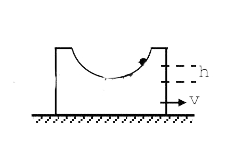
|
|
| 18. |
A uniform rod of length l oscillates about an axis passing through its end. Find the oscillation period and the reduced length of this pendulum. |
|
Answer» |
|
| 19. |
Mercury flows at a speed of 20 cm/s in a pipe with conducting walls of 5 cm diameter. The pipe is in the gap between the pole pieces of an electromagnet, the magnetic field in the gap having induction of 0.6 T. Will the magnetic field affect the hydraulic friction coefficient? The conductivity of mercury is 10^(6)ohm^(-1).m^(-1). |
|
Answer» `Re=(rhovl)/(eta)=(13.6xx10^(3)xx5xx10^(-2)xx0.2)/(1.55x10^(-3))=8.8xx10^(4)gtgt2300`. Hence the flow is TURBULENT and it should be assessed with the aid of the Stewart number: `N=(gammaB^(2)l)/(rhov)=(1.05xx10^(6)xx0.36xx5xx10^(-2))/(13.6xx10^(3)xx0.2)=7` But the Stewart number REPRESENTS the ratio of the magnetic force to the resistance of pressure. Hence, in this case the magnetic force will appreciably affect the COEFFICIENT of hydraulic friction. |
|
| 20. |
Time varying electrical field is produced along with time varying magnetic field, by |
|
Answer» a CHARGE moving with UNIFORM velocity |
|
| 21. |
Two pointcharges q_(1) and q_(2) of magnitude + 10^(-8) c and -10^(-8) crespectively are placed 0.1 m apart calculate the electricfields at points a, b and c |
|
Answer» Solution :The electricflield vector `E_(1A)` at a due to the positive charge `q_(1)`point towards the right and has a magnitude `E_(1A)=(9xx10^(9)Nm^(2)C^(2)xx(10^(-8)C))/(0.05 m)^(2)=3.6 xx10^(4) NC^(-1)`the electirc field vectors`E_(2A)`at a due to the NEGATIVE charge `q_(2)` pointsof the total electric field `E_(A)`at A is `E_(A)` is directedtowards the right the electricfieldvector `E_(1B)`at B due to thepositive charge `q_(1)` pointstowards the leftand has a manitude the magnitude of the total ELECTRICFIELDAT BIS `E_(B)` is directed towards the left The magnitude of each electricfieldvectorat pointc due to charge `q_(1)` and `q_(2)`is `E_( c)=E_(1c)` COS `(pi)/(3)+E_(2c)` cos `(pi)/(3)=9xx10^(3) Nc^(-1)` `E_(c )` points towards the right |
|
| 22. |
If white light is used in Young.s double -slit experiment a) bright white fringe is formed at the centre of the screen b) fringes of different colours are observed on both sides of central fringe clearly only in the first order c) the first order fringe.s are closer to the centre of the screen than the first order red fringes d) the first order red fringes are closer to the centre of the screen than the first order violet fringes |
|
Answer» only a and d are true |
|
| 23. |
Young.s experiment is performed in air, water and glass. The descending order of fringe width for these media is |
|
Answer» WATER, AIR, glass |
|
| 24. |
If light travels a distance of 5 m in a medium of refractive index mu, then equivalent path in vaccum it would travel in same time is |
|
Answer» `(5/MU)` m |
|
| 25. |
Two point charges + 8q and - 2q are located at x = 0 and x = L respectively. The location of a point on the x-axis at which the net electric field due to these two point chaises is zero is : |
|
Answer» 4L |
|
| 26. |
Show that the circuit drawn in the figure comprising of 3 NAND gate behavesas an OR gate. |
Answer» Solution :As explained in the earlier illustration, the gates 1 and 2 will BEHAVE as a NOT gate. Hence `Y_(1)=barA and Y_(2)=barBbarA and BARB` are the inputs to the gate 3. The output Y of the gate 3 can be prepared using the TRUTH table of the NAND gate.  It is CLEAR from the truth table that the above truth table resembles the truth table of an OR gate. Hence we have shown that the above circuit behaves as an OR gate. |
|
| 27. |
A biconvex thin lens is prepared from glass of refractive index mu_(2)=(3)/(2). The two conducting surfaces have equal radii of 20 cm each. One of the the surface is silvered from outside to make it reflecting. It is placed in a medium of refractive index mu_(1)=(5)/(3). It acts as a |
|
Answer» CONVERGING MIRROR |
|
| 28. |
The distance of an object and its image from the focus of a concave mirror are 8 cm and 12 cm respectively. The focal length of the mirror is |
|
Answer» 8cm |
|
| 29. |
Statement I: IF a current flows through a wire of non-uniform cross section, potential difference per unit length of the wire in the direction of current is same at different points. Statement II:V=IR and the current in the wire is same throughout. |
|
Answer» Statement I is true,statement II is true,statement II is a CORRECT EXPLANTION for statement I |
|
| 31. |
गेहूं, चना, जौ, ,मटर, आलू, चुकंदर, कौन- सी ऋतु की फसलें हैं |
|
Answer» खरीफ |
|
| 32. |
पंजाब,हरियाणा व उत्तर प्रदेश कौन- सी फसल के प्रमुख उत्पादक राज्य है ? |
|
Answer» जायद |
|
| 33. |
Of the follwoing quantities, which one has dimensions different from the remaining three ? |
|
Answer» Energy per UNIT volume |
|
| 34. |
The distance between the tew slits in a Young's double slit experiment is d and the distance of the screen from the plane of the slits is b, P is a point on the screen directly infront of one of the slits. The path difference between the waves arriving at P from the two slits is |
|
Answer» `(d^(2))/(b)` |
|
| 35. |
When an emperor penguin returns from a search for food, how can it find its mate among the thousands of penguins huddled together for warmth in the harsh Antarctic weather? It is not by sight, because penguins all look alike, even to a penguin. The answer lies in the way penguins vocalize. Most birds vocalize by using only one side of their two-sided vocal organ, called the syrinx. Emperor penguins, however, vocalize by using both sides simultaneously. Each side sets up acoustic standing waves in the bird's throat and mouth, much like in a pipe with two open ends. Suppose that the frequency of the first harmonic produced by side A is f_(A1) = 432 Hz and the frequency of the first harmonic produced by side B is f_(B1) = 371 Hz. What is the beat frequency between those two first-harmonic frequencies and between the two second-harmonic frequencies? |
|
Answer» Solution :The beat frequency between two frequencies is their difference, as given by Eq. `(f_("beat") = f_1 - f_2)` For the two first-harmonic frequencies`f_(A1)`and`f_(B1)` , the beat frequency is `f_("beat.1") = f_(A1)- f_(B1) = 432 Hz - 371 Hz` Because the STANDING waves in the penguin are effectively in a pipe with two open ends, the resonant frequencies are given by Eq. (f = nv/2L), in which L is the (unknown) length of the effective pipe. The first-harmonic frequency is` f_1`= v/2L, and the SECOND-harmonic frequency is `f_2`= 2v/2L. Comparing these two frequencies, we see that, in GENERAL, `f_2 = 2f_1` For the penguin, the second harmonic of side A has frequency `f_(A2) = 2f_(A1)`, and the second harmonic of side B has frequency `f_(B2) = 2f_(B1)` . Using Eq.with frequencies `f_(A2)` and `f_(B2)` ,we find that the corresponding beat frequency associated with the second harmonics is `f_("beat.2")- f_(A2) - f_(B2)= 2f_(A1) - 2f_(B1)` ` =2 (432 Hz) - 2(371 Hz)` = 122 Hz |
|
| 36. |
An insect starts moving up in a liquid from point O of variable refractive index mu = mu_0 (1+ay) where y is depth of liquid from the surface. If u is the speed of insect, its apparent speed to the observer E is |
|
Answer» u LN(1 + aH) |
|
| 37. |
An artificial satellite moves in a circular orbit around the earth. Total energy of the satellite is given by E. The potential energy of the satellite is |
|
Answer» `-2E` =2(Total energy of the satellite)=2E |
|
| 38. |
In a p-n junction, the thickness of the depletion region is 10^-5 m.What is the P.D. that should be applied across it, to produce an electric field of intensity 10^-5V//m ? |
| Answer» ANSWER :D | |
| 39. |
The phase difference between the coherent waves of wavelength lamda originating from two slits is 3pi radian A point P on a screen is at distance of 20lamda and 21.5lamda from the two slits .is the point P bright or dark.? |
| Answer» Solution :A phase difference of `3pi` radian CORRESPONDS to a path difference of `1.5lamda` .HENCE the path difference between the waves from the TWO slits meeting at P is either `1.5lamda+-1.5lamda=3lamda` or 0. in either CASE path difference is an integral MULTIPLE of `lamda` hence the point P is bright. | |
| 40. |
What is the effect on the interference fringes in a Young's double-slit experiment if monochromatic source is replaced by source of white light ? |
| Answer» Solution :If monochromatic LIGHT source is replaced by a source of WHITE light, the interference patterns due to difference component colours of white light will overlap. The central bright fringes for all colours are at same point, hence the central FRINGE is white. but all other fringes are coloured. as the fringe width for violet colour light is least and that of red light maximum first minima for violet light will COME first and the fringe will appear red there. slightly farther away where there is first minima for red light, the fringe will appear blue. thus, fringe closest on either side of central white fringe is red and the farthest is blue-violet. after a few coloured fringes, no clear fringe PATTERN is seen due to overlapping of fringe patterns due to different colours. | |
| 41. |
Magnetic dipole moment of a bar magnet is 3 hat(i) "Am"^(2) and the magnetic field intensity is 2 xx 10^(-5) T in y direction calculate the torque on the magnet. |
|
Answer» `2 xx 10^(-5) hat(K) Nm` `overset(to)(tau)= overset(to)(M) xx overset(to)(B)` `= 3 hat(i) xx 2 xx 10^(-5) hat(j) = 6 xx 10^(-5) hat(k) Nm` |
|
| 42. |
The dimensional formula for linear density is |
|
Answer» `ML^1T^-2` |
|
| 43. |
A particleprojected withvelcoityv_(0)strikesat rightalpha planethroughthepointof projection . |
|
Answer» Solution :Let `ALPHA` be the angle betweenthe velocityof projectionand the inclined plane . `v_(ax) = v_(0) cos alpha , v_(AY) = v_(0) sin alpha ` ` a_(x) = g beta , a_(y) = - g cos beta` `rArr V_(x) (t) = v_(0) cos alpha- g sin beta t` At the pointof impact ` v_(x) rArrt= (v_(0) cos alpha)/(g sin beta)""....(i)` Also y at the pointiszero . `rArr v_(0) sin alpha - (1)/(2) g cos betat^(2) = 0 rArr t = (2v_(0) sin alpha)/(g cos beta)""....(ii)` From(i) and (ii) `(v_(0) cos alpha)/(g sin beta) = (2v_(0) sin alpha)/(g cos beta)` `tan alpha =(1)/(2) cot beta` `x = v_(0) = cos (alpha + beta) t` `= v_(0)[cos alpha cos beta - sin alpha beta] (v_(0)cos alpha)/( g sin beta) = (V_(0)^(2))/(g)[cos^(2) alpha cot beta - sinalpha cos alpha]` ` = (v_(0)^(2))/(g)[((2)/(sqrt(4+cot^(2)beta)))^(2) cot beta - (cot beta)/(sqrt(4+cot^(2) beta))(2)/(sqrt(4+cot^(2)beta))]` (using`tan alpha = (1)/(2) cot beta`) = `(v_(0)^(2))/(g) (2 cotbeta)/(4+cot^(2) beta)` From FIGURE `therefore y = x tan beta = (v_(0)^(2))/(g).(2cot beta)/(4+cot^(2) beta) tan beta rArr y = (2V_(0)^(2))/(g(4+ cot^(2)beta))` 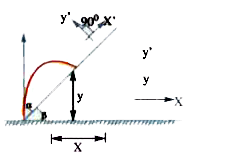
|
|
| 44. |
In the above question, if the direction of the field is reversed and is from B to A and g gt(Eq)/(m), then the period is : |
|
Answer» `2pi SQRT((l)/(G))` `a.=g-(qE)/(m)` `:.""T.=2pi sqrt((l)/(g-(qE)/(m)))` Hence correct choiceis (B). |
|
| 45. |
Radiation of light possess the following property |
|
Answer» a)Rectilinear propagation |
|
| 46. |
The p.d. across the terminals of a battery is 50 V when 11 A are drawn and 60 V when 1A is drawn. The emf and internal resistance of the battery are |
|
Answer» `62 BV ,2 OMEGA ` |
|
| 47. |
Given the resistances 1 Omega , 2 Omega , 3 Omega how will you combine them to get an equivalent resistance of (11//5) Omega. |
| Answer» SOLUTION :parallel combination of `2 OMEGA` and `3OMEGA` in SERIES with 1 `Omega` | |
| 48. |
Given the resistances 1 Omega , 2 Omega , 3 Omega how will you combine them to get an equivalent resistance of (11/3) Omega |
| Answer» SOLUTION :JOIN `1 Omega , 2Omega` in PARALLEL and the combination is series with `3 Omega`. | |
| 49. |
In a certain region of a thin film we get 5 fringes with light of wavelength 600 mm. How many fringes will we get in the same region with wavelength 500 mm ? |
|
Answer» 5 |
|