Saved Bookmarks
This section includes 7 InterviewSolutions, each offering curated multiple-choice questions to sharpen your Current Affairs knowledge and support exam preparation. Choose a topic below to get started.
| 1. |
For stationary waves, the particles of the medium perform- |
|
Answer» OSCILLATORY MOTION with same periods |
|
| 2. |
The magnitude of the induced emf in a coil of inductance 30 mH in which the current changes from 6A to 2A in sec is |
|
Answer» 0..6V `30xx10^(-3)xx(6-2)/(2)=6XX10^(-2)V` =`0.06V` |
|
| 3. |
निम्न में से कौन नर सहायक ग्रन्थि नहीं है - |
|
Answer» शुक्राशय |
|
| 4. |
Imperfections is optical lenses can be observed with the help of |
|
Answer» NEWTON's rings |
|
| 5. |
A rod of height h stands erect on a flat horizontal mirror. Sunrays fall on the mirror at some angle and reflected on to the nearby wall. Find the length of the shadow. |
|
Answer» |
|
| 6. |
A photon will have less energy if its |
|
Answer» AMPLITUDE is higher |
|
| 7. |
Bohr's theory of hydrogen atom didi not explain fully |
|
Answer» diameter of H-atom |
|
| 8. |
If an elevator is moving vertically up with an acceleration 'a', the force exerted on the floor by a passenger of mass M is |
|
Answer» M a |
|
| 9. |
A dip circle lies initally in the magnetic meridian if it is now rotated throughangle thetain the horizontal plane thentangent of the angle ofd dip is chagedin the ratio |
|
Answer» `1:cos theta` `THEREFORE (tan delta)/(tan delta)=(v)/(H cos theta)xx(H)/(V )=(1)/(cos theta)` |
|
| 10. |
From the above table we can see that the ratio of their atomic masses is 2. But it is not exactly 2. Why is it so ? Explain. |
| Answer» SOLUTION :Because the mass of a nucleus is slightly less than the mass of the CONSTITUENT NUCLEONS. (Actual atomic mass is DIFFERENT from mass NUMBER) | |
| 11. |
Two slits 0.3mm apart are illuminated by light of wavelength 4500Å. The screen is placed at 1m distance from the slits. Find the separation between the second bright fringe on both sides of the central maximum. Data : d=0.3mm=0.3xx10^(-3)m, lambda=4500Å=4.5xx10^(-7)m, D=1m, n=2, 2x=? |
|
Answer» SOLUTION :`2x=2(D)/(d)nlambda` `=(2xx1xx2xx4.5xx10^(-7))/(0.3xx10^(-3))` `:.2x=6xx10^(-3)m` (or) `6MM` |
|
| 12. |
Explain Bohr's atomic model. |
|
Answer» Solution :Bohr in 1913, concluded that in spite of the success of electromagnetic theory in explaining large scale phenomena it could not be applied to the processes at the atomic scale. Concepts that are different from the classical mechanics and electromagnetism would be needed to understand the structure of atoms and the relation of atomic structure to atomic spectra. Bohr combined classical and early quantum concepts and gave his theory in the form of three postulates they are as follows: (1) An electron in an atom could revolve in certain stable orbits without the emission of radiant energy, contrary to the predication of electromagnetic theory. According to this postulate, each atom has certain definite stable states in which it can exist and each possible state has definite total energy. These are called the stationary states of the atom. (2) The electron revolves AROUND the nucleus only in those orbits for which the ANGULAR MOMENTUM is some integral MULTIPLE of `(h)/(2pi)` where h is the planks.s constnat `(=6.6xx10^(-34))`. Thus the angular momentum (1). of the ORBITING electron is quantised. That is `L=(nh)/(2pi)=mvr` Bohr.s third postulate incorporated into atomic theory the early quantum concepts that had been developed by Planck and Einstein. It state that an electron might make a transition from one of its specified nonradiating orbits to another of lower energy. When it does so, a photon is emitted having energy equal to the energy difference between the initial and final states. The frequency of the emitted photon is `hv=E_(i)-E_(f)` `:.v=(E_(i)-E_(f))/(h)` where v= frequency of photon `E_(i)`= energy of initial state and `E_(f)=` energy of initial state and`E_(i) gt E_(f)`. |
|
| 13. |
Two electric dipoles ,each of dipole moment oversetto p , are enclosed within a closed surface. Total electric flux linked with the surface is _______________ |
|
Answer» |
|
| 15. |
A berillium particle (z = 4) having 5.3 MeV energy experience head-on collision with gold atom (z = 79). It can move to what closest distance to gold nucleus ? |
|
Answer» `10.32xx10^(-14)m` Minimum DISTANCE, `r_(0)=(KXX(79e)(4e))/(K)` `=(9xx10^(9)xx79xx4xx(1.6xx10^(-19))^(2))/(5.3xx10^(6)xx1.6xx10^(-19))` `=858.56xx10^(-16)` `~~8.58xx10^(-14)m` |
|
| 16. |
If radius of curvature of curved surface of plano-convex lens of refractive index 1.5 is 60 cm, then its focal length is ...... cm. |
|
Answer» SOLUTION :`1/f=(n-1)[(1)/(R_1)-(1)/(R_2)]` `=(1.5-1)[(1)/(infty)-(1)/(-60)] R_1=infty,R_2=-60` cm `=0.5xx(1)/(60)` `therefore f=(60)/(0.5)` = 120 cm and fis positive for convex lens. |
|
| 17. |
A bettery of emf 10 V and internal resistacne 3 Omega is connected to a resistor. Ifthe current in the circuit is 0.5A, what is the resistance of the resistor ? What is the terminal voltage of the bettery when the circuit is closed ? |
|
Answer» Solution :For the adjoining closed LOOP, `I = (EPSILON)/(R + r)` `THEREFORE R +r = (epsilon)/(I)` `therefore R = (epsilon)/(I) -r ` = `(10)/(0.5) - 3 ` `therefore R = 17 Omega` Terminal voltage of battery, `V_(ab) = IR ` = (0.5) (17) = 8.5 V OR V = `epsilon - `Ir `= 10 - (0.5) (3)` = 10 - 1.5 = 8.5 Volt |
|
| 18. |
In the nth stable orbit of a hydrogen atom, the energy of an electronE =-(13.6)/(n^(2)) eV. Theenergy required to take the electron from first orbit to second orbit will be |
| Answer» Solution :Energy required ` E = E_(2) - E_(1) =(-13.6)/((2)^(2)) - [-(13.6)/((1)^(2))] = - 3.4 + 13.6 =+ 10.2 eV` | |
| 19. |
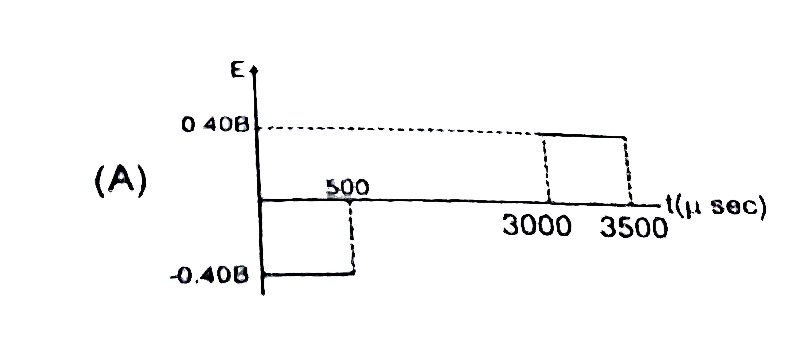
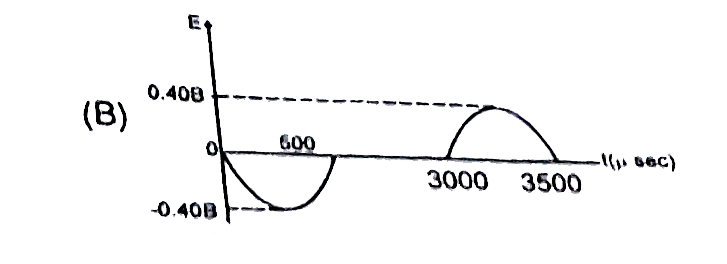
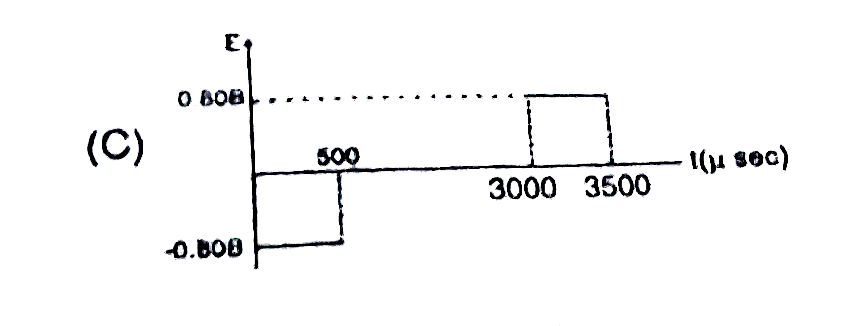
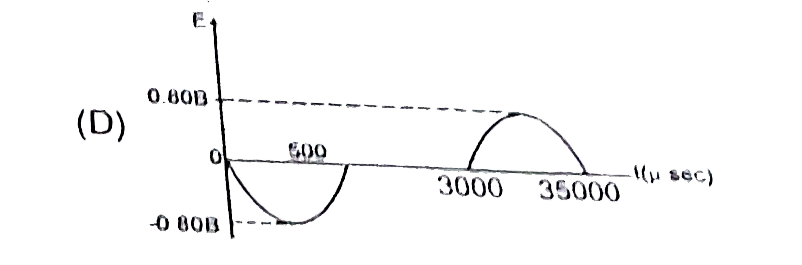
A magnetic field (B), uniform between two magnets can be determined measuring the induced voltage in the loop as it is pulled through the gap at uniform speed 20 m/sec. Size of magnet and coil is 2cmxx1cmxx2cm and 4cmxx6cm as shown in figure. The correct variation of induced emf with time is : (Assume at t=0, the coil enters in the magnetic field): |
|
Answer»
|
|
| 20. |
The inside and outside temperatures of a refrigerator are 273 K and 303 K respectively. Assume that the refrigerator cycle is reversible. For every joule of work done, the heat delivered to the surrounding will be nearly |
|
Answer» 10 J |
|
| 21. |
What we call the communication process In which space serves as the communication channel? |
| Answer» SOLUTION :SPACE COMMUNICATION | |
| 22. |
A 4kg mass is resting on a horizontal surface. For this surface mu_s = 0.6 & mu_(k)= 0.2. Force required to move the body with 5ms^(-2) acceleration is (g = 10ms^(-2)) |
|
Answer» 20 N |
|
| 23. |
Predict the direction of induced current in the situations described by the following Figs. 6.03(a) to (f). |
|
Answer» Solution :(a) In Fig. 6.03(a), on bringing the magnet nearer the coil pq, the nearer end q will behave as the south pole as per Lenz.s law i.e., the induced current will flow clockwise at q. Hence, in the coil, the induced current is from p to q or in the entire CIRCUIT induced current flows ALONG qrpq. (b) In this case, coil pg develops S-pole at q and coil XY also develops S-pole at X. Therefore, the induced current in coil pq will be from a top (or along prqp) and the induced current in coil XY will be from X to Y (or along XYZX). (c) As current in given coil is flowing clockwise and the current (i.c., the magnetic flux) is increasing because the tapping key has been just closed, the induced current in the 2ND coil will be in anticlockwise direction i.e., the induced current will flow along YZX. (d) As theostat SETTING is being changed in such a way that current in right loop is increasing. Hence, induced current in left loop will be, in accordance with Lenz.s law, in an opposite direction. Hence, as seen from the front the induced current in left loop will be along ZYX i.e., in clockwise direction. (e) As tapping key in electrical circuit of left side coil has just been released, current and hence magnetic flux in this coil is falling with time. Hence, in accordance with Lenz.s law induced current in the right side coil will also flow in same direction i.e., anticlockwise or along xry direction through the coil. (f) In this case magnetic field lines produced due to current flowing in straight wire are in the plane of given loop, hence no current is induced in the loop. |
|
| 24. |
For a total intemal reflection, which of the following is correct? |
|
Answer» Light travel from RARER to denser medium. |
|
| 25. |
Write down the application of ICT in Fisheries? Fisheries. |
|
Answer» Solution :(a) SATELLITE vessel monitoring system helps to identify fishing zones. (b) Use of barcodes helps to identify time and DATE of CATCH, species name, quality of FISH. |
|
| 26. |
A flow of 10^7 electrons per second in a conducting wire constitutes a current of |
|
Answer» `1.6 XX 10^(-12) A` |
|
| 27. |
n identical bulbs operating on same voltage are available. When all such bulbs are connected in series to the same operating voltage source, then power consumed in each bulb = ...... W. |
|
Answer» nP The resistance of every BULB R= `(V^(2))/(P)` The total resistance joined in SERIES of n bulb R.= nR = `(nV^(2))/(P)` `therefore `Total Power P. = `(V^(2))/(R.)= (V^(2) XX P)/(nV^(2)) = (P)/(n)` |
|
| 28. |
In a series circuit R= 300 Omega, L= 0.9 H, C = 2.0 muF " and " omega= 1000 rad//sec. The impendence of the circuit is |
|
Answer» `1300 OMEGA` |
|
| 29. |
The phenomenon of diffraction of light was discovered by |
|
Answer» fresnel |
|
| 30. |
The voltage gain of the following amplifier is |
|
Answer» 10 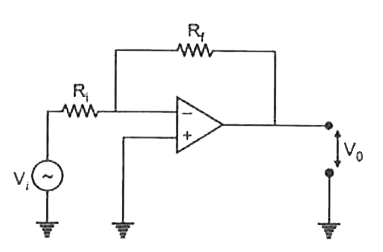
|
|
| 31. |
The diagram shows the energy levels for an electron iin a certain atom. Which transition shown represents the emission of photon with the most energy ? |
|
Answer» III |
|
| 32. |
ltBRgt A nozzle throws a stream of gas against a wall with a velocity v much larger than the thermal agitation of the molecules. The wall deflects the molecules without changing the magnitude of their velocity. Also, assume that the force exerted on the wall by the molecules is perpendicular to the wall. (This is not strictly true of a rough wall). Find the force exerted on the wall |
|
Answer» `Anmv^2cos^2theta` 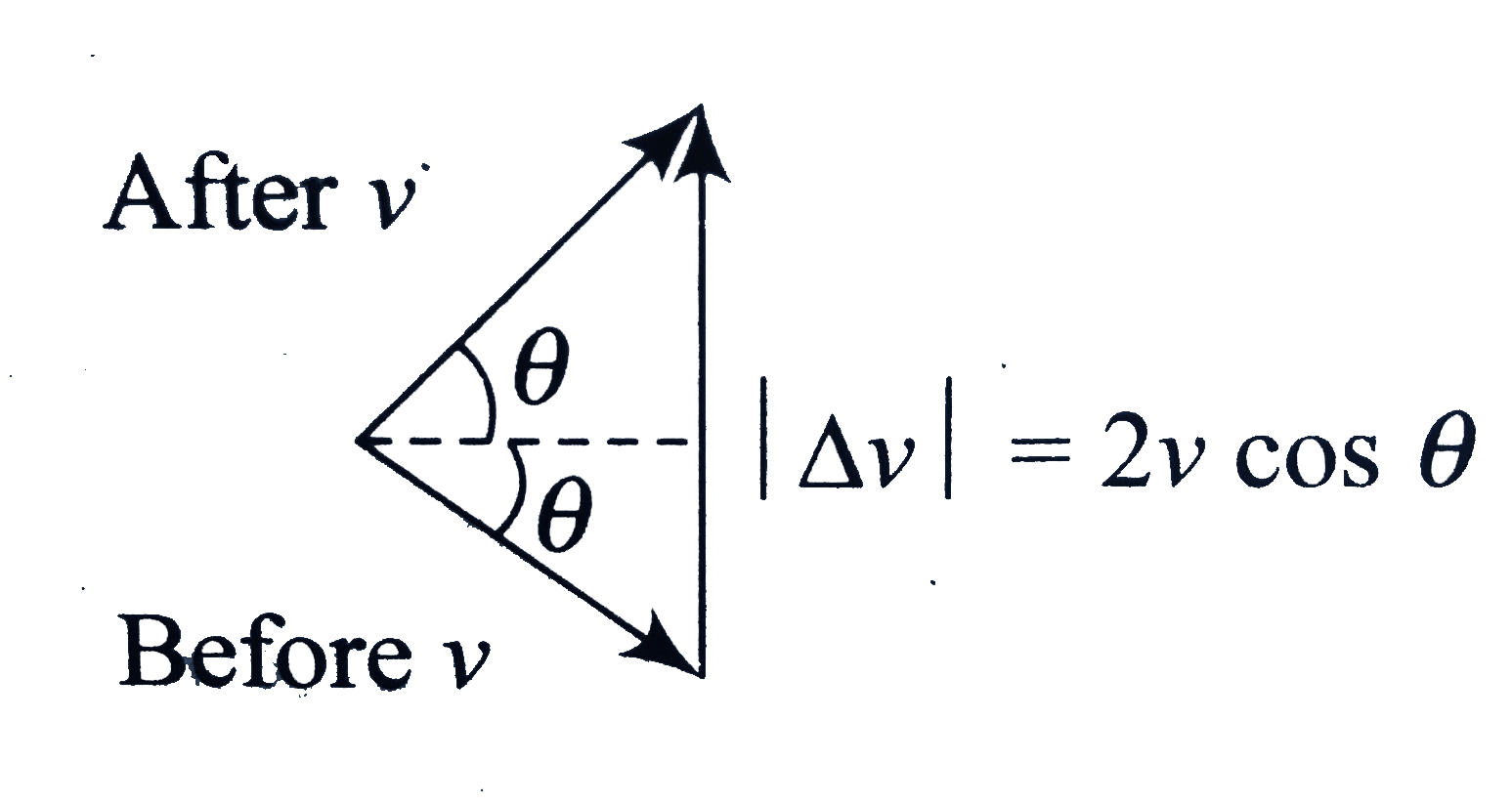 Since the molecules rebound from the wall, the component of VELOCITY perpendicular to the wall is reversed, whole its velocity parallel to the wall does not change. The change is velocity of molecules is parallel to normal N. The magnitude of change is `|trianglevecv|=2vcostheta` The change is momentum of a molecule is `|trianglevecp|=m|trianglevecv|=2mvcostheta` in the direction of normal N. Let n be the number of molecules per unit volume. The number of molecules arriving at an area A of the wall per unit time is the number in a slanted cylinder whose length is equal to the velocity v and whose CROSS section as `Acostheta`. Number of molecules`=n(Avcostheta)` Each molecule suffers a change of momentum `2mvcostheta`. Change of momentum of a steam of gas in a direction perpendicular to the wall is equal to `(nAvcostheta)xx(2mvcostheta)=2Anmv^2cos^2theta`. Hence, force EXERTED on stream of gas by the wall, `F=2Anmv^2cos^2theta` This is also the force exerted by gas molecules on the wall. pressure=(normal force)/(Area)`=(F)/(A)=2nmv^2cos^2theta` REMARK: for oblique incidence, the change in momentum of the radiation per unit volume at the perfectly reflecting surface is `2pcostheta` and the corresponding radiation pressure is `P_(rad)=2pccos^2theta=2Ecos^2theta` |
|
| 33. |
Answer the following questions: (e) The energy and momentum of an electron are related to the frequency and wavelength of the associated matter wave by the relations: E=hv, p=(h)/(lambda) But while the value of lambda is physically significant, the value of ν (and therefore, the value of the phase speed νlambda) has no physical significance. Why? |
|
Answer» Solution :The ABSOLUTE value of energy E (but not momentum p) of any particle is arbitrary to within an ADDITIVE constant. Hence, while `lambda` is physically significant, absolute value of ν of a matter WAVE of an electron has no direct physical MEANING. The phase speed `vlambda` is likewise not physically significant. The group speed given by `(DV)/(d(1//lambda))=(dE)/(dp)=(d)/(dp)((p^(2))/(2m))=(p)/(m)` is physically meaningful. |
|
| 34. |
What is wave packet?Explain by using necessary diagram. |
|
Answer» Solution :Resultant were obtained by superposition of WAVES of different wavelengths is called wave packet. MATTER wave associated with electron is not extended in inifinite space.It is a wave packet extended about a central wavelength. In this condition `Deltax` is not infinite but it has some definite value which depend on RANGE of wave packet. Also a wave packet does not have definite wavelength but made up of no. of wavelengths about a central wavelength. With description of wave packet with de-Broglie relation and Born.s probability interpretation reproduce the Heisenber.s uncertaintly principle exactly.  (a)The wave packet description of an electron.The wave packet corresponds to a spread of wavelength around some central wavelength (and hence by de Broglie relation ,a spread in momemtum).Consequently ,it is associated with an uncertainly in POSITION `(Deltax)` and an uncertainly in momentum `(Deltap)` (a)The wave packet description of an electron.The wave packet corresponds to a spread of wavelength around some central wavelength (and hence by de Broglie relation ,a spread in momemtum).Consequently ,it is associated with an uncertainly in POSITION `(Deltax)` and an uncertainly in momentum `(Deltap)` (b) The matter wave corresponding to a definite momentum of an electrin extends all over space.In this case ,`Deltap=0` and `Deltaxtooo` Figure (a) shows a schematic DIAGRAM of wave packet and figure (b) shows an extended wave will fixed wavelength. The particle at that point.Probability density means probability per unit volume.Thus ,If A is the amplitude of the wave at a point ,`|A|^(2)DeltaV` is the probability of the particle being found in a small volume `DeltaV` around that point .Thus ,if the intensity of matter wave is large in a certain region,there is greater probability of the particle being found there than where the intensity is small. |
|
| 35. |
Calculate electric field intensity at point P due to a thin positive uniformly charged rod . Point P is at perpendicular distance d from the rod . The lower and upper ends of the rod make the angles alpha and beta as shown below . |
Answer» Solution : Refer the given figure . Let us SELECT one segment of length dy at a distance y from O. Electric field due to this segment is `dvecE` as shown. We have `lambda` as linear CHARGE DENSITY .So the charge on segment is `lambdady` . `dE=1/(4piepsilon_0)(lambdady)/(d^2+y^2)` The direction of `dvecE` is dissimilar for different locations of the segment . Hence `dvecE` cannot be integrated directly. So, we shall integrate components perpendicular and parallel to rod separately . `E_x=int dE cos theta =lambda/(4piepsilon_0)int (dy)/(d^2+y^2)cos theta` `E_y=int dE sin theta =lambda/(4piepsilon_0) int (dy)/(d^2+y^2)sin theta` To solve above integrations, let us assume : `y=d tan theta` `dy=d sec^2 theta d theta ` `d^2+y^2 =d^2 sec^2 theta` `(dy)/(d^2+y^2)=(d theta)/d` On substituting , `E_x=int dE cos theta - lambda/(4piepsilon_0d) int_(-ALPHA)^(beta)cos theta d 0` `E_y=int dE sin theta =lambda/(4pi epsilon_0 d)int_(-alpha)^beta sin theta d theta` In the above integration , the limits are taken from `theta=-alpha` corresponding to lower end of rod . And `theta=beta` for the upper end of the rod . On solving both, we GET the following :`E_x = int dE cos theta = lambda/(4piepsilon_0d) int_(-alpha)^beta cos theta d theta =lambda/(4piepsilon_0d) [sin theta]_(-alpha)^(beta)` `=lambda/(4piepsilon_0d) [sin beta - sin (-alpha)]` `E_y=int dE sin theta =lambda/(4pi epsilon_0d) int_(-alpha)^beta sin theta d theta =lambda/(4pi epsilon_0 d) [-cos theta ]_(-alpha)^(beta)` `=lambda/(4piepsilon_0d)[(-cos beta)-(-cos (-alpha))]` `E_x=lambda/(4pi epsilon_0d)(sin alpha + sin beta) E_x` represents the component, perpendicular to rod in the direction away from the rod for `lambda > 0 . E_y=lambda/(4piepsilon_0d)(cos alpha -cos beta)` `E_y` represents component that is parallel to the rod . The direction of `E_y` can be upwards or downwards depending on the values of `alpha` and `beta`. |
|
| 36. |
The work done in moving an electric charge q in an electric field does not depend upon |
|
Answer» mass of the particle |
|
| 37. |
Dimensions of 1/(sqrt(mu_0 in_0)) are |
|
Answer» `[L^(-1)T]` `:.c^(2)=(1)/(mu_(0)epsilon_(0))` `:.`Dimensions of `(1)/(mu_(0)epsilon_(0))=[L^(2)T^(-2)]` Hence CORRECT choice is `( c)`. |
|
| 38. |
A ray of light traveling in glass (mu_g= 3//2) is incident on a horizontal glass-air surface at the critical angle theta_c . If a thin layer of water (mu_w = 4//3) is now poured on the glass-air surface, at what angle will the ray of light emerges into water at glass-water surface? |
| Answer» SOLUTION :`SIN^(-1) (3//4)` | |
| 39. |
(A) : If two beams of protons move parallel to each other in same direction then these beams repel each other. (R) : Like charges repel while opposite charges attract each other. |
|
Answer» Both 'A' and 'R' are true and 'R' is the correct EXPLANATION of 'A'. |
|
| 40. |
Velocity of the body on reaching the ground is same in magnitude in the following cases (a) a body projected vertically from the top of tower of height 'h' with velocity 'u' |
|
Answer» a, d, C and d are CORRECT |
|
| 41. |
A body of mass 60 kg is pushed up with just enough force to start it moving on a rough surface with mu_(s)=0.5and mu_(k)=0.4 and the force continues to act afterwards. What is the acceleration of the body ? |
|
Answer» SOLUTION :`m=60 kg , mu_(s)=0.5, mu_(K)=0.4` FORCE `f=ma=m(mu_(s)-mu_(k))G` `therefore a=(mu_(s)-mu_(k))g` `=(0.5-0.4)9.8=0.98 m//s^(2)` |
|
| 42. |
In Rutherford experiments on alpha- ray scattering the number of particles scattered at 90^(@) be 29 per minute. Then the number of particles scattered per minute by the same foil, but at 60^(@) is |
|
Answer» 56 |
|
| 43. |
Read the pasage given below as well as theadjoining energylevel diagram and then answer the questions given afterthe passage . As per Bohr'stheory oghydrogen atom the energy of an atom in a statecorresponding to principal quantum numbern is given as : E_(n) = - (13.6)/(n^(2)) eV Theenergyof an atom is the least when itselectron is revolvingin an orbit closets to thenucleus i.e.,theone forwhich n =1. This stateis called the groundstate. When a hydrogen atom receives energyby processes suchas electron collision, theatom may acquire sufficientenergyto raise theelectron to higherenergystates and the atom is then saidto bein an excited state . From theseexcited states the electron can then fall back to a state of lower energy , emitting a photon in the process. The energy level diagram for thestationary states of a hydrogen atom , compouted from Bohr'srelation for energy, is givenin Fig.12.02. Theprincipalquantum number n labels the stationary states in the ascendingorderof energy . Obviously , thehighestenergycorrespondsto n = ooandhasan energy of 0 eV. Thisis the energy of the atom when the electron is completely removed (r= oo) from the nucleus and is at rest. Now answer the follwoingquestions: Whatis the energy of hydrogen atom and give its value. |
|
Answer» Solution :Energyrequired to excite an ELECTRON of HYDROGENATOM from its groundstate (n = 1) to firstexcites STATE (n=2). `E = E_(2) = E_(1) =[-(13.6)/((2)^(2))] - [-(13.6)/((1)^(2))] = 10.2 EV` |
|
| 44. |
When you have learned to integrate, derive formule (18.25) from the familiar expression for the field intensity of a point charge. |
| Answer» Solution :`varph=- int E dr=-(Q)/(4PI epsi_(0)) int (dr)/(R^(2))=(q)/(4pi epsi_(0)r)+` CONST | |
| 45. |
if y=e^sqrtx ,then dy/dx equals |
|
Answer» `e^SQRTX /(2sqrtx)` |
|
| 46. |
When does the story takes place? |
|
Answer» 2155 |
|
| 47. |
Read the pasage given below as well as theadjoining energylevel diagram and then answer the questions given afterthe passage . As per Bohr'stheory oghydrogen atom the energy of an atom in a statecorresponding to principal quantum numbern is given as : E_(n) = - (13.6)/(n^(2)) eV Theenergyof an atom is the least when itselectron is revolvingin an orbit closets to thenucleus i.e.,theone forwhich n =1. This stateis called the groundstate. When a hydrogen atom receives energyby processes suchas electron collision, theatom may acquire sufficientenergyto raise theelectron to higherenergystates and the atom is then saidto bein an excited state . From theseexcited states the electron can then fall back to a state of lower energy , emitting a photon in the process. The energy level diagram for thestationary states of a hydrogen atom , compouted from Bohr'srelation for energy, is givenin Fig.12.02. Theprincipalquantum number n labels the stationary states in the ascendingorderof energy . Obviously , thehighestenergycorrespondsto n = ooandhasan energy of 0 eV. Thisis the energy of the atom when the electron is completely removed (r= oo) from the nucleus and is at rest. Now answer the follwoingquestions: Define ionisation energyof hydrogenatom and give its value. |
| Answer» Solution :Minimum amountof energyrequired to FREE ELECTRON of hydrogenatom from its groundstate is called its ionisation energy . Itsvalueis + 13.6 EV. | |
| 48. |
A 5 kg body is suspended from a spring balance physical balance. If both is balaced on the pan of a physical balance. If both the balances are kept in an elevator then what would happen in each case when the elevator is moving upward acceleration? |
| Answer» SOLUTION :The READING of spring balance will increase while there will be no EFFECT on the equilibrium of the physical balance. | |
| 50. |
a. An electrostatic field line is a continuous curve. That is, a field line cannot have sudden breaks. Why not? b. Explain why two field lines never cross each other at any point? |
|
Answer» Solution :Electric lines of force exist throughout the region of an electric field. The electric field of a CHARGE decreases gradually with increasing distance from it and becomes zero at infinity i.e., electric field can.t VANISH abruptly. So a line of force can.t have sudden breaks, it MUST be a continuous curve. B. If two lines of force intersect, then there would be two tangents and HENCE two directions of electric fields at the point of interseetion, which is not possible. |
|