

Saved Bookmarks
This section includes 7 InterviewSolutions, each offering curated multiple-choice questions to sharpen your Current Affairs knowledge and support exam preparation. Choose a topic below to get started.
| 1. |
The kinetic energy of a projectile at the highest point is half of the initial kinetic energy. The angle of projection with the horizontal is |
| Answer» Answer :B | |
| 2. |
Figure shows a weight of 30kg suspended at one end of cord and a weight of 70kg applied at other end of the cord passing over a pulley. Neglecting weight of rope and pulley find the tension in the cord and acceleration of the system (g=10ms^(-2)) |
|
Answer» |
|
| 3. |
To reduce the ripples in a rectifier circuit with capacitor filter |
|
Answer» `R_(L)` should be increased. `lambda=(1)/(4sqrt(3)fCR_(L))` `rArr` To reduce `gamma`, values of F, C and `R_(L)` should be increased. `rArr` Options (A, C, D) are correct. |
|
| 4. |
A 10Omega resistance coil has 1000 turns and at a certain time 5.5 xx 10^(-4) Wb of flux passes through it. If the flux falls to 0.5 xx 10^(-4) Wb in 0.1. second find the emf generated in volts and the charge flown through the coil in coulombs. |
| Answer» SOLUTION :5V, 0.05C | |
| 5. |
वूलर झील निम्नलिखित में से किस राज्य में स्थित है? |
|
Answer» राजस्थान |
|
| 6. |
UV light of wavelength 1800Å is incident on a lithium surface whose threshold wavelength 4965Å. Determine the maximum energy of the electron emitted. |
|
Answer» SOLUTION :`{:("Maximum kinetic energy of electron,",,LAMBDA = 1800 XX 10^(-10)m),(,,lambda_(0) = 4965 xx 10^(10)m),(K_(max) = hc((1)/(lambda)-(1)/(lambda_(0))),,h = 6.6 xx 10^(-34)Js),(,,c = 3 xx 10^(8) ms^(-1)):}` `= (6.6 xx 10^(-34) xx 3 xx 10^(8))/(10^(-10)) xx ((1)/(1800) - (1)/(4965))` `= 19.8 xx 10^(-16) xx (3165)/(8937 xx 10^(3)) = 7.01208 xx 10^(-19)J` `= (7.01208 xx 10^(-19))/(1.6 xx 10^(-19)) = 4.38 eV` `K_(max) = 4.40 eV` |
|
| 7. |
Calculate the energy equivalent of 1 g of substance. |
|
Answer» SOLUTION :ENERGY `E = 10^(-3) xx (3 xx 10^(8))^(2) J` `E = 10^(-3) xx 9 xx 10^(16) = 9 xx 10^(13) J` THUS, if one gram of matter is converted to energy, there is a release of enormous amount of energy. |
|
| 8. |
What is the effectiveresistance when they are connected in parallel? |
| Answer» SOLUTION :`1/R=1/R+1/R_2` | |
| 9. |
A nuclear raction is given us P+^(15)N rarr _(Z)^(A)X +n (a). Find, A,Z and identitythe nucleus X. (b) Find the Q value of the reaction . ( c) If the proton were to collide with the .^(15)N at rest, find the minimum KE needed by the proton to initiate the above reaction. (d) If the proton has twice energy in (c) and the outgoing neutron emerges at an angle of 90^(@) with the direction of the incident proton, find the momentumof the protons and neutrons. {:("[Given,"m(p)=1.007825 u","m(.^(15)C)=15.0106u","),(m(.^(16)N)=16.0061 u","m(.^(15)N)=15.000u"),"),(m(.^(16)O)=15.9949 u","m(u)=1.0086665u ","),(m(.^(15)O)=15.0031u"," and 1 u ~~ 931.5MeV."]"):}. |
|
Answer» (b) `Q=[m(P)+(m)(N^(15))-m(O^(15))-m(n)]c^(2)=-3.67 MeV` (c ) `K_(TH)= -Q(1+(m_P)/(m_(M)))=3.9 MeV` (d) Now,`E_(k) =2 XX K_(th) =2 xx 3.9 MeV=7.8 MeV` and `Q = -3.63 MeV` (a) Conservation of momentum: `p_(0)cos theta =sqrt(2m_(p)E_(k))` `P_(0) sin theta =p_(n)` (b) Conservation of energy: `(p_(n)^(2))/(2m_(n))+(p_(0)^(2))/(2m_(0))=E_(k)+W` `p_(n)^(2)=(E_(k)(1-(m_(p))/(m_(0)))+Q)/((1)/(2m_(0))+(1)/(2m_(n)))` `:. P_(n) =79.4 MeV//c,P_(0)=145 MeV//C` and `theta =33^(@)` . |
|
| 10. |
The wavelength of light observed on the earth , from a moving star is found to decrease by 0.05% .Relative to earth , the star is |
|
Answer» moving away with a velocity of `1.5 XX 10^(5) m//s` |
|
| 11. |
Name the unit of P.D. in SI. |
|
Answer» |
|
| 12. |
A 10kgsatellitecirclesearthonceevery2 hrsin anorbithavinga radiusof8000 Km. Assumingthat bohr'sangularmomentumpostulateappliesto satellitesjustas itdoesto anelectronin thehydrogenatom, findthequantumnumberof theorbitof thesatellite |
|
Answer» SOLUTION :`m= 10 kgandr_n= 8 XX 10^6m` ` T= 7200s` ` mv_n r_n =(n h)/(2 pi)` ` v_n=(2 pir_n ) /(t)` thequantumnumberof theorbit of thesatellite`n=(2 pir_n ) ^2 xx (m )/( (T xx h ))` ` n= (2 pixx 8xx 10^6) ^2xx (10)/((7200 xx 6.64 xx 10^(-34)))=5.3 xx 10^(45)` |
|
| 13. |
In a Young's double slit experiment, the fringes are displaced by a distancex when a glass plate of refractive index 1.5 is introduced in the path of one of the beams. When this plate is replaced by another plate of the same thickness, the shift of fringes is (3)/(2)x. The refractive index of the second plate is : |
|
Answer» 2.25 |
|
| 14. |
A plano - convex lens has a focal length of 0.25 m and is made of glass of refractive index 1.5. Find the radius of curvature of its curved surface. If two such lenses are placed with their curved surfaces in contact then what will be the focal length of the combination? If the space between them is filled with a liquid of refractive index 1.7, what will be the focal length of the combination? |
|
Answer» Solution :Given `r=?, f=0.25m, n=1.5, n_(1)=1.7` For a plano CONVEX lens, 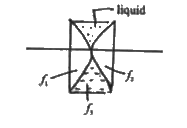 (i) `(1)/(f)=(n-1)((1)/(oo)+(1)/(r))` `(1)/(0.25)=(1.5-1)((1)/(r))` HENCE `r=0.5xx0.25=0.125m` `r=0.125m` (ii) When thin lenses are in contact, `(1)/(f)=(1)/(f_(1))+(1)/(f_(2))+(1)/(f_(3))` where, `(1)/(f_(3))=(n_(1)-1)((1)/(-r_(1))+(1)/(-r_(2)))` i.e.,`(1)/(f_(3))=(1.7-1)((-2)/(0.125))=(-1.4)/(0.125)` hence, `(1)/(f)=(1)/(0.25)+(1)/(0.25)+(-1.4)/(0.125)=(1+1-2.8)/(0.25)` i.e., `(1)/(f)=(0.8)/(0.25)` `THEREFORE` Focal LENGTH of the COMBINATION `=(0.25)/(-0.8)= -0.3125m`. |
|
| 15. |
Under the influence of a uniform magnetic field, a charged particle moves with constant speed v in a circle of radius r. The time period of revolution of the particle |
|
Answer» depends on v and not on r |
|
| 16. |
The physical quantity which has dimensional formula as that of ("Energy")/("mass"xx "lenth") is |
|
Answer» FORCE |
|
| 17. |
Four identical cells of emf E and and internal resistancer are to be connected in series . Supposeif one of the cellis connectedwrongly , the equivalent emf and effective internal resistance of the combination is |
|
Answer» 2E and 2r  If all are CONNECTED correctly, `E_("EFF")= 4E` `r_("eff")= 4r` Now `E_("eff") = 2E rArr r_("eff")= 4r` |
|
| 18. |
For the digital circuit given below, write the truth table showing outputs Y_1 and Y_2 for all possible inputs of A and B. |
Answer» SOLUTION :
|
|
| 19. |
आहार नली मूल रूप से मुख से कहाँ तक विकसितहै |
|
Answer» गुदा |
|
| 20. |
In the arrangement shown in figure , the current through 5Omega resistor is |
| Answer» Answer :A | |
| 21. |
Current I_(0) is flowing through a bent wire atobtoctod in z-x plane as shown in figure, then ointvecB.vec(dl) over the loop PQRS lying in the X-Y plane as shownin figure, due to the bent wire abcd |
|
Answer» `(mu_(0)I_(0))/8` `dy=l/2sec^(2)theta d theta` `8 int_(0)^((PI)/4) Bdycostheta+oint _(atobtoctod)vecB.vec(dl)=mu_(0)l_(0)` `int_(0)^((pi)/2) (8mu_(0)I_(0))/(4pix). (2l/2)/(sqrt(x^(2)+(l^(2))/4)).l/2 sec^(2)theta cos theta+oint_(atobtoctod)vecB.vec(dl)=mu_(0)I_(0)` `2/3 mu_(0)I_(0)+oint_(atobtoctod)vecB.dl=mu_(0)I_(0)` `oint_(atobtoctod) vecB.vec(dl)=mu_(0)I_(0)-2/3mu_(0)I_(0)=(mu_(0)I_(0))/3` 
|
|
| 22. |
A cup of tea cools from 65*5^(@)C in one minute in a room of 22*5^(@)C. How long will the same cup of tea to cool from 46*5^(@)C to 40*5^(@)C in the same room. (Choose the nearest value in min.) : |
|
Answer» 1 `(theta_(1)-theta_(2))/(t)=k[(theta_(1)+theta_(2))/(2)-theta_(0)]` where `theta_(0)` is temp. of surroundings. `:.""(65*5-32*5)/(1)=k[(65*5+62*2)/(2)-22*5]`. . . (i) Also `(46*5-40*5)/(t)=k[(46*5+40*5)/(2)-22*5]`. . . (ii) DIVIDING (i) by (ii) `t/2=(64-22*5)/(43*5-22*5)` `rArrt=4` min. Correct CHOICE is (d). |
|
| 23. |
Two points A and B are maintained at a potential of 7 V and -4 V respectively. The work done in moving 50 electrons from A to B is |
|
Answer» `8.80xx10^(-17)J` |
|
| 24. |
निम्न भौतिक राशियों में से कौन सी मूलभूत राशि नहीं है? |
|
Answer» ज्योति तीव्रता |
|
| 25. |
Electromagnetic radiation of wavelength lambda = 0.30 mu m falls on a photocell operating in the saturation mode. The corresponding spectra sensitivity of the photocell is J = 4.8mA//W. Find the yield of photoelectrons, i.e. the number of photoelectrons produced by each incident photon. |
|
Answer» Solution :Suppose `N` photons fall on the photocell PER sec. Then the power incident is `N(2picancelh c)/(LAMBDA)` This will GIVE rise to a photocurrent of `N(2picancelh c)/(lambda).J` which means that `N(2picancelh c)/(elambda).J` electrons have been emitted. THUS the number of photoelectrons produced by each photon is `w = (2picancelh c)/(elambda) = 0.0198~~0.02` |
|
| 26. |
In a house the temperature at the surface of a window is 25^(@)C The temperatuere outsideat the window surface is 5.0^(@)C .Heat is lost through the window via conduction, and the heat lost per second has a certain value. The temperature outside begins to fall, while the conditions inside the house remain the same. As a result, the heat lost per secondincreases. What is the temperatureat the outside window surface when the heat lost persecond doubles ? |
|
Answer» |
|
| 27. |
A solenoid of length T has N turns of wire closely spaced, each turn carrying a current i. If R is cross sectional radius of the solenoid, the magnetic induction at 'O' is. |
|
Answer» `(mu_0iN )/( 2 SQRT(R^2 +I^2))` |
|
| 28. |
A thin glass plate of thickness t(=lambda//3,lambda being the wavelength of incident light ) and refractive index mu =1.5 is inserted between one of the slits and the screen in Young's double slit experiment.If the intensity at a point on the screen equidistance from the slit is i, then |
|
Answer» intensity at the same POINT before INTRODUCTION of glass plate was 31/2 |
|
| 29. |
State radioactive decay law. Derive N=N_0e^(-lambdat)for a radioactive element |
|
Answer» Solution : Statement : In any RADIOACTIVE sample which undergoes `alpha m beta , GAMMA - `DECAY it is found thatthe number of nuclei undergoing the decay per unit time is proportional to the total number of nuclei in the sample. If N is the number of nuclei in the sample and `Delta N`UNDERGO decay in the time `Delta t`then `(Delta N)/(Delta t) prop N rArr (Delta N)/(Delta t) = lamda N` Where `lamda`is CALLED radioactive decay constant (or) disintegration constant The change in the number of nuclei in the sample is `dN = -Delta N` in time `Delta t ` Thus the rate of change of N is (in the limit `Delta tto 0` ) `(dN)/(dt) = - lamda N rArr (dN)/(N) = - lamda dt` Now integration on both sides `int_(N_0)^(N) (dN)/(N) = - lamda int_(t_0)^(t) dt` `ln N - ln N_0 = - lamda (t - t_0)` Here `N_0`is the number of radioactive nuclei in the sample at some arbitarary time `t_0`and N is the number of radioactive nuclei at any subsequent time t, but `t_0 = 0`, then `ln((N)/(N_0)) = - lamda t` `rArr (N)/(N_0)= e^(-lamda t)` `N = N_0 e^(-lamda t)` |
|
| 30. |
"Increasing the current sensitivity of a galvanometer may not increase its voltage sensitivity". Justify this statement . |
|
Answer» Solution :Current sensitivity=`(NAB)/K`, Voltage sensitivity= `(NAB)/(KR)` Current sensitivity can be increased by INCREASING the number of turns. But it increases the RESISTANCE of the coil (for a given AREA A). So the voltage sensitivity REMAINS the same. |
|
| 31. |
A plane monochromatic wave of natural light with intensity I_(0) falls normally on an opaque screen with round hole corresponding to the first Fresnel zone for the observation point P. Find the intensity of light at the point P after the hole was converd with two identical Polaroids whose principle directions are mutually perpendicular and the boundary beween them passes (a) along the diameter of the hole, (b) along the circumference of the circle limiting the first half of the fresnel zone. |
|
Answer» SOLUTION :Assume FIRST that there is no polaroid and the amplitude due to the entire hole which EXTENDS over the first Fresnel zone is `A_(1)` then, we know, as equal, `I_(0) = (A_(1)^(2))/(4)`, When the polaroid is introduced as shown above, eaxh half transits only the corresponding polarized light. if the full hole were coveres by one polaroid the ampliyude transmitted will be `(A_(1)//sqrt(2))`. Therefore the amplitude transmitted in the present case will be `(A_(1))/(2sqrt(2))` through either half. Since these transmitted waves are polarized in mutually perpendicualr planes, the total intensity will be `((A_(1))/(2sqrt(2)))^(2) + ((A_(1))/(2sqrt(2))^(2) = A_(1)^(2))/(4) = I_(0)`. (b) We interpert the problem to mean that the two polaroid pieces are separated along the circulference of the CIRCLE limiting the first half of the Fresnel zone. (This HOWEVER is inconsistent with the polaroids being identical in shape, however no other interpretaion makes sense.) From `(5.103)` and the previous problem we see that the amplitudes of the waves transmitted through the two parts is `(A_(1))/(2sqrt(2)) (1+i)`and `(A_(1))/(2sqrt(2)) (1-i)` and the intensity is `|(A_(1)^(2))/(2sqrt(2)) (1+i)|^(2) +|(A_(1))/(2sqrt(2)) (1-i)|^(2)` `= (A_(1)^(2))/(2) = 2I_(0)` 
|
|
| 32. |
Determine V_(0) and I_(d) for the network. |
| Answer» SOLUTION :`I=(E_(1) - E_(2) -V_(d))/( R) = (20- 4-0.7)/(2.2 xx 10^(2)) = 6.95` mA | |
| 33. |
If voltage across on X-ray tube is doubled, then energy of X-ray emitted by |
|
Answer» be doubled |
|
| 34. |
Two cells of internal resistance r_1 and r_2 and of same emf are connected in series across a resistor of resistance R. If the terminal potential difference across the call of internal resistance r_1 is zero , then the value of R is |
|
Answer» `R=2(r_(1)+r_(2))` TERMINAL p.d across 1 st cell is `V_(1)=E-Ir_(1)` GIVEN : `V_(1)=0` `rArrE-Ir_(1)=0` `E-((2E)/(R+r_(1)+r_(2)))r_(1)=0` `E=(2Er_(1))/(R+r_(1)+r_(2))` `R+r_(1)+r_(2)=2r_(1)` or `R=r_(1)-r_(2)` 
|
|
| 35. |
Our country's freedom is valuable. Why? |
|
Answer» Because the BRITISHERS were generous |
|
| 36. |
A small ball of volume V madeof paramagneticwith susceptibilitychiwas slowlydisplace along theaxisof a current-carryingcoil fromthe pointwherethe magneticinductionequalsB outto theregionwhere themagneticfield is thepractically absent. What amountof work was performedduringthis process ? |
|
Answer» Solution :`F_(X) = (vec(p_(m)) . vec(grad)) B_(x) = (chi B V)/(MUM mu_(0)) (dB)/(dx) = (chi V)/(2 mu_(0)) (dB^(2))/(dx)` This force is attractive and an equal force must be applied for balance. The WEOK doneby applied FORCES is, `A = int_(x = 0)^(x = L) -F_(x) dx = (chi V)/(2 mu_(0)) (-B^(2))_(x = 0)^(x = L) = (chi V B^(2))/(2 mu_(0))` |
|
| 37. |
Column II gives certain systems undergoing a process. Column I suggests changes in some of the parameters realated to the system. Match the statement in Column I to be appropriate process(es) from column II. |
|
Answer» (ii) WORK is done on the gas hence energy increases therefore q. (III) When mass DECREASES its energy increases. (iv) when current flows energy of magnetic of magnetic field is GENERATED therefore t. (B) work is done on the gas (C) mass is reduced and mass defect is converted into energy. (D) mass decreases due to mass defect. |
|
| 38. |
{:("Coulmn -I","Column-II"),("Spherical wave found"," location of new wave found"),("plane wave found ","line source"),("cylindrical wavefound"," point source at infinite "),("Huygen.s principle","point sourceat infinite distance "):} |
|
Answer» |
|
| 39. |
A plane em wave of frequency 30 MHz travels in free space along x direction. The electric field component of the wave at a particular component of the wave at a particular point of space and time E=6 v/m along y direction. It magnetic field component B at that point : |
|
Answer» `2xx10^(8) T` along Z direction |
|
| 40. |
भारत में केले का सबसे बड़ा उत्पादक राज्य कौन- सा है? |
|
Answer» मिजोरम |
|
| 41. |
Consider the situation shown in figure. Water (mu_w = 4/3) is filled in a beaker upto a height of 10 cm. A plane mirror is fixed at a height of 5 cm from the surface of water. Distance of image from the mirror after reflection from it of an object O at the bottom of the beaker is: |
|
Answer» 15cm |
|
| 42. |
Electrons in hydrogen atom jumps from orbit corresponding to n=infty to n=5. the energy of the emitted electron is: |
|
Answer» 3.4 eV |
|
| 43. |
The power of an achromatic convergent lens of two lenses is + 2 D . The power of convex lens is + 5 D . The ratio of dispersive power of convex and concave lens will be |
|
Answer» `5:3` |
|
| 44. |
In the year 2100, an astronaut wears an antique, but accurate, quartz wristwatch on a journey at a speed of 2.0xx10^(8)m//s. According to mission control in Houston, the trip lasts 12 hours. How long was the trip as measured on the watch? |
|
Answer» 6.7 HR |
|
| 45. |
(A): An electric heater is heated first by direct and then by alternating currents. For both the currents, the potential difference across the ends of the heater is the same. The rate of production of heat will be different in two cases. (R): The resistance of a coil in alternating cur- rent will be more than the resistance of a coil in direct current, hence heat produced in case of direct current will be high. |
|
Answer» Both 'A' and 'R' are true and 'R' is the CORRECT EXPLANATION of 'A'. |
|
| 46. |
When X-rays are produced |
|
Answer» heat is generated at the target |
|
| 47. |
The charge of cathode rays is |
|
Answer» positive |
|
| 48. |
डायटम, अमीबा, पैरामीशियम और युग्लीना किस वर्ग के है : |
|
Answer» प्रोटिस्टा |
|
| 49. |
The foundamental frequency of an open pipe is N Keeping the pipe vertical, it is submerged in water so foundamental frequency of air column is : |
|
Answer» Solution :For open orgam pipe fundamentle frequency `v_(0) = (V)/(2L)` = N for closed pipe ` v_(c) = (V)/(4 ((L)/(2)) ) = (V)/(2L) = N ` `therefore` correct CHOICE is (a) . |
|