

Saved Bookmarks
This section includes 7 InterviewSolutions, each offering curated multiple-choice questions to sharpen your Current Affairs knowledge and support exam preparation. Choose a topic below to get started.
| 1. |
Calculate the field due to a uniformly charged straightconductor of length 2j at a distance d along its perpendicular bisector. The charge on the conductor is q. |
|
Answer» |
|
| 2. |
Figure shows the graph of the x-co-ordinate of a particle going along the x-axis as function of time. Find the instantaneous speed of particle at t = 12.5 s (in m/s) |
|
Answer» 2m/s |
|
| 3. |
A dipole consists of two particles one with charg +1 mu C and mass 1kg and the other with charge 1 mu C and mass 2kg separated by a distance of 3m. For small oscillations about its equilibrium position, the angular frequency when, placed in a uniform electric field of 20k V/m is ____ 10^(-1) rad/s |
|
Answer» |
|
| 4. |
The below figure shows a potentiometer arrangement, where B_1 is the driving cell, B_2 is the cell whose emf is to be determined. AB is the potentiometer wire and G is the galvanometer. J is a sliding contact which can touch any point on AB. Which of the following are essential conditions for obtaining balance? |
|
Answer» The emf of `B_1` must be greater than the emf of `B_2` |
|
| 5. |
A sinusoidal voltage V(t) = 100 sin (500t)is applied across a pure inductance of L = 0.02 H. the current through the coil is |
|
Answer» 10 cos (500t). `V_(L)(t) = L (di)/(dt)` `int_(0)^(i) dt = int_(0)^(t) (V(t))/(L) dt` `I = int_(0)^(t) (1000sin(500t))/(0.02)dt ` `= (-100xx100)/(2)XX((cos(500t))/(500))` `i=-10cos (500t) +C` Here C is ZERO . |
|
| 6. |
Find the age of a wooden article, if it is known that its C^(14) isotope activity is one third of that of newly cut wood. |
|
Answer» |
|
| 7. |
(a) Draw a diagram showing the Young's arrangement for producing 'a sustained interference pattern. Hence obtain the expressionforthe width of the interference fringes obtainet in this patten. |
Answer» Solution :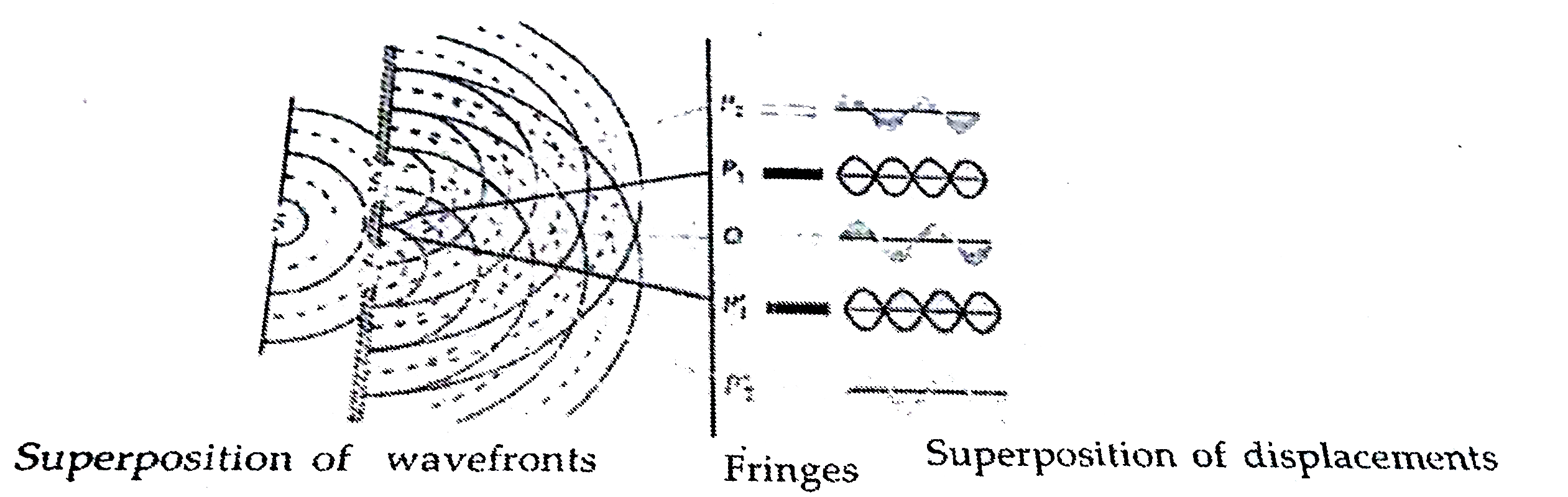 Consider a point P onthe screen at distance x from the centre O. The nature of the interference at the point P depends onpath difference. `p=S_(2)P-S_(1)P` From right-angled `DeltaS_(2)BPandDeltaS_(1)AP`, `S_(2)P^(2)-S_(1)P^(2)=[S_(2)B^(2)+PB^(2)]-[S_(1)A^(2)+PA^(2)]` `=[D^(2)+(x+(d)/(2))^(2)]-[D^(2)+(x-(d)/(2))^(2)]` or `(S_(2)P-S_(1)P)(S_(2)P+S_(1)P)=2xd` or, `S_(2)P-S_(1)P=(2xd)/(S_(2)P+S_(1)P)` In practice, the point P lies very close to O, THEREFORE `S_(1)P=S_(2)P=D`. Hence, `p=S_(2)P-S_(1)P=(2xd)/(2D)` or, `p=(xd)/(D)` For constructive interference, `p=(xd)/(D)=nlamda` or, `x=(nDlamda)/(d)"""where "n=0,1,2,3......` Clearly, the positions of various bright fringes are as follows : For, n=0, `x_(0)=0 ""Central bright fringe For, `n=1,x_(1)=(Dlamda)/(d)` ""First bright fringe `n=2,x_(2)=(2Dlamda)/(d)` ""Second bright fringe For, `n=n,x_(n)=(nDlamda)/(d)" nth bright fringe"` `p=(xd)/(D)=(2n-1)(LAMDA)/(2)` or, `x=(2n-1)(Dlamda)/(2d)` where n=1,2,3..... Clearly, the positions of various dark fringes are as follows: For, `n=1,x_(1)=(1)/(2)(Dlamda)/(d)"""First dark fringe"` For, `n=2,x_(2)=(3)/(2)(Dlamda)/(d)"""Second dark fringe"` For, `n=n,x_(n)=(2n-1)(Dlamda)/(2d)" nth dark fringe"`. Since, the central point O is equidistant from `S_(1)andS_(2)`, the path difference. P for it is ZERO. There will be a bright fringe at the centre O. But as we move from O upwards or downwards, alternate dark and bright fringes are formed. Fringe width : It is the separation between two successive bright or dard fringes,. Width of a dark fringe= Separation between two consecutive bright fringes `=x_(n)-x_(n-1)=(nDlamda)/(d)-((n-1)Dlamda)/(d)=(Dlamda)/(d)` Width of a bright fringe = Separation between two consecutive dark fringes `=x_(1)-x_(n-1)` `=(2n-1)(Dlamda)/(2d)-[2(n-1)-1](Dlamda)/(2d)=(Dlamda)/(d)`. Clearly, both the bright and dark fringes are of equal width. Hence, the expression for the fringe width in YOUNG's double slit experiment can be written as `beta=(Dlamda)/(d)`. |
|
| 8. |
Suppose you are given a chance to repeat the alpha-particle scattering experiment using a thin sheet of solid hydrogen in place of the gold foil. (Hydrogen is a solid at temperatures below 14 K.) What results do you expect? |
| Answer» Solution :If in Rutherford.s alpha-PARTICLE scattering experiment we USE a thin SHEET of solid hydrogen in place of GOLD foil then no large angle scattering of alpha-particles is possible. We know that nucleus of hydrogen atom is a proton having a mass of only `1.67 xx 10^(-27)kg`, whereas mass of alpha-particle is FOUR times the mass of proton `(6.64 xx 10^(-27)kg)`. As the scattering particle is more massive than the target nucleus, the alpha-particle would not bounce back even for a head-on collision. The situation is similar to a football colliding with a tennis ball at rest and in such a situation we do not expect large angle scattering. | |
| 9. |
In a standing wave pattern obtained in an open tube filled with Iodine, due to vibrations betweenfirst node, eleventh node is found to be 1 m when the temperature of iodine vapour is 352^@C. If thetemperature is 127^@C , the distance between consecutive nodes is (in centimeters) (approximately). |
|
Answer» |
|
| 10. |
Law of multiple proportion is valid for |
| Answer» Answer :A | |
| 11. |
In a transistor, give the relation between collector current, base current and emitter current. |
| Answer» SOLUTION :`I_(C)=I_(B)+I_(c)` | |
| 12. |
A ball is made of a material of density p where p_("oil") < p < P_("water") with p_("oil") and p_("water") representing the densities of oil and water, respectively. The oil and water are immiscible. If the above ball is in equilibrium in a mixture of this oil and water, which of the following pictures represents its equilibrium position ? |
|
Answer»
p oil is most LIGHTER while water most heavier. So correct CHOICE is (C). |
|
| 13. |
If a capacitor having capacitance of 600 muF is charged at a uniform rate of50(muC)/(s) . What is the time required to increase itspotential by 10 volt ? |
|
Answer» 500 s `Q = 6XX10^(-3) C` Now CURRENT I `= (50 muC)/(s) ` and `I= (Q)/(t)` `:. T=(Q)/(I) = (6xx10^(-3))/(50xx10^(-6))=(6000)/(50)=120 s ` |
|
| 14. |
In the system shown in figure, mass m is released from rest from position A. Suppose potential energy of m at point A with respect to point B is E. Volume of m is negligible and all surfaces are smooth. When mass m reaches at point B {:(,"column I","columnII",),((A),"Kinetic Energy of m",(P),E//3),((B),"Kinetic Energy of 2m ",(Q),2E//3),((C),"Momentum of m",(R),sqrt(4/3 mE)),((D),"Momentum of 2m",(S),sqrt(2/3 mE)),(,,(T),"None"):} |
|
Answer» When m REACHES point B: APPLYING momentum conservation in horizontal:`"" 0 = mv_1 + 2M (-v_2) implies v_1 = 2v_2` Applying ENERGY conservation: `-mgR + 0 + (1/2m v_1^2 - 0) + (1/2 2 m v_2^2 - 0) = 0 , 1/2 m (2v_2)^2 + 1/2 2 mv_2^2 = mgR`. `implies 3 mv_2^2 = mgR implies v_2 = sqrt((gR)/(3)) , v_1 = 2v_2 = 2sqrt((gR)/(3))` `K.E. "of" m = 1/2 m v_1^2 = 1/2 m(2sqrt((gR)/(3)))^(2) = 2/3 m gR = (2E)/3` `K.E "of" 2m = 1/2 2m v_2^2 = 1/2 2m (sqrt((gR)/(3)))^(2) = (m gR)/3 = E/3` Momentum of `m =m v_1 = m2 sqrt((gR)/3) = sqrt(4/3 m E)`, Momentum of `2m = 2V_2 = 2m sqrt((gR)/(3)) = sqrt(4/3 ME)` 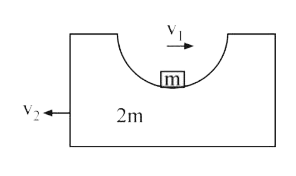
|
|
| 15. |
Tritium is an isotope of hydrogen whose nucleus triton decays , it would transform into He^3 nucleus . This does not happen .This is because |
|
Answer» Triton energy is LESS than that of a `He^3` nucleus |
|
| 16. |
A : Cyclotron does not accelerate electron. R : Mass of the electron is very small. |
|
Answer» Assertion is true, reason is true and reason is the CORRECT explanation for assertion. |
|
| 17. |
In Bohr's theory for hydrogen -like atoms |
|
Answer» if atomic number increases RADIUS of the orbit increases |
|
| 18. |
The figure represents the instantaneous picture of a transverse harmonic wave traveling along the negative x-axis. Choose the correct alternative(s) related to the movement of the nine points shown in the figure. The points moving upward is |
|
Answer» a |
|
| 19. |
What happens if an iron bar magnet is melted ? Does it retain its magnetism ? |
| Answer» SOLUTION :Melting POINT of IRON a greater than its Curle temperature , So iron bar is no more FERROMAGNETIC and does not RETAIN its magnetism. | |
| 20. |
The figure represents the instantaneous picture of a transverse harmonic wave traveling along the negative x-axis. Choose the correct alternative(s) related to the movement of the nine points shown in the figure. The stationary points is: |
|
Answer» o |
|
| 21. |
The materials which conduct electricity at zero resistance are called …………………. . |
| Answer» SOLUTION :SUPERCONDUCTORS | |
| 22. |
The figure represents the instantaneous picture of a transverse harmonic wave traveling along the negative x-axis. Choose the correct alternative(s) related to the movement of the nine points shown in the figure. The points moving downwards is |
|
Answer» o |
|
| 23. |
A sky wave with a frequency 55 MHz is incident on D-region of earth's atmosphere at 45^(@). The angle of refraction is (electorn density for D-region is 400 "electron"//cm_(3)) |
|
Answer» `60^(@)` Also, `mu=(sini)/(sinr)` or `i=r=45^(@)` |
|
| 24. |
The method of reducing chromatic aberration is called_____ |
| Answer» SOLUTION :achromatisation | |
| 25. |
For a given truth table A, Band C are input and Y is the output , then the funtional form of the circuit is |
|
Answer» `barA` 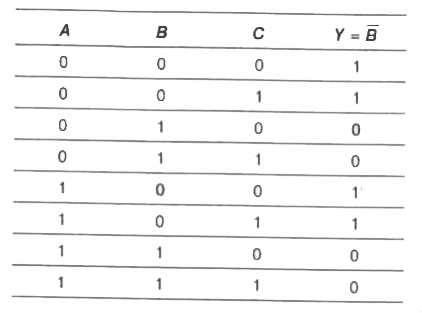 From above truth table, it is CLEAR that the function from of the CIRCUIT is `barB` i.e., `y = barB` |
|
| 26. |
If the magnetic field of an electromagnetic wave is given as B_(y)=2xx10^(-7)sin (10^(3)x+1.5xx10^(12)t) tesla, the wavelength of the electromagnetic wave is |
|
Answer» 0.314 MM |
|
| 27. |
A free electron was initially confined within a region with linear dimensions l=0.10nm. Using the uncertinty principle evaluate the time over which the width of the corresponding trin of waves becomes eta=10 time s as large. |
|
Answer» Solution :Initial uncertainty `Deltav OVERSET(~) gt (ħ)/(ml)`. With this incertainty the wave train WIL spread out to a distance `eta l` LONG in time `t_(0)~~etal//(ħ)/(ml)~~(etaml^(2))/(ħ)SEC.=8.6xx10^(6)sec~10^(-15)sec`. |
|
| 28. |
A condenser of capacity C is charged to a potential difference of V_1. The plates of the condenser are then connected to an ideal inductor of inductance L. The current through the inductor when thepotential difference across the condenser reduces to V_2 is :- |
|
Answer» `[(C(V_1-V_2)^2)/L]^(1/2)` `q=q_0 cos omegat` where `omega=1/sqrt(LC)` `therefore cos omegat=q/q_0=(CV_2)/(CV_1)=V_2/V_1(because q=CV)` ….(i) CURRENT through the inductor `I=(dq)/(DT)=d/(dt)(q_0cos omega t)=-q_0omega sin omegat` `|I|=CV_1 1/sqrt(LC) [1-cos^2 omegat]^(1//2)` `=V_1sqrt(C/L)[1-(V_2/V_1)^2]^(1//2)=[(C(V_1^2-V_2^2))/L]^(1//2)` {(USING (i))} |
|
| 29. |
A body starts from rest and moves with constant acceleration for t s. It travels a distance x_(1) in first half of time and x_(2) in next half of time, then |
|
Answer» `x_(2) = x_(1)` `x_(1) = (1)/(2) a t^(2)` from eqn (1) `RARR a t^(2) = x_(2) - (1)/(2) a t^(2)` `a t^(2) + (1)/(2) a t^(2) = x_(2)` `(3)/(2)a t^(2) = x_(2)` `3x_(1) = x_(2)` |
|
| 30. |
The magnifying power of a simple microscope can be increased if we use eye piece of ......... |
|
Answer» higher focal LENGTH Magnification (m) = `D/f` Where D = near POINT, f = focal length of lens. From this EQUATION it is clear that as f is smaller magnification is bigger. |
|
| 32. |
A uniformly magnetized bar of brittle steel is broken into two pieces, one twice as long as the other, and the pieces are fastend together at right angles to each other. How would the combination thus formed set itself under the action of the earth's magnetic force, if made to float on water ? |
|
Answer» |
|
| 33. |
The light ray is incident at an angle of 60^(@) on a prism of angle 45^(@). When the light ray falls on the other surface at 90^(@), the refractive index of the material of the prism mu and angle of deviation d are given by |
|
Answer» `MU=SQRT(2),d=30^(@)` |
|
| 34. |
When a magnet is pushed in and out of a circular coil C connected to a very sensitive galvanometer G as shown in the adjoining diagram with a frequency v , then |
|
Answer» CONSTANT deflection is observed in the galvanometer |
|
| 35. |
A force of 2.25 N acts on a charge of 15x10-4C. The intensity of electric field at that point is |
|
Answer» `150NC^(-1) |
|
| 36. |
Use the formula lambda_(m)T=0.29cmK to obtain the characteristic temperature ranges for different parts of the electromagnetic spectrum. What do the numbers that you obtain tell you? |
|
Answer» Solution :According to Wien.s displacement law, for a black body maintained at a temperature T K the WAVELENGTH `lambda_(m)` corresponding to maximum INTENSITY of radiation is given by the relation `lambda_(m)T=0.29cmK=0.29xx10^(-2)mK=2.9xx10^(-3)mK` `rArr""T=(2.9xx10^(-3))/(lambda_(m)" (in m)")K` If we consider `lambda_(m)=1mum=10^(-6)m," then T"=(2.9xx10^(3))/(10^(-6))=2900K` Similarly, temperatures for other VALUES of wavelength may also be found. These figures tells us the temperature range required for obtaining radiations of different regions of electromagnetic spectrum. As an EXAMPLE, if we example, if we want to obtain visible LIGHT of `6000Å=6xx10^(-7)m`, then `T=(2.9xx10^(3))/(6xx10^(-7))=4833K` |
|
| 38. |
Draw the diagram of the circuit arangement used for studying the 'input' and the 'output' characteristics of an n-p-n transistor inits CE configuration. Briefly explain how these two types of characteristics are obtained and draw these characteristics. (b) 'Define' the terms (i) Input resistance, (ii) Output resistance , (iii) Current amplification factor, for a given transistor. |
|
Answer» Solution :(a) N/A (i) The input resistance `r_i` of the TRANSISTOR in CE configuration is defined as the ratio of the small CHANGE in base -EMITTER voltage to the corresponding small change in the base current, when the collector-emitter voltage is kept fixed. Thus. `r_i[(DeltaV_BE)/(DeltaI_B)]_(V_(CE)="constant")`. (ii) The output resistance `r_0` of a transistor in CE configuaration is definded as the ratio of the small change in the collector-emitter voltage to the corresponding change in the collector current when the base current is kept constant. Thus, `r_0[(DeltaV_CE)/(DeltaI_C)]_(I_(B)="constant ")`. (ii) Current amplification factor `(beta)` : It is defined as the ratio of the change in collector current to the small change in base current at constant collector-emitter voltage `(V_CE)` when the transistor is in the acitve state. `beta_ac=[(DeltaI_C)/(DeltaI_B)]_(V_(CE)="constant")` |
|
| 39. |
Solve the previous problem for the cases of an isochoric, an isobaric and an isothermic process. |
|
Answer» Solution :For an isochoric process `S_2 - S_1 = m/M C_(MV) in (T_2)/(T_1)` For an isobaric process, `S_2 - S_1 m/M C_(MP) ln (T_2)/(T_1)`. For an isothermal process `S_2 - S_1 = m/M R ln (V_2)/(V_1)`. |
|
| 40. |
Amorphous solids do not have any definite_____form. |
|
Answer» |
|
| 41. |
Choose the correct alternative :(a) Alloys of metals usually have (greater/less) resistivity than that of their constituent metals.(b) Alloys usually have much (lower/higher) temperature coefficients of resistance than puremetals.(c) The resistivity of the alloy manganin is nearly independent of increases rapidly with increaseof temperature.(d) The resistivity of a typical insulator (e.g., amber) is greater than that of a metal by a factor of theorder of (10^22 / 10^3) . |
| Answer» SOLUTION : (a) greater (B) LOWER (c) nearly independent (d) `10^22` | |
| 42. |
Induction furnaces work on the principle of |
|
Answer» SELF induction |
|
| 43. |
What is the focal length of the combination if a lens of focal length - 70 c is brought in contact with a lens of focal length 150 cm? What is the power of the combination? |
|
Answer» Solution :Give: focal length of first lens `f_(1) = - 70 cm`, focal length of second lens, `f_(2) = 150` cm. Equation for focal length of lenses in contact. `((1)/(F) = (1)/(f_(1)) + (1)/(f_2))` SUBSTITUTING the values. `(1)/(F)=(1)/(-70)+(1)/(150)=-(1)/(70)+(1)/(150)` `(1)/(F)=(-150)/(70xx150)=(-50)/(70xx150)=-(80)/(10500)` `F = (-1050)/(8) = - 131.25 cm` As the focal lenght is negative, the COMBINATION of two lenes is a diverging system of lenses. The power of combination is. `P=(1)/(F)=(1)/(-1.3125)=-0.76` DIOPTER |
|
| 44. |
K.E. of body is increased by 300 percent, then percentage increase in linear momentum will be: |
|
Answer» Solution :Here `E_(K)=K.E=(L^(2))/(2I)` Where L = angular momentum `THEREFORE L=(2IxxE_(k))^(1//2)` % age increase = `((L_(2)-L_(1))/(L_(1)))xx100` `=(sqrt(E_(k_(2)))-sqrt(E_(k_(1))))/(sqrt(E_(k_(1))))xx100` `=(sqrt(400)-sqrt(100))/(sqrt(100))xx100` `=((20-10)/(10))xx100` `=100%` |
|
| 45. |
Monochromatic light of wavelength 589 nm is incident from air on a water surface. What are the wavelength, frequency and speed of (a) reflected, and (b) refracted light? Refractive index of water is 1.33. |
|
Answer» 444 nm |
|
| 46. |
Wavelenght of given light waves in air and in a medium are 6000 Å respectively. The critical angle is : |
|
Answer» `tan^(-1)((2)/(3))` `(1)/(sinC) = (6000)/(3000)` `(1)/(sinC) = (6)/(3) = (3)/(2)` `sin C = (2)/(3)` `C = sin^(-1) ((2)/(3))` |
|
| 47. |
Keeping the voltage of the charging source constant, what would be the percentage change in the energy stored in a parallel platecapacitor if the separation between its plates is decreased by 10%? |
| Answer» SOLUTION :11.1% INCREASE | |
| 48. |
Two point charges q_(1) and q_(2), of magnitude +10^(-8) C and -10^(-8) C, respectively, are placed 0.1 m apart. Calculate the electric fields at points A, B and C shown in figure. |
|
Answer» Solution :The electric field vector `E_(1A)` at A DUE to the positive charge `q_1`, points TOWARDS the right and has a magnitude `E_(1A)=(9 xx 10^(9)) xx (10^(-8))/((0.05)^(2))` `=3.6 xx 10^(4)NC^(-1)` 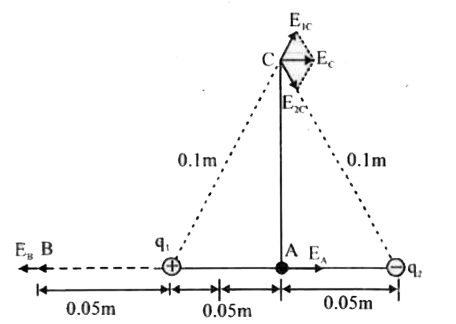 The electric field vector `E_(2A)` at A due to the NEGATIVE charge `q_(2)`, points towards the right and has the same magnitude. Hence the magnitude of the total electric field `E_A" at A is "E_(1A)+ E_(2A) =7.2 xx 10^(4) NC^(-1)`. `E_(A)` is directed towards the right. The electric field vector `E_(1B)` at B due to the positive charge `q_1`, points towards the left and has a magnitude, `E_(1B) =(9xx 10^(9)) xx (10^(-8))/((0.05)^(2))=3.6 xx 10^(2) NC^(-1)` The electric field vector `E_(2B)`, at B due to the negative charge `q_2`, points towards the right and has a magnitude `E_(2B)=((9 xx 10^(9)) xx (10^(-8)))/((0.15)^(2)) =4 xx 10^(3) NC^(-1)` The magnitude of the total electric field at B is `E_(B)=E_(1B)-E_(2B)=3.2 xx 10^(4) NC^(-1) E_(B)` is directed towards the left. The magnitude of each electric field vector at point C, due to charge `q_1 and q_2` is The directions in which these two vectors point are indicated in figure. The resultant of these two vectors is `E_(C)=E_(1) cos "" pi/3+E_(2) cos ""pi/3=9 xx 10^(3) NC^(-1) E_(C)` points towards the right. |
|
| 49. |
In amplitude modulation, carrier wave frequencies are….. Than that compared to those in frequency modulation |
|
Answer» lower |
|


