Saved Bookmarks
This section includes 7 InterviewSolutions, each offering curated multiple-choice questions to sharpen your Current Affairs knowledge and support exam preparation. Choose a topic below to get started.
| 1. |
The arrangement store energy in the………………………………………... (Magnetic field, Electric field, Electromagnetic field, Gravitational field) |
| Answer» SOLUTION :ELECTRIC FIELD | |
| 2. |
The current in the forward bias is known to be more (~mA) than the current in the reverse bias (~µA). What is the reason then to operate the photodiodes in reverse bias? |
|
Answer» Solution :Consider the case of an n-type SEMICONDUCTOR. Obviously, the majority carrier density (n) is considerably larger than the MINORITY hole density p (i.e., n >> p). On illumination, let the excess electrons and HOLES generated be `Deltan` and `DELTAP` respectively. `n. = n + Deltan` `p. = p + Deltap` Here n′ and p′ are the electron and hole concentrations* at any particular illumination and n and p are carriers concentration when there is no illumination. Remember `Deltan= Deltap`and n >> p. Hence, the fractional change in the majority carriers (i.e., ∆n/n) would be much less than that in the minority carriers (i.e., ∆p/p). In general, we can state that the fractional change due to the photo-effects on the minority carrier dominated reverse bias current is more easily measurable than the fractional change in the forward bias current. Hence, photodiodes are preferably used in the reverse bias condition for measuring light INTENSITY. |
|
| 3. |
The (x, y) coordinates of the corners of a square plate are (0,0), (L,0), (L,L) and (0,L). The edges of the plate are clamped and transverse standing waves are set-up in it. If u(x,y) denotes the displacement of the plate at the point (x,y) at some instant of time, the possible expression(s) for u is (are) (a=positive constant) |
|
Answer» `a cos (pix// 2L) cos (pix//2L)` |
|
| 4. |
What is an amplifier? Draw the simple circuit of transistor amplifier in CE mode. |
Answer» SOLUTION :Amplifier: Amplifier is a device which is used for increasing the amplitude variation of alternating voltage or CURRENT or power. 
|
|
| 5. |
A ray is incident at an angle of incidence I on one surface of a prism of small angle A and emerges normally from the opposite face. If the refractive index of the prism material is mu, then angle of incidence is nearly equal to: |
|
Answer» `A/mu` |
|
| 6. |
During an adiabatic process, the pressure of a gas is found to be proportional to the cube of its absolute temperature. What is the value of (C_p)/(C_v) for the gas ? |
|
Answer» 2 |
|
| 7. |
A long thin flat sheet has a uniform surface charge density sigma. The magnitude of the electric field at a distance .r. from it is given by |
|
Answer» `sigma//epsi_(0)` |
|
| 8. |
The adjoining figure shows the connection of potentiometer experiment to determine internal resistance of a leclanche cell. When the cell is an open circuit the balancing length of the potentiometer wire is 3 .4m and on closing the key K_2 the balancing length becomes 17.m. If the resistance R through which current is dream is 10 Omega then the internal resistance of the cell is: |
|
Answer» `0.1 OMEGA` |
|
| 9. |
If energy of electron in first orbit of H-atom is - y then what will be its energy in fourth excited orbit ? |
|
Answer» `-(y)/(25)` `:.(E_(5))/(E_(1))=(1)/(25)` [ `:.` For fourth excited STATE n=5] `:.E_(5)=(1)/(25).(-y)=-(y)/(25)[:.E_(1)=-y]` |
|
| 10. |
Select the correct option about the friction between the two bodies |
|
Answer» Static FRICTION is always greater than kinetic friction |
|
| 11. |
Assertion (A) : A double convex lens (n_(g)=1.5) has a focal length of 10 cm in air. When the lens is immersed in a medium of refractive index n_(m)=(4)/(3), its focal length becomes 40 cm. Reason (R ) : (1)/(f)=((n_(g))/(n_(m))-1)((1)/(R_(1))-(1)/(R_(2))) |
|
Answer» If both ASSERTION and REASON are true and the reason is the CORRECT explanation of the assertion. On simplification, we get `f=+40 CM` |
|
| 12. |
Consider an arbitrary electrostatic field configuration A small test charge is placed at a null point ( i.e., where vec(E) = 0) of the configuration. Show that the equilibrium of the test charge is necessarily unstable. |
|
Answer» Solution :Let us assume the free charge to remain in stable equilibrium. Under this CONDITION the test chargewould return to its original positive of neutral point when deflected SLIGHTLY in any direction. This implies that all the field linear near the neutral point are directed towards it. This proves the existence of inward bound electric flux ASSOCIATED with the imaginary Gaussian surface SURROUNDING the point. But according to Gauss' theorem the flux associated with a closed surface in the absence of any enclosed charge is zero. Hence our assumption was not correct, i.e., the free charge should remain in UNSTABLE equilibrium. |
|
| 13. |
Use Kirchhoff's rules to determine the potential difference between the points A and D when no current flows in the arm BE of the electric network shown in the Fig. |
|
Answer» Solution : As per question no current flows in the ARM BE of ELECTRIC CIRCUIT, so a constant current I flows along AFEDCBA as shown in above FIG. Now applying Kirchhoff.s loop rule for AFEBA, we have -2I +1 -3I +3 +6=0`rArr 5I = 10 `or I = 2 A Now considering the path AFED, we have `V_A - 2I + 1 - 3I = V_D rArr V_A - V_D = 5I - 1 = 5 xx 2 - 1 = 10 - 1 = 9 V` |
|
| 14. |
(a) What do you mean by Hysteresis ? Explain. (b) Discuss some uses of the study of hysteresis studies. |
|
Answer» Solution :(a) Hysteresis. The LAGGING of intensity of MAGNETISATION behind the magnetising field is called hysteresis. To explain term hysteresis, suppose a bar of iron is magnetised slowly. The intensity of magnetisation M increases with increase in the strength of magnetising field along OA as shown in the figure. At A, any further increase in H does not PRODUCE any increase in M and therefore, corresponding to point A, the bar has acquired a state of magnetic saturation. If the magnetising field is now decreased slowly, the intensity of magnetisation also decreases but corresponding to point B when H becomes zero the intensity of magnetisation does not become zero. The value of intensity of magnetisation retained by the magnetic material, even when the magnetising field is reduced to zero is called its retentivity or remanent magnetism or residual magnetism. Thus, OB represents the retentivity of the material under study. If now the direction of magnetising field is reversed, the intensity of magnetisation reduces along BC till it becomes zero at C. Thus to reduce the residual magnetism to zero, magnetising filed equal to OC has to be applied in reverse direction. The value of the reverse magnetising field which is to be applied to the magnetic material so as to reduce the residual magnetism to zero is called its coercivity. 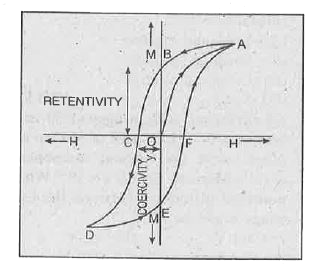 When the magnetising field is further increased in reverse direction, the intensity of magnetisation increases along CD till corresponding to point B, it again acquires saturation value symmetrical to point A. On increasing the field again, the intensity of magnetisation follows the path DEFA, and the closed curve ABCDEFA is obtained for complete cycle of magnetisation. This closed curve is known as hysteresis loop. On repeating the process, the same closed curve is obtained again and again but portion OA is never obtained. Corresponding to point B, H is zero but M has still some finite value and becomes zero after increasing H in reverse direction. Therefore, intensity of magnetisation does not become zero on making magnetising field zero but does so a little and this effect is called hysteresis. (b) Uses. When a ferromagnetic substance is taken over a complete cycle of magnetisation, the energy spent per unit volume is numerically equal to the area of the hysteresis loop. 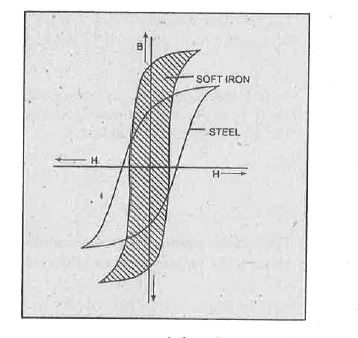 1. The shape of the hysteresis loop is characteristic of the magnetic materials. For example, for soft iron, the hysteresis loop is narrow and large in height, while that for steel, it is quite wide and small in height, while that for steel, it is quite wide and small in height, [as shown in the fig.] The area of hysteresis loop for soft iron is found to be much smaller than for steel. Due to this, the loss of energy in case of soft iron bar will be very small as compared to that in case of steel, when both are taken over complete cycle of magnetisation. On account of this, soft iron is used to make the core of transformers and generators. Silicon, iron and mumetal (76% nickel, 17 % iron and small percentage of copper and chromium) also POSSESS narrow hysteresis loop and can be used to make the core of a transformer. 2. Due to high value of coercivity and fairly large value of retentivity, steel is used to make permanent magnets. The area of hysteresis loop is large for steel but it is of no consideration as a permanent magnet has never to be taken through a cycle of magnetisation. Materials suitable for making permanent magnets are cobalt steel (containing cobalt, tungsten and carbon) chromium, steel, tungsten steel. The alloy alnico (54% iron, 18% nickel, 10% aluminium, 12% cobalt, and 6% copper) is also very suitable for making permanent magnets. The only disadvantage is that alnico is brittle. 3. For soft iron, coercivity is very small and area of hysteresis loop is very small. Because of these characteristics soft iron is an ideal material for making ELECTROMAGNETS. |
|
| 15. |
A convex lens |
|
Answer» is thicker at the edge than at the MIDDLE |
|
| 16. |
Estimate the induction of the magnetic field of a pulsar taking into account that for ordinary stars the field induction is of the order of 10^(-5) to 10^(-4) T |
|
Answer» |
|
| 17. |
Two radioactive substance A and B have decay constants 5 lambda and lambda respectively. At t=0 they have the same number of nuclei. The ratio of number of nuclei of nuclei of A to those of B will be (1/e)^(2) after a time interval |
|
Answer» `4lambda` At t=0, `(N_0)_A =(N_0)_B` At TIME t, `N_A/N_B=(1/e)^2` According to radioactive decay, `N/N_0=e^(-lambdat)` `THEREFORE N_A/((N_0)_A)=e^(-lambda_A t)`…(i) and `N_B/((N_0)_B )=e^(-lambda_B t)` ....(ii) Divide (i) by (ii) , we GET `N_A/N_B=e^(-(lambda_A-lambda_B)t)` or `N_A/N_B=e^(-(5lambda-lambda)t)` or `(1/e)^2 = e^(-4 lambdat) ` or `(1/e)^2 =(1/e)^(4 lambdat)` `rArr 4lambdat=2 ` or `t=2/(4lambda)=1/(2lambda)` |
|
| 18. |
A radioactive nucleus [initial mass number A and atomic number Z] emits 3 alpha-particles and 2 positrons. The ratio of number of neutrons to that of protons in the final nucleus will be |
|
Answer» `(A-Z-8)/(Z-4)` |
|
| 19. |
Motion of a conductor in a magnetic field induces an emf across its ends. Write an expression for the emf induced across the ends of a conductor moving right angles to a uniform magnetic field. |
| Answer» SOLUTION :`EPSILON BLV` | |
| 20. |
Assertion (A) : Radioactive nuclei emit beta- particles whose charge and rest mass are exactly same as that of electrons . Reason (R) : Electrons exists inside the nucleus . |
| Answer» Solution :ELECTRONS do not exist in nucleus . At the time of `beta` - decay , a NEUTRON is transformed into a PROTON and ELECTRON comes out as `beta`- PARTICLE. | |
| 21. |
S.H.M. wave is representedby y = 0.02 sin ( x + 50 t ) in C.G.S system then wave velocity will be |
|
Answer» Solution :The given equation is `y = 0.02 sin[x + 50T] ` REARRANGING` y = 0.02sin2pi[x/(2pi) + (50t)/(2pi)]` ` y = 0.02 sin((8pi)/3) (300T +x)` |
|
| 22. |
A lift is moving down with acceleration a. A man in the lift drops a ball inside the lift. The acceleration of the ball as observed by the man in the lift and a man standing stationary on the around are respectively : |
|
Answer» g,g |
|
| 23. |
In the figure below is : (i) the emitter, (ii) the collector forward or reverse biased ? Justify. |
|
Answer» SOLUTION :It is a n-p-n TRANSISTOR , so here `(i)` Emitter is reverse biased. `(ii)` COLLECTOR is reverse biased. 
|
|
| 24. |
The gravitational attraction between electron and proton in a hydrogen atom is weaker than the coulomb attraction by a factor of about 10^(-40). An alternative way of looking at this fact is to estimate the radius of the first Bohr orbit of a hydrogen atom if the electron and proton were bound by gravitational attraction. You will find the answer interesting. |
|
Answer» Solution :`v=(me^(4))/((4pi)^(3)epsilon_(0)^(2)(h//2pi)^(3))[(1)/((n-1)^(2))-(1)/(n^(2))]=(me^(4)(2n-1))/((4pi)^(3)epsilon_(0)^(2)(h//2pi)^(3)n^(3))` Orbital frequency `v_(C)=(v//2pir)." In BOHR MODEL v"=(n(h//2pi))/(mr), and `r=(4pi epsilon_(0)(h//2pi)^(2))/(me^(2))n^(2)`. This GIVES `v_(c)=(n(h//2pi))/(2pinv^(2))=(me^(4))/(32pi^(3)epsilon_(0)^(2)(h//2pi)^(3)n^(3))` which is same as v for LARGE n. |
|
| 25. |
If the electric flux entering and leaving an enclosed surface respectively is phi _1 and phi_2 the electric charge inside the surface will be : |
|
Answer» `(phi_2 - phi_1)/epsilon_0` |
|
| 26. |
Derive an expression for the magnetic moment (vecmu) of an electron revolving around the nucleus in terms of its angular momentum (vecl). What is the direction of the magnetic moment of the electron with respect to its angular momentum ? |
|
Answer» Solution :We have`mu = iA` ` = (e.v)/(2pir).pir^(2)` ` = (evr)/(2)` `L = mvr` `VR = (l)/(m)` `vecmu = (-evecl)/(2m)` The direction of `vecmu` is opposite to that of `VECL` because of the negative charge of the ELECTRON. |
|
| 27. |
The pair of equations y=0 and y=-7 has |
|
Answer» ONE solution |
|
| 28. |
In an amplitude modulated wave for audio-frequency of 500 "cycles" // "second", the appropriate carrier frequency will be: |
|
Answer» `50 "CYCLES" // s` |
|
| 29. |
In a galvanometer there is a deflection of one divisions per mA. The internal resistance of the galvanometer is 80Omega. If a shunt of 2.5Omega is connected to the galvanometer and there are 50 divisions in all, one the scale of the galvanometer, what maximum current can this galvanometer read? |
|
Answer» |
|
| 30. |
Graphically represent the variationof electric potential and electric field due to point charge with respect to the distance from the point charge. |
Answer» Solution :For a POINT charge `V prop (1)/(r ), E prop (1)/(r^(2))` 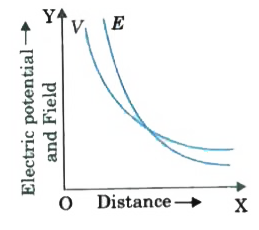
|
|
| 31. |
The conductivity of an intrinsic semiconductor is very, low, why ? |
| Answer» Solution :An INTRINSIC SEMICONDUCTOR has -a very SMALL concentration of FREE electrons and holes `(approx16^10m^-3)` so, it ,has low conductivity. | |
| 33. |
Which among the curves shown in figure cannot possibly represent electrostatic field lines? |
| Answer» Solution :Only (c) is right, the REST cannot represent ELECTROSTATIC field lines. (a) is WRONG because field lines must be normal to a conductor. (b) is wrong because field lines cannot START from a negative CHARGE. (d) is wrong because field lines cannot intersect each other. (e) is wrong because electrostatic field lines cannot form closed loops. | |
| 34. |
Unpolarised light is incident on a plane surface of glass of glass of refractive index n at angle i. If the reflected light gets totally polarised, write the relation between the angle i and refractive index n. |
| Answer» Solution :When the reflected LIGHT GETS TOTALLY POLARISED, `tani=n` where n is the refractive INDEX of glass. | |
| 35. |
Given a vector vac A =3hati-4hat j . Which of the following is perpendicular to it ? |
|
Answer» 3`HAT i` |
|
| 36. |
Water rises to a height of 10 cm in a capillary tube and mercury falls to a depth of 3.42 cm in the same capillary tube. If the contact angle for mercury and surface tension of water and mercury is |
|
Answer» `1:0.15` or `S=(hr rho g)/(2 cos theta) implies S prop (h rho)/(cos theta)` `:. S_(w)/S_(Hg)=h_(1)/h_(2)XX(cos theta_(2))/(cos theta_(1))xxrho_(1)/rho_(2)` `=10/((-3.42))xx(cos 135^(@))/(cos 0^(@))xx1/13.6` `S_(w)/S_(Hg)=10/3.42xx0.707/13.6=1/6.5` |
|
| 37. |
In a simple microscope, if the final image is located at 25 cm from theeye placedclose to the lens, then magnifying power is |
|
Answer» `(25)/(f)` |
|
| 38. |
When two cells of different emf's are connected in series to an external resistance the current is 5A. When the poles of one cell are interchanged, the current is 3A. The ratio of emf's of two cell is |
| Answer» ANSWER :C | |
| 39. |
What is the sum of co-efficient of absorption, reflection and transmission of a body |
|
Answer» a)5 |
|
| 40. |
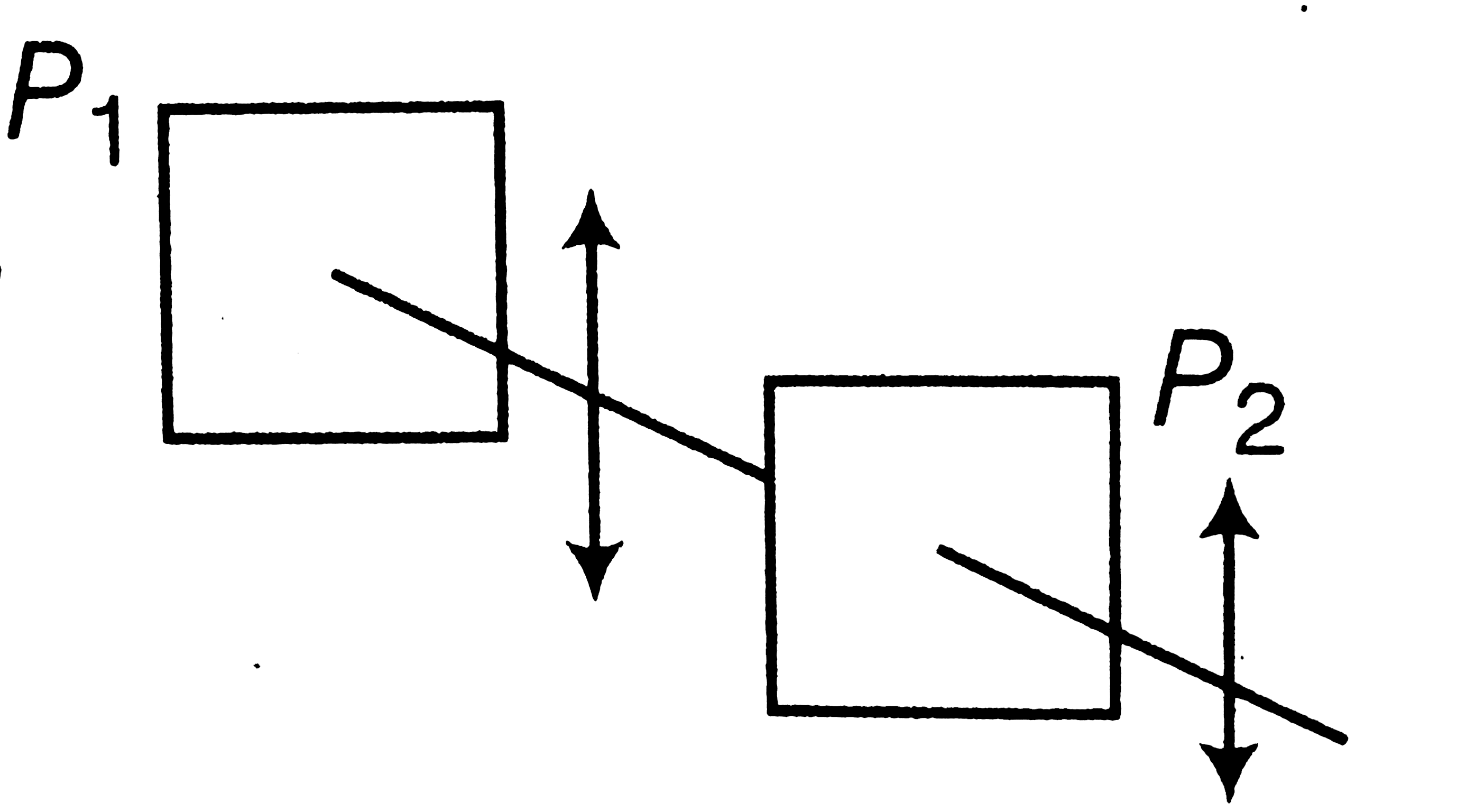
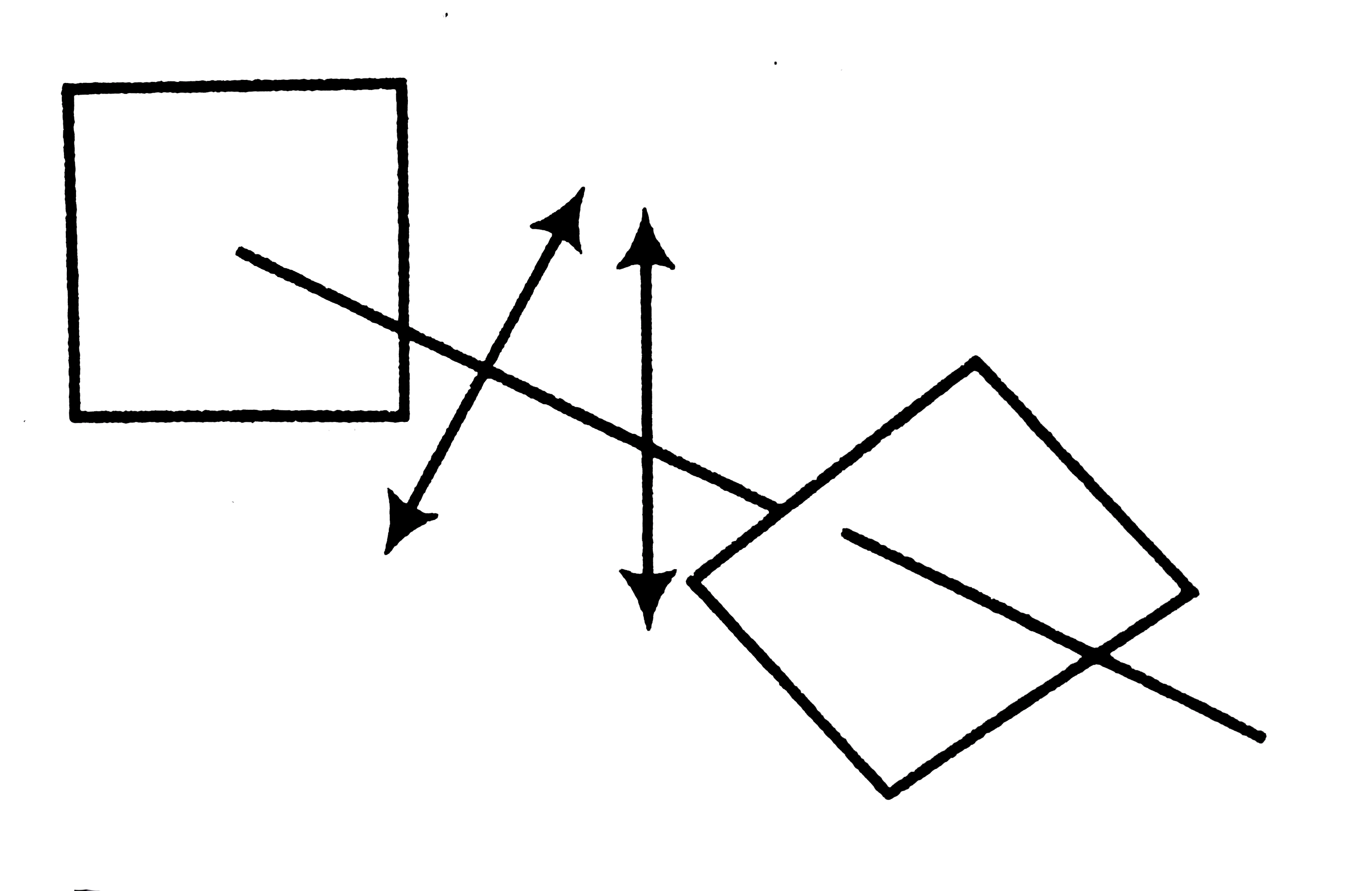
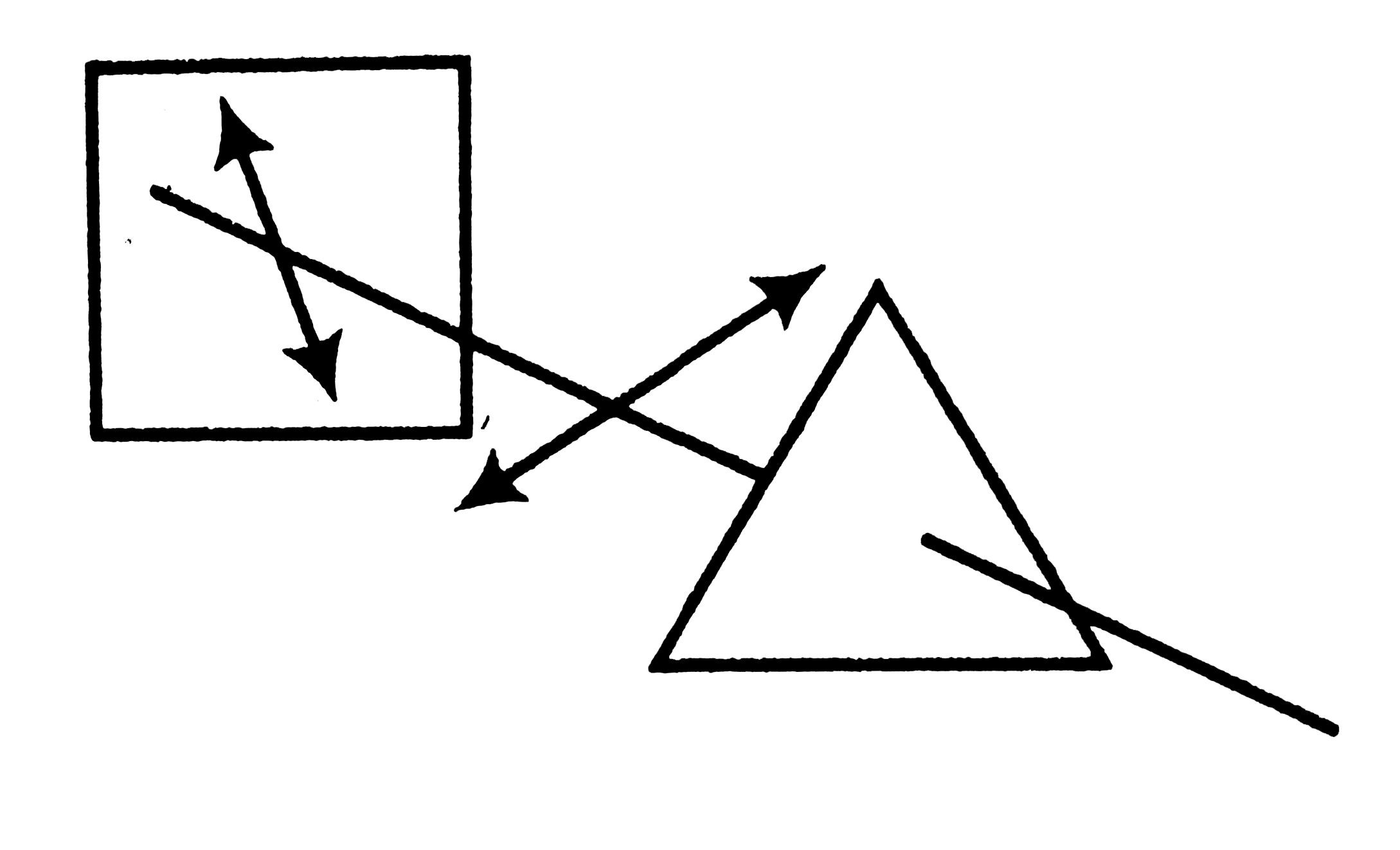
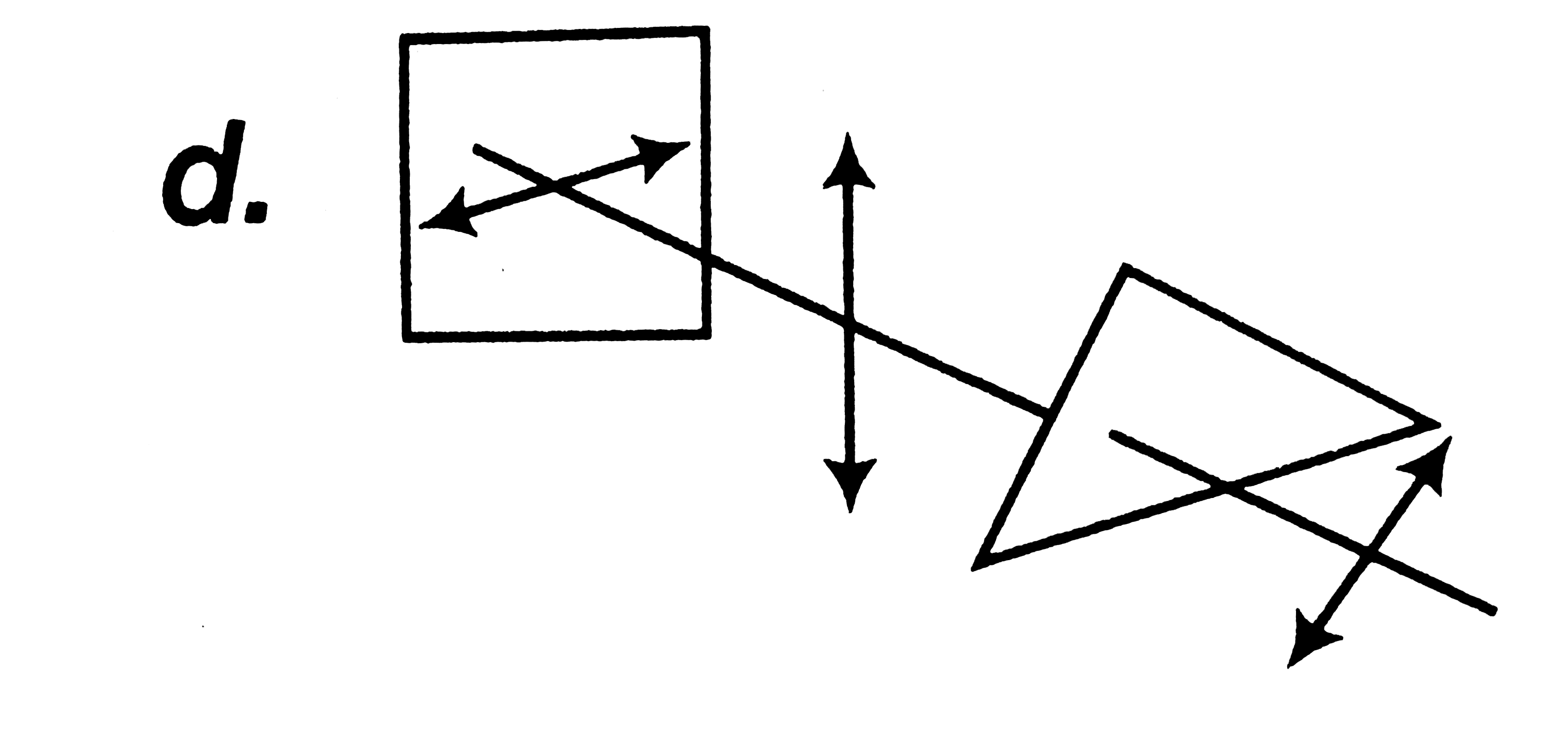
When light passes through two polaroids P_(1) and P_(2), then transmitted polarisation is the component parallel to the polaroid axis. Which of the following is correct? |
|
Answer»

|
|
| 41. |
What are application of matter waves ? |
| Answer» Solution :The ELECTROMAGNETIC WAVES are PRODUCED by accelerating CHARGED particles . | |
| 42. |
A car moving with a speed of 50 km/hr can be stopped by brakes after at least 6m.If the same car is moving at a speed of 100 km/hr the minimum stopping distance is |
|
Answer» 12 m |
|
| 43. |
There were 100 droplets of mercury of 1 mm diameter on a glass plate. Subsequently they merged into one big drop. How will the energy of the surface layer change? |
|
Answer» Solution : The TOTAL surface AREA of all the droplets is `S_(0)=400 pi r^(2)=` `100 pid^(2)` their total volume is `V_(0)= 100pi a^(3)//6`. After the droplets merge, the volume remains unchanged, but the surface area decreases: `V=pi D^(3)//6=V_(0),S=piD^(2)`.From the condition of EQUALITY of the volumes, find the DIAMETER of the large drop: `(100 pi d^(3))/(6)=(piD^(3))/(6)`, where `D=d^(3)sqrt(100)` The surface area of the large drop is `s=pid^(2)""^(3) sqrt(10^(4))`. The decrease in the surface layer energy corresponding to the decrease in the surface area of `DeltaS=S_(theta)-S= pid^(2)(10^(2)-10^(4//3))` is `Delta_("sur")=alpha DeltaS~~ sigma DeltaS=pi sigma d^(2)(10^(2)-10^(4//3))` |
|
| 44. |
The current flowing through an inductor of self inductance L is continuously increasing plot a graph showing the variation of induced emf versus (dI)/(dt) |
Answer» Solution :INDUCE emf VERSUS `(dI)/(DT)e=-L(dI)/(dt)` 
|
|
| 45. |
The acceleration of any electron due to the magnetic fields is |
|
Answer» `3.14xx10^(14)m//s^(2)` |
|
| 46. |
चाय कौन- से प्रकार की कृषि है? |
|
Answer» रोपण कृषि |
|
| 47. |
How did Bhagat Singh react when he noticed the fear in the magistrate's eyes? |
|
Answer» He was proud |
|
| 48. |
Which of the following statements are correct. (a) Electric lines of force are just imaginary lines (b) Electric lines of force will be parallel to the surface of conductor (c ) If the lines of force are crowded, then field is strong (d) Electric lines of force are closed loops |
|
Answer» both a & c |
|
| 49. |
As per Curie's law the magnetisation of a paramagnetic substance is inversely proportional to the absolute temperature but magnetisation of a diamagnetic substance is directly proportional to the absolute temperature. |
| Answer» SOLUTION :False - Magnetisation of a DIAMAGNETIC MATERIAL is INDEPENDENT of temperature. | |
| 50. |
Some amount of radioactive substance (half life =10 days) is spread inside a room and consequently the level of radiation becomes 50 times the permissible level for normal occupancy of the room. After how many days the room will be safe for occupation ? |
|
Answer» 45.56 days `R/R_(0)=1/(50) or N/N_(0)=1/(50) or e^(-lambdat)=(1)/(50)` or `lambdat=log_(e) 50` `or t=(log_(e)50)/(lambda) =(log_e 50 XX T)/(log_(e) 2)` `or t=(1.6990)/(0.3010) xx 10" days "=56.45 days` |
|