

Saved Bookmarks
This section includes 7 InterviewSolutions, each offering curated multiple-choice questions to sharpen your Current Affairs knowledge and support exam preparation. Choose a topic below to get started.
| 1. |
a के किस मान के लिए x=1,y=3 समीकरण 2x−5y=a का एक हल है? |
|
Answer» 13 |
|
| 2. |
A parallel plate capacitor is charged to a potential difference of V volts. After disconnecting the charging battery the distance between the plates of the capacitor is increased using an insulating handle. As a result the potential difference between the plates |
|
Answer» CHARGE and POTENTIAL DIFFERENCE |
|
| 3. |
Statement I:A beam of light rays has been reflected from a rough surface. Statement II: Amplitude of incident and reflected rays would be different. |
|
Answer» Statement is TRUE, Statement II is True, Statement II is correct explanation for Statement I |
|
| 4. |
The volume V of a liquid crossing through a tube is related to the area of cross-section A,velocity v and times t as Valpha A^(a) v^(b) t^(c )which of the following is correct |
|
Answer» `a NE B ne C ` |
|
| 5. |
If the wavelength of light is 4000^@A, then the number of wave in 1 mm length will be: |
|
Answer» 25 |
|
| 6. |
The current through 10Omega resister in the figure is approximately |
|
Answer» 0.1A |
|
| 7. |
A ray PQ is incident normally on the face AB of a triangular prism of refracting angle 60°, made of a transparent material of refractive index 2/sqrt(3) , as shown in Fig. Trace the path of the ray as it passes through the prism. Also calculate the angle of emergence and angle of deviation. |
Answer» Solution :A TRACE of PATH of the ray through the prism is shown in Fig. 9.80. Here at first face AB of the prism `anglei =0` and hence, `angler_(1) =0^(@)` too. At the second face AC, the ray subtends an angle `angler_(2) = angleA - angler_(1) = 60^(@) - 0^(@) = 60^(@)`  As refractive index of prism `n=2/sqrt(3)`hence critical angle for prism-air interface is: `i_( c) = sin^(-1)(1/n) = sin^(-1)(sqrt(3/2)=60^(@)` Thus, while UNDERGOING refraction at second face of prism, the emergent ray RS travels just along the face AC so that angle of emergence `anglee = 90^(@)` . Moreover angle of deviation `delta =angle(TRS) = 30^(@)` |
|
| 8. |
Electrons are ejected from a metallic surface when light with a wavelength of 6250 Å is used. If light of wavelength 5250 Å is used instead, |
|
Answer» there will not be any photoemission |
|
| 9. |
Demostrate that molar heat capacity of a crystal at a temperature Tlt Theta, where Theta is the Debye temperature, is defined by Eq. (6.4f) |
|
Answer» Solution :We use the formula (6.4d) `U= 9R Theta[(1)/(8)+((T)/(Theta))^(4) int_(0)^(Theta//T)(x^(3)DX)/(e^(x)-1)]` `= 9 R Theta[(1)/(8)+{int_(0)^(OO)(x^(3)dx)/(e^(x)-1)}((T)/(Theta))^(4)-((T)/(Theta))^(4) int_(0)^(oo) int_(Theta//T)^(oo)(x^(3)dx)/(e^(x)-1)]` In the LIMIT `Tlt lt Theta`, the third term in the bracket is exponentially small together with its derivatives. Then we can drop the last term `U= Const+(9R)/(Theta^(3))T^(4) int_(0)^(oo) (x^(3)dx)/(e^(x)-1)` Thus `C_(v)=((delU)/(delT))_(v)=((delU)/(delT))_(Theta)=36R(T/(Theta))^(3) int_(0)^(oo) (x^(3)dx)/(e^(x)-1)` Now from the table in the book `int_(0)^(oo)(x^(3)dx)/(e^(x)-1)=(pi^(4))/(15)`. Thus `C_(v)=(12pi^(4))/(5)((T)/(Theta))^(3)` Note: Call the `3^(rd)` term in the bracket above- `U_(3)`. Then `U_(3)=((T)/(Theta))^(4) int_(Theta//T)^(oo)(x^(3))/(2 sin h(x//2)).e^(-x//2)dx` The maximum value of `(x^(3))/(2 sin h(x)/(2))` is a finite+ve qauntity `C_(0)` for `0 le x lt oo`. Thus `U_(3) le 2C_(0)((T)/(Theta))^(4)e^(-Theta//2T)` we see that `U_(3)` is exponentially small as `T rarr 0`. So is `(dU_(3))/(dT)`. |
|
| 10. |
Uniformly polarised dielectric has ...... of induced charge. |
|
Answer» linear charge density |
|
| 11. |
Two long straight wires with equal cross-sectional radii a are located parallel to each other in air. The distance between their axes equal b. Find the mutual capacitance of the wires per unit length under the condition b gt gt a. |
|
Answer» `C~~piepsilon_(0)//LN(b//a)` |
|
| 12. |
A bar magnet of pole strength (m) is divided into two equal parts by cutting it perpendicular to its length . The pole strength of either pieces will be : |
|
Answer» ZERO |
|
| 14. |
The coefficient of friction for an inclined plane and a biock is (1)/sqrt(3)what is the acceleration of the block when angle of inclination of the plane is 30^(@) ? |
|
Answer» `sqrt(3)ms^(-2)` `=(g)/(2)-(g)/(2)=zero` (c) is the choice |
|
| 15. |
When a bar magnet is placed on the axis of a coil with north pole facing the coil, face of coil towards the magnet behaves like ____ |
|
Answer» a north pole There will not be any current through the coil and so face of coil, facing magnet will not behave like any magnetic pole. |
|
| 16. |
Classically, an electron can be in any orbit around the nucleus of an atom. Then what determines the typical atomic size? Why is an atom not, say, thousand times bigger than its typical size? The question had greatly puzzled Bohr before he arrived at his famous model of the atom that you have learnt in the text. To simulate what he might well have done before his discovery, let us play as follows with the basic constants of nature and see if we can get a quantity with the dimensions of length that is roughly equal to the known size of an atom (~ 10^(-10)m). (a) Construct a quantity with the dimensions of length from the fundamental constants e, m_e, and c. Determine its numerical value. (b) You will find that the length obtained in (a) is many orders of magnitude smaller than the atomic dimensions. Further, it involves c. But energies of atoms are mostly in non-relativistic domain where c is not expected to play any role. This is what may have suggested Bohr to discard c and look for ‘something else’ to get the right atomic size. Now, the Planck’s constant h had already made its appearance elsewhere. Bohr’s great insight lay in recognising that h, m_e, and e will yield the right atomic size. Construct a quantity with the dimension of length from h, me, and e and confirm that its numerical value has indeed the correct order of magnitude. |
|
Answer» Solution :(a) The quantity`((e^2)/(4 pi epsilon_0 mc^2))` has the DIMENSIONS of length. Its value is `2.82 xx10^(–15) m` – much SMALLER than the typical atomic size. (b) The quantity `(4 pi epsilon_0(h//2pi)^(2))/(me^2)` has the dimensions of length. Its value is `0.53 xx 10^(–10) m` – of the order of atomic sizes. (Note that the dimensional arguments cannot, of course, TELL us that we should use `4piand h//2pi` in place of h to arrive at the RIGHT size.) |
|
| 17. |
Explain knee voltage. |
| Answer» SOLUTION :At room temperature, a POTENTIAL difference equal to the barrier potential is required before a reasonable FORWARD CURRENT starts flowing across the diode. This VOLTAGE is known as threshold voltage or cut-in voltage or knee voltage `(V_th)`. | |
| 18. |
A particle of mass m having collided with a stationary particle of mass M deviated by an angle pi//2 whereas the particle M recoiled at an angle theta=30^@ to the direction of the initial motion of the particle m. How much (in per cent) and in what way has the kinetic energy of this system changed after the collision, if M//m=5.0? |
|
Answer» Solution :Since, no external impulsive force is effective on the system `"M+m"`, its total momentum along any direction will REMAIN conserved. So from `P_x=const.` `m U=Mv_1 cos theta` or, `v_1=(m)/(M)(u)/(costheta)` (1) and from `p_y=const` `mv_2=Mv_1sin theta` or, `v_2=M/mv_1sintheta=u tan theta`, [using (1)] Final kinetic energy of the system `T_f=1/2mv_2^2+1/2Mv_1^2` And INITIAL kinetic energy of the system `=1/2m u^2` So, % change `=(T_f-T_i)/(T_i)xx100` `=(1/2m u^2tan^2theta+1/2Mm^2/M^2(u^2)/(cos^2theta)-1/2m u^2)/(1/12 m u^2)xx100` `=(1/2u^2tan^2theta+1/2m/Mu^2sec^2theta-1/2u^2)/(1/2u^2)xx100` `=(tan^2theta+m/Msec^2theta-1)xx100` and putting the values of `theta` and `m/M`, we GET % of change in kinetic energy `=-40%` 
|
|
| 19. |
What is mean by fibre optic communication? |
| Answer» Solution :The METHOD of TRANSMITTING information from one place to another in terms of light PULSES through an optical FIBER is called fiber OPTIC communication. | |
| 20. |
In a two slit experiment with monochromatic light, fringes are obtained on a screen placed at some distance from the slits.If screen is moved by 5 xx 10^(-2) m towards the slits, then change in fringe width is 3 xx 10^(-5) m. If the distance between slits is 10^(-3) m, then wavelength of the light used will be : |
|
Answer» `4000 do A` |
|
| 21. |
Give definition of magnetic field and give its unit. |
|
Answer» SOLUTION :1. Magnitude of force on electric charge in magnetic FIELD is given by, `F=Bqvsintheta` `thereforeB=F/(qvsintheta)` 2. The magnitude of magnetic field B is 1 SI unit, when the force acting on a unit charge (1C), moving perpendicular to B with a speed 1 m/s in one newton. 3. SI unit : Unit of B = `("Unit of F")/(qvsintheta)` = `(1N)/(1Cxx1ms^(-1)xx1)=(1N)/(1Cs^(-1)xx1m)` = `1NsC^(-1)m^(-1)` is also called Tesla = `1N/(AM)` = `1NA^(-1)m^(-1)` = 1 Tesla Gauss is the smaller unit of magnetic field. 1 gauss = `10^(-4)` Tesla Tesla is denoted by T. |
|
| 22. |
How is a wavefront defined ? Using Hygen's construction draw a figure showing the propagation of a plane wave refracting at a plane surface separating two media. Hence verify Snell'a law of refraction. |
|
Answer» Solution :Wavefront : The continuous locus of all the particles of a medium, which are vibrating in the same phse is called a wavefront. (ii) Snell's law of refraction : Let `PP'` represent the SURFACE separating medium `1` andmedium `2` as shown in fig. 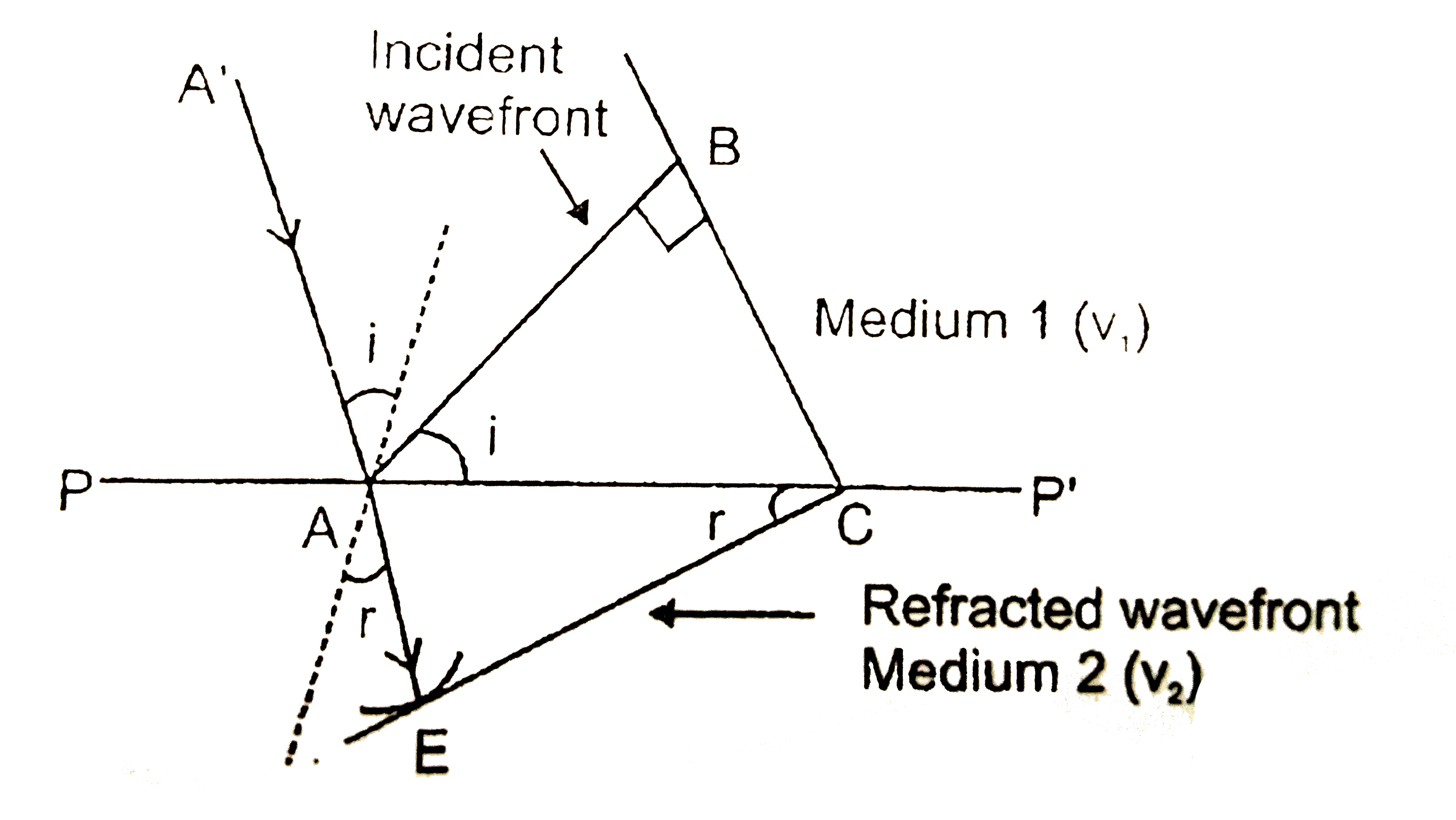 Let `v_(1)` and `v_(2)` represents the speed of light in medium `1` and medium `2` respectively. We assume a plane wavefront `AB` propagating in the direction `A'A` INCIDENT on the interface at an angle `i.` Let `t` be the time taken by the wavefront to travel the distance `BC`. `therefore BC=v_(1)t ["distance=speed"xx"time"],AE=v_(2)t` `therefore CE` would represent the refracted wavefront. In `Delta ABC` and `Delta AEC,` we have `sini =(BC)/(AC)=(v_(1)t)/(AC)` and `sinr=(AE)/(AC)=(v_(2)t)/(AC)` where `i` and `r` the angles of incident and refraction respectively. `therefore(sini)/(sinr)=(u_(1))/(AC).(AC)/(u_(2)t)` `(sini)/(sinr)=(u_(1))/(u_(2))` If `C` represents the speed of ligth in vacuum, then `n_(1)=(C)/(u_(1)) and n_(2)=(C)/(u_(2)) rArr v_(1)=(C)/(n_(1))and v_(2)(C)/(n_(2))` Where `n_(1) and n_(2)` are the refractive indices of medium `1` and medium `2`. `therefore (sini)/(sinr)=(C//n_(1))/(C//n_(2))rArr(sini)/(sinr)=(n_(2))/(n_(1))` `rArrn_(1)sini=n_(2)sinr` This is the Snell's law of refraction |
|
| 23. |
In a Young's double-slit experiment, the slits are separated by 0.28 mm and the screen is placed 1.4 away. The distance between the central bright fringe and the fourth bright fringe in measured to be 1.2 cm. determine the wavelength of light used in the experiment. |
|
Answer» Solution :Here `N=4,d=0.28mm=2.8xx10^(-4)m,D=1.4mand x=1.2cm=1.2xx10^(-2)m`. For BRIGHT fringe `x_(n)=(nDlamda)/(d)implieslamda=(x_(n)*d)/(nD)=(1.2xx10^(-2)xx2.8xx10^(-4))/(4xx1.4)=6xx10^(-7)m or 600NM`. |
|
| 24. |
In an L-R circuit, the inductive reactance is equal to the resistance R of the circuit. An emf E = E_(0) cos(omegat) is applied to the circuit. The power consumed in the circuit is : |
|
Answer» `(E_(0)^(2))/(SQRT(2)R)` |
|
| 25. |
A toothed wheel is rotated at 120 r.p.m and a post-card is placed aginest the teeth. How many teeth (frequency) must the wheel have to produce a note whse pitch is same as that of a tunning fork of frequency 256/ second ? |
|
Answer» `256` `256 = (120)/(60) xx m` m ` = (60 xx 256)/(120) = 12.8 ` HENCE the CORRECT choice is (d). |
|
| 26. |
Statement I: A wire of uniform cross-section and uniform resistivity is connected across an ideal cell. Now the length of the wire is doubled keeping volume of the wire constant. The drift velocity of electrons after stretching the wire becomes one-fouth of what it was before stretching the wire. Statement II: If a wire (of uniform resistivity and uniform cross section) of length l_0 is stretched to length nl_0, then its resistance becomes n^2 times of what it was before stretchingthe wire (the volume of wire is kept constant in stretching process). Further at constant potential difference, current is inversely proportional to resistance. Finally, drift velocity of free electron is directly proportional to current and inversely proportional to cross-sectional area of current carrying wire. |
|
Answer» Statement I is true, Statement II is True, Statement II is a correct explanation for Statement I. area of the wire BECOMES half. Therefore, resistance of the wire becomes FOUR times and the current beocmes one- fourth of the initial value. Also, `V_(d) = I/(neA)` Since current becomes one-fourth and cross-sectional area of the wire becomes half, from the above equation the drift velocity of electron becomes half. Hence, Statement I is false. |
|
| 27. |
A 6.00 kg box is sliding across the horizontal floor of an elevator. The coefficient of kinetic friction between the box and the floor is 0.360. Determine the kinetic frictional force that acts on the box when the elevator is stationary. |
|
Answer» `18.6 N` |
|
| 28. |
A rod of cross sectional area 10cm^(2) is placed with its length parallel to a magnetic field of intensity 1000 Am^(-1). The flux through the rod is 10^(4) Wb. Find the permeability of the material of the rod. |
| Answer» SOLUTION :`10^(4)Wb//Am` | |
| 29. |
If the radius of earth's orbit is made 1//4, the duration of an year will become : |
|
Answer» 4 times `RARR T_(2)=(T_(1))/(8)`. Thus correct CHOICE is (d). |
|
| 30. |
Give types of mirror. |
|
Answer» Solution :Mainly two TYPES : (1) PLANE MIRROR (2) Spherical mirror Two types of spherical mirror are : (1) CONCAVE mirror (2) CONVEX mirror Concave mirror : If internal surface of spherical mirror is made reflecting, then it is called concave mirror. Convex mirror : If external surface of spherical mirror is made reflecting, then it is called convex mirror. |
|
| 31. |
A flat coil carrying a current has a magnetic moment vec(m). It is placed in a magnetic field vec(B)such that vec(m)is antiparallel to vec(B) . The coil is : |
|
Answer» not in EQUILIBRIUM |
|
| 32. |
For photoelectric emission from certain metal the cut off frequency is v. If radiation of frequency 2v impinges on the metal plate the maximum possible frequency of the emitted electron will be (m is electron mass) |
|
Answer» `SQRT(HV)/(2M)` |
|
| 33. |
Statement -1 : Nuclear density is almost same for all nuclei. because Statement -2 Size of nucleus prop A^(1//3) |
|
Answer» Statement -1 is TRUE, statement -2 is True, Statement -2 is a correct explanation for Statement -1. |
|
| 34. |
In a two slit experiment with monochromatic light, fringes are obtained on a screen placed at some distance from the slits.If screen is moved by 5 xx 10^(-2) m towards the slits, then change in fringe width is 3 xx 10^(-5) m. If the distance between the slits is 10^(-3) m, calculate the wave length of light used. |
|
Answer» `6000 Å` First CASE : `beta = (lambdaD)/(10^(-3))` ...(i) Second case : `beta -( 3 xx 10^(-5)) = (lambda(D - 5 xx 10^(-2))/(10^(-3))` ...(ii) Subtracting (ii) from (i) ` 3 xx 10^(-5) = lambda ( 5 xx 10^(-2))/(10^(-3))` i.e. `3 xx 10^(-5) = 50 lambda` WAVELENGTH ` lambda = 3 xx 10^(-5) /50` `6 xx 10^(-7) m` `6000 Å`. |
|
| 35. |
To observe diffraction, the size of the obstacle |
|
Answer» should be of the ORDER of WAVELENGTH |
|
| 36. |
The law of reflection of light are valied for : |
|
Answer» PLANE mirror only |
|
| 37. |
If the current flowing in a coil is reduced to half of its original value, the relation between the new energy (E_2) and the original energy (E_1) stored in the coil will be? |
| Answer» SOLUTION :`E_2 = 1/2L[I/2]^2 = 1/4[1/2LI^2]` = E_1/4` | |
| 38. |
A piec of ice ("heat capacity "=2100 J kg^(-1)""^(@)C^(-1) "and latent heat "=3.36 xx 10^(5) J kg^(-1)) of mass m grams is at -5^(@)C at atmospheric pressure. It is given 420 J of heat so that the ice starts melting. Finaly when the ice-water mixutre is in equilibrium, it is found that 1 gm of ice has melted. Assuming there is no other heat exchange in the process, the value of m is ......... |
|
Answer» 2 `RARR 10.5 m+336" "=420` `rArr m =840//10.5=8` gm. So, correct CHOICES are (d). |
|
| 39. |
The current in an RL circuit drops from 2.30 A to 3.40 mA in 0.025 s following removal of the battery from the circuit. If L is 10 H, find the resistance R in the circuit. |
| Answer» SOLUTION :`2.6Omega` | |
| 40. |
An ideal gas having pressure I’volume V and temperature T and undergoes a thermodynamic ' process in which dW=0 and dQlt0. Then for the gas |
|
Answer» T will INCREASE |
|
| 41. |
A police car with a siren of frequency 8 khz is moving with uniform velocity 36 km/hr towards a tall building which reflects the sound waves. The speed of sound in air is 320 m/s. The frequency of the siren heard by the car driver is |
|
Answer» 8.50 kHz So , correct CHOICE is a. |
|
| 42. |
If wavelength of maximum intensity of radiations emitted by sun and moon are 0.5xx10^(-6)m and 10^(-4)m respectively, the ratio of their temperature is : |
|
Answer» `1//200` `(T_(1))/(T_(2))=(lamda_(2))/(lamda_(1))=(10^(-4))/(0*5XX10^(-6))=200`. Thus correct choice is (d). |
|
| 43. |
Two identical blocks P and Q have mass m each. They are attached to two identical springs initially unstretched. Now the left spring (along with P) is compressed by (A/2) and the right spring (along with Q) is compressed by A. Both the blocks are released simultaneously. They collide perfectly inelastically. Initially time period of both the block (assuming each block was individually connected to one spring) was T. The amplitude of combined mass is |
|
Answer» A/4 |
|
| 44. |
A 200Omega resistor , 1.5 H inductorand 35 muFcapacitor are connectedin serieswith a 220V ,50 Hz ac supply.Calculatethe impedanceof the circuitand alsofind the currentthroughthe circuit . |
|
Answer» Solution :GIVEN R=20 W ,L=1.5 H , `C=35xx10^(-6)` F `V_(rms)`=220V , f=50 Hz w.k.t `X_L=2pifL` =2 x 3.142 x 50 x 1.5 `=471.3 Omega ~~ 91 Omega` `X_C=1/(2pifC)=1/(2xx3.142xx50xx35xx10^(-6))` `(X_L-X_C)` = 471.3-91 `=380.3 Omega` w.k.t. `Z=sqrt(R^2+ (X_L -X_C)^2)=sqrt(400+144704)` IMPEDANCE, z `~~ 381 Omega` `thereforeI_(rms)=V_(rms)/Z=220/381`=0.578 A `I_(rms)`=r.m.svalue of current= 0.578 A `~~` 0.6 A |
|
| 45. |
Four point chargesq_(A) =2 mu C ,q_(B )=-5 muC,q_(c )=2 mu c andq_(d)=-5 mu c areforce ona chargeof 1mu cplaced at the centre of the square |
| Answer» SOLUTION :ZERO N | |
| 46. |
Answer the question in one sentence each (Alternatives are to be noted): How is the direction of a magnetic field vec(B) ata point related to the magnetic line of force passing through that point? Or, A long straight wire of length l is moving within a uniform magnetic field B with a velocity v perpendicular to the field. how much emf will induce? |
|
Answer» Solution :MAGNETIC field `VEC(B)` acts in the DIRECTION of the line of force. Or, INDUCED emf = Blv |
|
| 47. |
A point charge of 2.0 muC is at the centre of a cubic Gaussian surface 9.0 cm on edge. What is the net electric flux through the surface? |
| Answer» SOLUTION :`2.2 xx10^(5) N m^(2) //C` | |
| 48. |
In davisson-Germer experiment,thermionically emitted electron are incident on…….crystal. |
|
Answer» tungsetn |
|
| 49. |
Define alphaand beta |
| Answer» SOLUTION :`alpha=I_C/I_Ebeta=I_C/I_B` | |
| 50. |
A wire in the form of a tightly wound solenoid is connected to a DC source, and carries a current. If the coil is stretched so that there are gaps between successive elements of the spiral coil, will the current increase or decrease? Explain. |
| Answer» Solution :The current will INCREASE because when the coil is stretched, the MAGNETIC flux LEAKS through the gaps and according to Lenz.s law induced emf resist this DECREASE. THUS there will be an increase in current | |