Saved Bookmarks
This section includes 7 InterviewSolutions, each offering curated multiple-choice questions to sharpen your Current Affairs knowledge and support exam preparation. Choose a topic below to get started.
| 1. |
When a wheel with metal spokes 1.2m long is rotated in a magnetic field of flux density 5 xx 10^(-5)T normal to the plane of the wheel, an e.m.f. of 10^(-2) volt is induced between the rim and the axle. Find the rate of rotation of the wheel. |
| Answer» SOLUTION :44.23 RPS | |
| 2. |
How many parallel p-orbitals are present in pyridine. |
|
Answer» |
|
| 3. |
In a projectile motion the velocity (a) is always perpendicular to the acceleration (b) is not always perpendicular to the accele ration (c) is perpendicular to the acceleration for oneinstant only (d) is perpendicular to the acceleration for two instants. |
|
Answer» a & B are correct |
|
| 4. |
A cyclotron is device for accelerating ions and charged particles. It was developed by Lawerence in 1932. The heart of the appritus consists of a split metal pillbox. Figure sHOws top and front views of the halves called dees.A rapidly oscilating potential difference is applied between the Dees. This produces an oscilating electric field in the gap between the dees, the region inside each dee being essentially free of electric field. The Dees are enclosed in an evaccutaed container, and the entire unit is placed in a uniform magnetic field B whose direction is normal to the plane Of Dees, A charged particle of mass 'm' and charge 'q' in the gap between the dees, it moves with constant speed in a semi-circle. The period of uniform circular motion is T=(2pim)/(qB) and is independant of speed. If the time-period of the oscilating elctric field is equal to this time, then the charged particle will be accelerated again and again Answer the following questions (consider the mass of particles remains constant during motion): The maximum radius of the dees required if deutron is to acquire 100 MeV of energy in the above question is: |
|
Answer»
|
|
| 5. |
An angular magnification (magnifying power) of 30 X is desired using an objective of focal length 1.25 cm and an eyepiece of focal length 5cm. How will you set up the compound microscope ? |
|
Answer» Solution :In normal ajustment, image is formed at least distance of distinet vision, d = 25 cm Angular MAGNIFICATION of EYE piece `=(1+(d)/(f_(e)))=(1+(25)/(5))=6` As total Magnification is 30, Magnification of objective lens. `m=(30)/(6)=5` `m=(upsilon_(0))/(-u_(0))=5, or v_(0)=-5u_(0)` As `(1)/(v_(0))-(1)/(u_(0))=(1)/(f_(0))` `(1)/(-5u_(0))-(1)/(u_(0))=(1)/(1.25)` `(6)/(-5u_(0))=(1)/(1.25)` `u_(0)==(-6xx1.25)/(5)=-1.5cm.` i.e. object should be held at 1.5 cm in - front of objective lens As `v_(0)=-5u_(0)` `v_(0)=-5(-1.5)=7.5cm` From `(1)/(upsilon_(e))-(1)/(uu_(2))=(1)/(f_(e))` `(1)/(u_(e))=(1)/(v_(e))-(1)/(f_(e))` `=-(1)/(25)-(1)/(5)=-6//25` `u_(e)=(-25)/(6)=-4.17cm` `therefore` Seperation between the objective lens and eye piece `|u_(e)|+|v_(0)|` `=4.17+7.5` `=11.67cm` |
|
| 6. |
A cyclotron is device for accelerating ions and charged particles. It was developed by Lawerence in 1932. The heart of the appritus consists of a split metal pillbox. Figure sHOws top and front views of the halves called dees.A rapidly oscilating potential difference is applied between the Dees. This produces an oscilating electric field in the gap between the dees, the region inside each dee being essentially free of electric field. The Dees are enclosed in an evaccutaed container, and the entire unit is placed in a uniform magnetic field B whose direction is normal to the plane Of Dees, A charged particle of mass 'm' and charge 'q' in the gap between the dees, it moves with constant speed in a semi-circle. The period of uniform circular motion is T=(2pim)/(qB) and is independant of speed. If the time-period of the oscilating elctric field is equal to this time, then the charged particle will be accelerated again and again Answer the following questions (consider the mass of particles remains constant during motion): A cyclotron is acceleratingdeutrons having mass=2xx1.6xx10^(-27) kg and charge +e. If B=2T, then the required angular frequency of oscilating electric field is : |
|
Answer»
|
|
| 7. |
On increasing the temperature of a conductor the product of its resistivity (rho) and conductivity (sigma) will ....... . |
|
Answer» increase `RHO SIGMA = rho XX (1)/(rho) = 1 ` `therefore `Which remains constant |
|
| 8. |
In Fig. 30-45 , a rectangular loop of wire with length a= 2.2 cm, width b = 0.80 cm, and resistance R = 0.40 mn is placed near an infinitely long wire carrying current i = 4.7 A. The loop is then moved away from the wire at constant speed v = 3.2 mm/s. When the center of the loop is at distance r = 1.5b, what are (a) the magnitude of the magnetic flux through the loop and (b) the current induced in the loop? |
| Answer» SOLUTION :(a) `1.4 xx 10^(-8)WB, (b) 1.0 xx 10^(-5) A` | |
| 9. |
A string of length L consists of two distinct sections. The left half has linear mass density mu_1 = mu_0 // 2while the right half has linear mass density mu_2 = 3mu_0. Tension in the string is F_0 . The time required for a transverse wave pulse to travel from one end of the string to the other is |
|
Answer» `L.4 sqrt((mu_0)/(F_0)) (sqrt2 + SQRT6)` |
|
| 10. |
A person suffering from defective vision can see objects clearly only beyond 100 cm from the eye. Find the power of lens required so that he can see clearly the object placed at a distance of distinct vision (D = 25cm) |
| Answer» ANSWER :2 | |
| 11. |
A plane monochromic light falls normally on a diaphragm with two narrow slits separated by a distance d = 2.5mm. A fringe pattern is formed on the screen placed at D = 100 cm behind the diaphragm.If one of the slits is covered by a glass plate of thickness 10 mu m, then distance by which these fringes will be shifted is : |
|
Answer» 2 mm `therefore X = ((mu - 1)t D)/(d) = 0.2 cm` |
|
| 12. |
In..... model electron is in steady equilibrium in ground state where as in ...... model electron experience net force. |
|
Answer» RUTHERFORD, THOMSON |
|
| 13. |
Discuss sign convention of distances for reflection by spherical mirror and refraction by spherical lens. |
|
Answer» Solution :The distances object distance (u), image distance (u), focal length (f), RADIUS of curvature (R) are measured from pole for spherical MIRROR and from optical centre for spherical lens. Sign convention of distances is as following : (1) All distances are measured from the pole of the mirror or the optical centre of the lens.  (2) The distances measured in the same direction as the incident light are taken as positive and those measured in the direction opposite to the direction of incident light are taken as NEGATIVE. (3) The heights measured upwards with respect to X-axis and NORMAL to the principal axis (X-axis) of the mirror/lens are taken as positive. The heights measured downwards are taken as negative. |
|
| 14. |
Calculate the back e.m.f of a 10H, 200Omega coil 40ms after a 100Vd.c supply is connected to it. |
| Answer» SOLUTION :`L (DI)/(dt)= 100- 0.275 XX 200= 45V` | |
| 15. |
A square loop which is free to rotate about the axis OO' is suspended in space in which a vertical magnetic field B is present as shown in the figure. The mass and length of each side of the wire are m and l, respectively. A cell of emf epsilon and an uncharged capacitor are connected in the wire frame. The angular velocity of the wire loop just after closing the key K is. |
|
Answer» `(Bcepsilon)/(5M)` |
|
| 16. |
Instuments based on tangent law are most accurate when the defiection is |
|
Answer» `30^(@)` |
|
| 17. |
The light gathering power of a camera lens depends on |
|
Answer» a) its diameter only |
|
| 18. |
What is the meaning of the term horror ? |
|
Answer» GREAT puzzle |
|
| 19. |
In the given diagram [Fig. 14.161, is the diode D forward or reverse biased ? |
| Answer» SOLUTION :FORWARD BIASED. | |
| 20. |
Discuss the experiment to determine the wavelenght of monochromatic light using diffraction grating. Experiment to determine the wavelenght of monochromatic light: |
|
Answer» Solution :The wavelenght of a spectral line can be very accurately determined with the help of a diffraction grating and a spectrometer. Intially all the preliminary adjustments of the spetrometer are made. The slit of colimator is illuminated by a monochromatic LIGHT, whose wavelenght is to be determined. The telescope is brought in line with collimator to view the image of the slit. The given plane transmission grating is then MOUNTED on the prism table with its plane perpendicular to the incident beam of light coming from the collimator. The telescope is turned to one side untill the first order diffraction image of the slit coincides with the vertical cross wire of the eye piece. The reading of the POSTION of the telescope is noted. Similarly the first order diffraction image on the other side is made to coincide with the vertical cross wire and corresponding reading is noted. The difference between two positions gives `2THETA`. Half of its value gives `theta`, the diffraction ANGLE for first order maximum. The wavelenght of light is calculated from the equation, `lambda = (sin theta)/(Nm)` Here, N is the number of rulings per metre in the grating and m is the order of the diffracion image, |
|
| 21. |
An enemy plane is flying horizontally at an altitude of 2 km with a speed of 300 ms^(-1) An army man with an anti-aircraft gun on the ground sights hit enemy plane when it is directly overhead and fires a shell with a muzzle speed of 600 ms^(-1). Ar what angle with the vertical should the gun be fired so as to hit the plane ? |
|
Answer» Solution :Let G be the position of the GUN and Ethat of the enemy plane FLYING horizontally with speed `U=300 ms^(-1)` when the shell is fired with a speed `v_(0)` is`v_(x)=v_(0) cos theta` Let the shell hit the plane a POINT and lett be the time TAKEN for the shell to hit the plane. It is clear that the shell will hit the plane, if the horizontal distance EP travelled by the plane in time t = the distance travelled by the shell in the horizontal direction in the same time i.e., `u xx v= v_(s) xx t or u= v_(x)= v_(0) cos theta` or `cos theta =(u)/(v_(0))= (300)/(600)`  `=0.5 or theta=60^(@)` therefore angle with the vertical `90^(@), theta=30^(@)` |
|
| 22. |
A venturi meter is used to measure the flow speed of a fluid in a pipe . The meter is connected between two sections of the pipe (Fig) the cross-sectional area A of the entrance and exit of the meter matches the pipe's cross-sectional area a with speed v . A manometer connects the wider portion of the meter to the narrower portion . The change in the fluid's speed is accompanied by a change Deltap in the fluid 's pressure , which causes a height difference h of the liquid in the two arms of the manometer. (Here , Deltap means pressure in the throat minus pressurein the pipe). (a) By applying Bernoulli's equation and the equation of continuity to points 1 and 2 in Fig show that V = sqrt((2 a^(2) Delta p)/(rho (a^(2) - A^(2)))) where r is the density of the fluid . |
|
Answer» SOLUTION :The continuity equation yields AV = av , and Bernoulli.s equation yields `DELTA p + 1//2 rho V^(2) = 1//2 rho V^(2) ` , where `Delta p = p_(1) - p_(2)` . The first equation gives v = (A/a) V . We use this to substitute for v in the second equation and OBTAIN `Delta p + 1//2 rho V^(2) = 1//2 rho (A // a)^(2) V` . We solve this equation for V , to GET `V = sqrt((2 Delta p)/(rho (A //a)^(2) - 1)) = sqrt((2a^(2) Delta p)/(rho (A^(2) - a^(2))))` |
|
| 23. |
Three bodies a ring (R ) , a solid cylinder (C ) and a solid sphere (S ) having same mass and same radius roll down the inclined plane without slipping . They start from rest , if V_(R),V_(C) ans V_(S) are velocities of respective bodies on reaching the bottom of the plane then |
|
Answer» `v_(R )=v_(C )=v_(S)` `mgh=(1)/(2)mv^(2)+(1)/(2)I(v^(2))/(R^(2))=(1)/(2)v^(2)(m+(I)/(R^(2)))` `v=sqrt((2mgh)/((m+(I)/(R^(2)))))IMPLIES` moreI, LESS v `implies v_(R)ltv_(C)ltv_(S)` |
|
| 24. |
A venturi meter is used to measure the flow speed of a fluid in a pipe . The meter is connected between two sections of the pipe (Fig) the cross-sectional area A of the entrance and exit of the meter matches the pipe's cross-sectional area a with speed v . A manometer connects the wider portion of the meter to the narrower portion . The change in the fluid's speed is accompanied by a change Deltap in the fluid 's pressure , which causes a height difference h of the liquid in the two arms of the manometer. (Here , Deltap means pressure in the throat minus pressurein the pipe). Suppose that the fluid is fresh water , that the cross-sectional areas are 64 cm^(2) in the pipe and 32 cm^(2) in the throat , and that the pressure is 55 kPa in the pipe and 41 kPa in the throat , and that the pressure is 55 kPa in the pipe and 41 kPa in the throat . What is the rate of water flow in cubic meters per second ? |
|
Answer» SOLUTION :We substitute the values to OBTAIN `v = SQRT((2 (32 XX 10^(-4) m^(2))^(2) [(55 xx 10^(3) PA) - (41 xx 10^(3) Pa)])/((1000 kg //m^(3))[(64 xx 10^(-4) m^(2))^(2) - (32 xx 10^-4 m^(2) )^(2)])` Consequently , the flow rate is `Av = (64 xx 10^(-4) m^(2)) (3.06 m//s) = 2.0 xx 10^(-2) m^(3)//s` |
|
| 25. |
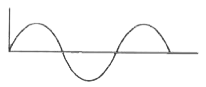
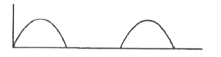
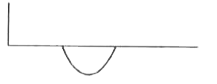
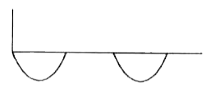
In the half - Wave rectifier circuit , which one of the following wave forms is true for V_(CD) , the output across C and D ? |
|
Answer»
|
|
| 26. |
Passage : Post office is useful to measure the value of unknown resistance correctly upto 2nd decimal place. It is based on Wheatstone bridge. Systematic diagrams of post office box are shown in the above figures. Each of the arms AB and BC contains three resistance of 10 Omega, 100 Omega and 1000 Omega. These arms are generally known as ratio arms. With the help of these resistance, we can introduce resistance P in arm AB and Resistance Q in arm BC. The resistance arm AD is complete resistance box containing resistance from 1 Omega "to" 5000 Omega. In this arm, we can introduced resistance R by taking out plugs of suitable values. The unknown resistance X is connected in fourth arm CD. These four arms actually form Wheatstone bridge shown in figure. For balanced conditions, no deflection is formed in galvanometer. At balanced condition PX= QR , X= (QR)/( P) While measuring surface tension of water using capillary rise method the necessary precaution to be taken is/are |
|
Answer» capillary tube should be clean while WATER should have some grease |
|
| 27. |
A device to store electric charge is called |
|
Answer» transformer |
|
| 28. |
A charge Q is enclosed by a Gaussian spherical surface of radius R. if the radius is doubled. Then the outward electric flux will be |
| Answer» Answer :A | |
| 29. |
A short electric dipole (vecP) has been placed in a uniform electric field (vecE) with the dipole mopment vector (vecP) parallel to vecE. Show the field lines in the regio. Mark the null point (i.e., the points where the field is zero) |
|
Answer» |
|
| 30. |
A square loop of side 12 cm with its sides parallel to X and Y axes is moved with a velocity of 8 cm s^(-1) in the positive x-direction in an environment containing a magnetic field in the positive z-direction. The field is neither uniform in space nor constant in time. It has a gradient of 10^(-3) T cm^(-1) along the negative x-direction (that is it increases by 10^(-3)T cm^(-1) as one moves in the negative x-direction), and it is decreasing in time at the rate of 10^(-3) T s^(-1). Determine the direction and magnitude of the induced current in the loop if its resistance is 4.50 mOmega. |
|
Answer» Solution :Here side of square loop `l = 12 cm = 0.12 m`, hence area of square loop `A = l^(2) = (0.12)^(2) = 1.44 xx 10^(-2)m^(2)`, Velocity of loop `V = 8cm s^(-1) = 0.08 m s^(-1)` along + ve x-direction, Along + vex-direction field gradient `(dB)/(dx)=-10^(-3)Tcm^(-1)=-10^(-1)Tm^(-1),` and rate of CHANGE of field with time `(db)/(dx) = - 10^(-3) T s^(-1)` `therefore` Induced cmf due to change in field with distance `varepsilon=-d/dt(BA)=-A(dB)/(dt)=-A(dB)/dx.dx/dt=-A(dB)/dxv` `=-(1.44xx10^(-2))xx(-10^(-1))xx(0.08)=11.52xx10^(-5)V` and induced emf due to change in field with time `varepsilon_(1)=-A(dB)/dt=-1.44xx10^(-2)xx(-10^(-3))=1.44xx10^(-5)V` `therefore` Total induced emf `varepsilon = varepsilon_(1)+ varepsilon_(2)=11.52 xx10^(-5)+1.44xx10^(-5)=12.96xx10^(-5)V` As resistance of loop `R = 4.5 mOmega = 4.5 xx 10^(-3) OMEGA` `therefore` Induced current `I=varepsilon/R=(12.96xx10^(-5))/(4.5xx10^(3))=2.88xx10^(-2)A`. As the magnetic field is along +ve z direction and motion of the loop is along the +ve x-direction, along which magnetic field is decreasing. Hence, on applying Lenz.s law we find that for an observer, who observes the loop to be moving towards RIGHT, the induced current will be seen to be flowing anticlockwise. |
|
| 31. |
Microwaves are electromagnetic waves with frequency, in the range of |
|
Answer» MICRO hertz |
|
| 32. |
For a ideal monoatomic gas match the following graphs for constant mass in different processes (rho = Density of gas) |
|
Answer» Solution :`P = (rho)/(M_(w))RT` For (A): For `AB P prop V IMPLIES T alphaV^(2) implies T prop rho^(-2)` For `BC V= "constant" implies rho = "constant"` For `CA P = "constant" implies rhoT = "constant"` For (B) For `AB P prop T implies rho = "constant"` For `BC T = "constant" implies P prop rho` For `CA P = "constant" implies rhoT = "constant"` For (C) For `AB P ="constant" implies rhoT = "constant"` For `BC T = "constant" implies P prop rho` For `CA V = "constant" implies rho = "constant"` For(D) For `AB rho prop T implies P prop T^(2)` For `BCT ="constant" implies P prop rho` For `A rho = "constant" implies P prop T` |
|
| 33. |
Passage : Post office is useful to measure the value of unknown resistance correctly upto 2nd decimal place. It is based on Wheatstone bridge. Systematic diagrams of post office box are shown in the above figures. Each of the arms AB and BC contains three resistance of 10 Omega, 100 Omega and 1000 Omega. These arms are generally known as ratio arms. With the help of these resistance, we can introduce resistance P in arm AB and Resistance Q in arm BC. The resistance arm AD is complete resistance box containing resistance from 1 Omega "to" 5000 Omega. In this arm, we can introduced resistance R by taking out plugs of suitable values. The unknown resistance X is connected in fourth arm CD. These four arms actually form Wheatstone bridge shown in figure. For balanced conditions, no deflection is formed in galvanometer. At balanced condition PX= QR , X= (QR)/( P) In an experiment with a post office box, the ratio arms 1000 : 10. The value of third resistance is 999 Omega. Thevalues of unknown resistance is |
|
Answer» `99.9 OMEGA` |
|
| 34. |
The current gain of a common emitter transiter circuit shown in figureis. Drawthedc load line andmark the Q point on it . |
|
Answer» SOLUTION :`BETA=120` Base CURRENT`I_B=(25V)/(1MOmega)=(25)/(1xx10^6)=25muA` `beta=(I_C)/(I_B),I_C=betaI_B` `I_C=120xx25muA` `I_C=3mA` `V_CE=V_CC-I_CR_C` `V_CE=25-3mAxx5k` `V_CE=10V` 
|
|
| 35. |
Passage : Post office is useful to measure the value of unknown resistance correctly upto 2nd decimal place. It is based on Wheatstone bridge. Systematic diagrams of post office box are shown in the above figures. Each of the arms AB and BC contains three resistance of 10 Omega, 100 Omega and 1000 Omega. These arms are generally known as ratio arms. With the help of these resistance, we can introduce resistance P in arm AB and Resistance Q in arm BC. The resistance arm AD is complete resistance box containing resistance from 1 Omega "to" 5000 Omega. In this arm, we can introduced resistance R by taking out plugs of suitable values. The unknown resistance X is connected in fourth arm CD. These four arms actually form Wheatstone bridge shown in figure. For balanced conditions, no deflection is formed in galvanometer. At balanced condition PX= QR , X= (QR)/( P) In post office box, the galvanometer deflection versus resistance R (pulled out of resistance box) for arm ratio 100 : 1 is given as shown in (due to unstable values of R, galvanometer shows deflection). The consecutive value of R ( as shown in figure) is |
|
Answer» `324 OMEGA` |
|
| 36. |
A conducting and closed container of capacity 100 liter contains an ideal gas at a high pressure. Now using a pump, the gas is taken out at a constant rate of 5 liter/sec. Find the time taken in which the pressure will decrease to initial (P_("initial"))/(100) ? (Assume isothermal condition) |
Answer» Solution :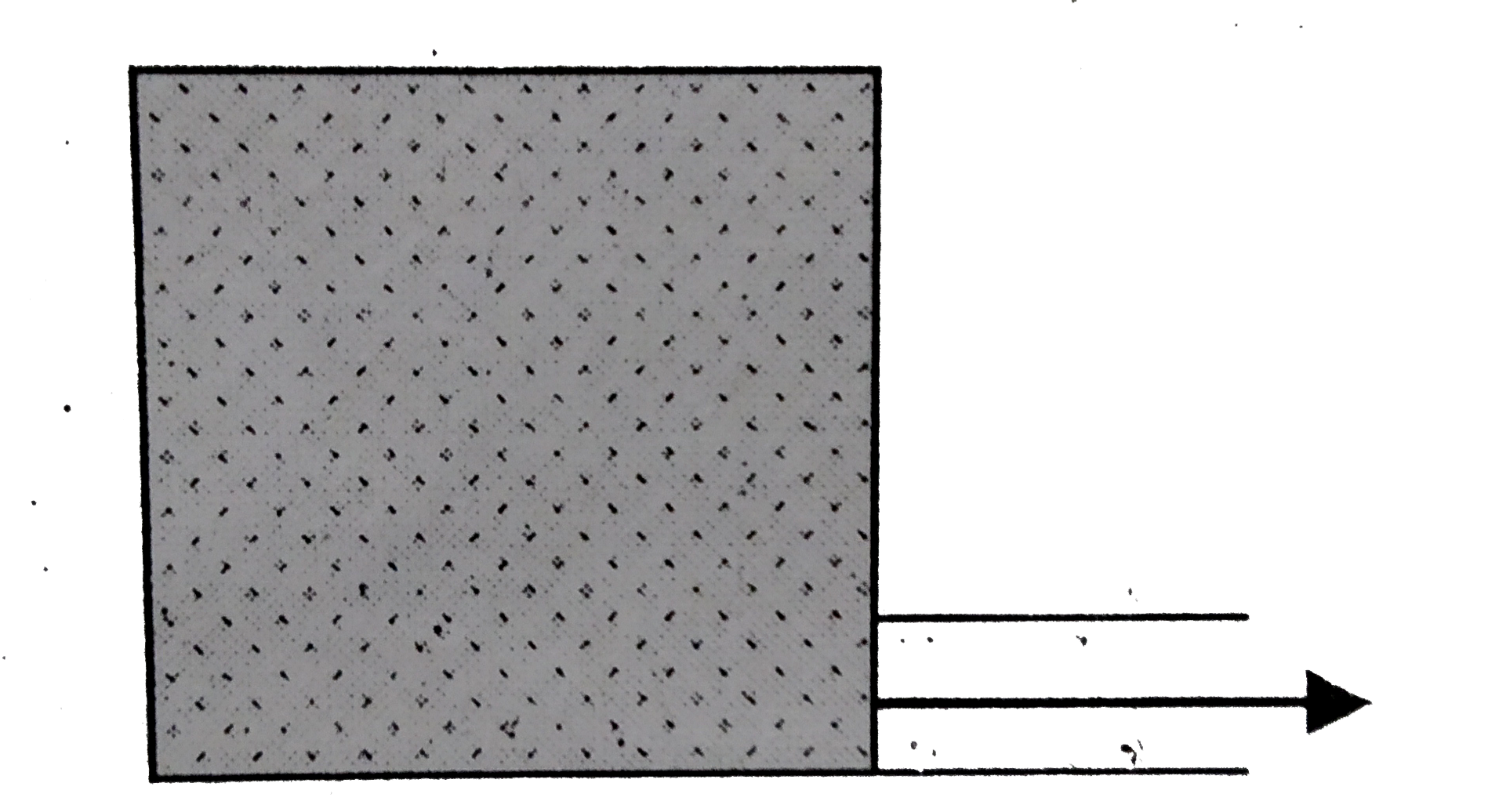 The gas is taken out at the rate of 5 lit/sec. The volume of gas ejected in 'DT' time is (vol) = 5 dt Moles of gas ejected `=(n)/(v)(5dt)` `PV=nRT""rArr""(dp)V=(dn)RT""rArr""(dp)V=-((n)/(V)5dt)RT` `rArr""(dp)V=-5dt(nRT)/(V)=-(5dt)P` `rArr""(dp)/(p)=(5)/(V)dt""rArr""(dp)/(p)=-(5)/(100)dt=-(1)/(20)dt` `int_(p=p_(i))^(p=p_(f))(dp)/(p)=-(1)/(20)int_(t=0)^(t=t)dt""rArr""p_(f)=p_(i)E^(-(1)/(20))""rArr""(p_(i))/(100)=p_(i)e^(-(1)/(20))` T= 20 ln 100 `=20xx2ln 10=92 sec.` |
|
| 37. |
Passage : Post office is useful to measure the value of unknown resistance correctly upto 2nd decimal place. It is based on Wheatstone bridge. Systematic diagrams of post office box are shown in the above figures. Each of the arms AB and BC contains three resistance of 10 Omega, 100 Omega and 1000 Omega. These arms are generally known as ratio arms. With the help of these resistance, we can introduce resistance P in arm AB and Resistance Q in arm BC. The resistance arm AD is complete resistance box containing resistance from 1 Omega "to" 5000 Omega. In this arm, we can introduced resistance R by taking out plugs of suitable values. The unknown resistance X is connected in fourth arm CD. These four arms actually form Wheatstone bridge shown in figure. For balanced conditions, no deflection is formed in galvanometer. At balanced condition PX= QR , X= (QR)/( P) While measuring surface tension of water using capillary rise method, height of the lower meniscus from free surface of water is 3cm while inner radius of capillary tubne is found to be 0.5cm. Then compute surface tension of water using this data. [Take contact angle between glass and water as 0° and g=9.8 ms^(-2) ] |
|
Answer» `0.72 NM^(-1)` |
|
| 39. |
Passage : Post office is useful to measure the value of unknown resistance correctly upto 2nd decimal place. It is based on Wheatstone bridge. Systematic diagrams of post office box are shown in the above figures. Each of the arms AB and BC contains three resistance of 10 Omega, 100 Omega and 1000 Omega. These arms are generally known as ratio arms. With the help of these resistance, we can introduce resistance P in arm AB and Resistance Q in arm BC. The resistance arm AD is complete resistance box containing resistance from 1 Omega "to" 5000 Omega. In this arm, we can introduced resistance R by taking out plugs of suitable values. The unknown resistance X is connected in fourth arm CD. These four arms actually form Wheatstone bridge shown in figure. For balanced conditions, no deflection is formed in galvanometer. At balanced condition PX= QR , X= (QR)/( P) In previous questions, if we add some detergent to water, then |
|
Answer» liquid level in capillary tube is LESS than 3 cm |
|
| 40. |
Write the applications of internet. |
|
Answer» SOLUTION :(i) Search ENGINE: The search engine is basically a WEB-based service tool used to search for information on World Wide Web. (ii) Communication: It helps millions of people to connect with the use of social networking emails, instant messaging services and social networking tools. (iii) E-Commerce: BUYING and selling of goods and services, transfer of funds are done over an electronic NETWORK. |
|
| 41. |
Elaborate any two types of Robots with relevant examples. |
|
Answer» Solution :(i) Human Robot : Certain robots are made to resemble humans in appearance and REPLICATE the humanactivities like walking, lifting, and sensing, etc. (i) Power conversion unit: Robots are powered by batteries, solar power, and hydraulics, 2)ACTUATORS: Converts energy into movement. The majority of the actuators produce - rotational or linear motion. 3) Electric motors: They are used to actuate the parts of the robots like wheels, arms, fingers, legs, sensors, camera, weapon systems etc. Different types of electric motors are used. The most often used ones are AC motor, Brushed DC motor, Brushless DC motor, Geared DC motor, etc. 4) Pneumatic Air Muscles: They are DEVICES that can contract and expand when air is pumped inside. It can replicate the function of a human muscle. They contract almost 40% when the air is sucked inside them. 5) Muscle wires: They are thin strands of wire made of shape memory alloys. They can contract by 5% when electric current is passed through them. 6) Piezo Motors and Ultrasonic Motors: Basically, we use it for industrial robots. 7) Sensors: Generally used in task environments as it provides information of real-time knowledge. 8) Robot locomotion: Provides the types of movements to a robot. The different types are (a) Legged (Z?) Wheeled (c) Combination of Legged and Wheeled Locomotion (d) Tracked slip/skid (ii) Industrial Robots: Six main types of industrial robots. (1) Cartesian, (2) SCARA (Selective Compliance Assembly Robot Arm) (3) Cylindrical (4) Delta, (5) Polar (6) Vertical articulated. Six-axis robots are ideal for: (1) Arc Welding (2) SPOT Welding, (3) Material Handling (4) Machine Tending (5) Other applications. |
|
| 42. |
Passage : Post office is useful to measure the value of unknown resistance correctly upto 2nd decimal place. It is based on Wheatstone bridge. Systematic diagrams of post office box are shown in the above figures. Each of the arms AB and BC contains three resistance of 10 Omega, 100 Omega and 1000 Omega. These arms are generally known as ratio arms. With the help of these resistance, we can introduce resistance P in arm AB and Resistance Q in arm BC. The resistance arm AD is complete resistance box containing resistance from 1 Omega "to" 5000 Omega. In this arm, we can introduced resistance R by taking out plugs of suitable values. The unknown resistance X is connected in fourth arm CD. These four arms actually form Wheatstone bridge shown in figure. For balanced conditions, no deflection is formed in galvanometer. At balanced condition PX= QR , X= (QR)/( P) What is the minimum and maximum possible resistance, which can be determined by using post office box? |
|
Answer» `0.01 Omega , 1111 xx 10^(3) Omega` |
|
| 43. |
A small object stuck on the surface of a glass sphere (mu=1.5) is viewed from the diametrically opposite position. What is the transverse magnification produced? |
| Answer» ANSWER :D | |
| 44. |
A block released from rest from the top of a smooth inclined plane of angle of inclinatione, reaches the bottom in time t_(1) The same block, released from rest from the top of another smooth inclined plane of angle of inclination theta_(2)reaches the bottom in time ty. If the two inclined planes have the same height, the relation between t_(1) and t_(2) is : |
|
Answer» `(t_(2))/(t_(1))=1` cases is`l_(1)=(h)/(sin theta_(1))`and `l_(2) = (h)/(sintheta_(2)`and acceleration `a_(1) = g sin theta-(1)`, and `a_(2) = g sin theta_(2)` `l=ut+(1)/(2)at^(2)` `l_(1)=0+(1)/(2)a_(1)t_(1)^(2)...(i)` and`l_(2)=0+(1)/(2)a_(2)t_(2)^(2)...(ii)` DIVIDING (ii) by (i) `(l_(2))/(l_(1))=(a_(2))/(a_(1))xx(t_(2)^(2))/(t_(2)^(2))` `:.(t_(2)^(2))/(t_(1)^(2))=(l_(2))/(l_(1))xx(a_(20))/(a_(1))=(sin theta_(1))/(sin theta_(2))xx(g sin theta_(1))/(g sintheta_(2))` `:.(t_(2))/(t_(1))=((sin theta_(1))/(sin theta_(2)))` Hence CORRECT choice is (b) |
|
| 45. |
A body is sliding down an inclined plane have coefficient of friction 0.5. If the normal reaction is twice that of the resultant downward force along the incline, the angle between the inclined plane and the horizontal is |
|
Answer» `90^(@)` |
|
| 46. |
What is formula of Sodium Sulphate? |
|
Answer» `Na_2SO_4` |
|
| 47. |
In an experiment with a potentiometer to measure the internal resistance of a cell, when the secondary circuit is shunted by 5Omega, the null point is at 220 cm. when the cell is shunted by 20Omega, the null point is at 300 cm. calculate the internal resistance of the cell. |
|
Answer» |
|
| 48. |
An alternating e.m.f. is given by E = 10 cosomegat . If the frequency is 50 Hz, then at time t = (1/600) s, the instantaneous value of e.m.f. is : |
| Answer» Answer :D | |
| 49. |
Some electric lines of force are shown in figure, for point A and B |
|
Answer» `E_(A) gt E_(B)` |
|
| 50. |
A current of 25/pi Hz frequency is passing through an A.C. circuit having series combination of R = 100 Omega and L =2 H, the phase difference between voltage and current is … |
|
Answer» Solution :`tan DELTA=(omegaL)/R=(2pifL)/R=(2pixx25/pixx2)/100` `THEREFORE tan delta=100/100=1` `therefore delta =45^@` |
|