Saved Bookmarks
This section includes 7 InterviewSolutions, each offering curated multiple-choice questions to sharpen your Current Affairs knowledge and support exam preparation. Choose a topic below to get started.
| 1. |
In thermodynamic processes which one of the . ' following statements is wrong ? |
|
Answer» In an adiabatic process the system is INSULATED from the surroundings |
|
| 2. |
A potentiometer wire has resistance of 10 ohms. A resistance box with a resistance 19990 ohm is connected in series with the wire. The emf of the battery in the primary circuit is 2V. A thermo couple produces 2m V for a temperature difference 1^(@)C between its jucntion. When the hot junction is at 200^(@)C and cold junction at 0^(@)C, can the thermo emf be balanced on the potentiometer wire? |
|
Answer» thermo EMF is BALANCED |
|
| 3. |
Therelation between dynamic plate resistance (r_(p)) ofa vacuum diode and plate current in the space charge limited region, is |
|
Answer» <P>`r_(p)PROP I_(p)` |
|
| 4. |
The root mean square(r.m.s.) velocity of hydrogen molecules at 300 K is 1930 m/sec. Then the r.m.s. velocity of oxygen molecules at 1200 K will be |
|
Answer» `482.5 m/sec` |
|
| 5. |
Which of the following communication system has maximum band width ? |
|
Answer» OPTICAL FIBRE COMMUNICATION |
|
| 6. |
Explain the working of a device which makes use of Lorentz force with the help of a neat diagram |
| Answer» SOLUTION :REFER TEXT, TOPIC CYCLOTRON | |
| 7. |
In the shown diagram for the rectangular lamina lying in xy plane, two sets of mutually perpendicular axis are shown namely (x,y) and (x',y') Given that I_(x) = (M.Iabout x axis) = I_(0) and (a)/(b) = (4)/(3) & I_(x) (M.Iabout x' axis lying in xy plane) = (43)/(36) I_(0), then : |
|
Answer» `I_(y)=(4)/(3)I_(0)` |
|
| 8. |
A particle of mass m moves along a circle of radius R. Find the modulus of the average vector of the force acting on the particle over the distance equal to a quarter of the circle, if the particle moves (a) uniformly with velocity v, (b) with constant tangential acceleration w_tau, the initial velocity being equal to zero. |
|
Answer» Solution :Let us sketch the diagram for the motion of the particle of mass m along the cirle of RADIUS R and indicate x and y axis, as shown in figure. (a) For the particle, CHANGE in momentum `Deltavecp=mv(-veci)-mv(vecj)` so, `|Deltavecp|=sqrt2mv` and time taken in describing quarter of the CIRCLE, `DELTAT=(piR)/(2v)` Hence, `lt vecF ge(|Deltavecp|)/(Deltat)=(sqrt2mv)/(piR//2v)=(2sqrt2mv^2)/(piR)` (b) In this case `vecp_i=0` and `vecp_f=mw_it(-veci)`, so `|Deltavecp|=mw_tt` Hence, `|lt vecF GT|=(|Deltavecp|)/(t)=mw_t` 
|
|
| 9. |
What is an intrinsic semiconductor ? How can this material be converted into (i) p-type, (ii) n-type extrinsic semiconductor? Explain with the help of energy band diagrams. |
|
Answer» Solution :A pure semiconductor is called an intrinsic semiconductor. Pure SILICON and germanium behave as intrinsic semiconductors. (i) -type semiconductor: When we dope an intrinsic semiconductor (say silicon), which has four valence electrons, with a controlled QUANTITY of pentavalent atoms, say phosphorous, which has five valence electrons, these impurity atoms are adjusted in the crystal structure of silicon. Four of the five valence electrons of phosphorous are shared in covalent bonding with four neighbouring siliconatoms, while the fifth electron is comparatively free to move. Impurity atoms are therefore called the donor atoms and n-type semiconductor is formed. As shown inthe energy band diagram in. these donor electrons form an energy level slightly below the conduction band and on applying an external electric field pass on to the conduction band and can freely conduct (ii) p-type semiconductor: When we dope intrinsic silicon witha controlled quantity of trivalent (say aluminium) impurity atoms, there will be one incomplete bond wherever impurity atom is present because it has only three valence electrons. Thus, there is a deficiency of an electron. This deficiency may be completed by taking an electron from one of the Si-Si bonds. It will make it ionised one (negatively charged) and creates an electron deficiency in that silicon atom from where an electron was taken. Thus, electron deficiency, referred to as hole, will continue to move. As a result, the semiconductor BECOMES p-type semiconductor havinga number of holes which form an energy level just above the valence band as shown in energy band diagram shown in . The impurity atoms are called "ACCEPTOR atoms" . |
|
| 10. |
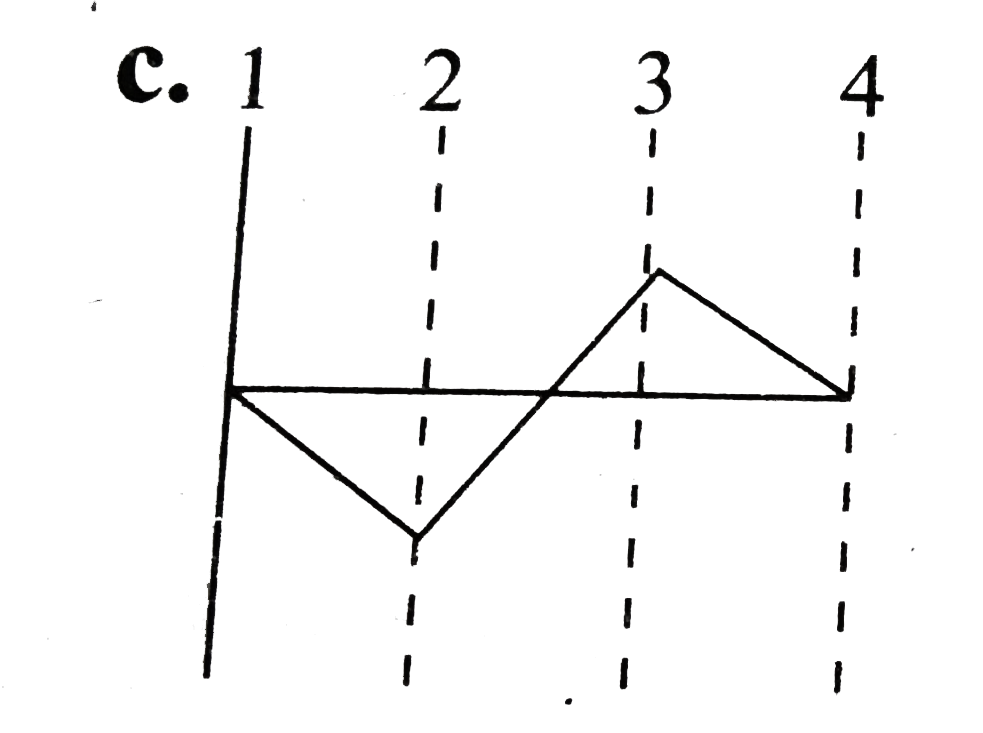
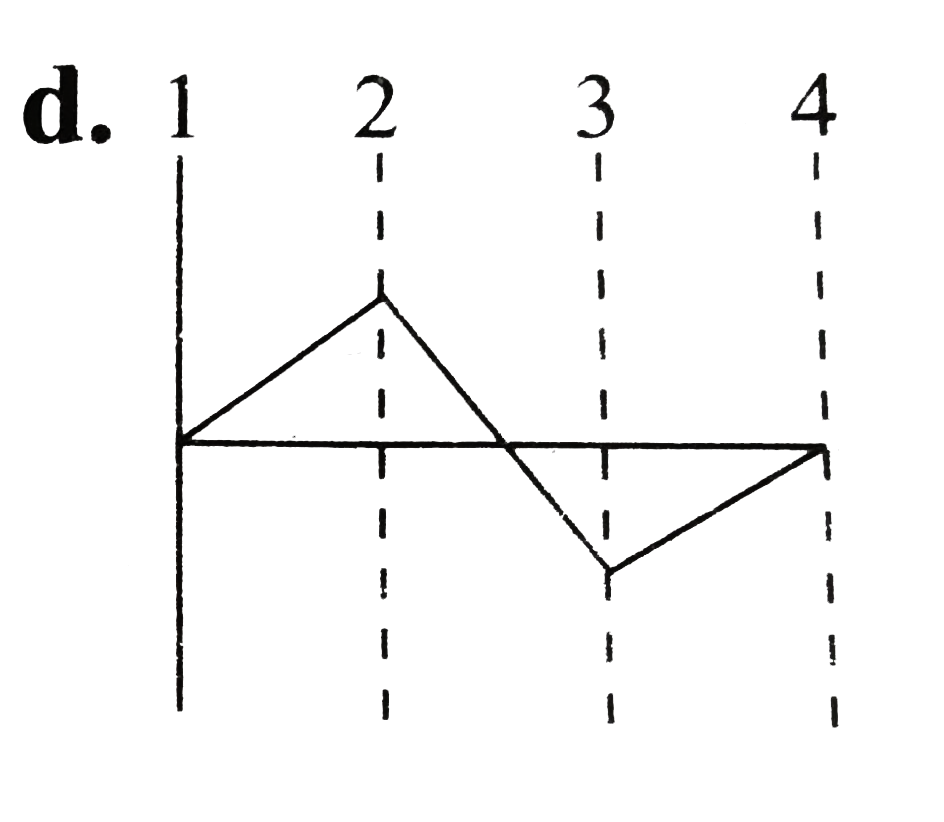
Four identical metallic plates (1,2,3, and 4) are arranged in air at same distance d from each other with their outer plates being connected together and earthed. If the plates 2 and 3 are connected with a cell of constant emf E, then ratio of electric fields between the plate is |
|
Answer» `E_1:E_2:E_3 = 2/3 :1:2/3` Plate `2` acquires a net positive CHARGE and `3` acquiresnet NEGATIE charge. Due to INDUCTION, plate `1` acqurires negative charge and plate `4` positive charge. `1` and `4` are equipotential (since they are joined). Due to symmetry `V_(1-2)=V_(3-4)` and `V_(2-3)=2V_(2-1)=2V_(4-3)` because charge capacitor `2-3` is double. Electric field `=("potential")/(d)` `E_(1):E_(2):E_(3)=1:2:1=(1)/(2):1:(1)/(2)` and form plate `1` to `4` potential first INCREASES, then decreases, and again increases. Since we are going first in direction opposite of `E` and then in directon of `E`. 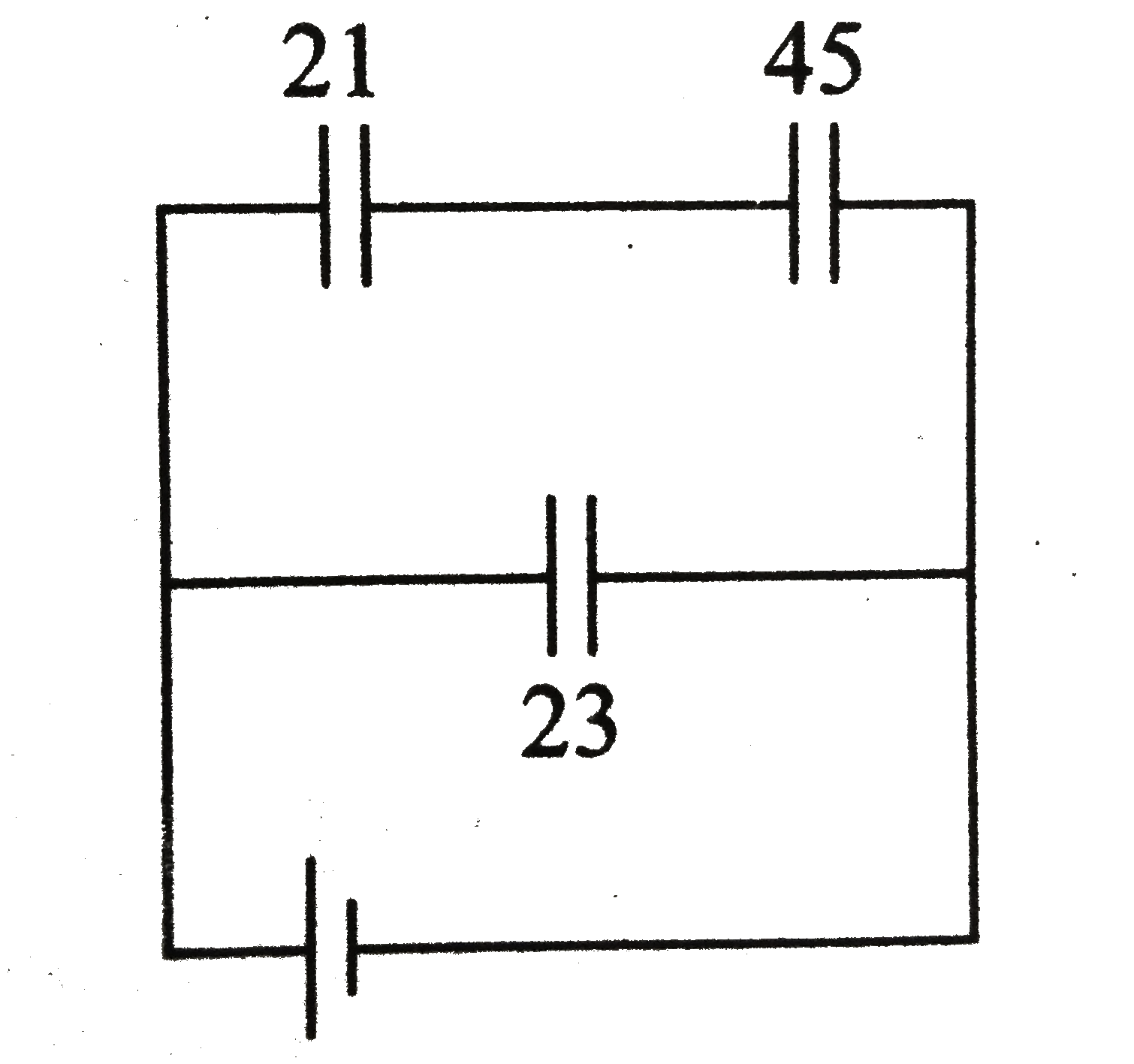
|
|
| 11. |
The wavelength of the Na yellow doublet (.^(2)P rarr .^(2)S) are equal to 589.59 and 589.00nm. Find: (a) the ratio of the intervals between neighbouring sublevels of the Zeeman splitting of the term .^(2)P_(3//2) and .^(2)P_(1//2) in a weak magnetic field, (b) the magnetic field induction B at which the interval between neighbouring sublevels of the Zeemansplitting of the term .^(2)P_(3//2) is eta=50 times smaller than the natural splitting of the .^(2)P. |
|
Answer» SOLUTION :(a) For the `.^(2)P_(3//2)` term `g=1+((3)/(2)xx(5)/(2)+(1)/(2)xx(3)/(2)-1xx2)/(2xx(3)/(2)xx(5)/(2))= 1+(10)/(30)=(4)/(3)` and the enrgy of the `.^(2)P_(3//2)` sublevels will be `E(M_(Ƶ))=E_(0)-(4)/(3)mu_(B)BM_(Ƶ)` where `M_(Ƶ)= +- (3)/(2),+-(1)/(2)`. Thus, between NEIGHBOURING sublevels. `deltaE(.^(2)P_(3//2))=(4)/(3)mu_(B)B` For the `.^(2)_(1//2)` term `g=1+((1)/(2)xx(3)/(2)+(1)/(2)xx(3)/(2)-1xx2)/(2xx(1)/(2)xx(3)/(2))` `=1+(6-8)/(6)=1-(1)/(3)=(2)/(3)` and the SEPERATION between the two sublevels into which the `.^(2)P_(1//2)` term will split is `deltaE(.^(2)P_(1//2))=(2)/(3)mu_(B)B` The ratio of hte two splitting is `2:1` (b) The interval betweenneighbouring ZEEMAN sublevels of the `.^(2)P_(3//2)` term is `(4)/(3)mu_(B)B`. The energy seperation between `D_(1)` and `D_(2)` lines is `(2piħc)/(lambda^(2)) Delta lambda` (this is the natural seperation of the `.^(2)P` them) Thus `(4)/(3)mu_(B)=(2 piħcDelta lambda)/(lambda^(2)eta)` or `B=(3 piħcDelta lambda)/(2mu_(B)lambda^(2) eta)` Substitution gives `B= 5.46kG` |
|
| 12. |
The correct relation between limit of resolution and resolving power is |
|
Answer» LIMIT of RESOLUTION `=(1)/("resolving power")` |
|
| 13. |
An audo signal of 15 KHz frequency cannot be trasmitted over long distances without modulation because |
|
Answer» the size of the required antenna WOULD be LEAST 5 km which is not conveient. |
|
| 14. |
An aluminium sphere of 20 cm diameter is heated from ""^(@)C" to "100^(@)C. Its volume changes by (given that coefficient of linear expansion for aluminium alpha _(Al)= 23 xx 10^(6)//^(@)C). |
|
Answer» `2.89 CC` `Delta V=28.9 cc.` Correct choice : (d). |
|
| 15. |
A galvanometer having 30 divisions has current sensitivity of 20 muA/ division. It has a resistance of 25 ohm. How will you convert it into an ammeter measuring voltmeter reading upto 1V? |
|
Answer» Solution :The full scale DEFLECTION current `i_g = 30 XX (20 xx 10^(-6) ) = 6 xx 10^(-4) A` If S is the required VALUE of the shunt connected in parallel with galvanometer, then ` i_g = (S)/(S+G) I rArr 6 xx 10^(-4) = (S)/(S +25) xx 1` After solving , we get `S= 150/9994 Omega = 0.0150 Omega` The resistance of the ammeter ` R_A = (SG)/(S + G) = (0.0150 xx 25)/(0.0150+ 25) = 0.0150 Omega` To convert this ammeter into the VOLTMETER , we can use ` V = i_g (R_A + R_0)" Here " V = 1V, i_g = 1A` ` therefore 1 =1 (0.0150 + R_0) " or" R_0 0.985 Omega ` |
|
| 16. |
The threshold frequency for a certain metal is 3.3xx10^(14) Hz.If light of frequency 8.2xx10^(14)Hz is incident on the metal ,predict the cutoff voltage for the photoelectric emission. |
|
Answer» Solution :Here `V_(0)=3.3xx10^(14)HZ,h=6.63xx10^(-34)Js` `V=8.2xx10^(14)Hz` `V_(0)=?` `implies` Maximum kinetic energy of photon electron, `(1)/(2)mv_(MAX)^(2)=hv-phi_(0)` `therefore eV_(0)=hv-hv_(0)` `therefore V_(0)=(h)/(e )(v-v_(0))` `=(6.63xx10^(-34)XX(8.2xx10^(14)-3.3xx10^(14)))/(1.xx10^(-19))` `=20.30xx10^(-1)` `therefore V_(0)=2.03 V` |
|
| 17. |
Explain how Rutherford's experiment of scattering of alpha-particle led to estimation of the size of the nucleus ? |
| Answer» Solution :In Rutherford.s EXPERIMENT, most of the `alpha-particle` PASSED straight through the GOLD foil and very few scattering back. | |
| 18. |
The figure shows NAND gates followed by a NOR gate . The system is equivalent to the following logic gate . |
|
Answer» OR 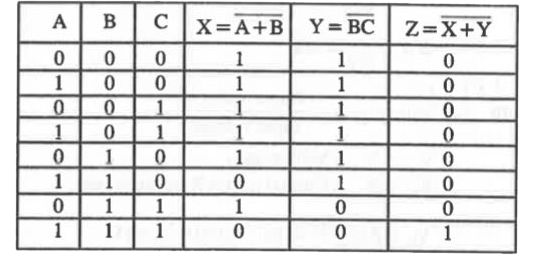 Output Z of SINGLE three input gat is that of AND GATE. |
|
| 19. |
Three similar bar magnets are placed to form an equilateral triangle. The magnetic moment of each magnet is M. What is the magnetic moment of the system? |
|
Answer» ZERO |
|
| 20. |
The strength of earth's magnetic field is of the order of 10^(-3) T. |
| Answer» Solution :False - The strength of earth.s MAGNETIC FIELD is of the ORDER of `10^(-5)`T. | |
| 21. |
Write the condition for constructive interfernce in terms of path difference. |
|
Answer» PATH DIFFERENCE `=2n lambda` |
|
| 22. |
What is the speed of light in a denser medium of polarising angle 30^(@) ? |
|
Answer» <P> Solution :If a light ray PASSING through a denser medium is incident on air SURFACE and the polarising angle`i_(p)=30^(@)`, then `tani_(p)=(1)/(n_(d))=(v_(d))/(C)`, where `v_(d)=`speed of light in denser medium and `c=`speed of light in air. `impliesv_(d)=ctani_(p)=(3xx10^(8))xx(tan30^(@))=SQRT(3)xx10^(8)ms^(-1)=1.732xx10^(8)ms^(-1)`. |
|
| 23. |
Explain electrostatics of conductors. Explain the effects produced inside a metallic conductor placed in an external electric field. |
|
Answer» SOLUTION :In metallic conductors the charge carriers are electrons. In a metal the OUTER (valance) electrons part away from their atoms and are free to move. These electrons are free from PARENT atom but not free to leave the metal. Hence, free electrons form a kind of .gas.. Free electron collide with each other and with the ions and move randomly in different directions. In an external electric field they drift against the direction of the field and get deposited on the surface and an equal amount of positive charge can be considered as deposited on the surface ( other end). This is shown in below figure. 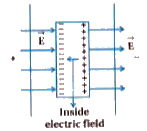 The induced charges produce an electric field inside the conductor in the direction opposite to the external electric field. When the external electric field and internal electric field become equal in magnitude the charges stop to DEPOSIT on the surface. |
|
| 24. |
What are the most significant differences between electrostatic forces and gravitational forces? |
|
Answer» Solution :i) Gravitational FORCES are ALWAYS attractive but electrostatic forces may be attractive or repulsive depending upon the signs of the charges. ii) The gravitational constant (G) is independent of nature of the medium. However, electrical constant `k(=1//4pi epsilon_(0)K)` depends upon the nature of the medium. iii) Electrostatic forces are extremely large as compared to the gravitational forces. For example, electrostatic force of attraction between an ELECTRON and a proton is about `10^(39)` times STRONGER than the gravitational force between them. |
|
| 25. |
Unit of magnetic flux density is ____ |
|
Answer» `V/"SEC"` `THEREFORE B=phi/A` `therefore` UNIT of `B=("unit of" phi)/"unit of A" = "Wb"/m^2` |
|
| 26. |
What works has to be performed to make a hoop out ofa steel band of length l, width h and thickness delta? The process is assumed to proceed within the elasticity range of the material. |
|
Answer» `pi^2Ebdelta^3//l` |
|
| 27. |
Draw a labelled diagram of Hertz's experiment. Explain how electromagnetic radiations are produced using this set-up? |
|
Answer» Solution :Hertz Experiment : Hertz.s experiment was based on the fact that an oscillating electric charge radiates electromagnetic waves and these waves carry energy which is being supplied at the cost of K.E. of the oscillating charge. Hertz Apparatus : The experimental arrangement used by Hertz for the production and detection of electromagnetic waves in the laboratory, is shown in fig. His experimental arrangement consists of two metal sheets `P_1 and P_2`. These sheets are connected to a source of very high voltage (ie, an induction coil, which can supply a potential difference of several thousand volts). `S_1 and S_2` are two metal spheres connected to the metal sheets `P_1 and P_2`. The distance between the metal sheets is kept nearly 60 cm and that between the sphere is normally from 2 cm to 2.5 cm. The two plates `P_1 and P_2` form a capacitor of very low capacitance (C). The circuit containing `P_1 and P_2` (being completed by conducting WIRE), has also some low value of inductance L. It thus forms an LC circuit. Detector (D) consisting of a coil to the ends of which two other small metal spheres `S._1` and `S._2` are connected. 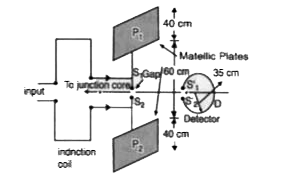 Fig. : Schematic diagram of Hertz Experiment Working of Hertz apparatus : Due to existence of very high voltage, air present in the gap across the plates or spheres `S_1 and S_2` gets ionised. Due to presence of the ions or charged particles, the path between the spheres `S_1 and S_2` BECOME conducting. As a result of this, very high time-varying current flows across the gap between `S_1 and S_2` (as plates `P_1 and P_2` form an LC circuit). Due to this a spark is produced. Since, sheets `P_1 , P_2` form an LC circuit, hence, electromagnetic waves of frequency `f = 1/(2pi) sqrt((1)/(LC))` are radiated . Function of the detection D : Hertz detected the electromagnetic waves by means of a detector D, kept at suitable distance from the conducting spheres `S_1^1, S_2^1` .Detector D is made of two similar conducting spheres `S_1^1` and `S_2^1` joined to the ends of a coil to form another LC circuit. The frequency of this LC circuit is made equal to the frequency of electromagnetic waves reaching it. The frequency can be adjusted by changing the diameter of the coil of the detector and by changing the distance between `S._1 and S._2`. Hertz placed the detector in such a way that the magnetic lines of force produced by the oscillating electric field across the gap between `S._1 and S._2` are normal to the plane of coil (C). When magnetic lines of force cut the detector coil, an emf is induced in it. Hence, air in between the gap gets ionised. A conducting path becomes available for the induced current to flow across the gap. Thus, the spark is produced between `S._1 and S._2`. Hertz also observed that the spark across the gap was the greatest when `S._1 S._2` were parallel to each other. This clearly ESTABLISHED that electromagnetic waves produced were polarised i.e., `VECE` and `vecB` always lie in one plane. |
|
| 28. |
A modulating signal is a square wave as shown in figure. The carrier wave is given by c(t)=2 sin(8pit)"volt". The modulation index is |
|
Answer» 0.2 Modulation INDEX, `MU=(A_(m))/(A_(c))=(1)/(2)=0.5` |
|
| 29. |
Eye detects the green light (lamda=5000Å),5xx10^(4) photons per square metre per second and the ear can detect 10^(-13) watt per square metre. In form of power 10^(-13) watt per square metre. In form of power detector, the eye is sensitive in comparison to the ear by |
|
Answer» 2 times `=((6.6xx10^(-34))(3XX10^(8)))/((5000xx10^(-10)))=(3.96xx10^(-19))J` Energy received per second `=(3.96xx10^(-19))(5xx10^(4))` `=1.98xx10^(-14)W//m^(2)` Sensitivity of eye in COMPARISON to ear= `=("Power per square METRE detected by ear")/("Energy received per second")` `=(10^(-13))/((1.98xx10^(-14)))=5` |
|
| 30. |
What is a transformer ? On what principle the transformer is based ? |
| Answer» SOLUTION :It is a device USED to CHANGE the magnitude of ALTERNATING voltage . It is based on the principle of mutuall induction. | |
| 31. |
Nickel shows ferromagnetic property at room temperature. If the temperature is increased beyond Cure temperature, then it will show |
|
Answer» A) ANTI ferromagnetism |
|
| 32. |
Nature of equipotential surface for a point charge is |
|
Answer» Ellipsoid with CHARGE at foci |
|
| 33. |
The temperature coefficent of resistance of a wire is 0.00125 per .^(@)C, At 300 K, its resistance is 1Omega. At what temperature will its resistance become 2 Omega ? |
|
Answer» |
|
| 34. |
An electric dipole of dipole moment vecp is placed in a uniform external electric field vecE. Then the |
|
Answer» torque experienced by the dipole is `vecE XX vecp` |
|
| 35. |
What is the effect of interchanging the position of cell and galvanometer in a Wheatstone bridge ? |
| Answer» Solution :There is no effect and the BALANCE CONDITION remains UNCHANGED. | |
| 36. |
What is radioactivity ? Derive an experssion N=N_(0)e^(-lambda t) for radioactive disintegration. |
|
Answer» Laws of Radioactive DISINTEGRATION 1. Radioactivity is spontaneous process which does not DEPEND upon external factors. During disintegration either `alpha` or `beta`-particle is emitted. Both are never emitted simultaneously. 3. Emission of `alpha`-particle decreases atomic number by two and mass number by 4. 4. Emission of `beta`-particle increases atomic number by one but mass number remains the same. 5. Emission of `gamma`-ray does not change atomic or mass number. 6. The number of atoms disintegrated per SECOND is directly proportional to the number of radioactive atoms actually present at that instant. This law is called radioactive decay law. i.e. `-(dN)/(dt) prop N` or `-(dN)/(dt)= lambda N`,...(i) where `lambda` is a constant called disintegration constant and depends upon the nature of the radioactive substance. Now from (i) , we have `(1)/(N) dN = - lambda dt` or `int 1/N dN = lambda int dt` or `log_(e)N=lambda t +C`,...(ii) where C is constant of integration. To determine its value. Let `N=N_(0)` initially, i.e. when `t=0, N=N_(0)` `log_(e)=N=0+C` Substituting the value of C in (ii) , we have `log_(e)N=-lambda t + log_(e)N_(0)` or `log_(e)N-log_(e)N_(0)=-lambda t` or `log_(e). (N_(0))/(N)= -lambdat` or `(N)/(N_(0))=e^(-lambda t)` or `N=N_(0)e^(-lambda t)` which is the REQUIRED equation. Disintegrationconstant `(lambda)` is defined as the time after which the number of radioactive atoms reduce to 1/e times the original number of atoms. Half life period (T) is the time during which the number of atoms of a radioactive material reduces to half of the original number . |
|
| 37. |
In a cylindrical capacitor , if the potential difference is too great, dielectric breakdown will occur. Will such breakdown begin near the inner or the outer conductor why? |
| Answer» Solution :Inner conductor as ELECTRIC FILLED STRENGTH will reach its BREAKDOWN VALUE there first. | |
| 38. |
State Biot-Savart law, giving the mathematical expression for it. Use this law to derive the expression for the magnetic field due to a circular coil carrying current at a point along its axis. How does a circular loop carrying curent behave as a magnet? |
|
Answer» Solution :(a)Biot -Savart Law : "Magnetic FIELDS acting at a particular point due to current carrying element is proportional to the division pf cross product of the current element and position vector of point where the field is to be calculated from the current element to the cube of the distance between current element and the point where the field is to be calculated." `DB=(mu.j"dl"sintheta)/(4pi.r^2)` 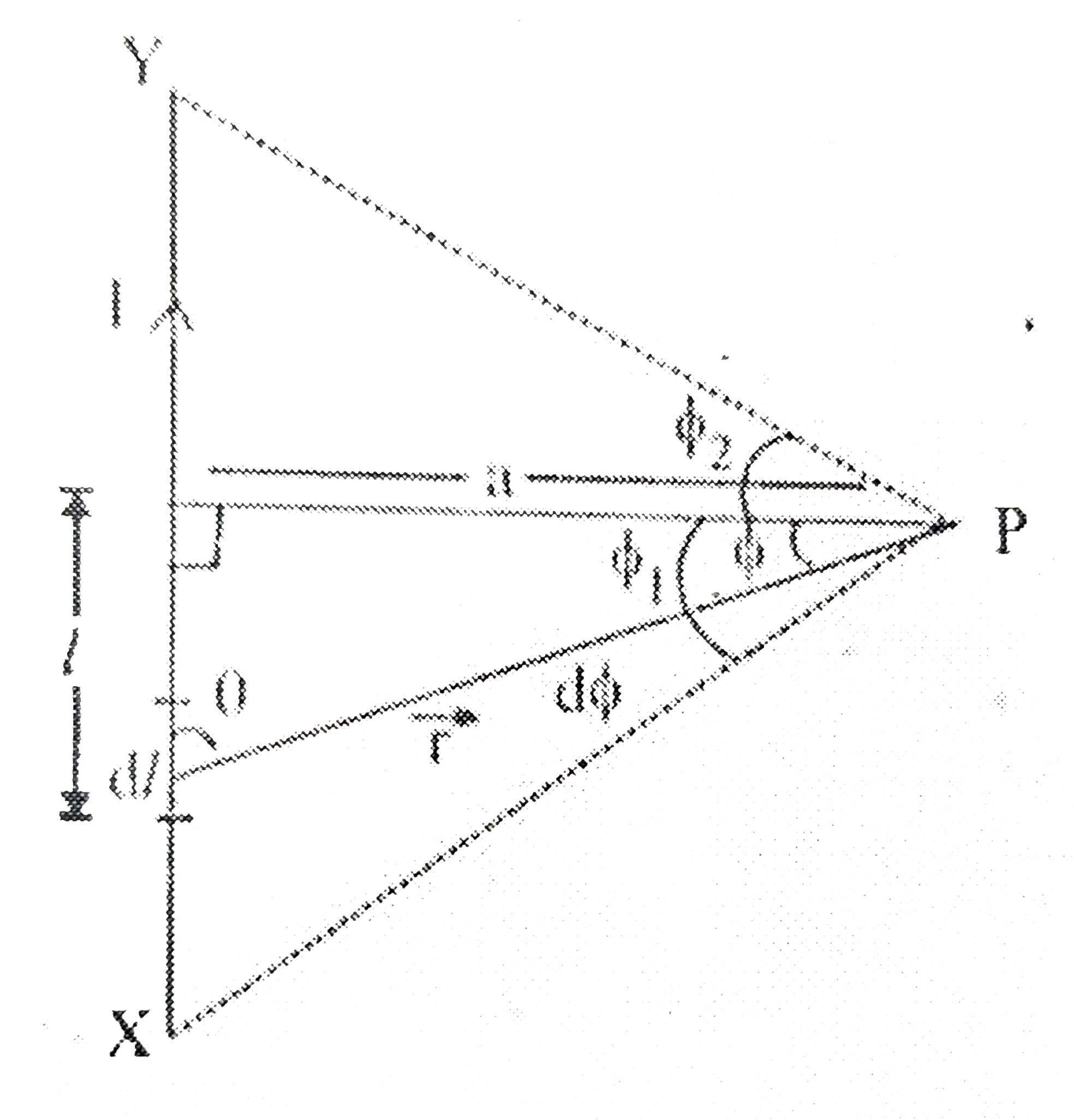 (b)Magnetic field due to a straight conductor carrying current : A long straight conductor XY carrying current I from X to Y. Let P be a point at a perpendicular distance 'a'from the conductor. Such that PC = a. Consider a small current element of length dl of the conductor. Let `oversettor` be the position vector of Pw.r.t current element and `theta` be the angle between `oversetto (dl)and oversettor`. According to Biot-Savart's Law, the magnetic field at point p due to current element dl is `dB=(mu)/(4pi)(Idlsintheta)/r^2` In rt `DeltaPOC,theta+phi=90^@` `theta=90-phi` `sintheta=sin(90^@-phi)=cosphi` `cosphi =a/r rArr r=a/cosphi=asecphi`. Also`tanphi=l/alpharArr l=atanphi` Now`dl=alphasec^2phidphi` Thus, `dB=(mu_o)/(4pi)(Ia sec^2phidphi.cosphi)/(a^2sec^2phi)rArrdB=(mu_o)/(4pi)1/acosphidphi` According to right hand RULE, the direction of `overset(to)(dB)` is perpendicular to the plane of paper and directed inwards. Since all the current elements of the conductor, produce magnetic field in the same direction. Therefore, total magnetic field at point P through whole conductor is `B=underset(-phi_i)overset(phi_2)intdB=underset(-phi_i)overset(phi_2)int(mu_0)/(4pi)I/acosphidphirArr B=(mu_o)/(4pi)1/aunderset(-phi_1)overset(phi_2)intcosphidphi` `B=(mu_o)/(4pi)1/a[sinphi_2]_(-phi_1)^(phi_2)rArr B=(mu_0)/(4pi)I/a[sinphi_2-sin(-phi_1)]` `B=(mu_o)/(4pi)I/a[sinphi_2+sinphi_1]` For infinily long conductor,`phi_1=phi_2=pi/2` `B=(mu_0)/(4pi)I/a[sin.pi/2+sin.pi/2]rArrB=(mu_0)/(4pi)(2I)/arArrB=(mu_0)/(2pi)I/a` (c)One face of current loop behaves as a south pole and other face as north pole. Therefore, the loop behaves as a magnetic dipole. |
|
| 39. |
Photoelectriceffect ia based on : |
|
Answer» CORPUSCULAR THEORY of LIGHT |
|
| 40. |
A shell of mass 5 m, acted upon byno external force and initially at rest , burts into three fragments of masses m, 2 m, 2 m respectively . The first two fragments move in opposite directions with velocitesmagnitude 2 v and v respectively . The third fragment will |
|
Answer» MOVE with a VELOCITY v in direction perpendicular to the other TWO |
|
| 41. |
When current flows through a conductor, then the order of drift velocity of electrons will be: |
|
Answer» `10^(10)` m/s |
|
| 42. |
A long belt is moving horizontally with a speed of 5 km h^(-1). A child runs on this belt to and fro with a speed of 9 km//h (w.r.t. bett) between his father and mother located 50 m apart on the belt. For an observer on a stationalry plateform outsied, what is the (a) speed of the chils runningin the derection of motion of the belt, (b) speed of thechaild runing opposite to thedirection of the belt, and (c ) time taken by the child in cases (a) and (b) ? Which of theanswers change, if motionis viewed by one of the parents ?gt |
|
Answer» Solution :Let US consider, left to right be the positive direction of x-axis. Here, `v_(B) = +5 km//h, v_(c) = –9 km//h` SPEED of child with respect to STATIONARY observer `V = v_(C) + v_(B) = –9 + 5 = –4 km//h` Here, negative SIGN shows that the child will appear to run in a direction opposite to the direction of motion of the belt. |
|
| 43. |
A capacitor of 2 muF is charged as shown in the figure. When the switch S is turned to position 2, the percentage of its stored energy dissipated is |
| Answer» Answer :C | |
| 44. |
An electron moving horizontally from left to right in a region where a magnetic field exists vertically downwards describes: (when seen from above) |
|
Answer» HORIZONTAL clock-wise CIRCULAR path |
|
| 45. |
Three solid sphere of mass M and radius R are placed in contact as shown in figure. Find the potential energy of the system ? |
|
Answer» Solution :`PE=PE_(12)+PE_(23)+PE_(31)` `= - (GM^(2))/(2R)- (GM^(2))/(2R)- (GM^(2))/(2R) implies PE = -(3GM^(2))/(2R)`. 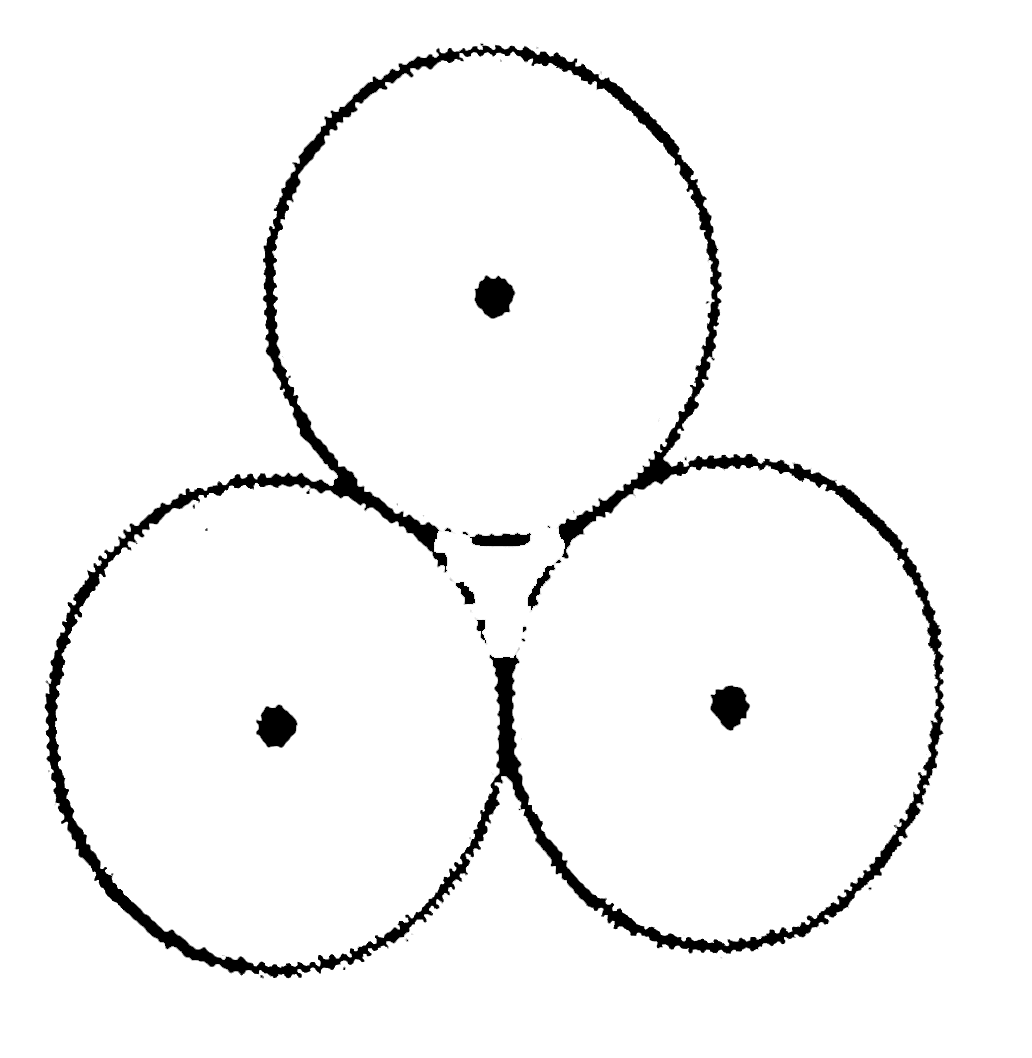
|
|
| 46. |
Electrons can undergo diffraction just like waves. What is the wavelength of an electron accelerating in p.d. of 54v? |
| Answer» SOLUTION :`LAMBDA=(1.227xx10^-9)/sqrt54=0.167 NM` | |
| 47. |
Take the particle in question number 49 an electron projected with velocity v_(x)=4xx10^(6)ms^(-1). If electric field between the plates separated by 1 cm is 8.2xx10^(2)NC^(-1), then the electron will strike the upper plate if the length of plate is (Take m_(e)=9.1xx10^(-31)kg) |
|
Answer» 2.14cm `E=8.2xx10^(2)NC^(-1),q=e=1.6xx10^(-19)C,m_(e)=9.1xx10^(-31)kg` The electron will strike the UPPER plate at its other end of x = L as soon as its deflection. And `y=d/2=10^(-2)/2M=5xx10^(-3)m` From eqn. (III), `L=sqrt((2m_(e)v_(x)^(2)y)/(qE))=sqrt((2xx9.1xx10^(-31)xx(4xx10^(6))^(2)xx5xx10^(-3))/(1.6xx10^(-19)xx8.2xx10^(2)))` `L=3.3xx10^(-2)m` = 3.3 cm |
|
| 48. |
A stretched string fixed at both ends vibrate and P nodes are obtained then length of string is |
|
Answer» <P>`P=(lamda/2) |
|
| 49. |
Summarise thephoton pictureof electromagneticradiation . |
|
Answer» SOLUTION :We can summarise the PHOTON picture of electromagneticradiation as follows . (1) In interaction of radiation with matter , radiationbehaves as if it is made up of particles called photons . (2) Eachphoton has ENERGY E `E[(=hv),(=(hc)/(lambda))]` and momentum P ` [ (=(hv)/c)/(=h/lambda)]` and speed c, the speed of light . (3 ) By increasing the density of lightof given wave length , there is only an increases in thenumberof photons per second crossing a given area , with each photon having the same energy . Thus , energy is independentof intensityof radiation . (4 ) Photons are not deflectedby electric and magnetic field . This showsthatphotons are electricallyneutral . (5 ) In a photon - particlecollision ( such as photo - electron collision ) , the energyand momentumare CONSERVED . However the numberof photonsmay not be conservedin a collision . One photon may be absorbedor a newphoton may be created . (6 ) The rest mass of photonis zero. According to theory of relativity , the massof moving particle is given by m = `(m_(0))/(sqrt(1-(v^(2))/(c^(2))))`wherev is VELOCITY of particle and c is velocityof light . |
|
| 50. |
A block of mass 300g is attached to the ceiling by spring that has a force constant k=200N/mconducting massless rod is rigidly attached to the block and can slide without friction alon vertical parallel rails which are adistance L=1cm apart. A capacitor of known C=500muF attached to the rails by the wire and the entire system is kept in magnetic field B=20cm perpendicular to plane of paper inwards. Neglect the self inductance to plane of paper inwards. Negect self inductance and electrical resistance of all wire and rod. In 'omega' is angular frequency (in rad/sec) vertical oscillaitons of block i then (omega)/(10) is equal to |
|
Answer» |
|