

Saved Bookmarks
This section includes 7 InterviewSolutions, each offering curated multiple-choice questions to sharpen your Current Affairs knowledge and support exam preparation. Choose a topic below to get started.
| 1. |
The scale of a galvanometer is divided into 150 equal divisions. The galvanometer has the current sensitivity of 10 divisions per mA and the voltage sensitivity of 2 divisions per mV. How the galvanometer be designed to read i) 6A, per division and ii) 1V, per division? |
|
Answer» `40 mu Omega` is CONNECTED in PARALLEL, `1000 Omega` is connected in series |
|
| 2. |
For a plane electromagnetic wave propagating along + X axis, electric field is E_(y)=48 sin{-10^(3)x + 10^(11)t} V/m. Find wavelength and frequency of above wave. Also write equation of corresponding magnetic field. (All values are in SI units). |
| Answer» Solution :`6.28xx10^(-3)m, v=1.592xx10^(10)Hz` and `VEC(B)=vec(B)_(z)=16xx10^(-8)SIN{-10^(3)x +10^(11)t}HAT(k)T` | |
| 3. |
Among the following four spectral regions, the photon has the highest energy in: |
|
Answer» Infrared |
|
| 4. |
Rate of change of torque tau with deflection theta is maximum for a magnetsuspended freely in a uniform magnetic fieldof induction B when |
|
Answer» `THETA=0^(@)` `(d tau)/(d theta)=MH cos theta` `cos theta =1` i.e `theta=0^(@)` |
|
| 5. |
What happens if the galvanometer and cell are interchanged at the balance point of the bridge ? Would the galvanometer show any current ? |
| Answer» SOLUTION :The GALVANOMETER will SHOW no CURRENT. | |
| 6. |
A point charge q is placed at the centre of a cube of side length L . The electric flux emerging from the cube is…… |
|
Answer» `Q/e_0` `phi=q/e_0` |
|
| 7. |
A parallel plate capacitor with air between the plates has capacitance C. What will be the capacitance if (a) the distance between the plates is doubled? (b) the space between the plates is filled with a substance of dielectric constant 5? |
|
Answer» SOLUTION :(a) CAPACITANCE becomes half `((C )/(2))` (b) Capacitance becomes FIVE times (5C) |
|
| 8. |
In a common - base circuit of transistor , current amplification factor is 0.95 Calculate the emitter current , if base current is 0.2 mA : |
|
Answer» 4 mA `I_e = 0.2 xx10^(-3) + 0.95 I_e " or "0.05I_e = 0.2 xx10^(-3)` `:. I_e = (0.2 )/(0.05 ) XX 10^(-3) = 4 xx10^(-3) A` |
|
| 9. |
Two vibrating tuning forks produce waves given byy_(1) = 4sin 500 pit and y_(2) = 2sin 506 pit . Number of beats produced per minute is |
|
Answer» 360 `omega_(1) = 500 pi, therefore omega_(1) = 2piv_(1) rArr v_(1) = 250`, similarly, `v_(2) = 253` `v=v_(2) -v_(1) = 253 - 250 = 3` beats/s. Number of beats per MINUTE `=3 XX 60 = 180`. |
|
| 10. |
A conducting ring of radius ris placed perpendicularly inside a time varying magnetic field given by B=B_(0) + alphal. B_(0) and a are positive constants. E.m.f. induced in the ring is |
|
Answer» `-pi ALPHA r` |
|
| 11. |
A light ray is travelling from a denser medium into rarer medium. The velocities of light in the two media are 2 xx 10^8 m//s and 2.5 xx 10^8 m//s respectively. What is the critical angle at the interface of the two media? |
| Answer» SOLUTION :`SIN^(-1) 4/5` | |
| 12. |
Oxidation is ............of electron while Reduction is....... . Of electrons |
|
Answer» GAIN, loss |
|
| 13. |
A plane mirror is placed at origin parallel to y-axis, facing the positive x-axis. An object starts from (2m, 0, 0) with a velocity of (2hati +2hatj) m/s. Find the relative velocity of image with respect to object. |
Answer» SOLUTION : The relative velocity of image with respect to object along normal =` -4 hati `The relative velocity of image with respect to object along plane of MIRROR = 0. Hence the relative velocity of image with respect to object = `4hati`. |
|
| 14. |
The mass of a H-atom is less than the sum of the masses of a proton and electron. Why is this? |
|
Answer» <P> Solution :By Einsteins. equation relation between energy and mass,`E = mC^(2)` E = energy, m = mass decayed (DISINTEGRATED) C = speed of light Here mass defect `Deltam = (m_(p) + m_(e)) - M` M= mass of H atom But binding energy `B*E=DeltamC^(2)` `:.(B*E)/(=DeltamC^(2)` `:.(B*E)/(C^(2))=Deltam=m_(p)+m_(e)-M` `:.M lt m_(p)+m_(e)` Thus, mass of H atom is less than total mass of electron and proton in free state. |
|
| 15. |
For a short magnetic dipole of magnetic moment 0.5 Am^(2). Find the magnetic field at a point ( a) 1 m on the axis and from the cetre of the magnet ( dipole ) ( b) 1 m on the equatorial line from the centre ( c) at an angle of 60^(@) w.r. to the line joining the point and the centre of the dipole at distance 1 m. |
Answer» SOLUTION :We know that ,  (a) `"" B_(A)=((mu_(o))/(4pi))(2m)/(R^(3))`tesla = `(10^(-7)xx2xx0.5)/(1^(3))` `= 1.0 xx10^(-7)`T (b) `"" B_(B)=((mu_(o))/(4pi))(m)/(r^(3))`tesla = `(10^(-7)xx0.5)/(1^(3)) = 0.5 xx10^(-7)`T (C)`"" B = (mu_(o))/(4pi)(m)/(r^(3))sqrt(3cos^(2)theta+1)=(10^(-7)xx0.5)/(1^(3))sqrt(3cos^(2)60^(@)+1)` `B = (0.5xx10^(-7)xx1.732)/(4) = 0.2165 xx 10^(-7) T ~~ 0.22 xx 10^(7) `T |
|
| 16. |
A tall man of height 6feet, want to see his full image. Then required minimum length of the mirror will be |
| Answer» Solution :Minmum HEIGHT of MIRROR required for seeing full IMAGE = `(1)/(2) xx "Height of the man" = 3 feet`. | |
| 17. |
A force vecF=(5hati+3hatj+2hatk)N is applied over a particle which displaces it from its origin to the point vecr=(2hati-hatj) m. The work done on the particle in joules is : |
|
Answer» SOLUTION :Here, `W=vecF.vecS` =`(5hati+3hatj+2hatk).(2hati-hatj)` =10-3=7 J. |
|
| 18. |
How is depletion region formed in a p-n junction ? How will its thickness change when the junction is forward biased ? |
|
Answer» Solution :Formation of junction diode. When a p-type crystal is place in contact with n-type crystal so as to form one piece, the assembly so OBTAINED is called p-n junction or junction diode or crystal diode. The surface of contact of p-type and n-type crystals is called junction. In the p-section, HOLES are the majority carriers while in n-section, the majority carriers are ELECTRONS. Due to high concentration of different types of charge carriers in the two sections, holes from p-region diffuse into n-region and electrons from n-region diffuse into p-region. In both cases, when an electron meets a hole they CANCEL the effect of each other and as a result, a thin layer at the junction becomes devoid of charge carriers. This is called depletion layer as shown in the figure. The thickness of depletion layer is of the order of `10^(-6)m`. Change in thickness of depletion layer with foward bias. Initially when forward bias voltage is zero, current is also zero. When p-n junction is forward biased, the positive holes in the p-type material are repelled by the positive voltage towards the junction. Simultaneously the free elctrons in the p-type material are replled by the negative voltage towards the junction (a minimum voltage of `0.7V` for `Si` and `0.3V` for `Ge` is needed to overcome the potential barrier at the junction) See fig. PRACTICALLY no current flows until the barrier is overcome.  As bias voltage is increased, little by little current remains zero till bias voltage is `0.3V` (potential barrier). When bias voltage increases from potential barrier, current starts flowing and the thickness of depletion layer starts decreasing and becomes minimum at potential barrier. |
|
| 19. |
An aluminium ( alpha_(Al) = 4 xx 10^(-3) //""^(0) C) wire resistance R_1' and carbon wire ( apha_c = 0.5 xx10^(-3) //""^(@) C) resistance R_2' are connected in series to have a resultant resistance of 18 ohm at all temperatures. The values of R_1 and R_2 in ohms |
|
Answer» `2,16` |
|
| 20. |
A short bar magnet placed in a horizontal plane has its axis aligned along the magnetic north - south direction . Null point are found on the axis of the magnet at 14 cm from the centre of the magnet . The earth's magnetic field at the place if 0.36 G and the angle of dip is zero. What is the total magnetic field on the normal bisector of the magnet at the same distance as the null point (i.e., 14 cm) from hte centre of the magnetic ? (At null points , field due to a magnet is equal and opposite to the horizontal component of earth's magnetic field.) |
|
Answer» Solution :`d = 14 cm = 14 X10^(-2) m, B = 0.36G` Given `(10^(-7)xx2m)/d^3=0.36xx10^(-1)(T)` On the equatorial LINE , `B_("equatorial line ")=1/2B_("axial")` `=0.18 xx10^(-4)(T)=0.18G` TOTAL field `=B_("equatorial line ")+H_E` (of earth ) = 0.18 + 0.36 = 0.54 G 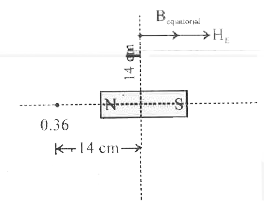
|
|
| 21. |
Light waves are electromagnetic waves and hence transverse in nature. The electric field in a light wave propagating in free space is perpendicular to the direction of propagation. But there are infinite number of directions perpendicular to the direction of propagation. but there are infinite number of directions perpendicular to the direction of propagation of light. for example if light propagates along x-axis, the electric field may be along y-axis or along the z-axis or along any direction in y-z plane in the ordinary light. However, if electric field vecE remains parallel to a fixed direction (say y-axis) then such light is called linearly polarised light. There are several methods to produce polarised light from the unpolarised light. now-a-days polaroid sheets are commonly used to produce linearly polarised light. a polaroid has long chain of hydrocarbons which become conducting at optical frequencies. when light falls normally on the polaroid sheet, the vecE parallel to the chains is absorbed in setting up electric currents in the chains but vecE perpendicular to the chain gets transmitted. so, light on passing through the polaroid i.e., the transmitted light become linearly polarised with vecE parallel to the transission (pass) axis of polaroid. If linearly polarised light of intensity 'I' is incident on another polaroid whose pass axis is inclined at an angle theta from pass axis of first polaroid (or transmission axis of vecE of linearly polarised light) the intensity of transmitted light I_(t) is given as: I_(t)=Icos^(2)theta. Q. What is unpolarised light ? |
| Answer» Solution :UNPOLARISED light is the light in which `VECE` can vibrate in any random direction PERPENDICULAR to the direction of propagation of light. | |
| 22. |
A thin uniform ring of radius R carrying charge q and mass m rotates about its axis with angular velocity omega. Find the ratio of its magnetic moment and angular momentum. |
|
Answer» Solution :The EQUIVALENT current in the RING is `i=q/T=q/((2pi)/omega)=(qomega)/(2pi)` MAGNETIC moment `M=ia=(qomega)/(2pi)xxpiR^(2)=(qomegaR^(2))/2` Angular momentum `L=Iomega(MR^(2))omegathereforeM/L=q/(2m)` 
|
|
| 23. |
Two satellites revolve around the earth at distances 3R and 6R from the centre of earth. Their periods of revolutions will be in the ratio: |
|
Answer» `1:2^(0.67)` `(T_(2))/(T_(1))=2^(1.5) rArr T_(1):T_(2)=1:2^(1.5)` So the correct CHOICE is (C ). |
|
| 24. |
A current loop is considered a magnetic dipole. Explain. Also give an expression for its dipole moment. |
|
Answer» Solution :CONSIDER a plane loop of wire carrying current I as shown in Fig. Looking at the upper face, current is anticlockwise and , therefore , it has a north polarity. Looking at the lower face of the loop, the current is clockwise and hence it has a south polarity. The current loop, THUS, behaves as a magnetic dipole. The magnetic MOMENT `vecm` of a current loop is equal to the product of current I and area A enclosed by the loop. Thus, `vecm = I vecA` If instead of a single loop, we have a coil of N TURNS, then its magnetic moment. `vec(m) = N I vecA` 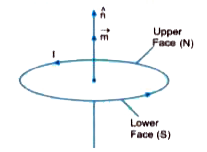
|
|
| 25. |
Light waves are electromagnetic waves and hence transverse in nature. The electric field in a light wave propagating in free space is perpendicular to the direction of propagation. But there are infinite number of directions perpendicular to the direction of propagation. but there are infinite number of directions perpendicular to the direction of propagation of light. for example if light propagates along x-axis, the electric field may be along y-axis or along the z-axis or along any direction in y-z plane in the ordinary light. However, if electric field vecE remains parallel to a fixed direction (say y-axis) then such light is called linearly polarised light. There are several methods to produce polarised light from the unpolarised light. now-a-days polaroid sheets are commonly used to produce linearly polarised light. a polaroid has long chain of hydrocarbons which become conducting at optical frequencies. when light falls normally on the polaroid sheet, the vecE parallel to the chains is absorbed in setting up electric currents in the chains but vecE perpendicular to the chain gets transmitted. so, light on passing through the polaroid i.e., the transmitted light become linearly polarised with vecE parallel to the transission (pass) axis of polaroid. If linearly polarised light of intensity 'I' is incident on another polaroid whose pass axis is inclined at an angle theta from pass axis of first polaroid (or transmission axis of vecE of linearly polarised light) the intensity of transmitted light I_(t) is given as: I_(t)=Icos^(2)theta. Q. What is linearly polarised light ? |
| Answer» Solution :LINEARLY polarised light is the light in which `VECE` can vibrate in only one particular direction PERPENDICULAR to the direction of PROPAGATION of light. | |
| 26. |
Light waves are electromagnetic waves and hence transverse in nature. The electric field in a light wave propagating in free space is perpendicular to the direction of propagation. But there are infinite number of directions perpendicular to the direction of propagation. but there are infinite number of directions perpendicular to the direction of propagation of light. for example if light propagates along x-axis, the electric field may be along y-axis or along the z-axis or along any direction in y-z plane in the ordinary light. However, if electric field vecE remains parallel to a fixed direction (say y-axis) then such light is called linearly polarised light. There are several methods to produce polarised light from the unpolarised light. now-a-days polaroid sheets are commonly used to produce linearly polarised light. a polaroid has long chain of hydrocarbons which become conducting at optical frequencies. when light falls normally on the polaroid sheet, the vecE parallel to the chains is absorbed in setting up electric currents in the chains but vecE perpendicular to the chain gets transmitted. so, light on passing through the polaroid i.e., the transmitted light become linearly polarised with vecE parallel to the transission (pass) axis of polaroid. If linearly polarised light of intensity 'I' is incident on another polaroid whose pass axis is inclined at an angle theta from pass axis of first polaroid (or transmission axis of vecE of linearly polarised light) the intensity of transmitted light I_(t) is given as: I_(t)=Icos^(2)theta. Q. Can sound waves be polarised ? Give reason for your answer. |
| Answer» SOLUTION :SOUND WAVES cannot be POLARISED because sound waves in air are longitudinal waves. | |
| 27. |
किसी वस्तु की स्थिति समय के साथ परिवर्तित नहीं हो रही है तो वह वस्तु है |
|
Answer» गति अवस्था में |
|
| 28. |
A charged capacitro and an inductor are connectedin series. At time t = 0 , the current is zero but thecapacitor is charged, If T is the period of resulting oscillations, then the time after which current in the circuit becomes maximum , is |
|
Answer» `T` |
|
| 29. |
Light waves are electromagnetic waves and hence transverse in nature. The electric field in a light wave propagating in free space is perpendicular to the direction of propagation. But there are infinite number of directions perpendicular to the direction of propagation. but there are infinite number of directions perpendicular to the direction of propagation of light. for example if light propagates along x-axis, the electric field may be along y-axis or along the z-axis or along any direction in y-z plane in the ordinary light. However, if electric field vecE remains parallel to a fixed direction (say y-axis) then such light is called linearly polarised light. There are several methods to produce polarised light from the unpolarised light. now-a-days polaroid sheets are commonly used to produce linearly polarised light. a polaroid has long chain of hydrocarbons which become conducting at optical frequencies. when light falls normally on the polaroid sheet, the vecE parallel to the chains is absorbed in setting up electric currents in the chains but vecE perpendicular to the chain gets transmitted. so, light on passing through the polaroid i.e., the transmitted light become linearly polarised with vecE parallel to the transission (pass) axis of polaroid. If linearly polarised light of intensity 'I' is incident on another polaroid whose pass axis is inclined at an angle theta from pass axis of first polaroid (or transmission axis of vecE of linearly polarised light) the intensity of transmitted light I_(t) is given as: I_(t)=Icos^(2)theta. Q. Two polaroids P_(1) and P_(2) are set with their pass axis inclined at an angle 30^(@). if I_(0) be the light incident on P_(1), what is the intensity of light transmitted through P_(2) ? |
|
Answer» Solution :`because` Intensity of LIGHT INCIDENT on polaroid `P_(1)=I_(0)` `therefore` Intensity of light after passing through `P_(1),I_(1)=(I_(0))/(2)` Since axis of polaroid `P_(2)` is inclined at `theta=30^(@)` from `P_(1)`, hence intensity of light being transmitted through `P_(2)` is: `I_(2)=I_(1)cos^(2)(30^(@))=(I_(0))/(2)xx((sqrt(3))/(2))^(2)=(3)/(8)I_(0)` |
|
| 30. |
(a) What is linearly polarized light ? Describe briefly using a diagram how sunlight is polarised. (b) Unpolarised light is incident on a polaroid. How would the intensity of transmitted light change when the polaroid is rotated? |
|
Answer» Solution :(a) Natural light is UNPOLARISED i.e., the electric vector takes all possible directions in the transverse plane, rapidly and randomly, during a measurement. A polarizer transmits only one component. This resulting light is called linear or plane polarized. The incident sunlight isunpolarised. The dot and double arrows show the polarization in the perpendicular and in the plane of the figure. Under the influence of the electric field of the incident wave, the electrons in the molecules of the atmosphere acquire COMPONENTS of motion in both these directions. An observer looking at `90^(@)` to the direction of the sun, the CHARGES accelerating parallel to the double arrows do not radiate energy towards theis observer since their ACCERATION has no transverse component. The radiation scattered by the MOLECULE is therefore represented by dots. It is linearly polarized perpendicular to the plane of the figure. 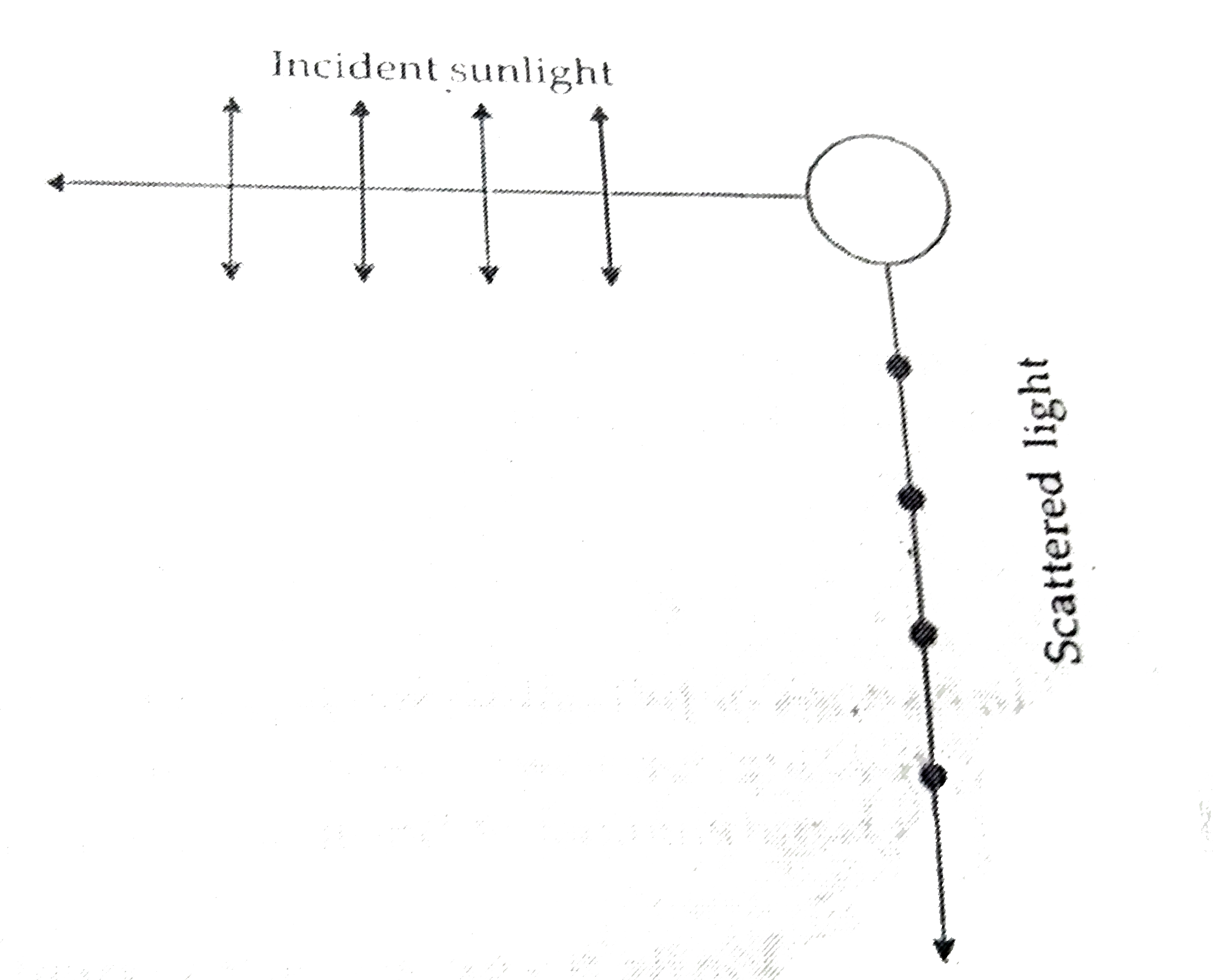 (b) If the unpolarised light is incident on a polaroid, the intensity is reduced by half. Even if the polaroid is rotated by angle `theta` the average over `cos^(2) theta = (1)/(2)`. Thus, from Malus' Law : I = `I_(0) cos^(2) theta` Or `I = I_(0)cos^(2)theta` `= I_(0) (cos^(2) theta) = (I_(0))/(2)` Thus, the intensity of the transmitted light remains unchanged when the polaroid is rotated. |
|
| 31. |
When a point charge of 6 mu C is moved between two points in an electric field, the work done is 1.8 xx 10^(-5) J. The potential difference between the two points is : |
|
Answer» 1.08 V `=(1.8xx10^(-5))/(6xx10^(-6))=18/6` V=3V |
|
| 32. |
Light waves are electromagnetic waves and hence transverse in nature. The electric field in a light wave propagating in free space is perpendicular to the direction of propagation. But there are infinite number of directions perpendicular to the direction of propagation. but there are infinite number of directions perpendicular to the direction of propagation of light. for example if light propagates along x-axis, the electric field may be along y-axis or along the z-axis or along any direction in y-z plane in the ordinary light. However, if electric field vecE remains parallel to a fixed direction (say y-axis) then such light is called linearly polarised light. There are several methods to produce polarised light from the unpolarised light. now-a-days polaroid sheets are commonly used to produce linearly polarised light. a polaroid has long chain of hydrocarbons which become conducting at optical frequencies. when light falls normally on the polaroid sheet, the vecE parallel to the chains is absorbed in setting up electric currents in the chains but vecE perpendicular to the chain gets transmitted. so, light on passing through the polaroid i.e., the transmitted light become linearly polarised with vecE parallel to the transission (pass) axis of polaroid. If linearly polarised light of intensity 'I' is incident on another polaroid whose pass axis is inclined at an angle theta from pass axis of first polaroid (or transmission axis of vecE of linearly polarised light) the intensity of transmitted light I_(t) is given as: I_(t)=Icos^(2)theta. Q. What is the pass axis of a polaroid ? |
| Answer» SOLUTION :The pass AXIS of a POLAROID is the direction in which `vecE` of light incident normally on polaroid sheet are ALLOWED to be transmitted. | |
| 33. |
A virtual image. We always say, cannot be caught on a screen. Yet when we 'see' a virtual image, we are obviously bringing it on to the 'screen ' (i.e., the retina ) of our eye. Is there a contradiction ? |
| Answer» SOLUTION :No. the lens of our eye MAKES a REAL IMAGE on the retina. | |
| 34. |
A metre stick of mass 400 gm is pivoted at one end and displaced through an angle of 60°. The increase in its P.E. is: |
|
Answer» 1 Joule `cos 60^(@)=(OD)/(OC)=(1/2-h)/(1/2)` `:.1/2=(1/2-h)/(1/2)implies1/2-h=1/4impliesh=(1)/(4M)` `:.` Increases in potential energy=mgh=`0.4xx10xx1/4` =1 J 
|
|
| 36. |
A cylindrical wavefront is divided into number of Fresnel.s half period elements. With the increase of the order of the element, the area of the element |
|
Answer» INCREASE |
|
| 37. |
Resistores are sometimes joinned together and they have several applications in electronics. Obtain the expression for the effective resistance of the combination of two resistors R_1 and R_2 connected in parallel . |
| Answer» SOLUTION :REFER TEXT | |
| 38. |
Light from a point source in air falls on a spherical glass surface (n = 1.5 and radius of curvature = 30 cm). The distance of the light source from the glass surface is 12 cm. At what position the image is formed |
| Answer» SOLUTION :V= 18 CM | |
| 39. |
In Column some operation performed on capacitor are given, while in Column-II are given some probable effects on capacitor. Malch the entries of Column with the entries of Column-II |
|
Answer» |
|
| 40. |
A galvanometer of resistance100 Omegais converted to a voltmeter of range 10 V by connecting a resistance of 10k Omega . The resistance required to convert the same galvanometer to an ammeter ofrange 1 A is |
|
Answer» a. `0.4 OMEGA` |
|
| 41. |
A monoenergetic (18 keV) electron beam initially in the horizontal direction is subjected to a horizontal magnetic field of 0.04 G normal to the initial direction. Estimate the up or down deflection of the beam over a distance of 30 cm (m_(e) = 9.11 xx 10^(-31) kg). [Note : Data in this exercise are so chosen that the answer will give you an idea of the effect of earth's magnetic field on the motion of the electron beam from the electron gun to the screen in a TV set.) |
Answer» Solution : WIDTH="80%"> WIDTH="80%"> Consider uniform magnetic field `overset(to) (B) (.)` with a width `x lt R` where R is the radius of curvature of CIRCULAR path followed by charge q (here charge e of electron), entering the magnetic field `overset(to) (B)` perpendicularly as shown in the figure. Here, width of magnetic field is `x= DH= CG and x lt R`. Now, we have the formula, `R = (mv sin 90^@)/( "Be") = (mv ) /( "Be") = (p)/( "Be") = ( sqrt(2mK) )/( "Be")` `therefore R= ((sqrt(2 xx 9.1 xx 10^(-31) xx 18 xx 10^(3) xx 1.6 xx 10^(-19) ))/( 0.4 xx 10^(-4) xx 1.6 xx 10^(-19) ))= 11.3` m Here width of region of magnetic field is `x= 0.3m rArr x lt R`. In right angled `Delta ACG`, we have`sin alpha = (x)/( R)= (0.3)/( 11.3) = 0.0265` As shown in the figure, D is the point of entry of electron in the magnetic field and G is the point of exit of electron from the magnetic field. Here, perpendicular distance between two horizontal LINES passing through points D and G is `d = DC = HG`, which is called linear deflection of electron (here vertically upward), which is to be found out. From the diagram, `d- DC = AD = R - R cos alpha` `therefore d= R(1- cos alpha ) = R (1- sqrt(1 - sin^(2) alpha))` `therefore d= 11.3 { 1 - sqrt(1- (0.0265)^(2) ) }` `= 0.003956 m= 3.956` mm |
|
| 42. |
A circular coil having N turns is made from a wire L meter long. If a current of I ampere is passed through this coil suspended in a uniform magnetic field of B tesla, find the maximum torque that can act on this coil. |
|
Answer» `(BIL^(2))/(2piN)` Numbers of turns in `2piR` length = 1 `therefore` Numbers of turns in L length = `L/(2piR)=N` `thereforeR=L/(2piN)` Area of cross section of coil A = `piR^(2)` `thereforeA=(PIL^(2))/(4pi^(2)N^(2))=L^(2)/(4piN^(2))` Torquc PRODUCED in coil after passing current through it is, `tau=NIAB=(NIL^(2)B)/(4piN^(2))` `thereforetau=(IL^(2)B)/(4piN)Nm` |
|
| 43. |
Consider a wire of length 4m and cross-sectional area 1 mm^2 carrying a current of 2A, If each cubic meter of the material contains 10^(29) free electrons find the average time taken by an electron to cross the length of the wire. |
| Answer» SOLUTION :8.9 HOURS | |
| 44. |
Area of a surface is 1256 m^(2). If 25 Js^(-1) radiant energy is incident on it at each second and absorbed completely, then findWave intensity |
| Answer» Solution :`I=(DELTA U)/(C )=(25)/(1256)=0.0199~~0.02 Wm^(-2)` | |
| 45. |
Sketch a graph showing the variation of capacitive reactance with the changein frequency of the a.c. source. |
Answer» SOLUTION :
|
|
| 46. |
The product of resistivity and conductivity of a cylindrical conductor depends on : |
|
Answer» TEMPERATURE |
|
| 47. |
Area of a surface is 1256 m^(2). If 25 Js^(-1) radiant energy is incident on it at each second and absorbed completely, then findMagnitude of energy density |
|
Answer» SOLUTION :`rho=(I)/(C )=(0.02)/(3XX10^(-8))=0.00666xx10^(8)` `~~6.67xx10^(11)JM^(-3)` |
|
| 48. |
When current I flows through a wire, the drift velocity of the electrons is v. When current 2I flows through another wire of the same material having double the length and area of cross-section, the drift velocity of the electrons will be |
| Answer» SOLUTION :`v_(d)=(I)/(nAe), v_(d)^(.)=(2I)/((2A)N e)=v_(d)` | |
| 49. |
The distance covered by a body in time (40.0 pm 0.4)m is (5.0pm 0.6)s. Calculate the speed of the body. The percentage error in the speed is |
|
Answer» `13%` |
|
| 50. |
A rectangular metal slab of mass 33.333 g has its length 8.0 cm, breadth 5.0 cm and thickness Imm. The mass is measured with accuracy up to 1 mg with a sensitive balance. The length and breadth are measured with vernier calipers having a least count of 0.01 cm. The thickness is measured with a screw gauge of least count 0.01 mm. The percentage accuracy in density calculated from the above measurements is |
|
Answer» 0.13 |
|