Saved Bookmarks
This section includes 7 InterviewSolutions, each offering curated multiple-choice questions to sharpen your Current Affairs knowledge and support exam preparation. Choose a topic below to get started.
| 1. |
What we mean from magnetic flux density ? |
| Answer» SOLUTION :FIELD CONCENTRATION | |
| 2. |
The balancing lengths of potentiometer wire are l_(1) and l_(2) when two cells of emf E_(1) and E_(2) are connected in the secondary circuit in series first to help each other and next to oppose each other (E_(1))/(E_(2)) is equal to (E_(1)gt E_(2)). |
|
Answer» `(l_(1))/(l_(2))` |
|
| 3. |
An object is placed in front of a concave mirror of focal length 20 cm. The image formed is three times the size of the object. Calculate two possible distances of the object from the mirror. |
|
Answer» Solution :m = + 3 and m = - 3, f = - 20cm When, m = 3 `m = - (v)/(u) = 3` v = - 3 u From mirror equation, `(1)/(f) = (1)/(v) + (1)/(u)` `(1)/(-20) = (1)/(-3u) + (1)/(u)` `=(1)/(u)[-(1)/(3)+1]` `(1)/(-20) = (2)/(3u)` `u = - (40)/(3) CM` When, `m =- 3 rArr v = 3u` `(1)/(f) = (1)/(v) + (1)/(u)` `(1)/(-20) = (1)/(3u) + (1)/(u)` `(1)/(-20) = (4)/(3u)` `u = - (4 xx 20)/(3)` ` u = - (80)/(3) cm` |
|
| 4. |
What is beta for a particle with (a) K=3.00E_(0) and (b) E=3.00E_(0)? |
|
Answer» |
|
| 5. |
Prove that the pressure and the volume of a degenerate electron gas are related by an equation similar to the Poisson equation, and find the adiabatic index gamma=C_(p)//C_(v). |
|
Answer» `P=(2h^(2))/(5M)(3/(8pi))^(2//3)N^(5//3)V^(-5//3)` which yields `PV^(5//3)` = const The ..adiabatic index.. is `gamma=5//3`. |
|
| 6. |
A shell at rest at the origin explodes into three pieces of masses 1 kg, 2 kg, and m kg, The 1 kg and 2 kg pieces fly off with speeds 12 ms^(-1) and 16 ms^(-1), along X-axis and Y-axis respectively. If m kg flies off with a speed of 40 ms^(-1), the total mass of the shell must be : |
|
Answer» 3.64 kg |
|
| 7. |
Lenz's law is consequence of the law of conservation of |
|
Answer» energy |
|
| 8. |
The magnetic field perpendicular to the plane of a conducting ring of radius r changes at the rate.(dB)/(dt) . Then |
|
Answer» the emf induced in the ring is `pi R^(2) (DB)/(dt)` |
|
| 10. |
A small ball of mass m and charge q is attached to the bottom end of a piece of negligible mass thread of length l, whose top end is fixed. The system formed by the thread and ball is in vertical plane and is in uniform horizontal magnetic field B, which is perpendicular to the plane of figure and points into the paper The ball is started with a velocity v_(0)from lower most point of circle in a direction perpendicular both to the magnetic induction and to direction of thread. The ball moves along a circular path such that thread remains tight during the whole motion. Neglect any loss of enery. Choose CORRECT statement |
|
Answer» If direction of magnetic field is reversed then VALUE of B will be same as calculated in above question of this PARAGRAPH |
|
| 11. |
A Franhoffer diffraction pattern due to a single slit of width 0.2 mm is being obtained on a screen placed at a distance of 2 m from the slit. The first minima lie at 5mm in either side of the centre maximum on the screen. Find the wavelength of the light used . |
|
Answer» |
|
| 12. |
An experimental setup of verification of photoelectric effect is shown in the diagram. The voltage across theelectrodes is measured with the help of an ideal voltmeter, and which can be varied by moving jockey 'j' on the potentiometer wire. The battery used in potentiometer circuit is of 20 V and its internal resistance is 2 Omega. The resistance of 100 cm long potentiometer wire is 8 Omega The photocurrent is measured with the help of an ideal ammeter. Two plates of potassium oxide of area 50 cm^(2) at separation 0.5 mm are used in the vacuum tube. Photo current in the circuit is very small so we can treat potentiometer circuit an independent circuit. The wavelengths of various colours is as follows : {:("Light",underset("Violet")(1),underset("Blue")(2),underset("Green")(3),underset("Yellow")(4),underset("Orange")(5),underset("Red")(6)),(lamda "in" Å rarr,4000-4500,4500-5000,5000-5500,5500-6000,6000-65000,6500-70000):}. When other light falls on the anode plate the ammeter reading remains zero till. jockey is moved from the end P to the middle point of the wire PQ. There after the deflection is recorded in the ammeter. The maximum kinetic energy of the emitted electron is |
|
Answer» 16 eV `:. KE = 8 eV`. |
|
| 13. |
Two metallic spheres of radii R and 2 R are charged so that both of these have same surface charge density sigma. If they are connected to each other with a conducting wire , in which direction will the charge flow and why ? |
|
Answer» Solution :Consider two metallic SPHERES A and B of radius `R_A = R` and `R_B = 2 R` respectively and they have same surface charge density `sigma`. LET `Q_A` and `Q_B` be total charges on spheres A and B and `V_A` and `V_B` be their respective potentials . Then `V_(A) = (Q_(A))/(4pi in_(0) R_A) = (4 pi R^2 sigma)/(4 pi in_(0) R) = (R sigma)/(in_(0))` and `V_(B) = (Q_(B))/(4pi in_(0) R_(B)) = (4pi (2R)^(2)* sigma)/(4 pi in_(0) (2 R)) = (2 R sigma)/(in_(0))` 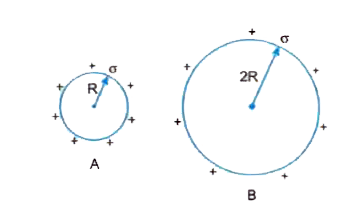 THUS `V_(B) gt V_(A)` If the two spheres are connected to each other with a conducting wire , then charge will flow from higher potential to lower potential . As `V_(B) gt V_(A)` , hence charge must flow from sphere B to sphere A , TILL they acquire the same potential . |
|
| 14. |
Colours appear on a thin soap film and soap bubbles due to the phenomenon of ...... |
|
Answer» REFRACTION |
|
| 15. |
What is the meaning of "dreadfully"? |
|
Answer» Moderate |
|
| 16. |
The radius of a nucleus is R. a. How is it related to atomic mass (A) ? b. Give the relation . c. What is the value of the constant of proportionality? |
| Answer» SOLUTION :`a. R prop A^(1/3) "" b. R = R_0 A^(1/3) "" c. R_0 = (1.2 +- 0.2) xx 10^(-15)m` | |
| 17. |
An electric dipole is placed in a uniform electric field of Intensity E as shown in the figure. Copy the diagram, mark the forces and derive an expression for torque. |
| Answer» SOLUTION :TORQUE `VECR =VECP * VECE` | |
| 18. |
An electric dipole is placed in a uniform electric field of Intensity E as shown in the figure. If the dipole is placed in a nonuniform electric field what nature of motion does it show? |
| Answer» Solution :Potential ENERGY U = -PE COS Q or U= `vecP*vecE` | |
| 19. |
What is the value of conductivity of a semiconductor at absolute zero ? |
|
Answer» INFINITE |
|
| 21. |
Figute shows the motion of a particle along a straight line.Find the average velocity of the particle during the intervals (a)A to E, (b)B to E,(c )C to E, (d) D to E, ( e) C to D. |
Answer» SOLUTION :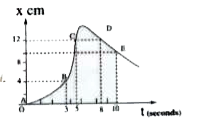 (a) As the particle moves from A to E, is the initial point and E is the final point. The slope of the line drawn from A to E i.e., `(Deltax)/(DELTAT)` gives the average velocity during that interval of time. The displacement `Deltax` is `X_(E)-X_(A)`=10cm-0cm=+10cm The time interval `Deltat_(EA)=t_(E)-t_(A)=10S`. `therefore` During this interval average velocity `barV=(Deltax)/(Deltat)=(+10cm)/(10S)=+1CMS^(-1)` (b)During the interval B to E. the displacement `Deltax=x_(E)-x_(B)=10cm-4cm=6cm` and `Deltat=t_(E)-t_(B)=10s-3S=7s.` `Therefore` Average velocity `barV=(Deltax)/(Deltat)=(6cm)/(7s)` =+0.857 `cms^(-1)=0.86cms^(-1)` (c) During the interval C to E,the displacement `Deltax=X_(E) -X_(c)=10cm0-12cm=2cm` nd `Deltat=t_(E)-t_(c)=10s-5s=5s` `therefore barv=(Deltax)/(Deltat)=(-2cm)/(5s)=-0.4 cms^(-1)` (d)During the interval D to E, the displacement `Deltax=x_(E)-x_(D)=10cm-12cm=-2cm` and the time interval `Deltat=t-(E)-t_(D)`=10s-8s=2 `therefore barv=(v)=(Deltax)/(deltat)=(-2cm)/(2s)=-1cms^(-1)` (e)During the interval C to D.the displacement `Deltax-x_(D)-x_(c)`=12cm 12 cm=0 and the time interval `Deltat=t_(D)-t_(c)`=8s-5s=3s `therefore` The average velocity `barv=(Deltax)/(Deltat)=(0m)/(3s)=0 ms^(-1)` (The particle has reached the same position during these 3s.The average velocity is zero because the displacement is zero). |
|
| 22. |
Potential energy of an electric dipole is minimum (Negatively maximum) when ......... |
|
Answer» <P>The dipole is PERPENDICULAR to the field If `theta=0 IMPLIES U = - Eo ` it is negative so minimum. |
|
| 23. |
The magnetic flux linked with a coil changes by 2xx10^(-2) Wb when the current by 0.01 A. The self - inductance of the coil is __________. |
|
Answer» |
|
| 24. |
वृषण में क्या उत्पन्न होता है: |
|
Answer» शुक्राणु |
|
| 25. |
S.T. for a constructive interference of two identical and coherent light waves, the maximum intensity is four times the intensity of individual waves and zero for a destructive interference. |
|
Answer» Solution :For an interference of two identical waves `R=sqrt((A)^2+(A)^2+2(A)(A)cos (phi_1-phi_2))` i.e., `R=sqrt(2A^2(1+cos (phi_1-phi_2)))` or `R=sqrt2 A(sqrt(1+cos phi))` where `phi_1=phi_1-phi_2` or `R=sqrt2 (A sqrt(2 cos^2 ((phi)/(2))))` or `R=2A cos (phi)/(2)` so that intensity `I=4A^2 cos^2. (phi)/(2)` For `C.I. cos^2 .(phi)/(2)=1 rArr (phi)/(2)=0, pm pi , pm2pi,....................pmnpi` or `phi=0,pm2pi,pm4pi,...................,pm2n pi`, where `n=0,1,2,3`. i.e., `I_("max")=4A_2=4I_0` where `I_0` is the maximum intensity of individual waves. For destructive interference `I=0 rArr cos^2. (phi)/(2)=0` i.e.., `phi =pm1pi,pm3pi,pm5pi,..................pm(12n+1)pi,` where, `n=0,1,2.` Note : if the PHASE DIFFERENCE b/w the two waves is not constant then the average intensity `=4I_(0) lt cos^2. (phi)/(2) GT` i.e., `lt I gt =2I_0` at all points. |
|
| 26. |
If the focal length of the eyepiece of a telescope is doubles, its magnifying power m will be |
|
Answer» 2m |
|
| 27. |
Light travels through a glass plate of thickness 't' and having refractive index n. If c be the speed of light in air then the lime taken by the light to travel the thickness of glass plate is |
|
Answer» `(t)/(nc)` |
|
| 28. |
How is magnetic flux linked with the armature coil changed in a generator ? |
| Answer» Solution :When the coil rotates in a magnetic field its effective AREA i.e. `A COS THETA` (i.e. area NORMAL to the magnetic field) keeps on changing hance magnetic flux `NBA cos theta`,keeps from changing. | |
| 29. |
A body is projected from a point with different angles of projections 20^(@), 35^(@), 45^(@), 60^(@) with the horizontal but with same initial speed. Their respective horizontal ranges are R_(1) R_(2) R_(3) and R_(4). Identify the correct order in which the horizontal ranges are arranged in increasing order |
|
Answer» `R_(1),R_(4),R_(2)R_(4)` |
|
| 30. |
When a tiny circular obstacle is placed in the path of light from distant source. A bright spot is seen at the centre of the obstacle . Explain why. |
|
Answer» Solution :This is because of DIFFRACTION of light Light gets diffracted by the tiny CIRCULAR obstacle and REACHES the centre of the SHADOW of the obstacle . [Altermatively. There is as a MAXIMUM , at the centre of the obstacle, in the diffraction pattern produced by it .] |
|
| 31. |
(A) : A unitless quantity cannot have a dimensional formula. (R): A dimensionless quantity cannot have a unit. |
|
Answer» Both (A) and (R) are TRUE and (R) is the CORRECT explanation of (A) |
|
| 32. |
A straight conductor 1 meter long moves a right angles to both, its length and a uniform magnetic field. If the speed of the conductor is 2.0 ms^(-1)and the strength of the magnetic field is 10^(4) gauss, find the value of induced emf in volt. |
|
Answer» |
|
| 33. |
A metallic rod of 1 m length is rotated with a frequency of 50 rev/s, with one end hinged at the centre and the other end at the circumference of a circular metallic ring of radius 1 m, about an axis passing through the centre and perpendicular to the plane of the ring as per figure. A constant and uniform magnetic field of 1T parallel to the axis is present everywhere. What is the emf between the centre and the metallic ring ? |
Answer» Solution :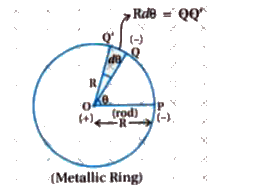 Consider uniform magnetic field `vecB(x)`, perpendicularly inside the plane of figure. Also consider a metallic ring of radius R whose plane is perpendicular to `vecB`. There is a conducting rod (OQ) of length R, with its one end hinged at O (centre of ring) and another end in contact with the ring. SUPPOSE, this rod ROTATES anticlockwise with constant angular speed `omega` . Because of this motion of rod, free ELECTRONS in it acquire velocity `vecv bot vecB`and hence they are exerted upon by magnetic force `vecF_m=e (vecBxxvecv)` in a direction from centre to outer end. Hence, free electrons in the rod start displacing away from centre, making centre positive and outer end negative. After some time when electric force `vecF_e` exerted on free electrons becomes equal and opposite to magnetic force `vecF_m`, a steady state is REACHED when Lorentz force exerted on electrons becomes zero. At this STAGE, we get maximum induced emf across the two ends of rod (or between centre and periphery of ring). Let this emf be `epsilon` whose formula can be derived as follows. Across the elemental length dr of rod chosen at distance r from centre if induced emf is `depsilon` then according to formula of motional emf we can write, `d epsilon=Bvdr` `therefore depsilon=B(romega)dr` `therefore` Total induced emf across the rod will be , `epsilon= intd epsilon` `=intB(romega)dr` `=Bomega int_0^R r dr` `therefore epsilon= Bomega{r^2/2}_0^R` `therefore epsilon=1/2BomegaR^2` Second Method : In above figure, suppose the rod rotates by extremely small angle `d theta` in time dt. Here, length of arc `Q Q. = Rd theta`. Now, area traversed (or swept) by rod in time dt would be `dA=1/2` (base)(height) `=1/2(R)(R d theta)` `dA=1/2R^2 d theta` Magnetic flux cut by the rod in time dt is , `d phi=B (dA)` `therefore d phi=B(1/2R^2 d theta)` `therefore (dphi)/(dt)=1/2BR^2 (d theta)/(dt)` `therefore (dphi)/(dt)=1/2BR^2 omega` (`because omega=(d theta)/(dt)` = constant angular speed of rod ) Now, induced emf across the rod will be , `epsilon=-(dphi)/(dt)` `therefore epsilon=-1/2 BomegaR^2` `therefore |epsilon|=1/2BomegaR^2` Third Method : At time t=0 , `epsilon_1=0 ( because v=0 rArr epsilon= Bvl=0)` At time t=t, `epsilon_2=Bvl` ( `because` Forl=R, `(v=R omega)`) `=B(R omega)R` `epsilon_2=BomegaR^2` `therefore` Average induced emf `lt epsilon gt = (epsilon_1+epsilon_2)/2=(0+BomegaR^2)/2` `therefore lt epsilon gt =1/2 B omegaR^2` Now , value of induced emf across the rod in the present situationwill be , `epsilon=1/2 B omegaR^2` `=1/2B(2pif)R^2`(`because omega = 2pif` where f=frequency of rotation) `=(1)(3.14)(50)(1)^2` `therefore epsilon`=157 V |
|
| 34. |
2.346 मे कितने सार्थक अंक है |
|
Answer» 1 |
|
| 35. |
When two forces 5 kg wt and 10 kg wt act with inclination of 120^@ between them, the angle which the resultant makes with 10 kg wt is |
| Answer» Answer :C | |
| 36. |
A solid sphere of radius R has a charge Q distributed in its volume with a charge density rho = kr^(a) where .k. and .a. are constants and r is the distance from its centre. If the electric field at r = (R )/(2) is (1)/(8) times that at r = R, find the value of a. |
|
Answer» |
|
| 37. |
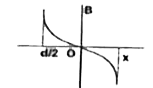
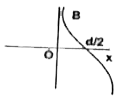
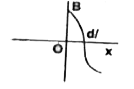
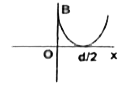
Which graph approximately shows the plot of magnetic field (B) with x between two current carrying conductors (as shown in the adjacent figure) if one of the conductors is at origin and they are separated by a distance d. |
|
Answer»
|
|
| 38. |
The value of the Q-factor in an L-C-R seriescircuit is …….. |
|
Answer» DEPENDENT on the frequency of the A source. |
|
| 39. |
When source and detector are stationary, but the wind is blowing at speed V_w, the apparent wavelength lambda^1 on the wind side is related to the actual wavelength lambda by (speed of sound is V): |
|
Answer» `LAMBDA^(1) = lambda` |
|
| 40. |
What is a conduction bond ? |
| Answer» SOLUTION :The RANGE of ENERGIES ASSOCIATED with conduction elctrons is called as conduction BAND. | |
| 41. |
Name different processes involved in electron emission. |
|
Answer» SOLUTION :The PROCESSES are : (i) Thermionic EMISSION (ii) Field Emission (iii) Photoelectric Emission (IV) Secondary Emission. |
|
| 42. |
A swimmer is diving in a swimming pool vertically down with a velocity of 2 ms^(-I). What will be the velocity as seen by a stationary fish at the bottom of the pool right below the diver? Refractive index of water is 1.33 |
|
Answer» `2.66 cms^(-1)` `therefore(h_i)/(h_0)=(n_("water"))/(n_("air"))` `therefore h_i=h_0xx1.33` From equation (1),`h_i=1.33 h_0` difference with respect to time, `therefore(dh_i)/(dt)=1.33(dh_0)/(dt)` `therefore v_i=1.33 v_0` `=1.33xx2` `=2.66 m//s` So, the fish will see the swimmer falling with speed of 2.66 m`//`s. |
|
| 43. |
A ball of mass m travelling horiozntally with velocity v strikes a massive vertical wall and rebounds back along its original direction with no change in speed. What is the magnitude of the impulse delivered by the wall to the ball? |
| Answer» Solution :The impulse delivered to the ball is equal to its CHANGE in momentum. The momentum of the ball was mv before hitting the wall and m(-V) after. Therefore, the change in momentum is m(-v)-mv=-2mv, so the MAGNITUDE of the momentum change (and the impulse) is 2mv. | |
| 44. |
A material of resistivity rho is formed in the shape of a truncated cone of altitude h. The top end has a radius a while bottom b. Assuming a uniform current density through any circular cross-section of the cone. Find the resistance between the two ends. |
|
Answer» `(rho)/(2PI)(h)/(AB)` |
|
| 45. |
A card sheet divided into squares eachof size "1 mm"^(2) is being viewed at a distance of 9 cm through a magnifyingglass (a converging lens of focal length 9 cm) held close to the eye. a) What is the magnification in produced by the lens? How much is the area of each square in the virtual image ? |
|
Answer» Solution :`(1)/(v)+(1)/(9)=(1)/(10)` i.e., `v=-90cm`. Magnitude of magnification `= 90//9 = 10`. Each square in the virtual image has an area `10 xx 10 xx 1 mm^(2) = 100 mm^(2) = 1 cm^(2)` (b) Magnifying power `= 25//9 = 2.8` (c) No, magnification of an image by a lens and angular magnification (or magnifying power) of an optical instrument are two separate things. The LATTER is the ratio of the angular SIZE of the object (which is equal to the angular size of the image even if the image is magnified) to the angular size of the object if placed at the near point (25 cm). Thus, magnification magnitude is `|(v//u)|` and magnifying power is `(25// |u|)`. Only when the image is LOCATED at the near point `|v| = 25 cm,` are the two QUANTITIES equal. |
|
| 46. |
The correct relationship between the two current gains alpha and beta in a transistor is |
|
Answer» `ALPHA = BETA/(1-beta)` |
|
| 47. |
The self inductance angle of a solenoid of length and are of cross section A with a fixed number of turns N increases as, |
|
Answer» l and A increase `=mu_0(N/l)^2Al` `=(mu_0N^2Al)/l^2` `THEREFORE L=(mu_0N^2A)/l` When N= constant SELF inductance L will increase by decreasing l and by INCREASING A. |
|
| 48. |
A metallic rod of mass per unit length 0.5kgm^(-1) is lying horizontally on a smooth inclined plane which makes an angle of 30° with the horizontal. The rod is not allowed to slide down by flowing a current through it when a magnetic field of induction 0.25 T is acting on it in the vertical direction. The current flowing in the rod to keep it stationary is |
|
Answer» 7.14 S |
|
| 49. |
State working principle of potentiometer. Explain how the balance point shifts when value of resistor R increases in the circuit of potentiometer, given below. |
|
Answer» Solution :A potentiometer WORKS on the principle that for a constant current flowing through the potenti-ometer wire of uniform cross-section the fall in potential is directly proportional to the length. When value of resistor R is increased in the circuit of potentiometer, current flowing through potentiometer wire due to driver CELL V decreases and consequently the valueof potential gradient .k.along potentiometer decreases. Mathematically `I=(epsilon)/(R+R_(1))`, where `epsilon=emf` of driver cell and `R_(1)=` resistance of potentiometer wire and `k=1(R_(1))/(L)`, where L = TOTAL length of potentiometer wire AB. `rArr""k=(epsilon R_(1))/((R+R_(1))L)` Due to decrease in the value of .k., the BALANCE point will shift towards right i.e., the BALANCING length increases. |
|
| 50. |
Ahollow cylindrical box of length 1m area of cross-section 25 cm^(2)is placed in a three dimensional coordinate system as shown in the electric field in the region is given byoversetto E = 50 x hati , where E is inN C^(-1)and x is in metres . Find (i)Net flux through the cylinder.(ii) charge enclosed by the cylinder.(##U_LIK_SP_PHY_XII_C01_E10_019_Q01.png" width="80%"> |
|
Answer» Solution :As ELECTRIC field `oversetto E = 50 x hat I N C^(-1)` is along +ve DIRECTION of X - axis, hence flux passing through side faces 1 and 2 of cylinder is ` phi_1 =E_1 ` A INWARD and ` phi_2 =E_2` A outward . However , there is no flux associated with curved surface of cylinder. ` therefore "" phi_1 =-E_1 A = - (50 xx 1)xx 25 xx 10^(-4)N m^(2)C^(-1)=- 0.125 N m^(2)C^(-1) ` and ` "" phi_2 =+ E_2A =+ ( 50 xx 2) xx 25 xx 10 ^(-4)N m^(2)C^(-1)=+ 0.250 N m^(2)C^(-1) ` ` therefore ` Net electric flux through cylinder ` "" phi_in =phi_1 +phi_2 =-0.125 +0.250 =+ 0.125 N m^(2) C^(-1) ` (b) As net flux `f_in =(q)/( in_0), `hence charge enclosed by the cylinder will be ` ""q= in _0 . Phi_in =( 8.85xx 10 ^(-12)) xx 0.125 = 1.1 xx 10^(-12)C = 1.1 pC ` |
|