Saved Bookmarks
This section includes 7 InterviewSolutions, each offering curated multiple-choice questions to sharpen your Current Affairs knowledge and support exam preparation. Choose a topic below to get started.
| 1. |
What will be the maximum speed of a car on a road turn of radius 30 m, if the coefficient of friction between the tyres and the road is 0.4? (Take g=9.8m//s^(2)) |
|
Answer» 10.84 m/s |
|
| 2. |
A solid flywheel of 20 kg mass and 120 mm radius revolves at 600 r.p.m. With what force must a brake lining be pressed against it for the flywheel to stop in 3 s, if the coefficient of friction is 0.1? |
|
Answer» `DELTAK = (Iomega^2)/2=(mr^2omega^2)/4, W_r=Tl=muNv_(av)t=(muNomegart)/2` Hence `N = (mromega)/(2mut)=(pi m rn)/(mut)` Try to solve this problem with the aid of the FUNDAMENTAL EQUATION of rotational dynamics of a rigid body. |
|
| 3. |
A sheet of aluminium foil of negligible thickness is placed between the plates of a capacitor of capacitance C as shown in the figure, the capacitance of capacitor becomes |
|
Answer» 2C `C_(1) = (epsilon_(0)A)/(d//2), C_(2) = (epsilon_(0)A)/(d//2)` `:. (1)/(C') = (d)/(epsilon_(0)A) :. C' = (epsilon_(0)A)/(d) = C` |
|
| 4. |
Hydrogen atom from excited state comes to the ground state by emitting a photon of wavelength lamda, then what is the quantum number ofexcited states ? |
|
Answer» `SQRT((lamdaR-1)/(lamdaR))` `:.(1)/(lamdaR)=(1)/(1)-(1)/(n^(2))` `(1)/(n^(2))=1-(1)/(lamdaR)=(lamdaR-1)/(lamdaR)` `:.n=sqrt((lamdaR)/(lamdaR-1))` |
|
| 5. |
In young.s double slit experiment two slits are illuminated by real monochromatic light source.If one of the slits is closed, what will be the observation on the screen? |
| Answer» SOLUTION :SINCE WAVELENGTH DECREASES, the BANDWIDTH decreases | |
| 6. |
Explain what would happen if in the capacitor given in Question 2.8, a 3 mm thick mica sheet (of dielectric constant =6) were inserted between the plates, (a) while the voltage supply remained connected. (b) after the supply was disconnected. |
|
Answer» Solution :As for mica K = 6, HENCE NEW capacitance of the capacitor `C. = KC = 6 xx 18 pF = 108 pF` (a) If voltage supply remains connected then voltage will still remain V = 100 V and charge `Q. = C.V = 108 xx 10^(-12) xx 100 xx 10^(-8) C or 10.8 NC` (b) If supply was isconnected then charge on each plate of capacitor remains at `Q = 1.8 nC = 1.8 xx 10^(-19) C` `:.` Potential difference `V. = Q/(C.) = (1.8 xx 10^(-9))/(108 xx 10^(-12)) = 16.6V.` |
|
| 7. |
A ray of light enters in air from glass. What wi be deviation angle if angle of incidence is 50^@ Take refractive index of glass 1.5. |
|
Answer» `0^@`  ACCORDING to Snell.s LAW, `1.5sin 50^@=(1)sinr` `therefore r=sin^(-1)(1.5sin50^@)` Now,`delta=r-50^@` `delta=sin^(-1)(1.5sin50^@)` |
|
| 8. |
As moving to the higher orbits orbital velocity of the electron |
|
Answer» REMAINS the same |
|
| 9. |
In propagation of electromagnetic waves, what is the angle between the direction of propagation of the wave and the plane of polarisation? |
| Answer» Solution :DIRECTION of the propagation of wave and the plane of POLARISATION are at RIGHT ANGLES to each other. | |
| 10. |
What is the magnitude of the equatorial and axtal feilds due to a bar magnet of length 5.0 cm at a distance of 50 cm from its mid-point? The magnetic moment of the bar magnet is 0.40 A m^2 the same as in Example 5.2. |
|
Answer» Solution :From EQ (5.7) `B_(E)=(mu_(0)m)/(4pi r^(2))=(10^(-7) xx 0.4)/((0.5)^(3))=(10^(-7) xx 0.4)/(0.125) =3.2 xx 10^(-7)T` From Eq. (5.8) `B_(A)=(mu_(0)2m)/(4pi r^(3))=6.4 xx 10^(-7)T` |
|
| 11. |
Two parallel beams of protons and electrons, carrying equal currents are fixed at a separation d. The protons and electrons move in opposite directions. P is a point on a line joining the beams , at a distacne x from any one beam. The magnetic fieldat P is B . If B is plotted against x, which of the following best represents the resulting curve |
|
Answer»
|
|
| 12. |
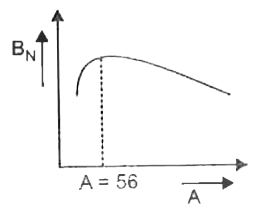
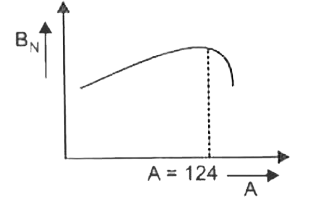
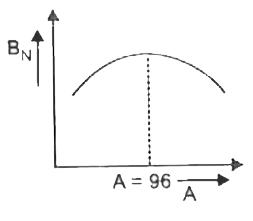
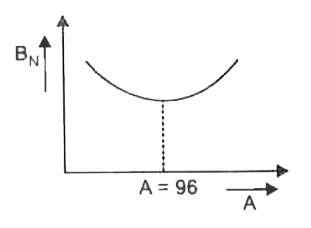
The dependence of binding energy per nucleon, B_N on the mass number, A is represented by |
|
Answer»
|
|
| 13. |
Charge carriers responsible for flow of electricity in gases at low pressure are ___ and ____. |
| Answer» SOLUTION :FREE ELECTRONS, POSITIVE IONS | |
| 14. |
Name the parts of the electromagnetic spectrum which is suitable for radar systems used in aircraft navigation. Write in brief, how these waves can be produced. |
| Answer» Solution :MICROWAVESMicrowave are produced by SPECIAL vacuum TUBES, like klystorms, MAGNETRONS and gunn diodes. | |
| 15. |
Assertion : Electric lines of force cross each other. Reason: Electric field at a point supermpose to give one resultant electric field. |
|
Answer» If both assertion and reason are true and the reason is the CORRECT explanation of the assertion. explanation: if electric lines of FORCES cross each other, then the electric field at the POINT of intersection WIL have two direction simultaneously which is not possible PHYSICALLY . |
|
| 16. |
How can you charge a metal sphere positively without touching it ? |
Answer» Solution :Consider an isolated metallic sphere as shown in figure (a). Net CHARGE on this sphere is zero. 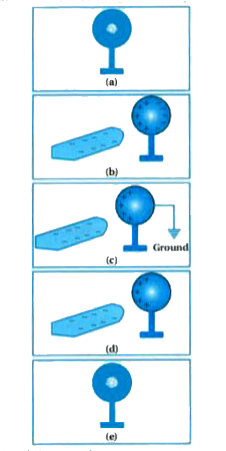 Now, bring negatively charged rod quite CLOSE to above sphere as shown in figure (b). Because of this, free electrons in the sphere move away because of repulsion. As a result, part of surface of sphere nearer to rod becomes positive and part of surface of sphere, farther from rod becomes NEGATIVE. Now, make this farther part of surface of sphere grounded with the help of conducting wire, as shown in figure (C). Now these accumulated electrons rush towards ground as shown in figure (d). When we disconnect the sphere from the ground, positive charge on the sphere still remains ATTRACTED towards negatively charged rod. Now when the rod is taken away, positive charge on the sphere gets distributed uniformly on its surface as shown in figure (e). Such a method of charging in which electrically neutral body gets charged up by a charged body without any physical contact is called "charging by induction". Note : In case of charging by induction, inducing charge and induced charge are opposite in nature. If the body to be charged is metallic these charges are of equal in magnitude. Ground is negatively charged. |
|
| 17. |
An ideal gas is enclosed in a closed, rigid and thermally insulated container. A coil of 100 resistance and carrying a current of 1A supplies heat to the gas. What is the change in the internal energy of the gas after 5 minutes |
| Answer» Answer :A | |
| 18. |
Suppose the prism of Fig. 34-83 has apex angle ph=60.^(@) and index of refraction n=1.60. (a) What is the smallest angle of incidence theta for which a ray can enter the left face of the prism and exit the right face ? (b) What angle of incidence theta is required for the ray to exit the prism with an identical angle theta for its refraction as it does in Fig. 34-83. |
|
Answer» |
|
| 19. |
A projection aimed at a mark which is in the horizontal planethroughthepointof projection falls 'a' cm shortof it when the elevationis alpha and goesb cm forfar whenthe elevation is beta . Showthat if the speed of projection is samein all the cases the properelevation is . |
| Answer» Solution :`(1)/(2) SIN^(-1)[(a sin 2 ALPHA a+ B sin 2 beta)/(a+b)]` | |
| 20. |
When did kailash satyarthi win the Nobel Prize? |
|
Answer» 2014 |
|
| 21. |
In a hydrogen atom, the electron and proton are bound at a distanceof about0.53 Å. (a) Esimate the potential energy of the system in eV, takingthe zero of potential energy of infinite separation of electron from proton. (b) What is the minimum work required to freethe electron, giventhat its KE in the orbit is half the magnitudeof potentialenergyobtained in (a) ? (c ) What are the anwersto (a) and (b) above, if zero of potentitalenergy is takenat 1.06 Å separation ? |
|
Answer» Solution :Here `q_(1) = 1.6xx10^(-19) C , q_(2) = +1.6xx10^(-19) C, r = 0.53 Å = 0.53xx10^(-10) m` Potentialenergy= P.E at `oo -` P.E at r `= 0 - (q_(1) q_(2))/(4pi in_(0) r) = (-9xx10^(9) (1.6xx10^(-19))^(2))/(0.53xx10^(-10)) = -43.47xx10^(-19) joul e` `= (-43.47xx10^(-19))/(1.6xx10^(-19)) EV = -27.16eV` (b) K.E. in the orbit `= (1)/(2) (27.16)eV = 13.58eV` Total energy ` = K.E. + P.E. = 13.58 - 27.16 = -13.58 eV` WORK requiredto freethe ELECTRON`= 13.58 eV` (c ) Potental energyata separation of `r_(1) (= 1.06 Å)` is `= (q_(1) q_(2))/(4pi in_(0) r_(1)) = (9xx10^(9) (1.6xx10^(-19))^(2))/(1.06xx10^(-10)) = 21.73xx10^(-19) J = 13.58 eV` Potentialenergy of the system, when ZERO of P.E. is taken at `r_(1) = 1.06 Å` is `= P.E." at "r_(1) - P.E at r = 13.58-27.16 = -13.58 eV`. By shifting the zero of potentialenergy, workrequiredto freethe electron is not affected. It CONTINUES to bethe same, beingequal to `+13.58 eV`. |
|
| 22. |
In a Young's double-slit experiment with light of wavelength lambda, the separation of slits is d and distance of screen is D such that D > > d > > lambda. If the Fringe width is beta, the distance from point of maximum intensity to the point where intensity falls to half of maximum intensity on either side is: |
|
Answer» `BETA/2` `I_("max") = 4I_0` Now `(I_("max"))/(2) = 4I_0 cos^2 (phi)/2` `1/2 = cos^2 (phi)/2 IMPLIES cos (phi)/2 = 1/(sqrt(2))` `(phi)/2 = (PI)/4` `phi = (pi)/2` `Deltax = lambda/(2pi) xx phi` `implies Deltax = lambda/(2 pi) xx pi/2 = lambda/4` `Delta X = lambda/4` `Delta x = (dy)/D = lambda/4` `implies y = (D/d) xx lambda/4` `y = ((lambda D)/d) xx 1/4` `y = beta/4`. |
|
| 23. |
We know that speed of light in vacuum is always constant and equal to c = 3 xx 10^(8) m//s. There is a source of light and speed of light emitted from the source is to be measured. Three different frames of refernce, namely P, Q and R, are used in the experiment. Frame of reference P is moving towards the source and R is moving away from the source with same speed. Frame of reference Q is fixed at its location. V_p, V_Q and V_R are the speeds of light as measured by the observers in corresponding reference frames. Answer the following question : Select correct option(s) if surrounding space is vacuum everywhere |
|
Answer» `V_P gt V_Q gt V_R` |
|
| 24. |
We know that speed of light in vacuum is always constant and equal to c = 3 xx 10^(8) m//s. There is a source of light and speed of light emitted from the source is to be measured. Three different frames of refernce, namely P, Q and R, are used in the experiment. Frame of reference P is moving towards the source and R is moving away from the source with same speed. Frame of reference Q is fixed at its location. V_p, V_Q and V_R are the speeds of light as measured by the observers in corresponding reference frames. Answer the following question : Select correct option(s) if surrounding space is water everywhere |
|
Answer» `V_P gt V_Q gt V_R` |
|
| 25. |
A 250-Turn rectangular coil of length 2.1 cm and width 1.25 cm carries a current of 85 μA and subjected to a magnetic field of strength 0.85 T. work done for rotating the coil by 180° against the torque is |
|
Answer» `1.15muJ` |
|
| 26. |
In developed countries, people are? |
|
Answer» Too happy |
|
| 27. |
In _____ phenomenon, toroid is being used. |
|
Answer» NUCLEAR fission |
|
| 28. |
In the above problem find the speed with which the stone hits the ground . |
|
Answer» |
|
| 29. |
What is the true for 3 moles of a gas? |
|
Answer» `3(C_(p)-C_(V))=R` |
|
| 30. |
Find the time required for a 50 Hz alternating current to become its value from zero to the rms value. |
|
Answer» 2.5 MS `therefore (2PI)/TXX t= pi/4` `therefore I_(RMS)/I_m=sin omegat` `therefore t=T/8` `therefore 1/sqrt2 = sin omegat` but `T=1/f = 1/50`=0.025 `therefore omegat=pi/4` `therefore t=0.02/8`= 0.0025 =2.5 ms |
|
| 31. |
If by mistake volmeter is connected in series with the resistance then I-V curve expeced is (Here I = reading of ammeter V = reading of voltmeter) . |
|
Answer»
|
|
| 32. |
Magnetic susceptibility of a material of a rod is 499. Find absolute permeability of the material of the rod. |
|
Answer» `pi XX 10^(-4) ( Tm )/( A)` `therefore (MU)/( mu_0) = chi_(m) +1 ""(because mu_(r) = (mu)/( mu_0) )` `therefore mu= mu_(0) (chi_(m) +1) = 4pi xx 10^(-7) (499 +1)` `therefore mu= 2pi xx 10^(-4) ( Tm )/( A)` |
|
| 33. |
A wheel of moment of inertia5 xx 10 ^(-3) kgm^2 is making 20 rev/s. Torque to stop it in 10 sec is |
|
Answer» `2pi`XX 10^(-2)NM |
|
| 34. |
A network of four capacitors, each of capacitance 15muF,is connected across a battery of 100 V as shown in the figure. Find the net capacitance and the charge on the capacitor C_4. |
|
Answer» Solution :Here `C_1 = C_2 = C_3 = C_4= 15 muF and V = 100V` In the network shown,capacitors `C_1, C_2 andC_3` are joined in series and their equivalent capacitance C. is GIVEN by : `1/(C.) = 1/C_1 + 1/C_2 + 1/C_3 = 1/15+ 1/15+ 1/15 = 1/5 rArr C. = 5 muF`. Now, C. and `C_4` are connected in parallel, hence the net capacitance of the network : `C = C. + C_4= (5 + 15) mu F= 20 muF` Moreover, the charge on the capacitor `C_4`, `Q_4= C_4 V = (15 muF) xx 100V =1500 muC = 1.5 MC` |
|
| 35. |
Select and write the corrcet answer : A simpleharmonic progressive wave is represented byy = 0.01sin4 pi (t - x/2) in SI units. The wavelength of thewave is |
|
Answer» 4 m ` :. lambda = 1 m ` |
|
| 36. |
A tube of length l and radius R carries a steady flow of fluid whose density is rho and viscosity eta. The fluid flow velocity depends on the distance r from the axis of the tube as v=v_0(1-r^2//R^2). Find: (a) the volume of the fluid flowing across the section of the tube per unit time: (b) the kinetic energy of the fluid within the tube's volume, (c) the friction force exerted on the tube by the fluid, (d) the pressure difference at the ends of the tube. |
|
Answer» Solution :(a) LET `dV` be the volume flowing per second through the cylindrical SHELL of thickness `dr` then, `dV=-(2pirdr)v_0(1-(r^2)/(R^2))=2piv_0(r-(r^3)/(R^2))dr` and the total volume, `V=2piv_0underset(0)overset(R)int(r-r^3/R^2)dr=2piv_0(R^2)/(4)=pi/2R^2v_0`  (b) Let, `dE` be the KINETIC energy, within the above cylindrical shell. Then `dT=1/2(dm)v^2=1/2(2pirldrrho)v^2` `=1/2(2pilrho)rdrv_0^2(1-(r^2)/(R^2))=pilrhov_0[r-(2r^3)/(R^2)+(r^5)/(R^4)]dr` Hence, total energy of the fluid, `T=pilrhov_0^2underset(0)overset(R)int(r-(2r^3)/(R^2)+(r^5)/(R^4))dr=(piR^2rholv_0^2)/(6)` (c) Here frictional force is the shearing force on the tube, exerted by the fluid, which equals `-etaS(dv)/(dt)`. Given, `v=v_0(1-r^2/R^2)` So, `(dv)/(dt)=-2v_0(r)/(R^2)` And at `r=R`, `(dv)/(dt)=-(2v_0)/(R)` Then, viscous force is given by, `F=-eta(2piRl)((dv)/(dr))_(r=R)` `=-2piRetal(-(2v_0)/(R))=4pietav_0l` (d) Taking a cylindrical shell of thickness `dr` and radius r viscous force, `F=-eta(2pirl)(dv)/(dr)`, Let `Deltap` be the pressure difference, then net force on the element `=Deltappir^2+2pietalr(dv)/(dr)` But, since the flow is steady, `F_(n et)=0` or, `Deltap=(-2pil etar(dv)/(dr))/(pir^2)=(-2pil etar(-2v_0(r)/(R^2)))/(pir^2)=4etav_0l//R^2`
|
|
| 37. |
A cylindrical conductor of radius R carries a current along its length. The current density J, however, is not uniform over the cross section of the conductor but is a function of the radius according to J = br, where b is a constant. Find an expression for the magnetic field B. (a) at r_1 lt R (b) at distance r_2 gt R, measured from the axis. Hint [use Ampere's Law] |
| Answer» Solution :`B_(1) = (mu_0 br_(1)^(2))/(3). B_(2) = (mu_0 R^3)/(3r_2)` | |
| 38. |
Polarization of electromagnetic wave is caused by |
|
Answer» reflection |
|
| 39. |
S_(1) : Even at different temperature and pressure, equal volume of all the gases contains equal number of moles. S_(2) : 11.2 L CO_(2)(g) atSTP contains the same number of free entity as 22.4 L O_(2)(g) at STP. S_(3) : If reacting species in a reaction are not taken in their stoichiometric coefficient ratio then one of the reactant will be limiting reagent. S_(4) : If two different solutions having different solute are mixed in certain volume proportion then resulting concentration of the components will decrease. |
|
Answer» `F F T T ` |
|
| 40. |
Can there be a potential difference between two adjacent conductors carrying the same charge ? |
|
Answer» Solution :YES, if the SIZES are different . Capacitance of CAPACITOR ` C= (Q)/(V)` where Q is the charge of CONDUCTOR and V is the electric potential of conductors. For GIVEN charge potential `V prop (1)/(C)`. So two adjacent conductors carrying the same charge of different dimensions may have different potentials. |
|
| 41. |
What is the net flux of the uniform electricfield of Question 1.15through a cube of side 20cm oriented so that its faces are parallel to the coordinate planes?(##U_LIK_SP_PHY_XII_C01_E01_016_Q01.png" width="80%"> |
| Answer» Solution :As `oversetto E ` is directed ALONG x-axis, hence flux by the faces of the CUBE lying in x-y and x-zplanes is ZERO.. Further as field is UNIFORM one, for faces lying in y-z plane, flux is positive for one FACE andequal but negative for second face. Therefore , net flux through the cube will be zero. | |
| 42. |
An electric lamp connecvted in series with a variable capacitor and an ac source is glowing with some brightness. Predict your observation when the ac source is replaced by a dc source. How will the brightness of the bulb affectede in each cases if the capacitance of the capacitor is reduced ? |
| Answer» Solution :The bulb will not burn with the dc source beacause the capacitive reactance `X_e=1/C_omega` is infinite. That MEANS the capacitor BLOCKS dc. When the lamp is connected to ac, the bulb will GLOW. On REDUCING the capacitance, capacitative reactance `1/C_omega` will increase. So, the BRIGHTNESS of the bulb gets reduced. | |
| 43. |
For a transistor amplifier, the voltage gain |
|
Answer» remain constant for all frequency |
|
| 44. |
Calculate the distancefor which ray optics is good aproximation for an aperture of 5 mm and wavelenght 500 nm. |
|
Answer» Solution :`a = 5 MM = 5 xx 10^(-3) m ,` `lambda = 500 nm = 500 xx 10^(-9) m, z = ?` Equation for Fresnel.s distance, `z = (a^(2))/(2 lambda)` Substituting, `z=((5xx10^(-3))^(2))/(2xx500xx10^(-9))=(25xx10^(-6))/(1xx10^(-6))=25M` z = 25 m |
|
| 45. |
A magnetic compass needle of magnetic moment 60 A-m^2 is placed at a place. The needle points towards the geographic north. Using the data given below, find the value of declination at that place. Horizontal component of earth's magnetic field = 40 xx 10^(-6) Wb m^(-2) and torque experienced by the needle = 1.2 xx 10^(-3) Nm. |
|
Answer» Solution :Let angle of declination at the place be `D^@` Then toryue acting on magnetic compass NEEDLE when placed along GEOGRAPHIC north-south direction `tau = mB_H sin D`. Here `m = 60 A-m^2 , B_H = 40 xx 10^(-6) Wb m^(-2) and tau = 1.2 xx 10^(-3) Nm` `THEREFORE sin D =(tau)/(mB_H)=(1.2 xx 10^(-3))/(60xx40xx10^(-6))=0.5 impliestheta =30^@`. |
|
| 46. |
In YDSE bi-chromatic light of wavelengths 400 nm and 560 nm are used. The distance between the slits is 0.1 mm and the distance between the plane of the slits and the screen is 1.0m. The minimum distance between two successive regions of complete darkness is |
|
Answer» SOLUTION :Let nth minimum of 400 nm coincides with mth MINIMA of 560 nm, then `(2n-1)((400)/(2))= (2 m-1)((560)/(2))" or "(2n-1)/(2m-1)= (7)/(5)= (14)/(10)="……."` i.e., 4th minima of 400 nm coincides with 3rd minima of 560 nm. Location of this minima is, `Y_(1)= ((2xx4-1)(1000)(400xx 10^(-9)))/(2xx 0.1)= 14 mm` Next 11th minima of 400 nm will coincide with 8th minima of 560 nm. Location of this minima is, `Y_(2)= ((2xx 11-1)(1000)(400xx 10^(-9)))/(2xx0.1)= 42 mm` Required DISTANCE `Y_(2)-Y_(1)= 28mm`. |
|
| 47. |
The surface of a metal is illuminated with the light of 400 nm. The kinetic energy of the ejected photo electrons was found to be 1.68 eV. The work function of the metal is (h_(c)=1240eV.nm) |
|
Answer» 1.41 eV As `E=phi_(0)+K_(max),` hence `phi_(0)=E-K_(max)=3.1-1.68=1.42eV` |
|
| 48. |
We have obtained the barometric distribution for the case of an isothermal atmosphere, indeed, in xi 26.10 we assumed the temperature to be the same at every point. Actually, in the real atmosphere the temperature drops with altitude. It may be demonstrated that if the decrease in the temperature with the altitude is linear, i.e. if T = T = T_0(1- alpha h), the barometrical formula assumes the form p/(p_0) = ((T)/(T_0))^(mg//ahT_0) Prove that if a is small this formula reduces to the formula for the barometric distribution in an isothermal atmosphere. |
|
Answer» |
|
| 49. |
The average intensity of electromagnetic wave is (where symbols have their usual meanings) |
|
Answer» `epsilon_0` × `E^2_RMS` × C |
|
| 50. |
A sphere of mass m is tied to end of a string of length l and rotated through the other and along a horizontal circular path with speed v. The work done in full horizontal circle is : |
| Answer» Answer :A | |
 WIDTH="