Saved Bookmarks
This section includes 7 InterviewSolutions, each offering curated multiple-choice questions to sharpen your Current Affairs knowledge and support exam preparation. Choose a topic below to get started.
| 1. |
Consider a capacitor shown in Fig. 1 . If we pull the plates of capacitor to a final position as show in Fig ,2 then we must performwork against electric force. For this situation . Mark out the correct statement .[take areas of plates as A] |
|
Answer» WORK done is `(Q^2)/(2epsilon_(0)A)(d_(2)-d_(1))` and is stored in VOLUME `A(d_(2)-d_(1))` |
|
| 2. |
What is the direction of the force acting on a charged. Particle q moving with a velocity vecv in a uniform magnetic field vecB ? |
| Answer» Solution :Force `vecF_(B)` is ALONG the direction of `(VECV xx VECB)` | |
| 3. |
What kind of a spherical mirror must be used and what must be its radius of curvature in order to get an erect image (1)/(5) as large as an object placed 15 cm in front of it ? |
|
Answer» SOLUTION :m = `(1)/(5) , U = - 15 cm , m = (f)/(f - u)` `(1)/(5) = (f)/(f - 15) "" 5f = f - 15 "" f= - 3.75` cm Negative sign shows that the MIRROR is concave.R = 2f = 2 `xx 3.75 = 7.5` cm |
|
| 4. |
An equiconvex lens of refractive index 1.5 and focal length 10 cm is held with its axis vertical and its lower surface immersed in water, the upper surface being in air. At what distance from the lens will a vertical beam of parallel rays incident on the lens be focussed? mu. = 4//3. |
| Answer» SOLUTION :20 CM from the LENS in WATER | |
| 5. |
The energy of radiation emitted by LED is : |
|
Answer» Greater than the band GAP of the SEMICONDUCTOR used. |
|
| 6. |
The surface tension of a soap solution is 0.030N/m. What is the energy needed to increase the radius of the soap bubble from 4cm to 6cm. |
|
Answer» Solution :`W = 2 xx T xx [4piR_2^2 - 4piR_1^2]` = `8piT [R_2^2 - R_1^2]` = `8 xx 3.14 xx 30 xx 10^-3 [36 -16] xx 10^-4` = `240 xx 3.14 xx 20 xx 10^-2` = `150 xx 10^-5 = 1.5 xx 10^-3 J` |
|
| 7. |
28ग्राम मे उपस्थित नाइट्रोजन अणु के मोलों की संख्या |
|
Answer» 2 |
|
| 8. |
A uniform but time varying magnetic field is present in a circular region of radius R. The magnetic field is perpendicular and into the plane of the paper and the magnitude of the field is increasing at a constant rate alpha. There is a straight conducing rod length 2R placed as shown in the figure. Themagnitude of induced emf across the rod is |
|
Answer» `PIR^(2)alpha` |
|
| 9. |
One speaks of mutual characteristics in connection with L : |
|
Answer» an INDUCTANCE |
|
| 10. |
The magnetic potential at the distance 20 cm from the axis of dipole of dipole moment10^-5 Wb/m on equatorial line is : |
| Answer» ANSWER :A | |
| 11. |
Two forces of equal magnitude F act at a point. If the angle between them is θ, then the magnitude of the resultant force is |
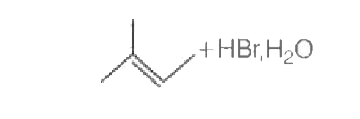
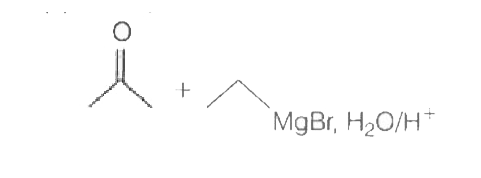
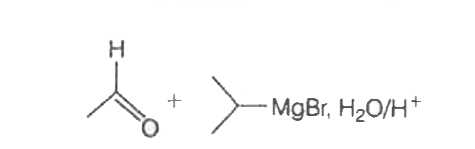
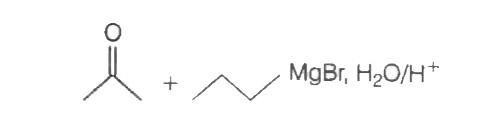
|
Answer» `F sqrt(2(l-sintheta))` `R=sqrt(F_(1)^(2)+F_(2)^(2)+2F_(1)^(2)F_(2)^(2)costheta)` implies`R = sqrt(F^(2)+F^(2)+2F^(2)costheta)` implies `R = sqrt(2F^(2)+2F^(2)costheta)` `implies R = sqrt(2F^(2)(1 +costheta)` since, `1+costheta = 2 cos^(2)theta/2` `R = sqrt(2F^(2)(2cos^(2)theta/2))` `R = sqrt(4F^(2)cos^(theta/2))` `R = 2Fcostheta/2`. |
|
| 12. |
(a) The potential difference applied across a given resistor is altered so that the heat producedper second increases by a factor us 9. By what factor docs the applied potential difference change?(b) In the figure shown, an ammeter A and a resistor of 4Omega are connected to the terminals of the source. The emf of the source is 12 V having an internal resistance of 2Omega . Calculate the voltmeter and ammeter readings. |
|
Answer» Solution : (a) We know that heat produced per second across a given resistor R is`H = (V^2)/(R )`,where V is the potential difference applied across it. Thus `(H.)/(H)= ( (V.)/(V))^2 `or`(V.)/(V) = sqrt( (H.)/(H)) = sqrt( (9H)/(H)) = 3 rArr V. = 3V` (b) Here `R = 4 Omega , r = 2Omega` and `E = 12 V` ` therefore` Current flowing in the circuit i.e., ammeter reading`I = (epsi)/(R+ r) = (12)/(4+2) = 2A`and VOLTMETER reading `V = E -IR = 12 - 2 xx 2 = 8V` |
|
| 13. |
Two blocks of masses 5 kg and 2 kg are kept in contact with each other on a frictionless horizontal surface. If a force of 14 N is applied on the larger block what is the acceleration of the system? What is the contact force between the two blocks? |
|
Answer» `2 m//s^(2) , 4 N` |
|
| 14. |
A parallel plate capacitor of plate are A and plate seperation d is charged to potential difference V then the battery is disonnected . A slab of dielectric K is then inserted between the plates of the capacitor so as to fill the space between the plates . If Q , E and W denote respectively. the magnitude of charge on each plate. the electric field between the plates (after the slab in inserted and the work done on the system , in question , in the process of inserting the slab, then ) |
|
Answer» `Q=(epsilon_0AV)/d` |
|
| 15. |
Two metallic solid spheres of radii R and 2R are charged such that both of them have same charge density sigma . If the spheres are located far away from each other and connected by a thin conducting wire, the new charge density on bigger sphere is : |
|
Answer» `5 sigma ` |
|
| 16. |
In the adjoining figure of a potentiometer arrangement, B is the main battery, C is the cell whose emf is to be determined, WW' is the potentiometer wire, G is the galvanometer and Jis the jockey which may touch any point on the wire WW'. Choose the correct alternativels for the potentiometer to work properly |
|
Answer» The emf of B MUST be GREATER than the emf C |
|
| 17. |
(a) A mobile phone lies along the principal axis of a concave mirror. Show by suitable diagram the formation of its image. Explain, why the magnification is not uniform. (b) Suppose the lower half of the concave mirror's reflecting surface is covered with an opaque material, what effect this will have on the image of the object ? Explain. |
|
Answer» Solution :(a) Let AB be a mobile phone placed longitudinally in front of a concave mirror along its principal axis. Then its IMAGE FORMATION has been shown in Fig. 9.54. The magnification of the image is not UNIFORM. To explain it, let us consider that the NEARER end A of mobile phone be placed at a distance x from the mirror and / be the length of mobile phone. Then linear magnification of the mobile end A will be `m_(A) = f/(f-u)`  For the other end B of mobile u. = (u + 1). Hence, magnification of the mobile phone end B will be `m_(B) = f/(f-(u+1)) = f/(f-u-l)` Obviously, mA and mB have different values. Fl8- 9-54 (b) If the lower half of the concave mirror.s refracting surface is covered with an opaque material, a complete image of an object placed in front of it is formed because image formation is independent of the size of mirror. However, intensity of the image is reduced. |
|
| 18. |
Sexual Reproduction Of Flowering PlantsWas Discovered By |
|
Answer» Camerarius |
|
| 19. |
Figure shows a uniform magnetic field of induction B confined to a cylindrical volume of radius R. B is increasing at a constant rate of 100 T/s. What is instantaneous acceleration experienced by a charged particle placed at C distant r from centre. Assume r = 5 m. (Given (q)/(m) = 1.6 xx10^(-2) C/kg) |
|
Answer» Solution :`E= (R )/(2) (dB)/(dt)` Force EXPERIENCED by an ELECTRON `ma =F =eF = (ER)/(2) (dB)/(dt) or a = ( e)/(m)xx(r )/(2) (dB)/(dt) = 4 m//s^(2)` |
|
| 20. |
A radioactive element has half life of 30 seconds. If one ofthe nuclei decays now, the next one will decay |
| Answer» Answer :A | |
| 21. |
An athlete takes a long run before the jump. Explain why? |
|
Answer» It helps to APPLY a LARGE force |
|
| 22. |
If L,R,C and V respectively represent inductance resistance, capacitance and potential difference then the dimensions of (L)/(RCV)are the same as those of : |
|
Answer» Charge `=(1)/(dI)=(1)/("current")` Hence CORRECT choice is `(d).` |
|
| 23. |
An electric dipole consisting of two opposite charges 2 xx 10^(-6)C each separated by a distance of 3cm is placed in an electric field of 2 xx 10^(5)N//C. The maximum torque on the dipole will be |
|
Answer» `12 xx 10^(-1)NM` |
|
| 24. |
What is meant by triboelectric charging ? |
| Answer» Solution :CHARGING the objects through RUBBING is CALLED TRIBOELECTRIC charging. | |
| 25. |
एक परिमेय संख्या को एक सांत दशमलव के रूप में व्यक्त किया जा सकता है यदि हर के गुणनखंड है : |
| Answer» Answer :D | |
| 26. |
Write the expression for the radius of n^(th) orbit of the hydrogenic atoms and give the meanings of the symbols used. |
|
Answer» SOLUTION :Kinetic energy for the electron `E_(k)=(1)/(2)mv^(2)` But `(mv^(2))/( r)=(1)/(4pi epsi_(0).(Ze^(2))/(r^(2))` `E_(k)=(1)/(2)((1)/(4pi epsi_(0)).(Ze^(2))/ (r ))=(1)/(8pi epsi_(0)).(Ze^(2))/( r )` Potential energy, E = Charge `E_(p)`= Charge `XX` potential `=-exx(1)/(4pi epsi_(0)).(Ze)/(r)=-(1)/(4pi epsi_(0)).(Ze^(2))/(r)` Total energy `E=E_(k)+E_(p)` `=(1)/(8pi epsi_(0)).(Ze^(2))/(r)-(1)/(4pi epsi_(0)).(Ze^(2))/( r )=-(1)/(8pi epsi_(0)).(Ze^(2))/( r )` Butradius `r=(epi_(0)n^(2)h^(2))/(nmZe^(2))` substituting the value the value of r, we get Total energy `T.E.=(-mZ^(2)e^(4))/(8 epsi_(0)^(2)n^(2)h^(2))` |
|
| 27. |
What is magnetic permeability ? |
| Answer» SOLUTION :Magnetic PERMEABILITY: The magnetic permeability can be defined as the measure of ability of the material to ALLOW the passage of magnetic field lines through it or measure of the CAPACITY of the substance to take magnetisation or the degree of penetration of magnetic field through the substance. | |
| 28. |
Two cirties are 75 km apart . Electric power is sent from one city to another city through copper wires. Resistance per km is 0.5 Omega. The power loss in the wire is |
|
Answer» 19.2 W.  Potential gradient = `(dV)/(dI)=-8 V/km` TOTAL fall in potential from cone city to another city `V= -8xx150 =- 1200 V ` Total resistance in the wire `R=0.5xx150=75 OMEGA` The power loss in the wire `P =(("Voltage loss")^(2))/(R) = ((1200)^(2))/(75 ) = 19200` W P = 19.2 kW |
|
| 29. |
In the newtwork shown below, the ring has zero resistance . The equivalent resistance resistance between the point A and B is : |
|
Answer» 2 R |
|
| 30. |
Read the following paragraph and answer the following questions : In a reaonance tube apparatus a tunning fork of unknown frequency after striking with a rubber pad is held near the open end of resonance tube. The airm column of resonance tube can be varied. For definite length of air column is resonance tube. the airm column of resonance tube can be varied. For definite length of air column in resonance tube, standing waves are set up due to superposition of sound arives travelling in oppositc directions. the smallest value of length of air column which intensity of sound is maximum is 10 cm. Take speed of sound 344 m/s. The frequency of second overtone is : |
|
Answer» 2580 Hz `THEREFORE v_(5) = 5v_(1) = 5 xx 860` = 4300 Hz so correct choice is (c). |
|
| 31. |
Read the following paragraph and answer the following questions : In a reaonance tube apparatus a tunning fork of unknown frequency after striking with a rubber pad is held near the open end of resonance tube. The airm column of resonance tube can be varied. For definite length of air column is resonance tube. the airm column of resonance tube can be varied. For definite length of air column in resonance tube, standing waves are set up due to superposition of sound arives travelling in oppositc directions. the smallest value of length of air column which intensity of sound is maximum is 10 cm. Take speed of sound 344 m/s. Find the number of times, intensity is maximum in time interval of 1 sec. |
|
Answer» 4 `y = A cos (0.46 pi x - 92 pi t)` comparing these equations with standard FORM y = A cos `[ kx - 2pi VT]` we have ` 2pi v_(2) = 100 pi RARR v_(1) = 50 ` ` 2pi v_(2) = 92 pi rArr v_(1) = 46 ` `therefore` beat frequency b = `v_(1) - v_(2) `50 - 46 = 4Hz. |
|
| 32. |
Read the following paragraph and answer the following questions : In a reaonance tube apparatus a tunning fork of unknown frequency after striking with a rubber pad is held near the open end of resonance tube. The airm column of resonance tube can be varied. For definite length of air column is resonance tube. the airm column of resonance tube can be varied. For definite length of air column in resonance tube, standing waves are set up due to superposition of sound arives travelling in oppositc directions. the smallest value of length of air column which intensity of sound is maximum is 10 cm. Take speed of sound 344 m/s. Find wave velocity of sound : |
|
Answer» 100 m/s `therefore "" V = (omega)/(K) = (100 pi)/(0.5 pi)= 200 `m/s So correct choice is (c). |
|
| 33. |
Read the following paragraph and answer the following questions : In a reaonance tube apparatus a tunning fork of unknown frequency after striking with a rubber pad is held near the open end of resonance tube. The airm column of resonance tube can be varied. For definite length of air column is resonance tube. the airm column of resonance tube can be varied. For definite length of air column in resonance tube, standing waves are set up due to superposition of sound arives travelling in oppositc directions. the smallest value of length of air column which intensity of sound is maximum is 10 cm. Take speed of sound 344 m/s.Find the number of times y_(1) + y_(2) = 0at x = 0 in 1 sec. |
|
Answer» 100 `y_(1) = A cos (- 100 pi t) = A cos( 100 pi t ) ` `y_(2) = A cos (-92 pi t ) = A cos (92 pi t )` y= `y_(1) + y_(2) = A [ cos 100 pi t + cos 92 pi t ]` When y = 0 `rArr cos 100 pi t = - cos 92 pi t ` cos `(100 pi t) = cos [ (2N + 1 ) pi - 92 pi t ]` `100 pi t = (2n + 1) pi - 92 PIT ` `t = ((2n + 1) pi)/(192 pi )= (2n + 1)/(192) ` `Delta t = t_(n+ 1)- t_(n) = (2n + 3)/(192) ` 1 = `(2n + 3)/(192) rArrn = 95 ` So CORRECT choice is (d). |
|
| 34. |
Read the following paragraph and answer the following questions : In a reaonance tube apparatus a tunning fork of unknown frequency after striking with a rubber pad is held near the open end of resonance tube. The airm column of resonance tube can be varied. For definite length of air column is resonance tube. the airm column of resonance tube can be varied. For definite length of air column in resonance tube, standing waves are set up due to superposition of sound arives travelling in oppositc directions. the smallest value of length of air column which intensity of sound is maximum is 10 cm. Take speed of sound 344 m/s. The frequency of tunning fork used in the above experiment is : |
|
Answer» Solution :`(lambda)/(4) = l rArr lambda 4 xx 10 = 40 cm = 4 m ` `v = (V)/(lambda)= (344)/(0.4) = 860` Hz. so correct choice is b . |
|
| 35. |
What is the value of forbidden gap energy of germanium ? |
| Answer» Solution :The VALUE of FORBIDDEN ENERGY gap in GERMANIUM is about `0.7eV`. | |
| 36. |
Where has the story been set up? |
|
Answer» JEWELLERY shops |
|
| 37. |
In the above figure an uncharged conducting plate B is brought near A (left side of A) What will happen to plate B? b. What will happen to the deflection theta_(0) c. If the plate B is earthed, what will happen to the potential and capacitance of plate A? |
|
Answer» Solution :a. Induced CHARGES appear in B b. EFFECT of induced charge is to REDUCE the field of A, HENCE DEFLECTION of e of the electroscope decreases. Potential decreases and capacitance increases. |
|
| 38. |
A wave y a sin (omega t - kx ) on a string meets with another wave producing a node at x = 0 . Then the equation of the unknown wave is : |
|
Answer» y = a SIN `(OMEGA t + KX)` |
|
| 39. |
At what angle of incidence will the light reflected from glass of refractive index 1.5 be completely plane polarized? |
| Answer» ANSWER :C | |
| 40. |
An electron falls from rest through a vertical distance h in a uniform and vertically upward directed electric field E. the direction of electric field is now reversed, keeping its magnitude the same. A proton is allowed to fall from rest in it through the same vertical distance h.The time of fall of the electron, in comparison to the time of flal of the proton is |
|
Answer» 10 times greater `F=qE`………(i) Where, q is the charge on the charged particle and E is the electric field. From Newton's second law of motion, force on a particle with mass m is given as F=ma..............(ii) From Eqs. (i) and (ii), we GET F=ma=qE`rArr a=(qE)/m`..........(iii) Now, CONSIDER that a particle falls from rest through a VERTICAL distance h. Therefore, u=0 andthe second equation of motion becomes `s=ut+1/2at^(2)` or `h= 0xxt+1/2at^(2)` `=1/2 XX (qE)/(m)t^(2)` from Eq. (iii) `rArr t^(2)=(2hm)/(qE)` or `t=sqrt(2hm)/(qE)` since, the particle given in the question is electron and proton, and the quantitiy `sqrt(2h)/(qE)` (here, `q_(p) = q_(e) = e)` for both of them is constant. Thus, we can write `t=ksqrt(m)` Where, `k=sqrt(2h)/(qE)` or `t propto sqrt(m)` As, mass of proton `m_(p) gtgt` mass of electron `(m_(e)`. Thus,the time of fall of an electron would be smaller than the time of fall of a protons. |
|
| 41. |
What is meant displacement current? |
| Answer» Solution :The CURRENT which appears in the REGION in which the electric field is CHANGING with time is CALLED displacement current, | |
| 42. |
According to ..... atomic model positive charge is uniformly distributed uniformly in entire volume of atom. |
|
Answer» THOMSON |
|
| 43. |
Unpolarized light of intensity I_(0)is incident on a polarizer and the emerging light strikes a second polarizing filter with its axis at 45^(0)to that of the first . The intensity of the emerging beam |
|
Answer» `(I_(0))/(2)` |
|
| 44. |
A ball is thrown from the top of a tower of 67 m high with a velocity 24.4 ms^(-1) at an clevation of 30^(@) above the horizontal. What is the distance from the foot of the tower to the point where the ball hits the ground? |
Answer» Solution :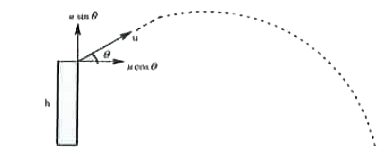 `h=(1)/(2) "GT"^(2)-(-U sin THETA) t "" rArr t=5` sec ONDS ALSO, `d=(u cos theta t=105.65m)` |
|
| 45. |
A steel rod 25 cm long has a cross -sectiional area of 0.8cm^(2). What force wouyld be required to stretch this rod by the same amount as the expansion produced by heating it by 10^(@)C? Given that for steel coefficient of linear expansion and Young's modulus are given as alpha=1.1xx10^(-5).^(@)C^(-1) and Y=2xx10^(11)Nm^(-2) |
|
Answer» |
|
| 46. |
A logic circuit is shown in the diagram. Draw the output signal at the point X and Y for the input signal shown in the figure at point A. |
| Answer» SOLUTION :Here, the output of the NOT gate will be equal to `X=barA`. Hence the output obtained will be equal to opposite of A. This signal is GIVEN as INPUT to another NOT gate. The signal again GETS inverted. As a result we again get back the ORIGINAL signal A. `(Y=barX=barbarA=A)` | |
| 47. |
समुच्चय {1,2,3,4} के उचित उपसमुच्चयों की संख्या है |
|
Answer» 16 |
|
| 48. |
2-methyl-2 butane on hydration gave an alcohol X. Isomers of X could be prepared from which of the following? |
|
Answer»
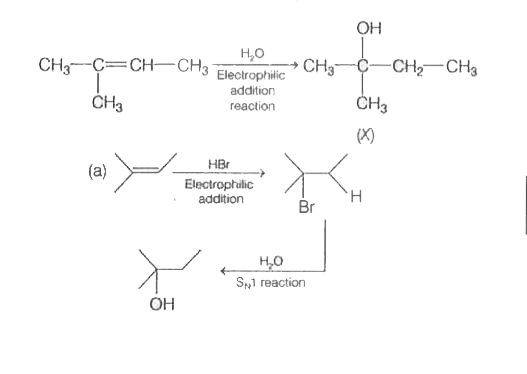 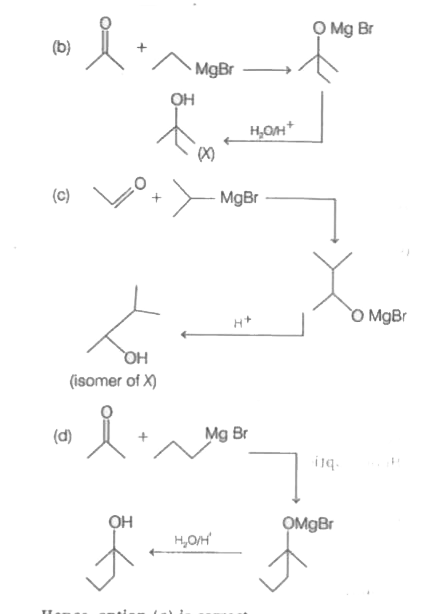 HENCE, OPTION ( C) is CORRECT. |
|
| 49. |
In the following circuits PN - junction diodes D_1,D_2 and D_3 are ideal for the following potentials of A and B. The correct increasing order of resistance between A and B will be (i) -10V, -5V (ii) -5 V,-10V (iii) -4V,-12V |
|
Answer» `(i) LT (ii) lt (iii)` Diodes `D_1 and D_3` are REVERSE biased and `D_2 ` is forward biased. 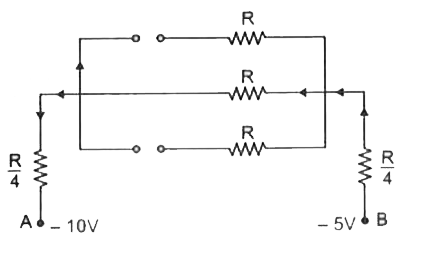 `implies R_(AB)=R+R/4+R/4=3/2R` (ii) When `V_A = - 5V and V_B = -10 V` Didoes `D_2` is reverse biased `D_1 and D_3` are forward biased 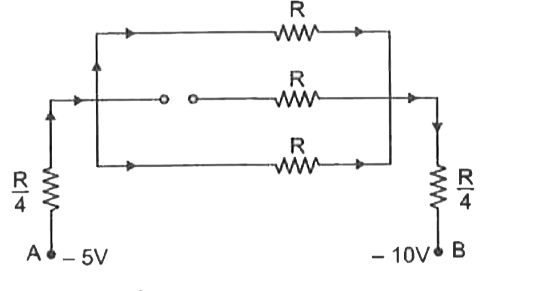 `implies R_(AB)=R/4+R/2+R/4=R` (iii) In this CASE equivalent resistance between A and B is ALSO R, HENCE (ii) = (iii) `lt` (i) |
|