

Saved Bookmarks
This section includes 7 InterviewSolutions, each offering curated multiple-choice questions to sharpen your Current Affairs knowledge and support exam preparation. Choose a topic below to get started.
| 1. |
Focal length of the Objective lens is 140 cm. Focal length of the eyepiece is 5cm. If this telescope is used to view a 100 m tall tower 3 km away, what is the height of the image of the tower formed by the objective lens ? |
|
Answer» Solution :Angle subtended by the TOWER = `alpha` `alpha = ("height of the power " )/(" DISTANCE between the telescope and tower ") = (100)/(3000) = (1)/(30) ` Let.h. be height of the image. Then `alpha = (h)/(f_(0)) = (h)/(140 ) "" THEREFORE(h)/(140) = (1)/(30) "" h =(140)/(30) = 4.7 ` cm |
|
| 2. |
Electromagnetic radiation is emitted by accelerating charges. The rate at which the e nergy is emitted from an accelerating charge that has charge q and acceleration a is given by dE/dt = q^(2)a^(2)//6piepsilon_(0)c^(3) , where c is the speed of light. A proton and an electron of kinetic energy 6 Me V is traveling in a particle accelerator in a circular orbit of radius0.75 m. What fraction of its energy does a proton emit per second? |
|
Answer» `1.1 xx10^(-11) s^(-1)` |
|
| 3. |
A tuning fork produces a wave of wavelength 110 cm in air at O^(0)C. The wavelength at 25^(@)C would be |
| Answer» ANSWER :B | |
| 4. |
A 10muF capacitor is charged to a voltage of 12 volts. The stored energy is : |
|
Answer» `72xx10^-5J` |
|
| 5. |
A battery of emf epsiand internal resistance r, when connected across an external resistance of 12 Omega , produces a current of 0.5 A. When connected across a resistance of 25Omega, it produces a current of 0.25 A. Determine the emf and internal resistance of the cell. |
|
Answer» Solution :We KNOW that current DRAWN `I = (epsi)/(R + r)` As per question when external resistance `R_1 = 12OMEGA` current `I_1`=0.5 A, and for resistance `R_2 = 25Omega`, current `I_2 = 0.25 A` . ` therefore0.5 = (epsi)/(12 + r) `....(i)and`0.25 = (epsi)/(25+ r)`.....(ii) From (i) and (ii) , we GET`r = 1 Omega ` and `epsi = 6.5 V` |
|
| 6. |
When the rectangular metal tank is filled to the top with an unknown liquid, as observer with eyes level with the top of the tank can just see the corner E , a ray that refracts towards the observer at the top surface of the liquid is shown. The refractive index of the liquid will be |
|
Answer» `1.2` |
|
| 7. |
A copper wire is held at the two ends by rigid supports. At 60 0 C, the wire is just taut with negligible tension. The speed of transverse waves in this wire at 10^(@)C is x xx 10^(1) m/s, what is the value of x (y = 1.6 xx 10^(11) N//m^(2), alpha = 1.8 xx 10^(-6) l^(0)C) and density rho = 9 xx 10^(3) kg//m^(3) |
|
Answer» |
|
| 8. |
A mixture of diatomic gases is obtained by mixing m_(1)and m_2 masses of two gases, with velocity of sound in them c_(1)and c_2 respectively. Determine the velocity of sound in the mixture of gases. (Temperature of the gas remains constant) |
|
Answer» `C= SQRT((m_(1)c_(2)^(2) - m_(2)c_(1)^(2))/(m_(2) + m_(1)))` |
|
| 9. |
What is angle of deviation due to reflection? |
| Answer» Solution :The angle between the INCIDENT and deviated light RAY is called angle of deviation of the light ray. It is written as, d = 180 - (I + r). As, I = r In reflection, we can write angle of deviation in reflection at plane SURFACE as, d = 180 - 2I | |
| 10. |
The electric flux through a Gaussian surface that enclose three charges given by q_(1)=-14nC.q_(2)=78.85nC,q_(3)=-56nC |
|
Answer» `10^(3) NM^(2) C^(-1)` |
|
| 11. |
Whatis thesignificanceof Lenz'slaw ? |
| Answer» SOLUTION :Lenz.slawis BASED on thelawconservationofenergy . | |
| 12. |
A p-n junctiondiode is designed to withstand currentwithout damage up to 5Ma across the combination. What is the maximum voltage of the battery that can forward bias the diode safely given that the diode has aconstant potential drop of 0.5 V when forward biased |
Answer» Solution : Here`V_(d)= 0.5V, R=20Sigma` Thevoltageequation for thecircuit is `V= IR+ V_(D)= 5 XX 10^(3)xx 200+ 0.5 = 1.5 V` |
|
| 13. |
(A) : Torque on the coil is always maximum, when coil is suspended in a radial magnetic field. (R) : Torque depends upon the magnitude of the applied magnetic field. |
|
Answer» Both 'A' and 'R' are true and 'R' is the CORRECT EXPLANATION of 'A'. |
|
| 14. |
In Figure, two microscope slides touch at one end and are separated at the other end. When light of wavelength 420 nm shines vertically down on the slides, an overhead observer sees an interference pattern on the slides with the dark fringes separated by 1.9 mm. What is the angle between the slides? |
| Answer» SOLUTION :`0.0063^(@)` | |
| 15. |
A wheel with 15 metallic spokes, each 60 cm long, is rotated at 360 revolutions per minute in a plane normal to the horizontal component of earth's magnetic field. The angle of dip at that place is 60^(@). If the emf induced between rim of the wheel and the axle 400 mV, calculate the horizontal component of earth's magnetic field at the place. How will the induced emf change if the number of spokes is increased ? |
|
Answer» Solution :Here number of spokes in wheel n = 15, length of each spoke l = 60 cm = 0.6 m, angular SPEED of wheel `omega = 360 rpm = rps = (360)/60 rps = 6 xx 2pi rad s^(-1) = 12pi rad s^(-1)` and INDUCED emf `varepsilon = 400 mV = 400 xx 10^(-3) V = 0.4 V` As wheel is revolving in a plane normal to the horizontal component `B_(H)`, induced emf between its AXLE and the rim of wheel `|varepsilon| =1/2B_(H)l^(2)omega implies B_(H) = (2varepsilon)/(l^(2)omega) = (2 xx 0.4)/((0.6)^(2) xx (12pi))=5.9xx10^(-2)T` |
|
| 16. |
If the wavelength of light in vacuum is 5800xx10^(-10)m, then calculate the wavelength in glass. (m_g^a=1.5) |
| Answer» Answer :A | |
| 17. |
The primary and secondary coils of a transformer have 50 and 1500 turns respectively. If the magnetic flux linked with the primary coil is given by phi = phi_(0) +4t, where phi is in webers, t is time in seconds and phi_(0) is a constant, the output voltage across the secondary coil is |
| Answer» ANSWER :C | |
| 18. |
C^(2)mN^(-1)is unit of ...... . |
|
Answer» electric susceptibility |
|
| 19. |
Two metallic sphere A and B kept on insulating stand are in contact with each other. A positively charged rod P is brought near the sphere A as shown in the figure. The two spheres are separated from each other , and the rod p is removed. What will be the nature of charges on sphere A and B ? (##U_LIK_SP_PHY_XII_C01_E08_035_Q01.png" width="80%"> |
| Answer» Solution :Charge on sphere A will be NEGATIVE but charge on sphere B will be positive as SHOWN in adjoining | |
| 20. |
Half life of ""^(131)I is 8 days. Sample has an activity 6.4 mCi at a certain time. What is the activity 40 days later? |
|
Answer» Solution :DATA SUPPLIED, `A_0 = 6.4 xx 10^(-3) Ci = 6.4 xx 10^(-3) xx 3.7 xx 10^(10) BQ = 2.368 xx 10^8 Bq` `LAMBDA = (0.6931)/(T_(1//2)) = (0.6931)/8 = 0.0866` per day `A_t = A_0 e^(-lambda t)` `(A_t)/(A_0) = e^(-lambda t) = 1/(2^n)` `A_t = (A_0)/(2^n) and n = (t_1)/(T_(1//2)) = 40/8 = 5` `:. A_t = (2.368 xx 10^8)/(2^5) = 7.4 xx 10^6 Bq` or `A_t = (7.4 xx 10^6)/(3.7 xx 10^(10)) = 2 xx 10^(-4) Ci = 0.2 mCi`. |
|
| 21. |
An electron in hydrogen atom revolving in a radius of 5.29 xx 10^(-11) m around the nucleus. According to the condition of Bohr's allowed electron orbits, find the principle quantum number corresponds to this orbit. h=6.625xx10^(-34)Js, e=1.6xx10^(-19)C. epsi_(0)=8.85xx10^(-12)MKS, m=9.1xx10^(-31)kg Find out conclusion from your answer. |
|
Answer» Solution :For hydrogen atom Z = 1 and centripetal force PROVIDED by coulomb force to electron, `(mv^(2))/(r)=(1)/(4pi epsi_(0))(e^(2))/(r^(2))( :.Z=1)` `:.v^(2)=(e^(2))/(4pi epsi_(0) mr)` Here LINEAR momentum `p=mv :. P= sqrt((me^(2))/(4pi epsi_(0)r))` de-Broglie wavelength, `lambda=(h)/(p)=(h)/(e) sqrt((4pi epsi_(0)r)/(m))` `=(6.625xx10^(-34))/(1.6xx10^(-19))[(4xx3.14xx8.85xx10^(-12)xx5.29xx10^(-11))/(9.1xx10^(-31))]^((1)/(2))` `=4.141xx10^(-15)xx[64.617xx10^(8)]^((1)/(2))` `=33.28xx10^(-11)` `=lambda=3.328x10^(-10)m` `=3.328A^(@)` A According to the condition for Bohr.s allowed electro orbits, `2pi r= n lambda` `:. n=(2pi r)/(lambda)=(2xx3.14xx5.29xx10^(-11))/(3.328xx10^(-10))` `=9.98xx10^(-1)` `~~1` Hence, according to Bohr.s quantum condition the electron is in it ground state (n = 1) while it can be said from de-Broglie hypothesis that ONE de-Broglie wavelength fits for a given RANGE of circumference. |
|
| 22. |
Two coherent sources are 0.15 mm apart and fringes are observed 1m away with monochromatic light of wavelength 6000^(0).Find The fringe width in air. |
|
Answer» Solution :Fringe width `beta= (LAMBDA D)/(d)= (6000xx 10^(-10)xx1)/(0.15xx10^(-3))` i.e., `beta= 4 MM`. |
|
| 23. |
Two coherent sources are 0.15 mm apart and fringes are observed 1m away with monochromatic light of wavelength 6000^(0).Find The fringe width in a liquid of refraction index 5"/"2. |
| Answer» SOLUTION :FRINGE width in a medium `BETA. = (beta)/(mu)=(4)/(5"/"2)= 1.6mm`. | |
| 24. |
A capacitor of capacitance 1/300muF is connected .to a battery of 300 volts and charged. The energy supplied by the battery is : |
|
Answer» `3xx10^-4"JOULE"` |
|
| 25. |
In a Young's double slit experiment, the slits separated by 1 mm are illuminated by a mixture of two wavelengths lambda = 600 nm and lambda' = 750 nm.The distance of screen from slits is 1 m. The minimum distance from the common central bright fringe where the bright fringe of one interfernece pattern will coincide with the bright fringe of second interference pattern will be : |
|
Answer» `0.3 cm` `y = (mDlambda)/(d)` and `y. = (m.Dlambda.)/(d)` Since `y = y.therefore (m)/(m.) = (lambda.)/(lambda) = (750)/(600) = 5/4` i.e., m = 5 and m. = 4 Now the position where 5th bright fringe of `lambda` pattern will coincide with 4th bright fringe of `lambda.` pattern. `y = (5 xx 1 x 600 xx 10^(-9))/(1 xx 10^(-3)) = 0.3 xx 10^(-3) m = 0.3 mm`. |
|
| 26. |
The potential to which conductor is raised depends on |
|
Answer» The AMOUNT of CHARGE |
|
| 27. |
A metal ring of mass 2.1 kg and of 10 cm radius is revolving about its axis (350)/(11) r.p.s. If this ring is dropped in a viscous liquid, then the heat generated is (J=4.2" J/cal") : |
|
Answer» 100 cal `(because omega =2 pi n)` So, CORRECT CHOICE is (a). |
|
| 28. |
A cube of side 'b' has a charge 'q' at each of its vertices. Determine the potential and electric field due to this charge array at the centre of the cube. |
|
Answer» Solution :`sqrt(b^(2)+2b^(2))/(2)=b/2 sqrt3` is the CENTRE Distance of centre of the cube form one vertex is `b/2 sqrt3`. Hence potential due to charge `=(1)/(4PI epsi_(0)) q/(b/2 sqrt3)` Total potential `=(8 xx q)/(4pi epsi_(0) ""b/2 sqrt3)` `=(2 xx 8 xx q)/(4pi epsi_(0)b sqrt3)=(4q)/(sqrt3 b PI epsi_(0))` Field =zero 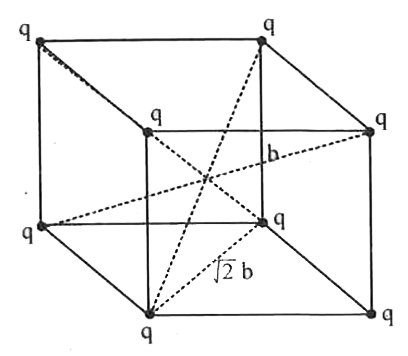
|
|
| 29. |
A body of mass m at rest is subjected to a constant force F for time. The kinetic energy at timet is given by : |
|
Answer» `F^2 t^2 //2m` Now`Deltap="IMPULSE"=F.t`. `DeltaE=(Deltap^2)/(2m)=(P^2t^2)/(2m)`. |
|
| 30. |
Imagine removing one electron from He^(4) and He^(3). Their energy levels, as worked out on the basis of Bohr model will be very close. Explain why ? |
| Answer» Solution : Here `""_(2)He^(3) and ""_(2)He^(4` are isotopes of helium. When one electron is removed from each of them, they both behave like H-atom with single electron. Electrons in them have same ORBITAL radii as per the formula `r_(n)=(epsi_(0)n^(2)h^(2))/(pi m Ze^(2))` andhence their ENERGY levels are also OBTAINED very CLOSE to each other. | |
| 31. |
If the speed of light were 2/3 of its present value , what would be fractional decrease in the energy released in a given atomic explosion |
|
Answer» SOLUTION :ENERGY ` prop c^2` FRACTIONAL DECREASE in energy = `(E_1-E_2)/(E_1)=1-((C_2)/C_1)^2=1-(2/3)^2=5/9` |
|
| 33. |
In an adiabatic process wherein pressure is increased by 2/3%. If (C_(p))/(C_(v))=3/2, then the volume decreases by about : |
|
Answer» `4/ul(9)%` |
|
| 34. |
One end of a piano wire is wrapped around a cylindrical tuing peg and the other end is fixed in place. The tuning peg is turned so as to stretch the wire. The piano wire is made from steel (Y=2.0xx10^(11)N//m^(2)). It has a radius of 0.80 mm, and an unstrained length of 0.76 m. The radius of the tuning peg is 1.8 mm. Initially, there is not tension in the wire. Find the tension in the wire when the tuning peg its turned through two revolutions. |
|
Answer» 15,000 N |
|
| 35. |
A second's pendulum is taken in a lift going up with an acceleration g/2. The frequency of the pendulum is, |
|
Answer» `SQRT(4/3) HZ` |
|
| 36. |
If a charge is moved against the coulomb force of an electric field. |
|
Answer» a) work is done by the ELECTRIC field |
|
| 37. |
A 6 cm long bar magnet possessing magnetic dipole moment 0.3 A-m^(2) is placed vertically on a horizontal wooden table. The north pole of the magnet touches the table. A neutral point is found on the table at a distance of 8 cm south of the magnet. Find the horizontal component of Earth's magnetic field. |
Answer» SOLUTION :Magnetic field due to single pole of a MAGNET is given by  `B = (mu_0)/(4pi) (M)/(d^(2))` where m is pole strength Field due to north pole , `B_N = (mu_0)/(4pi)(M)/((d^(2))) ` along NP Field due to south pole , `B_S = (mu_0)/(4pi) (M)/((d^(2) + 4l^(2))) ` along PS Horizontal component of `B_S = B_S cos theta ` `= (mu_0)/(4pi)(M)/((d^(2) + 4l^(2)))*(d)/((d^(2) + 4l^(2))^(1//2))` Resultant horizontal field ` = (mu_0 m)/(4pi) [ (1)/(d^(2)) -(d)/((d^(2) + 4l^(2))^(3//2))]` or , `B_H = (mu_0 M)/( 4pi (2l)) [ (1)/(d^(2)) - (d)/((d^(2) + 4l^(2))^(3//2))]` (where magnetic moment `M = mxx 2l` ) On SUBSTITUTING numerical values , we get `B_H = 3.81 xx 10^(-5)` Tesla. |
|
| 38. |
परावैद्युतता का SI मात्रक होता है - |
|
Answer» `C^2N^(-1)m^(-2)` |
|
| 39. |
A pendulum has maximum kinetic energy K_1 If its length is doubled keeping amplitude same then maximum kinetic energy becomes K_2.Then relation between K_1 and K_2is |
|
Answer» `K_2=2K_1` |
|
| 40. |
If a ball is thrown vertically upwards with speed u,the distance covered during the last t seconds of its ascet is |
|
Answer» `UT-(1)/(2)"GT"^(2)` |
|
| 41. |
An AND gate is followed by a NOT gate in series with two inputs A and B, the Boolean expresion for the output Y will be ………. |
|
Answer» `bar(A+B)` The NAND GATE is OBTAINED by combining the AND and NOT gates in the series. |
|
| 42. |
What are characteristics of em. Waves ? |
| Answer» Solution :Varying,sinusoidal,electric and MAGNETIC FIELD are perpendicular,propagae PERPANDICULAR to the direction of propagation. | |
| 43. |
दो परिमेय संख्याओं के बीच अधिकतम कितनी परिमेय संख्या हो सकती है? |
|
Answer» 1 |
|
| 44. |
A parallel plate capacitor is charged by a battery . After sometime the battery is disconnected and a dielectric slab with its thickness equal to the plate separation is inserted between the plates . How will the capacitancee of the capacitor. ? Justify your answer |
|
Answer» Solution :Let the capacitor has a CAPACITANCE C and charge on it , when charged by a battery , be Q . Hence potential difference between the PLATES of capacitor `V = (Q)/(C)`. When the battery is disconnected and a dielectric slab with its thickness equal to the plate separation is inserted between the plates , the charge Q remains conserved , Now : The new capacitance of the capacitor `C. = (K in_(0))/(Ad) = KC ` where K is the dielectric constant of GIVEN dielectric slab. |
|
| 45. |
Assertion: Current versus time graph is as shown in figure, rms value of current is 4A. Reason: For a constant current, rms current is equal to that constant values. Reason: For a constant current, rms current is equal to that constant value. |
|
Answer» If both ASSERTION and REASON are TRUE and Reason is the CORRECT explanation of Assertion. |
|
| 46. |
Consider Fraunhoffer diffraction pattern obtained with a single slit illuminated at normal incidence. AT the angular position of the first diffraction minimum the phase difference (in radian) between the wavelengths from the opposite edges of the slit is |
| Answer» ANSWER :D | |
| 47. |
The resistivity of n-type germanium is 0.01Omegam at room temperature. Find the donor concentration if the mobility of electrons is 0.39m^2//"volt"-sec. |
| Answer» SOLUTION :Let `N_d`be the donor concentration. CONDUCTIVITY,`sigma-1/p=1/(0.01)=100astS//m` Now,`sigma=eN_dmu_e......N`type SEMICONDUCTOR or `N_d=sigma/(emu_e)=100/(1.6xx10^-19xx0.39)=1.6xx10^21//m^3` | |
| 48. |
An unsymmetrical double convex thin lens forms the image of a point object on its axis will the position of the image change if the lens is reversed ? |
|
Answer» Solution :`rArr` ACCORDING to formula, `(1)/(f) = ((n_2 - n_1)/(n_1))(1/(R_1) -1/(R_2))` `therefore 1/V -1/u = ((n_2 - n_1)/(n_1))(1/(R_1) - 1/(R_2))` Here even after inverting the LENS (UPSIDE down) values of `u,n_1,n_2` and `(1/(R_1) - 1/(R_2))` remain unchanged. Hence value of v (image distance) will remain same. It means that position of image will unchanged. |
|
| 49. |
A parallel plate capacitor is charged by a battery . After sometime the battery is disconnected and a dielectric slab with its thickness equal to the plate separation is inserted between the plates . How will potential difference between the plates? Justify your answer |
|
Answer» SOLUTION :Let the capacitor has a CAPACITANCE C and charge on it , when charged by a battery , be Q . Hence potential difference between the PLATES of capacitor `V = (Q)/(C)`. When the battery is disconnected and a dielectric SLAB with its thickness equal to the plate separation is inserted between the plates , the charge Q remains conserved , Now : New potential difference between the plates `V = (Q.)/(C.) = (Q)/(KC) = (V)/(K)` . |
|
| 50. |
Two circular coils made of same material having radii 20cm & 30cm have turns 1 00 & 50 respectively. If they are connected a) in series b) in parallel c) separately across a source of emf find the ratio of magnetic inductions at the centres of circles in each case |
|
Answer» SOLUTION :a) `B=(mu_(0)ni)/(2r)` COILS are in series `rArr` I is same both `Bpropn/r` `(B_(1))/(B_(2))=100/50xx30/20=3:1` b) coils are parallel `rArr` potential difference is same `iprop1/R` where `R=(p(n2pir))/A` where A is area of cross SECTION of wire which is same for both `rArrRpropnr,iprop1/(NR)` but `B_(0)=(mu_(0)ni)/(2r)` `rArrBpropn/rxx1/(nr)rArrBprop1/(r^(2))therefore(B_(1))/(B_(2))=(30/20)^(2)=9/4` C) For the coils, potential difference is same `iprop1/R` where `R=(p(n2pir))/A,Rpropnr` `Iprop1/(nr)rArrB_(0)1/(r^(2))therefore(B_(1))/(B_(2))=9/4` |
|