

Saved Bookmarks
This section includes 7 InterviewSolutions, each offering curated multiple-choice questions to sharpen your Current Affairs knowledge and support exam preparation. Choose a topic below to get started.
| 1. |
Show that a force that does no work must be a velocity dependent force. |
|
Answer» Solution :As work done by force is zero, `thereforedW=vecF*vec(DL)=0` `thereforevecF*(vec(dl))/(DT)*dt` `thereforevecF*(vecv*vec(dl))=0" "(becausevecv=vec(dl)/(dt))` `thereforevecF*vecv=0,dl NE0` `thereforeFvcostheta=0" "thereforetheta=90^(@)` If v changes direction then to make `theta=90`, F MUST charne ANGLE according to v. So, F is dependent on v to make work done zero. |
|
| 2. |
The primary origin(s) of magnetism lies in |
|
Answer» atomic currents. This atomic current gives rise to magnetism. The revolving and spinning about nucleus of an atom is called intrinsic spin of electron. Hence option (D) is correct. |
|
| 3. |
Calculate the conductivity of pure silicon at room temperature where the concentration of carriers is 1.6 xx 10^(16)//m^(3) . Assume the mobility of electrons and holes to be 0.15 and 0.05 m^(2)V^(-1)s^(-1). |
| Answer» SOLUTION :`5.1xx10^(-4)OMEGA^(-1)m^(-1)` | |
| 4. |
A uniform rod kept vetically on the groundfalls from rest. Its foot does not slip on the ground. |
|
Answer» No part of the rod can have acceleration greater than g in any position. |
|
| 5. |
Square root of which number is rational - |
|
Answer» 7 |
|
| 6. |
To an observer, the pitch of a stationary source of sound appears to be reduced by 20%. If the speed of sound is 340m/s then speed and direction of the observer is |
|
Answer» 86 m/s TOWARDS the SOURCE |
|
| 7. |
In an a.c. circuit with an inductor |
|
Answer» voltage lags current by `PI//2` |
|
| 8. |
What suggestion was done to correct discrepencies in Ampere circuital law ? |
|
Answer» Solution :Scientist Faraday suggested that time variant magnetic field produce ELECTRIC field. Maxwell suggested that electric field changing with time produces electric field. Maxwell tried to obtain magnetic field in outside capacitor when it is connected with VARYING electric field. Maxwell found discrepancies in this law. This law is represented as, `OINT vec(B).vec(d)l=mu_(0)I+?` Maxwell added term of .displacement current. to remove discrepencies in it. |
|
| 9. |
Gauss' law is true only if electric force due to a given charges varies with distance 'r'as |
|
Answer» `R^(-2) ` |
|
| 10. |
A circular coil of 200 mm diameter is made of 100 turns of thin wire and carries a current of 50 mA. Find the magnetic field induction at the centre of the coil. |
|
Answer» where to is the number of turns, a is the radius of a burn, and h is the distance from the centre to the point on the axis of the coil where the field is to be DETERMINED. |
|
| 11. |
A tube 1m long is closed at one end. A stretched wire is placed near the open end. The wire is 0.3 m long and has a mass of 0.01 kg. It is held fixed an both ends and vibrates in its fundamental mode. It sets the air column in the tube into vibration all its fundamental frequency by resonance Find the tension in the wire. Speed of sound in air: 330 m/s |
|
Answer» Solution :FUNDAMENTAL frequency of closed pipe `= v/(4l)` `=330/(4xx1) =82.5 Hz` B) At resonance, given : fundamental frequency of stretched wire (fixed at both ends) =fundamental frequency of air column `:. v/(2L) = 82.5 Hz` `:. Sqrt(T//MU)/(2l) =82.5 (or)` `T = mu (2 xx0.3 xx 82.5)^2` `=81.675 N` |
|
| 12. |
A particle executes S.H.M. with a period 6 sec. and amplitude 0.03 m. Its maximum speed in cm/sec is, |
| Answer» ANSWER :B | |
| 13. |
(a) Find the emf induced in the coil if it were positioned such that its plane contains the axis of the solenoid (b) In the above problem (example 3) what is the emf induced when current is reduced to zero and then increases again to 1.5 A in reverse direction in 25 ms. |
|
Answer» Solution :(a) No emf is induced in the loop even though the magnetic FIELD in SPACE is changing. This is because no flux is LINKED with the coil. (b) 150 MV |
|
| 14. |
(A) : : Plane angle has unit but no dimensional formula (B) : All dimension less quantities are unit less |
|
Answer» Both A & B are tue |
|
| 15. |
What is the force required to seprate two glass plates of area 10^-2m^2 with a film of water of thickness 0.05mm between them surface tension of water 72xx10^-3 N/m? |
|
Answer» Solution :T = W/A or E/A `therefore W = F XX d` = 2TA ` `therefore F = 2TA/d = (2 xx 7 xx 10^-2 xx 3 xx 10^-2)/(0.07 xx 10^-3)` = `6 xx 10^1` = 60 N |
|
| 16. |
A capacitor has a capacity C, when air is present between the two plates. If a dielectric of value k placed between the plates, the new capacity C will be equal to: |
| Answer» ANSWER :A | |
| 17. |
The displacement of a standing wave on a string is given by yox, 1) = 0.4 sin (0.5.x) cos (300) where Xandy are in centimeters. (a) Find the frequency, amplitude and wave speed of the component waves. (b) What is the particle velocity x=2.4 cmat =0.8 s? |
|
Answer» <P> Solution :The given WAVE can be written as the sum of two component waves `y_(1)=0.2 sin (0.5x-30t) and y_(2)=0.2 sin (0.5x+30t)`Now` omega=30(rad)/(s) and k=0.5 cm^(-1)` `:.` Freqency of `f=(omega)/(2PI)=(15)/(pi)Hz` amplitude `A=0.2 cm` and were speed, `V=(omega)/(K)=(30)/(0.5)=60 cm//s` (b) particle velocity `v_(p)(X,t)=(dy)/(dt)=-12 sin (0.5x)sin(30t)` `v_(p)(x=2.4 cmt,=0.8s)` `=-12 sin(1.2 sin(24)=10.12 cm//s` |
|
| 18. |
(a) State the laws of radioactive decay and deduce the relation: N=N_(0)e^(-lambdat) N=N_(0)e^(-lambdat) Where the symbols have their usual meaning. (b) (i) Write symbolically the process expressing the beta^(+)decay of ""_(11)Na^(22). Also write the basic nuclear process underlying this decay. (ii) Is the nucleus formed in the decay of the nucleus ""_(11)Na^(22) an isotope or isobar? |
|
Answer» (ii) As a DIFFERENT nucleus is formed having same mass number as sodium,`""_(10)Ne^(22)`is an ISOBAR. |
|
| 19. |
A parallel plate capacitor has an electric field of 10^5V/m between the plates, If the charge on the capacitor plate is 1 mu C, the force on each capacitor plate is |
|
Answer» `0.5 N` |
|
| 20. |
Two moving-coil galvanometer, P and Q, are alike in all respects except that P's coil has 10 turns of resistance 2Omega and Q's coil has 100 turns of resistance 30 Omega. Compare their (i) current sensitivities (ii) Voltage sensitivities. |
|
Answer» SOLUTION :DATA: `N_(p) = 10, G_(p)= 2Omega, N_(Q) = 100, G_(Q) = 30 Omega` (i) The current sensitivity, `S_(1) = (NAB)/C` `therefore S_(LP)/S_(LQ) = N_(P)/N_(Q) = 10/100=1/10` (ii) The voltage sensitivity, `S_(v) = S_(l)/G` `therefore S_(V.P)/S_(I.Q).G_(Q)/G_(P)=1/(10.30/2)=1.5` |
|
| 21. |
A, B and C are voltmeters of resistance R, 1.5R and 3R respectively as in fig. when some P.D. is applied between x and y, the voltmeter readings are V_A, V_B and V_C respectively, then: |
|
Answer» `V_AneV_B=V_C` |
|
| 22. |
The force between two charged bodies was studied by .................... . |
|
Answer» |
|
| 23. |
Two blocks are connected by a spring of natural length 2 m. The force constant of spring is 200 N/m. Find spring force in following situations : B is kept at rest and A is displaced by 1m in left direction. |
|
Answer» `F_("spring")=200N`. |
|
| 24. |
An object is projected with velocity u at angle theta to horizontal . The trajectory followed by the object is |
|
Answer» STRAIGHT line |
|
| 25. |
A particle moves with velocity (6hat(i)-4hat(j) + 3hat(k))ms^(-1) under the influence of a constant force F = 20 hat(i) + 15hat(j)-5 hat(k) N. The instantaneous power applied to the particle is: |
|
Answer» 35 J/s |
|
| 26. |
If E is the electric field intensity of an electrostatic field, then the electrostatic energy density is proportional to |
|
Answer» `E` |
|
| 27. |
Explain the working principle of a solar cell. Mention its applications. |
|
Answer» Solution :Principal : (i) A solar cell, also KNOWN as photovoltaic cell. converts light energy directly into electricity or electric potential difference by photovoltaic effect. (II) It is basically a p-n junction which generates emf when solar radiation falls on the p-n junction. (iii) A solar cell is of two types p-type and n-type. Construction : (i) Both types use a combination of p-type and n-type Silicon which together forms the p-n junction of the solar cell. (ii) The difference is that p-type solar cells use p- type Silicon as the base with an ultra-thin layer of n-type Silicon while n-type solar cell uses the opposite combination. (iii) The other side of the p-Silicon is coated with metalwhich forms the back electrical contact. (iv) On top of the n-type Silicon, metal grid is deposited which acts as the front electrical contact. (v) The top ofthesolar cell is coated with antireflection coating and toughened glass. Working: (i) In a solar cell, electron-hole pairs are generated due to the absorption of light near the junction. (ii) Then the charge carriers are separated due to the electric field of the depletion region. (iii) Electrons move towards n -type silicon and holes move towards p -type silicon layer. (iv) The electrons reaching the n-side are collected by the fron contact and holes reaching p - side are collected by the back electrical contact. (v) Thus a potential difference is developed across solar cell. (vi) When an external load is connected to the solar cell, photocurrent flows through the load. (vii) Many solar cells are connected together either in series or in parallel combination to form solar panel or module. Many solar panels are connected with each other to form solar arrays (viii) For HIGH power application, solar panels and solar arrays are used. Applications: (i)Solar cells are widely used in calculators watches, toys , portable power supplies , etc. (ii) Solar cells are used in SATELLITES and space applications . Solar panels are used to GENERATE electricity . |
|
| 28. |
If charge q is placed at the centre of the line joining two equal charges Q, the system of three charges will be in equilibrium, if q is : |
|
Answer» `-Q/2` |
|
| 29. |
In column-II liquid (s) are fillied in a container of large base area as shown in the figure. If h is the height above the ground where a small hole to be made in order to get maximum range,R. v is the velocity with which the liquid comes out from the hole and t is the time taken by the liquid to reach ground just aftr the hole is made. Then match the column I with column II |
|
Answer» <P> |
|
| 30. |
MI of a solid sphere about it's diameter is _____ and about its tangent is _____. |
| Answer» SOLUTION :[`(2)/5 MR^2, (7)/5 MR^2`] | |
| 31. |
The radius of curvature of the face of plano-convex lens is 12cm and its refractive index is 1.5. If the plane surface of the lens is now silvered, then find the focal length of the lens. |
|
Answer» Solution :(c) `1/f=(mu-1)(1/(r_(1))-1/(r_(2)))` `1/f=(1.5-1)(1/12-1/(oo))` `f=+24cm` |
|
| 32. |
Thimmakka set up a trust for ____________. |
|
Answer» PLANTING TREES |
|
| 33. |
In a semi conductor diode, the barrier potential opposes diffusion of |
|
Answer» FREE ELECTRONS from n-region |
|
| 34. |
Critical angle for a medium is sin^(-1) (0.6), then polarization angle for this medium is ...... |
|
Answer» <P>`sin^(-1)(0.8)` `:. sinC=0.6` `:.(1)/(n)=0.6` `:.n=(1)/(0.6)` `:. "tan" theta_(p)=(1)/(0.6) "" [ :. n= tan theta_(p)]` `:. theta_(p)=tan^(-1)((1)/(0.6))` `:.theta_(p)tan^(-1)((1.6666)` |
|
| 35. |
Answer the questions : As you have learnt in the text, the principle of linear superposition of wave displacement is basic to understanding intensity distributions in diffraction and interference patterns. What is the justification of this principle ? |
| Answer» SOLUTION :SUPER position principle follows from the linear character of the equation GOVERNING WAVE motion. It is true so ions as wave have small AMPLITUDE. | |
| 36. |
In a hydrogen tube it is observed that through a given cross-section 3.13 xx 10^(15) electrons per sec. moving from right to left and 3.12 xx 10^(15) protons per sec are moving from left to right. The electric current in the discharge tube and its direction is |
|
Answer» `1.6 MU A `towardsleft |
|
| 37. |
In X-ray tube the potential difference between the anode and the cathode is 20 kV and the current flowing is 1.6 mA. The number of electrons striking the anode in 1s is .....(Take e=1.6xx10^(-19)C) |
|
Answer» `10^(14)` `n=(1)/(3)=(1.6xx10^(-3))/(1.6xx10^(-19))=10^(16)` |
|
| 38. |
Derive an expression for the electric potentialin a electric field of positive point charge at distance r. |
Answer» Solution :Consider a point charge Q at the ORIGIN as SHOWN in figure.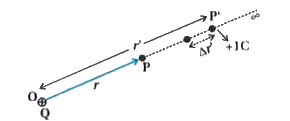 The work done in bringing a unit positive test charge from infinity to the point P. For Q which is positive the work done against the repulsive force on the test charge is positive. Since the work done is independent of the path we choose a convenient path along the radial direction from infinity to the point P . At some intermediate point P. on the path, the electrostatic force on a unit positive charge is, `F=(kQxx1)/((r)^(2))hatr` Where f is the unit vector along OP. Work done against this force from r. to r +` Deltar` is `DeltaW= -(kQ)/((r)^(2)). Deltar`[ From W = F r cos`theta]` Here `Deltar lt 0 ` so `DeltaW gt 0` in this formula . Total work done by the external force is obtained by INTEGRATING above equation from `r = prop ` to r = r . `:. -int_(oo)^(r)(kQ)/((r)^(2)).dr [underset(Deltar rarr0)lim=dr]` `:. W =- kQ [-(1)/(r)]_(oo)^(r) = (kQ)/(r)` `:. W= (Q)/(4pi in_(0)r)` From definition of ELECTRIC potential `V(r) = (W)/(q)=(W)/(I) [ because q=1C]` `:. V(r) = W= (kQ)/(r)` |
|
| 39. |
The magnetic field along the axis of an air cored solenoid is B. The magnetic field energy density is |
|
Answer» `1/2 (B^2)/(mu_0)` |
|
| 40. |
Each atom of every matter is a complete magnet itself: |
|
Answer» TRUE MAY be true or false |
|
| 41. |
The magnetic induction at p for the arrangement shownin when tow similar short magnets of magneticmoment M are joinedat the middle so that they are mutually perpendicualr will be |
|
Answer» `(m_(0))/(4PI)(msqrt(3))/(d^(3))` `therefore B=(mu_(0))/(4pir^(3))sqrt(4+1)=(mu_(0)M)/(4pid^(3))sqrt(5)` |
|
| 42. |
(A) : The frequency of charge circulating in cyclotron depend upon the speed of the charge. (R) : The time which charge spends inside a dee of cyclotron is dependent on its velocity and radius of the semicircular path. |
|
Answer» Both 'A' and 'R' are TRUE and 'R' is the CORRECT EXPLANATION of 'A'. |
|
| 43. |
The period T of revolution of the earth around the sun depends upon (1) Orbital radius R (2) mass M of the sun and (3) gravitational that T^2ooR^3. |
|
Answer» a)2 |
|
| 44. |
An electric dipole of momentum vecpis placed in a uniform electric field. The dipole is rotated through a very small angle thetafrom equilibrium and is released. It executes simple harmonic motion with frequency f=1/(2pi)sqrt((pE)/I) where, I= moment of interia of the dipole. |
|
Answer» Solution :A dipole MAKES an angle 9 with an electric field from its equilibrium position. So, torque ACTING on it, `vectau = VECP xx vecE` `therefore tau = pEsintheta` This torque rotates the dipole in clockwise direction `therefore tau =-pEsintheta` Here `theta` is very small. `therefore sintheta =theta` `therefore tau =-pEtheta` but, `tau = 1alpha` and `alpha =-omega^(2)theta` `1alpha = -pEtheta`, where `alpha`is the angular acceleration in S.H.M. `therefore 1(-omega^(2)theta) = -pEtheta` `therefore omega = sqrt((pE)/1)` `therefore 2pif = sqrt((pE)/1) (therefore omega = 2pif)` `therefore f=1/(2pi)sqrt((pE)/1)` |
|
| 45. |
Find the thickness of a plate whichwill produce a change in optical path equalto halfthe wavelengthlambda of the light passing through it normally . The refractive index of the palte is mu. |
|
Answer» `LAMBDA/(4(mu-1))` |
|
| 46. |
A mercury drop of radius R splits up into 1000 droplets equal radii. What is the change in surface area? |
|
Answer» Solution :Volume of ONE drop = Volume of 1000 DROPLETS `THEREFORE 4/3 piR^3 = 1000 xx 4/3 pir^3` `therefore R^3 = 1000r^3` `therefore r = R/10` Change in surface area = `1000 xx 4pir^2 - 4piR^2` `4pi [ 1000 xx R^2/100 - R^2]` dA = `4pi (10R^2 -R^2) = 36 pi R^2` |
|
| 47. |
Draw a graph of resistivity of nichrome as a function of absolute temperature. |
Answer» SOLUTION :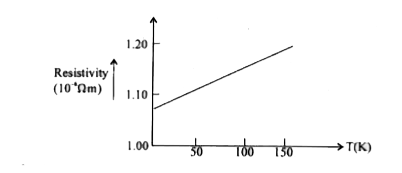
|
|
| 48. |
The initial pressure of air is 4.0 xx 10^6 Pa, the initial volume is 2.0 m^3. The gas was compressed adiabatically so that its volume decreased to a quarter of its original volume. Find the final pressure. Compare with the pressure -that would result from a similar compression of the gas at & constant temperature. Which process requires the greater work to be performed in compressing tho gas? |
|
Answer» |
|
| 49. |
A straight wire AB of length a is placed at a distance a from an infinitely long straight wire as shown in the figure. Angle theta is 30^(@). Find the magnetic force on wire AB if it is also given a current I. Both the wires are in xy plane. |
|
Answer» |
|