

Saved Bookmarks
This section includes 7 InterviewSolutions, each offering curated multiple-choice questions to sharpen your Current Affairs knowledge and support exam preparation. Choose a topic below to get started.
| 1. |
In a uniform electric field find the total flux associated with the given surfaces |
|
Answer» `a-0, b-0, c-0` |
|
| 2. |
(a) Write two maln observations of photoelectric effect experiment which could only be explained by Einstein's photoelectric equation. (b) Draw a graph showing variation of photocurrent with the anode potential of a photocell. |
|
Answer» Solution :(a) Two main observations are : (i) No photoelectric emission TAKES place when frequency of incident RADIATION is less than threshold frequency for given surface. (II) Photoelectric emission is an instantaneous PROCESS. (b) The GRAPH is shown here. 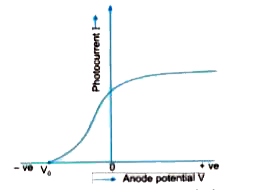
|
|
| 3. |
A box with rigid instating walls is divided into two parts by a partition. An ideal gas occupies half the box and other half is completely evacuated. The partition is suddenly removed. Will there be any temperature change in the gas? |
| Answer» Solution :The temperature of the GAS remains UNCHANGED. According to first law of THERMODYNAMICS `DeltaQ=DeltaU+PDeltaV` Here `DeltaQ=0` (adiabatic process) and P = 0, the gas expands in VACUUM. Hence AU = 0. As the gas is ideal, there is no internal POTENTIAL energy and hence the internal kinetic energy of the gas is constant. | |
| 4. |
The moment of inertia of a unifmm rod of mass M and length L about an axis through centre and perpendicular to length L is given by (ML^(2))/12 . Now consider one such rod pivoted at its centre free to rotate in a vertical plane. The rod is at rest in the vertical position. A bullet of mass M moving horizontally at a speed V strikes and gets embedded in one end of the rod. The angular velocity CD of the rod after collision will be |
|
Answer» `V//L` `MVL/2=(ML^(2))/3omegarArromega=(3V)/(2L)` |
|
| 5. |
Calculate the value of θ, for which light incident normally on face AB grazes along the face BC. mu_(glass)=3//2 and mu_(water)=4//3 |
| Answer» SOLUTION :`THETA= sin^-1 (8//9)` | |
| 6. |
In the following question a statement of assertion (A) is followed by a statement of reason (R ) A : work done by the field of a nucleus in a complete orbit of the electron is zero even if the orbit is elliptical . R : Electrostatic force is conservative in nature. |
|
Answer» If both Assertion & REASON are TRUE and the reason is the correct explanation of the assertion , then mark (1). |
|
| 7. |
A concave mirror gives an image three times as large as the object placed at a distance of 20 cm from it. For the image to be real, the focal length should be |
|
Answer» Solution :As `m=-(v)/(U)=-3 rArr v=3u=3xx20=60cm` `therefore""(1)/(f)=(1)/(v)+(1)/(u)=(1)/((-60))+(1)/((-20))=-(1)/(15) rArr f=-15cm` |
|
| 8. |
A rifle bullet loses 1/20th of its velocity in passing through a plank. The least number of planks required just of stop the bullet is |
|
Answer» 20 |
|
| 9. |
Two point charges 4muC and 9muC are separated by 50 cm. Find the potential at the point between them where the field is zero. |
|
Answer» |
|
| 10. |
(a) A cell of emf 3.4 V and internal resistance 3 Omega is connected to an ammeter having resistance 2 Omega and to an external resistance 100 Omega. When a voltmeter is connected across the 100 Omega resistance the ammeter reading is 0.04 A. Find the voltage read by the voltmeter and its resistance. Had the voltmeter been an ideal one, what would have its reading ? (b) Two resistances of 100 Omega and 200 Omega are connected in series with battery of emf 4 V and negligible internal resistance. A voltmeter of resistance 200 Omega is used to measure voltemeter of resistances separately. Calculate the voltmeter indicated. ( c) In the circuit shown, a voltmeter reads 30 V when it is connected across the 400 Omega resistance. Calculate what the same voltmeter will read when it is connected across the 300 Omega resistance ? (d) An ammeter and a voltmeter are connected in series to a battery of emf E = 6.0 V. When a certain resistance is connected in parallel with the voltmeter. the reading of the ammeter is doubled. while voltmeter reading is reduced to half. Find the voltmeter reading after the connection of the resistance. |
Answer» Solution :(a) 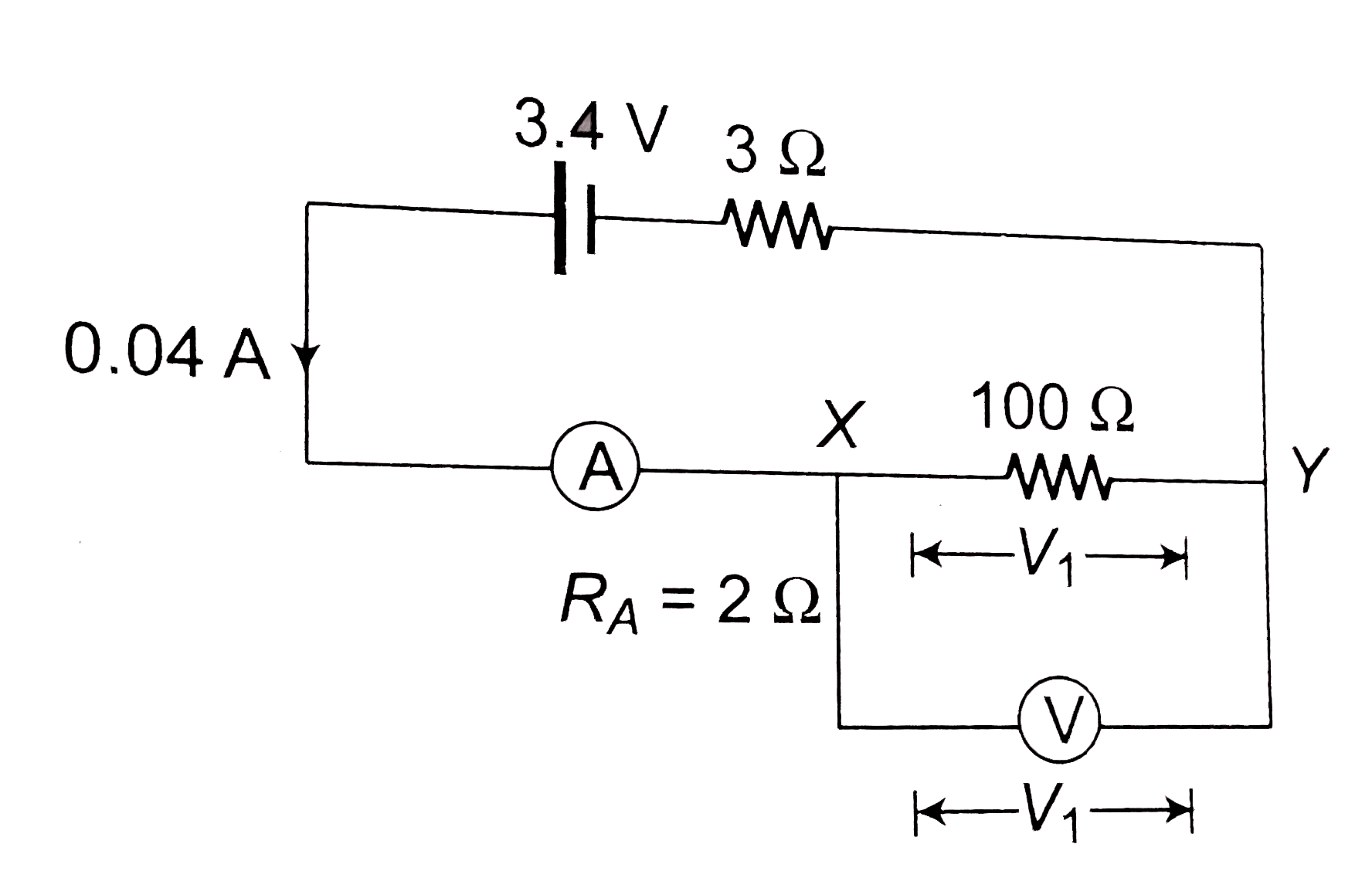 `3.4 = 0.04 xx R_A + 0.04 xx 3 + V_1` =`0.04 xx 2 + 0.04 xx 3 + V_1` =`0.2 + V_1` `V_1 = 3.2 V` Current in `100 OMEGA, (3.2)/(100) = 0.032 A` Current through voltmeter `= 0.040 - 0.032 = 0.08 A` Let resistance of voltmeter is `R_V` `V_1 = 0.08 R_V` `3.2 = 0.08 R_V` `R_V = 40 Omega` If voltmeter is ideal, `R_V = oo` , no current will flow through it. `R_(eq) = 3 + 2 + 100 = 105 Omega` Current in CIRCUIT `i = (3.4)/(105) A` `V_X - V_Y = i xx 100 = (3.4)/(105) xx 100 = 3.23 V = V_1` (b) (i) 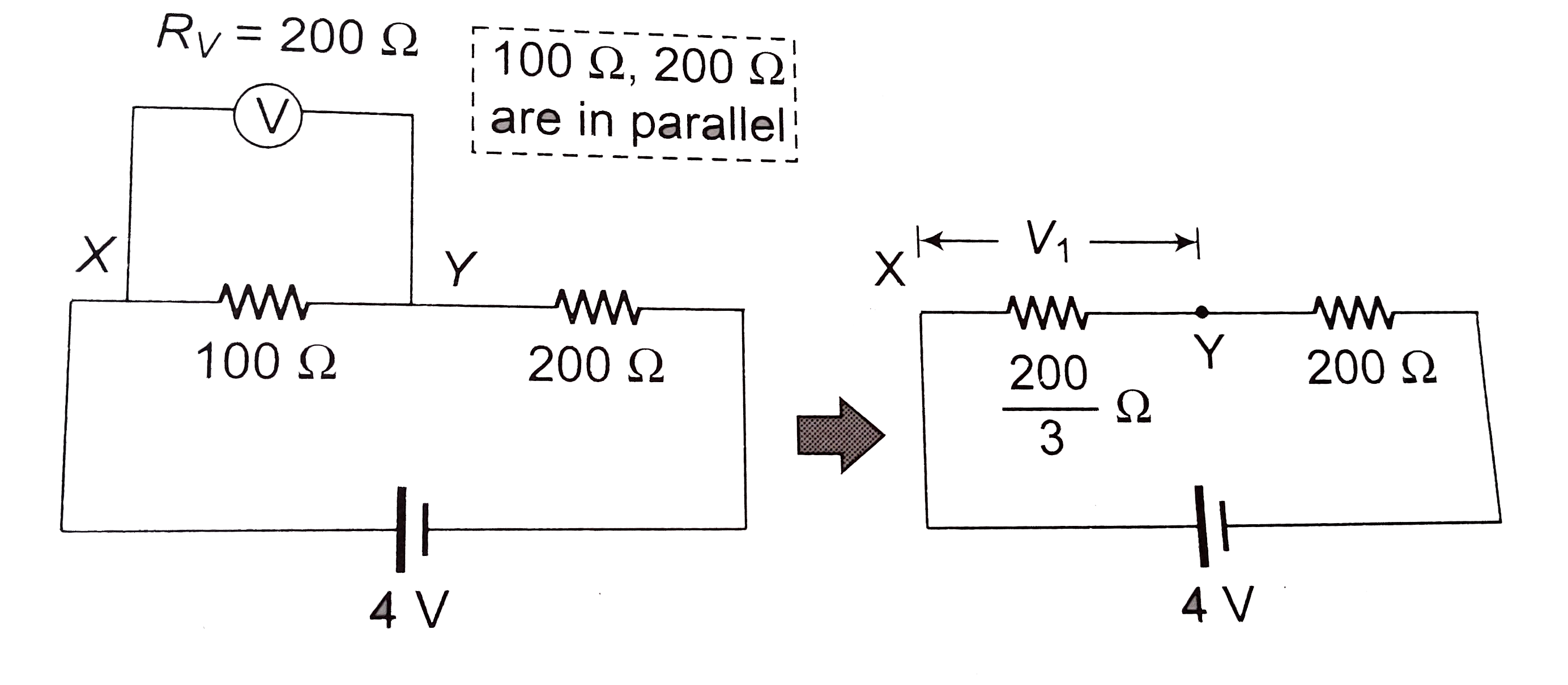 `V_1 = (200//3)/(200//3 + 200) xx 4 = 1 V`: reading of voltmeter (ii) 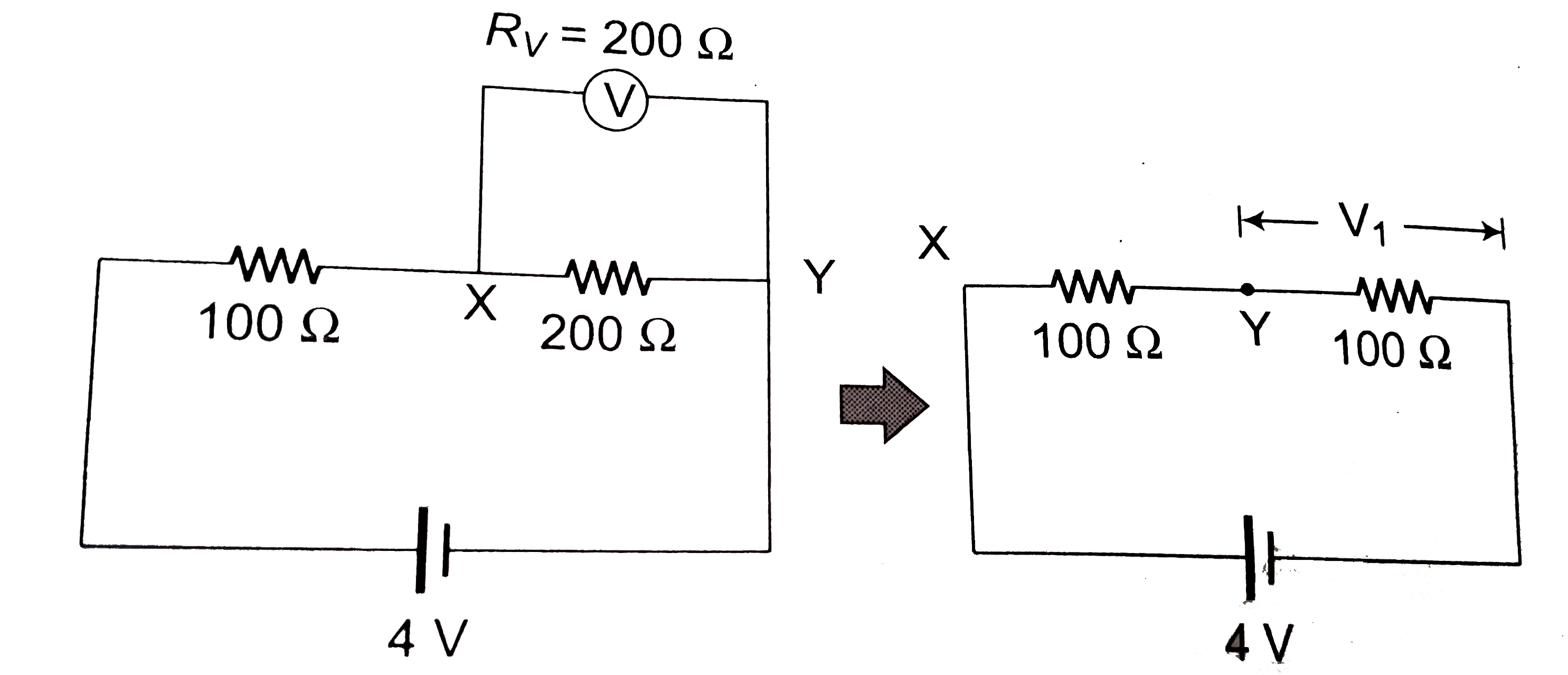 `V_1 = 2 V` : reading of voltmeter. ( c) 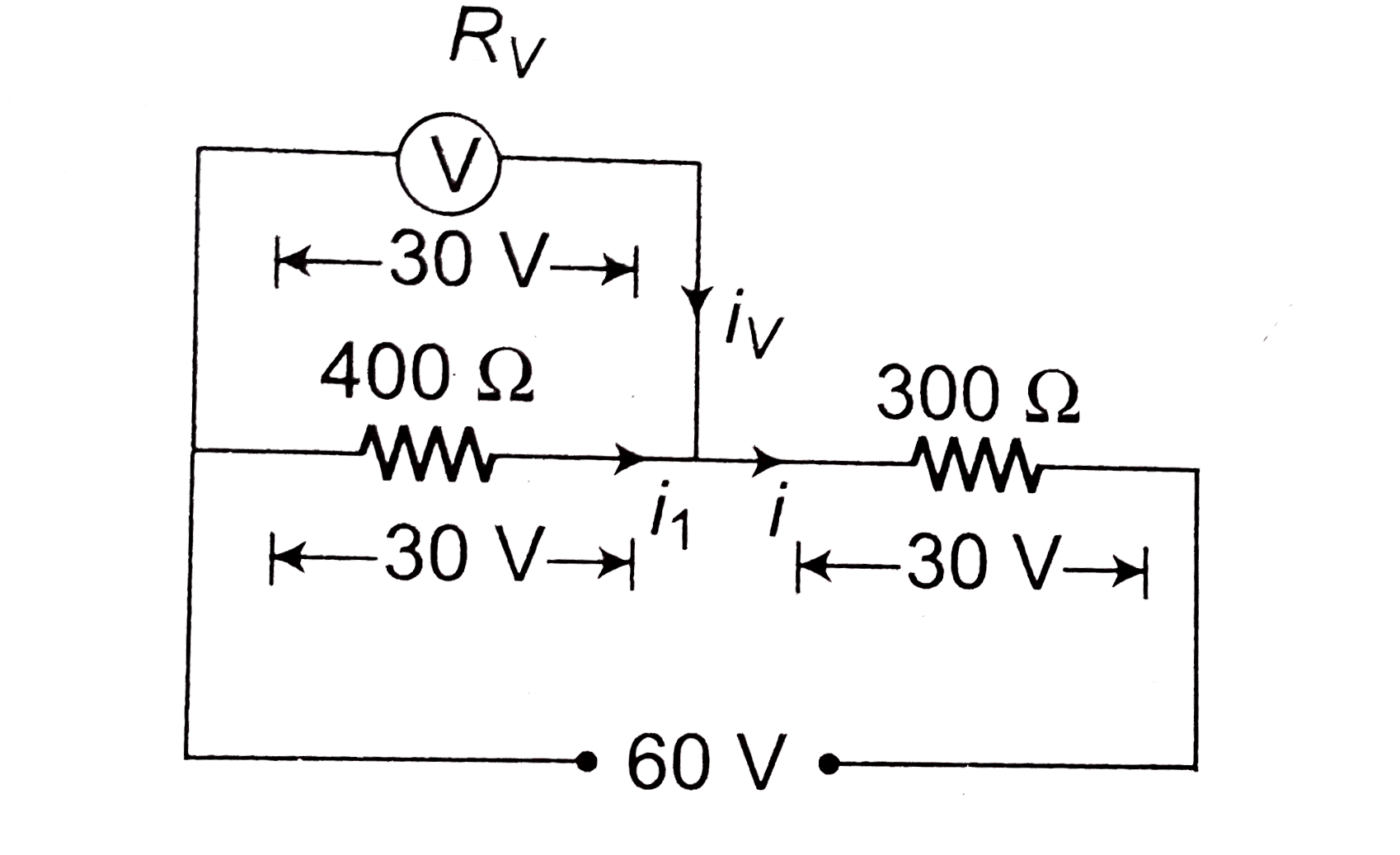 `p.d` across `300 Omega = 30 V` Current in `300 Omega i = (30)/(300) = (1)/(10) A` Current in `400 Omega i_1 = (30)/(400) = (3)/(40) A` Hence current through voltmeter `i_V = i - i_1 = (3)/(10) -(3)/(40) = (1)/(40) A` `p.d` across voltmeter `30 = i_V R_V = (1)/(40) R_V` `R_V = 1200` Resistance of voltmeter `= 1200 Omega` Voltmeter across `300 Omega`. 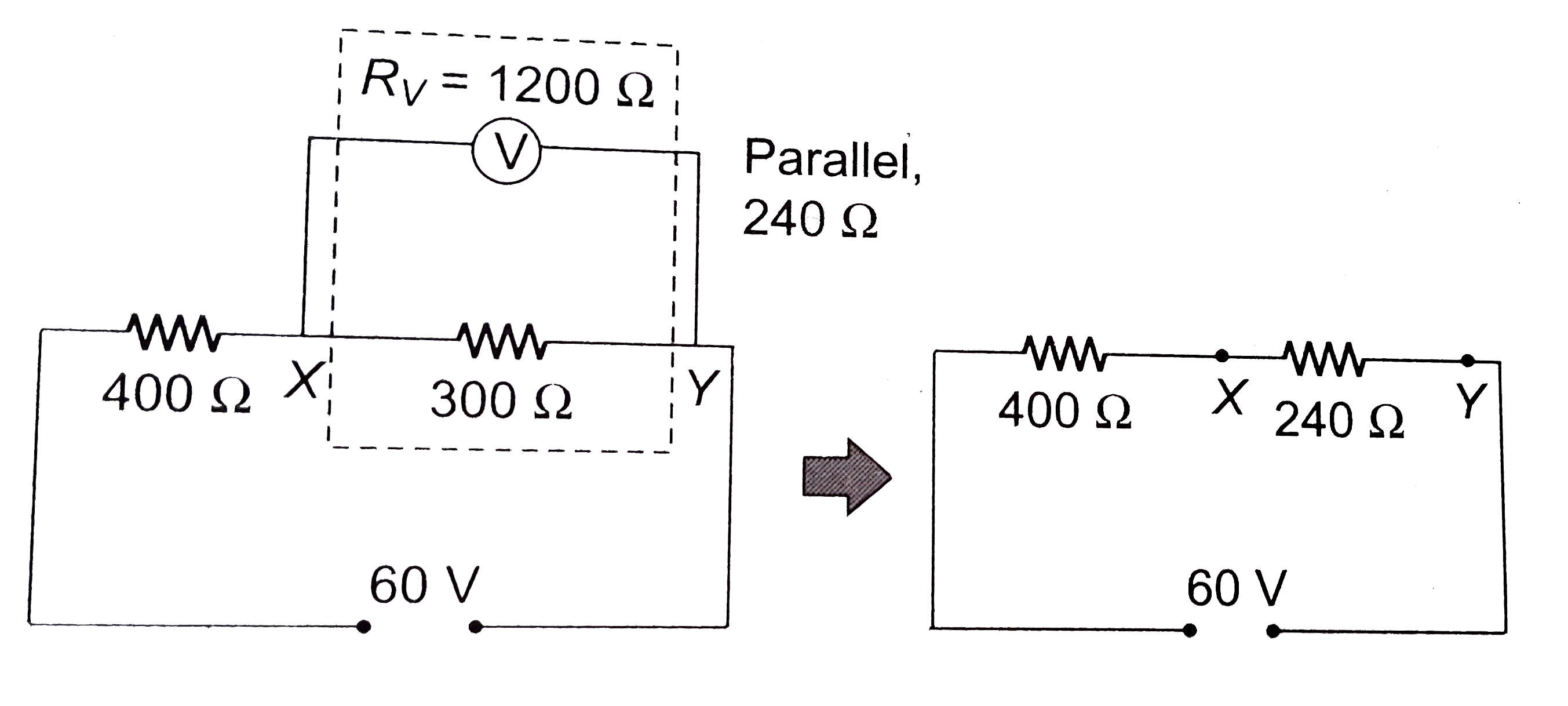 `V_X - V_Y = (240)/(240 + 400) xx 60 = 22.5 V` Reading of voltmeter `= 22.5 V` (d) 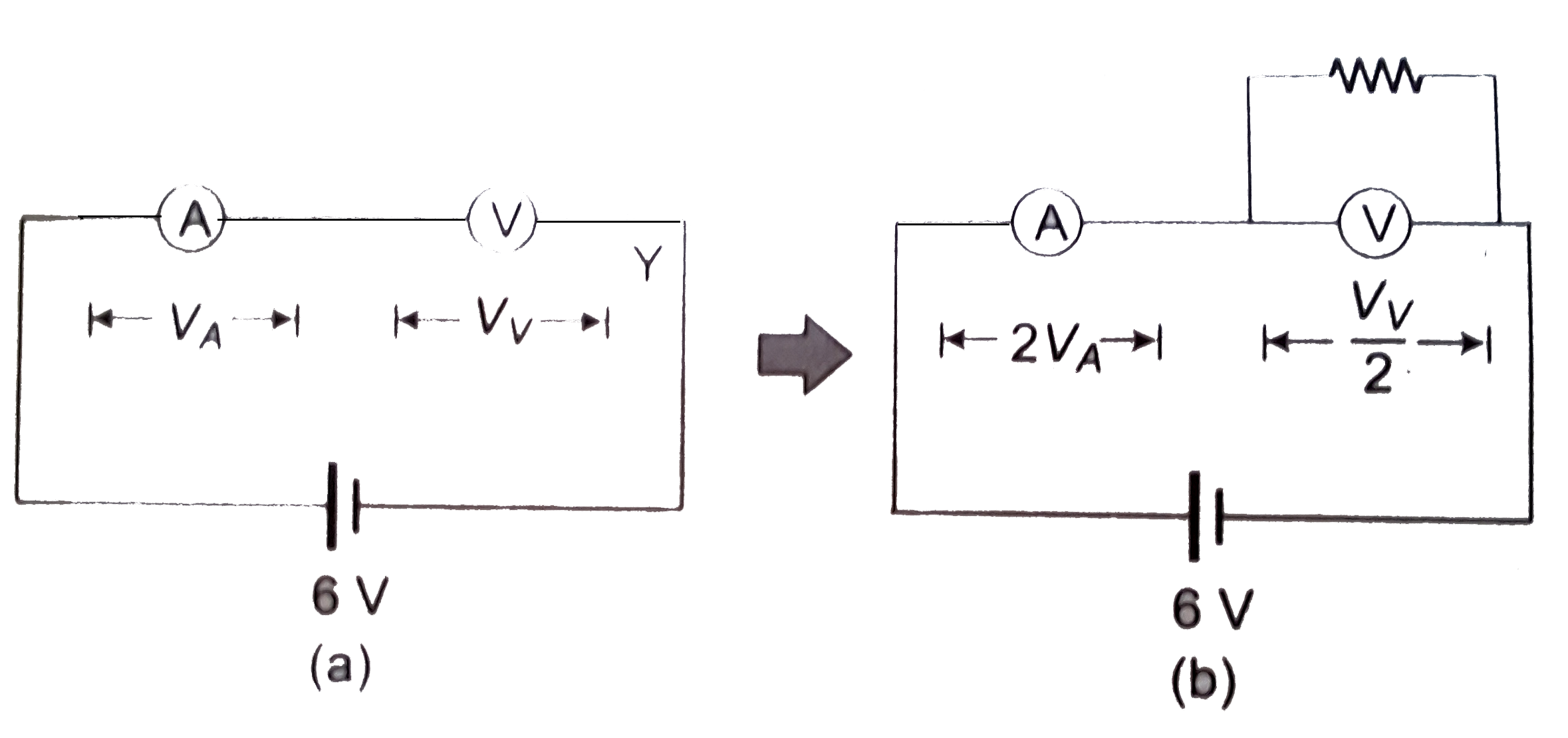 Case (a), `V_A + V_V = 6` ....(i) Case (b), `2 V_A + (V_V)/(2) = 6` ...(ii) Solving `V_V = 4 V` Reading of voltmeter in case (b) `(V_V)/(2) = (4)/(2) = 2 V`. |
|
| 11. |
A quartz plate cur parallel to the optical axis placed between two crossed Nicol prisms. The angle between the principal directions of the Nicol prism and the plate is equal to 45^(@). The thckness of the plate is d = 0.50mm. At what wavelengths in the interval from 0.50 to 0.60 mu m is the intensity of light which passed through that system independent of rotation of the rear prism? The difference of refractive indices for ordinary and extraordinary rays in that wavelength intervalis assumed to be Deltan = 0.0090. |
|
Answer» Solution :As in the previous problem the quartz plate introduces a phase difference `delta` between the `O & E` components. When `delta = pi//2` (modulo `pi`) the resultant wave is circularly polarized. In this case intensity is independent of the rotation of the rear prism. Now `delta = (2pi)/(LAMBDA) (n_(e) - n_(0)) d` `= (2pi)/(lambda)0.009 XX 0.5 xx 10^(-3) m` `= (9pi)/(lambda),lambda`in `mu m` For `lambda = 0.50mu m. delta = 18 pi`. The relevent values of `delta` have to be shosen in the form `(K +(1)/(2))pi`. For `k = 17, 16, 15` we get `lambda = 0.5143mum, 0.5435mu m` and `0.806 mu m` These are the values f `lambda` which lie between `0.50 mu m` and `0.60mum`. |
|
| 12. |
Sample of two radioactive nuclides A and B are taken. lambda_(A) and lambda_(B) are the disintergration constants of A and B respectively. In which of the following cases, the two sample can simultaneously have the same decay rate at any time ? |
|
Answer» INITIAL rate of decay of A is twice the initial rate of decay of B and `lambda_A=lambda_B`. |
|
| 13. |
(A): The alternating current lags behind the e.m.f. by a phase angle of pi//2, when AC flows through an inductor. (R) : The inductive reactance increases as the frequency of AC source decreases. |
|
Answer» Both 'A' and 'R' are true and 'R' is the correct EXPLANATION of 'A'. |
|
| 14. |
A free electron is located in the field of a plane electromagnetic wave. Neglecting the magnetic component of the wave distrurbing its motion, find the ratio of the mean energy radiated by the oscillating electron per unit time to the mean value of the energy flow density of the incident wave. |
|
Answer» Solution :If the electric field of the wave is `oversetrarr(E) = oversetrarr(E_(0)) cos omegat` then the induces a dipole MOMENT whose second derivative is `ddotoversetrarr(p) = (e^(2)oversetrarr(E_(0)))/(m) cos omegat` Hence radiated mean power `lt p gt = (1)/(4piepsilon_(0)) (2)/(3c^(3)) ((e^(2)E_(0))/(m))^(2) xx (1)/(2)` On the other HAND the mean Poynting flux of the INCIDENT radiation is `lt S_("inc") gt = sqrt((epsilon_(0))/(mu_(0))) xx (1)/(2)E_(0)^(2)` Thus `(P)/( lt S_("inc") gt ) = (1)/(4piepsilon_(0))(2)/(3) (epsilon_(0)mu_(0))^(3//1) ((e^(2))/(m))^(2) xx sqrt((mu_(0))/(epsilon_(0)))` `= (mu_(0)^(2))/(6pi) ((e^(2))/(m))^(2)` |
|
| 15. |
A capacitor of capacitance C is initially charged to a potential difference of V volt. Now it is connected to a battery of 2V with opposite polarity. The ratio of heat generated to the final energy stored in the capacitor will be n/4 where .n. is |
|
Answer» |
|
| 16. |
A certain preparation includes two beta-active components with different half-lifes. The measurment resulted in the following dependence of the natural logrithm of preparation acitivity on time t expressed in hours. {:(t,0,1,2,3,5,7,10,14,20),("In A",4.10,3.60,3.10,2.60,2.60,1.82,1.60,1.32,0.90):} Find the half-lifes of both componets and the ratio of radioactive nuclei of these components at the moment t = 0. |
|
Answer» Solution :Suppose `N_(1),N_(2)` are the initial number of component nuclei WHOSE decay constant are `lambda_(1),lambda_(2) (In("houe")^(-1))` Then the activity at any instant is `A=lambda_(1)N_(1)E^(-lambdat)+lambda_(2)N_(2)e^(-lambda_(2)t)` The activity so defined is in units dis//hour. We assume that the `In A` given is of its NATURAL logarithm. The daughter nuclei are assumed nonradioactive. We see from the data that at large `t` the change in In A per hour of elapsed time is constant and equal to `-0.07`. Thus `lambda_(2)= 0.07` per hour We can then see that the best fit to data is obtained by `A(t)= 51.1e^(-0.66t)+10.0e^(-0.07t)` [ To get the fit we calculate `A(t)e^(0.07t)`. We see that it reaches the constant value `10.0` at `t= 7,10,14,20` very nearly. This fixes the second term. The first term is obtained by subtracting out the constant value `10.0` from each value of `A(t)e^(0.07t)` in the data for small `t`] Thus we get `lambda_(1)= 0.66 per hour` or,`{:(T_(1),=,1.05 hour,,),(T_(2),=,9.9 hours,,):}}` half-lives Ratio `(N_(1))/(N_(2))= (51.1)/(10.0)xx(lambda_(2))/(lambda_(1))= 0.54` The ANSWER given in the book is misleading. |
|
| 17. |
Mr. Chawla and Mr. Batra are two friends. Both are senior citizens. Mr. Batra once fell-ill. He took medicine from a quack who diagnonses by pulse check only. The medicine did not work and he continued ailing for along. Mr. Chawla then took him to a qualified doctor who diagnosed the cause of his illness by testing his blood sample and urine sample using clinical microscopes. The medicine prescribed by the doctor worked and Mr. Batra got well within a couple of days. Read the above passage and answer the following questions : (i) Should we go in for clinical tests ? Why ? (ii) Should we go to specialists inspite of their exorbitant charges ? (iii) What values did Mr. Chawla display ? |
|
Answer» Solution :(i) Yes, we MUST go in for clinical TESTS as recommended by attending physician. These tests are necessary to ascertain the exact cause of ailment. (ii) Healthy life is more precious than MONEY. Therefore, we should consult specialists as and when required, to TAKE advantage of the repaid advances in medical sciences. (III) Mr. Chawla displays health concern for his friend and advised him to take right course of action. |
|
| 18. |
The rms value of the electric field of the light coming from the sun is 720 N C^(-1). The average total energy density of the electromagnetic wave is |
|
Answer» `3.3xx10^(-3) J m^(-3)` `lt u gt = 1/2 epsilon_0 E_(rms)^2 + 1/(2mu_0) B_"rms"^2` `=1/2 epsilon_0 E_(rms)^2 + 1/(2mu_0) (E_"rms"^2/c^2) "" (because B_"rms"=E_"rms"/c)` `=1/2epsilon_0 E_(rms)^2 + 1/(2mu_0) E_(rms)^2 epsilon_0mu_0 "" (because c=1/sqrt(mu_0epsilon_0))` `=1/2 epsilon_0E_(rms)^2 +1/2epsilon_0E_(rms)^2 = epsilon_0E_(rms)^2` `=(8.85xx10^(-12))xx(720)^2 = 4.58xx10^(-6) J m^(-3)` |
|
| 19. |
A carnot engine takes in heat from a reservoir of heat at 427^@C and gives out heat to the sink at 77^@C. how many calorie per second must it take from the reservoir in- order to produce useful mechanical work at the rate of 357 W ? |
|
Answer» `150cal//s` |
|
| 20. |
The air resistance for a particular vehicle is proportional to square of its velocity. The ratio of power required at 40 km/hr to that reqd.at 80 km/hr is: |
|
Answer» Solution :`F prop v^(2)implies F = KV^(2)`. Now `P=Pv=kv^(3)` `:. (P_(1))/(P_(2))=((v_(1))/(v_(2)))^(3)=(40/80)^(3)=1/8`. |
|
| 21. |
Assertion: A convex mirror is preferred over a plane mirror in vehicles toobserver traffic coming from behind. Reason: Images formed by convex mirrors are erect and diminished in size. |
|
Answer» If both assertion and reason are TRUE and reason is the correct EXPLANATION of assertion. |
|
| 22. |
In a hydrogen atom, an electron is revolving with an angular frequency 6.28 rad/s around the nucleus. Then the equivalent electric current is 10^(-19)A |
|
Answer» 0.16 |
|
| 24. |
The mysterious sliding stones. Along the remote Racetrack Play a in Death Valley, California, stones sometimes gouge out prominent trails in the desert floor, as if the stones had been migrating (Fig. 6-32). For years curiosity mounted about why the stones moved. One explanation was that strong winds during occasional rainstorms would drag the rough stones over ground softened by rain. When the desert dried out, the trails behind the stones were hardbaked in place. According to measurements, the coefficient of kinetic friction between the stones and the wet playa ground is about 0.80. What horizontal force must act on a 20 kg stone (a typical mass) to maintain the stone's motion once a gust has started it moving? (Story continues with Problem 34.) |
| Answer» SOLUTION :`F=1.6xx10^(2)N` | |
| 25. |
A ray of light is refracted through a sphere whose material has a refractive index mu in such a way that it passes through the extremities of two radii which make an angle beta with each other. Prove that if alpha is the deviation of the ray caused by its passage through the sphere, then cos((beta-alpha)/2)=mu cos(beta/alpha) |
Answer»  `:. alpha=(i-r)+(i-r)` `or i-r=alpha/2….(i)` Further, in `angleOPQ, r+r+beta=180^@` `:. r=90^@-beta/2…..(ii)` From EQ.(i), `i=r+alpha/2=90^@+((alpha-beta)/2).....(III)` `mu=sini/sinr=(SIN[90^@+((alpha-beta)/2)])/(sin(90-beta/2))` `=(COS((beta-alpha)/2))/(cos(beta/alpha))` or `cos((beta-alpha)/2)=mu cos beta/2` Henced proved |
|
| 26. |
A man of height 1.47 m stands on a straight road on a hot day. The vertical temperature in the air results in a variation of refractive index with height y as mu=mu_(0)sqrt((1+ay)) where mu_(0) is the refractive index of air near the road a =1.5xx10^(-6)/m. What is the apparent length of the road man is able to sec? |
|
Answer» 700m |
|
| 27. |
The force between two similar charges of magnitude 2C each separated by a distance 2 km |
| Answer» Answer :B | |
| 28. |
Write the reason why do we preferred an a.c. voltage instead of d.c. voltage. |
|
Answer» Solution :DC signals ( current or voltage) do not change direction with time. They are unidirectional ( current or voltage )signal. If the voltage obtained from source varies like a sine function with time then such a voltage is called alternating voltage (ac voltage). Voltage-common used means potential difference between TWO points. The current driven by in a circuit by ac voltage is called the alternating current ( ac current ). The most of the electrical ENERGY sold by power companies is transmitted and distributed as alternating current. The main reason for preferring use of ac voltage over dc voltage. ac voltages can be easily and efficiently CONVERTED from one voltage to the other by means of TRANSFORMERS. Electric energy can also be transmitted economically over long distances. |
|
| 29. |
A parallel-sided slab is made of two different materials. The upper half of the slab is made of material X, of thermal conductivity lambda, the lower half is made of material Y, of thermal conductivity 2 lambda. In the steady state, the left hand face of the composite slab is at a higher, uniform temperature than the right-hand face, and the flow of heat through the slab is parallel to its shortest sides. What fraction of the total heat flow through the slab passes through material X ? |
|
Answer» `(1)/(4)` Total HEAT FLOW through slab, `rArr``H_(1) =(k_(eq)(2A)(Delta T))/(L)` `rArr``H_(1)=(3 lambda(2A)Delta T) /(2 L)`…(1) Heat flow through x, `H_(2) (k_(x)A(Delta T))/(L)`....(2) `rArr``(H_(2))/(H_(1)) =(lambda A(Delta T)/(L) xx (2L)/(3 lambda(2A)(Delta T)) =(1)/(3)` |
|
| 30. |
Two metallic wires P_(1) & P_(2) ofthe same material & same length but different cross sectional areas A_(1) & A_(2) are joined together & connected to a source of emf. Find the emf of the drift velocities of free electrons in the two wires when they are connected in series. |
Answer» Solution :In SERIES the circuite remain the same.  `:. I=- "NE" A_(1)v_(d_(1))= nA_(2)ev_(d_(2)) (or) (v_(d_(1)))/(v_(d_(2)))=(A_(2))/(A_(1))` |
|
| 31. |
Three large identical conducting plates are placed at a distance d. in air. The space between the first two plates is filled completely with dielectric of dielectric constant .2. as shown. The plates are given charges 7Q,3Q and 2Q respectively. The outer plates are connected by good conducting wire through switch .S.. When .S. is closed, the charge that flows through switch is .nQ Find the value of no? |
|
Answer» |
|
| 32. |
An ideal gas is transformed from state A(P_(1), V_(1)) to the state B(P_(2), V_(2)) through path AB. In this process the work done by the gas is |
| Answer» Answer :A | |
| 33. |
The earth's field departs fromits dipole shape substantially at large distances (greater than about 30,000 km). What agencies may be responsible for this distortion ? |
| Answer» SOLUTION :The earth'a magnetic FIELD gets modified by the field PRODUCED by MOTION of IONS in earth's ionoshpere. | |
| 34. |
A travelling wave in a string has speed 5 cm/s in -ve x direction its amplitude is 10 mm and wavelength 1 m. At a particular time a point P has displacement 5sqrt(3)mm. Find the velocity vector of point P ? |
|
Answer» `pi/20 hatj m//s` |
|
| 35. |
The above figures represent a p-n-p transistor and an n-p-n transistor. a. Draw the circuit symbols of p-n-p transistor and n-p-n transistor . b. Write the names of the terminals (1) , (2) and (3) . |
Answer» Solution :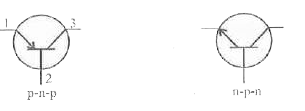 B(1) EMITTER (2) Base(3) Collector |
|
| 36. |
In Young.sdouble slit experiment the distance betweenslits is 2xx10^(-3) m , the distance between screen and slits is 200 cm . Whenthe light of wave length 5000 A^(0) is used ,then the fringe width on the screen will be |
| Answer» ANSWER :D | |
| 37. |
Choose the correct statement (s) related to the two circuits |
|
Answer» Both the capacitors are charged to the same CHARGE |
|
| 38. |
Estimate the specific heat of the electron gas in copper at 100^(@)C, and compare it with the lattice heat capacity. |
|
Answer» |
|
| 39. |
A coil of inductance 0.50 H and resistance 100Omegais connected to a 240 V, 50 Hz ac supply. a. What is the maximum current in the coil? . b. What is the time lag between the voltage maximum and the current maximum? |
|
Answer» Solution :a. `I_(rms) = (V_(rms))/(sqrt(R^2+ (OMEGA L)^2)) = (240 SQRT2)/(sqrt((100)^2+ (2pi xx 50 xx 0.5)^2)) = 1.82 A` b. ` tan PHI = (2pi V L)/( R) = (2pi xx 50 xx 0.5)/(100)= 1.571` `phi = tan^(-1) (1.571) = 57.5^@` Time lag ` = (T xx 57.5^@)/(360^@)= (2pi)/(omega) xx (57.5)/(360) = (2pi xx 57.5)/(2pi xx 50 xx 360) = 3.2 ms ` |
|
| 40. |
The frequencies of electromagnetic waves employed in space communication vary over a range of |
|
Answer» `10^(4)` HZ to `10^(7)` Hz |
|
| 41. |
Knowing the mass and the radius of the Sun one may find the average density of the Sun's material. Estimate the pressure and the temperature of the gas in the middle of the radius assuming, for the sake of simplicity, that the density is constant and that the acceleration due to gravity at this point is one half its value at the surface. What is the proton concentration at this point? |
|
Answer» SOLUTION :In this problem,we shall make USE of the fact that the gas pressure is equal to the hydrogtatic pressure, which may be approximately calculated as follows: `p = vecp_(o.) g_(o.)h = VEC(rho_(o.)) (gamma M_(o.))/(2R_(o.)^2) . (R_(o.))/(2)` where the average density of matter is `vecrho_(o.) = (M_(o.))/(V_(o.)) = (3M_(o.))/(4pi R_(o.)^3)` |
|
| 42. |
The ratio of number density of free electron and hole in p-type semiconductor is ……. |
|
Answer» almost same In p-semiconductor `n_(E ) lt n_(H) THEREFORE (n_(e ))/(n_(h)) lt 1` |
|
| 43. |
The force acting on an electron at rest in a uniform magnetic field B will |
|
Answer» COMPEL the ELECTRON to move in the DIRECTION of B |
|
| 44. |
A small piece of metal wire is dragged across the gap between the pole pieces of a magnet in 0.4 sec. If magnetic flux between the pole pieces is known to be 8 xx 10^(-4)Wb, then induced emf in the wire, is |
|
Answer» `4 xx 10^(-3)` V |
|
| 45. |
Assertion: A metal object kept in time varying magnetic field gets cooled.Reason: When metal object is kept inside time-varying magnetic field then due to electromagnetic induction electric current start flowing on the surface. |
|
Answer» If both ASSERTION and REASON are CORRECT and reason is correct EXPLANATION of the assertion |
|
| 46. |
Table 29.10 gives the coordinates of some of the points of the asymptotic hysteresis cycle of a ferromagnetic material. Plot the hysteresis loop. (The recommended scale is 10 mm = 100 A/m and 10 mm 0.20 T.) Find the coercive force and saturation induction from the graph. Calculate the saturation magnetization and remnant magnetization M_(r). |
Answer»  (Fig 29.10). The coercive froe is DETERMINED at the point of intersection of the graph WTH the H-axis, saturation induction is the point where the upper and lower branches of the loop interest. The saturation magnetization is `M_("SAT")=(B_("sat"))/(mu_(0))-H_("sat") APPROX B_("sat")/(mu_(0))` for `B_("sat") GT gt mu_(0)H_("sat")`. The residual magnetiztion is `M_(r)=B_(r)//mu_(0)`, where `B_(r)` is determined at the point of intersection of the graph with the B-axis. (Fig 29.10). The coercive froe is DETERMINED at the point of intersection of the graph WTH the H-axis, saturation induction is the point where the upper and lower branches of the loop interest. The saturation magnetization is `M_("SAT")=(B_("sat"))/(mu_(0))-H_("sat") APPROX B_("sat")/(mu_(0))` for `B_("sat") GT gt mu_(0)H_("sat")`. The residual magnetiztion is `M_(r)=B_(r)//mu_(0)`, where `B_(r)` is determined at the point of intersection of the graph with the B-axis.
|
|
| 47. |
For a given surface the Gauss's Law is stated as oint E.ds=0. From this we can conclude that : |
|
Answer» E is necessarily zero on the surface |
|
| 48. |
Three cells of emf 1.5 V and internal resislance 1 Omega are connected in parallel. This combination will have the emf ........ |
|
Answer» 4.5 V In PARALLEL connection, ELECTRIC potential is equal. |
|
| 49. |
A radar sends a radio signal of frequency 9 xx 10^3Hztowards an aircraft approaching the radar. If the reflected wave shows a frequency shift of 3 xx 10^3Hzthe speed with which the aircraft is approaching the radar in ms-1 (velocity of the rador signal is 3 xx 10^8 ms^(-1) ) |
|
Answer» 150 |
|