

Saved Bookmarks
This section includes 7 InterviewSolutions, each offering curated multiple-choice questions to sharpen your Current Affairs knowledge and support exam preparation. Choose a topic below to get started.
| 1. |
Which group includes nutritionally most derived group of organisms and has no well defined boundaries. |
|
Answer» Monera |
|
| 2. |
The ratio of spectral emissive power of a body lamda and temperature T is equal to a physical quantity at the wavelength and temperature. Then the physical quantity is |
|
Answer» emissive POWER of the body |
|
| 3. |
In a biprism expeirmentthe fringes are observed in the focal plane of eyepiece at a distance of 1 mfrom the slit. The distance between 10^(th) bright band from the central bright band is 0.22 . When convex lenz is interposed between the biprism the slit the distance betwen the magified imaes of the siit is found to be 0.93 cm. The wavelenght of light is uded is |
|
Answer» `5820Å` `(d)/(d_(1))=(U)/(v)` `:.d=(25xx0.93)/(75)=0.31cm=31xx10^(-4)m` `lamda=(d)/(D)beta=(31xx10^(-4)xx22xx10^(-5))/(1)=6820xx10^(-10)m` |
|
| 4. |
A satellite X moves round the earth in a circular orbit of radius R. If another satellite Y of the same mass moves round the earth in a circular orbit of radius 4R, then the speed of X is ____________ times that of Y. |
|
Answer» |
|
| 5. |
Vector A has a magnitude of 10 units and makes an angle of 30° with the positive X-axis. Vector B has a magnitude of 20 units and makes an angle of 30° with the negative X-axis. What is the magnitude of the resultant between these two vectors ? |
|
Answer» `20sqrt(3)` `:.R=sqrt(A^(2)+B^(2)+2ABcos120^@)` `sqrt(300)=10sqrt(3)` |
|
| 6. |
A telescope uses light having wavelength 5000 Å and aperture of the objective is 10 cm, then the resolving limit and magnifying power of the telescope is respectively |
|
Answer» `6.1xx10^(-6)` RAD and 12 |
|
| 7. |
a. Magnetic field lines show the direction (at every point) along which a small magnetised needle aligns (at the point) Do the magnetic field also represent the lines of force one a moving charged particle at every point ? b. Magnetic field lines can be entirely confined within the core of a toroid , but not within a straight solenoid. Why ? c. If magnetic monopoles existed, how would the Gauss ' law of magnetism be modified ? d. Does a bar magnet exert a torque on itself due to its own field ? Does one element of a current - carrying wire exert a force on another element of the same wire ? e.Magnetic field arises due to charges in motion . Can a system have magnetic moments eventhough its charge is zero ? |
|
Answer» Solution :(a) No. The magnetic force is always NORMAL to B (remember magnette force `=qv xx B).` It is misleading to call magiette fteld ithes as lines of force. (b) If field lines were entirely confined between two ends of a straight SOLENOID, the flux through the cross-section at each end would be non-zero. But the flux of field B through any closed surface must always be zero. For a toroid, this difficulty is ABSENT because it has no .ends.. (c) Gauss.s law of magnetism states that the flux of B through any closed surface is always zero `int_(s) B. triangleS=0` If monopoles existed, the right hand side would be equal to the monopole (magnetic charge) `q_(m)` enclosed by S. (Analogous to Gauss.s law of electrostaties, `int_(S) B. triangleS=mu_(0)q_(m)" where "q_(m)` is the (monopole) magnetic charge enclosed by S.) (d) No. There is no force or torque on an element due to the field produced by that element itself. But there is a force (or torque) on an element of the same wire. (For the special case of a straight wire, this force is zero.) (e) YES. THe AVERAGE of the charge in the system may be zer. Yet, the mean of the magnetic moments due to various current loops may not be zero. We will come across such examples in connection with paramagnetic material where atoms have net dipole moment thorugh their net charge is zero. |
|
| 8. |
Eddy currents are developed, when |
|
Answer» conductor is kept in CHANGING MAGNETIC field |
|
| 9. |
Figure shows two current segment . The lower segment carries a current of i_(1)=0.40 A and includes a semicircular arc with radius 5.0 cm, angle 180^(@) , and center point P The upper segment carries current i_(2)=2i_(1) and includes a circular arc with radius 4.0 cm, angle 120^(@) and the same center point P. What are the (a) magnitude and (b) direction of the net magnetic field vecB at P for the indicated current directions? What are the (c) magnitudeand (b) direction of vecB if i_(1) is reversed? |
|
Answer» |
|
| 10. |
Ampere's circuital law is another form of |
|
Answer» Tangent LAW |
|
| 11. |
The device which is a combination of a receiver and a transmitter is |
|
Answer» amplifier |
|
| 12. |
Find V and E at : (Q is a point charge kept at the centre of the non-conducting neutral thick sphere of inner radius 'a' and outer radius 'b') (dielectric constant =in_(r)) (i) 0 lt r lt a "" (ii) a le r lt b "" (iii) r ge b |
|
Answer» Solution :`-q` and `+q` charge will INDUCE on inner and outer surface RESPECTIVELY `E (0ltrlta)=(KQ)/(r^(2))` `E(r ge B)=(KQ)/(r^(2))` `E(a le r lt b) = (KQ)/(r^(2))-(Kq)/(r^(2))=(KQ)/(in_(r)r^(2))` `q=Q.(1-(1)/(in_(r))) , V(r ge b) = (KQ)/(r)` `(a le r le b) V_(A)=V_(P)+UNDERSET(b) overset(r)int (KQ)/(in_(r)r^(2))(-dr)=(KQ)/(b)+(KQ)/(in_(r))((1)/(r)-(1)/(b))` `V(r le a) " " V_(B)=5V_(c)+ underset(a)overset(r)int (KQ)/(r^(2))(-dr)=(kQ)/(b)+(kQ)/(in_(r))((1)/(a)-(1)/(b))+kQ((1)/(r)-(1)/(a))` |
|
| 13. |
In Young's double slit experiment while using a source of light of wavelength 4500 A, the fringe width is 5mm. If the distance between the screen and the plane of the slits is reduced to half, what should be the wavelength of light to get fringe width 4mm? |
|
Answer» Solution :GIVEN: first CASE `lambda_(1)=4500 A` `beta_(1)=5mm` `=5xx10^(-3)m` `beta_(1)=(lambda_(1)D)/(d)` In the second case, the distance between the SLIT and .screen is — `(D)/(2)` eqn (ii) and (i) `(4XX10^(-3))/(5xx(10^(-3)))=(lambda_(2))/(2xx4500xx10^(-10))` `4/5=(lambda_(2))/(9000xx10^(-10))` `0.8xx9000xx10^(-10)=lambda_(2)` `lambda_(2)=7200 xx10^(-10) m` `lambda_(2) =7200 A` |
|
| 14. |
In Fresnel's Biprism experiment, on inserting a thin plate of glass in the path of one of the interfering beames, it is found that the central bright fringe shifts into the position perviously occupied by the 6th bright fringe. If ther wavelength of the light used is 6xx10^(-5)cm and the refractive index of glass plate is 1.5 for the wavelength, calculate thethickness of the plate. |
|
Answer» |
|
| 15. |
In previous question the current in the circuit at resonance is . |
|
Answer» `10A` |
|
| 16. |
Two hollow cylinderical drums one of radius R and other 2R but of a common height 'h' are rotating with angular velocity omega in anticlockwise direction and also omega in clockwise direction respectively, with their axes fixed and parallel to each other in a horizontal plane saparated by little greater than 3R distance so that they just do not touch each other. They are now brought in contact making the separation exactly 3R. What would be the ratio of final angular velocity of the two when friction ceases ? |
|
Answer» `(2)/(1)`  Here let `omega_(1)andomega_(2)` be the FINAL angular velocity in anticlockwise and clockwise DIRECTIONS respectively. Finally as the friction ceases, then `Romega_(1)=2Romega_(2)` or `(omega_(1))/(omega_(2))=(2)/(1)` |
|
| 17. |
Deduce the expression for the electric filed oversetto E due to a system of two charges q_1 and q_2 with position vectorsoversetto (r_1) and oversetto (r_2)at a point P having position vectoroversetto ® . |
|
Answer» Solution :Let as shown TWO point charges ` q_1 and q_2` be situated at points A and B respectively with POSITIONS vectors `oversetto (r_1)and oversetto (r_2) `. Let P be a point having position vector ` oversetto ® `. Electric field at P DUE to charge `q_1` ` oversetto (E_1) =(1)/(4 pi in _0).(q_1)/(|oversetto r -oversetto (r_1) |^(3) ) .(oversetto r-oversetto (r_1)) ` and field at P due to charge `q_2 ,oversetto (E_2) =(1)/(4 pi in _0).(q_2)/(|oversetto r -oversetto (r_2) |) (oversetto r- oversetto (r_1)) ` ` therefore ` Total electric field atpoint P is ` oversetto (E) =oversetto (E_1) +oversetto (E_2) =(1)/(4 pi in _0) [(q_1)/(|oversetto r-oversetto (r_1)|^(3) ).(oversetto r-oversetto(r_1)) +(q_2)/(|oversettor-oversetto(r_2)|) ]` 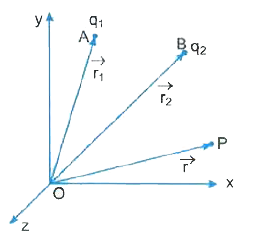
|
|
| 18. |
Two particles of masses M_(1)andM_(2) and having the equal electric charge are accelerated through equal potential difference and then move inside a uniform magnetic field, normal to it. If the radii of their circular paths are R_(1)andR_(2) respectively, find the ratio of their masses. |
|
Answer» Solution :1. Two particles having mass `M_(1)andM_(2)` and equal electric CHARGE move under potential v (suppose) 2. For a particle having mass `M_(1)=qV=1/2M_(1)v_(1)^(2)` For a particle having mass `M_(2)=qV=1/2M_(2)v_(2)^(2)` `therefore1/2M_(1)v_(1)^(2)=1/2M_(2)v_(2)^(2)` `thereforeM_(1)/M_(2)=v_(2)^(2)/v_(1)^(2)""...(1)` 3. After ENTERING into uniform magnetic field, both the particles perform uniform circular motion DUE to CENTRIPETAL FORCE acting on them. For a particle having mass `M_(1)=(M_(1)v_(1)^(2))/R_(1)=qv_(1)B` `therefore(M_(1)v_(1)^(2))/R_(1)=qB` Similarly for a particle having mass `M_(2)`, `(M_(2)v_(2)^(2))/R_(2)=qv_(2)B` `therefore(M_(2)v_(2))/R_(2)=qB` `therefore(M_(1)v_(1))/R_(1)=(M_(2)v_(2))/R_(2)` `thereforeM_(1)/M_(2)=v_(2)/v_(1)R_(1)/R_(2)` From equation (1) `v_(2)/v_(1)=(M_(1)/M_(2))^(1/2)` `thereforeM_(1)/M_(2)=(M_(1)/M_(2))^(1/2)*R_(1)/R_(2)` `therefore(M_(1)/M_(2))^(1/2)=R_(1)/R_(2)` `thereforeM_(1)/M_(2)=(R_(1)/R_(2))^(2)` |
|
| 19. |
what is a ground wave or surface wave ? |
| Answer» Solution :Ground WAVES are the waves which propagate through earth from one POINT to another. These waves are actually guided by the earth and follows its curved SURFACE from TRANSMITTER to RECEIVER. | |
| 20. |
The photoelectric cutoff voltage in a certain expertiment is 1.5 V.What is the maximum kinetic energy of photoelectrons emitted? |
|
Answer» Solution :Here `V_(0)=15V,e=1.6xx10^(-19)C` `K_(max)=eV_(0)=1.6xx10^(-19)xx1.5=2.4xx10^(-19)J` |
|
| 21. |
Abiconves lens has radil of curvature 20 cm and 15 cm each. The refractive index of the material of the lens is 1.5. What is its focal length? Will the focal length change if the lens is fipped by the side? |
|
Answer» Solution :For a biconvex lens, radius of curvature of the first surface is positive and that of the second surface is negative side Give: N = 1.5. `R_(1) = 20 cm and R_(2) = - 15 cm` Lens maker.s formula. `(1)/(F) = (n - 1)((1)/(R_(1))-(1)/(R_(2)))` Substituting the values. `(1)/(f)=(1.5-1)((1)/(20)-(1)/((-15)))=(0.5)((1)/(20)+(1)/(15))=(0.5)((3+4)/(60))=((1)/(2)xx(7)/(60))=(7)/(12)` `f = (120)/(7) = 17.14 cm` As the focal lenght is positive the lens is a converging lens. If the lens is FLIPPED BACK to fornt. Now, `R_(1) = 15 cm and R_(2) = - 20 cm, n = 1.5` Substituting the values. `(1)/(f)=(1.5-1)((1)/(15)-(1)/(-20))` `(1)/(f) = (1.5-1)((1)/(15)+(1)/(20))` This will also result in. f = 17.14 cm Thus, it is concluded that the focal lenght of the lens will not charge it is flipped side wise. This is true for any lens. Students can verify this for any lens  
|
|
| 22. |
In Fig ., the fresh water stands at depth D = 30.0 m behind the vertical upstream face of a dam of width W = 250 m. Find (a) the net horizontal force on the dam from the gauge pressure of the water and (b) the net torque due to that force about a horizontal line through O parallel to the (long) width of the dam. This torque tends to rotate the dam around that line, which would cause the dam to fail. (c) Find the moment arm of the torque. |
| Answer» SOLUTION :(a) `1.10 XX 10^(9) N, (B) 1.10 xx 10^(10) N * m (c) 10.0`m | |
| 23. |
A transformer has 140 turns in the primary and 280 turns in the secondary. If current in primary is 4A, then the current in secondary will be ………… |
|
Answer» 4A `THEREFORE I_2=I_1xxN_1/N_2=4xx140/280` `therefore I_2`= 2A |
|
| 24. |
Let A=R-{3} and B=R-{1}. Then f:ArarrB: f(x)=(x-2)/(x-3) is |
|
Answer» ONE - one and into |
|
| 25. |
How are express average power in an AC circuit ? |
|
Answer» Solution :`P_av = E_0I_0 /2 COS PHI` where `E_0`=Peak value of AC. `I_0`= Peak value of I. `phi` = PHASE difference between E and L. |
|
| 26. |
People usually prefer light colored dresses during summer and dark dresses during winter. Why? |
| Answer» SOLUTION :An object LOOKS blue in WHITE light, because it ABSORBS all colors except the blue. | |
| 27. |
A calorimeter contains 70.2 g of water at 15.3^@C. IF 143.7 g of water at 36.5^@C is mixed with it, the common temperature becomes 28.7^@C. The water equivalent of a calorimeter is |
|
Answer» 15.6 G |
|
| 28. |
The critical angle of a for a medium is 45^(@). What is its polarising angle. |
|
Answer» |
|
| 29. |
A current circular conducting loop exerts a magnetic field both inside and outside it. The magnetic field at the cetre of a current loop of radius 'R' and carrying a current I is given as : B = (mu_0 I)/(2 R) The magnetic field lines due to a circular current loop form closed loops. The direction of the magnetic field is given by the right hand thumb rule, which states that if one curls the palm of his right hand around the current loop with the fingers pointing in the direction of the current, the right hand thumb will give the direction of the magnetic field. From this law it is clear that the direction of magnetic field vecB is always perpendicular to the direction of flow of current or perpendicular to the plane of circular current loop. How is the magnetic field at O modified when the two loops are rearranged as shown in Fig. |
|
Answer» Solution :For the ARRANGMENT shown in FIG. (II), we have `vecB_1 = (mu_0 I)/(4 R_1) ox and vecB_2 = (mu_0 I)/(4 R_2) ox.` `:. VECB = vecB_1 + vecB_2 = (mu_0 I)/(4) [1/(R_1) + 1/(R_2)] ox.` |
|
| 30. |
Two coils P and Q are placed co-axially and carry currentI and I' respectively |
|
Answer» If `I`'=0` and P` moves towards `Q`, a current in the same DIRECTION as `I` is INDUCED in `Q` 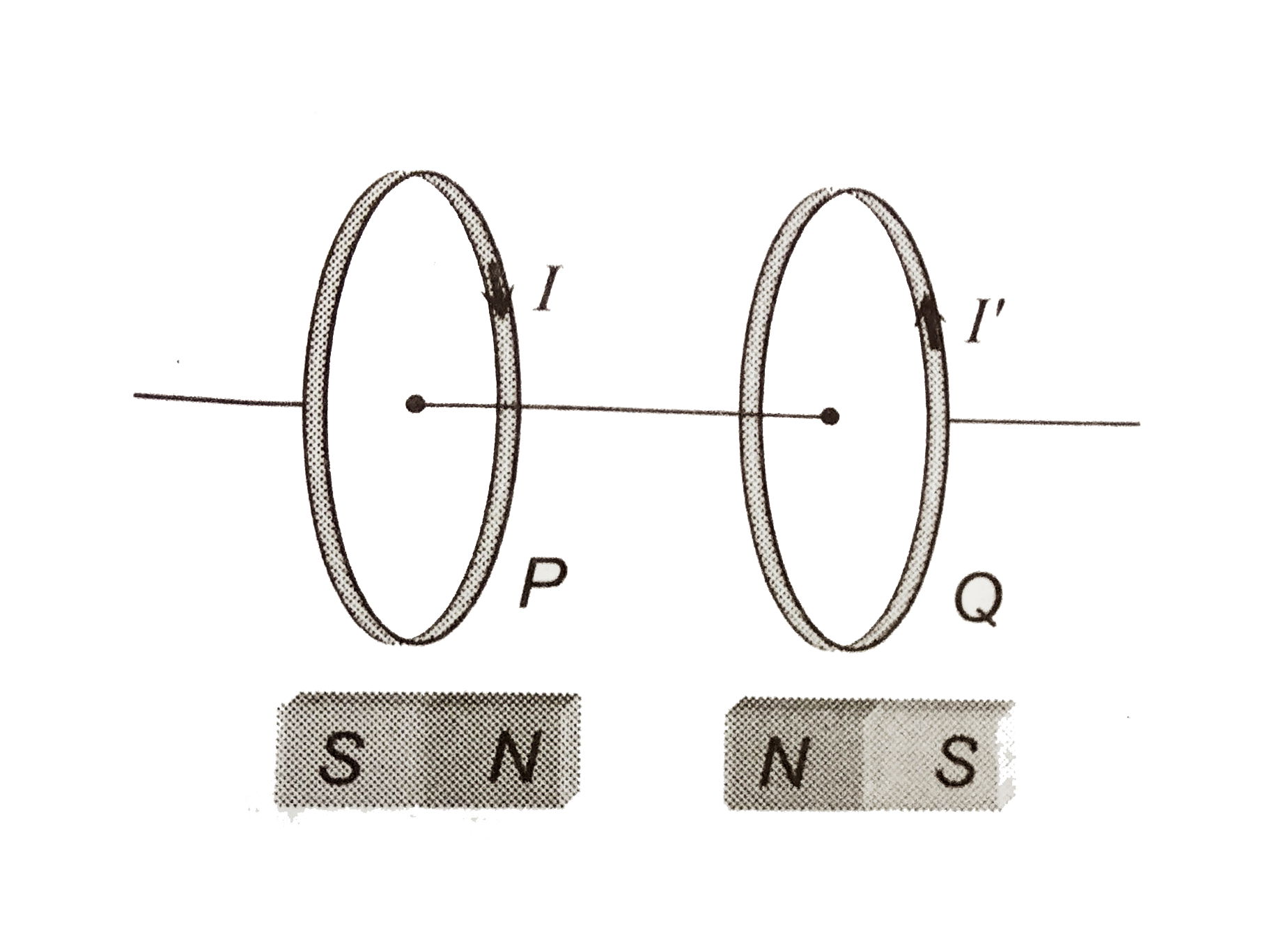
|
|
| 31. |
A 10 Omega resistor, 5 mH inductor coil and a 10 uF capacitor are joined in series, when a suitable frequency alternating current source is joined to this combination, the circuit resonates. If the value of resistance is halved to 5 Omega, the resonance frequency |
|
Answer» is HALVED |
|
| 32. |
A current circular conducting loop exerts a magnetic field both inside and outside it. The magnetic field at the cetre of a current loop of radius 'R' and carrying a current I is given as : B = (mu_0 I)/(2 R) The magnetic field lines due to a circular current loop form closed loops. The direction of the magnetic field is given by the right hand thumb rule, which states that if one curls the palm of his right hand around the current loop with the fingers pointing in the direction of the current, the right hand thumb will give the direction of the magnetic field. From this law it is clear that the direction of magnetic field vecB is always perpendicular to the direction of flow of current or perpendicular to the plane of circular current loop. Determine the magnetic field at the centre point O due to two concentric semicircular loops of radii R_1 and R_2 carrying a current I, when the loops of radii R_1 and R_2 carrying a current I, when the loops are arranged as shown in Fig. |
|
Answer» Solution :For a semicircular loop, FIELD `B = (mu_0 I)/(4R)` In the ARRANGMENT shown in Fig., field `B_1` due to semicicular loop QR and field `B_2` due to semicircular loop SP are `vecB_1 = (mu_0 I)/(4 R_1) OX and vecB_2 = (mu_0 I)/(4 R_2) o.` `:. VECB = vecB_1 + vecB_2 = (mu_0 I)/(4) [1/(R_1) - 1/(R_2)] ox` |
|
| 33. |
A current circular conducting loop exerts a magnetic field both inside and outside it. The magnetic field at the cetre of a current loop of radius 'R' and carrying a current I is given as : B = (mu_0 I)/(2 R) The magnetic field lines due to a circular current loop form closed loops. The direction of the magnetic field is given by the right hand thumb rule, which states that if one curls the palm of his right hand around the current loop with the fingers pointing in the direction of the current, the right hand thumb will give the direction of the magnetic field. From this law it is clear that the direction of magnetic field vecB is always perpendicular to the direction of flow of current or perpendicular to the plane of circular current loop. Draw the magnetic field lines due to a circular current loop placed in a horizontal plane. An enamelled copper wire of length L is bent in the form of a circular loop and a curretn I is passed through it so that a magnetic field B is get up at its centre. Now the same wire is bent in the form of a circular coil having N turns and same current I is passed through it. What is the magnetic field develop at the centre of this coil? |
|
Answer» Solution :Initially radius of current LOOP `R = L/(2 PI)` and magnetic field `B = (mu_0 I)/(2 R) = (2 pi u_0 I)/(2L) = (mu L_0 I)/(L)` FINALLY radius of current loop `R. = L/(2 pi N.)` , are the magnetic field `B. = (mu_0 NI)/(2 R.) = (mu_0 NI.2pi N)/(2L) = (pi u_0 N^2 I)/(L) implies B. = N^2 B` |
|
| 34. |
What is a transducer in communication? |
| Answer» Solution :A device that converts ONE FORM of signal or energy into ANOTHER is known as TRANSDUCER. | |
| 35. |
A current circular conducting loop exerts a magnetic field both inside and outside it. The magnetic field at the cetre of a current loop of radius 'R' and carrying a current I is given as : B = (mu_0 I)/(2 R) The magnetic field lines due to a circular current loop form closed loops. The direction of the magnetic field is given by the right hand thumb rule, which states that if one curls the palm of his right hand around the current loop with the fingers pointing in the direction of the current, the right hand thumb will give the direction of the magnetic field. From this law it is clear that the direction of magnetic field vecB is always perpendicular to the direction of flow of current or perpendicular to the plane of circular current loop. Draw the magnetic field lines due to a circular current loop placed in a horizontal plane. |
Answer» SOLUTION :FIELD LINES (FIG) are DRAWN here. 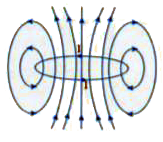
|
|
| 36. |
After 280 days, the activity of a radioactive sample is 6000 dps. The activity reduces to 3000 dps after another 140 days. Find the initial activity of the sample in dps. |
|
Answer» 6000 |
|
| 37. |
A magnetic field set up using Helmholtz coils (described in Exercise 4.16) is uniform in a small region and has a magnitude of 0.75 T. In the same region, a uniform electrostatic field is maintained in a direction normal to the common axis of the coils. A narrow beam of (single species) charged particles all accelerated through 15 kV enters this region in a direction perpendicular to both the axis of the coils and the electrostatic field. If the beam remains undeflected when the electrostatic field is 9.0 × 10^(5 )V m^(-1) , make a simple guess as to what the beam contains. Why is the answer not unique? |
| Answer» SOLUTION :Deuterium ions or DEUTERONS, the answer is not unique because only the ratio ofcharge to mass is determined. Other possible answers are `He^(++) , LI^(+++) `, etc | |
| 38. |
A planet has twice the density of earth but the acceleration due to gravity on the surface is same as on the surface of earth. Its radius in terms of the radius R of earth is : |
|
Answer» `(R )/(64)` `rArr R rho=(3g)/(4pi G)` `rArr R rho=` CONSTANT. So if densityis doubled, the radius is halved. Hence correct choice choice is (d). |
|
| 39. |
In the givencircuit diagram ,calculate:The maincurrentthroughthe circuit Also currentthrough9Omegaresistor. |
|
Answer» SOLUTION :Given`R_1=6Omega` , `R_2=12Omega` , `R_3=9OMEGA` , `E=3V, R=0.24 Omega`  w.k.t. `1/R_(eq)=1/R_1+1/R_2+1/R_3` i.e., `1/R_(eq) =1/6+1/12 +1/9=13/36` `THEREFORE R_(eq)=36/13=2.76 Omega` w.k.t `I=E/(R_(eq)+r)` , `I=3/(2.76+0.24)~~ 1A` P.d. across internalresistance`V_r` =Ir = 1 x 0.24 =0.24 V `therefore` P.d. across each resistors =3-0.24 = 2.76 V `therefore `CURRENT in `9Oemga = 2.76/9=0.31 A ~~ 0.3A` Hence Current in `9Omega ~~ 0.3A` |
|
| 40. |
A current circular conducting loop exerts a magnetic field both inside and outside it. The magnetic field at the cetre of a current loop of radius 'R' and carrying a current I is given as : B = (mu_0 I)/(2 R) The magnetic field lines due to a circular current loop form closed loops. The direction of the magnetic field is given by the right hand thumb rule, which states that if one curls the palm of his right hand around the current loop with the fingers pointing in the direction of the current, the right hand thumb will give the direction of the magnetic field. From this law it is clear that the direction of magnetic field vecB is always perpendicular to the direction of flow of current or perpendicular to the plane of circular current loop. Does a charge at rest produes a magnetic field around it? |
| Answer» Solution :No, a charge at rest does not PRODUCE a MAGNETIC FIELD AROUND it. | |
| 41. |
Consider the following two statement A and B and identify the correct answer given below : A)Nuclear density is same for all nuclei B) Radius of the nucleus (R) and its mass number (A) are related as sqrt(A) alpha R^(1//6) |
|
Answer» A and B are TRUE |
|
| 42. |
A bar magnet moves toward two idential parallel circularloops with a contant velocity upsilon as shown in Fig. |
|
Answer» (a) Both the loops will atytract each other Current induced in both `A and B` will be in same direction . So they will ATTRACT each other. A is CLOSER to magnet, so RATE of CHANGE of flux in `A` will be more. So more current is induced in `A`. |
|
| 43. |
A ring is rolling on a surface without slipping. what is the ration of its translational to rotational kinetic energies? |
|
Answer» 5:7 |
|
| 44. |
A point source of monochromatic light of 1.0 mW is placed at a distance of 5.0 m from a metal surface. Light falls perpendicularly on the surface. Assume wave theory of light to hold and also that all the light falling on the circular area with radius =1.0 xx (10^-9)m(which is few times the diameter of an atom)is absorbed by a single electron on the surface. Calculate the time required by the electron to receive sufficient energy to come out of the metal if the work function of the metal is 2.0e V. |
|
Answer» Solution : The energy radiated by the light source PER second is 1.0mJ. This energy is spread over the total solid angle `4PI`. The solid angle subtended at the source by the circular AREA mentioned is ` d(Omega)= (dA/(r^2))= ((pi xx (1.0 xx (10^-9)m))^2/(5.0m)^2) = (pi/25) xx (10^-18) sr.` Hence the energy heading towards the circular area per second is ` (d Omega/ 4pi)(1.0mJ) = (10^-20)mJ.` ` The time REQUIRED for accumulation of 2.0e V of energy on this circular area is ` (t=(2.0 xx 1.6 xx (10^-19)J)/(10^-20)mJ(s^-1)) = 3.2 xx (10^4)s = 8.8 hours. ` |
|
| 45. |
A body falling with a speed of 2 ms-strikes the floor and rebounds with a speed of 1 ms. The loss of energy is: |
|
Answer» 0.125 =`1/2m[(2)^2-1^2]=3/2m`. Initial energy=`1/2mxx(2)^2=2m` % AGE loss=`(3/2m)/(2m)xx100=75%` |
|
| 46. |
A voltmeter with resistance 500 Omega is used to measure the emf of a cell of internal resistance 4 Omega. The percentage error in the reading of the voltmeter will be |
| Answer» SOLUTION :`0.8 % ` | |
| 47. |
Evaluate the amplitude constant A in Eq. 38-10 for an infinite potential well extending from x=0" to "x=L. |
|
Answer» Solution :KEY IDEAS The wave function of Eq. 38-10 must satisfy the normalisation requirement of Eq. 38-14, which states that the probability that the electron can be detected somewhere along the x axis is 1. Calculations : Substituting Eq. 38 - 10 into Eq. 38 - 14 and taking the constant A outside the integral yield `A^(2)int_(0)^(L)sin^(2)((npi)/(L)x)dx=1`. We have changed the limits of the integral from `-oo and +oo`to 0 and Lbecause the ..outside.. wave function is ZERO. We can simplify the indicated integration by changing the VARIABLE from the dimensionless variable y, where `y=(npi)/(L)x.` hence`""dx=(L)/(npi)dy.` When we change the varibale, we must also change the integration limits (again). Equation 38-16 tells us that y = 0 when x = 0 and that `y=npi` when `x=L`, thus 0 and `npi` are our new limits. With all these subtitutions, Eq. 38-15 BECOMES `A^(2)(L)/(npi)int_(0)^(npi)(sin^(2)y)dy=1.` We can use integral 11 in appendix E to value with the integral obtaining the equation `(A^(2)L)/(npi)[(y)/(2)-(sin2y)/(4)]_(0)^(npi)=1`. EVALUATING at the limits yields `(A^(2)L)/(npi)(npi)/(2)=1`, thus `A=sqrt((2)/(L))`. This result tells us that the dimension for `A^(2)`, and thus for `Psi_(n)^(2)(x)`, is an inverse length. This is appropriate because the probability density of Eq. 38-12 is a the probability per unit length. |
|
| 48. |
A condenser of capacitance 5muF is charged a voltage of 1000 volts. The stored energy is : |
|
Answer» `25xx10^-3J` |
|
| 49. |
A source of light of wavelength 5000 Å is placed at one end of table 2 m long and 5 mm above its flat polished metal top. Find the fringe width of the interference bands are located ona screen at the end of the table . |
|
Answer» |
|
| 50. |
Explain why convex lenses converge incident beam of light whereas concave lenses diverge light. |
| Answer» Solution :LENSES can be assumed to be made up of a large NUMBER of PRISMS. Light after refraction has a tendency to move towards the BASE having a larger area. Hence light beam converges inside a CONVEX lens and diverges inside a concave lens. | |