

Saved Bookmarks
This section includes 7 InterviewSolutions, each offering curated multiple-choice questions to sharpen your Current Affairs knowledge and support exam preparation. Choose a topic below to get started.
| 1. |
The distance between the plates of a parallel plate capacitor is 'd'. The capacitance of thecapacitor gets doubled when a metal plate of thickness d/2 is placed between the plates. |
| Answer» SOLUTION :True – Effective SEPARATION between the plates CHANGES from d to `d/2` and CONSEQUENTLY CAPACITANCE of the capacitor is doubled. | |
| 2. |
Unit of capacitance of a capacitor is |
|
Answer» henry |
|
| 3. |
A closely wound solenoid of 2000 turns and area of cross-section 1.6 xx 10^(-4)m^2 carrying a current of 4.0 A, is suspended through its centre allowing it to turn in a horizontal plane. (a) What is the magnetic moment associated with the solenoid ? (b) What is the force and torque on the solenoid if a uniform horizontal magnetic field of 7.5 xx 10^(-2) T is set up at an angle of 30^@ with the axis of the solenoid ? |
|
Answer» SOLUTION :Here N = 2000 , A `=1.6 xx 10^(-4) m^2 and I = 0.4 A` (a) magnetic moment of solenoid m = NIA `= 2000xx4.0xx1.6xx10^(-4) = 1.28 m^2 ` (b) When B =` 7.5xx10^(-2) T and THETA = 30^@` Net force on the solenoid F= 0 [Since the magnetic field B is uniform one] Net torque on the solenoid `tau= m B SIN theta = 1.28 xx 7.5xx10^(-2) xx sin 30^@ = 4.8 xx 10^(-2) N m`. The Torque tends to align the solenoid AXIS along the direction of field `vecB`. |
|
| 4. |
m_(e)= mass of electron : m=mass of nucleus : M = mass of atom |
|
Answer» |
|
| 5. |
Me and the Ecology Bit |
|
Answer» 3 |
|
| 6. |
A ray of light incidents on a plane mirror at an angle of 30^(@). The deviation produced in the ray is |
|
Answer» `30^(@)` |
|
| 7. |
The displacementequation of a standing wave in a homogeneous elastic medium is given by y=a cos (kx) cos (omegat) Match the physical quantitiesalpha in the column (I) to the correct statement in the column (II) |
|
Answer» P-2,Q-3,R-1,S-4 |
|
| 9. |
What is the condition of destructive interference ? |
| Answer» Solution :`phi = (2N - 1)pi` , PATH difference = (2n - 1)`lambda/2` | |
| 10. |
Apoint - like object is placed at 40 cm distance from a covex lens of 20 cm . Plan mirror is placed behindconvex lens at 30 cm . Find the image distance by this combination. |
|
Answer» Solution :Think only convex lens `thereforeu =-40 cm f = +20cm ` `therefore` From lens FORMULA. `1/f = 1/v - 1/u` `therefore1/v = 1/f + 1/u` `therefore 1/v = 1/20 + 1/(-40) = (2-1)/(40) = 1/40` `thereforev =+ 40 cm ` If there is no plane mirror, then image Q. will be at 40 cm from lens. It will work as object for plane mirror. `therefore ` Here, THEDISTANCE of Q. from mirror = 40 - 30 = 10 cm Hence, image will be obtained at 10 cm to left from plane mirror. |
|
| 11. |
The ionisation potential of mercury is 10.39 volt. To gain energy sufficient enough to ionise mercury, an electron must travel in an electric field of 1.5 xx 10^6 Vm^(-1) at distance of : |
|
Answer» `(10.39)/(1.5 XX 10^(6))m` `10.39 xx 1.6 xx 10^(-19) =1.5 xx 10^(6) xx d xx 1.6 xx 10^(-19)` `d=(10.39)/(1.5 xx 10^(6))m` |
|
| 12. |
(a) Find the equivalent capacitance of the combination between Aand B in the figure If the points A and B are maintained at 15 V and 0 V respectively then (b) Find the charges on 3mu F, 4 mu F "and " 5 muFcapacitors (c ) What are the potentials of the points C and D ? |
|
Answer» Solution :The simplified form of the GIVEN combination has been SHOWN in the figure (b ) Here `(C_(1))/(C_(2))= (2muF)/(4mu F) = (1)/(2)` `(C_(3))/(C_(4))=(3muF)/(6 muF) =(1)/(2)` 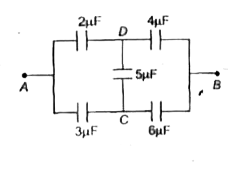 Thus `(C_(1))/(C_(2))=(C_(3))/(C_(4))` Hence (a) `C_(eq)= (C_(1)C_(2))/(C_(1)+C_(2))+(C_(3)C_(4))/(C_(3)+C_(4))` `=((2xx4)/(2+4)+(3xx6)/(3+6))muF=((4)/(3)+2)muF=(10)/(3)muF` (b ) `V_(A)-V_(B)= 15 V ` `:.` The charge on `(4)/(3)muF` capacitor is `q_(1)=((4)/(3)muF)(15V) = 20 muC ` 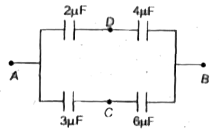 Hence the charge on `4muF` capacitor in figure ( c) is ALSO `q_(1) = 20 muC ` The charge on 2`muF` capacitor in figure (d) is `q_(2) = (2muF) (15 V) =30 muC` So the charge on the `3mu F` capacitor in figure ( c) is also `q_(2) = 30 muC` The charge on `5 muF ` capacitor is zero . Hence our answer are `30mu C ` on `3 MU F` capacitor `20 mu C` on 4 `muF` capacitor and zero on `5muF` capacitor . (c ) The potential difference across `3mu F ` capacitor of figure ( c) is 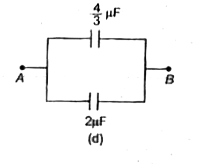 `V_(A)-V_(C) =(30muC)/(3 muF) = 10 V` or `15 V- V_(C) = 10 V ` `IMPLIES V_(C) = 5 V` |
|
| 13. |
(A): Absolute error is unitless and dimensionless. (R): Errors are considered in measured quantities, not in the given constants. |
|
Answer» Both (A) and (R) are true and (R) is the CORRECT EXPLANATION of (A) |
|
| 14. |
(i) Identify the part of electronmagnetic spectrum which is : (a) suitable for radar system used in aircraft navigation, (b) Produced by bombarding a metal target by high speed electrons. (iii) Why does galvanometer show a momentary deflection at the time of charging or discharging a capacitor ? Write the necessary expression to explain this observation. |
|
Answer» Solution :`(i) (a)` Microwaves. `(b)` X-rays. `(II)` During charging of a cpacitor, current flows in the circuit. Conduction current in wire and DISPLACEMENT current between the PLATES of the capcitor. When capacitor is fully charged both conduction and displacement current BECOMES zero. `ointvecB.vecdl=mu_(0)(I+I_(D))` |
|
| 15. |
A metal conductor of length 1 m rotates vertically about one of its ends at an angular velocity of 5 rad s^(-1). If the horizontal component of earth's magnetic field be 0.2 G, find the value of potential difference developed between the two ends of the conductor. |
|
Answer» |
|
| 16. |
Rays of light from Sunn falls on abiconvex lens of focal length f an the circular image of Sun of radius r is formed on the focal plane of the lens. Then, |
|
Answer» area of IMAGE is `pir^(2)` and area is DIRECTLY proportinal of F |
|
| 17. |
One mole of a gas is isothermally expanded at 27^@C till the volume is doubled. Then it is adiabatically compressed to its original volume. Find the total workdone. (gamma= 1.4 andR = 8.4 joule/mole/.^@K). |
|
Answer» Solution :In case of isothermal expansion, the workdone is given by `dW_1=RT.ln(V_f//V_i)` HereR=8.314, `T=27^@C` =273+27=`300^@K`, `(V_f//V_i)`=2 or `dW_1=8.314xx300xxln(2)` =8.314 x 300 x 0.693 =1728.48 J. Now the gas is adiabatically COMPRESSED to its original volume. Initially at the beginning of adiabatic COMPRESSION, the TEMPERATURE of the gas is 300 K and at the end of adiabatic compression, the temperature becomes `T_2` because the temperature is changed. The INITIAL volume of the gas is `2V_1` and after compression it again becomes the original volume i.e.,`V_i` .. For an adiabatic process, we know temperature and volume are RELATED as `T_1V_1^(gamma-1)=T_2V_2^(gamma-1)` or `300xx(2V_i)^(gamma-1)=T_2xx(V_i)^(gamma-1)` or `300xx(2)^(1.4-1) =T_2(1)^(1.4-1)` or `T_2=300xx(2)^(0.4)`=395.85 K Workdone during adiabatic process is `W_2=(nR)/(gamma-1)(T_2-T_1)` `=8.314/(-(1.4-1))(395.85-300)` =-1992.24 J Total workdone=-1728.47-1992.24 =-263.77 J |
|
| 18. |
In an electromagnetic wave E=100V m^(-1). Find the value of H. |
| Answer» SOLUTION :`H=(B)/mu_0=(3.33xx10^(-7)/(4PIXX10^(-7)) = 0.0265 A/m` | |
| 19. |
An air bubble in a glass slab (mu = 1.5) is 5 cm deep when viewed from one face and 2 cm deep when viewed from opposite face.The thickness of the slab is : |
|
Answer» 7 cm |
|
| 20. |
Calculate the bulk modulus of air from the following data about a sound wave of wavelength 35 cm travelling in air. The pressure at a point varies between (1.0 xx 10^5pm 14)Pa and the particles of the air vibrate in simple harmonic motion of amplitude 5.5 xx 10^(-6) m. |
| Answer» SOLUTION :`1.4 XX 10^5 N//m^2` | |
| 21. |
A : Though quark particles have fractional electronic charges, the quantum of charge is still electronic charge ( e ). R : Quark particles do not exist in free state. |
|
Answer» If both ASSERTION & Reason are true and the reason is the correct explanation of the assertion, then MARK (1). |
|
| 23. |
The ratio of hydraulic stress to the corresponding strain is known as |
|
Answer» BULK MODULUS So CORRECT CHOICE is (a). |
|
| 24. |
A nucleus ""_(z)X^4 emits an alpha -particle with velocity v. The recoil speed of the daughter nucleus is : |
|
Answer» `(A-4)/(4V)` 0=(A-4v.+4v) or (A-4)=-4v or `v.=-(4v)/((-A-4))` |
|
| 25. |
Following are graphs of angle of deviation versus angle of incidence. Based on the above graphs mark the correct options. |
|
Answer» Graph-a may be a part of the graph for ray of light that travels from DENSER to rarer medium 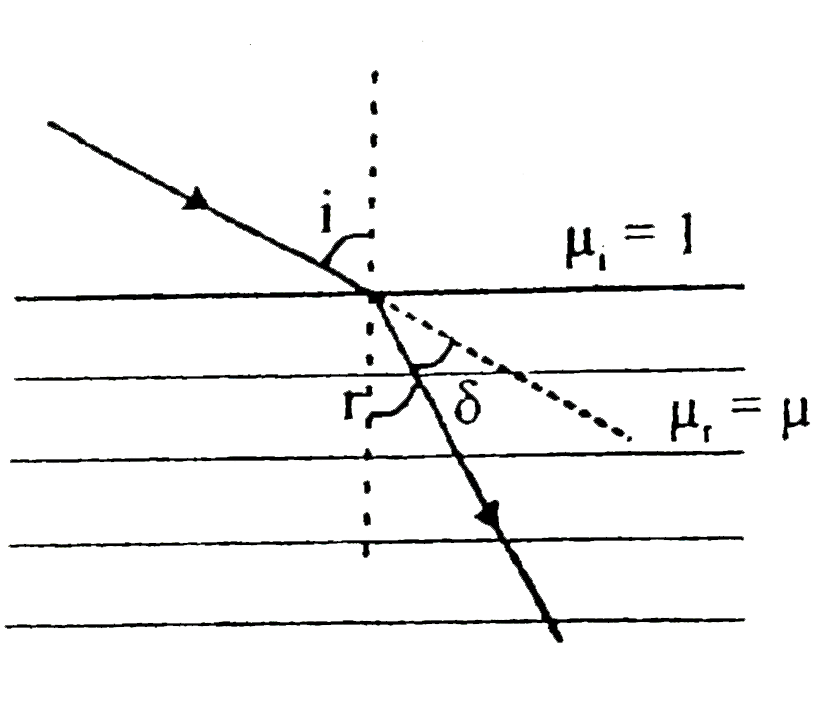 `delta=i-r` `delta=i-sin^(-1) (sini)/mu` non-linear increasing function of i. slope of tangent `(d delta)/d_(i)=1-(COS i)/sqrt(mu^(2)-sin^(2)i)` Slope of tangent increases as i increases Hence'c' is not the graph for light that travels from rarer to denser medium. 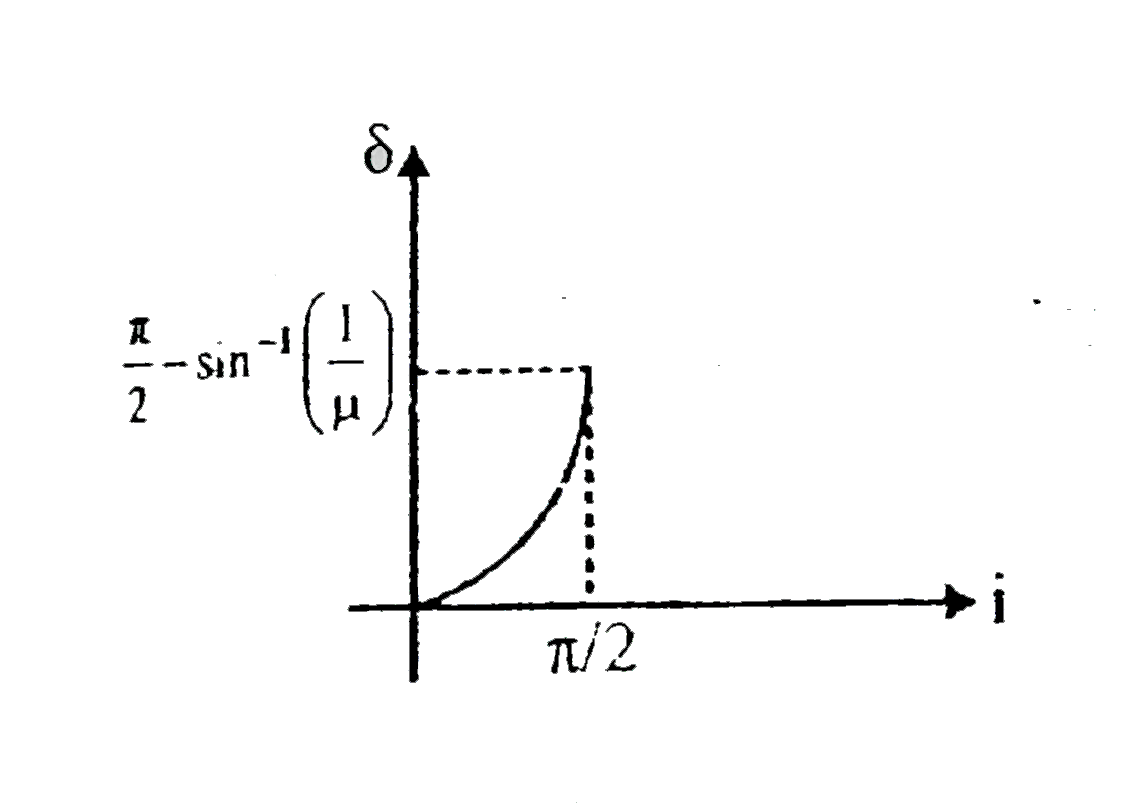
|
|
| 26. |
In classical mechanics,the time interval between two events has "_____________" value (s) for any two observers in motion. |
|
Answer» different |
|
| 27. |
in Davisson-Germer experiment filament of electron gun is coated with….. |
|
Answer» CARBON oxide |
|
| 28. |
In Young's double-slit experiment, the path difference between two interfering waves at a point on the screen is (5lambda)/(2),lambda being wavelength of the light used. The ___________ dark fringe will lie at this point. |
|
Answer» |
|
| 29. |
If the frequency of a.c. is doubled then the value of inductive reactance (X) as well as capacitive reactance (X) gets doubled. |
|
Answer» |
|
| 30. |
The sum of the given two numbers with regard to significant figures is (5.0 xx 10^(-8)) + (4.5xx10^(-6)) = |
|
Answer» `4.55 X 10^(-6)` |
|
| 31. |
Power of lens depends on ..... |
|
Answer» only type of medium of LENS. |
|
| 32. |
The equivalent wavelength of a moving electron has the same value as that of a photon having an energy of 6 xx 10^(-17) J. Calculate the momentum of the electron. |
|
Answer» Solution :E = Energy of the photon `=hv=(hc)/(lambda)` `:. lambda=(hc)/(E)` `:.` Wavelength of the MOVING electron `=lambda=(hc)/(E)` `:.` Momentum of the electron =p `=(h)/(lambda)=(hE)/(hc)=(E)/(C)` `=(6xx10^(-17))/(3xx10^(8))kg ms^(-1)` `=2xx10^(-25)kg ms^(-1)` |
|
| 33. |
Define resolving power of a compound microscope. How does the resolving power of a compound microscope change when : (i) refractive index of the medium between the object and objective lens increases, (ii) wavelength of the radiation used is increased? |
|
Answer» SOLUTION :For definition of resolving POWER of a compound microscope (i) If the REFRACTIVE index (n) of the medium between the object and objective lens increases, the resolving power increases because resolving power `mu` N.A. (ii) On increasing the wavelength of radiation used, the resolving power of microscope decreases because resolving power `PROP(1)/(lamda)`. |
|
| 34. |
A soild sphere is initially kept in open air, and the pressure exerted on it by air is 1.0xx10^(5)N//m^(2) (atmospheric pressure). The sphere is lowered into the ocean to a depth where the pressure is 200 times the atmospheric pressure. The volume of the sphere in air is 0.5 m^(3). What is the change in the volume once the sphere is submerged ? Given that bulk modulus is 6.1xx10^(10)N//m^(2). |
|
Answer» Solution :What happens when you squeeze a tennis ball in your hand ? Its volume REDUCES as it shrinks. We can expect same to happen to the sphere when it is subjected to high pressure from the ocean water. We need to perform a SIMPLE calculation using Eq. 12-5. `Delta U=-(V,Delta p)/(B)`. Substituting the numerical VALUES : `Delta V=((0.50 m^(3))(2.0xx10^(7)N//m^(2)-1.0xx10^(5)N//m^(2)))/(6.1xx10^(10)N//m^(2))` `=-1.6xx10^(-4)//m^(3)`. The NEGATIVE sign indicates that the volume of the sphere decreases when submerged. |
|
| 35. |
Transverse progressive wave . |
| Answer» Solution :A PROGRESSIVE wavein which the vibration of the individual particlesof the MEDIUM is perpendicularto the DIRECTION of propagationof the wave is called a TRANSVERSE progressive wave . | |
| 36. |
A condenser of10muF capacity is charged at 100 volt. The energy stored by the condenser is : |
|
Answer» 0.5 J |
|
| 37. |
The angle of deviation will be |
|
Answer» `32.5^(@)` |
|
| 38. |
A circular coil with cross - sectional area 0.1 cm^(2) is kept in a uniform magnetic field of strength 0.2 T. If the current passing in the coil is 3 A and plane of the loop is perpendicular to the direction of magnetic field . Calculate (a) total torque on the coil (b) total force on the coil (c ) average force on each electron in the coil due to the magnetic field of the free electron density for the material of the wire is 10^(28) m^(-3) . |
|
Answer» Solution :Cross sectional area of coil, A = 0.1 `cm^(2)` A = `0.1 xx 10^(-4) m^(2)` Uniform magnetic field of strength , B = 0.2 T CURRENT passing in the coil, I = 3A angle between the magnetic field and normal to the coil, `theta = 0^(@)` (a) Total TORQUE on the coil, `tau` = ABI sin `theta = 0.1 xx 10^(-4) xx 0.2 xx 3 sin 0^(@) sin 0^(@) = 0 ` `tau` = 0 (b) Total force on the coil F = BIL sin `theta = 0.2 xx 3 xx l xx sin 0^(@)` Average force: `F = q V_(d) B)` Drift velocity , `V_(d) = (I)/("ne A")"" [ because q = e ]` F = e `((I)/("ne A"))B ""[ because n = 10^(28) m^(-3)]` = `(IB)/(nA) = (3 xx 0.2)/(10^(28) xx 0.1 xx 10^(-4) ) = 6 xx 10^(-24)` `F_(av) = 0.6 xx 10^(-23) `N |
|
| 39. |
A comb after going through dry air is able to attract small bits of paper towards it. Why is it so ? |
| Answer» Solution :Comb, while working through dry air, gets charged due to friction between comb and air. As this charged comb is BROUGHT NEAR a bit of PAPER it induces a charge of opposite nature on the nearer end of the paper. This RESULTS in attraction between the comb and bits of paper. | |
| 40. |
When an object is placed at a distance of 25cm from a mirror, the magnification is m_1. The object is moved 15 cm farther away with respect to the earlier position, and the magnification becomes m_2. If (m_1)/(m_2) = 4, then calculate the focal length of the mirror. |
| Answer» SOLUTION :CONCAVE, 20 CM | |
| 41. |
A hollow conducting sphere is placed in an electric field produced by a point charge placed at Pas shown. Let V_A, V_B,V_c be the potentials at points A, B and C respectively. Then : |
|
Answer» `V_CgtV_B`. |
|
| 42. |
Two long parallel metallic wires with a resistance 'R' from a horizontal plane . A conducting rod AB is on the wires shown in figure . The space has magnetic field pointing vertically downwards. The rod is given an initial velocity 'v_(0)'. There is no friction in the wire and the rod . After a time 't' the velocity v of the rod will be such that :- |
|
Answer» `V GT v_(0)` |
|
| 43. |
The space between the plates of a parallel plate capacitor is completely filled with a material of resistivity 2xx10^(11)Omega-m and dielectric constant 6. Capacity of the capacitor with the given dielectric medium between the plates is 20nF. Find the leakage current if a potential difference 2500 V is applied across the capacitor. |
|
Answer» `4.7muA` |
|
| 44. |
An inductance L, a capacitance C and a resistance R may be connected to an ac source of angular frequency omega, in three different combinations of RC, RL and LC in series. Assume that omegaL =1//omega//C. The power drawn by the three combinations are P_(1), P_(2), P_(3) respectively. Then |
|
Answer» <P>`P_(1)GT P_(2)gt P_(3)` |
|
| 45. |
Show that if A gt A_(max) (=C C), theninternal reflection occursat secondrefracting surfacePR of the prism for anyvalue of 'I'. |
|
Answer» Solution :For `T.I.R`at secondsurface `r'gtCrArr(A-r)gt C` or`A gtV + C` or `A gt 2C` (j) On the BASIC of above examples and similar reasoning, it can be shown that(you should trythe following cases (ii) and (iii) yourself.) (i) If `A gt 2C`, all rays are reflected back from the secound surface. (ii) If `AleC`, no rays are reflectedback fromthe secoundsurface i.e., all rays are refracted from secondsurface. (iii) If `2C ge A gtC`, no rays are reflectedback form the secondsurface and somerays are refractedfrom second surface, dependingon the angle of incidience. (k) `DELTA` si MAXIMUM for two values of `i` `rArr i_(min)` (corresponding to `e = 90^(@)`) and `i = 90^(@)` (corresponding to `e_(min)`) For `i_(min) : n_(S) sin i_(min) = n_(0) sin (A-C)` If `i it i_(min)` then `T.I.R` takes place at secondrefractingsurface `PR` 
|
|
| 46. |
A photon with momentum p = 1.02 MeV//c, where c is the velocity of light, is scattered by a stationary free electron, changing in the process its momentum to the value p' = 0.255MeV//c. At what angle is the photon scattered? |
|
Answer» Solution :We use the equation `lambda = (h)/(p) = (2pi cancel h)/(p)`. Then from COMPTON formula `(2pi cancel h)/(p') = (2pi cancel h)/(p) +2pi(cancel h)/(mc)(1-cos theta)` so `(1)/(p') = (1)/(p) + (1)/(mc).2SIN^(2) theta//2` Hence `sin^(2)((theta)/(2)) = (mc)/(2)((1)/(p')-(1)/(p))` `=(mc(p-p'))/(2pp')` or `sin((theta)/(2)) = sqrt((mc(p-p'))/(2pp'))` Substituting from the DATA `sin((theta)/(2)) = sqrt((mc^(2)(cp-cp'))/(2cp.cp')) = sqrt((0.511(1.02-0.255))/(2xx1.02xx0.255))` This GIVEN `theta = 120.2` DEGRESS. |
|
| 47. |
A current of 3 A flows through the 2Omegaresistor shown in the circuit. The power dissipated in the 5 Omegaresistor is |
|
Answer» 5 WATT. ` therefore I_3 = (I_1R_1)/(R_3) = (3 xx 2)/(6) = 1A` Power dissipated in 5 `Omega`RESISTOR` P= I_3^2R = (1)^2 xx 5 = 5`watt |
|
| 48. |
The speed of electromagnetic waves in a vacuum is given by : |
|
Answer» `(1)/(mu_(0) epsilon_(0))` |
|
| 49. |
A positivively charged particle moving due east enters a region of uniform magnetic field directed vertically upwards. The particle will |
|
Answer» continue to move DUE east |
|