

Saved Bookmarks
This section includes 7 InterviewSolutions, each offering curated multiple-choice questions to sharpen your Current Affairs knowledge and support exam preparation. Choose a topic below to get started.
| 1. |
Two coherent point sources S_(1) and S_(2) are located at a distance 4l from each other. Perpendicular to the straight line joining S_(1) and S_(2) there is a large screen at a distance of 1000 lambda from S_(1) as shown in Figure. Find the radius of the third maxima starting from the point 0. |
| Answer» SOLUTION :`SQRT3 XX 1000 LAMBDA` | |
| 2. |
This voltage drop across the resistor in a LCR series circuit is ………….. |
| Answer» | |
| 3. |
Two infinitely long, thin, insulated, straight wires lie in the x-y plane along the x and y-axes respectively. Each wire carries a current l, respectively in the positive x-direction and positive y-direction. The magnetic field will be zero at all points on the straight line |
|
Answer» y=x |
|
| 4. |
An oxide coated filament is useful in vacuum tubes because essentially |
|
Answer» It has high MELTING point |
|
| 5. |
Figure shows two blocks, each of mass 2kg, connected by a string passing over two pulleys. One block rests on a smooth horizontal surface and the other blockhangs vertically. Assume pullyes to be frictionless and massless. What is the tension in the string? |
|
Answer» Solution :From the free-body DIAGRAM of vertically HANGING 2 kg block, `2G - T=2a`...... (i) considering the 2 kg block on the horizontal surface . `T=2a`............ (ii) combining (i) and (ii) ` 2g -T=T or 2T = 2g or T=g ` Newton =9.8 N 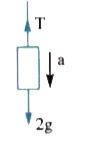
|
|
| 6. |
What is the effect of lorentz force on a moving particle which has its velocity perpendicular to the magnetic field? |
| Answer» SOLUTION :This FORCE CHANGES the DIRECTION of MOTION | |
| 7. |
Explain the concept of nuclear binding energy. Draw a curve between mass number and average binding energy per nucleon.What conclusions do you draw from this curve ? |
|
Answer» CONCLUSION. (i) There exists peaks in the curve corresponding to mass number `A=4, 12, 16, 20`. The nuclei corresponding to those mass number `""_(2)He^(4), ""_(6)C^(12), ""_(8)O^(16), ""_(10)Ne^(20)`, the peaks indicate that these nuclei have more binding energy per nucleon than their immediate neighbours. So they are more stable nuclei. (ii) Binding energy per nucleon is smaller for light and heavier nuclei i.e. light and heavier nuclei are less stable than middle one. In order to attain higher value of binding energy per nucleon, the heavier nuclei may split into lighter nuclei (process of fission) and lighter nuclei may unite to form heavier nuclei (process offusion). In both of these NUCLEAR processes, a large amount of energy is released. 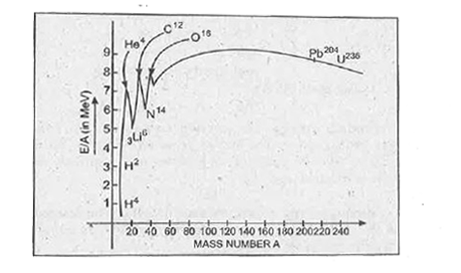
|
|
| 9. |
When the inputs of a two input logic gate are 0 and 0, the output is 1, when the inputs are 1 and 0, the output is zero. The type of logic gate ….. |
|
Answer» XOR If the output of truth table in QUESTION is CREATED, then it will be equal to the truth table of the NOR gate. `Y=bar(A+B)` 
|
|
| 10. |
Young's double slit experiment is made in a liquid. The 10th bright fringe in liquid lies where 6th dark fringe lies in air. The refractive index of liquid is ....... |
|
Answer» `1.2` The `10^(th)` bright fringe is found in the liquid, `:.x=(10 lambda.D)/(d)""......(1)` The `6^(th)` bright fringe is found in the liquied `:. x=(2xx6-1)(lambda)/(2D)=(11lambdaD)/(2d) ""....(2)` Equation (1) and (2) are equal `:.(10 lambda.D)/(d)=(11lambda D)/(2d)` `(20)/(11)=(lambda)/(lambda)` `:. n=1.818` |
|
| 11. |
What is Conventional current ? |
| Answer» Solution :The current that flows from +ve pole to negative pole of a cell in the external CIRCUIT is CALLED CONVENTIONAL current ? | |
| 12. |
A table has three legs that are 1.00 m in length and a fourth leg that is longer by d - 0.50 mm, so that the table wobbles slightly. A steel cylinder with mass M = 290 kg is placed on the table (which has a mass much less than M) so that all four legs are compressed but unbuckled and the table is level but no longer wobbles. The legs are wooden cylinders with cross - sectional area A = 1.0 cm^(2), Young's modulus is E = 1.3xx10^(10)N//m^(2). What are the magnitudes of the forces on the from the floor ? |
|
Answer» Solution :We take the table plus steel CYLINDER as our system. The situation is like that in Fig. 12-1, except now we have a steel cylinder on the table. If the tabletop remains level, the legs must be compressed in the following ways : Each of the short legs must be compressed by the same amount (call it `Delta L_(3)`) and thus by the same force of magnitude `F_(3)`. The single long leg must be compressed by a LARGER amount `Delta L_(4)` and thus by a force with a larger magnitude `F_(4)`. In other words, for a level tabletop, we must have `Delta L_(4)=Delta L_(3)+d`. From Eq. 12-3, we can relate a change in length to the force causing the change with `Delta L = FL//AE`, where L is the original length of a leg. We can USE this relation to replace `Delta L_(4)` and `Delta L_(3)` in Eq. 12-6. However, note that we can approximate the original length L as being the same for all four legs. Making those replacements and that approximation gives us `(F_(4)L)/(AE)=(F_(3)L)/(AE)+d`. We cannot solve this equation because it has two unknowns, `F_(4)` and `F_(3)`. To get a second containing `F_(4)` and `F_(3)`, we can use a vertical y axis then write the balance of vertical forces `(F_("net,y")=0)` as `3F_(3)+F_(4)-Mg=0`, where Mg is equal to the magnitude of the gravitational force of the system. (Three legs have force `F_(3)` on them.) To solve the SIMULTANEOUS Eqs. 12-7 and 12-8 for, say, `F_(3)`, we first use Eq, 12-8 to FIND that `F_(4)=Mg-3F_(3)`. Substituting that into Eq. 12-7 then yields, after some algebra, `F_(3)=(Mg)/(4)-(dAE)/(4L)` `=((290 kg)(9.8 m//s^(2)))/(4)` `-((5.0xx10^(-4)m)(10^(-4)m^(2))(1.3xx10^(10)N//m^(2)))/((4)(1.00m))` `=548N ~~ 5.5xx10^(2)N`. From Eq. 12-8, we then find `F_(4)=Mg-3F_(3)=(290 kg)(9.8 m//s^(2))-3(548 N)` `~~1.2 kN`. You can show that the three short legs are each compressed by 0.42 mm and the single leg by 0.92 mm. |
|
| 13. |
Which of the following is the SI unit of poynting vector ? |
|
Answer» `WS^(-1)` The poynting Vector is `("POWER")/("area").` `:.` Its units are WATTS per `m^(2)` `:.Wm^(-2)` is the correct. HENCE `(b)` is the RIGHT choice. |
|
| 15. |
What is spherical aberration? |
| Answer» SOLUTION :When the IMAGE is blurred and distorted in case of a lens, it is SPHERICAL ABERRATION. | |
| 16. |
The capacitance of a parallel plate condenser, with plate area A and distance between plates d, whenfiled with a dielectric whose dielectric constant varies as, is epsilon(x) = epsilon_(0)+betax.for 0 lt xlt d/2 epsilon(x) = epsilon_(0) +beta(d-x) for d/2 lt x lt d |
|
Answer» `(betaA/2)/(log_(E)((in_0)/((BETAD)/2)))` |
|
| 17. |
If an as observer places his ear at the end of a long steel pipe, he can hear two distinct sounds, when a workman hammers the other end of the pipe. Why? |
| Answer» Solution :Sound is transmitted both in air and in a steel TUBE. VELOCITY of propagation of sound in air is of the order of 340 m/s, where as the velocity of the sound in steel is of the order of 4990m/s. | |
| 18. |
What earth's atmosphere contains? |
| Answer» Solution :(i) Troposphere, (II) STRATOSPHERE, (III) Mesosphere, (IV) Ionosphere. | |
| 19. |
A sonometer wire fixed at one end has a solid mass M hanging from its other end to produce tension in it. It is found that a 70cm length of wire produces a certain fundamental frequency when plucked. When the same mass M is hanging in water completely submerged in it, it is found that the length of the wire has to be changed by 5cm in order that it will produced the same fundamental frequency. The density of the material of mass M hanging from the wire is 7.26 xx 10^n. Find n |
|
Answer» |
|
| 20. |
Describe schematically the equipotential surfaces corresponding to (a) a constant electric field in the z-direction, (b) a field that uniformly increases in magnitude but remains in a constant (say, z) direction, (c) a single positive charge at the origin, and (d) a uniform grid consisting of long equally spaced parallel charged wires in a plane. |
|
Answer» Solution :We know that an equipotential surface is always perpendicular to the direction of ELECTRIC field lines. Hence, (a) For a constant electric field in the z-direction, equipotential surfaces are planes parallel to x-y plane as shown in Figure. (b) For a filed in z-direaction increasing UNIFORMLY in magnitude, equipotential surfaces are planes parallel to x-y plane. However, planes differing by a fixed potential get closer as the electricfiled increases figure. (c) For a single positive cahrge at the origin, equipotential surfaces are concentric SPHERES with origin as their centre. For a UNIFORM grid consisting of long equally spaced parallel CHARGED wires in a plane,equipotential surface at large distances are planes parallel to the grid. However, very near the grid the equipotential surfaces have curved shapes due to edge effect. 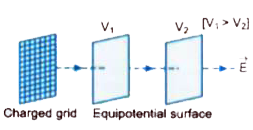
|
|
| 21. |
….. can be used to cook the food. |
|
Answer» (A) Radio |
|
| 22. |
The half life of radium is 1600 years. The mean life of radium is |
|
Answer» 800 years |
|
| 23. |
A sharp vertical impulse J is given to a uniform solid sphere ofmass m and radius R place on a rough horizontal surface. Choose the correct options |
|
Answer» Impulse imparted to the sphere by the surface perpendicular to TE suurface will also have MAGNITUDE `J` `J(4R)/5-J_(f)R=2/5mR^(2)omega` `4/5J-J_(f)=2/5mv_(cm)=2/5J_(f)` `implies4/5J=4/5J_(f)impliesJ_(f)=4/7J` `muJ t 4/7 impliesmu gt 4/7` for ROLLING 
|
|
| 24. |
Near the point plane surface of a uniformisotropicdielectricwith permittivityepsilon the electricfieldstrengthin vacumm is equalto E_(0) the vectorE_(0)formingan angle theta with the normalof thedielectric'ssurface (FIg). Assumingthe field to be uniformboth inside and outside the dielectric, Find: (a) the flux of the vector E througha sphere of radius R with centre located at the surface of the dielectric, (b) the circulation of the vector D around the closed path I' og length l (see fig) whose plane isperpendicularto the surface of the dielectricand parallel to the vector E_(0). |
Answer» Solution :From the previous problem, `sigma'= epsilon_(0) (EPSILON - 1)/(epsilon) E_(0) cos THETA`  (a) Then `oint VEC(E) . vec(dS) = (1)/(epsilon_(0)) Q = pi R^(2) E_(0) cos theta (epsilon - 1)/(epsilon)` (b) `oint vec(D) . vec(dl) = (D_(1t) - D_(2t)) t = (epsilon_(0) E_(0) sin theta- epsilon epsilon_(0) E sin theta) = -(e - 1) epsilon_(0) E_(0) l sin theta` |
|
| 25. |
Two long straight parallel conductors 10 cm apart, carry currents of 5A each in the same direction. Then the magnetic induction at a point midway between them is |
| Answer» Answer :D | |
| 26. |
The oscillating electric and magnetic field vectors of an electromagnetic waves are oriented along : |
|
Answer» MUTUALLY perpendicular directions and are in PHASE |
|
| 27. |
Referring to previous wustration, what is the time elapsed for swimming, width of the river is (1//2) km |
|
Answer» SOLUTION :Time of swimming , `t=(d)/(v_(MW)COSTHETA)` `rArr t=(1//2)/(5cos30^(2))=(1)/(10)xx(2)/(sqrt3)=(1)/(5sqrt3)HR` |
|
| 28. |
A ball of mass 2 kg and another of mass 4 kg are dropped together from a 60 ft tall building . After a fall of 30 feet each towards the earth, their respective kinetic energies will be in the ratio of |
| Answer» ANSWER :C | |
| 29. |
A dipole of moment vecp is placed in a uniform electric field vecE. The force on the dipole is vecF and the torque is vec(tau) |
|
Answer» (i), (ii) and (iii) are correct |
|
| 30. |
What do you mean by angle of minimum deviation? What a neat diagram arrive at an expression for the refractive index of the material of the prism in terms of angle of the prism and angle of minimum deviation |
| Answer» SOLUTION :DISPERSION | |
| 31. |
In the circuit shown. Initially the capacitor is uncharged. The switch S is closed at time t=0. Then |
|
Answer» `(V_(a)-V_(B))` is increasing with TIME |
|
| 32. |
When an open pipe vibrating for it's second overtone, the no. of nodes formed is |
|
Answer» 1 |
|
| 33. |
If the temperature of a perfect gas is raised from 27^@C to 327^@C, the kinetic energy of the molecule increases by a factor of |
|
Answer» 2 |
|
| 34. |
How resistors can be connected in different ways ? |
|
Answer» Solution :Resistors can be connected in three different COMBINATION. (1) Series connection of RESISTOR. (2) PARALLEL connection of resistor. (3) Mixed connection (series and parallel) |
|
| 35. |
On a hot summer night, the refractive index of air is smallest near the ground and increases with height from the ground. When a light beam is directed horizontally,the Huygen's principle leads us to conclude that as it travels, the light beam |
|
Answer» BECOMES narrower |
|
| 36. |
The potential barrier of the p-n junction depends …….. (i) On kind of semiconductor material (ii) On amount of doping (iii) On temperature |
|
Answer» Only (i) and (ii) The potential BARRIER depend on kind of semiconductor, AMOUNT of doping and temperatureit is on all THREE. [For `Si, V_(0)=0.7V`, For `Ge, V_(0)=0.3V]` |
|
| 37. |
A 500-W-200V electric kettle is used to prepare 4cups of tea How long will it take? Assume that a cup contains 250cc of water. Specific heat capacity of water 4200Jkf^(-1)K^(-1) and the initial temeprature of water 250^(@)C. Also calcuate the cost of prepare tea if 1 B.O.T. costs 35 paise. |
|
Answer» |
|
| 38. |
An open pipe of length I is sounded together with another open organ pipe of length l + x in their fundamental tones. Speed of sound in air is v. The beat frequency heard will be (x gt gt l). |
|
Answer» `(VX)/(4l^(2))` |
|
| 39. |
If mu_(a) , mu_(b) and mu_( c ) are the absolute refractive indices of three media then a^(mu) xx b^(mu)_(c) = ________ [Fill in blank]. |
|
Answer» |
|
| 40. |
A smell object Q of lengthQ of length 1mmleis along the principleaxis of a sphericalglass of radiusR = 10cm and refreactiveindex 3//2. The objectis seenfrom airalong theprincipleaxis form left. The distanceof objectfrom teh centre P is 5cm. Find thesize of image is it real, inverted? |
|
Answer» `(1)/(v) + (1)/(10) = (-1)/(10) rARr v = -20CM` (VIRTUAL) `- (n_(2))/(v^(2)) dv + (n_(1))/(u^(2)) du = 0, (1)/(400)dv = (3)/(2xx225) XX 1mm` `dv = (400)/(2xx75)mm (8)/(3)mm` `+ve,dv rArr "no inversion"` 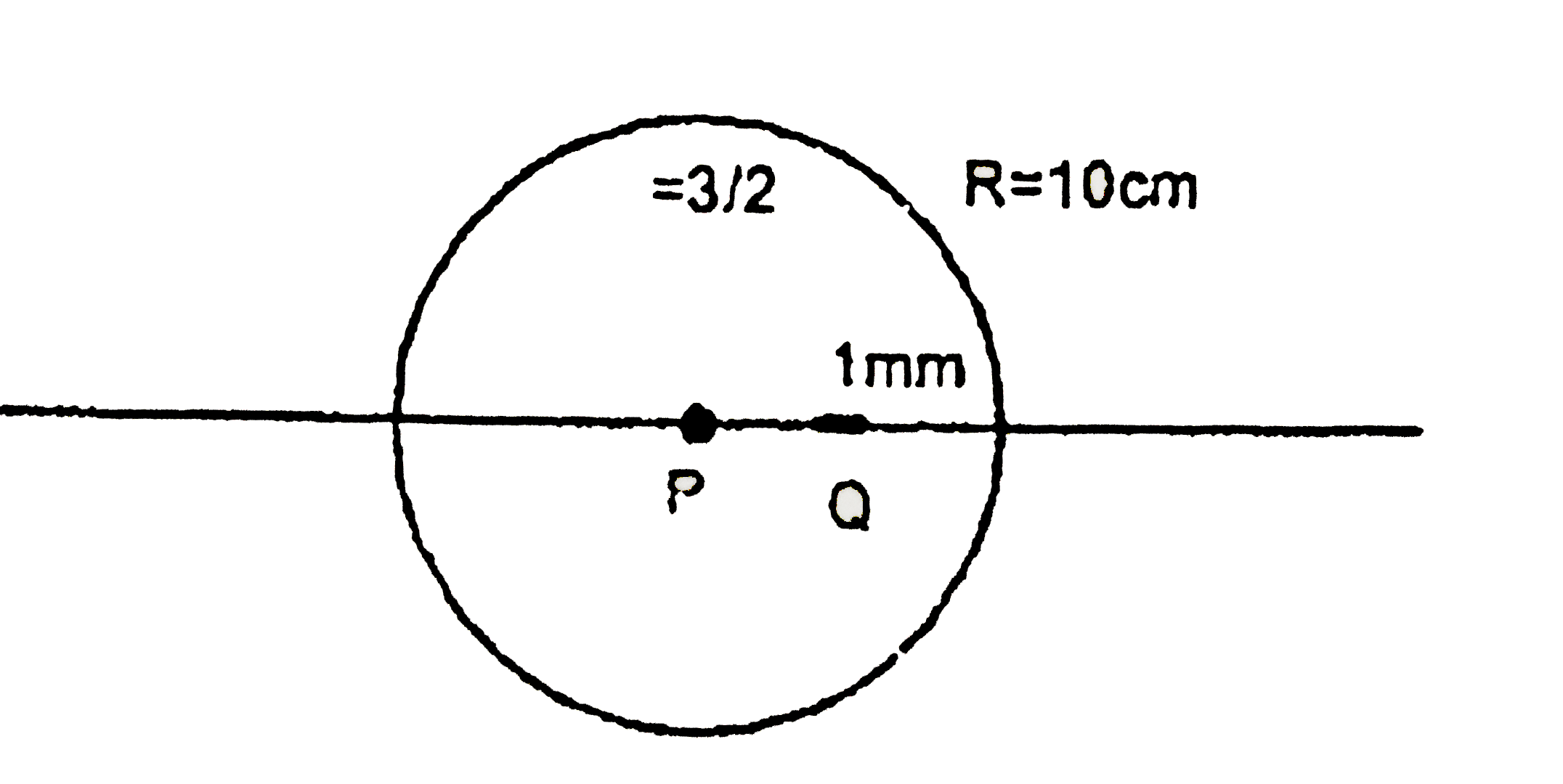
|
|
| 41. |
Three identical charges are placed at the vertices of an equilateral triangle. The force experienced by each charge, (if k = 1/4piepsi_(0)) is |
|
Answer» `2K(q^(2))/(r^(2))` |
|
| 42. |
From the above collection two bodies show amost identical field parent . a. Which are they ? b. Draw the lines of force produced by them c. Identify the cause producing the field in each . |
|
Answer» SOLUTION :a. The bar magnet and solenoid ((B) and (E)) b. 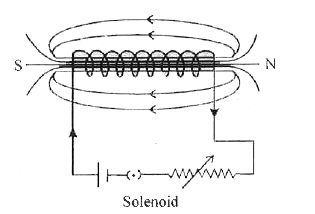 C. MOLECULAR magnets in bar magnet and current loops (the individual turns ) |
|
| 43. |
Four point +ve charges of same magnitude (Q) are placed at four corners of a rigid square frame as shown in figure. The plane of the frame is perpendicular to Z-axis. If a -ve point charge is placed at a distance z away from the above frame (z ltlt L) then |
|
Answer» `-ve` CHARGER oscillates along the Z-axis |
|
| 44. |
you are given a cell whose internal resistance is to be calculated which instrument do you use? |
| Answer» SOLUTION :POTENTIOMETER | |
| 45. |
The period of oscillation of a simple pendulum is given by T = 2pisqrt((L)/(g)), where L is the length of the pendulum and g is the acceleration due to gravity. The length is measured using a meter scale which has 500 divisions. If the measured value L is 50 cm, the accuracy in the determination of g is 1.1% and the time taken for 100 oscillations is 100 seconds, what should be the possible error in measurement of the clock in one minute (in milliseconds) ? |
|
Answer» 1 |
|
| 46. |
The energy radiated by a 100 kW transmitter in 1 hour is |
|
Answer» `36 XX 10^(7)` J |
|
| 47. |
एक गाड़ी का ओडोमीटर क्या मापता है ? |
|
Answer» चली गयी दूरी |
|
| 48. |
Define resolving power of a telescope. |
| Answer» Solution :Resolving power of a TELESCOPE is defined as the reciprocal of the SMALLEST angular separation between two distant OBJECTS so that they appear just separated (DISTINCT) when seen through the telescope. | |
| 49. |
Variation of radiant energy emitted by sun, filament of tungsten lamp and welding arc as a function of its wavelength is shown in fig : |
|
Answer» Sun- `T_(1)`, tungsten FILAMENT `T_(2)`, welding arc- `T_(3)` `:.T_(m_(3))gtT_(2)gtT_(1)"As "lamda_(m).T=` CONSTANT. Correct CHOICE is (c ). |
|
| 50. |
Define magnetic filux density ( magnetic induction ) . The magnetic induction of a point is B. What is the magnetic flux through an area A ? |
|
Answer» SOLUTION :Magnetic FLUX density : The magnetic flux passing normally through unit areaat a POINT is called magnetic flux density at that point . If `PHI` be the magnetic flux passing through the AREA .A. normally , magnetic flux density , `B = (phi)/(A) Wb// m^(2)` ( or Tesla ) `:.` magnetic flux , `phi = vecB . vecA ` W b |
|