

Saved Bookmarks
This section includes 7 InterviewSolutions, each offering curated multiple-choice questions to sharpen your Current Affairs knowledge and support exam preparation. Choose a topic below to get started.
| 1. |
A compound microscope is of magnifying power 100". The magnifying power of its eyepiece is 4. Find the magnification of its objective |
|
Answer» 25 |
|
| 2. |
Draw a plot showing the variation of de-Broglie wavelength of electron as a function of its kinetic energy . |
Answer» SOLUTION :SINCE de-Broglie wavelength `lamda=(h)/(sqrt(2mK))`, where m=mass of electron and K its kinetic energy, `lamdaprop(1)/(sqrtK)` and `lamda-K` plot is as SHOWN in figure. 
|
|
| 3. |
A circular coil with a cross-sectional area of 4cm^(2) has 10 "turns"/cm. It is placed at the centre of a long solenoid that has 15 "turns"/cm and a cross-sectional area of 10cm^(2). The axis of the coil coincides with the axis of the solenoid. What is their mutual inductance ? |
|
Answer» `7.54 MU H` |
|
| 4. |
Two protons are broughttowards each other. Will the potential energy of the system decrease or increase ? If a proton and an electron be brought nearer, then ? |
| Answer» Solution :When two protons are brought nearer, some work will be DONE up in the form of potential ENERGY. So the potential energy will increase. It should be remembered that when a proton and ELECTRON are brought NEAR each other. The potential energy will decrease. | |
| 5. |
At a certain place, Earth's magnetic field has magnitude B = 0.590 gauss and is inclined downward at an angle of 70.0° to the horizontal. A flat horizontal circular coil of wire with a radius of 10.0 cm has 1000 turns and a total resistance of 85.0 Omega. It is connected in series to a meter with 140 Omega resistance. The coil is flipped through a half revolution about a diameter, so that it is again horizontal. How much chHrge flows through the meter during the flip? |
| Answer» SOLUTION :`1.55 XX 10^(-5) C` | |
| 6. |
A liquid drops of radius R breaks up into 64 small drops of equal size. If the surface tension of the liquid is T , the work done is |
|
Answer» `5piR^2T` |
|
| 7. |
Referring to previous illustration, (a)if the width of tho giver is 0.5 km. find the displacement or the man in crossing mo hiver(b) what is the drift of the man? |
|
Answer» Solution :(a)`AC=sqrt(AB^(2)+BC^(2))` `where AB=1//2kmand BC=(AB)/(V_(mW).V_(W))` put`v_(m)=4km//hr`, `v_(mw)=sqrt(v_(m)^(2)-v_(w)^(2))=sqrt(8^(2)-4^(2))=sqr48km//hr` (b) `BC=((AB)/(V_(mw)))v_(w)=((AB)(V_(w)))/sqrt((V_(OMEGA)^(2)-v_(w)^(2)))` Put `AB=(1//2)KM`, `v_(m)=4km//hr`,`v_(m)=8km//hr`t |
|
| 8. |
प्रक्कथन : कोई वस्तु तब भी त्वरित हो सकती है, जबकि यह एक समान गति करती है| कारण : जब वस्तु की गति की दिशा बदलती है, तब उसमें त्वरण हो सकता है। |
|
Answer» प्रक्कथन और कारण दोनों सही हैं और कारण प्रक्कथन का सही स्पष्टीकरण देता है |
|
| 9. |
Obtain the first Bohr's radiusand the groundstate energy of muonichydrogen atom [i.e., an atom in whicha negatively charged (mu^(-)) of mass about 207 m_(e) orbits around a proton]. |
|
Answer» Solution :According to Bohr.s theory of hydrogen atom radius of nth orbitwill be `r_(N) = (in_(0) n^(2) h^(2))/(pi me^(2))rArr r_(n) oo (1)/(m)` `therefore ` Radius of first Bohr.s orbit for a muonic hydrogen atom . `r_(m) = (r_(e).m_(e))/(m_(m)) = (5.3 xx 10^(-11).m_(e))/(207 m_(e)) =2.56 xx 10^(-13) m` Similarly EXPRESSION for energy `E_(n) = - ( me^(4))/(8 in_(0)^(2) n^(2) h^(2))`suggests that `E_(n) prop m` `therefore ` Energyin 1 st orbit of muonichydrogen atom will be `E_(m) = (E_(e) .m_(m))/(m_(e)) =((-13.6 eV).207 m_(e))/(m_(e)) = - 2.8 xx 10^(3) eV = - 2.8 KeV` |
|
| 10. |
The scale of a galvanometer is divided into 150 equal divisions. The galvanometer has the current sensitivity of 10 divisions per mA and the voltage sensitivity of 2 divisions per m V. How the galvanometer be designed to read (i) 6A, per division and (ii) 1 V, per division? |
Answer» Solution :The resistance of galvanometer,  `G=("Full scale votage")/("Full scale current")=(75xx10^(-3))/(15xx10^(-3))=5OMEGA` For CONVERSION into ammeter of range I AMP. `(I-I_(g))S=I_(g)G` `thereforeS=(I_(g)G)/(I-I_(g))=(15xx10^(-3)xx5)/((150xx6-15xx10^(-3)))=(15xx10^(-3)xx5)/(150xx6)` `8.3xx10^(-5)` ohm For conversion into voltmeter of range V volt, `I_(g)(G+R)=V` `thereforeR=V/(I_(g))-G=150/(15xx10^(-3))-5-9995` ohm |
|
| 11. |
For electron moving with speed of 20 m/s and accelerated by 120 V p.D. de-Broglie wavelength can be easily obtained. |
|
Answer» Solution :Let stationary electron having mass m and CHARGE e is accelerated by voltage V. Kinetic energy of electron =voltage (p.d.) K=eV But `K=(1)/(2)mv^(2)` Multiplying and DIVIDING by m, `=(1)/(2)(m^(2)v^(2))/(m)` p=mV `p^(2)=m^(2)V^(2)` `THEREFORE K=(p^(2))/(2m)` `therefore p^(2)=2mK` `therefore p=SQRT(2mK)` k=eV `therefore p=sqrt(2meV)` `therefore lambda=(h)/(p)=(h)/(sqrt(2meV))` `therefore lambda=(h)/(sqrt(2meV))` Substituting value `m=9.11xx10^(-31)`,e`=1.6xx10^(-19)`, V=120 V, `h=6.625xx10^(-34)` `lambda=(6.625xx10^(-34))/(sqrt(2xx9.1xx10^(-31)xx1.6xx10^(-19)xx120))` 0.112 nm |
|
| 12. |
A film of soap solution is formed in a rectangular wire frame of length 8cm and width 4cm. Find the surface energy of the film if the S.T. of soap solution is 0.035 N/m. |
|
Answer» `2.2 XX 10^-4 J` |
|
| 13. |
A particle of mass m is located in a one dimensional potential field where potential energy is given by V(x) = A(1 - cospx), where A and p are constants. The period of small oscillations of the particle is |
|
Answer» `2pi sqrt(m/(AP))` Force, `F =-(dV)/(dt) =-d/(dx) (A-A cos px) =-Ap sinpx` For small x, `F =-Ap^(2)x` Acceleration, `a=F/m =-(Ap^(2)x)/m`.............(i) The standard equation of SHM is, `a=-omega^(2)x`...........(II) Comparing (i) and (ii), we get `omega^(2) =(Ap^(2))/m` or `omega =sqrt((Ap^(2))/m)` Periodic of OSCILLATION, `T =(2pi)/omega =2pisqrt(m/(Ap^(2))` |
|
| 14. |
The average path difference between two waves coming from third and fifth fresnel zones of a wave front at the centre of the screen is |
|
Answer» `(LAMBDA)/(2)` |
|
| 15. |
Name of a p-n junction which can be used as a voltage regulator is |
|
Answer» ZENER diode |
|
| 16. |
A spectral line of wavelength 0.59 mm is observed in the directions to the opposite edges of the solar disc along its equator.A difference in wavelength equal to (Delta lambda), 8 picometre is observed.Period of sun's revolution around its own axis will be about (Radius of sun = 6.95 xx 10^(8)m) |
|
Answer» 30 days `Deltalambda = (lambda v)/(c)` Change in WAVELENGTH at edges `= pm Deltalambda` `THEREFORE`Total change in wavelengths, `delta lambda = 2 Delta lambda = (2 lambda v)/(c)`" `therefore v = (c delatlambda)/(2 lambda)` Now `T = (2pi R)/(v)` =`(2 PI R. 2 lambda)/(c. delatlambda) = 24.8 approx 25 days` |
|
| 17. |
A beam of light of wavelength 600nm from a distant sorce falls on a single slit 1.00 mm wide and resulting diffraction pattern is observed on a screen 2 m away. The diatnce between the first dark fringes on either side of the central bright fringe is : |
|
Answer» `0.6 mm` `theta = (lambda)/(d) = 6 xx 10^(-4) m`. LINEAR half width, `y = D theta = 2 xx 6 xx 10^(-4) m` ` = 1.2 mm` |
|
| 18. |
The net external force F is doubled but the body does not move, then the force of friction F_fis |
|
Answer» `F_f=oo` |
|
| 19. |
If the nucleus of hydrogen fuses with a nucleus of lithium to form two helium nuclei, (a) write down the nuclear reaction equation (b) find the release of energy in joule per fusion (c) find the number of hydrogen atoms equired to generate 9.8 J Mass of hydrogen, lithium and helium atoms are 1.0078 amu, 7.017 amu and 4.0036 amu respectively. |
|
Answer» |
|
| 20. |
The current voltage relation of diode is given by I=(e^(1000V//T)-1) mA , where the applied voltage V is in volts and the temperature T is in degree Kelvin . If a student makes an error measuring pm0.01 V while measuring the current of 5 mA at 300K, what will be the error in the error in the value of current in mA ? |
|
Answer» 0.5 mA `impliese^(1000V/T=6)""....(1)` Again , `I=e^(1000V/T)-1` `(dI)/(DV)=e^((1000V)/T)1000/T` `dI=1000/Te^(1000/TV)dV` Using (1) , `DeltaI=100/Txx6xx0.01` `=60/T=60/(300)=0.2mA` So correct choice is (C) . |
|
| 21. |
Find the energy released when 5.5g of matter is used. |
|
Answer» `1.6 xx 10^(8) J` |
|
| 22. |
Give information about Earth's magnetism. |
|
Answer» Solution :The strength of the Earth.s magnetic field varies from place to place on the Earth.s surface. The value of magnetic field being of the ORDER of `10^(-5)` T. It was believed that the magnetic field arising from a giant bar magnet placed along the axis of rotation of the Earth and deep in the interior, but this is not the truth. The magnetic field is now thought to ARISE due to electric currents produced by convective motion of metallic fluids (consisting mostly of molten iron and nickel) in outer core of the Earth. This is known as the dynamo effect. Earth.s magnetic lines are like magnetic lines of bar magnet. The axis of the dipole does not coincides with the axis of rotation of the Earth but is presently tilted by 11.3°. The magnetic poles are located where the magnetic field lines due to the dipole enter or leave the earth. The location of the north magnetic pole is at a latitude of 79.74° Nanda longitude of 71.8° W, a place somewhere in north CANADA. The magnetic south pole is at 79.74° S, 108.22° E in the Antarctica. The pole near the geographic north pole of the Earth is called the north magnetic pole. Likewise the pole near the geographic south pole is called the south magnetic pole.  There is some confusion in the nomenclature of the poles. As shown figure, the magnetic field lines of Earth, one sees that unlike in the case of a bar magnet. (1) The field lines go into the Earth at the north magnetic pole `N_m` and (2) COME out .from the south magnetic pole `S_m`. The convention AROSE because the magnetic north pole was the direction to which the north pole of a magnet needle pointed, the north pole of a magnet was so named as it was the north seeking pole. Thus, in reality, the north magnetic pole behaves like the south pole of a bar magnet inside the earth and viceversa. |
|
| 23. |
For a CE - transistor amplifier , the audio signal voltage across the collector resistance of 2kOmega is 2 V. Suppose the current amplification factor of the transistor is 100, find the input signal voltage and base current , if the base resistance is 1 kOmega. |
|
Answer» `5 muA` `:.` voltage amplification factor `A_v=V_o/V_i=alpha(R_o)/(R_i)` `:. V_t=(V_oR_i)/(alphaR_o)=(2xx1000)/(100xx2000)=0.01V` Also , `I_b=V_i/R_i=(0.01)/(1000)=1xx10^(-5)xx10^(6)muA` `= 10 muA`. |
|
| 24. |
A thin sheet of a transparent material (mu = 1.60)is placed in the path of one of the interfering beams in a YDSE using sodium light, lamda = 5890 Å. The central fringe shifts to a position originally occupied by the 12th bright fringe. Calculate the thickness of the sheet. |
|
Answer» Solution :`Delta X = (mu - 1)t= n LAMDA` . It is given that`mu = 1.60, n = 12,lamda = 5890 Å` ` therefore t = (12 xx 5890 xx 10^(-10))/(1.60 - 1)` ` = 1.18 xx 10^(-5) m = 12mu m` |
|
| 25. |
The speed of electromagnetic wave is a medium of dielectric constant 2.25 and relative permeability 4 is: |
|
Answer» `1xx10^8m s^(-1)` |
|
| 26. |
A relativistic particle with chargeq and restmass m, moves along a circleof readiusr in a uniformmagneticfield of induction B. Find: (a) the modulus of the particl's momentum vector, (b) the kineticenergy of the particle, (c) the acceleartionof the particle. |
|
Answer» Solution :(a) As before, `p = B QR`. (b) `T = sqrt(c^(2) p^(2) + m_(0)^(2) c^(4)) = sqrt(c^(2) B^(2) Q^(2) r^(2) + m_(0)^(2) c^(4))` (c) `w = (v^(2))/(r) (c^(2))/(r[1 + (m_(0)c//Bq r)^(2)])` usingtheresultfor `v` FROMTHE previous problem. |
|
| 27. |
(A) : Si and GaAs are preferred terials for solar cells (R): Energy gap of Si is 1.1eV and that of GaAs is 1.53eV which give maximu irradiance where as other materials like CdS or CdSe(E = 0.4eV) and give minimum irradiance. |
|
Answer» Both 'A' and 'R' are true and 'R' is the CORRECT EXPLANATION of 'A' |
|
| 28. |
The work function for a certain metal is 4.2 eV. Will this metal give photoelectric emission for incident radiation of wavelength 330 nm ? |
|
Answer» Solution :Here work function `phi_(0)=4.2eV` and wavelength of RADIATION `lamda=330nm` Energy of radiation photon `E=(hc)/(lamda)=(6.63xx10^(-34)xx3xx10^(8))/(330xx10^(-9)xx1.6xx10^(-19))eV=3.767eV` As `E lt phi_(0)`, HENCE no PHOTOELECTRIC emission will take place. |
|
| 29. |
A coil having 500 square loops, each of side 10 cm, is placed normal to a magnetic field which increases at the rate of 1.0 Ts^(-1). The induced emf in volts is |
|
Answer» 0.1 |
|
| 30. |
The electric potential at a distance of 3 m on the axis of a short dipole of dipole moment 4 xx 10^(-12) coulomb-metre is |
| Answer» Answer :B | |
| 31. |
In parallel resonant circuit, the current and voltage at resonance are |
|
Answer» both MAXIMUM |
|
| 32. |
Deviation of a ray incident on a converging lens Find the point at which the first ray crosses the principal axis after refraction (Fig. 34-39). Also find its deviation. |
Answer» Solution :We can see that the two refracted rays will meet at a POINT in the focal PLANE. Since the ray passing through the 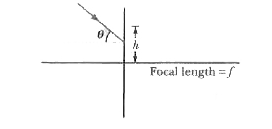 Optical center will pass undeviated, we can say that this meeting occurs at an angle of `theta` and hence at a distance `ftheta` below the focus Calculation : By the property of the similar triangles, we can say that `(h)/(X)=(ftheta)/(f-x)=phi`. Solving, we GET `x=(hf)/(h+ftheta)` and `phi=(h+ftheta)/(f)`. 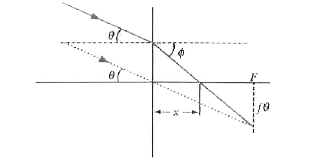 THEREFORE, the deviation is `theta-phi=(h)/(f)` |
|
| 33. |
One goes from the centre of the earth to a distance two third the radius of the earth. The acceleration due to gravity is highest at |
|
Answer» the CENTRE of the earth |
|
| 34. |
A plane electromagnetic wave of wave intensity 6 W // m^(2) strikes a small mirror of area 39 cm^(2), held perpendicular to the approaching wave. The momentum transferred in kg ms^(-1) by the wave to the mirror each second will be: |
|
Answer» <P>`1.2 XX 10^(-10)` `P=(2AI)/(C)=1.21 xx 10^(-10) kg ms^(-1)` |
|
| 35. |
Key is the position 2 for time t. Thereafter, it is in position 1. Resistance of the bulb and inductance of inductor are marked in the figure choose the figure choose the correct alternative. |
|
Answer» Bulb 2 dies as soon as key is wsitched into position 1. `i_(0)=(epsilon)/(R_(2))` Energy stored in the inductor `U=(1)/(2)Li_(0)^(2)=(1)/(2)L((epsilon)/(R_(2)))^(2)=(L epsilon^(2))/(2R_(2)^(2))` When key is in position 1, this energy will convert into heat energy through RESISTOR. |
|
| 36. |
Some hyphae are continuous tube filled with multinucleated cytoplasm. These are called |
|
Answer» Syncytial hyphae |
|
| 37. |
When a motor car is started, their lights become slight dim, Why ? |
| Answer» Solution :At START, the STARTER takes a high current and so, larger potential DROP occurs and the BULBS get dim. | |
| 38. |
If each element of set A is connected to every ement of Set B then relation is called |
|
Answer» UNIVERSAL Relation |
|
| 39. |
In uniform motion body moves with |
|
Answer» CONSTANT velocity |
|
| 40. |
A convex lens of focal length 6 cm is to be used as magnifying glass. In order to produce an erect image which is 5 times magnified, the distance between the object and the lens should be __________. |
|
Answer» Solution :Hint : Here `F=+6 cm and m=+5 =(v)/(u) rArr v=5u` `THEREFORE (1)/(v)-(1)/(u)=(1)/(f) rArr (1)/(5u)-(1)/(u)=(1)/(6) rArr -(4)/(5u)=(1)/(6) rArr u=-4.8 cm` |
|
| 41. |
An ammeter and a millimeter are converted from the same galvanometer. Out of the two, which current measuring instrument has higher resistance? |
| Answer» SOLUTION :`S=(I_Gg)/I-I_g)`. The current to be measured, I is greater in the CASE of an ammeter. So it REQUIRES a shunt resistance of SMALLER value. So MILLIMETER has higher resistance . | |
| 42. |
Give an expression for an ac driven series RLC circuit. |
|
Answer» Solution :For a series RLC circuit and for a sustained oscillation, `L(d^(2)q)/(dt^(2))+R(dq)/(dt)+(q)/(C)=v_(m)sinomegat` where, `q=q_(m)sin(omegat+theta)` and `q_(m)=(v_(m))/([L^(2)(omega_(0)^(2)-omega^(2))^(2)+omega^(2)R^(2)]^(1//2))` Note : `i_(m)=omegaq_(m)` It can also be SHOWN that `i_(m)=(v_(m))/(sqrt(R^(2)+(X_(C)-X_(L))^(2)))` where `Z=sqrt(R^(2)+(X_(C)-X_(L))^(2))`. |
|
| 43. |
In an experiment, a graph was plotted of the potential differenceVbetween the terminals of a cell against the circuit currenti by varying load rheostat. Internal conductance of the cell is given by |
| Answer» ANSWER :B | |
| 44. |
A narrow beam of plane-polarized light passes through dextrorotatory positive compound placed into a longitudinal magnetic field as shown in Fig. Find the angle through which the polarization plane of the transmitted beam will turn if the length of the tube with the componed is equal to l, the specific rotation constant of the compound is equal to alpha, the verder constant is V, and the magnetic field strength is H. |
|
Answer» Solution :We write `varphi = varphi_("chermical") + varphi_("magnetic")` We look against the transmitted beam and COUNT the positive DIRECTION clockwise. The chemical part of the rotation is annulled by reversal of wave vector upon reflection. THUS `varphi_("chermical") = alphal` SInce in effect there is a single transmission. On the other hand `varphi_(mag) =- NHVl` To get the sings right recall that rotatory compounds ROTATES the plane of vibration in a clockwise direction on looking against the oncoming beam. The sense of rotation of light vibration in Faraday effect is defined in terms of the direction of the field, positive rotation being that of a right handed screw advancing in the direction of the field. This is the opposite of the definition of `varphi_(chemical)` for the present case. Finally `varphi = (alpha - VNH)l` (Note: If plane polarized light is reflected back & both fourth through the same active medium in a magnetic field, the Faraday rotation increases with each traveresal.) |
|
| 45. |
When a motor car is started, their lights become slight dim. Why ? |
| Answer» Solution :When it is STARTED, the starter takes a high current from the battery. So a LARGE POTENTIAL drop occurs at the terminals of the battery and the bulb GETS dim. | |
| 46. |
Two small balls A and B of positive charge Q each and masses m and 2m, respectively, are connected by a non conducting light rod of length L. This system is released in a uniform electric field of strength E as shown. Just after the release (assume no other force acts on the system) |
|
Answer» rod has angular acceleration `QE//2ML` in anticlockwise DIRECTION. Resultant force on arrangement is `2QE`, thus acceleration of center of mass is given by `a_(c)=2QE//3m`. Net torque on system is `QE((2L)/(3))=QE((L)/(3))=[mxx(4L^(2))/(9)+2mxx(L^(2))/(9)]a` `a=(QE)/(2mL` (clockwise) From constraint equation, we get `a_(A)=a_(c)+a((2L)/(3))` `=(2QE)/(3m)+(QE)/(2mL)((2L)/(3))=(3QE)/(3m)=(QE)/(m)` |
|
| 47. |
A uniform spring has a centain block suspended from it and its period for vertical oscillation is T_(1). The spring is now cut into two parts of lengths (1)/(3) rd and (2)/(3) rd of original length and these springs are connected to the same block as shown in the figure. If time period of oscillation now is T_(2) " then " T_(1)//T_(2). |
| Answer» Answer :A | |
| 49. |
Draw the approximate diffraction pattern oringinating in the case of the fraunhofer diffraction from a greating consisting of three identical slits if the ratio of the grating period to the slit width is equal to (a) two, (b) three. |
|
Answer» SOLUTION :The general formula for DIFFRACTION from `N` slits is `I = I_(0) (sin^(2) alpha)/(alpha^(2))(sin^(2)N beta)/(sin^(2)beta)` where `alpha = (pi a sin theta)/(lambda)` `beta =(pi(a+b)sintheta)/(lambda)` and `N = 3` in the CASE here. (a) In this case `a + b = 2a` so `beta = 2 alpha` and `I = I_(0)(sin^(2)alpha)/(alpha^(2)) (3 - 4sin^(2)2 alpha)^(2)` (b) In this case `a + b = 3a` so `beta = 3 alpha` and `I = I_(0)(sin^(2) alpha)/(alpha^(2)) (2 -4sin^(2) 3 alpha)^(2)` This has `3` MINIMA between the principle maxima 
|
|