

Saved Bookmarks
This section includes 7 InterviewSolutions, each offering curated multiple-choice questions to sharpen your Current Affairs knowledge and support exam preparation. Choose a topic below to get started.
| 1. |
Show that the magnetic field B at a point in between the plates of a parallel plate capacitor during charging is B=(mu_(0)in_(0)r)/(2).(dE)/(dt) (symbols having usual meaning). |
Answer» Solution :Consider current `I_(d)` between plates of parallel plate capacitor.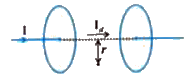 Magnetic field at perpendicular DISTANCE R from one plate of capacitor, `B=(mu_(0)I)/(2pi r)=(mu_(0))/(2pi r)I_(d)=(mu_(0))/(2pi r)xx(in_(0)(d phi_(E ))/(DT)) "" [because I_(d)=in_(0)(d phi_(E ))/(dt)]` `=(mu_(0)in_(0))/(2pi r)[(d)/(dt)(E pi r^(2))]` `=(mu_(0)in_(0))/(2pi r).pi r^(2)(dE)/(dt)` `B=(mu_(0)in_(0)r)/(2).(dE)/(dt)[because phi_(E )=EA=E xx pi r^(2)]` |
|
| 2. |
A light bulb is rated at 200W for a 230 V supply. Findthe resistance of the bulb. |
| Answer» SOLUTION :`R=264.5 OMEGA` | |
| 3. |
The intensity of a sound gets reduced by 20% on passing through two consecutive slabs is : |
|
Answer» 0.4 after passing through one SLAB `I_(1) = I - (20)/(100) I = (4I)/(5)` . after passing through `2^(nd)` slab `I_(2) = I_(2) = (4I)/(5) - (20)/(100) ((4I)/(5)) = (16 I)/(25)` . % decrease in intenity = `(I - I_(2))/(I) xx 100` = `(I - ((16 I)/(25))/(I) ) xx 100 = 36%`. HENCE, the correct CHOICE is (b). |
|
| 5. |
A thin equiconvex spherical glass lens (mu=3//2) of radius of curvature 30 cm is placed on the x-axis with its optical centre at x=40 cm and principal axis coinciding with the x-axis. A light ray given by the equation 39y=-x+1 ( x and y are is incident on the lens, in the direction of positive (in cm) X-axis. Then choose the correct alternative(s) |
|
Answer» The EQUATION of REFRACTED ray is `39y=x+1` |
|
| 6. |
Calculate the self-inductance of the coil by direct method by using the following data : {(1,1.0,1.5,0.4,1.5),(2, 1.3, 2.0, 0.6, 2.0):} Frequency of AC =50 Hz. |
|
Answer» Solution : Formula : `L = (sqrt(Z^(2)-R^(2)))/(2 PI F)` Using `R=V/I`, Calculating `R_(1) = 1.50 Omega` `R_(2)=1.54 Omega` & Mean `R = 1.52 Omega` Using `Z= V/I`, Calculating `Z_(1) = 3.75 Omega` `Z_(2)=3.33 Omega` Mean `Z=3.54 Omega` CALCULATION of `L=0.01019` H Deltailed Answer : For trial NUMBER (1) D.C. part, `R=V/I` `rArr R_(1)=(15)/(1) = 1.5 Omega` and for trial number (2) D.C. part `R_(2)=(2.0)/(1.3) = 1.54 Omega` Mean `R=(1.5+1.54)/(2) = 1.52 Omega` for A.C. part `Z_(1) = (1.5)/(0.4) = 3.75 Omega` `Z_(2)=(2.0)/(0.6) = 3.33 Omega` Mean `Z=3.54 Omega` Now `L= (sqrt(Z^(2)-R^(2)))/(2 pi f)` `rArr L = (sqrt((3.54)^(2)-(1.54)^(2)))/(2 xx 3.14 xx 50)` `L=0.01019 H`. |
|
| 8. |
A metal plate of area 1xx10^(-4)m^(2) is illuminated by a radiation 16 mW//m^(2).The work function of the metal is 5eV.The energy of the incident photons is 10 eV and only 10% of it produces photo-electrons .The number of emitted photoelectrons per second and their maximum energy respectively will be |
|
Answer» `10^(10)` and 5 eV `=16xx10^(-3)xx1xx10^(-4)xx1=16xx10^(-7)J` `impliesE. 10&` of `E=(16xx10^(-7)xx10)/(100)` `therefore E.=16xx10^(-8)J` Let number of electron emitted be n, `impliesn=(E.)/(E )=(16x10^(-8))/(10xx1.6xx10^(-19))` `therefore n=10^(11)` Maximum energy =`hv-hv_(0)` |
|
| 9. |
For metals cesium ,potassium ,sodium and lithium graph of stopping potential (V_(0))to frequency (v) is shown in figure .These graph are parallel.Arrange work function from lerger to smaller value. |
|
Answer» `(i)gt (ii)gt(iii)gt(iv)` `therefore` From GIVEN graph, `(v_(0))_(iv)gt(v_(0))_(iii)gt(v_(0))_(ii)gt(v_(0))_(i)` and WORK function W=`hv_(0)` `(W_(0))_(iv)gt(W_(0))_(iii)gt(W_(0))_(ii)gt(W_(o))_(i)` `therefore`Option (C )is true. |
|
| 10. |
In the circuit in figure there are n repetitions of the same loop. What resistance should be connected across the end points so that the equivalent resistance between a and b may be independent of n? What is this equal to? |
|
Answer» |
|
| 11. |
Nehru enjoyed the company of |
|
Answer» ANIMALS |
|
| 12. |
If delta_(1)and delta_(2)be theapparent valuesof the dip observed in two planes at right angles to each other and delta is thetrue valueof the dip then |
|
Answer» `sin^(2)DELTA=sin^(2)delta_(1)+sin^(2)delta_(2)` |
|
| 13. |
Which of the following is not a property of equipotential surfaces ? |
|
Answer» a) They do not cross each other |
|
| 15. |
A TV tower of height h can broadcast program upto a distance ( given radius of earth R ): |
|
Answer» `RH` |
|
| 16. |
The pressure at the bottom of a liquid tank is not proportional to the |
|
Answer» ACCELERATION DUE to gravity |
|
| 17. |
If red light of wavelength 6300overset@A in air has wavelength of 4200oversetA |
|
Answer» `3500overset@A` |
|
| 18. |
Which of the following combinations should be selected for better tuning of an LCR circuit used for communication ? |
|
Answer» `R=20 Omega, L=1.5 H , C=35 MUF` `Q=1/R sqrt(L/C)` where R = RESISTANCE, L = induction, C =capacitance For better tuning of an L-C-R circuit, quality factor of the circuit must be as high as POSSIBLE. For this R should be low, L should be high and C should be low. |
|
| 19. |
A man in an empty swimming pool has a telescope focussed at 4o'clock sun. When the swimming pool is filled with water, the man observes the setting sun through telescope. If sunrises and sets at 6 o'clock, then refractive index of water is |
| Answer» Answer :A | |
| 20. |
Determine the potential difference across the plates of the capacitorC_1 of the network shown in the Fig. Assume epsi_1 gt epsi_2. |
|
Answer» Solution :As `epsi_1 gt epsi_2` HENCE the net effective voltage PRESENT in the network `EPSI= epsi_1 - epsi_2`. In the network `C_1 and C_2` are joined in series, hence EQUIVALENT capacitance of the network `C = (C_1C_2)/(C_1 + C_2)`. `:.`Charge one each capacitor q `= C epsi =((C_1C_2)/(C_1 + C_2))(epsi_1 - epsi_2)` `:.` Potential DIFFERENCE across the plate of the capacitor `C_1`, is `V = q/(C_1) = (C_2/(C_1 + C_2))(epsi_1 - epsi_2)` |
|
| 21. |
A rod AB of length l = 1m and mass m = 2kg is pinned to a vertical shaft and a massless string is tied with the shaft at the lower end of the rod ( length of the string is ( 4)/( 5) m ) as shown in figure.If the shaft starts rotating with a constant angular velocity omega = 5 rad // sec. Then find the tension in the string. |
|
Answer» 1N |
|
| 22. |
The term liquid crystal refers to a state that is intermediate between |
|
Answer» CRYSTALLINE solid and amorphous liquid |
|
| 23. |
A long solenoid has a diameter of 12.0 cm. When a current i exists in its windings, a uniform magnetic field of magnitude B = 30.0 mT is produced in its interior. By decreasing i, the field is caused to decrease at the rate of 6.50 mT/s. Calculate the magnitude of the induced electric field (a) 4.20 cm and (b) 10.3 cm from the axis of the solenoid. |
| Answer» SOLUTION :(a)137 μV/m, (B) 114 μV/m | |
| 24. |
A ray of light travelling from air to glass is deviated by an angle of24^(@). If the reflectedand refractedrays are at right angles then the angles of incidence is |
|
Answer» `48^(@)` `:. 2i=90^(@)+24^(@)=114^(@) "" :. i=57^(@)` |
|
| 25. |
A wire of length L metre carrying a current of l ampere is bent in the form of a circle. Its magnitude of magnetic moment will be |
|
Answer» `(IL)/(4PI)` |
|
| 27. |
Why conductivity of conductor decreases while of semiconductor increases with increasing temperature? |
| Answer» Solution :Conductivity of a material depend on two factors Factor 1: no. of electron in conduction BAND Factor 2: COLLISION of conduction electron with core atom Factor 1 INCREASES conductivity and Factor 2 decreases. Increase in temperature causes both factor to increases. For conductor factor 2 dominates over factor 1because conduction and valence band overlapso all the ELECTRONS of valence and are ALREADY in conduction and hence there is no increase in conduction electron with temperature but collision rate of conduction electron with core atom increases resistance. For semiconductor factor 1 dominates over factor 2 As temperature increases electrons from valance band jump to conduction band. Hence, no. of electron in conduction band increases and conductivity increases | |
| 28. |
The distance between two extreme points of two wings of an Aeroplane is 50 m. It is flying at a speed of 360 km/hr in horizontal direction. If the vertical component of earth's magnetic field at that place is 2 xx 10^(-4) "Wb m"^(-2), the induced emf between these two end points is _____ V. |
|
Answer» 0.1 `=100 MS^(-1)`,l=50 m, `B=2xx10^(-4)` TESLA `THEREFORE epsilon`=Bvl `=2xx10^(-4)xx100xx50` `therefore epsilon` = 1 VOLT |
|
| 29. |
The source voltage is 9 volt and source resistance is 1kOmega The current through the silicon diode is (knee voltage of silicon is 0.7 volt): |
|
Answer» 8.3 mA Now `I=V/R=(8.3)/(10^3)=8.3xx10^(-3)=8.3mA ` |
|
| 30. |
A battery of e.m.f. 10 V and internal resistance 2 Omega is connected in primary circuit with a uniform potentiometer wire and a rheostat whose resistance is fixed at 998 Omega.A battery of unknown e.m.f. is being balanced on this potentiometer wire and balancing length is found to be 50 cm.When area of cross section of potentiometer wire is doubled, then balancing length is found to be 75 cm. (i)Calculate e.m.f. of the battery. (ii)Calculate resistivity of potentiometer wire if length of wire is 100 cm and area of cross-section (initially) is 100 cm^2. |
|
Answer» |
|
| 32. |
In the question number 33, find the wavelength of the incident light if the stopping potential is 0.6 V. |
|
Answer» 326 nm `eV_(0)=hv-phi_(0)=(hc)/(lamda)-phi_(0)""( :.v=(C)/(lamda))` or `lamda=(hc)/((eV_(0)+phi_(0)))=(1242" EV "nm)/((0.6+2.14))~~454nm` |
|
| 33. |
There are two horizontal forces on the 2.0 kg box in the overhead view of Fig. 5-43 but only one (of magnitude F_(1)=30" N") is shown. The box moves along the x axis. For each of the following values of the acceleration a_(x) of the box, find the second force in unitvector notation: (a) 10" m"//"s"^(2), (b) 20" m"//"s"^(2), (c) 0, (d) -10" m"//"s"^(2), and (e) -20" m"//"s"^(2). |
| Answer» SOLUTION :(a) `(-10N)HATI,` (B) `(10N)hati,` ( C ) `(-30N)hati,` (d) `(-50N)hati,` (E) `(-70N)hati,` | |
| 34. |
A vessel contains a liquid of refractive index (5)/(3). Inside the liquid, S is a point source which is observed from above the liquid. An opaque disc of radius 1cm is floating on the liquid such that its centre is just above the source. Atthiscircumstances liquid of the vessel is leaving gradually through a hole. What is the depth of the liquid, so that the source no more remains visible from above? |
|
Answer» Solution :Let x be the required depth obviously, at this position light rays from the source s must be incident at critical ANGLE `(theta_(C))` at the EDGE of the disc [Fig. 2.70]. `"So", "" sintheta_(c) = (1)/(sqrt(1 + x^(2)))` `"ALSO", "" sintheta_(c) = (1)/(mu) = (3)/(5)` `therefore "" (3)/(5) = (1)/(sqrt(1 + x^(2)))` `or, "" 1 + x^(2) = (25)/(9) or, x = (4)/(3) = 1.33cm` 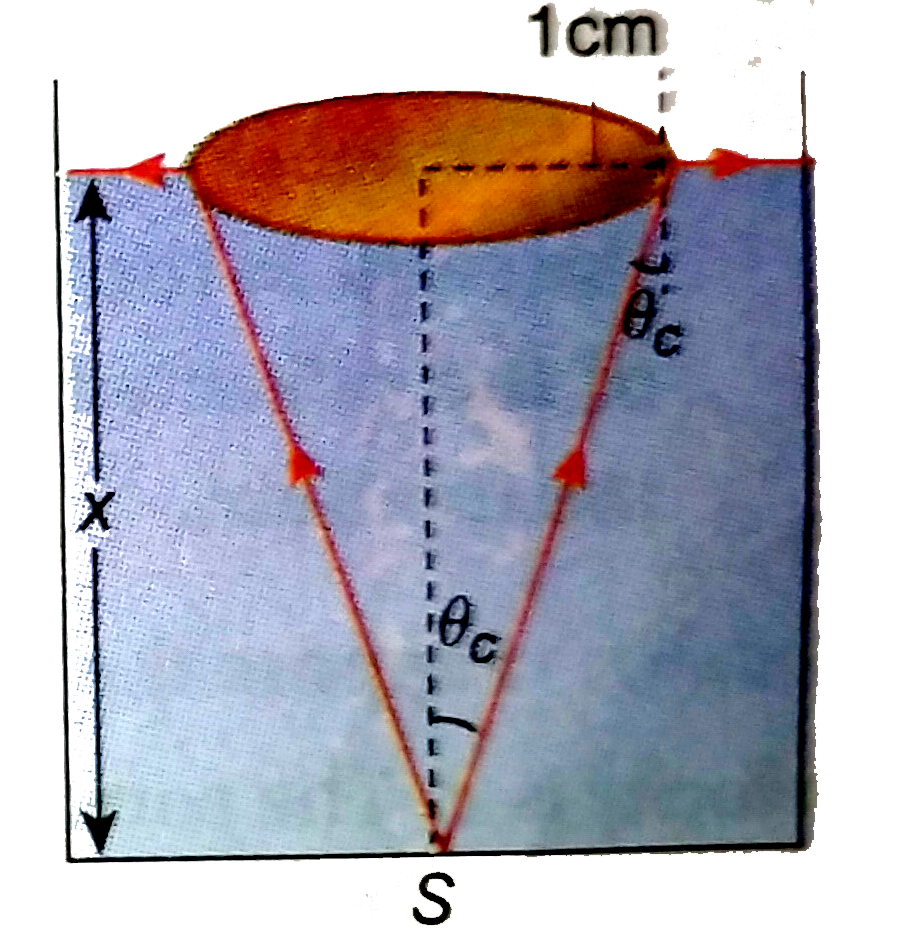
|
|
| 35. |
A particle is projected vertically upwards with a velocity given by V=sqrt(gR), where R denotes the radius of earth and 'g' the acceleration due to gravity on the surface of earth, then the maximum height ascended by the particle is : |
| Answer» Answer :C | |
| 36. |
The electric field due to a uniformly charged non-conducting sphere of radius R as a function of the distance from its centre is represented graphically by |
|
Answer»
|
|
| 37. |
An initially empty beaker, in the shape of a cylinder with cross sectional area A, is left out in th rain. The raindrops hit the beaker vertically downward with speed v. The rain continues at a constant rate, so the height of the water in the beaker h(t) increases with time t at a rate dh/dt=u, where u is small compared to v. The raindrops quickly come to rest inside the beaker, so we can neglect any kinetic energy of the water that has collected in the beaker. Let p denote the density of water (i.e., the mass per unit volume) If the beaker is placed on a weighing scale, while the beaker is wstill in the rain, the impact of the raindrops on the beaker will cause the reading on the scaleincreased by the impact of the raindrops ? (Neglect the effect of raindrops that hit the scale directily). |
|
Answer» `(pAv^(2))/(g)` m=pAh When the height changes at a rate dh/dt=w, the mass changes at the rate `(dm)/(dt)=pA(dh)/(dt)=pAu` (b) The height of the center of mass of the water in the beaker is at `y_(cm)` h/2 (at least if we ASSUME incompressible fund, i.e. a constant density, which is a very good approx imation for water). The rate at which the height of the center of mass increases is `(dy_(cm))/(dt)=(1)/(2) (dh)/(dt)=(w)/(2)` (c) The center of mass is moving upward because more water is added to the beaker.i.e. as time evolves we are talking about a whole sequence of PHYSICAL systems, not about the center of mass of a fixed given system. At any given time, the water in the beaker is at rest and hence its momentum vanishes. It is therefore incorrect to conclude that the water in the beaker has a total vertical momentum. (d) The raindrops enter the beaker with a speed v and then quickly come to rest inside the beaker. Consider a short time interval `Deltat`, and consider the system that consists of the beaker, all the water that has landed in the beaker by the beginning of the time intergval, plus the water that will come to rest inside the beaker during the time interval. During the time interval `Deltat`the height of the water in the beaker will increase by `Deltah=wDeltat`, so the volume of water that will come to rest during the time interval is `DeltaV=Adeltah=AwDeltat`, shown shaded in the diagram on the right. The mass of this water is `DeltaM=pDeltaV=pAwDeltat`. Taking the vertical direction as the y-direction, the momentum of this water at the beginning of the interval is `vecP_(i)` `=[0,-vDeltaM,0]=[0,-pAwvDeltat,0]`. The final momentum is zero, after the raindrops come rest, so `vecF_(ext)=(DeltavecP)/(Deltat)=(-vecP_(i))/(Deltat)=[0,pAw,0]` 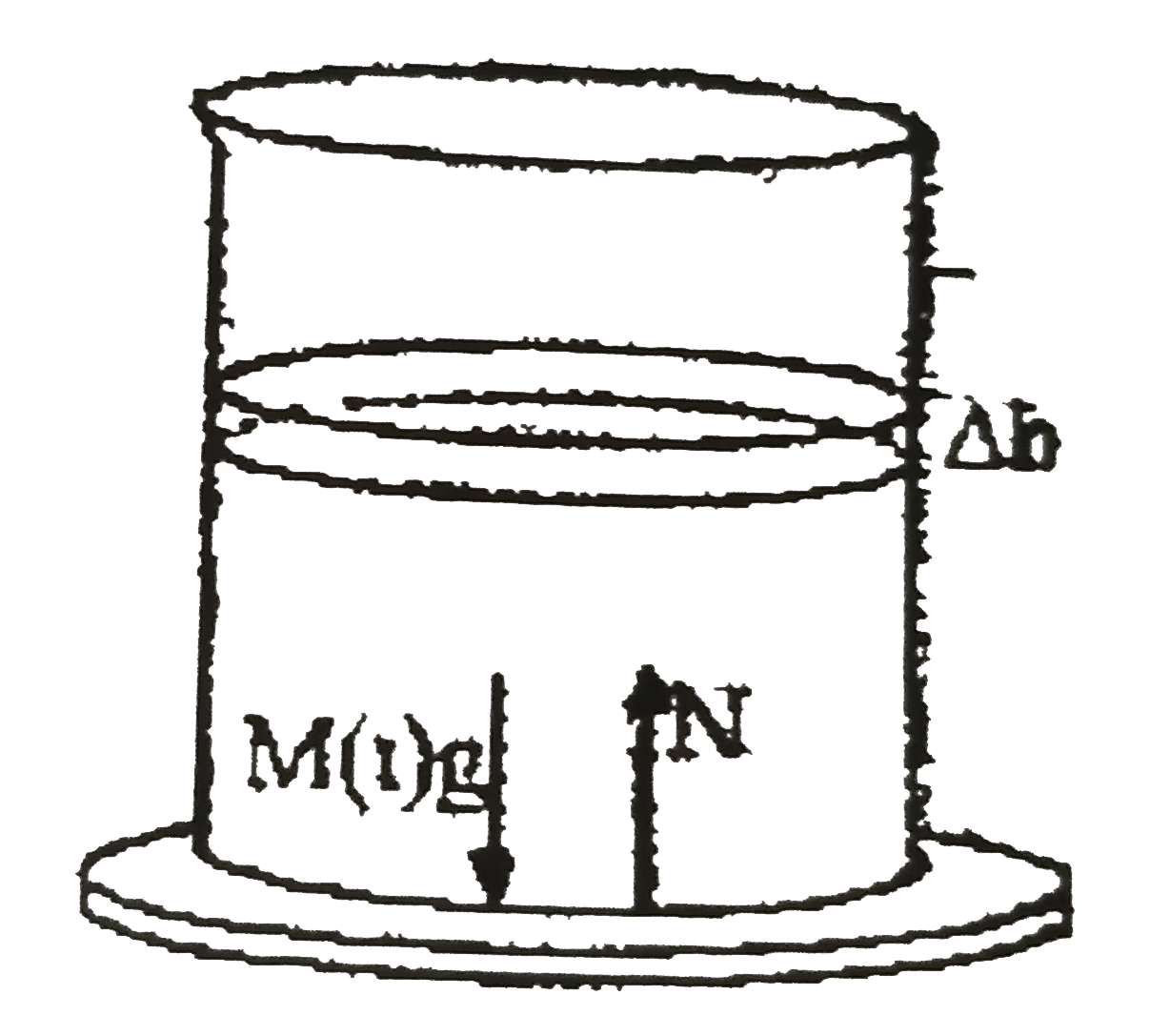 From the diagram one can see that `F_(ext)=N` M(t)g, where M(t) is the total mass of the beaker and the water in it at time t.So, N=M(t)g+pAwv By Newton's third law the beaker exerts a force of EQUAL magnitude on the scale, which detemines its reading the first term is just the weight of the system, while the question asks by how much the reading is increased by the impact of the raindrops. Thus the second term in the above expression is the answer to the question. `DeltaN=pAwv` Since, scales often read in units of mass rather than force, it would be equally CORRECT to say that the mass reading would be increased by `DeltaM=pAwv//g` |
|
| 38. |
Self induction is called the inertia of electricity why? |
| Answer» Solution :Self-inductance of a coil its property by virtue of which the coiol OPPOSES any CHANGE in the current flowing through it. It is because the induced emf PRODUCED opposes the change in current. For this REASON, self-induction is CALLED inertia of electricity. | |
| 39. |
A rays of light is incident on a thick slabof glass of thickness t as shown in figure. The emergent rayis parallel to the incident ray but displaced sideways by a distance d. If theangles are small then d is |
|
Answer» `t(1+(i)/(r))` For small ANGLES`sin(i-r) ~~i - r`, `cosr~~1` `d= t(i-r), d =` it `[1- (r)/(i)]` |
|
| 40. |
What is de Broglie hypothesis. |
| Answer» Solution :Material PARTICLES in motion DISPLAY WAVE LIKE PROPERTIES. | |
| 41. |
Match the following table. |
|
Answer» `{:(A,B,C,D),(IV,II,I,II):}` `Bto` (iii) The Stern-Gerlach experiment demonstrated that the spatial orientation of ANGULAR momentum is quantised. Due to spin MOTION of electrons, particles have non-zero MAGNETIC moment and hence they are deflected to the magnetic field gradient from a straight path. `Cto` (ii) Davission-Germer experiment demonstrates the wave nature of electrons i.e., the existence of de-Broglie matter waves. `Dto` (i) By STUDYING the tracks of cosmic ray parsitively charged particles with a mass seemingly equal to that of an electron, named positron, which suggests the existence of anti-matter. |
|
| 42. |
The wavelength of x-rays is of the order of |
| Answer» Answer :D | |
| 43. |
In an a.c. circuit average power consumed depends on the phase difference between current and voltage in the circuit. |
|
Answer» <P> |
|
| 44. |
Difference between electric field of point charge and electric field of a dipole. |
Answer» SOLUTION :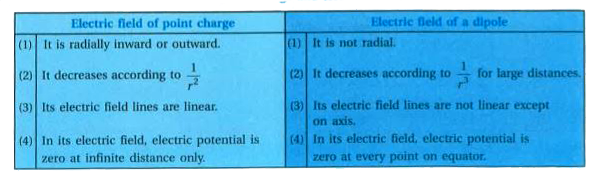
|
|
| 45. |
Youngs expriment establishes that |
|
Answer» LIGHT CONSIST of particles |
|
| 46. |
A stone is throwns horizontally from a height with a velocity v_(x)=15 m//s. Determine the normal and tangential acceleration of the stone in I second after it begins to move, |
|
Answer» Solution :The horizontal component of acceleration is ZERO. The net acceleration of the stone is DIRECTED VERTICALLY downward and is equal to the acceleration due to gravity 8. Thus`a=g= sqrt(a_(1)^(2)+a_(n)^(2))` from figure we an see that `cos theta=(v_(x))/(v)=(a_(c))/(a)=(a_(c))/(g)` and `sin theta=(v_(y))/(v)=(a_(t))/(a)=(a_(t))/(g)` Hence `a_(t)=g(v_(y))/(v)=(g^(2)t)/(sqrt(v_(x)^(2)+g^(2)t^(2)))` and `a_(c)=g(v_(x))/(v)= (gv_(x))/( sqrt(v_(x)^(2)+g^(2)t^(2)))` On SUBSTITUTING numerical values `v_(x)=15m//s anda_(a)=9.8 m//s^(2)` we get `a_(t)=5.4 m//s^(2) and a_(n)=8.2m//s^(2)` |
|
| 47. |
A circularantenna of area 3 m^(2) is installed at a place in Madurai. The plane of the area of antennais inclined at47^(@) with the direction of Earth's Magnetic field.If the magnitude of Earth's field at that place is 40773.9 nT find the magnetic flux linked with the antenna . |
|
Answer» SOLUTION :`B=40773.9 nT , theta = 90^(@) - 47^(@) = 43^(@) , A = 3m^(2)` We know that , `Phi_B= BA cos theta ` `B= 40773.9 xx 10^(-9) xx3 xx cos 43^(@) = 40.7739 xx 10^(-6) xx 3 xx 0.7314= 89. 47 xx 10^(-6) Wb` ` Phi_B= 89.47 mu ` Wb |
|
| 48. |
A particle having a mas of 10^(-2) kg carries a charge of 5 xx 10^(-8)C. The particle is given an initial horizontal velocity of 10^(5)ms^(-1) in the presence of electric . field E and magnetic field B. To keep the particle moving in a horizonmtal direction, it is necessary that 1) vecB should be perpeEdicular to the direction of velocity and vecE should be along the direction of velocity. 2) Both vecB and vecE should be along the direction of velocity 3) Both vecB and vecE are mutually perpendicular and perpendicular to the direction of velocity 4) vecB should be along the direction of velocity and vecE should be perpendicular to the direction of velocity. Which one of the following pairs of statements is possible ? |
|
Answer» (2) and (4) |
|
| 49. |
What is dielectric ? |
|
Answer» |
|
| 50. |
A football team's kicker punts the ball (mass=0.42 kg) and gives it a launch speed of 30m/s. find the impulse delivered to the football by the kicker's foot and the average force exerted by the kicker on the ball, given that the impact time is 0.0020 s. |
|
Answer» Solution :Impulse is equal to the change in linear momentum, so `J=Deltap=p_(f)-p_(i)=p_(f)=mv=(0.42kg)(30m//s)=13KG*m//s` Using the equation `overline(F)=(J)/(DELTAT)`, we find that the AVERAGE force exerted by the kicker is `overline(F)=(J)/(Deltat)=(13kg*m//s)/(2xx10^(-3)s)=6,500kg*m//s^(2)=6,500N`. |
|


