

Saved Bookmarks
This section includes 7 InterviewSolutions, each offering curated multiple-choice questions to sharpen your Current Affairs knowledge and support exam preparation. Choose a topic below to get started.
| 1. |
In Young's double slit experiment the slits are separated by 0.28mm and the screen is placed at a distance of 1.4m away from the slits. The distance between the central bright fringe and the fifth dark fringe is measured to be 1.35cm. Calculate the wavelength of the light used. Also find the fridge width if the screen is moved towards the slits by 0.4m, for the same experimental set up. |
|
Answer» Solution :Fringe width `BETA=(lambdaD)/d` Given The DISTANCE of the fifth dark fringe from the central bright fringe =1.35 cm `beta=(m-1/2)(Dlambda)/d` WAVELENGTHOF light USED `lambda=600 xx 10^(-9)`m ,m=5 Taking distance between the slits and the screen as 1m `rArr beta=(600xx10^(-9)xx9xx1)/(2xx1.35xx10^(-2)xx0.28xx10^(-3))` Calculation of fringe width = `7.142xx10^(-3)` m |
|
| 2. |
Give reasons The band gap of the semiconductor used for fabrication of visible LED's must at least be 1.8 eV. |
| Answer» Solution :The photon energy, of visible light photons VARIES from about 1.8 EV to 3 eV. HENCE for visible LED.s, the SEMICONDUCTOR must have a band GAP of 1.8 eV. | |
| 3. |
निम्नलिखित में से कौन किसी वस्तु का वास्तविक प्रतिबिंब बना सकता है |
|
Answer» काँच की समतल पट्टी (स्लैब) |
|
| 4. |
An under-water swimmer sends a sound signal to the surface. If it produces 5 beats per second when compared with the fundamental tone of a pipe of 20 cm length closed at one end, what is the wavelength of sound in water ? (v_(air) = 360 m/s and v_(water) = 1500 m/s) |
|
Answer» |
|
| 5. |
The diagram shows three cases. In all the three cases the circular part has radius r and straight ones are infinitely long . For the same current, i find barB at the centre P. |
|
Answer» Solution :a) `barB_p = (mu_0i)/(4r)odot` B) `barB_2 = B_P = 1/2 (mu_0i)/(2r) ox = (mu_0i)/(4r) ox` C) `barB_p = (3)/(4)(mu_0i)/(2r) ox + (mu_0 i)/(4pi r) odot = (mu_0)/(4)(i)/(r) (3/2 - 1/pi) ox` |
|
| 6. |
In Q No. 27 the frequency of wave is : |
|
Answer» 150 Hz `2 PI v = 314"" RARR "" v = (314)/(2 pi) = 50 `Hz. Hence the CORRECT choice is (b) . |
|
| 7. |
A uniformly charged thin spherical shell of radius R carries uniform surface charge density of sigma . It is made of two hemispherical shells, held together by pressing them with force F then F is proportional to |
|
Answer» `(1)/( in_0) sigma^2 R^2` |
|
| 8. |
What uplifted his mood? |
|
Answer» FALLING of SNOW on his shoulder |
|
| 9. |
The potential drop across 7mu F capacitor is 6V. Then |
|
Answer» POTENTIAL drop across `3 mu F` capacitor is 10V |
|
| 10. |
Figure shows a series LCR circuit connected to a variable frequency 230 V source. L = 5.0 H, C = 80 mu F, R = 40 Omega. Determine the source frequency which drives the circuit in resonance. |
|
Answer» Solution :(a) `50 rad s^(-1)` (b) `40 OMEGA, 8.1A` (c ) `V_(Lrms)=1437.5V, V_(Crms)=1437.5V, V_(Rrms)=230V` `V_(LCrms)=I_(rms)=(omega_(0)L-(1)/(omega_(0)C))=0` |
|
| 11. |
Name the latest digital communication system. |
| Answer» SOLUTION :Few system USING digital system are Fax, mobile telephone NETWORK, electronic mail (E-mail), teleconferencing, telemetry, communication satellite, GLOBAL positioning system `(GPS)`. | |
| 12. |
A wave equation which gives the displacement along the y-direction is given by : y = 10^(-4) sin (60t + 2x). Where x and y are in meter and t is time in second. This represents a wave |
|
Answer» travelling with a velocity of 30m/s in the NEGATIVE x-direction |
|
| 13. |
Three capacitors each having capacitance C=2uF are connected with a battery of emf = 30V as shown in figure. When the switch S is closed. |
|
Answer» The amount of the charge flown through the BATTERY is `20muC` |
|
| 14. |
The resistance of a coil for D.C. is in ohms. In A.C. the resistance ...... |
|
Answer» will REMAIN same |
|
| 15. |
An a.c. supply of 230 V is applied to a half-wave rectifier circuit through a transformer of turn ratio 10:1 . Find the output d.c. voltage and the peak inverse voltage. Assume the diode to be ideal. |
| Answer» SOLUTION :`I_(d.c.)=I_m/pithereforeV_(DC)=I_m/pixxR_L=V_(SM)/pi=32.53/pi=10.36V` | |
| 16. |
Light guidance in an optical fiber can be understood by considering a structure comprising of thin solid glass cylinder of refractive index n_(1) surrounded by a medium of lower refractive index n_(2) . The light guidance in the structure takes place due to successive total internal reflections at the interface of the media n_(1) and n_(2) as shown in the figure . all rays with the angle of incidence i less than a particular value of i_(m) are confined in the medium of refractive index n_(1) . The numerical aperture (NA) of the structure is defined as "sin"i_(m) If two structures of same cross - sectional area, but different numerical apertures NA_(1) and NA_(2)(NA_(2) lt NA_(1)) are joined longitudinally, the number aperture of the combined structure is |
|
Answer» `implies i_(m2) lt i_(m1)` Hence if the combination can be placed both ways i.e., `1^(ST)`STRUCTURE & then `2^(nd)` structure and then reversedalso , then the CONDITION of TIR is satisfied for lower `i_(m)` then it can satisfied for all other LESS angler as WELL. Hence `NA_(2)` will be the numerical aperture of the combined structure . |
|
| 17. |
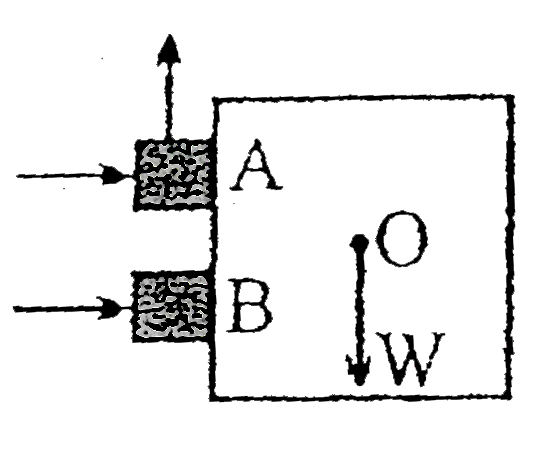
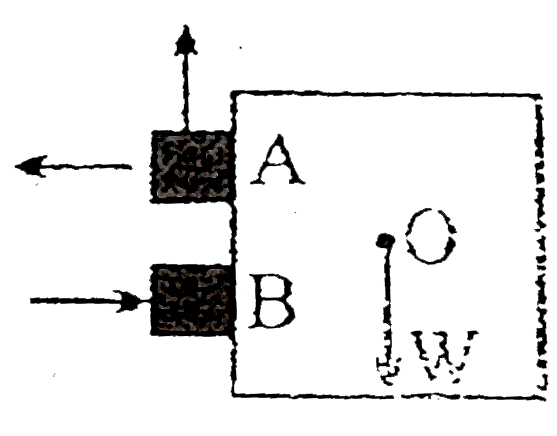
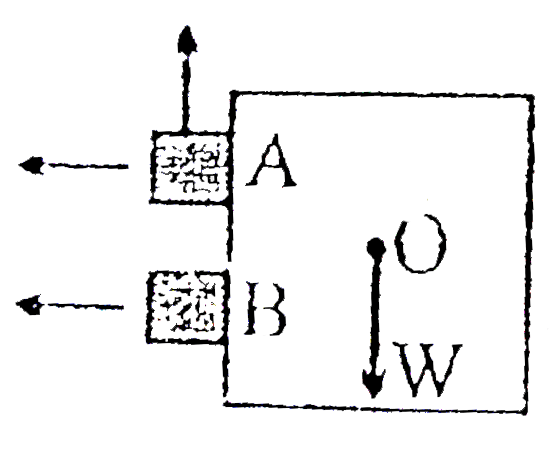
A vertical rectangular door with its centre of gravity at O (see figure) is fixed on two hinges A and B along one vertical length side of the door. The entire weight of the door is supported by the hinge A. Then the free body force diagram for the door (the arrows indicate the direction of the forces) is |
|
Answer»
|
|
| 18. |
In the figure shown PQRS is a fixed resistanceless conducting frame in a uniform and constant magnetic field of strength B. A rod EF of mass m length l and resistance R can smoothly move on this frame.A capacitor charged to a potential difference V_(0)initially is connected as shown in the figure.Find the velocity of the rod as function of time t if it is released at t=0 from rest. |
|
Answer» Applying loop law we get `q/C-iR=Blv=0` ..(1) The force on rod is `F=m(dv)/(dt)=Bil`..(2) differentiating equation (1) and (2) we get`-i/C-R(di)/(dt)-Bl(dv)/(dt)=0`...(3) From equation (2) and (3) we get `(di)/(dt)=-[(B^(2)l^(2))/(mR)+1/(RC)]i` `rArr (di)/(dt)=-Kdt`..(4) where `K=(B^(2)l^(2)C+m)/(MRC)` at `t=0 sec, q=CV_(0)` and `v=0` `therefore` from equation (1) the current at `t=0` is `i_(0)=V_(0)/R` integrating equation `underset(V_(0)//R)overset(i)int(di)/l=-K underset(0)overset(t)int dt` we get `i=V_(0)/R e^(-Kt)` from eqation (2) `(dv)=(Bl)/mi dt` or `dv=(Blv_(0))/(mR) e^(-Kt)dt` integarating the equation `underset(0)overset(v)int dv=underset(0)overset(t)int (Bl)/m V_(0)/R e^(-Kt)dt` `rArr v=(BlV_(0))/(mR)(-1/K)[e^(-Kt-e^(0))]=(BlV_(0))/(mRK)[1-e^(-Kt)]` By substituting `K` we get `v=(BlCB_(0))/(m+B^(2)l^(2)C)(1-e^(((B^(2)l^(2))/(mR) 1/(RC))t))` 
|
|
| 19. |
Light guidance in an optical fiber can be understood by considering a structure comprising of thin solid glass cylinder of refractive index n_(1) surrounded by a medium of lower refractive index n_(2) . The light guidance in the structure takes place due to successive total internal reflections at the interface of the media n_(1) and n_(2) as shown in the figure . all rays with the angle of incidence i less than a particular value of i_(m) are confined in the medium of refractive index n_(1) . The numerical aperture (NA) of the structure is defined as "sin"i_(m) For two structures namely S_(1) with n_(1) = sqrt(45) //4 "and" n_(2) = 3//2 , "and" S_(2) with n_(1) = 8//5 "and" n_(2) = 7//5 and taking the refractive index of water to be 4/3 and that of air to be 1 , the correct option (s) is (are) |
|
Answer» NA of `S_(1)` IMMERSED in water is the same as that of `S_(2)` immersed in liquid of REFRACTIVE index `(4)/(sqrt(5))` nsini = `n_(1) "sin"(90- theta)` ` " n sini" = n_(1) "cos" theta …..(i)` Here for `i_(m) , theta = C "and " "sin" C = (n_(2))/(n_(1))` fromeq. (i) , `n"sin"i_(m)= n_(1) sqrt((1 - n_(0)^(2))/(n_(1)^(2))) = sqrt(n_(1)^(2) - n_(2)^(2))` `implies "sin"i_(m) = sqrt(n_(1)^(2) - n_(2)^(2))/(n)` Now , for (A) `(NA)_(s_(1)) = (3)/(4)sqrt((45)/(16) - (9)/(4)) = (3)/(4) xx (3)/(4) = (9)/(16)` `(NA)_(s_(2)) = (3sqrt(15))/(16) sqrt(64)/(25) - (49)/(25)) = (3sqrt(15))/(16) (1)/(5)sqrt(15) = (9)/(16)` For (B) `(NA)_(s_(1)) = sqrt(15)/(6) xx (3)/(4) = sqrt((15))/(8)` `(NA)_(s_(2)) = (3)/(4) = sqrt(15)/(5)` Not equal For (C) `""(NA)_(s_(1)) = 1 xx (3)/(4) = (3)/(4)` `(NA)_(s_(2)) = sqrt(15)/(4) xx sqrt((15))/(5) = (15)/(4 xx 5) = (3)/(4)` For (D) `""(NA)_(s_(1)) = (3)/(4)` `(NA)_(s_(2)) = (3)/(4) sqrt(15)/(5)` Not equal |
|
| 20. |
Find the time taken by light to travel a distance of 3 cm in glass. (c = 3 xx 10^8 m//s and refractive index of water = 4/3) |
| Answer» SOLUTION :`0.13 NS` | |
| 21. |
Two cells of emf 3V and 2V and internal resistances 1.5Omega and 1Omega respectively are connected in parallel across a 3Omega resistor such that they tend to send current through the resistor in the same direction . Calculate the potential differences across the 3Omega resistor . |
|
Answer» Solution :`E_1=3V " " E_2=2V , "" r_1=1.5Omega "" r_2=1Omega ""R=3Omega` Equivalent internal resistance of the combination, `r_(eq)=(r_1r_2)/(r_1+r_2)=(1.5xx1)/(1.5+1)=0.6Omega` Equivalent emf of the combination, `E_(eqv)/r_(eq)=E_1/r_1+E_2/r_2 , E_(eqv)/0.6=3/1.5+2/1, E_(eq)`=2.4 V CURRENT through the `3Omega` resistor `I=E_(eq)/(R+r_(eq))=2.4/(3+0.6)` `I=2/3A` Potential DIFFERENCES across `3Omega` resistor `V=IR=(2//3)(3)=2V` |
|
| 22. |
A quantity x is given by espilon_(0)L(DeltaV)/(Deltat) where espilon_(0) is permittivity of free space L is length, DeltaV is a potential difference and Deltat is the time interval. The dimensional formula for x is the same as that of : |
|
Answer» resistance `=(q)/(V)xx(DeltaV)/(Deltat)=(q)/(Deltat)( :.C=(epsilon_(0)A)/(d))` Current. HENCE correct choice is `(d)`. |
|
| 23. |
In nuclear reaction ._2He^4 + ._ZX^A to ._(Z+2)Y^(A+3)+R,R denotes |
|
Answer» electron |
|
| 24. |
A ray of light is incident on a surface of glass slab at an angle 45^(@). If the lateral shift produced per unit thickness is (1)/(sqrt(3))m, the angle of refraction prduced is : |
|
Answer» `ta^(-1)((SQRT(3))/(2))`  `("lateral SHIFT"(d))/("thickness of glass slab")=(1)/(sqrt(3))` Angle of refraction, r = ? `d=(tsindelta)/(cosr)=(TSIN(i-r))/(cosr)rArr(d)/(t)=(sin(i-r))/(cosr)` `therefore(d)/(t)=(sinicosr-cosisinr)/(cosr)=sini-cositanr` Substituting the values of the given quantities, we get `(1)/(sqrt(3)) = sin 45^(@) - cos45^(@) tan r` `(1)/(sqrt(3))=(1)/(sqrt(2))(1-tanr)rArr=tan^(-1)(1-sqrt((2)/(3)))` |
|
| 25. |
Figure shows the initial position of a system of two particles. Given that centre of mass of the system remains at rest particle A moves i a trajectory givenn by (x^(2))/(a^(2))+(y^(2))/(b^(2))=1 Pick the correct option (s) for the nature of B's trajectory and the coordinates of B at the instant when A was at the position (0,b). |
|
Answer» Trajectory of `B` is elliptical `(2my_(B)+my_(A))/(3m)=0impliesy_(A)=2y_(B)` Trajectory of `B` is `((a-2x)^(2))/(a^(2))+((2y)^(2))/(b^(2))=1` |
|
| 26. |
In a certainregion of the inertial reference framethere ismagneticfield with induction B rotatingwith angluar velocity omega. Findgrad xx E in thisregionas a function of vectorsomega and B |
|
Answer» Solution :A ROTATING MAGNETICFIELD can be REPRESENTED by, `B_(x) = B_(0) cos omega t, B_(y) = B_(0) sin omega t` and`B_(x) = B_(zo)` Thencurl, `vec(E) = - (DEL vec(B))/(del t)`, So,`-(Curl vec(E))_(x) = -omega B_(0) sin omega t = -omega B_(y)` `-(Curl vec(E))_(y) = omega B_(0) cos omega t = omega B_(x)`, and `-(Curl vec(E))_(x) = 0` HENCE, Curl `vec(E) = -vec(omega) xx vec(B)`, where, `vec(omega) = vec(e_(3))omega`. |
|
| 27. |
In this figure the equivalent capacitance between A and B will be |
| Answer» ANSWER :C | |
| 28. |
निम्न में से कौन एकपदीय बहुपद हैं ? |
|
Answer» `x^3+2x^2+3x-1` |
|
| 29. |
The maximum velocities of the photoelectrons ejected are v and 2v for the incident light of wavelength 400 nm and 250 nm on a metal surface respectively. The work function of the metal in terms of Planck's constant h and velocity of light c is |
|
Answer» a. `HC xx 10^(6)J` |
|
| 30. |
An ideal choke draws a current of 8A when connected to an AC supply of 100 V, 50 Hz. A pureresistor draws a current of 10 A when connected to the same source. The ideal choke and the resistorare connected in series and then connected to the AC source of 150 V, 40 Hz. The current in thecircuit becomes : R=(100)/(10)=10 Omega X_(L)=(100)/(8)=12.5=2pi fL |
|
Answer» `=(15)/(sqrt(2))A` `X_(L)=(100)/(8)=12.5=2pi FL` `L=0.04 H` `X'_(L)=2pi f'L = 10 Omega` `Z'=sqrt(R^(2)+X'_(L)^(2))=10 sqrt(2)Omega` `I=(150)/(10sqrt(2))=(15)/(sqrt(2))A` |
|
| 31. |
A diver springs upward from a board that is three meters above the water. At the instant she contacts the water her speed is 8.90 m/s and her body makes an angle of 75.0^(@) with respect to the horizontal surface of the water. Determine her initial velocity, both magnitude and direction. |
|
Answer» `4.52m//s,59.4^(@)` |
|
| 32. |
An element Delta I = Delta x overset(^)(i)is placed at the origin and carries a large current I = 10A. What is the magnetic field on the y-axis at a distance of 0.5 m. Deltax = 1 cm. |
|
Answer» Solution :From Biot-Savart's Law, `|bar(d BETA)| = 1 dl sin theta//R^2` `dI = Delta X = 1 CM = 10^(-2) m, I = 10 A, r= y = 0.5 m` `mu_(0)/ 4pi = 10^(-7) Tm//A, theta = 90^@` so sin `theta=1` `|bar(d B)| = (10^(-7) xx 10xx10^(-2))/(25 xx 10^(-2)) = 4 xx 10^(-8)` T along + z axis |
|
| 33. |
A single pole doesn't exist . Why ? |
| Answer» Solution :In a MAGNET there are number of ATOMIC MAGNETS arranded along a line. Each atomic magnet has TWO poles . So a single pole can .t exist . | |
| 34. |
An electric dipole consists of two opposite charges of magnitude 1 mu C separated by a distance of 2cm. The dipole is placed in an electric filed 10^(-5) Vm^(-1). The maximum torque does the field exert on the dipole is |
|
Answer» `10^(-3)NM` |
|
| 35. |
If y = 2 (cm) sin[(pi t)/(2)+phi] then the maximum acceleration of the particle doing the S.H.M. is |
|
Answer» `(PI)/(2)"cm"//"s"^(2)` `a=(d^(2)y)/(dt)=-(pi^(2))/(2)sin((pi t)/(2)+phi)impliesa_("MAX")=(pi^(2))/(2)` |
|
| 36. |
A battery of e.m.f.2 volt is applied across the block of a semiconductor of length 0.1 m and area of cross section 1xx 10^(-4)m^(2) . If the block is of intrinsic silicon at 300 K, find the magnitude of the total current. What will be the order of magnitude of total current if germanium is used instead of silicon? Given that for Si at 300K mu_(e)=0.135 m^(2)vV^(-1)s^(-1),mu_(h)=0.048 m^(2)V^(-1)s^(-1) intrinsic carrier concentration n_(i)=1.5xx10^(16)m^(-3) For Ge at 300 K mu_(e)=0.39m^(2)V^(-1)s^(-1) mu_(h)=0.19m^(2)V^(-1)s^(-1),n_(1)=2.4xx10^(19)m^(-3) |
|
Answer» SOLUTION :For silicon Total current ,I=eA `(n_(e)v_(e)+n_(h)V_(h))` Since ,drift velocity `v_(e)=mu_(e)E` and `v_(h)=mu_(h).E` Where `E=(V)/(l) therefore `Total current . I=eA `(n_(e)Emu_(e)+n_(h)Emu_(h))=eA(n_(e)mu_(e)+n_(h)mu_(h))(V)/(l)` Where `n_(1)=n_(e)=n_(h)` for intrinsic semiconductor Substituting values for silicon :`I=8.7800xx10^(-7)A` and for Gernanium :`I=4.46xx10^(-3)A` the magnitude of current in Ge is `10^(4)` times higher than that in Si. |
|
| 37. |
A dipole of dipole moment 'p' is placed in nonuniform electric field along x-axis. Electric field is increasing at the rate of 1 Vm^(-1) then the force on dipole is |
| Answer» ANSWER :D | |
| 38. |
The normal component of the velocity of projectile projected from the bottom of an inclined plane remains unchanged in magnitude when it lands on the plane. |
|
Answer» |
|
| 39. |
When you look at the North Star (Polaris), you intercept ligllt from a star at a distance of 431 ly and emitting energy at a rate of 2.2 xx10^(3) times that of our Sun (P_("sun" ) = 3.90xx10^(26) W. Neglecting any atmospheric absorption, find the ans values of the electric and magnetic fields when the starlight reaches you. |
|
Answer» Solution :(1) The rms value `E_(rms)`of the electric field in light is related 10 the intensity I of the light via Eq. 32-28 `(I= E_("rms")^(2) //cmu_(0))` . (2) Because the source is so far away and emits light with equal intensity in all directions, the intensity lat any distance r from the source is related to the source.s power `P_(x) ` via Eq. 32-29 `(I=P_(3)//4pir^(2)`). (3)The magnitudes of the electric field and MAGNETIC lleld of an electromagnetic wave at any instant and al any point in the wave are related by the speed of Light c ACCORDING to Eq. 32-5 (E/B = c). Thus, therms values of those fields are also related by Eq. 32-5. Electric field: Putting the first two ideas together gives us `I = (P_(s))/(4pir^(2))=(E_("rms")^(2))/(cmu_(0))` `E_("rms")= sqrt((P_(s)cmu_(0))/(4pir^(2)))` By substituting `P_(s)= (2.2xx10^(3))(3.90xx10^(26)W)` r= 431 1y= `4.08xx10^(18)`m and values for the constants we find `E_("rms") = 1.24xx10^(-3) V//m~~1.2 m ` V/m . ( Answer) Magnetic field : From Eq . 32-5 we wirte `B_(rms) = (E_(rms))/(c ) = (1.24xx10^(-3)V//m)/(3.00xx10^(8)m//s)` . Cannot compare the fields: Note that `E_(rms)`(= 1.2 mV/m) is smaJl as JUDGED by ordinary LABORATORY standards, but `B_(rms)(=4.1P T)` , (= 4.1 pT) is quite smalJ. This difference helps to explain why most instruments used for the detection and measurement of electromagnetic waves are designed to respond to the electric component. It is wrong, however, to say that the electric component of an electromagnetic wave is "stronger" than the magnetic component. You cannot compare quantities that are measured in different units. However, these electric and magnetic components are on an equal basis because their average energies, which can be compared, are equal. |
|
| 40. |
A parallel plate capacitor of area of 50 cm^2 and plate separation 3.0mm is charged initially to 80muc. Due to a radioactive source nearby, the medium between the plates gets lightly conducting and the plate loses the charge initially at the rate of 1.5xx10^-8Cs^-1 (i) What is the megnitude and direction of displacement current ? (ii) What is the magnetic field between the plates? |
|
Answer» SOLUTION :Conduction current within the plates is from the positive plate to negative plate of parallel plate capacitor. (i) Displacement current, `I_D=in_0 (dphi_E)/(dt)=in_0d/(dt) (EA)=in_0A(dE)/(dt)` `=in_0A d/(dt)(q/(in_0A))=in_0A1/(in_0A) (dq)/(dt)` or `I_D=(dq)/(dt)=1.5xx10^-18A` Since charge is DECREASING with time, so `(dq)/(dt)` and hence `(dE)/(dt)lt0`. It shows that the direction of `I_D` is opposite to that of electric field and hence opposite to the conduction current. But the magnitude of displacement current is same as that of conduction current. The net current between the plates is zero. So total current, `I'=I+I_D=0` (ii) USING Ampere's LAW, `ointvecB.vec(dl)=mu_0I'=0` Hence magnetic field within the plates is zero. |
|
| 41. |
In a Young's double-slit experiment, the slit separation is 0.2 mm and the distance between the screen and double-slit is 1.0 m. wavelength of light used is 5000 Å. The distance between two consecutive dark fringes is |
|
Answer» 2.5 mm `therefore`Distance between two CONSECUTIVE dark FRINGES`=BETA=(lamdaD)/(d)=(5000xx10^(-10)xx1.0)/(0.2xx10^(-3))` `=2.5xx10^(-3)=2.5mm` |
|
| 42. |
When a magnetic field is applied in a direction perpendicular to the direction of cathode rays, then their |
|
Answer» ENERGY decreases |
|
| 43. |
What are de Broglie waves. What he explained about vthe nature of the waves ? |
| Answer» Solution :The waves associated with material particles are CALLED matter waves or de Broglie waves . They are seen with particles like electrons , protons, neutrons , dutrons etc. It is PROVED that RADIATION can have two forms (i) wave FORM (ii) PARTICLE form. If radiation can take two forms, then matter can have also two forms. | |
| 44. |
Three of the quantities defined below has the same dimensional formula. Identify the (i) sqrt("Energy/ mass") (ii) sqrt("pressure /density") (iii) sqrt("force / linear density") (iv)sqrt("angular frequency/radius") |
| Answer» Answer :D | |
| 45. |
If a ball of steel ( density p = 7.8 g cm^(-3)) attains terminal velocity of 10 cm s^(-1) when falling in a water ( coefficient of viscosity eta_("water") = 8.5 xx 10^(-4) Pa.s) then its terminal velocity in glycerine (p = 1.2 g cm^(-3) , eta = 13.2 Pa.s) would be, nearly : |
|
Answer» `6.25xx10^(-4)cms^(-1)` `Vg(p-p-(l))=6pietarv` `Vg(p-p_(l))=6pieta^(1)rv^(1)` `V^(1)ETA^(1)=((p-p_(l)^(1)))/((p-p_(l)))xxveta` `V^(1)=((p-p_(l)^(1)))/((p-p_(l)))xx(veta)/(eta^(1))` `=((7.8-1.2))/((7.8-1))xx(10xx8.5xx10^(-4))/(13.2)` `V^(1)=6.25xx19^(-4)cm`/s CORRECT choice is (a) |
|
| 46. |
When a rolling body enters onto a smooth horizontal surface, it will |
|
Answer» CONTINUE ROLLING |
|
| 47. |
A radiactive isotope of ""^(197)Hg decays into ""^(197)Au with a decay constant 0.0108 per hour. Calculate the half life. What amount of the sample will remain at the end of a. three half-lives b. 10 days . |
|
Answer» |
|
| 48. |
In Young.s double slit experiment, slits are separated by 2 mm and the screen is placed at a distance of 1.2 m from the slits. Light consisting of two wavelengths 6500Å and 5200Å are used to obtain interference fringes. Then the separation between the fourth bright fringes of two different patterns produced by the two wavelengths is |
|
Answer» 0.312 mm `x_(1)-x_(2)=(4D)/d(lamda_(1)-lamda_(2))` = `(4xx1.2)/(2XX10^(-3))(6500-5200)xx10^(-10)` = `0.312xx10^(-3)m` = 0.312mm |
|
| 49. |
Figure shows three circular ars, each of radis R and total charge as indicated. The net electric potential at the centre of curvature is : |
|
Answer» `(Q)/(2piepsilon_(0)R)` |
|
| 50. |
Two short bar magnets have magnetic moments 1.20 " Am"^(2) and 1.00 " Am"^(2) , respectively . They are kept on a horizontal table parallelto each other with their north polespointing towards the south . They have a common magnetic equator and are separated by a distance of 20.0 cm. The value of the resultant horizontal magnetic induction at the midpoint O of the line joiningtheir centers is ( Horizontal components of Earth's magnetic induction is 3.6 xx 10^(-5) Wbm^(-2)). |
|
Answer» `3.60 XX 10^(-5) Wb m^(-2)` |
|
3</p>Solution :Because of the W of door tries to rotate it clockwise, so, to oppose this normal at hinges produces anticlockwise torque.)