

Saved Bookmarks
This section includes 7 InterviewSolutions, each offering curated multiple-choice questions to sharpen your Current Affairs knowledge and support exam preparation. Choose a topic below to get started.
| 1. |
Two point charges - q and + q are located points (0,0, alpha) and (0,0, alpha) respectively. The electric potential at a point 0,0,z, where gt alpha is |
|
Answer» `(qalpha)/(4piin_(0)z^(2))` |
|
| 2. |
Inductive reactance. |
|
Answer» SOLUTION :It is the opposition offered by an INDUCTOR to the flow of current ` X_L = OMEGA L` `omega`- angular frequency. L - Self inductance. |
|
| 3. |
An object viewed by a person in water is at 3 m height in air, then real height of object is ...... |
|
Answer» 4 m |
|
| 4. |
Explain how a moving - coil galvanometer is converted into a voltmeter . Derive the necessary formula. |
Answer» Solution :A moving - coil galvanometr is converted into a voltmeter by increasing its effective resistance by connecting a high resistance `R_(s)` in series with the galvanometer,as shown . The series resistance is also USEFUL for changing therange of any given voltmeter.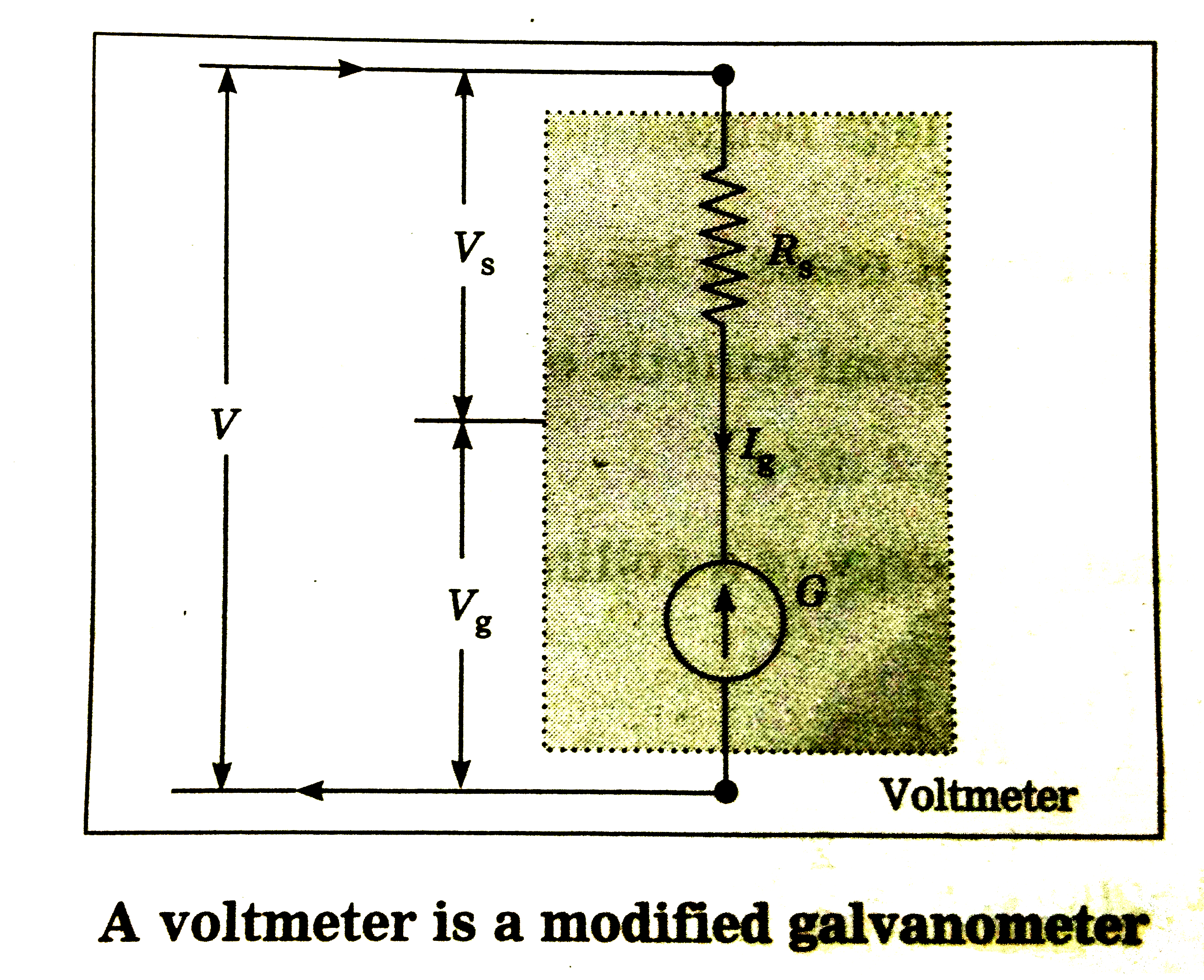 Let G be the resistance of the galvanometer coil and `I_(s)` be the current required for full - scale deflection. Let V bethemaximum p. d. tobe measured. THEVALUE of theseries resistance `R_(s)` should besuch that when the p.d. applied across theinstrument is V, the current through the galvanometer is `I_(g)`. In HTE series combination,thep.d. V gets DIVIDED across thegalvanometer ( resistance, G) and the resistance ` R_(s)` : ` V = I_(g) G + I_(g)R_(s) =I_(g)(G+R_(s))` ` :. R_(s) = V/I_(s) - G` This gives the required value of theseries resistance. Thescale of the galvanometer is then calibrated so as to READ thepotential difference in vot or its submultiples directly. |
|
| 5. |
Calculate the magnetic field inside a solenold ,when (a) The length of the solenoid becomes twice and fixed number of turns (b) both the length of the solenoid and number of turns are double (c ) the number of turns becomes twice for the fixed length of the solenoid compare the results, |
|
Answer» Solution :The MAGNETIC field of a solenoid (inside ) is `B_(L.N) = mu_(0) (NI)/(L)` (a) length of the solenoid becomes TWICE and FIXED number of turns L `rarr`2L (length becomes twice ) N `rarr` N(number of turns are fixed ) The magnetic field is `B_(2 L,N) = mu_(0) (NI)/(2L) = (1)/(2) B_(L,N)` (b) both the length of the solenoid and number of turns are double L `rarr` 2L (length becomes twice ) N `rarr` 2N ( number of turns becomes twice ) The magnetic field is `B_(2L,2N) = mu_(0) (2NI)/(2L) = B_(L,N)` ( c) the number of turns becomes twice but for the fixed lenght of the solenoid . L `rarr` L (length is fixed ) N `rarr` 2N ( number of turns becomes twices ) the magnetic field is `B_(L,2N) = mu_(0) (2NI)/(L) = 2B_(L,N)` From the above results , `B_(2L,2N) gt B_(2L,2N) gt B_(2L,N)` THUS, strength of the magnetic field is increased when we PACK more loops into the same length for a given current. |
|
| 6. |
What do you mean by sentiveness of a Wheatstonebridge ? |
| Answer» Solution :A WHEATSTONE bridge is said to be SENSITIVE if it shows large DEFLECTION in the galvanometer when ever a small change in RESISTANCE is taking PLACE is resistance arm. | |
| 7. |
Determine the electrostatic potential energy of a system consisting of two charges 6 muC and - 3 muC (and with no external field) placed at (-9 cm, 0, 0) and (9 cm, 0, 0) respectively. |
| Answer» SOLUTION :`U =- 0.7 J` | |
| 8. |
A concave mirror produces a virtual image when the object is |
| Answer» Answer :D | |
| 9. |
M and Msqrt(3) are the magnetic dipole moments of the two magnets which are joined to form a cross figurre the inclination of the systemwith the fiedl if theircombination is suspended freelyin a uniform external magnetic field B is |
|
Answer» `theta=30^(@)` MB `SIN theta =sqrt(3)` MB sin `(90^(@)-theta)` `therefore tan theta =sqrt(3) rarr theta =60^(@)` |
|
| 10. |
A galvanometer vaving 50 divisions provided with a variable shunt S is used to measure the current when conneted in series with a resistance of 90 Omega and a battery of internal resistance 10 Omega. It is observed that when the snt resistaces are 10 Omega & 70 Omega respectively, the deflection are respectively 9 and 30 dividions. What is the resistance of the galvanometer ? Further, if the full scale deflection of the galvanometer movement require 200 mA. find the emf of the cell. |
|
Answer» |
|
| 11. |
The unit of pole strength of magnet is ….. (where Q is charge and v is velocity ) |
|
Answer» SOLUTION :`Q_(v) = (Q)/( t) xx vt` `= Id` [ where d is distance ] unit = Am, which the unit of POLE strength |
|
| 12. |
A train wagon is attached to the engine through a shock absorber 1.5 m long the system having a total mass of 5 x 10⁴ kg is going at a speed of 36 km/h. Suddenly the brakes are applied to bring them to rest. In the process of coming to rest, the spring of the shock absorber gets compressed by 1 metre. If only 90% energy of the wagon is lost due to friction. What is spring constant of spring? |
|
Answer» `5xx10^(4)` N/m `v=36xx(5)/(18)=10 ms^(-1)` `:.` K.E. of system =`1//2 Mv^2` `E_k=1/2xx5xx10^4xx10^2` =`2.5xx10^6 J` Now 90% of this is LOST DUE to friction.10% of this is used for compressing the spring i.e. `1/2kx^2=(2.5xx10^6xx10)/(100)` =`2.5xx10^5 J` or`1/2xxkx(1)^2=2.5xx10^5` `:. K=5xx10^5 N//m` |
|
| 13. |
A thin pipe having outside diameter of 3 cm is to be covered with two layers of insulation each having thickness of 2.5 cm. The thermal conductivity of one material is five times that of the other. Assuming that the inner and outer surface temperatures of the composite wall are fixed, find the percentage reduction in heat transfer when the better insulating material is next to the thin pipe than when it is outside. |
|
Answer» |
|
| 14. |
Consider the adjacentfigure . Aknife of mass 1 kg slides on a frictionless wedgeof mass 5 kg between two frictionlessguides. At the instant shown, the spring has initial compression of 1 m. The ground is also frictionless.The velocity of the wedge when the knife edge is about to touch the ground (6k)/(sqrt(89))m//s. find the value of k. ( AsSigmae the spring to be ideal also for large compression) |
|
Answer» Solution :Let `V_(w)=` VELOCITY of WEDGE By conservationof mechanicalenergy `1XX10 xx 3 + 1/2 xx 1 xx 1^(2)= 1/2xx1xx(3/2 V_(w))^(2)+1/2xx5(V_(w))^(2)+1/2xx1xx5^(2)` `rArr V_(w)=(24)/(sqrt(89))`m/s Hence `k=4` |
|
| 15. |
Actually Sun is visible before Sunrise and after Sun set for some time. Explain this. |
|
Answer» Solution :Actual sunrise is the actual crossing of the horizon by the Sun. The Sun is visible a little before the actual sunrise and until a little after the actual sunset due to refraction of light through the atmosphere. Figure shows the actual and APPARENT positions of the Sun with respect to the horizon.  The refractive INDEX of air with respect to vacuum is 1.00029. Due to this, the apparent shift in the direction of the Sun is by about half a DEGREE. The corresponding time difference between actual sunset and apparent sunset is about 2 minutes. Time taken for displacement of `180^@ = 12 xx 60` min, then time taken for displacement of `0.5^@` t = ? `t=(12xx 60 xx 0.5)/(180)` `therefore`t = 2 minutes Thus, time difference between real and apparent Sunrise and real and apparent Sunset is 2 minutes. The reason behind the OVAL shape of Sun observed at the time of Sunrise and Sunset is refraction. |
|
| 16. |
(a) (i) How does an unpolarised light incident on a polaroid get polarised ? (ii) Describe briefly, with the help of a necessary diagram, the polarisation of light by reflection from a transparent medium. (b) Two polaroids 'A' and 'B' are kept in crossed position. how should a third polaroid 'C' be placed between them so that the intensity of polarised light transmitted by polaroid B reduces to 1/8th of the intensity of unpolarised light incidennt on A? |
|
Answer» SOLUTION :(b) Let TWO POLAROIDS A and B are KEPT in crossed position i.e., angle between their pass axes is `90^(@)`. Let a THIRD polaroid C be placed between them at an angle `theta` from polaroid A and angle `(90^(@)-theta)` from polaroid B. Let intensity of unpolarised light incident on polaroid A be `I_(0)`. Then intensity of light emerging from polaroid A, `I_(1)=(I_(0))/(2)` `therefore` Intensity of light emerging from polaroid A, `I_(1)=(I_(0))/(2)` `therefore` Intensity of light emerging from polaroid C, `I_(2)=(I_(0))/(2)cos^(2)theta` and final intensity of light emerging from polaroid B, `I_(3)=I_(2)cos^(2)(90^(@)-theta)` `therefore I_(3)=I_(2)sin^(2)theta=(I_(0))/(2)cos^(2)thetasin^(2)theta=(I_(0))/(8)sin^(2)(2theta)` As per question `I_(3)=(I_(0))/(8),` hence we have, `(I_(0))/(8)=(I_(0))/(8)sin^(2)(2theta)` `implies sin^(2)(2theta)=1implies2theta=90^(@) implies theta=45^(@) ` or `(pi)/(4)`. |
|
| 17. |
A thin plano-convex lens of focal length f is split into two halves,one of the halves is shifted along the optical axis. The separation between object and image plane is 1.8m. The magnification of theimage formed by one of the half lenses is 2. Find the focal length of the lens and separation between the helves. Draw the ray diagram for image formation. |
|
Answer» SOLUTION :Let MAGNIFICATION caused by the first lens be 2 and distance `OL_(1)=x.`Distance v of image from first lens`L_(1)` is given by `m=(v)/(u)=2 rArr v=2u=2x.` Clearly, `u+v=1.8rArr x+2x=1.8m ` or `3x = 1.8m rArr x=(1.8)/(3)=0.6m` By sign convention, `u=-x=-0.6m, upsilon=2x=1.2m` Lens formula `(1)/(F)=(1)/(v)-(1)/(u)` GIVES `(1)/(f)=(1)/(1.2)+(1)/(0.6)=(1+2)/(1.2)` `:.` Focal length `f=(1.2)/(3) =0.4m` For real image, lens formula takes the form `(1)/(f)=(1)/(v)+(1)/(u)` Clearly, u and v are interchangeable. THEREFORE, for lens `L_(2)` `u^(')=v=1.2m` and `v^(')=0.6m` `OL_(1)=L_(2)I_(2)=x` If d is the separation between the lenses, then `x+d+x=1.8m` `:. d=1.8-2x=1.8-2xx0.6=0.6m` Method-2 Since the magnification for `L_(1)` is 2 `rArr (v)/(u)=-2rArr ((D+d)/(2))/(-(D-d)/(2))=-2` `(D+d)/(D-d)=2rArr D=1.8m,d=0.6m.` `f=(D^(2)-d^(2))/(4D)=((1.8+0.6)(1.8-0.6))/(4xx1.8)=0.4m` 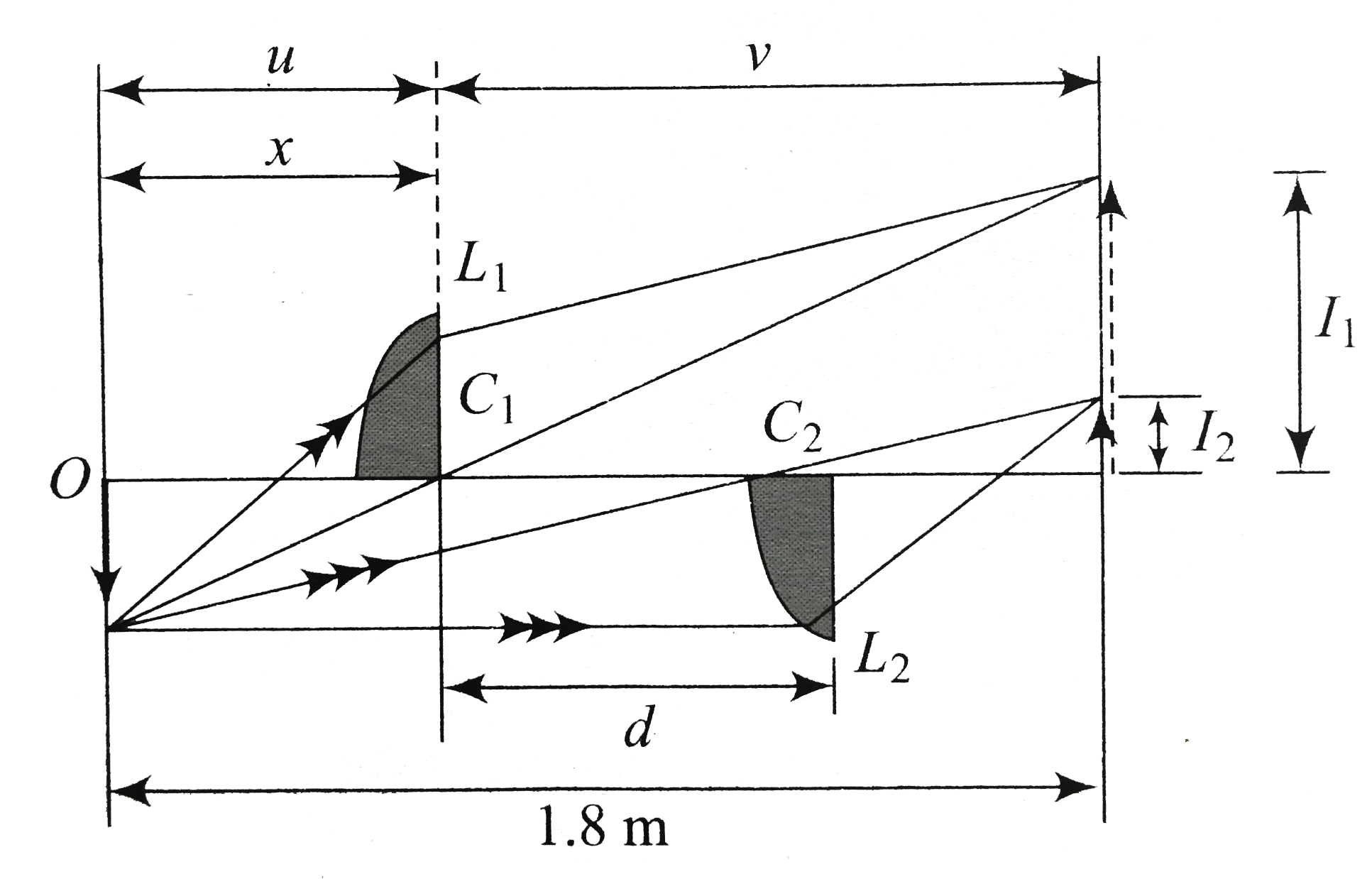
|
|
| 18. |
At a place of latitude 5^(@)the angle of dip is nearly |
|
Answer» `5^(@)` |
|
| 19. |
Following operations can be performed on a capacitor : X - connect the capacitor to a battery of emf. E.Y - disconnect the battery Z - reconnect the battery with polarity reversed. W - insert a dielectric slab in the capacitor |
|
Answer» In XYZ (perform X, then Y, then Z) the stored electric energy REMAINS unchanged and nothermal energy is developed. |
|
| 20. |
अपरिमेय संख्या का दशमलव प्रसार होता है |
|
Answer» शांत दशमलव प्रसार |
|
| 21. |
Rate of energy dissipation in a carrier wave transmission is 10 kW. What would be the rate of energy dissipated if the wave is frequency modulated to 10% level? |
|
Answer» 10 kW |
|
| 22. |
Atom consists of electrons distributed in apositively charged sphere was proved by: |
|
Answer» Planck |
|
| 23. |
Assertion (A) :The electric field at any point inside a uniformally charged thin spherical shell is zero. Reason ® : Entire charge given to a thin spherical shll lies only on its outer surface and there is no charge present inside the shell. |
|
Answer» |
|
| 24. |
When AC is switched on the thin metallic disc is found to thrown up in air. What makes the disc to be thrown? |
| Answer» Solution :EDDY current PRODUCED in the COIL thrown disc into AIR. | |
| 25. |
Pick the wrong statement of the following. |
|
Answer» Photoelectric CURRENT increases with increase in accelerating potential until it becomes maximum value. |
|
| 26. |
The end product of the decay of ""_(90)^(232)Th is ""_(82)^(208)Pb. The number of alpha and beta particle emitted are, respectively. |
|
Answer» 3,4 Then, `""_(90)^(232)Th to ""_(90)^(208)Pb+n(""_(2)^(4)He)+m(""_(-1)^(0)beta)` `rArr 90=82+2n-m` and `232=208+4n` `rArr n=6, m=7` |
|
| 27. |
Two identical stringed instruments have a frequency of 100 Hz. The tension in one of them is increased by 1 %. If they are now sounded together the number of beats produced is |
|
Answer» 1 |
|
| 28. |
LetA and Bbe twosetshavingm and nelementsrespectively. Thentotalnumberof functions fromA to Bis |
|
Answer» `8.80 XX 10^(-17)J` |
|
| 29. |
What is a filter ? With the help of a circuit diagram describe the role of a capacitor in filtering. Draw input and output waveforms too. |
Answer» Solution :In the output obtained from a full-wave rectifier, the output is unidirectional but pulsating one. To get steady output we use a filter circuit which FILTERS the a.c. ripple and gives a pure d.c. VOLTAGE. A capacitor based filter circuit has been shown in . When the voltage across the capacitor is rising, it gets charged. In the absence of external load it remains charged to the peak voltage of the rectified output. But in the presence of a load, the capacitor gets discharged through the load and the voltage across it begins to fall. In the next half-cycle of rectified output it again gets charged to the peak value. If product of capacitance C and load resistance `R_(L)` is LARGE, then rate of fall of the voltage across the capacitor is slow one. HENCE, the output voltage obtained by using capacitor input filter is almost equal to the peak voltage of the rectified output if value of capacitance C and `R_(L)` is high enough. The a.c. input and filtered output waveforms have been shown in. 
|
|
| 30. |
The magnetic field at the centre 'O' in the given figure is |
|
Answer» `3/(10) (mu_(0)I)/R` |
|
| 32. |
A boy of mass 40 kg climbs up a rope with an acceleration of 2 ms^(-2) What is the tension in the rope ? |
|
Answer» 472 N |
|
| 33. |
Energy density is expressed as E =_____. |
|
Answer» . |
|
| 34. |
If on heating liquid through 80^@C the mass expelled is (1//100)^(th) of mass still remaining , the co-efficient of apparent expansion of liquid is |
|
Answer» a)`126.5 XX 10^(-4)//^@C` |
|
| 35. |
A particle is at a distance r from the axis of rotation. A given torque tau produces some angular acceleration in it. If the mass of the particle is doubled and its distance from the axis is halved, the value of torque to produce the same angular acceleration is - |
| Answer» ANSWER :A | |
| 36. |
In a light emitting diode (LED) |
|
Answer» negative LEG is SHORTER than the positive |
|
| 37. |
The initial charge across capacitors A and B are shown with Q=CE. Find the ratio of final charge in capacitor A to the final charge in capacitor B, when cells are switched on. |
|
Answer» |
|
| 38. |
A plane light wave with wavelength lambda = 0.60 mu m and intensity I_(0) falls normally on a large glass plate whose side view is shown in Fig. At what height h of the ledge will be intensity of light at points located directly below be (a) minimum, (b) twice as low as I_(0) (the losses due to reflection are to be neglected). |
|
Answer» Solution :Just below the edge the amplitude of the wave is given by `A = (1)/(2)(A_(1) - A_(2) + A_(3) - A_(4)+………)e^(-I delta)` `+(1)/(2)(A_(1) - A_(2) + A_(3) - A_(4)+………)` Here the quantity in the brackets is the contribution of various Fresnel zones, the factor `(1)/(2)` is to TAKE account of the division of the plate into two parts by the ledge, the phase factor `delta` is given by `delta = (pi)/(lambda)H (n -1)` and takes into account the extra length traversed by the waves on the left. Using `A_(1) - A_(2) + A_(3) - A_(4) +......~~(A_(1))/(2)` we get `A = (A_(1))/(4)(1 + e^(i delta))` and the corresponding intensity is `I = I_(0) (1 + cos delta)/(2)`. where `I_(0) prop ((A_(1))/(2))^(2)` (a) This is minimum when `cos delta =-1` So `delta =(2k +1)pi` and `h =(2k +1) (lambda)/(2(n - 1)), k = 0,1, 2,.......` using `n = 1.5, lambda = 0.60mu m` `h = 0.60 (2k+1)MU m`. (B) `I = I_(0)//2` when `cos delta = 0` or `delta = kpi + (pi)/(2) = (2k + 1)(pi)/(2)` This in this case `h = 0.30 (2k + 1)mum`. 
|
|
| 39. |
In an L-C-R circuit, L = 8H, C = 0.5muF, R = 100Omega connected in series. The resonance frequency of the circuit will be….... |
|
Answer» 600 Hz Resonance FREQUENCY `f_0=1/(2pisqrt(LC))` `=1/(2pisqrt(8xx0.5xx10^(-6)))` `=1/(2pixx2xx10^(-3))` `=1000/(4pi)` `THEREFORE f_0=250/pi` Hz |
|
| 40. |
The phenomenon which proves the particle nature of electromagnetic wave is |
|
Answer» Interference |
|
| 41. |
The ratio of secondary to primary turns of an ideal transformer is 9:4. What will be the ratio of power output to power input for the given transformer? |
|
Answer» `4:9` |
|
| 42. |
The fraction of the radioactive sample will remain undecayed after 4 half-life periods is |
|
Answer» (a)`1/2` |
|
| 43. |
What is shunt ? State it's SI units. |
| Answer» Solution :A SMALL resistance connected in parallel to the coil of the galvanometer is called SHUNT. It.s SI unit is OHM. | |
| 44. |
A small hole is made in a hollow enclosure whose walls are at temp. of 1000 K. The amount of energy coming out of the hole per cm^(2) per sec is : |
|
Answer» 567 ergs `E=56700000` ergs Thus correct CHOICE is (d). |
|
| 45. |
Huygen's wave theory explain the phenomena of |
|
Answer» Reflection |
|
| 46. |
Two coherant narrow slits emitting light of wavelength lambda in the same phase are placed parallel to each other at a small separation of 2lambda.The light is collected on a screen S which is placed at a distance D( gt gt A) from the slit S_(1) as shown in figure .Find teh finitedistance x suchthat the intensity of P is equal to intensity at O . |
|
Answer» `D/(SQRT(3))` |
|
| 47. |
An object place in front of a plane mirror is displaced by 0.4 m along a straight line at angle of 30^@to mirror plane, the change in the distance between the object and its image is |
|
Answer» 0.20m |
|
| 48. |
To prepare the n-type semiconductor from a tetravalent Si or Ge, the impurity atoms of valency …… are chosen. |
|
Answer» 1 |
|
| 49. |
Which of the following electromagnetic waves emit- ted by the sun is responsible for heating the earth's atmosphere due to greenhouse effect ? |
|
Answer» VISIBLE light |
|
| 50. |
Velocity of sound in air is 300 m/s. Then the distance between two successive nodes of a stationary wave of frequency 1000 Hz is : |
|
Answer» Solution :v = 300 `ms^(-1), "" v = 1000` HZ. `lambda = (u)/(v) = (300)/(1000) = 0.3` m `lambda` = 30 cm x = `(30)/(2) = 15` cm Hence the CORRECT chioce is (C). |
|