Saved Bookmarks
This section includes 7 InterviewSolutions, each offering curated multiple-choice questions to sharpen your Current Affairs knowledge and support exam preparation. Choose a topic below to get started.
| 1. |
The width of a slit is 0.012mm. Monochromatic light is incident on it. The angular position of first bright line is 5.2^(0). The wavelength of the light incident is |
|
Answer» `6040 A^(0)` |
|
| 2. |
The Young.s double slit experiment is done in a medium of refractive index 4/3 . A light of 600 nm wavelength is falling on the slits having 0.45 mm separation . The lower slit S_(2) is covered by a thin glass sheet of thickness 10.4 mu mand refractive index 1.5 . The interference pattern is observed on a screenplaced 1.5 m from the slits as shown in figure .Findthe light intensity at point O relative to the maxmum fringe intensity |
|
Answer» |
|
| 3. |
Two Earth satellites, A and B, each of mass m, are to be launched into circular orbits about Earth's center. Satellite A is to orbit at an altitude of 6370 km. Satellite B is to orbit at an altitude of 19 850 km. The radius of Earth R, is 6370 km. (a) What is the ratio of the potential energy of satellite B tu trial of satellite A, in orbit? (b) What is the ratio of the kinetic energy of satellite R to that of satellite A, in orbit? (C) Which satellite has the greater total energy if each has a mass of 14.6 kg? (d) By how much? |
| Answer» SOLUTION :(a) 0.486, (B) 0.486 , ( c) Satellite B has the LARGEST energy, (d) `DELTAE = 2.3 xx 10^8 J` | |
| 4. |
Four identical capacitors each rates as 10 mu F - 10V are supplied to you to obtain capacitor of 10 mu F - 20 V, we should connect them in |
|
Answer» two ROWS each CONTAINING 2 condensers |
|
| 5. |
In Fig.R = 25.0 Omega, C = 4.70 muF, and L = 25.0 mH. The generator provides an emf with rms voltage 75.0 V and frequency 550 Hz. (a) What is the rms current? What is the rms voltage across (b) R, (c) C, (d) L, (e) C and L together, and (f) R, C, and L together? At what average rate is energy dissipated by (g) R, (h) C, and (i) L? |
|
Answer» |
|
| 6. |
A particle is projected with a velocity of sqrt(2) m//s at an angle of 45^(@) with the horizontal. Find the interval between the moments when speed issqrt(125)m//s |
|
Answer» Solution :`(g=10 m//s^(2)), u_(n)=10 , u_(y)=0` `V^(2)=v_(X)^(2)+v_(y)^(2)` `125=100 +v_(y)^(2)` `v_(y)=5 Delta =(2v_(y))/(g)=(2xx5)/(10)=1s` 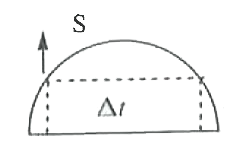
|
|
| 7. |
An insect crawls a rough hemispherical surface. The coefficient of friction between it and surface is 1//3. If the line joining the insect and the centre of surfaces makes an angle a with the vertical, the maximum possible value of a is : |
|
Answer» `COT ALPHA = 3` |
|
| 8. |
Define energy band. |
| Answer» SOLUTION :The band of very LARGE number of closely SPACED ENERGY levels in a very small energy RANGE is known as energy band. | |
| 9. |
The length of the potentiometer wire is 600 cm and a current of 40 mA is flowing in it. When a cell of emf 2 V and internal resistance 10Omega is balanced on this potentiometer the balance length is found to be 500 cm. The resistance of potentiometer wire will be |
| Answer» Answer :C | |
| 10. |
the temperature of the wire is increased keeping the other parameters same |
| Answer» SOLUTION :When the temperature increases,DRIFT velocity decreases because the collision FREQUENCY increases (relaxation TIME decreases) | |
| 11. |
when a sheet of transparent plastic is placed between two crossed palarizes, no light is transmitted. When the sheet is stretched in one direction, some light passes through the crossed polarizers. What is happening ? |
|
Answer» Solution :A transparent PLASTIC sheet is NOT a polaroid. As the two polarizers are crossed, no light is transmitted whether the plastic sheet is PLACED between them or not. But when the plastic sheet is STRETCHED, the polymer molecules in it makes it a polaroidwith its own polaroid axis. This axis will be at certain angle with the axes of two polaroids. Therefore some light WOULD PASS through the crossed polaroids. |
|
| 12. |
Two bar magnets of length 0.1 m and pole strength 75 Am each , are placed on the same line . The distance between their centres is 0.2 m . What is the resultant force due to one on the other when (i) the north pole of one faces the south pole of the other and (ii) the north pole of one faces the north pole of the other ? |
|
Answer» |
|
| 13. |
The area of the electron orbit for the ground state of hydrogen atom is A. Then what will be area of the electron orbit corresponding to the first excited state? |
|
Answer» `4A` `A_(2)/A_(1)=2^(4)/1^(4)=16` `A_(2)=16A` |
|
| 14. |
A charge of 8 mC is located at the origin. Calculate the work done in taking a small charge of -2 xx 10^(-9) C from a point P (0, 0, 3 cm) to a point Q (0, 4 cm, 0), via a point R (0, 6 cm, 9 cm) |
| Answer» SOLUTION :1.2 J, the point R is irrelevant to the ANSWER | |
| 15. |
Assume that temperature varies linearly with height near the Earth's surface. Considering temperature at the surface of the Earth T_1 and T_2at a height h above the surface, calculate the time t needed for a sound wave produced at a height. x. to reach the Earth's surface. Velocity of sound at the Earth's surface is c. |
|
Answer» `t = (2h)/(c ) (sqrtT_1)/((T_2 - T_1)) [ sqrtT_1- sqrt((T_2 - T_1)/(H))x + T_1]` |
|
| 16. |
A wire density 9 xx 10^3 kg//m^3 is stretched between two clamps 1 m apart and is stretched to an extension of 4.9 xx 10^(4)metre. Young.s modulus of material is 9 xx 10^(10) N//m^(2)transversal standing wave is setup. Then : |
|
Answer» The lowest frequency of standing WAVE is 35 Hz |
|
| 17. |
An electric charge 10^(-3) muC is placed at the origin (0, 0) of X-Y co-ordinate system. Two points is A and B are situated at (sqrt(2),sqrt(2))and (2, 0) respectively. The potential difference between the points A and B ,will be ...... |
|
Answer» 9 V `OA = SQRT((sqrt(2))^(2)+(sqrt(2))^(2))` `= sqrt(2+2)` r=2 and OB =2 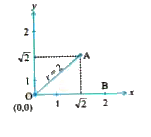 The electric potentialat A and B point `V_(A) = (kq)/(r) ` and `V_(B)= (kq)/(OB)` `:. V_(A)-V_(B)= (kq)/(2)-(kq)/(2):. V_(A)- V_(B) = 0` |
|
| 18. |
An alternating current of rms value 5 A, passes through a resistance of 24 Omega. What is the maximum P.D. across the resistor ? |
|
Answer» 17 V |
|
| 19. |
You are given reaction : ""_1H^2+""_1H^2to ""_2He^4+24 MeV. What type of nuclear reaction is this ? |
| Answer» SOLUTION :NUCLEAR FUSION. | |
| 20. |
During........too, the fruits of jamun tree ripened. |
|
Answer» Summer |
|
| 22. |
How does effective power radiated depend on the wavelength ? |
|
Answer» Solution :Effective power `alpha(1)/(lambda^(2))`. (ALTERNATIVELY : Effective power RADIATED decreases with an INCREASE in WAVELENGTH). |
|
| 23. |
Match the following Columns |
|
Answer» `{:("Column I","Column II"),((A)"Dielectric ring UNIFORMLY charged",(P)"Time independent electrostatic FIELD"):}` |
|
| 24. |
What is dielectric constant ? |
|
Answer» |
|
| 25. |
Potentials of pointsP and Q are 10 Vand - 4 V respectively. Work done in taking 100 electrons from P to Q ........ |
|
Answer» `22.4xx10^(-16)J` `:. W = q (V_(2)-V_(1))= (V_(Q)-V_(p))q ` `=(-4-10) (-1.6xx10^(-19)xx100) ( because`q= ne) `=14xx1.6xx10^(-17) = 2.24 xx10^(-16)` J |
|
| 26. |
The materials used in Robotics are |
|
Answer» ALUMINIUM and SILVER |
|
| 27. |
In the Dubna heavyion cyclotron neon ions are accelerated to an energy of 100 MeV. The diameter of the dees is 310 cm, the magnetic field induction in the gap is 1.1 T the accelerating potential is 300 kV. Find the degree of ionization of a neon atom, the total number of revolutions of an ion in the process of its acceleration and the frequency of the change in polarity of the accelerating field. |
|
Answer» A 20.18 amu is the atomic mass of NEON. The momentum of the ion is found from its kinetic energy `"mu"=sqrt(2mK)`. Hence the charge of the ion. `q=sqrt(2mK)/(BR)=sqrt(2 xx 20.18 xx 1.66 xx 10^(-27) xx 100 xx 1.6 xx 10^(-13))/(1.55 xx 1.1)` `=6.6 xx 10^(-19)C` Dividing by the electron charge we find teh neon ions to be ionized quadruply. The total NUMBER of revolution as ion makes is equal to its kinetic energy divided by the energy acquired in the process of pasing twice through the ACCELERATING GAP: `N=(K)/(2q Psi)=(100 xx 10^(8))/(2 xx 4 xx 300 xx 10^(3))=42` The frequency of the change in polarity of the accelerating fieldis equal to the circular frequency of the ion. `=u/(2pi R)=(q B)/(2pim)` |
|
| 28. |
In an astronomincal telescope, the distance between the objective and the eyepiece is 36cm and the final image is formed at infinity. The focal length f_(0) of the objective and the focall length f_(e)of th eeyepiece are |
|
Answer» `f_(0)=45` cm and `f_(E)=-9CM` |
|
| 29. |
In the steady state of conduction of rod AB of length 100 cm, the temperature at the ends A is 80^(@)C and at B the temperature is 0^(@)C. The temperature of the rod at the distance 60 cm from A is : |
|
Answer» `16^(@)C` Decrease in temperature for 60 cm length `=60xx0.8` `=48^(@)C`. `:.` Temp. at 60 cm from point `A=80^(@)C-48^(@)C=32^(@)C`. Thus correct choice is (B). |
|
| 30. |
Electromagnetic waves are radiated uniformly in all directions from a source . The rms electric field of the waves is measured 35 km from the source to have an rms value of 0.42 N/C. Determine the average total power radiated by the source. |
|
Answer» `4.1 xx10^(5)` W |
|
| 31. |
Assuming the propagation velocities of longitudinal and transverse vibrations to be the same and equal to v, find the Debye temperature (a) for a unidimensional crystal, i.e., a chain identical atoms, incorporating n_(0) atoms per unit length, (b) for a two-dimensional crystal, i.e., a plance square grid consisting of identical atoms, containing n_(0) atoms per unit area, (c ) for a simple cubic lattice consisting of identical atoms, containing n_(0) atoms per unit volume. |
|
Answer» Solution :To detemine the Debye temperature we cut off the high frequency modes in such a way as to GET the total number of modes correctly. (a) In a linear crystal with `n_(0)l` atoms, the number of modes of transverse vibrations in any given plane cannot exceed `n_(0)l`. Then `n_(0)l=(l)/(pi v) int_(0)^(omega_(0)) d omega=(l)/(piV)omega_(0)` The cut off frequency `omega_(0)` is related to the Debye temperature `Theta` by ` ħ omega_(0)=k Theta` Thus `Theta=(( ħ)/(k))pin_(0)v` (b) In a square lattice, the number of modes of transverse oscillations cannot exceed `n_(0)S` Thus `n_(0)S=(S)/(2 piv^(2)) int_(0)^(omega_(0)) omega d omega=(S)/(4PI v^(2))omega_(0)^(2)` or `Theta=(ħ)/(k)omega_(0)=((ħ)/(k))(sqrt(4pin_(0)))v` In a CUBIC crystal, the maximum number of transverse waves must be `2n_(0)V` (TWO for each atom). Thus `2n_(0)V=(V)/(pi^(2)v^(3))int_(0)^(omega_(0)) pmega^(2) d omega=(V omega_(0)^(3))/(3 pi^(2)v^(3))` Thus `Theta=((ħ)/(k))v(6pi^(2)n_(0))^(1//3)` |
|
| 32. |
STATEMENT-1 In YDSE centela fringe is always a bright fringe. STATEMENT-2 If path difference at central fringe is zero then it will be a bright fringe. |
|
Answer» Statement-1 is true Statemetnt-2 is True,Statement -2 is a CORRECT EXPLANATION for statement -1. |
|
| 33. |
The length of each side of a cubical closed surface is L metre. If charge 48C is situated at one of the corners of the cube, Find the flux passing through the cube. (In Volt-metre) |
|
Answer» `(6)/(in_(0))` |
|
| 34. |
Figure 22-18a shows there particles with charges q_(1)=+2Q, q_(2)=-2Q, and q_(3)=-2Q, each a distance d from the origin. What net electric field vecE is produced at the origin? |
|
Answer» Solution :KEY IDEAS Charges `q_(1), q_(2), and q_(3)` produce electric field vectors `vecE_(1), vecE_(2) and vecE_(3)`, respectively, at the origin, and the net electric field is the vector sum `vecE=vecE_(1)+vecE_(2)+vecE_(3)`. To FIND this sum, we first must find the magnitudes and orientations of the three field vectors. Magnitudes and directions: To find the magnitude of `vecE_(1)`, which is due to `q_(1)`, we use Eq. 20-20, substituting d for r and 2Q for q and obtaining `E_(1)=(1)/(4pi epsilon_(0))(2Q)/(d^(2))`. 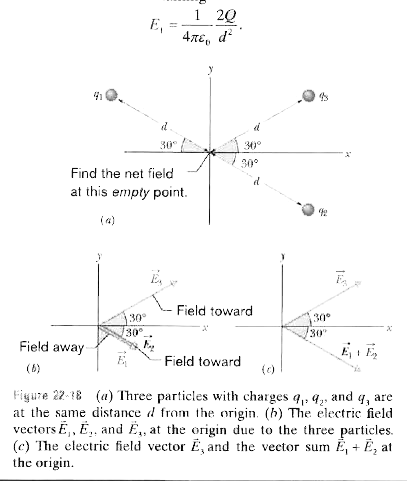 Similarly, we find the magnitudes of `vecE_(2) and vecE_(3)` to be `E_(2)=(1)/(4pi epsilon_(0))(2Q)/(d^(2)) and E_(3)=(1)/(4pi epsilon_(0)) (4Q)/(d^(2))`. We next must find the orientations of the three electric field vectors at the origin. Because `q_(1)` is a positive charge, the field vector it produces points directly away from it, and because `q_(2) and q_(3)` are both negative, the field vectors they produce point directly TOWARD each of them. Thus, the three electric fields produced at the origin by the three charged particles are oriented as in Fig. 22-18b. Adding the fields: We can now add the fields vectorially just as we add force vectors. However, here we can use symmetry to simplify the procedure. From Fig. 22-18b, we see that electric fields `vecE_(1) and vecE_(2)` have the same direction. Hence, their vector sum has that direction and has the magnitude `E_(1)+E_(2)=(1)/(4pi epsilon_(0)) (2Q)/(d^(2))+(1)/(4pi epsilon_(0))(2Q)/(d^(2))=(1)/(4pi epsilon_(0)) (4Q)/(d^(2))`, which happens to EQUAL the magnitude of field `vecE_(3)`. We must now combine two vectors, `vecE_(3)` and the vector sum `vecE_(1)+vecE_(2)`, that have the same magnitude and that are oriented symmetrically about the x axis, as shown in Fig. 22-18c. From the symmetry of Fig. 22-18c, we REALIZE that the equal y COMPONENTS of our two vectors cancel (one is upward and the other is downward and the equal x components add (both are rightward). Thus, the net electric field `vecE` at the origin is in the positive direction of the x axis and has the magnitude `E=2E_(3x)=2E_(3) cos 30^(@)` `=(2) (1)/(4pi epsilon_(0)) (4Q)/(d^(2)) (0.866)=(6.93Q)/(4pi epsilon_(0)d^(2))`. (Answer) |
|
| 35. |
What do you mean by wave nature of an electron? How was quantisation of angular momentum of the orbiting electron in Bohr's model of hydrogen atom explained by de-Broglie hypothesis ? |
|
Answer» Solution :As per de-Broglie concept of matter waves, even ELECTRON particles also exhibit WAVE nature and the wavelength `lamda` associated with an electron of mass m moving with a SPEED v is given as : `lamda=h/(mv)=h/p=h/(sqrt(2mK))` where p is the momentum and K is the kinetic energy of electron. If an electron is accelerated by a potential of V volt, then its de-Broglie wavelength is given as : `lamda=h/(sqrt(2meV))=(1.227)/(sqrtV)` nm As per de-Broglie.s hypothesis in terms of electron wave, only those stationary Bohr orbits are possible in which total distance (i.e., the circumference of the ORBIT) contains a definite numberof these electron waves. Mathematically, total path length of orbit = n `(lamda_("electron wave"))` where n is an integer and may have values 1, 2, 3, 4, ....... etc. From de-Broglie concept of matter waves, we know that wavelength of electron waves may be expressed as `lamda=h/(p_(n))=h/(mv_(n))` where m = mass of electron and `v_(n)` = velocity of electron in state corresponding to n. Substituting the value of A in de-Broglie.s quantum condition, we get `2pir_(n)=n.h/(mv_(n))rArrmv_(n)r_(n)=nh/(2pi)` which is Bohr.s quantum condition ( on the second POSTULATE for quantisation of angular momentum. |
|
| 36. |
An object of height 5cm is placed in midway between a concave mirror of radius of curvature 30cm and a convex mirror of placed opposite to each other and are 60cm apart. Find the position of the image formed by reflection at convexd mirror. |
Answer» Solution :(a) `u_(1)=30cm, f_(1)=-30/2=-15cm,u_(3)=v_(1)=?` 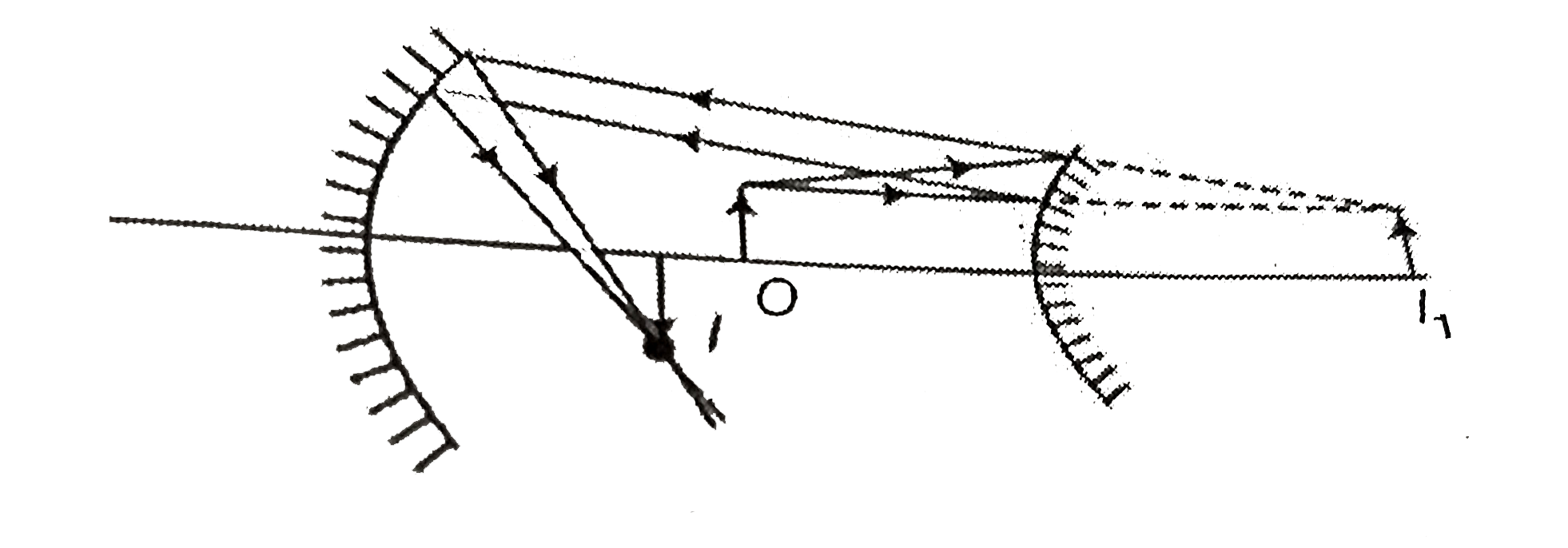 `-1/15=1/30+1/(v_(1))` Image formed is VIRTUAL which is formed BEHIND theh convex MIRROR. |
|
| 37. |
Find the potential differece between the poinst A and B and that between E and F of the circuit shown in. |
|
Answer» Left loop: `-q_(1)/5+q_(3)/(0.75)+q_(1)/(15)=0` or `q_(1)-3q_2+20 q_3=0` (i) Middle loop : `-(q_(2)+q_(3))/(15)-q_(3)/(0.75)+(q_(1)-q_()3)/5-q_(3)/(0.75)=0` or`3q_(1)-q_(2)-44q_(3)=0` (ii) Outermost loop: `23-q_(2)/5-(q_(2)+q_(3))/(15)-q_(2)/5=0` Outermost loop : `23-q_(2)/5-(q_(2)+q_(3))/(15)-q_(2)/5=0` or `345=7q_(2)+q_(3)` (III) `Solving for `q_(1),q_(2)`, and `q_(3)`. we get `q_(1)=(19xx345)/(92),q_(2)=(13xx345)/(92),q_(3)=(345)/(92)` Therefore, POTENTIAL difference between `A`and `B` is `q_(3)/(0.75)=(345)/(92)xx4/3=5 V` Potential difference between `E` and `F` is also `5 V` but in the opposite direction. 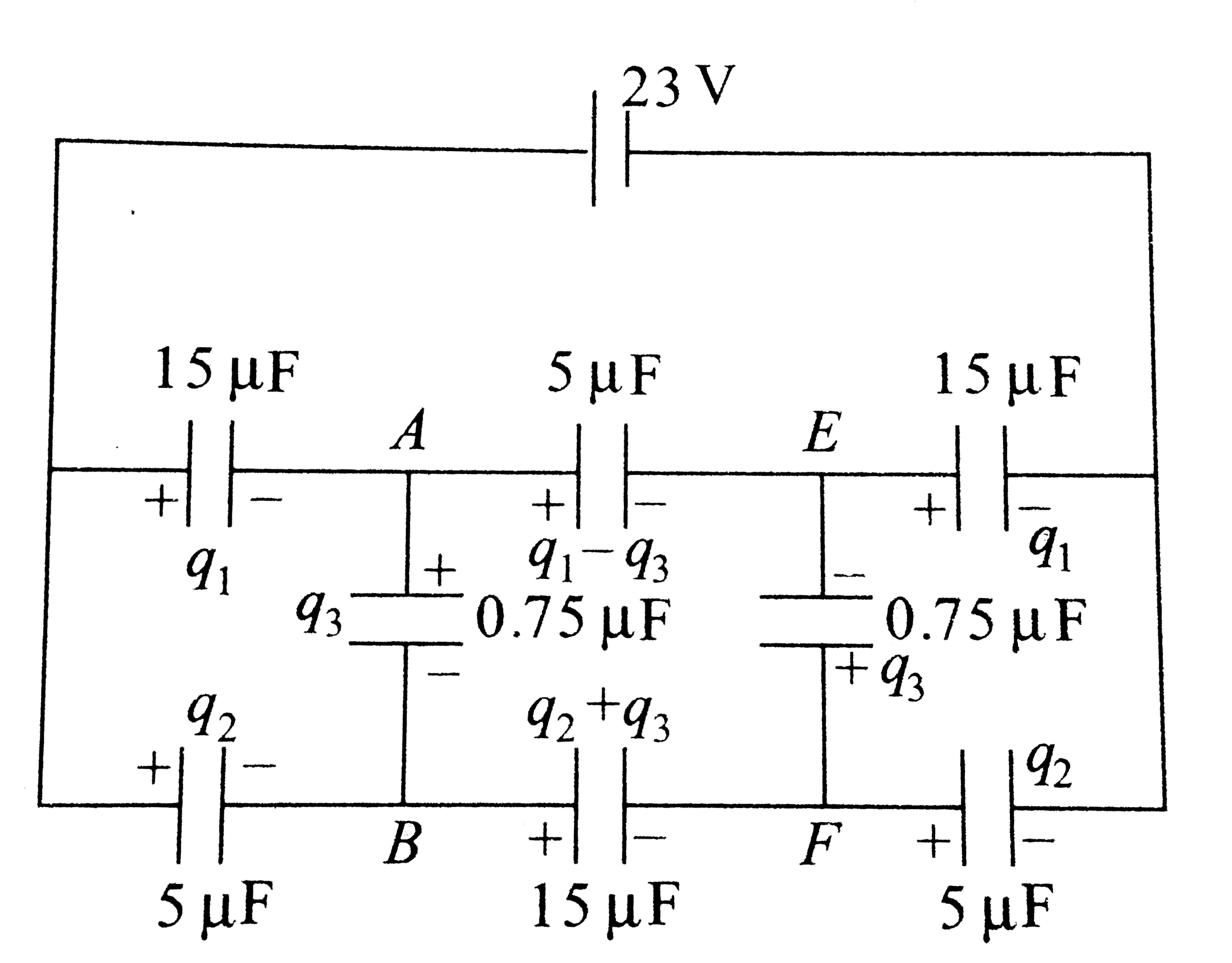 . .
|
|
| 38. |
On connecting the condensers in parallel having the different capacitance, they will have the same: |
|
Answer» Capacity |
|
| 39. |
What is the linear momentum of a car of mass 1,000 kg that is moving at a speed of 20 m/s? what is the momentum of a truck of mass 5,000 kg moving at the same speed? |
|
Answer» SOLUTION :The magnitude of the car's LINEAR momentum is `P_(car)m_(car)V=(1,000kg)(20m//s)=20,000kg*m//s`. WHOLE magnitude of the TRUCK's linear momentum `P_("truck")=m_("truck")v=(5,000kg)(20m//s)=100,000kg*m//s`. Although the car and truck have the same speed, the truck has more momentum because it has more mass. |
|
| 40. |
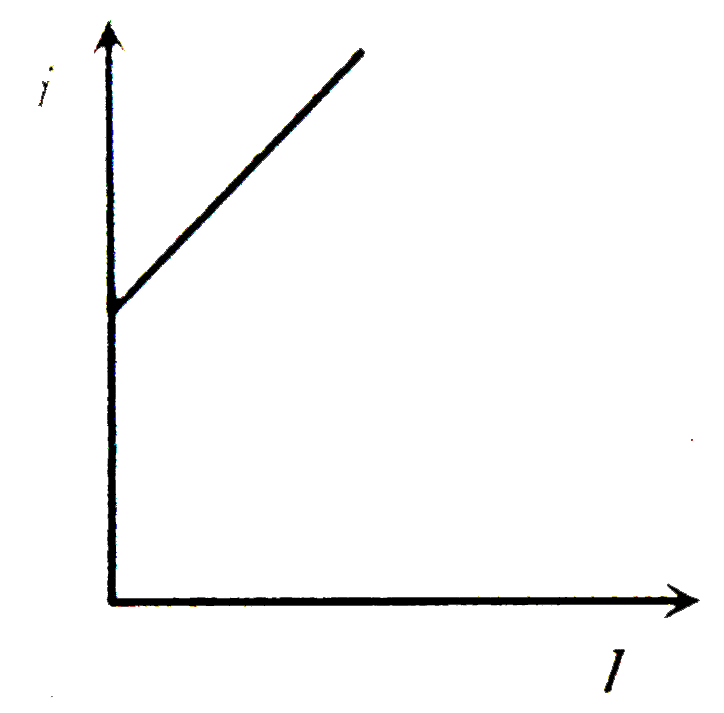
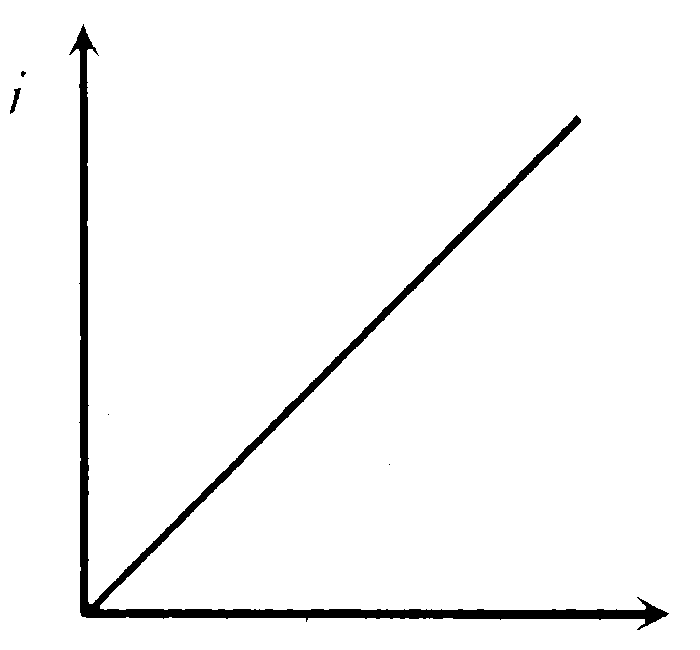
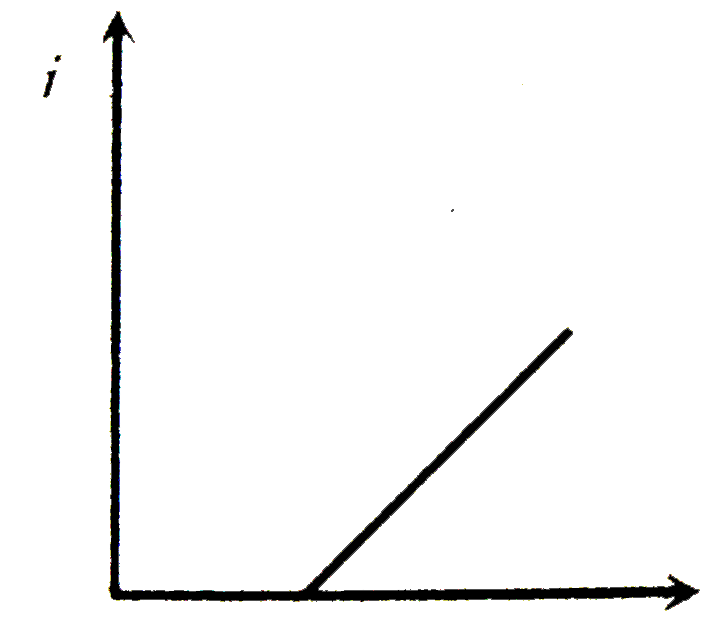
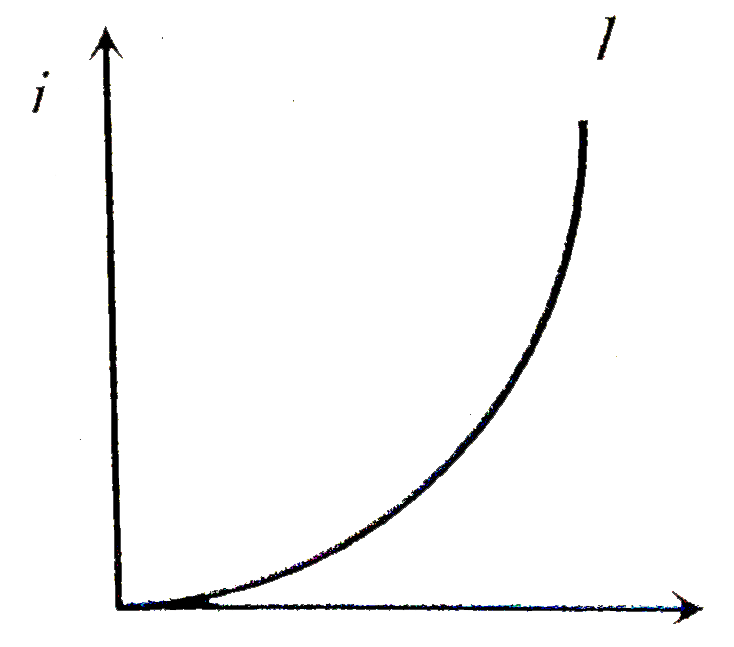
The graph between intensity of light falling on a metallic plate (I) with the current (i) generated is |
|
Answer»
|
|
| 41. |
Area sown more than once in an agricultural year plus net sown area is known as: |
| Answer» Answer :D | |
| 42. |
In the circuit shown in figure. Charge stored in 6 mu F capacitor will be |
|
Answer» `18 muC` |
|
| 43. |
Find the equivalent capacitance of the given figure. |
|
Answer» SOLUTION :` (1)/(dc) =(y)/(in _0 K_1bdx) +(d_0-y)/( in _0 k_1 bdx )+ (d_0 -y)/( in _0 k_2 bdx) ` ` (1)/(dc)=(d_0k_1+y (k_2-k_1)/( in _0 k_1k_2bdx) ` ` dc = (in _0 k_1k_2 bdx)/( d_0k_1+y(k_2-k_1))` All these capacitors (small )are PARALLEL so ` C_(AQ) = INT _0^(C_aq) dC =int _0^(a) ( in _0 k_1k_2bdx)/( d_0 k_1+y(k_2-k_1)) ` Now `""(d_0)/(a) =(y)/(x) rArr C_(aq)=int _0^(a) (in_0 k_1 k_2bdx)/(d_0 k_1+(d_0)/( a) (k_2-k_1) )` ` C_(aq) =(ain _0k_1k_2b)/( d_0( k_2-k_1))1n [((k_2-k_1))/( k_1) ]` 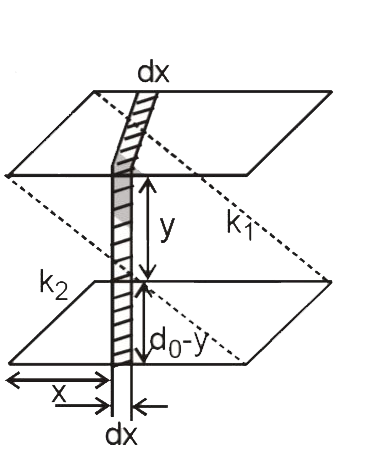
|
|
| 44. |
A full-wave rectifier is used to convert 'n'Hz a.c into d.c, then the number of pulses per second present in the rectified voltage is |
|
Answer» N |
|
| 45. |
An open pipe of sufficient length is dipping in water with a speed v vertically. If at any instant 1 is length of tube above water then the rate at which fundamental frequency of pipe changes, is (speed of sound = c) |
|
Answer» `cv//2l^(2)` |
|
| 46. |
A stationary source produces a note of frequency 1000Hz. An observer in a car moving towards the source measures the frequency of sound as 1057 Hz. Find the speed of the car. What will be the frequency of sound as measured by the observer in the car if the car moves away from the source at the same speed ? |
|
Answer» Solution :Data : N = 1000 Hz, `n_(a) = 1057 Hz` v= 350 m/s (i) when the CAR moves towards the source of sound ` n_(a) = n ((v+v_(0))/(v))` ` 1057 = 1000 ((350 + v_(0))/350)` ` 1.057 = 1 + v_(0)/350` The speed of the car, ` v_(0) = 350 XX 0.057 = 19.95 m//s ` (II) When the car moves AWAY from the source of sound `, n_(a) = n ((v-v_(0))/v)` ` n_(a) = 1000 ((350 -19.95)/350) = 1000 (1- (19.95)/350) = 1000 (1-0.057)` = `1000 xx 0.943` 943 Hz The frequency of the sound as measured by the observer in the car ` n_(a) = 943` Hz. |
|
| 47. |
Magnetic Induction due to a long solenoid B=______ |
| Answer» Solution :`mu_@NI` and `(mu_@nI)/2` for inside and NEAR POINTS. | |
| 48. |
A balloon is descending with a constant acceleration a, less than the acceleration due to gravity g. The weight of the balloon, with its basket and contents, is w. What weight w, should be released so that the balloon will begin to accelerate upward with constant acceleration a? Neglectair resistance. |
|
Answer» |
|
| 49. |
A. Potentiometer measures the potential difference more accurately than a voltmeter, because the potentiometer a. does not draw current from external circuit. b. has a wire of high resistance. c. draws a heavy current from external circuit. d. has a wire of low resistance. B. With the help of a diagram explain the principle of a potentiometer. |
|
Answer» It measure POTENTIAL in the OPEN CIRCUIT. |
|