

Saved Bookmarks
This section includes 7 InterviewSolutions, each offering curated multiple-choice questions to sharpen your Current Affairs knowledge and support exam preparation. Choose a topic below to get started.
| 1. |
In an electric shaver, the blade moves back and forth over a distance of 2.0 mm in simple harmonic motion, with frequency 100Hz. Find (a) the amplitude, (b) the maximum blade speed and (c ) the magnitude of the maximum blade acceleration. |
| Answer» SOLUTION :(a) 1.0mm, (B) 0.63m/s, (C ) `3.9 xx 10^(2) m//s^(2)` | |
| 2. |
A magnetic needleis kept in a non uniform magneitc fieldit experiences |
|
Answer» a FORCE but not a TORQUE |
|
| 3. |
At absolute zero temperature, a semiconductor acts as a/an |
|
Answer» DIELECTRIC |
|
| 4. |
A radio wave sent from the surface of the Earth reflects from the surface of the moon and returns to the Earth . The elapsed time between the generation of the wave and the detection of the reflected wave is .6444 s. Determine the distance from the surface of the Earth to the surface of the Moon . Note: The speed of lightis 2.9979xx10^(8) m/s |
|
Answer» `3.7688xx10^(8)` m |
|
| 5. |
The resistance of a bulb filament is 100Omega at a temperature of 100^(0)C. If its temperature coefficient of resistance be 0.005 per""^(0)C, its resistance will become 200Omega at a temperature of |
|
Answer» `300^(0)C` |
|
| 6. |
An A.C. generator is used to convert mechanical energy into electrical energy : But what does a transformer do? |
| Answer» SOLUTION :To CHANGE the VOLTAGE LEVEL | |
| 7. |
In an experiment designed to study the photoelectric effect, it is observed that lo-intensity visible light of wavelength 550 nm produced no photoelectrons. Which of the following best describes what would occur if the intensity of this light were increased dramatically? |
|
Answer» Almost immediately, PHOTOELECTRONS would be produced with a kinetic ENERGY equal to the energy of the incident photons. |
|
| 8. |
A charged particle is accelerated through a potential difference of 12 kV and acquires a speed of 10^(6) m/s. It is then injected perpendicularly into a magnetic field of strength 0.2T. Find the radius of circle described by it |
|
Answer» 2cm |
|
| 9. |
Predict the direction of indcued current in the situation described by the following Fig. |
|
Answer» Solution :(a) South pole developes at q, current induced must be clockwise at q. `:.` in the coil, induced current is from p to q (b) Coil PQ in this case would develop S-pole at q and coil XY would also develop S pole at X Therefore induced current in coil pq will be from q to p and induced current in coil XY will be from X to Y. (c ) Induced current in the RIGHT loop will be along XYZ. (d)Induced current in the LEFT loop will be along XYZ as seen from front. (E)Induced current in the right coil is from X to Y. (f) No current is induced because magnetic lines of force lie in the plane of the loop. |
|
| 10. |
A thin prism of angle 5.0^(@), omega = 0.07 and mu_(y) = 1.30 is cominedwith another thin prism having omega' = 0.08and mu'_(y) = 1.50. The combination producesno deviation in the meanray, (a) Find the angleof the secondprism. (b) Find thenet angualrdispersion producedby the combinationwhen a beamof white light passes through.it (c) If the prismsare similarlydirected, what will be the devation in the meanray? (d) Find the angulardispersion in the solution described in (c). |
|
Answer» |
|
| 11. |
Do given above with the replacment of earilier transformer by 40000-220 V step down transformer. Neglect as before, leakage losses. Hence explain why high voltage transmission is preferred. |
|
Answer» Solution :Here, `E_(v) = 40000` volt. Since `P = E_(v) I_(v) :. I_(v) = (P)/(E_(v)) = (800 xx 10^(3))/(40000) = 20 AMP` Line power loss `= I_(v)^(2) = (20)^(2) xx 15 = 6000 W = 6 kW`. plant supply `= 800 + 6 = 806 kW` Voltage drop on the line `= I_(v) R = 20 xx 15 = 300` volt. `:.` Voltage for transmission ` =40000 + 300 = 40300` volt. `:.` STEP up TRANSFORMER needed at the plant is `= 440 V - 40300 V` Power loss at higher voltage `= (6)/(800) xx 100 = 0.74 %` Power loss at lower voltage`= (600)/(1400) xx 100 = 42.8%` Hence high voltage transmission is preferred. |
|
| 13. |
Describe the laws of radioactive decay. Derive equation of radioactive decay using these laws. |
|
Answer» Laws of Radioactive disintegration 1. Radioactivity is spontaneous process which does not depend upon external factors. During disintegration either `alpha` or `beta`-particle is emitted. Both are never emitted simultaneously. 3. Emission of `alpha`-particle decreases atomic number by two and mass number by 4. 4. Emission of `beta`-particle INCREASES atomic number by one but mass number remains the same. 5. Emission of `gamma`-ray does not CHANGE atomic or mass number. 6. The number of atoms disintegrated per second is directly proportional to the number of radioactive atoms actually present at that instant. This law is called radioactive decay law. i.e. `-(dN)/(dt) prop N` or `-(dN)/(dt)= lambda N`,...(i) where `lambda` is a constant called disintegration constant and depends upon the nature of the radioactive substance. Now from (i) , we have `(1)/(N) dN = - lambda dt` or `int 1/N dN = lambda int dt` or `log_(e)N=lambda t +C`,...(ii) where C is constant of integration. To determine its value. Let `N=N_(0)` initially, i.e. when `t=0, N=N_(0)` `log_(e)=N=0+C` Substituting the value of C in (ii) , we have `log_(e)N=-lambda t + log_(e)N_(0)` or `log_(e)N-log_(e)N_(0)=-lambda t` or `log_(e). (N_(0))/(N)= -lambdat` or `(N)/(N_(0))=e^(-lambda t)` or `N=N_(0)e^(-lambda t)` which is the required EQUATION. Disintegrationconstant `(lambda)` is defined as the TIME after which the number of radioactive atoms reduce to 1/e times the original number of atoms. Half life period (T) is the time during which the number of atoms of a radioactive material reduces to half of the original number . |
|
| 14. |
Stable equilibrium of dipole in uniform electric field is, when angle between dipole moment and electric field is |
|
Answer» zero |
|
| 15. |
A wheel with 10 metallic spokes each 1 m long is rotated with a speed of 60 "rev"/"min"in a plane normal to the horizontal component of earth's magnetic field H_E at a place. If H_E = 0.4 G at the place, what is the induced emf between the axle and the rim of the wheel ? Note that 1 G=10^(-4) T |
|
Answer» |
|
| 16. |
A magnet vibrates in a magnetic field of strength 10^(-4) T. If the moment of the magnet is 10^(-1)A-m^2 and the moment of inertia about the axis of rotation is 10^(-5) kg m^(2), then find the time period of oscillation in seconds? |
| Answer» Solution :Period of OSCILLATION , `T= 2pi SQRT((I)/(MB))= 2pi sqrt((10^(-5))/(10^(-1) xx 10^(-4)))= 2pi `SEC. | |
| 17. |
Hertz in his historical experiment, produced stationary electromagnetic waves and measured the distance between two successive nodes. Explain how this measurement enabled him to show that electromagnetic waves travelled with the same speed as the speed of light. |
|
Answer» Solution :Hertz by measuring the distance `(=lambda//2)` between the two successive NODES in his experiment determined the wavelength `(lambda)`of electro- magnetic wave. The frequency (v) of this electromagnetic wave was equal to that of the oscillator given by, `v=(1)/(2pisqrt(LC))` Then the speed of electromagnetic wave was determine by the relation, `v=vlambda=1/(2pisqrt(LC))lambda` It was then found that this value AGREES with the speed of LIGHT. Therefore, it was concluded that electromagnetic waves travel with the same speed as the speed of light. |
|
| 18. |
A car weighing 12000 kg along with the weight of its driver and is moving at a uniform speed on a road which offers same force of friction consumes one litre of petrol for every 15 km run. If combustion of petrol ganerates 3 x 10') per litre and efficiency of the engine is 50%, calculate the force of friction acting on the car during 15 km drive. |
|
Answer» `10^(3)` N which is used for driving 15 km.Thus `F.x=1.5xx10^7 J` or`F=(1,5xx10^7)/(15000)=10^3 N` |
|
| 19. |
The upper half of an inclined plane with inclination is perfectly smooth while the lower half is rough. A body starting from rest at the top will again come to rest at the bottom if the coefficient of friction for the lower half is given by : |
|
Answer» `2 sinphi` , `upsilon^(2) = 2 (g sin phi)l` ...(a) For second half of motion `0= upsilon^(2) +2G (sin theta+mu cos phi)l...(b)` Solving (a) and (b) we GET `mu = 2 tan phi` Hence choice is (c). |
|
| 20. |
If a charge on the body is 1 nC, then how many electrons are present on the body ? |
|
Answer» `1.6 xx 10^(19)` |
|
| 21. |
A bird is flying with a velocity v between two long vertical mirrors making an angle theta with mirror M_(1) as shown. Then what will be the relative velocity of approach between the images formed by the mirrors due to the 1st reflection in each of them |
|
Answer» `V "sin"theta` _E01_004_S01.png) `implies v_(I)_(1)I_(2)= v_(I)_(2) - v_(I)_(1) = 0` |
|
| 22. |
Explain the experimental determination of material of the prism using spectrometer. Determination of angle of the prism. |
|
Answer» Solution :(i)The preliminary adjustments of the telescope, collimator and the prism tableof the spectrometer are made. (ii)The refractive index of the prism can be determined by knowing the angle of the prism and the angle of minimum deviation. Angle of the prism (A): (i) The prism is placed on the prism table with its refracting edge facing the collimator asshown in Figure. The slit is ILLUMINATED by a SODIUM light (monochromotic light).  (ii) The parallel rays coming from the collimator fall on the two faces AB and AC. (iii) The telescope is rotated to the position `T_1` until the image of the slit formed by the reflection at the face AB is made to coincide with the vertical cross wire of the telescope. (iv) The readings of the verniers are noted. The telescope is then rotated to the position `T_2` where the image of the slit formed by the reflection at the face AC coincides with the vertical cross wire. The readings are again noted. (v) The difference between these two readings gives the angle rotated by the telescope, whichis TWICE the angle of the prism. Half of this value gives the angle of the prism A. Angle of minimum deviation (D): (i) The prism is placed on the prism table so that the light from the collimator falls on a refracting face, and the refracted image is OBSERVED through the telescope as shown in Figure.  (ii) The prism table is now rotated so that the angle of deviation decreases. A stage comes when the image stops for a moment and if we rotate the prism table further in the same direction, the image is seen to recede and the angle of deviation increases. (iv) The vertical cross wire of the telescope is made to coincide with the image of the slit where it turns back. This gives the minimum deviation position. (iv) The readings of the verniers are noted. Now, the prism is removed and the telescope is turned to receive the direct ray and the vertical cross wire is made to coincide withthe image. The readings of the verniers are noted. (v) The difference between the two readings gives the angle of minimum deviation D. The refractive index of the MATERIAL of the prism n is calculated using the formula, `sin ((A+D)/ sin (A/2))` |
|
| 23. |
In Fig., particles 1 and 2 have charge 20.0 mu C each and are held at separation distance d = 0.75 m. (a) What is the magnitude of the electrostatic force on particle 1 due to particle 2? In Fig., particle 3 of charge 20.0 mu C is positioned so as to complete an equilateral triangle. (b) What is the magnitude of the net electrostatic force on particle 1 due to particles 2 and 3 ? |
| Answer» SOLUTION :(a) 6.39 N, (B) 11.1 N | |
| 24. |
In above question, the radius of gyration of the system about axis AB is : |
|
Answer» `SQRT(5)a` `therefore 10mk^(2)=50MA^(2)` `k=sqrt((50)/(10)).a=sqrt(5A)` |
|
| 25. |
The intensity of a sound wave while passing through an elastic medium falls down to 10% as it covers one metre distance through the medium. If the initial intensity of the sound wave was 100 decibels, its value after it has passed through 3 metre thickness of the medium will be : |
|
Answer» 60 DECIBEL `I_(3) ` = 72.9 dB. Correct choice is b. |
|
| 26. |
A rectangular loop of area 0.06 m2 is placed in a magnetic field of 0.3T with its plane (i) normal to the field (ii) inclined 30^(@) to the field (iii) parallel to the field. Find the flux linked with the coil in each case. |
|
Answer» Solution :`phi=NAB cos THETA` i) `phi=1 XX 0.06 xx 0.3 xx cos 0^(@)=0.018` weber ii) `phi=1 xx 0.06 xx 0.3 xx cos 60^(@)=0.009` weber III) `phi=1 xx 0.06 xx 0.3 xx cos 90^(@)=0` |
|
| 27. |
The following table has 3 columns and 4 row. Based on table there are THREE questions. Each question has FOUR option (A), (B), (C ) and (D) ONLY ONE of these four option iscorrect Column contains a current carrying loop second column contains the value of magnetic field at point O and third column shows the value of magnetic dipole moment. Pick a combination in which magnetic field at Q is given by (mu_(0) i)/(12) (mu_(0) i)/(16 pi) sqrt(3) units |
|
Answer» I,ii,p magnetic field due to current carrying striaght WIRE = `((mu_(0) i)/(4 pi R)) (sin theta_(1) + sin theta_(2))` Use these two formulas to get results in different cases. Magnetic dipole moment = Bi area of the LOOP) |
|
| 28. |
The following table has 3 columns and 4 row. Based on table there are THREE questions. Each question has FOUR option (A), (B), (C ) and (D) ONLY ONE of these four option iscorrect Column contains a current carrying loop second column contains the value of magnetic field at point O and third column shows the value of magnetic dipole moment. Pick correct combinations |
|
Answer» Solution :Magnetic field at the centre of a CURRENT carrying are `= ((mu_(0) i)/(2R)) ((theta)/(2 pi))` magnetic field due to current carrying striaght wire = `((mu_(0) i)/(4 pi R)) (sin theta_(1) + sin theta_(2))` Use these two formulas to get results in different cases. Magnetic dipole moment = Bi area of the loop) |
|
| 29. |
A long vertical pin placed 40 cm in front of a concave mirror gives an image at the same position. The focal length of the mirror is ______. |
| Answer» Solution :Image of FORMED at the same position in front of a concave mirror only when object is SITUATED at its centre of CURVATURE. So, here R = 40 cm and hence `f=(R )/(2)=20 cm. ` | |
| 30. |
The magnetic flux across a loop of resistance 10 Omega is given by phi = 5t^(2)-4t+1 weber. How much current is induced in the loop after 0.2 sec ? |
|
Answer» 0.4 A `therefore (d phi)/(dt)=10 t - 4 Wb s^(-1)` The INDUCED emf is `epsilon =-(d phi)/(dt)=-(10 t - 4)` At `t=0.2s, epsilon =- (10xx0.2-4)=2V` The induced CURRENT is `I=(epsilon)/(R )=(2V)/(10 OMEGA)=0.2 A` |
|
| 31. |
A gas heated geyser consumes V_(00=1.8cm^(3) of methane (CH_(4)) in an hour. Find the temperature of the water heated by the geyser if the water flows out at the rate of v=50 cm/s. The diameter of the stream D=1cm, the initial temeprature of the water and the gas is t_(1)=11.^(@)C and teh calorific value of methane is q_(0)=13 kcal/g. The gas in the tube is under a pressure of 1.2 atm. the efficiency of the heater is eta=60% |
|
Answer» |
|
| 32. |
Show that when a particle with uniform acceleration, the distances described in consecutive equal intervals of time are in A.P. |
|
Answer» Solution :Let us CONSIDER equal intervals of time,each having value t.Suppose u be the VELOCITY at the beginnig of the first time interval and a the uniform acceleration. DISTANCE travelled during the first n intervals [i.e., In time (n-1)t] `S_(1)=u(nt)+(1)/(2)(nt)^(2)a` Distance travelled during the first (n-1) interval [i.e., in time (n-1)t] `S_(2)=u(n-1)t+(1)/(2)a(n-1)^(2)t^(2)` Distance travelled in the nthtime interval=`S_(1)-S_(2)` `=(unt+(1)/(2)an^(2)t^(2))-[unt-ut+(1)/(2)an^(2)t^(2)-ant^(2)+(1)/(2)at^(2)]` `=ut+ant^(2)-(1)/(2)at^(2)=ut+(1)/(2)(2n-1)at^(2)` PUTTING n=1,2,3................, we get DISTANCES travelled in 1st,2nd,3rd.........we get distances travelled in 1st,2nd,3rd....... intervals to be `ut+(1)/(2)at^(2),ut+(5)/(2)at^(2)`......... Thus, distance described in consecutive equal intervals of time are in A.P. with common difference `at^(2)` |
|
| 33. |
Figure shows the variation of electric field intensity E versus distance x. What is the potential difference between the point at x = 2 m and at x = 6 m from O? |
| Answer» Answer :A | |
| 34. |
The following table has 3 columns and 4 row. Based on table there are THREE questions. Each question has FOUR option (A), (B), (C ) and (D) ONLY ONE of these four option iscorrect Column contains a current carrying loop second column contains the value of magnetic field at point O and third column shows the value of magnetic dipole moment. Pick a combination where magnetic dipole momentis maximum. |
|
Answer» iii,ii,p magnetic field due to current carrying striaght wire = `((mu_(0) i)/(4 pi R)) (sin theta_(1) + sin theta_(2))` USE these two formulas to get RESULTS in different cases. Magnetic dipole MOMENT = Bi area of the loop) |
|
| 35. |
A particle oscillates according to the law s=4(cos^(2)0.5t)(sin1000t) Expand this motion into a harmonics series and plot its spectrum. |
Answer»  `s=4cos^(2)""(t)/(2).sin1000t=2(1+cost)sin1000t=2sin1000t+2sin1000t.cost=2sin1000t+sin1001t-sin999t` The SPECTRUM is SHOWN if FIG 
|
|
| 36. |
In Young' s double slit experiment, one of the slit is wider than other, s that the amplitude of the light from one slit is double of that from other slit. If I_(m) be the maximum intensity , the resultant intensity I when they interfere at phase difference phi is given by : |
|
Answer» `(I_(m))/(9)( 1+ 8 cos^(2) "(theta)/(2))` ` = I_(0) + 4I_(0) + 4I_(0)cos phi = I_(0)(5 + 4 cos phi)` from EQUATION (1) put `phi = 0^(@), I_(m) = 9I_(0)` `I_(0) = (I_(m))/(9)` from equation (2) `I = (I_(m))/( 1 + cos^(2)phi/2)` `because cos phi = 2 cos^(2) phi/2 - 1` |
|
| 37. |
For alkali metals threshold frequencies lie in which region? |
|
Answer» Ultraviolet |
|
| 38. |
In the figure shown L is a converging lens of foacl length 10 cm and M is a concave mirror of radius of curvature 20 cm. A point object O is placed in front of the lens at a distance 15 cm.AB and CD are optical axes of the lens and mirror repectively. Find the distance of the final image formed by this system from the optical centre of the lens. The distance between CD & AB is 1 cm |
|
Answer» `(1)/(v_(1))-(1)/(u_(1))=(1)/(f) u_(1)=-15 f_(1)=10` SOLVING we get `v_(1)=30cm` `I_(1)` acts as source for MIRROR `therefore u_(2)=-(45-v_(1))=-15 cm` `I_(2)` is the iamge formed by the mirror `therefore (1)/(v_(2))=(1)/(f_(m))-(1)/(u_(2))=-(1)/(10)+(1)/(1\5) thereforev_(2)=-30 cm` 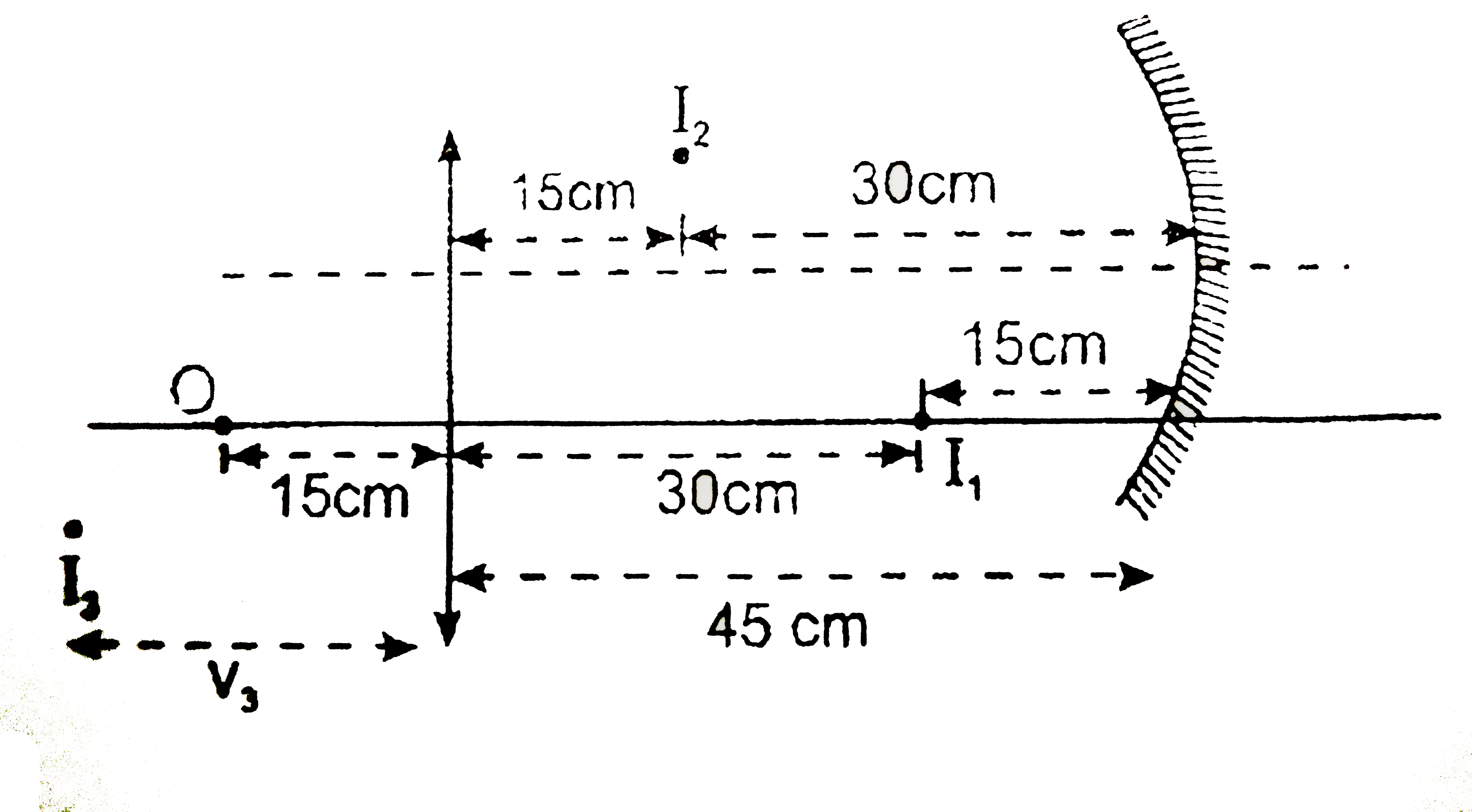 The height of `I_(2)` above pricnipal axis of lins is `=(v_(2))/(u_(2))xx1+1=3cm` `I_(2)` acts a source for lens`therefore u_(3)=-(45-v_(2))=-15 cm` Hence the lens forms an image `I_(3)` at a distance `v_(3)=30 cm` to the left of lens and at a distance The height of `I_(2)` above principal axis of lens is `|(v_(3))/(u_(3))|xx 3 cm =6 cm` `therefore` required distance `=sqrt(30^(2)+6^(2))=6sqrt(26) cm` |
|
| 39. |
Explain Hallwach's and Lenard's observation on photoelectric effect. Define : a.work function b. Threshold frequency c. Stopping potential |
|
Answer» Solution :Hallwach.s and Lenard conducted a detailed study of the phenomenon of photoelectric EMISSION. Lenard observed that when ultraviolet radiations were ALLOWED to FALL on the emitter plate of an evacuated glass tube enclosing two electrodes (metal plates), current flows in the circuit. As soon as the ultraviolet radiation is stopped , the current flows also stops. Thus, light falling on the surface of the emitter causes current in the external circuit. Hallwach.s observed that the uncharged zinc plate became positivelycharged when it is irradiated CHARGED zinc plate gets enhanced when it is illuminated by ultraviolet light. From the EXPERIMENTAL observations he conclude that zinc plateemits negativelycharged particles under the action of ultraviolet light. Definitions: a. Work function :The minimum energy required for an electron to excape from the metal surface is called the work function. Threshold frequency : Threshold frequency of a metal is the minimum cut-off frequency of incident light below which no photoelectric emission takes place irrespective of intensity of incident light. c. Stopping potential : Stopping potential of a photo sensitive metal is defined as the minimum negative potential applied to the collector at which the photoelectric current just drops zero. |
|
| 40. |
A p-n photodiode is fabricated from a semiconductor with a band gap of 2.8 eV. Can it detect a wavelength of 6000 run? |
|
Answer» Solution :Here energy band GAP `E_(g) = 2.8` eV and WAVELENGTH to be detected `lambda` = 6000 nm = `6 xx 10^(-6)` m ` therefore` Energy of light photonE = `(hc)/(E lambda) `eV ` = (6.626 xx 10^(-34) xx 3 xx 10^(8))/(6 xx 10^(-6) xx 1.6 xx 10^(-19) ) `eV = 0.207 eV As the energy of light photon is much less than the band gap, hence the given PHOTODIODE cannot detect it. |
|
| 41. |
The binding energies of deuteron (._1H^2) and alpha-particle (._2He^4) are 1.25 and 7.2 MeV/nucleon respectively. Which nucleus is more stable? |
| Answer» Solution :BINDING ENERGY of `""_2He^4` is more than deutron `""_1H^2` . HENCE `""_2He^4` is more STABLE. | |
| 42. |
If electronic charge e, electron mass m, speed of light in vacuum c and Planck's constant h are taken as fundamental quantities, the permeability of vacuum mu_(0) can be expressed in units of : |
|
Answer» `((mc^(2))/(he^(2)))` |
|
| 43. |
Assertion: No work is done in moving an electric dipole translationaly in a uniform electric field Reason:Net force on electric dipole in uniform electric field is zero. |
|
Answer» Both Assertion and Reason are TRUE and Reason is the correct explanation of Assertion |
|
| 44. |
An electron jumps from 1st orbit to 3rd orbit, then it will : |
|
Answer» RELEASE energy |
|
| 45. |
Meissner effect is observed in………substances. |
|
Answer» ferromagnetic |
|
| 46. |
Piecces of iron or steel that acquired magnetic properties when it is rubbedwith a magnet are called .......... . |
| Answer» SOLUTION :ARTIFICIAL MAGNET | |
| 47. |
The moment of Inertia of a uniform semicircular disc of mass M and radius 'r' about a line perpendicular to the plane of the disc through the centre is : |
|
Answer» `(1)/(4)Mr^(2)` implies MI of given half disc is `I.=(1)/(2)(Mr^(2))=(1)/(2)Mr^(2)` |
|
| 48. |
In conduction mode, heat an be transferred from a point ofhigher temperature of the point of lower temperature |
|
Answer» with the ACTUAL MIGRATION of the PARTICLES of medium |
|
| 49. |
What was the turning-point in their friendship? |
|
Answer» When they WENT to city |
|
| 50. |
In a reversible reaction , K_(e) lt K_(p) and Delta H =+40kca. The product will be obtained in less amount on |
|
Answer» Decreasing PRESSURE and temperature `K_(e)gtK_(p)` `4A+B rarrC+D` `Deltan=2-5 =-3` `DeltaH=+ve` Endothermic reaction ` Tdarr-` Backward direction `pdarr-` Backward According to Le-chatelier |
|