

Saved Bookmarks
This section includes 7 InterviewSolutions, each offering curated multiple-choice questions to sharpen your Current Affairs knowledge and support exam preparation. Choose a topic below to get started.
| 1. |
What is source of electromagnetic waves ? |
| Answer» SOLUTION :An accelerating chage PRODUCES em. Waves An electric charge oscillating harmonically with frequency V, | |
| 2. |
A low voltage supply from which one needs high currents must have very low internal resistance. Why? |
| Answer» Solution :As, `I_("MAX")` = emf INTERNAL resistance so for maximum CURRENT internal resistance should be LEAST. | |
| 3. |
A cell whose e.m.f. is 2V and internal resistance is 0.1Omega is connected with a resistance of 3.9Omega the voltage across the cell terminal will be |
|
Answer» 0.5 V |
|
| 4. |
A and B are two points separated by a distance 5cm. Two charges 10 mu C and 20 muC are placed at A and B. The resultant electric intensity at a point P outside the charges at a distance 5cm from 10 mu C is |
|
Answer» `54 xx 10^6` N/C away from `10 MU C` |
|
| 5. |
A cylindrical capacitor with external radius R, internal radius R-d(dltltR ), length l and mass M hangs on an insulating cord in a region where there is a homogenous, vertical magnetic field of strength B. It can rotate freely as a whole around its vertical axis, but is constrained, so that it can not move horizontally. The capacitor is charged and there is a voltage difference Choose CORRECT statement |
|
Answer» When capacitor is DISCHARGED through radial wire then value of `omega_(MAX)` depends on VALUES of R and d |
|
| 6. |
A cylindrical capacitor with external radius R, internal radius R-d(dltltR ), length l and mass M hangs on an insulating cord in a region where there is a homogenous, vertical magnetic field of strength B. It can rotate freely as a whole around its vertical axis, but is constrained, so that it can not move horizontally. The capacitor is charged and there is a voltage difference Charge on capacitor is given by |
|
Answer» `in_(0)(2piRlV)/(d)` `therefore C=in_(0)(2piRl)/(d)` `Q=CV=(in_(0)2pirlV)/(d)` `MR^(2) (DOMEGA)/(dt)=IBRd=BRd(dQ)/(dt)` `impliesMR^(2) Deltaomega = BRdDeltaQ` `impliesomega_(MAX)=(2piin_(0)VBl)/(M)` |
|
| 7. |
A cylindrical capacitor with external radius R, internal radius R-d(dltltR ), length l and mass M hangs on an insulating cord in a region where there is a homogenous, vertical magnetic field of strength B. It can rotate freely as a whole around its vertical axis, but is constrained, so that it can not move horizontally. The capacitor is charged and there is a voltage difference If without being mechaically disturbed, the capacitor is discharged through an internal radial wire then find maximum angular velocity of capacitor |
|
Answer» `(piin_(0)VBL)/(M)` |
|
| 8. |
Assertion: For cooking in a microwave oven, food is always kept in metal containers. Reason: The energy of microwave is easily transferred to the food in metal container. |
|
Answer» If both assertion and reason are TRUE and the reason is the CORRECT explanation of the assertion. |
|
| 9. |
A resistor R and an inductor L are connected in series to a source V=V_m sin omegat. Find the (a) peak value of the voltage drops across R and across L, (b) phase difference betweenthe applied voltage and current. Which of them is ahead ? |
|
Answer» Solution :Consider a circuit having an inductance land a resistance R, joined in series to an a.c. supply. Let voltage provided by a.c... supply be `V=V_(m) sin omegat`. (a) Let an instantaneous current l FLOWS through the coil. Then instantaneous VALUES of potential drops across inductance and resistance are verbs are given by `vecV_(L)=I X_(L) and vecV_(R)=IR," where "X_(L)=omega L` is the reactance due to the inductance. MOREVER phasor `vecV_(R)` is in phase with `vecI" but "vecV_(L)` leads in phase by `pi/2". Let "vecV_(R) and vecV_(L)` be represented by OA and OB in a phasor diagram. Then resultant voltage `vecV` will be given by the phasor OC. Hence. `V=OC =sqrt(OA^(2)+OB^(2))` 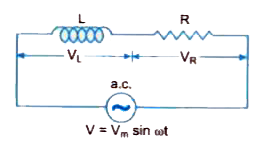 `=sqrt(V_(R)^(2)+V_(L)^(2))=I sqrt(R^2+X_(L)^(2))` `I=V/sqrt(R^(2)+X_(L)^(2)) and I_(m)=V_(m)/sqrt(R^(2)+X_(L)^(2))` Peak voltage drop across R, `(V_(m))_R=I_(m). R=(V_(m).R)/sqrt(R^(2)+X_(L)^(2))` and peak voltage drop across, `L (V_(m))_L=I_(m).X_(L)=(V_(m).X_(L))/sqrt(R^(2)+X_(L)^(2))` 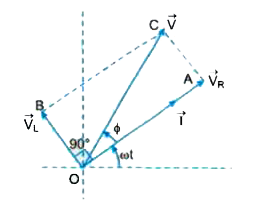 (b) As per phasor diagram, the circuit voltage V is ahead as compared to circuit current I (or current I is lagging behind hte SOURCE voltage V) by a phase ANGLE `theta`, where `tan phi=(AC)/(OA)=(OB)/(OA)=(IX_(L))/(IR)=X_L/R=(L omega)/(R)` |
|
| 10. |
In the circuit shown in figure a current I = 600 muA enters through A and leaves through B. Reading of the identical voltmeters V_(1) and V_(2) are 20 V and 30 V respectively. find R. |
|
Answer» |
|
| 11. |
The product of permittivity (in_(0)k) of a medium the normal component of electric intensity (Ecostheta) and the given small area (ds) is called as |
|
Answer» T. N. E. I. over small area ds |
|
| 12. |
(a) In hydrogenatom an electron undergoes transitions from2ndexcitedstateto the1st excitedstateand then to theground state. Identify the spectral series to whichtransition belong . (b) Find out the ratio of the wavelenghtof the emittedradiations in thetwo cases. |
|
Answer» Solution :(a) When an ELECTRON undergoes a TRANSITION from 2nd excited STATE (n = 3) to the 1st excited state (n = 2) in hydrogen atom, first spectral line of Balmer series is emitted. When the electron jumps from Ist excited state in 2) to the ground state (1=1), first spectral line of Lyman series is emitted. (b) `(1)/(lambda_(1)) = R [(1)/((2)^(2))- (1)/((3)^(2))] = (5R)/(36)and(1)/(lambda_(2)) = R [(1)/((1)^(2)) - (1)/((2)^(2))] = (3R)/(4)` `rArr (lambda_(1))/(lambda_(2)) = (27)/(5) = 5.4` |
|
| 13. |
A metallic rod of length l, linear mass density murotates about one of it.s end .O. in a smooth horizontal plane with an angular velocity omegaabout an end axis which is perpendicular to plane of rotation shown in figure. A transverse pulse generated at the free end P to reach the axis of rotation, (neglect the gravitational effect): |
|
Answer» The speed of the transverse pulse just after GENERATED at the FREE end point P with respect to ground is `l omega` |
|
| 14. |
Steam is passed into 54gm of water at 30^@C till the temperature of mixture becomes 90^@C . If the latent heatof steam is 536 cal//gm. The mass of mixture will be |
|
Answer» 80 gm |
|
| 15. |
A device to store electrical charge is called. |
|
Answer» Transformer |
|
| 16. |
In the circuit shown |
|
Answer» R=8 ohms `1=(12)/(6+R)` `R=6Omega` |
|
| 17. |
A proton released from rest in an electric field , will start moving towards a region of .............potential in the field. |
|
Answer» |
|
| 18. |
State Gauss' law in electrostatic. |
| Answer» SOLUTION :See point Number 47 under the HEADING " CHAPTER AtA GLANCE" | |
| 19. |
A vibration magnetometer consists of two identical bar magnets, placed one over the other, such that they are mutually perpendicular and bisect each other. The time period of oscillation in a horizontal magnetic field is 4 second. If one of the magnets is taken away, find the period of oscillation of the other in the same field. |
|
Answer» Solution :For a vibration magnetometer, we KNOWN that `T = 2pi SQRT((I)/(MB))` LET M bet the MAGNETIC moment and I be the moment of INERTIA of each magnet then , `M^(1) = sqrt(M^(2) + M^(2)) = sqrt(2)M and I^(1) = I + I =2I` `:. T^(1) = 2pi sqrt((2I)/(sqrt(2)MB)) = 2pi xx sqrt((sqrt(2)I)/(MB))`.......... (1) when one of the magnet is taken away then , `M^(1) = M, I^(11) = I` ` :. T^(11) = 2pi sqrt((I)/(MB))`............ (2) `(eq(2))/(eq(1)) implies (T^(11))/(T^(1)) = (1)/((2)^(1//4)) of ` `T^(11) = (4)/((2)^(1//4)) = 3.36 ` sec. |
|
| 20. |
A hole is drilled half way to the centre of the Earth. A body is dropped into the hole. How much will it weigh at the bottom of the hole if the weight fo the body on the Earth's surface is 350 N? |
|
Answer» Solution :GIVEN : WEIGHT of the BODY on Earth's surface, W = mg = 350 N. Body is thrown at depth, Depth, `d=(R )/(2)` Where R is the radius of the earth. At depth d, the acceleration due to gravity is given by, `g_(d)=G[1-(d)/(R )]` `therefore ` Weight of the body at depth d is `W_(d)=mg_(d)=mg[1-(d)/(R)]` `=350 [1-(R//2)/(R)]` `=350 xx (1)/(2)` ` =175 N.` |
|
| 21. |
A body of mass m, accelerates uniformly from rest to v_(1) in time t_(1). The instantaneous power delivered to the body as a function of time is : |
|
Answer» `(mv^2)/(T^2).t` `P=Fv=mav=m(v/T)(v/Tt)=(mv^2)/(T^2)t` |
|
| 22. |
Assume that light of wavelength 600 Å is comingfrom a star. What is the limit of resolution of telescope whose objective has a diameter of 100 inch? |
|
Answer» SOLUTION :The limit of resolution of a telescope, `dtheta = (1.22lambda)/(D)` `D=100 :"inch"=254CM "" [therefore1"inch"=2.54cm]` `LAMBDA = 6000 Å=6000xx10&^(-10) m` `dtheta = (1.22 xx 6000 xx 10^(-10))/(254 xx 10^(-2)) = 2.9 xx 10^(-7)` `d theta = 2.9 xx 10^(-7) rad` |
|
| 23. |
Clasically, an electron can be in any orbit around the nucleus of an atom. Then what determines the typical atomic size? Why is an atom not, say , thousand times bigger than its typical size? The question had greatly puzzled Bohr before he arrived at his famous model of the atom. To stimuluate what he might well have done before his discovery, let us play with the basic constants of nature and see if we can get a quantity with the dimensions of length that is roughly equal to known size of an atom (~~10^(-10)m). (a) Construct a quantity with the dimensions of length form the fundamental constant e,m_e and c. Determine its numerical value. (b) you will find that the length obtained in (a) is many orders of magnitude smaller than the atomic dimensions. Further, it involves c. But energies of atoms are mostly in non-relativistic domain where c is not expected to play any role. This is what may have suggested Bohr to discard c and look for something else to get the right atomic size. Now, the Planck's constant h had already made its appearence elsewhere. Bohr's great insight lay in recognising that h,m_e and e will yield the right atomic size. Construct a quantity with the dimensions of length form h, m_e and e and confirm that its numerical value has indeed the correct order of magnitude. |
|
Answer» Solution :(a) Using fundamental CONSTANTS, e,`m_e` and C, we construct a quantity which has the dimenstions of LENGTH. This quantity is `((e^2)/(4pi in_0m_ec^2))` Now, `(e^2)/(4pi in_0m_ec^2)=((1.6xx10^(-19))^2xx9xx10^9)/(9.1xx10^(-31)(3xx10^8)^2)=2.82xx10^(-15)m` This is much smaller than the typical atomic size. (b) However, when we drop c and USE h,`m_e` and e to construct a quantity, which has dimensions of length, the quantity we obtain is `(4pi in_0(h//2pi)^2)/(m_e e^2)` Now,`(4pi in_0(h//2pi)^2)/(m_e e^2)=((6.6xx10^(-34)//2pi)^2)/(9xx10^9xx(9.1xx10^(-31))(1.6xx10^(-19))^2)~~0.53xx10^(-10)m` This is of the order of atomic sizes. |
|
| 24. |
A convex lens has a focal length of 0.1 m in air. Calculate its power. If the lens is completely dipped in CS_(2) of refractive index 1.66, then what will be the change in power of the lens? Given R.I of the convex lens = 1.50. |
|
Answer» Solution :`f=0.1m` `THEREFORE "POWER"=(1)/(f)=(1)/(0.1m)` `P=+10D` w.K.t`(1)/(f)=P=(n-1)(k)` `therefore k=(P)/(n-1)=(10)/(1.5-1)=(10)/(0.5)=20` Also,`" "_(1)n_(2)=(n_(2))/(n_(1))=(n_(g))/(n_(cs_(2))) =(1.5)/(1.66)=0.9036` `therefore(1)/(f_(e))=k(""_(cs_(2))n_(g)-1) =20(0.9036-1)` `therefore P_(e) = 20xx(-0.0964)= -1.928D` LENS behaves as a diverging lens of power = -1.93 D Change in power `DeltaP=P_(f)-P_(1)= -1.93-(+10)= -11.93D` |
|
| 25. |
Potential difference of 100 V is applied to the ends of a copper wire one metre long. Calculate the average drift velocity at 27^@ C . Assume that there is one conduction electron per atom. The density of copper is 9.0xx10^3 kg//m^3 , Atomic mass of copper id 63.5 g. Avogadro's number =6.0xx10^(23) per gram- mole. Conductivity of copper is 5.81xx10^(7) Omega^(-1) . Boltzmann constant =1.38xx10^(-23) JK^(-1). |
|
Answer» Solution :Here , `V= 100 V , l = 1 m` M= 63.5 g = `63.5 xx 10^(-3) Kg` `rho = 9.0xx10^3 kg//m^3` `N = 6.0xx10^(23) ` per GRAM- mole, `sigma = 5.81 xx 10^7 Omega^(-1)` SINCE `6 xx 10^(23)` copper atoms have a MASS of 63.5 g , and there is one conduction electron per atom, number of electrons per unit volume is `n = (6.0xx10^(23))/(63.5xx10^(-3)) xx9.0xx10^3 kg//m^3 = 8.5xx10^(28) m^(-3)` ELECTRIC field `E= V/l = (100)/(1) = 100 Vm^(-1)` As J = `sigmaE= "ne"v_d` `therefore V_d = (sigmaE)/("ne") = ((5.81xx10^7) xx(100))/((8.5xx10^(28)) xx 1.6xx10^(-19)) = 0.43 MS^(-1)` Thermal velocity `v_("rms") = sqrt((3k_B T)/(m_e))` `= sqrt((3xx 1.38xx 10^(-23) xx 300)/(9.1xx10^(-31))) = 1.17xx10^5 ` m/s `(V_d)/(V_(rms)) = (0.43)/(1.17xx10^5) = 3.67xx10^(-6)` |
|
| 26. |
In the figure an arrangement of young's double slit experiment is shown. A parallel beam of light of wavelength 'lambda' (in medium n_(1)) is incident at an angle 'theta' as shown. Distance S_(1)O = S_(2)O. Point 'O' is the origin of the coordinate system. The medium on the left and right side of the plane of slits has refractive index n_(1) and n_(2) respectively. Distance between the slits isd. The distance between the screen and the plane of slits is D. Using D=1m , d =1mm, theta=30^(@), lambda=0.3mm,n_(1)=(4)/(3),n_(2)=(10)/(9), answer the following They-corrdinate of the point where the total phase difference between the interefering waves is zero, is |
| Answer» Solution :N//a | |
| 27. |
At SPT, The speed of sound in hydrogen is 1324 m/s then the speed of sound in air |
|
Answer» 331 m/s Molecular weigh of oxygen = 32 Bothare diatomic `v_(AIR)=SQRT(((gamma_(air)P_(air))/(p_(air)))),v_(H)=sqrt((gamma_(H)P_(H))/(P_(H)))` `(P_(air))/(p_(H))=(M_(air))/(M_(H))=(32)/(2)=16/1` `(v_(air))/(v_(H))=sqrt(((gamma_(air)Pp_(H))/(gamma_(H)Pp_(air))))rArr(v_(air))/(1324)=sqrt(((P_(H))/(P_(air))))` `""v_(air)=(1324)/4=331 m//s` |
|
| 28. |
To convert a galvanometer into a ammeter, one needs to connect a. |
| Answer» Solution :A galvanometer can be CONVERTED in to ammeter by connecting a SMALL RESISTANCE in parallel to it.A galvanometer can be converted into voltameter by connected a HIGH resistance in SERIES with it. | |
| 29. |
The current (I) – voltage (V) characteristic of three devices A, B and C connected in the circuit is as shown below. Plot the variation of current through the cell when its emf is changed from 0 and 90 V. |
|
Answer» |
|
| 30. |
Which one among the following waves are called waves of heat energy? |
|
Answer» RADIO WAVES |
|
| 31. |
Assertion:Voltameter measures current more accurately than ammeter. Reason: Relative error will be small if measured from voltameter. |
|
Answer» If both assertion and REASON are true and the reason is the CORRECT explanation of the assertion. |
|
| 32. |
The power of motor pump is 2 KW. The water raised by the pump per minute to a height of 10 m. is nearly : |
|
Answer» 100 litres |
|
| 33. |
The coefficient of friction is 0.75. If sin 37^(@) = 0.6, the angle of friction is |
|
Answer» `18^(@)` |
|
| 34. |
An alpha- particle and a proton are accelerated through same potential difference. Find the ratio. (v_(alpha)//v_(p)) of velocities acquired by two particles. |
|
Answer» <P> Solution :If a PARTICLE of mass m and charge q on accelerating through a potential difference V ACQUIRES a velocity v then `(1)/(2)mv^(2)=qV or v=sqrt((2qV)/(m))``rArr""(v_(alpha))/(v_(p))=sqrt((a_(alpha))/(q_(p))xx(m_(p))/(m_(alpha)))"[SINCE V = constant]"` `rArr""(v_(alpha))/(v_(p))=sqrt(2XX(1)/(4))=sqrt((1)/(2)) or v_(alpha):v_(p)=1:sqrt2`. |
|
| 35. |
The concentric spherical conducting shells are arranged in vacume as shown in fig. the electric capacity of the arrangement between .A. and .B. will be |
|
Answer» `48 piepsilon_(0)a` |
|
| 36. |
A long , rigid conductor , lyingalong x-axis carries a current of 5.0A in the negative x direction . A magnetic vecB=3.01 hat i+8.0 x^(2)hatj, with x in metres and vecB in milliteslas. Find, in unit -vector notation , the force on the 2.0 , segment of the conductor that lies between x=1.0 m andx=3.0 m |
|
Answer» |
|
| 37. |
Refractive index of a prism A ray is incident on an equilateral prism such that the angle of deviation is 30^(@) . It is seen that if the angle of incidence is increased by 30^(@), then the deviation is again 30^(@). Find the refractive index of the prism. |
|
Answer» Solution :We can EASILY see that in one SITUATION the angle of incidence will be `i` and in the next situation angle of incidence will be `i+30^(@)`. From the above DISCUSSION, we can SAY that in the first situation, the angle of emergence should be `i+30^(@)` and in the second situation, the angle of emergence should be `i`. Calculation : In both the cases `delta=i+e-A` `30^(@)=i+i+30^(@)-60^(@)` `i=30^(@)` The angle of emergence thus is `i+30^(@)=60^(@)` By Snell.s law, `1sin30=nsinr_(1)` By Snell.s law at the second surface we have `1sin60=nsinr_(2)` `1sin60=nsin(60-r_(1))` Solving for n we GET `n=sqrt((4+sqrt(3))/(3))`. |
|
| 38. |
With the help of labelled diagram, state the underlying principle of a cylclotron. Explain clearly how it works to accelerate the charged particles to high energies. Show that cyclotron frequency is independent of energy of the particle. Is there an upper limit on the enregy acquired by the particle? Give reason. |
| Answer» Solution :A cyclotron makes USE of the principle that the energy of the CHARGED particles or ions can be made to increase in presence of crossed ELECTRIC and magnetic fields. The magnetic field acts on the charged particle and makes them move in a circular path INSIDE the dee. Every time the particle moves from one dee to another it is acted upon by the alternating electric field, and is ACCELERATED by this field, which increases the energy of the particle. | |
| 39. |
Draw the block diagram of an AM receiver . |
Answer» SOLUTION :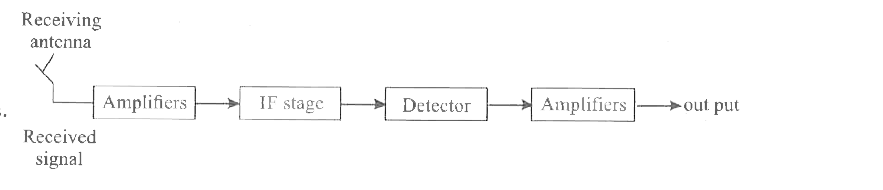
|
|
| 40. |
The diffusion current in a p - n junction is |
|
Answer» <P> from the n - side to the p-side |
|
| 42. |
Suppose the circuit in Exercise 18 has a resistance of 15 Omega. Obtain the average power transferred to each element of the circuit, and the total power absorbed. |
|
Answer» Solution :Given, the rms VALUE of voltage `V_("rms")=230 V` RESISTANCE `R = 15 Omega` Frequency `f = 50 Hz` Average power across inductor and capacitor is zero as the phase DIFFERENCE between current and voltage is `90^(@)`. Total power absorbed = power absorbed in resistor, `P_("av")` `= V_("rms").I_("rms")` So, `Z=sqrt(R^(2)+(X_(L)-X_(C ))^(2))` `= sqrt((15)^(2)+(2xx3.14xx50xx80xx10^(-13)-(1)/(2xx3.14xx50xx60xx10^(-6))))` `= sqrt(1002.85)=31.67 Omega` `I_("rms")=(V_("rms"))/(Z)=(230)/(31.67)=7.26 A` Total power absorbed `P_("av")` `= V_("rms").I_("rms")` `= I_("rms").R.I_("rms")` `= (7.26)^(2)xx15=790.6W` Total power absorbed = 790.6W |
|
| 43. |
The current in the forward bias is known to be more (~ mA) than the current in the reverse bias (~ mu A ). What is the reason, then to operate the photndiode in reverse bias ? |
|
Answer» Solution :LET us consider an n-type semiconductor which has electrons as majority charge carriers and holes as minority charge carriers such that `n_(e) gt gt n_(h)` . On illumination with appropriate light let excess electrons generated be `Delta n_(e) and Delta n_(p)` such that ` n_(e)' = n_(e) + Delta n_(e) and n_(p)' = n_(e) + Delta n_(e)`.Here `n_(e)' and n_(p)' ` are the electron and hole CONCENTRATIONS at a particular illumination level and `n_(e) and n_(p)`are carrier CONCENTRATION in the absence of illumiation. Due to illumination `Delta n_(e) = Delta n_(p) and n_(e) gt gt n_(p)`.Hence, FRACTIONAL change in majority charge carriers (electrons) `(Delta n_(e))/( n_(e))`would be much less than corresponding change in minority charge carriers (holes)` (Delta n_(p))/(n_(p))`.THUS, fractional change on minority charge carriers is more easily measurable when the semiconductor is illuminated. Due to this reason a photodiode is preferably used in reverse bias only. |
|
| 44. |
A network of four 10muF capacitors is connected to a 500 V supply, as shown in figure. Determine (a) the equivalent capacitance of the network and (b) the charge on each capcitor. |
|
Answer» Solution :(a) In the given network, `C_(1),C_(2) and C_(3)` are CONNECTED in series. The effective capacitance C. of these three capacitors is given by `1/(C.)=1/C_(1)+1/C_(2)+1/C_(3)` For, `C_(1)=C_(2)=C_(3)=10muF, C.=(10/3)muF`. The network has C. and `C_(n)` connected in parallel. Thus, the equivalent capacitance C of the network is `C=C.+C_(4)=(10/3+10)muF=13.3muF` (b) From the figure, the charge on each of the capacitors, `C_(1), C_(2) and C_(3)` is the same, say Q. Let the charge on `C_(4)` be Q.. Now, since the POTENTIAL difference ACROSS AB is `Q/C_(1)` across BC is `Q/C_(2)" across CD is "Q/C_(3)" we have "Q/C_(1)+Q/C_(2)+Q/C_(3)=500V` Also, `(Q.)/C_(4)=500V` This given for the given value of the capacitances, `Q=500 xx 10/3 xx 10^(-6) =1.7 xx 10^(-3)C and` `Q.=500 xx 10 xx 10^(-6) =5.0 xx 10^(-3)C` |
|
| 45. |
Two harmonic waves travelling in the same medium have frequency in the ratio 1:2 and intensity in the ratio 1:36. Their amplitude ratio is |
|
Answer» `1:6` |
|
| 46. |
Photons of energies 4.25eV and 4.7eV are incident on two metal surfaces A and B respectively. The maximum KE of emitted electrons are respectively T_(A)eV and T_(B)=(T_(A)-1.5)eV. The ratio de-Broglie wavelengths of photo electrons from them is lamda_(A):lamda_(B)=1:2, then find the work function of A and B |
|
Answer» Solution :DE BROGLIE wavelength `LAMDA=(h)/(sqrt(2km))implieslamdaprop(1)/(sqrt(k))""(k=k.E=T)` `(lamda_(B))/(lamda_(A))=sqrt((T_(A))/(T_(B)))` `2=sqrt(T_(A)/(T_(A)-1.5))impliesT_(A)=2eV` `impliesW_(A)=4.25-T_(A)=2.25eV` `impliesT_(B)=T_(A)-1.5=2-1.5=0.5eV` `impliesW_(B)=4.7-T_(B)=4.7-0.5=4.2eV` |
|
| 47. |
Two electromagnetic waves create (0, 0, 1) Vm and (-1,0,1) Vm^(-1) displacement at one point any instance. So resultant intensity at this point will be...... Wm^(-2) |
|
Answer» `sqrt(5)` `=(0,0,1)+(-1,0,1)` `=(-1,0,2)` `:.E^(2)=(-1)^(2)+(0)^(2)+(2)^(2)=1++4=5and I prop d` `:.I= KE^(2)` `:.I=1xx5` `:.I=5 Wm^(-2)` |
|
| 48. |
Two circular coils of wire each having a radius of 4cm and 10 turns have a common axis and are 6cm apart. If a current of 1 A passes through each coil in the opposite direction find the magnetic induction. (i) At the centre of either coil , (ii) At a point on the axis, midway between them. |
| Answer» SOLUTION :`1.3 xx 10^(-4) T, (II) ZERO` | |
| 49. |
A point charge +Q is placed at the centre of an isolated conducting shell of radius R. Find the electrostatic potential energy stored outside the spherical shell if the shell also contains charge +Q distributed uniformly over it. |
| Answer» SOLUTION :`(Q^(2))/(2piepsilon_(0)R)` | |