Saved Bookmarks
This section includes 7 InterviewSolutions, each offering curated multiple-choice questions to sharpen your Current Affairs knowledge and support exam preparation. Choose a topic below to get started.
| 1. |
Four identical conducting plates are placed parallel to each other at equal separations as shown below: Plates A and D are fixed while B and C are connected with the help of a conducting spring of spring constant k. Initially, the spring is in relaxed position and B and C are at rest, now the spring is compressed slightly by displacing B and C and then plates B and C are released to perform SHM. Now the capacitance of the system across PQ [ Mass of each plate is m] |
|
Answer» REMAIN constant |
|
| 2. |
A car is moving along a straight horizontal road with a speed V. If the coefficient of friction between road and tyres is H, the shortest distance in which the car stops when engine is shut off, is : |
|
Answer» `(V^(2))/(2mug)` `(1)/(2)mV^(2)=mumgxxX` `:.X=(V^(2))/(2mug)` Hence CORECT choice is (a). |
|
| 3. |
In Young's double slit experiment, the intensity at a point P on the screen is half the maximum intensity in the interference pattern. If the wavelength of light used is lambda and d is the distance between the slits, the angular separation between point P and the centre of the screen is ...... |
|
Answer» `sin^(-1)((lambda)/(d))` `(I_(0))/(2)=I_(0) cos^(2){(2pi)/(lambda)XX(d sin THETA)/(2)}` `(1)/(2)=cos^(2){(PI d sin theta)/(lambda)}` `:.(1)/(sqrt(2))= cos {(pi d sin theta)/(lambda)}` `:.(pi)/(4)=(pi d sin theta)/(lambda)` `:. (lambda)/(4)= d sin theta :. theta sin^(-1)((lambda)/(4d))` |
|
| 4. |
Pressure at a depth inside the liquid is given by |
|
Answer» h/pg |
|
| 5. |
Two particles oscillate in simple harmonic motion along a common straight-line segment of length A. Each particle has a period of 1.5s but they differ in phase by pi//6 rad. (a) How far apart are they (in terms of A) 0.60s after the lagging particle leaves one end of the path? (b) Are they then moving in the same direction, toward each other, or away from each other? |
| Answer» SOLUTION :(a) ~~0.093A`, (B) MOVING in the same DIRECTION. | |
| 6. |
Two streams of electrons are moving parallel to each other in the same direction. They |
|
Answer» a net REPULSION between them |
|
| 7. |
A rat of light travels from water to glass. Which one of the following statements is true? |
|
Answer» FREQUENCY of LIGHT DECREASES |
|
| 8. |
Estimate the probability of cold electron emission from a metal, if there is a uniform field of strength E close to the surface of the metal. |
|
Answer» `a=(2L)/hsqrt(2m(U_(0)-epsilon_(F)))=(2A_(0))/(eEh)sqrt(2mA_(0))` 
|
|
| 9. |
As shown in fig. a conducting ring R is placed on the axis of a bar magnet M. The plane of R is perpendicular to the axis M can move along this axis _____ |
|
Answer» M will repel R when it is moving TOWARDS R |
|
| 10. |
In a purely inductive circuit ,the circuit current |
|
Answer» in PHASE with the voltage |
|
| 11. |
A 50kg man is standing at one end of a 25m long boat. He starts running towards the other end. On reaching the other end his velocity is 2ms. If the mass of the boat is 200 kg, final velocity of the boat is (in ms^(-1)) |
|
Answer» `2/5` |
|
| 12. |
(A): If the length of the conductor is doubled, the drift velocity will become half of the original value. (keeping potential diffe rence unchanged). (R): At constant potential difference, drift velocity is inversely proportional to the length of the conductor. |
|
Answer» Both 'A' and 'R' are true and 'R' is the correct explanation of 'A' |
|
| 13. |
The plane wall of an oven is of thickness L = 0.05 m and is exposed to the surrounding at 300 K. The outer surface of the oven exposed to the surrounding is at temperature 320 K in steady state. The energy radiated (In W//m^2) by outer surface is proportional to the temperature difference between the surface and the surrounding, with proportionality constant 20 W//m^2K. What is the temperature of inner surface of the oven in steady state if the wall has a thermal conductivity of K = 0.5 W/mK |
| Answer» ANSWER :D | |
| 14. |
What is Snell's window? |
| Answer» SOLUTION :The RESTRICTED ILLUMINATED circular area is called Snell's WINDOW | |
| 15. |
SI unit of magnetic pole strength is………………… . |
|
Answer» |
|
| 16. |
If an increase in length of copper wire is 0.5% due to stretching, the percentage increase in its resistance will be |
|
Answer» 0.001 We know, resistance `(R )= rho(l)/(A)= rho (l)/(A)xx(A)/(A)= rho (V)/(A^(2)) ""` (`because`VOLUME, i.e., `V=l xx A`) Percentage increase in resistance `(= rho (V)/(l^(4)))` (area, i.e., `A = l^(2)`, i.e., l is length of a wire) i.e., `(Delta R)/(R )xx100=4(Delta l)/(l)xx100=4xx0.5%=2%` |
|
| 17. |
Name the diode which can act as a voltage regulator. Explain its working with the help of its labelled circuit diagram. Draw its V-1 characteristic. |
|
Answer» Solution :A zener diode can act as a voltage regulator. Zener diode is fabricated by heavily doping both p- and n-sides of the p-n junction. As a result, the depletion REGION formed is very thin, even less than `10^(-6)m`, and consequently the electric field at the junction is extremely high (of the order of `5 xx 10^(6)` V /m or even more) even for a small reverse bias voltage of about 5 V and breakdown voltage VR or Vz has a low value of about 5 V. After zener (or breakdown) voltage [i.e.,`V_(R) ge V_(z)`], a large change in electric CURRENT can be produced by almost insignificant change in reverse bias voltage i.e., the zener voltage remains constant even through current PASSING through zener diode varies over a wide range. We know that reverse current is due to flow of minority charge carriers (that is electrons from `pton` and holes from `n to p`). As the reverse bias voltage is increased, the electric field at the junction becomes significant. When `V = V_(z)` the electric field is high enough so as to pull valence electrons from the host atoms on p-side which are accelerated to n-side. These electrons ACCOUNT for high current obtained at the breakdown. V-I CHARACTERISTICS of a zener diode is shown here. 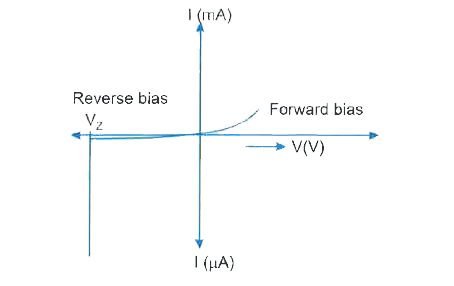 |
|
| 18. |
Some of the Passengers sitting in a stationary carriage push it from inside. Give reason whether carriage will move or not ? |
| Answer» SOLUTION :The force applied by the passengers is BALANCED by an equal and OPPOSITE force PROVIDES by the walll of the carriage. Hence, the net force is zero and the carriage cannot MOVE. | |
| 19. |
In a hydrogen atom as the electron moves to higher level its potential energy__________ and _________ kinetic energy. |
| Answer» SOLUTION :INCREASE , DECREASES | |
| 20. |
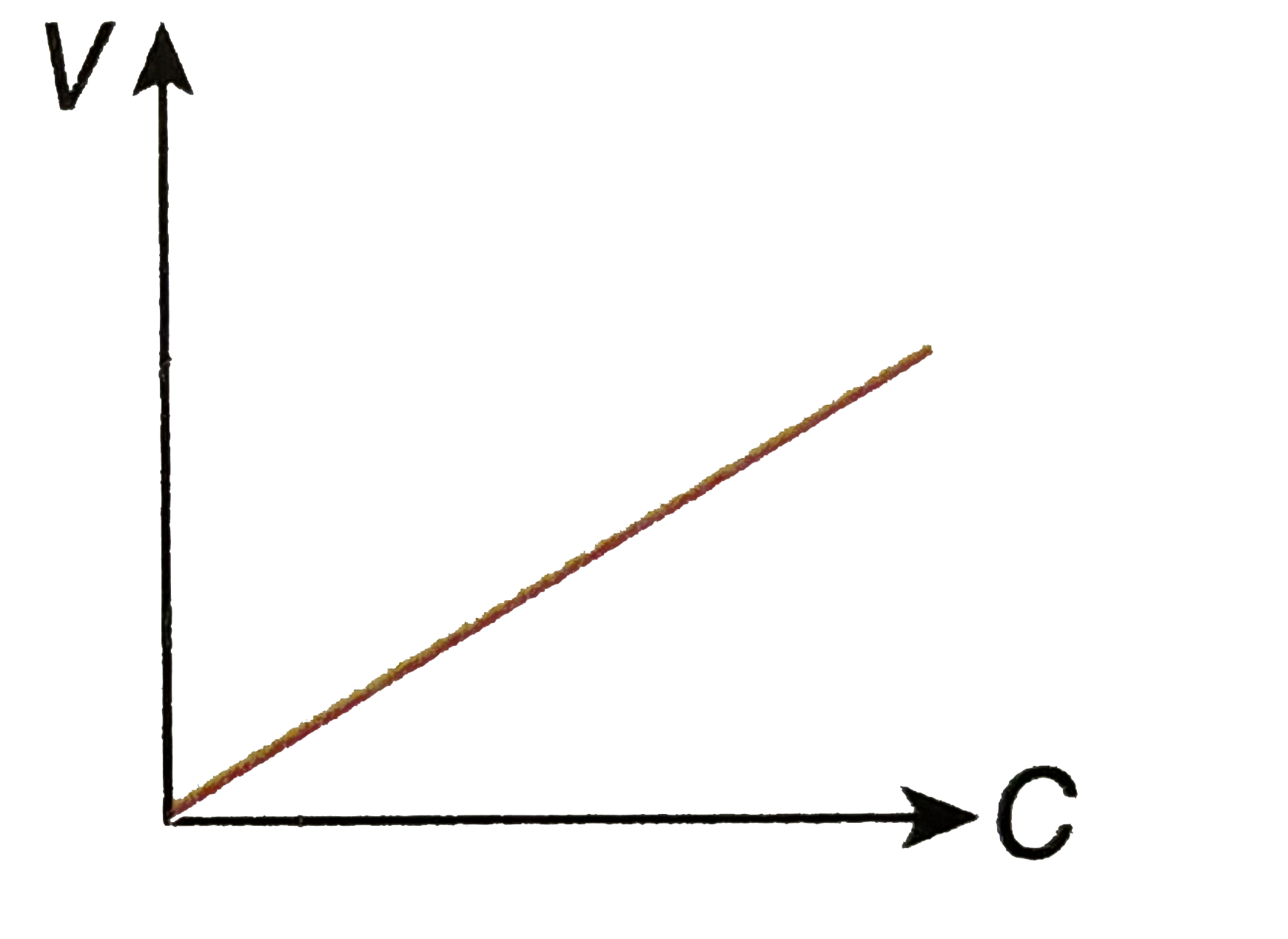
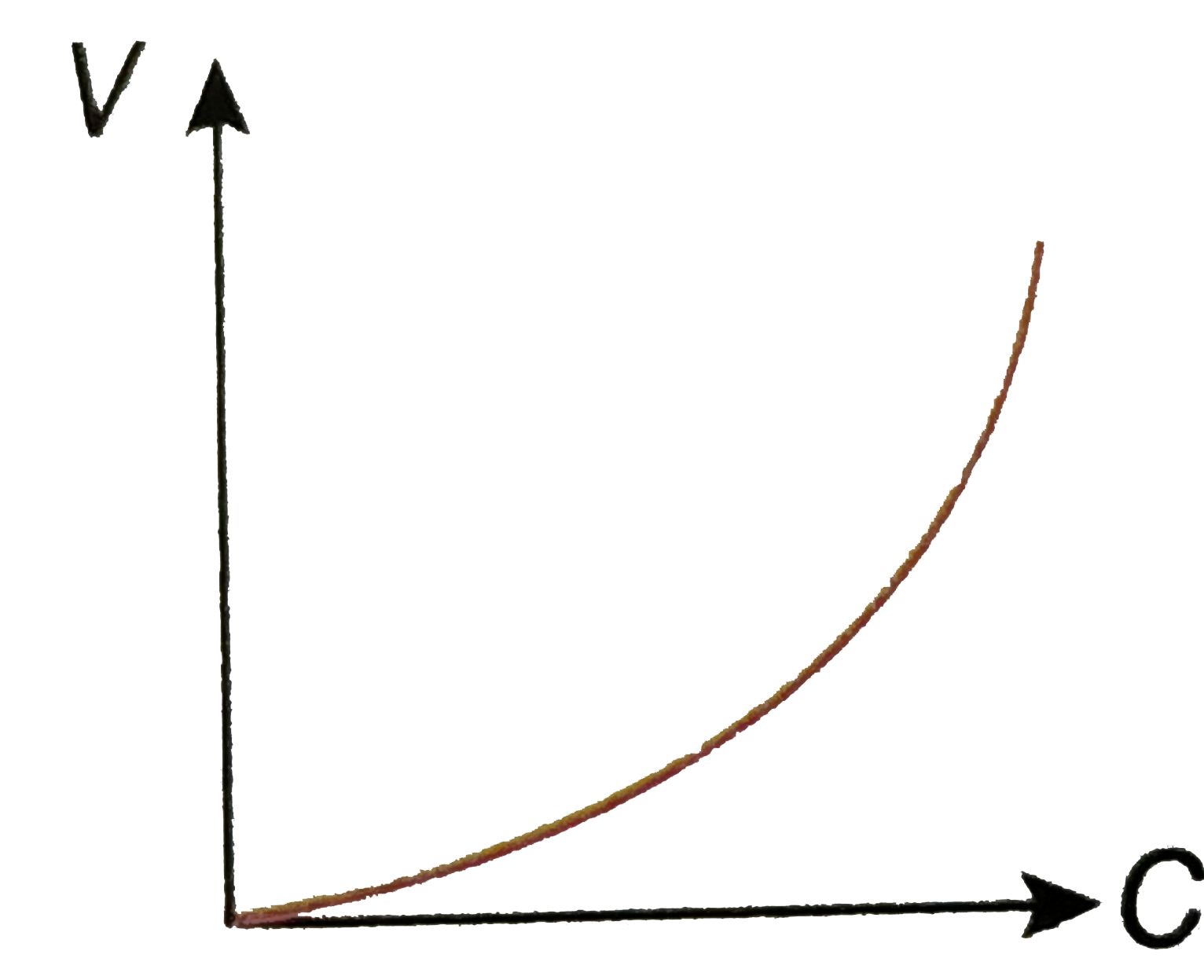
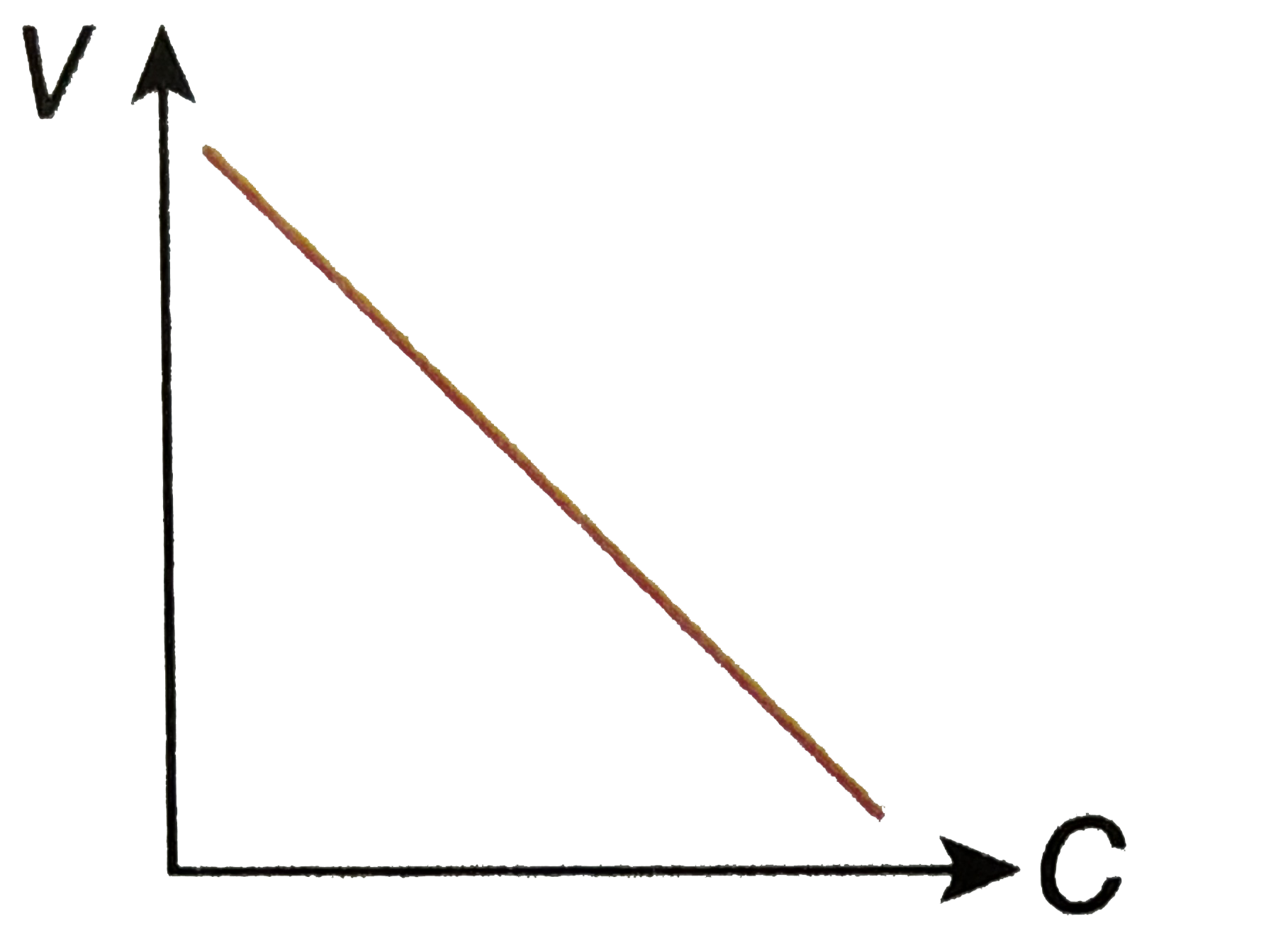
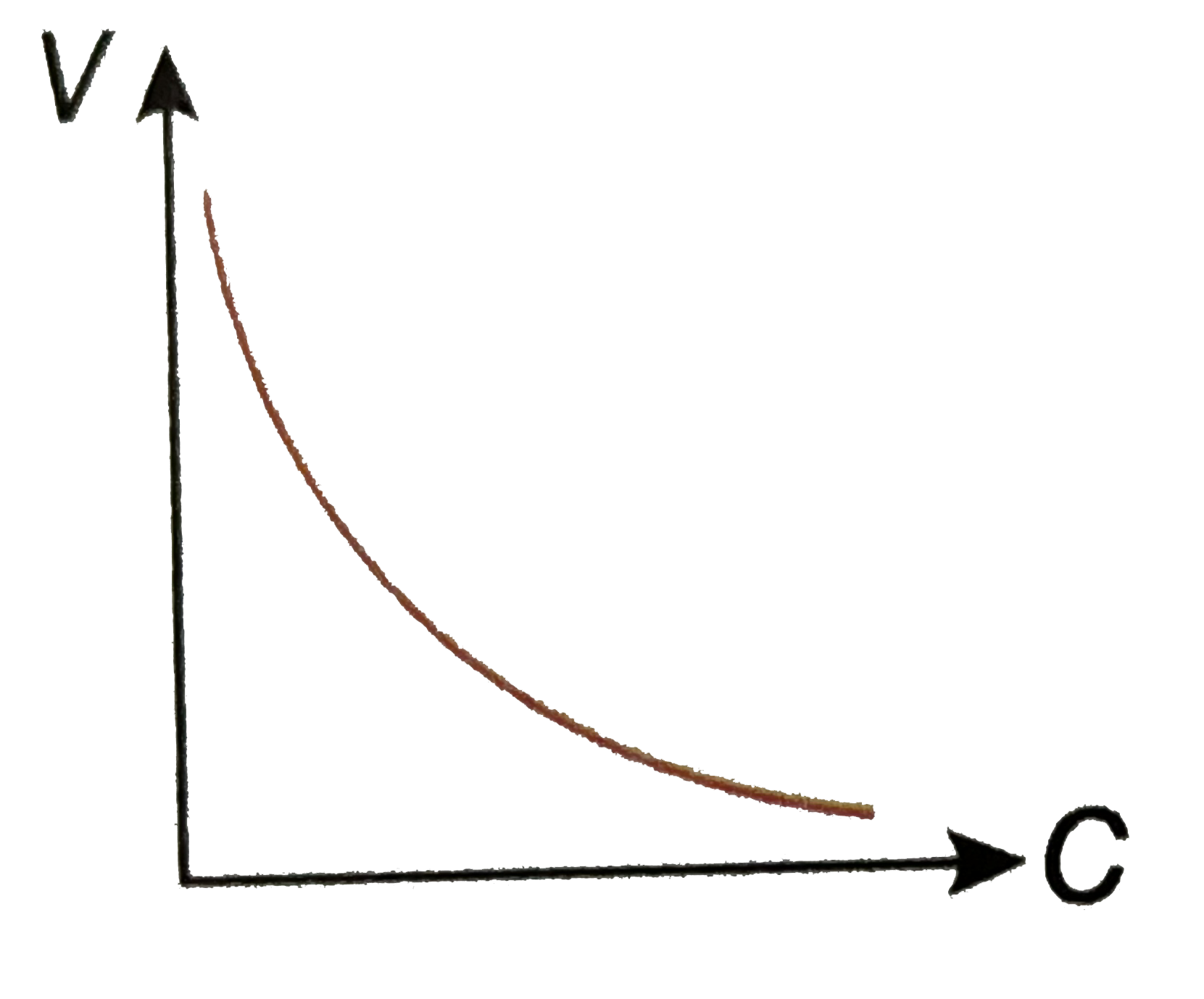
A few capacitors are equally charged. Which of the figures shows the nature of variation of the potential difference V between their plates with their capacitances C? |
|
Answer»
|
|
| 21. |
Derive an expression for electric potential at a point due to a system of N charges. |
|
Answer» <P> Solution :Consider a system of charges `q_(1), q_(2),q_(3),cdots, q_(N)` with position vectors `r_(1) ,r_(2) .r_(3) ,cdots r_(N )`.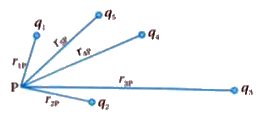 Electric potential at point P due to charge `q_(1)` `V_(1)=(kq_(1))/(r_(1)p)` where k is coulomb constant = `(1)/(4 pi in_(0))` and `r_(1)P` = distance between charge `q_(1)` and point P. Similarly electric potnetial due to charges `q_(2) , q_(3) cdots q_(N)` are `V_(2) = (kq_(2))/(r_(2)p), V_(3) = (kq_(3))/(r_(3)p)` and `V_(N)= (kq_(N))/(r_(NP))` Electric potential is a scalar quantity. HENCE total electric potential at P is, `V= V_(1)+V_(2)+V_(3)+, cdots, V_(N)` `:. V=k[(q_(1))/(r_(1P))+(q_(2))/(r_(2P))+(q_(3))/(r_(3P))+(q_(N))/(r_(NP))]` `:. N = k sum_(i=1)^(N)(q_(i))/(r_(iP))`where i =1,2,3, `cdots, ` N If `VECR` is the position vector of point P relative toorigin point and the position vectors `vecr_(1),vecr_(2),cdotsvecr_(n)`are of the charges `q_(1), q_(2), cdots , q_(N)` respectively then electric potential at point P, `V=ksum_(r=1)^(N)(q_(i))/((vecr-vecr_(i)))` where i=1,2,3 `cdots` N and `vecr_(iP)= (vecr-vecr_(i))` |
|
| 22. |
A small hole is made in a metallic hollow enclosure whose walls are maintained at a temperature of 10^(3)K. then the amount of radiant energy emitted per metre square per second from the hole is |
|
Answer» 56.7 J `=5.67xx10^(-8)XX(10^(3))^(4)` `=5.67xx10^(-8)xx10^(12)=5.67xx10^(4)` `=56.7xx10^(3)J` `=56.7kJ`. |
|
| 23. |
Consider the following two statemets Line spectra contain information about atoms. Band spectra contain information about molecules |
|
Answer» Both A and B are WRONG |
|
| 24. |
A regular polygon of 'n sides is formed by bending a wire of length 2 pi R which carries a current i. Find the magnetic field at the centre of the polygon? |
Answer» SOLUTION : ONE side of polygon `a = (2pir)/(n)` `alpha = beta = ((2pi)/(n))//2 = (PI)/(n) , cot alpha = (d)/(a//2)` ` d = (a)/(2) cot alpha = (pi R)/(n) cot"" ((pi)/(n))` All SIDES of polygen produce magnetic FIELD at O in same direction. so,, B = n (magnetic field due to one side) ` = n (mu_0i)/(4pi)(n)/(pi R cot ""(pi)/(n))(sin ""pi/n + sin "" pi/n)` `= (mu_0i)/(4R) (n^2)/(pi^2)(2 sin pi//n)/(cos pi//n) . sin ""pi/n` `B = (mu_0i)/(2R) xx ({sin pi//n//_(pi//n)}^2)/(cos pi//n)` |
|
| 25. |
An elevator weighing 500 kg is to be lifted up at a constant velocity of 0.4 m/s what should be the minimum horse power of the motor used ? |
|
Answer» 3.72 HP |
|
| 26. |
A horizontal force F is applied at the top of an equilateral triangular block having mass m. The minimum coefficient of friction required to topple the block before translation will be |
|
Answer» `F.(a sqrt(3))/(2)=mg ,(a)/(2) , ""F=(mg)/(sqrt(3))` fornot sliding ` F lemu mg , (mg )/(sqrt(3)) le mu mg ` ` MUGE (1)/( sqrt(3))` |
|
| 27. |
What type of electric current flows in a closed coil with the change in magnetic flux? |
| Answer» SOLUTION :An alternating CURRENT is induced in the closed COIL. | |
| 28. |
X and Y coils are joined in a circuit in such a way that when the change of current in X in 2A, the change in the magnetic flux in Y is 0.4 Wb. The mutual induction of the system of two coils is …... . H. |
|
Answer» 0.8 `THEREFORE 0.4=Mxx2` `therefore` M=0.2 H |
|
| 29. |
Given quantity of water is boiled by an electric heater in 5 min. If supply voltage of heater reduces to half then time taken to boil the same quantity of water will be ........... min. (Assume the resistance of the heater remaining constant) |
|
Answer» Solution :20 H = `I^(2) RT` = = `(V^(2))/(R^(2)) XX Rt = (V^(2))/(R) t ` In `t = (HR)/(V^(2)) `, HR REMAINS same. `therefore tprop (1)/(V^(2))` `therefore (t_(2))/(t_(1)) = ((V_(1))/(V_(2)))^(2)` = `((V)/((V)/(2)))^(2)` = 4 `therefore t_(2) = t_(1)xx 4 = 5 xx 4 = 20 ` min |
|
| 30. |
The potential drop across 7muFcapacitor is 6V. Then |
|
Answer» potential drop across `3muF`CAPACITOR is 10V |
|
| 31. |
(A): Heat is produced in a resistor when connected across the terminals of a cell. (R): The energy dissipated as heat in a resis tor came from the chemical energy of electrolyte of cell. |
|
Answer» Both 'A' and 'R' are true and 'R' is the CORRECT explanation of 'A' |
|
| 32. |
A coil having 500 square loops each of side 10 cm is placed normal to a magnetic field which increases at the rate of 1.0 "tesla"//"second". The induced e.m.f. in volts is |
|
Answer» 0.1 |
|
| 33. |
A glass tube 1.5m long and open at both ends is immered vertically in a water tank completely. A tuning fork of 600 Hz is vibrated and kept at the upper end of tube is gradually raised out of water. The total number of resonances heard before when the tube comes out of water, taking vv=330ms^-1. |
|
Answer» |
|
| 34. |
Two particles having position vectors vecr_(1)=(3hati+5hatj)mandvecr_(2)=(-5veci+3vecj)m are moving with velocities vecV_(1)=(4hati-4hatj)ms^(-1)andvecV_(2)=(aveci-3vecj)ms^(-1). If they collide after 2 seconds, the value of 'a' is |
|
Answer» 2 |
|
| 35. |
Find the moment of inertia of a disk about an axis passing througha point on its circumference perpendicular to its plane. |
|
Answer» |
|
| 36. |
According to Einstein's photoelectric equation, the plot of K.E. of the emitted electrons from a metal Vs the frequency of incident radiation gives a straight line whose slope: |
|
Answer» depends upon intensity of radiation |
|
| 37. |
Obtain the binding energy of the nuclei " "_(26)^(56)Fe and " "_(83)^(209)Bi in units of MeV from the following data : m(" "_(26)^(56)Fe) = 55.934939 u and m(" "_(83)^(209)Bi) = 208.980388 u. |
|
Answer» Solution :BINDING energy of the nucleus `" "_(26)^(56)Fe`: `(E_(B))_(Fe) = [26 m_(H) + (56 - 26) m_(n) - m_(Fe)] xx 931.5 MeV = [26 xx 1.007825 + 30 xx 1.008665 - 55.934939] xx 931.5 MeV = 492.3 MeV` and binding energy per nucleon of `" "_(26)^(56)Fe`: `(E_(bn))_(Fe) = 492.3/56=8.79` MeV /nucleon Similarly binding energy of the nucleus of `" "_(83)^(209)Bi` `(E_(b))_(Bi) = [83 m_(H) + (209 -83)m_(n) - m_(Bi) ] xx 931.5 MeV= [83 xx 1.007825 + 126 xx 1.008665 - 208.980388] xx 931.5 MeV = 1640.3 MeV` and binding energy per nucleon of `" "_(83)^(209)Bi, (E_(bn))_(Bi) = 1640.3/209 =7.84` MeV /nucleon. |
|
| 38. |
A body projected obliquely with velocity 19.6ms^(-1) has its kinetic energy at the maximum height equal to 3 times its potential energy there. Its position after tsecond of projection from the ground is (h = maximum height) |
| Answer» Answer :D | |
| 39. |
When the temperature of an ideal gas is increased by 600 K, the velocity of the sound in the gas become sqrt(3) times the initial velocity in it. The initial temperature of the gas is : |
|
Answer» `-73^(@)C` |
|
| 40. |
Light of 3,000Å is incident on a surface of work function 4 eV . calculate the wavelength of light to be incident on the surface such that the stopping potential is zero. |
|
Answer» |
|
| 41. |
The ratio of drift velocity to that of the thermal velocity of an electron in a conductor is |
|
Answer» `2×10^(-6)` |
|
| 42. |
What are primary focus and secondary focus of convex lens? |
|
Answer» Solution :Primary focus: The primary focus `F_(1)` is defined as a POINT where an OBJECT should be placed to give parallelemergent RAYS to the principal axis. Secondary focus: The secondary focus `F_(2)` is defined as a point where all the parallelrays travelling close to the principal axis converge to form an IMAGE on theprincial axis. |
|
| 43. |
An electron having charge e and mass m is moving in a uniform electric field E. Its acceleration will be |
|
Answer» `(E^2)/m` |
|
| 44. |
A proton, at deuteron and an alpha-particle are projected perpendicular to the direction of a uniform magnetic field with same kinetic energy. The ratio of the radii of the circular paths described by them is |
|
Answer» `1:sqrt(2):1` `r=(mv)/(qB)=(sqrt(2M(K.E)))/(qB)` `r alpha (m)/(q)` `r_(p): r_(d): r_(alpha)= sqrt((m)/(q)): sqrt((2m)/(q)):sqrt((m)/(q))` `=1: sqrt(2):1` |
|
| 45. |
Zero, a hypothetical planet, has a mass of 5.0 xx 10^2 kg, a radius of 3.5 xx 10^6 m, and no atmosphere. A 10 kg space probe is to be launched vertically from its surface. (a) If the probe is launched with an initial energy of 5.0 xx 10^7 J, what will be its kinetic energy when it is 4.0 xx 10^6m from the center of Zero? (b) If the probe is to achieve a maximum distance of 8.0 xx 10^6 m from the center of Zero, with what initial kinetic energy must it be launched from the surface of Zero? |
| Answer» SOLUTION :(a) `3.8 XX 10^7 J`, (B) `5.4 xx 10^7 J` | |
| 46. |
Consider the following statement A and B and identify the correct answer A) In the case of narrow source of light coherent sources are obtained by the division of wave front B) Diffraction is due to interference of light from secondary sources of the same wave front whereas interference is due to superposition of two waves derived from the same source. |
|
Answer» A is FALSE but B is true |
|
| 47. |
From the relation R = R_(0)A^(1/3), where R_(0) is a constant and A is the mass number of a nucleus, show that the nuclear matter density is nearly constant (i.e., independent of A). |
|
Answer» Solution :LET us have a nuclide `" "_(Z)^(A)X`. `therefore` Density of nuclide `RHO= M/V =(Au)/(4/3piR^(3))= (Au)/(4/3piR_(0)^(3)A) =(3u)/(4piR_(0)^(3))` Since `u (= 1.66 xx 10^(-27)` kg) and Ro(= 1.2 fm) are both constants, hence nuclear density too is a constant and independent of MASS number .A.. |
|
| 48. |
A compressive force is applied to a uniform rod of rectangular cross-section so that its length decreases by 1%. If the Poisson's ratio for the material of the rod be 0.2, which of the following statements is correct? "The volume approximately … |
|
Answer» DECREASES by 1% |
|
| 49. |
(a) Distiguish between linearly polarised and unpolarised light. (b) Show that the light waves are transverse in nature. (c ) Why does light from a clear blue portion of the sky show a rise and fall of intensity when viewed through a polaroid which is rotated ? Explain by drawing the necessary diagram. |
|
Answer» Solution :(a) A light WAVE, in which the electric vector oscillates in all possible directions in a plane perpendicular to the direction of propagation, is known as unpolarized light. If the oscillations of the electric vectors are restricted to put ONE direction , in a plane perpendicular to the direction of propagation, the corresponding light is known as linearly polarized light. (b)  Unpolarized light passing through polaroid `P_(1)` gets linearly polarized. [As the electric field vector components parallel to the pass axis of `P_(1)` are transmitted whereas the others are blocked]. When this polarized light is incident on a Polaroid `P_(2)`, kept crossed with respect ot `P_(1)`, then these components also get blocked and no light is transmitted beyond `P_(2)`. (c ) It is due to scattering of light by molecules of earth.s atmosphere.  Under the influence of the electric field of the incident (unpolarized) wave, the electrons in the molecules acquire components of motion in both these directions. CHARGES, accelerating parallel to the double arrows, do not radiate energy towards the observer since their acceleration has no transverse component. The radiation SCATTERED by the molecule is therefore represented by dots, i.e., it is polarized perpendicular to plane of figure. |
|
| 50. |
The mutual inductance between two coils depends on |
|
Answer» MEDIUM between the coils |
|