

Saved Bookmarks
This section includes 7 InterviewSolutions, each offering curated multiple-choice questions to sharpen your Current Affairs knowledge and support exam preparation. Choose a topic below to get started.
| 1. |
On axis of electric dipole, angle between dipole moment and electric field is....... (i)0^(@) (ii) 45^(@) (iii) 90^(@) (iv) 180^(@) |
|
Answer» `0^(@)` |
|
| 2. |
A charage Q is placed at each of the opposite corners of a square. A charge q is placed at each of the other two corners. If the net electric force on Q is zero, then Q/q equals: |
|
Answer» `-1` |
|
| 3. |
The ionization onergy of Li^(++) is equal to |
|
Answer» 9hcR |
|
| 4. |
In a single-slit diffraction experiment, light of wavelength lambda illuminates the slit of width 'a' and the diffraction pattern is observed on a screen. (a) Show the intensity distribution in the pattern with the angular position theta. (b) How are the intensity and angular width of central maxima affected when (i) width of slit is increased, and (ii) separation between slit and screen is decreased ? |
|
Answer» SOLUTION :(a) The graph is shown here. (b) (i) If the width .a. of the slit is increased then ANGULAR width of central maxima is decreased and INTENSITY of maxima increases. (II) If the separation between slit and screen (D) is increased, the angular width of central maxima REMAINS unaffected but intensity of light decreases. 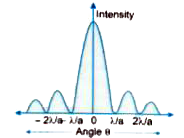
|
|
| 5. |
A wire AB is carrying current of 12 A and is lying on the table. Another wire CD carrying 5 A is held directly above AB at a height of 1 mm. Find the mass per unit length of the wire CD so that it remains suspended at its position when left free.Give the direction of the current flowing in CD with respect to that remains suspended at its position when left free. Give the direction of the current flowing in CD with respect to that in AB . [Take the value of g = 10 ms^(-2)] |
|
Answer» Solution :The wire CD will remain steady above AB at a height of `d = 1 mm = 10^(-3) m`, if force on it due to magnetic FIELD produced on account of current flowing in wire AB just balances its weight. As weight ACTS VERTICALLY downward, magnetic force must ACT in vertically upward and it is possible when current in wire CD is flowing along a direction opposite to that in AB as shown in Fig. If m be mass of wire CD per unit LENGTH, then `mg = (mu_0)/(4 pi) cdot (2 I_1 I_2)/(d)` `implies m = (mu_0)/(4pi) (2 I_1 I_2)/(dg) = (10^(-7) xx 2 xx 12 xx 5)/(10^(-3) xx 10) = 1.2 xx 10^(-3) kg m^(-1)` 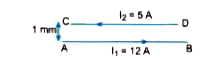
|
|
| 6. |
You are given two nuclides ""_(3)^(7)X and ""_(3)^(4)Y. a. Are they the isotopes of the same element ? b. Which one of the two is likely to be more stable? c. Give reason. |
|
Answer» Solution :a. Both are isotopes of the same element since they have the same atomic number. B. `""_(3)^(7)X` C. Nuclides with greater number of neutrons is stable. So here `""_(3)^(7)X` is more stable than `""_(3)^4Y`. |
|
| 7. |
A long wire carries a current of 5 A. Find the position of a point where it produces a magnectic field of 0.36xx10^-4 Web//m^2 . |
|
Answer» SOLUTION :DATA : i=5 A, `B=0.36xx10^-4 Wb/m^2``B=(mu_0)/(2pi) xx (2i)/R RARR r=mu_0//4pixx(2i)/B` .r=(10^-7xx2xx5)/(0.36xx10^-4)=0.0278m=2.78cm` |
|
| 8. |
A charged capacitor of unknown capacitance is connected in series with 100kOmega resistance and an ideal ammeter. The initial current in the circuit is found to be 0.2mA and the current after 7 sec is found to be 0.1mA. The potential energy that was stored in the capacitor before it was connected in the circuit is ______mJ. [Take log_(2)2=0.7] |
|
Answer» Since initial current `i_(0)=(V)/(R), V=20`Volts Time after which current reduces to half `T_(1//2)=RC log_(e)2` Therefore, `C=100muF` so, initial potential energy STORED, `U_(i)=(1)/(2)CV^(2)=(1)/(2)(10^(-4))(20)^(2)=20mJ`. |
|
| 9. |
The cyclontron'soscillator frequency is equlal to v = 10 MHz. Findthe effectivevoltageappliedacross the doesof thatcyclotron if the distance betweenthe neighbouring trajecroies of protonsis not less thanDelta r = 1.0 cm, withthe trajectoryradius beingequal to r = 0.5 m. |
|
Answer» SOLUTION :We know that for acharged particle (proton) in a magnetic field, `(mv^(2))/(r) = B EV` or `mv = BER` But, `omega = (eB)/(m)`, Thus `E = (1)/(2) mv^(2) = (1)/(2)m omega^(2) r^(2)`. So, `Delta E = m omega^(2) r Delta r = 4pi^(2) v^(2) mr Delta r` On the hand `Delta E = 2 eV`, where`V` is the effective acceleration voltage, across the Does, therebeing two CROSSINGS PER revolution. So, `V ge 2pi^(2) v^(2) mr Delta r//e` |
|
| 10. |
The coordinates of a body moving in a plane at any instant of time are x= alphat^(2)= and y=betat^(2). The velocity of theboyd is |
|
Answer» SOLUTION :`x= alphat^(2) rArr v_(x)=(dx)/(DT)=2alphat` `y= beta t^(2) rArr v_(y)=(dy)/(dt)=2betya` `:. velocity V= sqrt(v_(x)^(2)+v_(y)^(2)) rArr sqrt((2 alpha t)^(2)+( 2 beta t)^(2))` `=2t sqrt(alpha^(2)+beta^(2))` |
|
| 11. |
Which of the following is incorrect regarding limitations of Borhr's model? |
|
Answer» This model is APPLICABLE only to single electron lines |
|
| 12. |
What is an equipotential surface ? Write three properties Sketch equipotential surfaces of (i) Isolatedpoint charge (ii) Uniform electricfield (iii) Dipole If charge Q is given to a parallel plate capacitor and E is the electric field between the plates of the capacitor the force on each plate is 1/2 QE and if charge Q is placed between the plates experiences a force equal to QE. Give reason to explain the above. |
|
Answer» SOLUTION :If E. bethe ELECTRIC field due to each plate (of large dimensions) then net electric field between them ` E =E. +E. rArrE.E//2 ` Force on change Q at some point between the PLATES F = QE Forceon oneplateofthecapacitordue toanotherplate` F. =QE. =QE//2 ` |
|
| 13. |
In atom of any element when electron make transition from orbit of higher energy (n_(f)) to orbit of lower energy (n_(i)) equation representing wave number is given by ....... where n_(i)=1,n_(f)=2,3,4,……. |
|
Answer» `(1)/(lamda)=R[(1)/(n_(i)^(2))-(1)/(n_(f)^(2))]` |
|
| 14. |
A particles starts from point A moves along a straight line path with an aceleration given by a=p-qx where p,q are constants and x is distance from point A.The particle stops at point B.The maximim velocity of the paticle is |
|
Answer» <P>`(p)/(Q)` |
|
| 15. |
In Division Germer experiment an electron is accelerated through a potential difference of 100,000 V. The energy acquired by the electron is : |
|
Answer» `0.53 xx 10^(17) J` |
|
| 16. |
How does the self-inductance of a coil change when an iron rod is introduced in it ? |
| Answer» Solution :The soft iron has a large relative PERMEABILITY `(mu)` It.s PRESENCE increases the magnetic FLUX mu times . The self-inductance also increases by the same RATIO. | |
| 17. |
in an p-n-p transistor, majority charge carrier is………. |
|
Answer» electron |
|
| 18. |
A ray of light travelling in a transparent medium of refractive index n falls, on a surface separating the medium from air at an angle of incidents of 45^@. The ray can undergo total internal reflection for the following n, |
|
Answer» n = 1.25 `sinigtsinc "" "where, i - angleof INCIDENCE"` `But, sinc=(1)/(n) "" "c-cirtical ANGLE"` `sinigt(1)/(n)` `n gt (1)/(sin i)` `ngt(1)/(sin45),ngtsqrt(2),ngt1.414` |
|
| 19. |
Figure shows a netural metallic sphere with a pont charge+Q placed near its surface . Electrostatic equilibrium conditiaons exist on metallic sphere . Mark the correct statements - . |
|
Answer» Net FLUX through Gaussian surface due to changre Q is zero PATH will be a parabola when gravitational and electric field are perpendicular . |
|
| 20. |
An objected is placed at the principle focus of a convex mirror. The image will be at |
|
Answer» CENTRE of curvature |
|
| 21. |
Monochromatic light of wavelength 667 nm is produced by a helium neon laser. The power emitted in 9 nw. the number of photons arriving per sec. on the average at a target irradiated by this beam is : |
|
Answer» `3 XX 10^16` |
|
| 22. |
You have two copper cables of equal length for carrying current . One of them has a single wire of area of cross- section A , the other has ten wires of cross-section (A)/(10) each . Judge their suitability for transporting a.c. and d.c. |
|
Answer» Only SINGLE STRAND for d.C., either for a.c. |
|
| 23. |
A conducting sphere carries a net charge of -6 mu C. The sphere is located at the center of a conducting spherical shell that carries a net charge of +2 mu C as shown in the figure. Determine the excess charge on the outer surface of the spherical shell. |
|
Answer» `-4 MU C` |
|
| 24. |
A particle of mass m and charge q moves with a constant velocity V along the positive x-direction . It enters a regio containing a uniform magnetic field B directed along the negative z-direction, extending from x = a to x = b . The minimum value of Vrequired, so that the particle can just enter the region of x gt bis |
| Answer» SOLUTION :`(Q(B-a)B)/(m)` | |
| 25. |
(a) Calculate the distance of an object of height h from a concave mirror of radius of curvature 20 cm, so as to obtain a real image of magnification 2. Find the location of image also.(b) Using mirror formula, explain why does a convex mirror always produce a virtual image. |
|
Answer» Solution :(a) As per question the radius of curvature of concave mirror R = - 20 cm, hence its FOCAL LENGTH `f=R/2 = -10 cm` and magnification of real image `m=-2` As `m=-v/u`, hence, `-v/u =-2` or `v=2u` So, from mirror FORMULA `1/v+ 1/u = 1/f`, we have `1/(2u) + 1/u = 1/(-10) rArr 3/(2u) =-1/10 rArr u=-15 cm` and `v= 2u = 2 xx (-15) = -30 cm` Thus, the object is PLACED in front of mirror at a distance of 15 cm from it and its real, magnified and inverted image is formed at a distance of 30 cm in front of the mirror. (b) For a convex mirror `1/v = 1/f -1/u` but f is positive and u is negative i.e., `1/v = 1/f -1/(-u) = 1/f + 1/u = =ve` Therefore, irrespective of the value of u, value of v is ALWAYS +ve. It means that the image formed by convex mirror is always virtual independent of the location of the object. |
|
| 26. |
A particle is located in a unidimensional square potential well with infinitely high wall. The width of the well is l. Find the normalized wave fucntions of the stationary states of the particle taking the midpoint of the well for the origin of the x coordinate. |
|
Answer» Solution :Here `-(l)/(2)le(l)/(2)`. Again we have `Psi(x)=B "cos" (SQRT(2)mE)/( ħ)+A "SIN" sqrt(2mEx)/( ħ)` Then the BOUNDARY conditions `Psi(+-(l)/(2))=0` gives even solution. Here `sqrt(2mE)=(2N+1)(pi ħ)/(l)` and `E_(n)=(2n+1)^(2)(pi^(2) ħ^(2))/(2ml^(2))` `Psi_(n)^(e )(x)sqrt((2)/(l))cos (2n+1)(pi x)/(l)` `n= 0,1,2,3`.... This solution is even under `xrarr-x` (2) `B=0` `sqrt(2mEl)/(2ħ)=n pi,n=1,2`.... `E_(n)=(2npi)^(2)(ħ^(2))/(2ml^(2))` `Psi_(n)^(0)=sqrt((2)/(l))"sin"(2n pix)/(l),n=1,2`.... This solution is odd. |
|
| 27. |
In the arrangement shown in the fig. the ends P and Q color of a string are being moved downwards with a speed of v each. The pulleys are fixed. The mass M moves upwards with a speed of : |
|
Answer» `v/(costheta)` 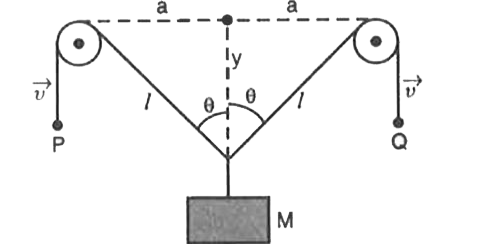 Here `l^(2) =y^(2) + a^(2)` diff. w.r.t time,`:. 2l (DL)/(dt)=2y dy/dt +0` since `(dl)/(dt)=v` `:. (dy)/(dt)=1/y v` Thus velocity of block `M=v/(costheta)` |
|
| 28. |
If an electron accelerated through a potential difference of 500 volt attains a speed of 1.33xx10^(7)ms^(-1), then specific charge of the electron should be: |
|
Answer» `1.67xx10^(11)Ckg^(-1)` `:.(E)/(m)=(V^(2))/(2V)=((1*33xx10^(7))^(2))/(2xx500)` `=1*76xx10^(11)C//kg` |
|
| 29. |
When p-n junction diode is forward biased ……… |
|
Answer» the DEPLETION REGION is reduced and barrier height is increased. As the electric field of the EXTERNAL batteryand the electric field in the depletioinlayer are opposite, so the WIDTH of the depletionlayerdecreasesand the heightof depletion barrieralso decreases. |
|
| 30. |
The wavelength of light coming from a star shifts towards the violet end of the spectrum . |
|
Answer» RECEDING from the earth |
|
| 31. |
A length of copper wire carries a current of 3.5 A uniformly distributed through its cross section. Calculate the energy density of (a) the magnetic field and (b) the electric field at the surface of the wire. The wire diameter is 2.5 mm, and its resistance per unit length is 3.3 Omega/km. |
| Answer» SOLUTION :(a) 0.12 J/`m^(3)`, (b) 5.9 `xx 10^(-16)` J/`m^(3)` | |
| 32. |
Give the characteristics of magnetic field lines. |
|
Answer» Solution :The properties of magnetic field lines are as follows : (i) The magnetic field lines of a magnet FORM CONTINUOUS closed loop. This is unlike the electric dipole where these field lines begin from a POSITIVE charge and END on the negative charge or escape to infinity. (ii) The tangent to the field line at a given point represents the direction of the net magnetic field `overset(to)(B)` at that point. (iii) The larger the number of field lines crossing per unit area, the stronger is the magnitude of the magnetic field `overset(to)(B)`. In figure (a) `overset(to)(B)` is larger around region (b) than in region (a). (iv) The magnetic lines do not INTERSECT for if they did, the direction of the magnetic field would not be unique at the point of intersection one can plot the magnetic field lines in a variety of ways. If they do it means at the point of intersect the tangent is showing two different directions which is not possible. |
|
| 33. |
How do you determine the magnetic nature of a material, given in the form of a rod? |
|
Answer» Solution :The GIVEN rod is placed NEAR a MAGNET. If it is STRONGLY attracted then it is Ferromagnetic. If it is feebly attracted then it is paramagnetic. If it is repelled by the magnet then it is DIAMAGNETIC. |
|
| 34. |
(a) Draw a ray diagram for final image formed at distance of distinct vision (D) by a compound microscope and write expression for its magnifying power. (b)An angular magnification (magnifying power) of 30x is desired for a compound microscope using as objective of focal length 1.25cm and eye piece of focal length 5cm. How will you set up the compound microscope? |
|
Answer» Solution :Ray Diagram: (with proper labeling) (a) 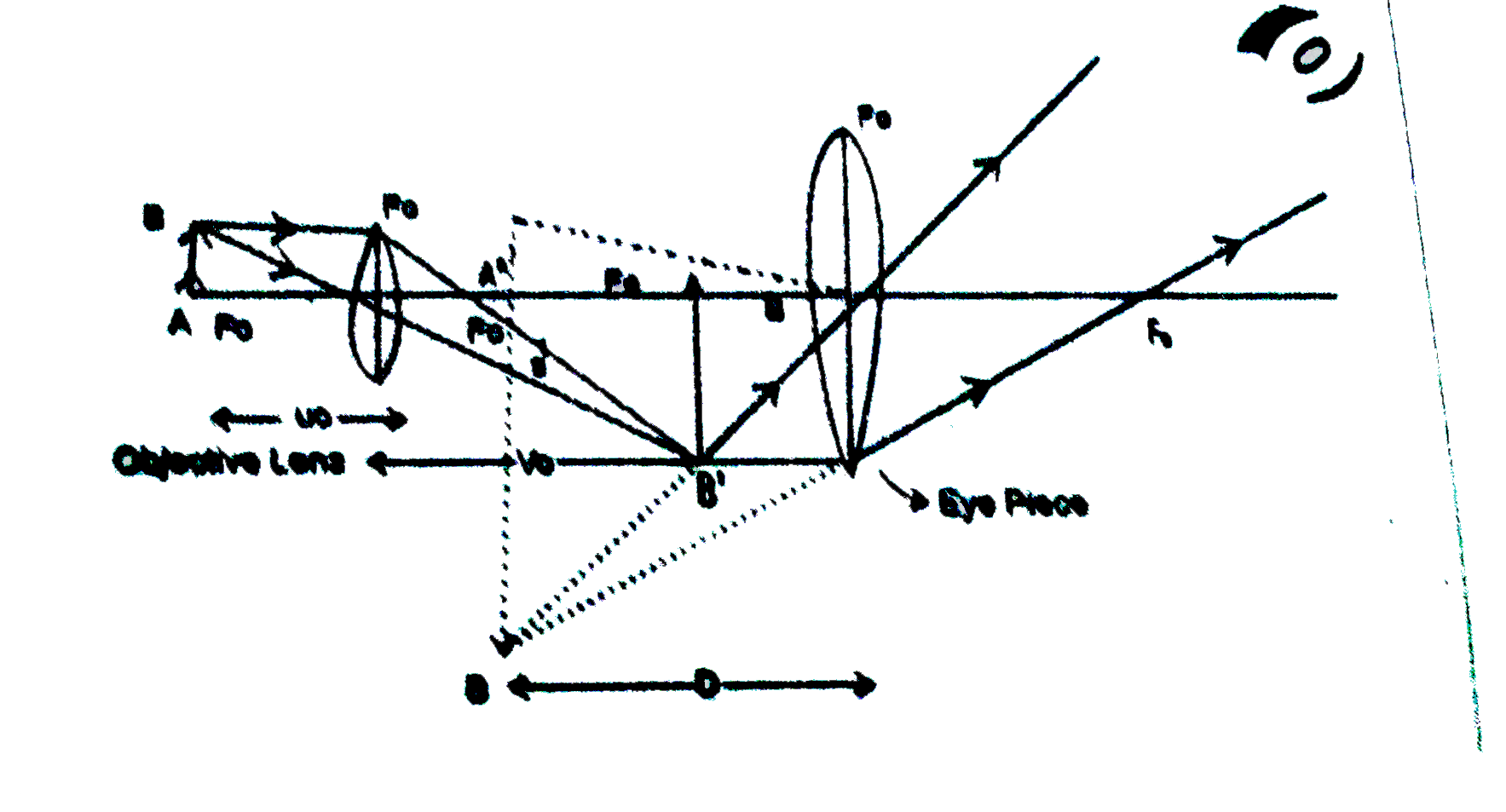 Magnifying power m =`(V_(0))/(u_(0)) (1+(D)/(fe))` `m = (L)/(FO)(1+(D)/(fe))` `because m = m_(o)m_(e) = -30 ("VIRTUAL, inverted")` (b) `because f_(o) = 1.25"CM"` `f_(e) = 5.0"cm"` Let us setup a compound microscope such that the final image be formed at D, then `m_(e) = 1+(D)/(fe) = 1 + (25)/(5) = 6` and position of object for this image formation can be calculated - `(1)/(Ve) - (1)/(ue) = (1)/(fe)` `(1)/(-25) - (1)/(ue) = (1)/(5)` `-(1)/(ue) =(1)/(5) + (1)/(25) = (6)/(25)` `ue = (-25)/(6) = -4.17 "cm"` `because m = m_(o) xx m_(e)` `therefore m_(o) = (+Vo)/(uo) = (-30)/(6) = -5` `therefore V = -5u_(o)` `(1)/(Ve)-(1)/(uo) = (1)/(fo)` `(1)/(-5uo)-(1)/(uo) = (1)/(1.25)` `(-6)/(5uo)= (1)/(1.25)` `"uo" = -1.5"cm" rArr "Vo" = 7.5"cm"` `"Tube length"= V_(o) + |u_(o)| = 7.5"cm" + 4.17"cm"` L = 11.67 cm Object be placed at 1.5cm distance from the objective lens. |
|
| 35. |
The decimal form of 129/2^2 5^7 7^5is- |
|
Answer» TERMINATING |
|
| 36. |
Three capacitors each of capacitance 9 pF are connected in series. (a) What is the total capacitance of the combination? (b) What is the potential difference across each capacitor if the combination is connected to a 120 V supply? |
|
Answer» SOLUTION :(a) 3 PF (b) 40 V |
|
| 37. |
How many types of C-C bond are present is the following compound CH_(3)-underset(CH_(3))underset(|)overset(CH_(3))overset(|)(C)-CH_(2)-underset(CH_(3))underset(|)overset(CH_(3))overset(|)(C)-CH_(3) |
| Answer» Solution :Two type of `C-C` BOND are PRESENT which are `(1^(@)-4^(@))C-C` bond and `(2^(@)-4^(@))C-C` bond. | |
| 38. |
Comment on the recent advancement in medical diagnosis and therapy. |
|
Answer» Solution :(i) Medical VIRTUAL reality is effectively used to stop the brain from processing pain and cure soreness in the hospitalized patients. Virtual reality has enhanced surgeries by the use of 3D models by surgeons to plan operations. It helps in the TREATMENT of Autism, Memory loss, and Mental illness. (ii) Precision medicine is an emerging approach for disease treatment and prevention that takes into account individual VARIABILITY in gens, environment, and lifestyle for each person. In this, it is possible to customise healthcare, with medical decisions, treatments, practices, or products which are tailored to the individual patient. (iii) A HEALTH wearable is a device used for tracking a wearer.s vital signs or health and fitness related date, location, etc. Medical wearables with articial intelligence and big date provide an added value to healthcare with a focus on diagnosis, treatment, patient monitoring and prevention. (iv) An artificial organ is an engineered device or tissue that is implanted or integrated into a human. It is possible to interface it with living tissue or to replace a natural organ. It duplicates or augments a specific FUNCTION or functions of human organs so that the patient may return to a normal life as soon as possible. (v) Advanced 3D printer systems and materials assist physicians in a range of operations inthe medical field from audiology, dentistry, orthopedics and other applications. (vi) Wireless brain sensors monitor intracranial pressure and temperature and then are absorbed by the body. Hence there is no need for surgery to remove these devices. (vii) Robotic surgery is robotically-assisted surgery helps to overcome the limitations of pre-existing and to enhance the capabilities of surgeons performing open surgery. (viii) Smart inhalers are the main treatment option for asthma. Smart inhalers use bluetooth technology to detect inhaler use, remind patients when to take their medication and gather date to help guide care. |
|
| 39. |
Two charges -qeach are separated by dsitance 2d. A third charge +q is kept at mid-point O. find potential energy of +q asfunction of small distance x from 0 due to -q charges. Sketch PE Vs/x and convince yourself that the charge at 0 is in an unstable equilibrium. |
|
Answer» Solution :let third charge +Q is slightly displaced from mean position TOWARDS first charge. So, the total POTENTIAL energy of the system is given by `U=(1)/(4piepsi_(0)){(-q^(2))/((d-x))+(-q^(2))/((d+x))}` `U=(-q^(2))/(4piepsi_(0))(2d)/((d^(2)-x^(2)))` `(dU)/(dx)=(-q^(2)2d)/(4piepsi_(0))*(2x)/((d^(2)-x^(2))^(2))` The system will be in equilibrium, if `F=-(dU)/(dx)=0` On solving, x=0 so for +q charge to be in stable/unstable equilibrium, finding second DERIVATIVE of PE. `(d^(2)U)/(dx^(2))=((-2dq^(2))/(4piepsi_(0)))[(2)/((d^(2)-x^(2))^(2))-(8x^(2))/((d^(2)-x^(2))^(3))]` `=((2-dq^(2))/(4piepsi_(0)))(1)/((d^(2)-x^(2))^(3))[2(d^(2)-x^(2))^(2)-8x^(2)]` at `x=0` `(d^(2)U)/(dx^(2))=((-2dq^(2))/(4piepsi_(0)))((1)/(d^(6)))(2d^(2)),` which is lt0 This shows that system will be unstable equilibrium. |
|
| 40. |
A silicon specimen is made into a P-type semiconductor by dopping, on an average, one helium atoms per 5xx10^(7) silicon atoms. If the number density of atoms in the silicon specimen is 5xx10^(28) at om//m^(3) then the number of acceptor atoms in silicon per cubic centimeter will be |
|
Answer» `2.5xx10^(20)" atom cm"^(-3)` |
|
| 41. |
Three uncharged capacitors are connected in the circuit as shown. What should be the value of C_3(in muF ) so that potential difference across each capacitor is same |
|
Answer» |
|
| 42. |
A motor car is going due north at a speed of 50 km/h. It makes a 90° left turn without changing the speed. The change in the velocity of the car is about. |
|
Answer» 50 km/h TOWARDS west |
|
| 43. |
In a potentiometer arrangement a cell of emf 1.25 V givesn a balance point at 35 cm length of the wire. If the cell is replaced by another cell and the balance point shift to 63 cm, what is the emf of the second cell ? |
|
Answer» Solution :Emf of the `"CELL"_(1), xi_(1)=1.25V` BALANCING length of the cell, `l_(1)=35cm=35xx10^(-2)m` Balancing length after interchanged, `l_(2)=63cm = 63xx10^(-2)m` Emf of the `"cell"_(2), xi_(2)=?` The RATIO of emf.s, `(xi_(1))/(xi_(2))=(l_(1))/(l_(2))` The ratio of emf.s, `xi_(2)=xi_(1)((l_(2))/(l_(1)))` `=1.25xx((63xx10^(-2))/(35xx10^(-2)))=12.5xx1.8` `xi_(2)=2.25V` |
|
| 44. |
The position of CM depends upon the _____ of the body and hence the _____ of masses. |
| Answer» SOLUTION :[SHAPE, DISTRIBUTION] | |
| 45. |
Communication system is some set up used to convey some type of information in the form of voice, data or picture from one point to other in its true or original form. During transmission of information some phenomenon change the originality of information. Can you match these processes affecting the originality of information mentioned in Column-I with their meaning to be understood by you in Column-II ? |
|
Answer» A- 1 , B - 2 , C - 3 , D - 4 |
|
| 46. |
Critical angle of glass and air is 42^(@) . If a ray of light is incident normally on a face of an equilateral prism, show that the ray will emerge from the base of the prism normally. Calculate the deviation of the ray. |
|
Answer» Solution :ABC is an EQUILATERAL prism [FIG. 2.72]. Each ANGLE of the prism is `60^(@)`. A ray of light PQ is incident normally on the face AB.Without changing the direction it travels along QR and is incident at R on the face AC. According to the figure, `angleARQ = 30^(@)` ` .therefore" " "Angle of incidence at"R= 60^(@)` We know that critical angle of glass and air is `42^(@)`. So the ray incident at R will be totally reflected and will follow the path RST. `therefore " " angleNRS = 60^(@) "s", angleCRS = 30^(@)` `"Again" " " angleACB = 60^(@) "so," angleCSR = 90^(@)` So the ray RST will emerge along the normal to the face BC. The angle of DEVIATION of the ray = `180^(@) - (60^(@) + 60^(@)) = 60^(@)`. 
|
|
| 47. |
A gas is compressed at a constant pressure of 50N/m^2from volume of 10m^3 to a volume of 4m^3. Energy of 100 J is then added to the gas by heating. It’s internal energy is |
|
Answer» INCREASED by 200 J |
|
| 48. |
A car travelling at the speed of 30 km/hr brakes and is brought to halt in 8m.If the same car is travelling at 60 km/hr, then it can be brought to rest with the same breaking power in: |
|
Answer» 5 m Here distance becomes `(2)^(2)xx8=32m`. |
|
| 49. |
A coil of metallic wire is held stationary in a non-uniform magnetic field. An emf is induced in the coil. |
| Answer» Solution :False - Induced emf is SET up only when there is RELATIVE MOTION between the coil and the magnetic FIELD. | |
| 50. |
(a) consider an arbitrary electrostic fieldconfiguration a small testcharge is placed at a null pointof the configuration show that the equailibrium of the test charge is necessarly unstable (b) verifythis resultfor the simple configuration of two charges of the same mangnitudeand sign placeda certain distance apart |
|
Answer» SOLUTION :(a) prove it by contradiction SUPPOSE the equlibriumis stable then the test chargedisplaed slighly in any direction will experiencea retoring force towards the null pointthat is there is a net inward flux of electric field througha closed surface arougn the null point butgauss law the flux of electric fieldthrougha surface not enclosing any chargemust be zero hence the equilibrium cannotbe stable (b) the mid pointof theline joining the two chargesis a null pointdisplacea testchargfrom the null pointslighly ALONGTHE the linerememebr stabilityof equibrium needs restoring forcein alldirection |
|